
Gastric Dilation Volvulus GDV Surgery Pharmacology and Pharmacy

- Slides: 20
Gastric Dilation Volvulus (GDV) Surgery Pharmacology and Pharmacy VETE 4305 02/22/2015
Case Study Group 2 Jennifer Hohle, LVT Ashley Lawley, LVT Michelle Hervey, LVT
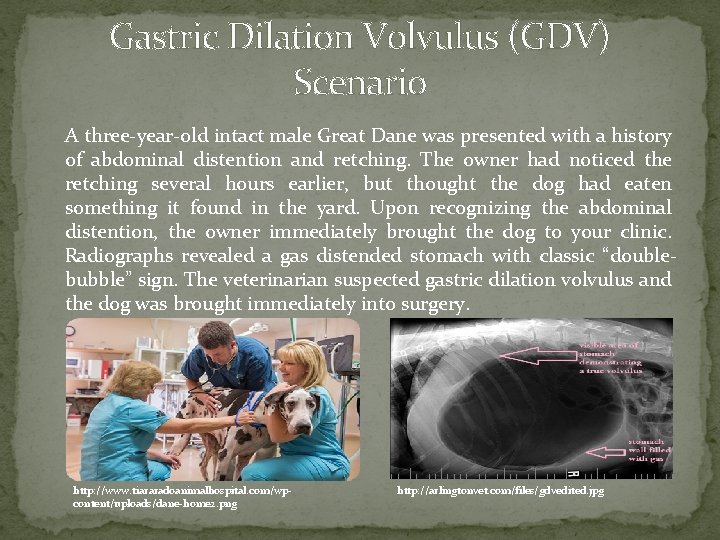
Gastric Dilation Volvulus (GDV) Scenario A three-year-old intact male Great Dane was presented with a history of abdominal distention and retching. The owner had noticed the retching several hours earlier, but thought the dog had eaten something it found in the yard. Upon recognizing the abdominal distention, the owner immediately brought the dog to your clinic. Radiographs revealed a gas distended stomach with classic “doublebubble” sign. The veterinarian suspected gastric dilation volvulus and the dog was brought immediately into surgery. http: //www. tiararadoanimalhospital. com/wpcontent/uploads/dane-home 2. png http: //arlingtonvet. com/files/gdvedited. jpg
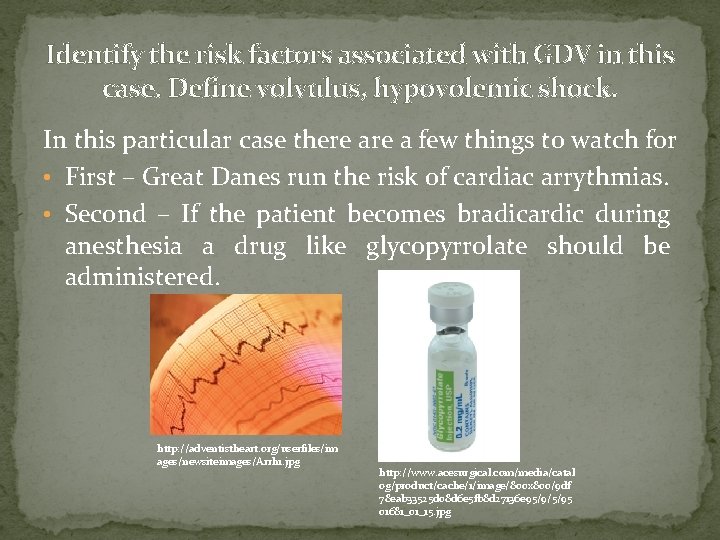
Identify the risk factors associated with GDV in this case. Define volvulus, hypovolemic shock. In this particular case there a few things to watch for • First – Great Danes run the risk of cardiac arrythmias. • Second – If the patient becomes bradicardic during anesthesia a drug like glycopyrrolate should be administered. http: //adventistheart. org/userfiles/im ages/newsiteimages/Arrh 1. jpg http: //www. acesurgical. com/media/catal og/product/cache/1/image/800 x 800/9 df 78 eab 33525 d 08 d 6 e 5 fb 8 d 27136 e 95/9/5/95 01681_01_15. jpg
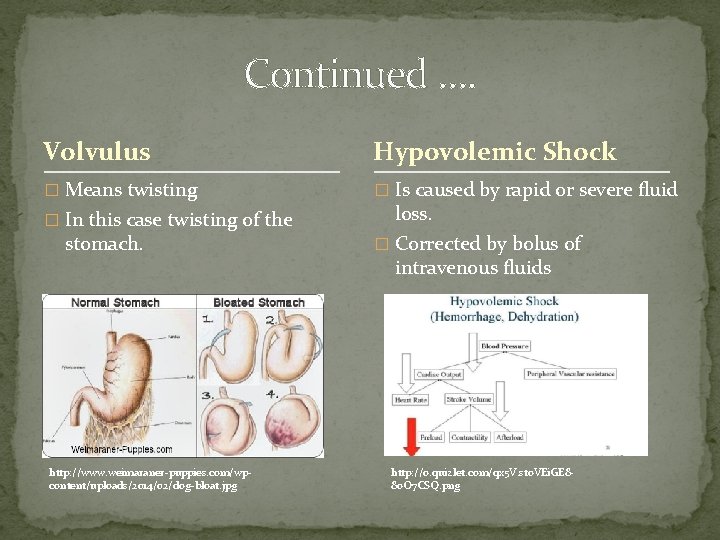
Continued …. Volvulus Hypovolemic Shock � Means twisting � Is caused by rapid or severe fluid � In this case twisting of the stomach. http: //www. weimaraner-puppies. com/wpcontent/uploads/2014/02/dog-bloat. jpg loss. � Corrected by bolus of intravenous fluids http: //o. quizlet. com/qx 5 V. sto. VEi. GE 88 o. O 7 CSQ. png
You are initiating the anesthesia record for the animal. The veterinarian has assigned an ASA status of Class IV. What is an ASA? Explain the clinical significance of a Class IV assignment. � ASA stands for American � It ranges from ASA I (normal, Society of Anesthesiologists � ASA is a classification for patients going under anesthesia to determine their anesthetic risk. healthy patient) to ASA VI (no brain activity). � This particular patient was given a grade of ASA IV, meaning that this is a patient with severe systemic disease that is life threatening (Thomas, 25).
The veterinarian has just entered the abdominal cavity through a ventral midline incision. You notice the dog appears to be lightening up and is responsive to painful stimuli. Please describe the actions you will take to determine why the animal is responding to stimuli/rapidly lightening up. First - Check Equipment 1. 2. 3. 4. 5. Vaporizer – sufficient anesthetic gas (Isoflurane). Endotracial tube – patient is not breathing around the tube. Rebreathing tube – hooked up properly to the machine. Inspiration and expiration is hooked up correctly. CO 2 Canister – soda lime is not exhausted and is tightly sealed. Bag – no new leaks in the bag, and the correct size bag is being used for this patient. Second – Check Patient 1. Patient’s anesthetic plane was not compromised by shallow respiration (Bauer, 2010, pp. 8 -16).
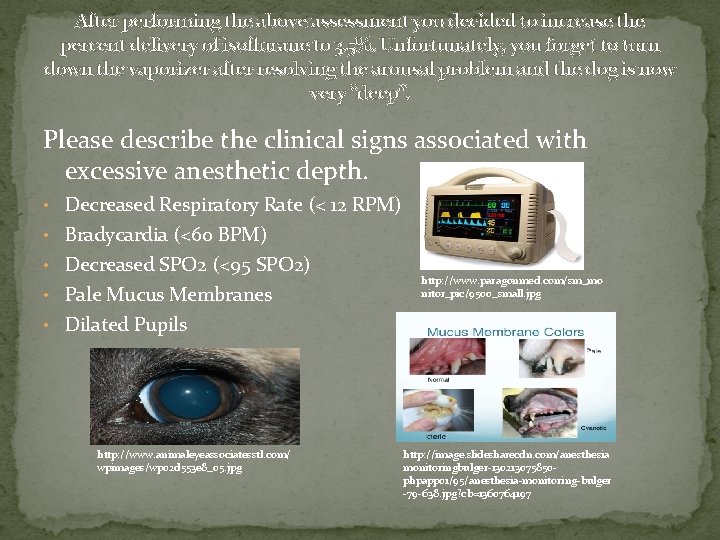
After performing the above assessment you decided to increase the percent delivery of isoflurane to 3. 5%. Unfortunately, you forget to turn down the vaporizer after resolving the arousal problem and the dog is now very “deep”. Please describe the clinical signs associated with excessive anesthetic depth. • Decreased Respiratory Rate (< 12 RPM) • Bradycardia (<60 BPM) • Decreased SPO 2 (<95 SPO 2) • Pale Mucus Membranes http: //www. paragonmed. com/sm_mo nitor_pic/9500_small. jpg • Dilated Pupils http: //www. animaleyeassociatesstl. com/ wpimages/wp 02 d 553 e 8_05. jpg http: //image. slidesharecdn. com/anesthesia monitoringbulger-130213075850 phpapp 01/95/anesthesia-monitoring-bulger -79 -638. jpg? cb=1360764197
What immediate steps should you take to correct excessively deep anesthesia? �First – decrease or turn off vaporizer. �Second – bag patient with pure oxygen every 5 seconds until normal vitals return, and can safely get the patient back to stage 3, plane 1 or 2 anesthetic depth (Bauer, 2010, pp. 8 -16). �Third – increase IV fluids to help increase patient’s blood pressure.
After the surgery is complete, a vet assistant asks you, “How did you know when the dog was too light or too deep? ” Please explain the common indicators (that do not require monitoring equipment) used to determine anesthetic depth. The animal’s depth of anesthesia is determined by evaluating reflexes without using any equipment, and response of vital signs to surgical stimulation using equipment such as heart rate and respiratory rate monitors. 1. Swallowing – monitored by observing movement in the ventral neck. This shows that the animal is too light under anesthesia. If not shown, animal is in a moderate plane. 2. Pedal – Notice by pinching a digit and observing whether the animal flexes the leg or withdraws the paw. Due to this being lost during inductions, if the animal shows this reflex, it is too light under anesthesia. 3. Palpeberal – Tested by lightly tapping the medial cantus of the eye and observing whether the animal blinks in response. 4. Corneal – Obtained by gentle palpation of the lateral aspect of the cornea which causes reflex closure of the eyelids. Not always reliable in a dog. 5. Lacrimation - Tear formation
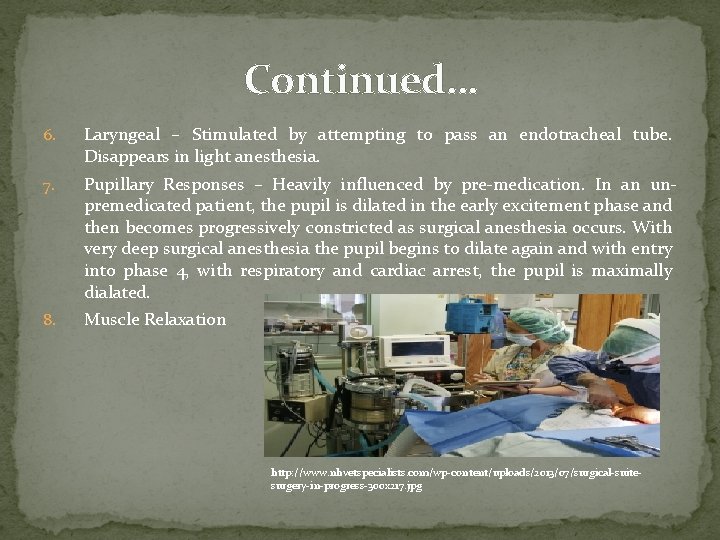
Continued… 6. Laryngeal – Stimulated by attempting to pass an endotracheal tube. Disappears in light anesthesia. 7. Pupillary Responses – Heavily influenced by pre-medication. In an unpremedicated patient, the pupil is dilated in the early excitement phase and then becomes progressively constricted as surgical anesthesia occurs. With very deep surgical anesthesia the pupil begins to dilate again and with entry into phase 4, with respiratory and cardiac arrest, the pupil is maximally dialated. 8. Muscle Relaxation http: //www. nhvetspecialists. com/wp-content/uploads/2013/07/surgical-suitesurgery-in-progress-300 x 217. jpg
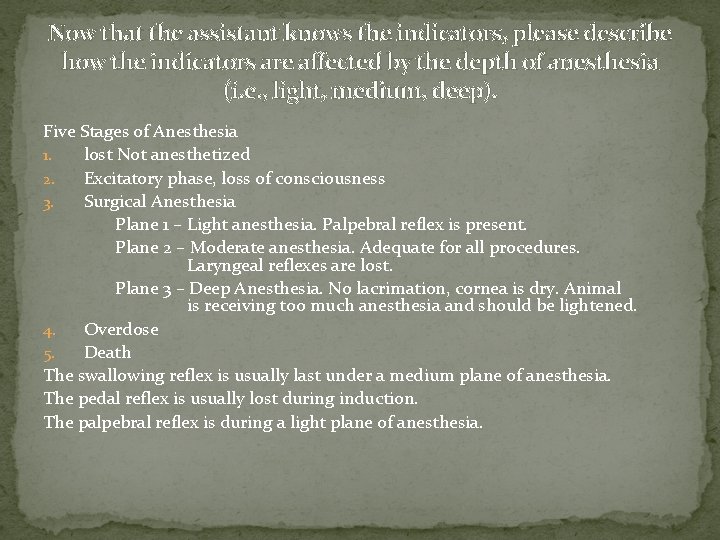
Now that the assistant knows the indicators, please describe how the indicators are affected by the depth of anesthesia (i. e. , light, medium, deep). Five Stages of Anesthesia 1. lost Not anesthetized 2. Excitatory phase, loss of consciousness 3. Surgical Anesthesia Plane 1 – Light anesthesia. Palpebral reflex is present. Plane 2 – Moderate anesthesia. Adequate for all procedures. Laryngeal reflexes are lost. Plane 3 – Deep Anesthesia. No lacrimation, cornea is dry. Animal is receiving too much anesthesia and should be lightened. 4. Overdose 5. Death The swallowing reflex is usually last under a medium plane of anesthesia. The pedal reflex is usually lost during induction. The palpebral reflex is during a light plane of anesthesia.
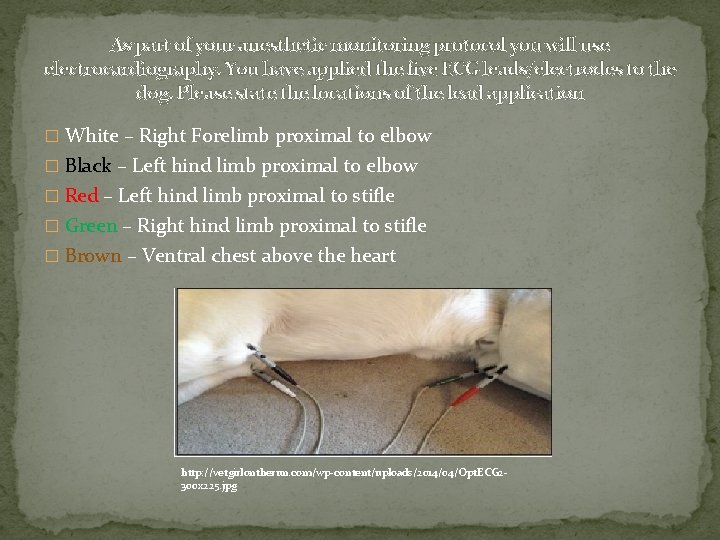
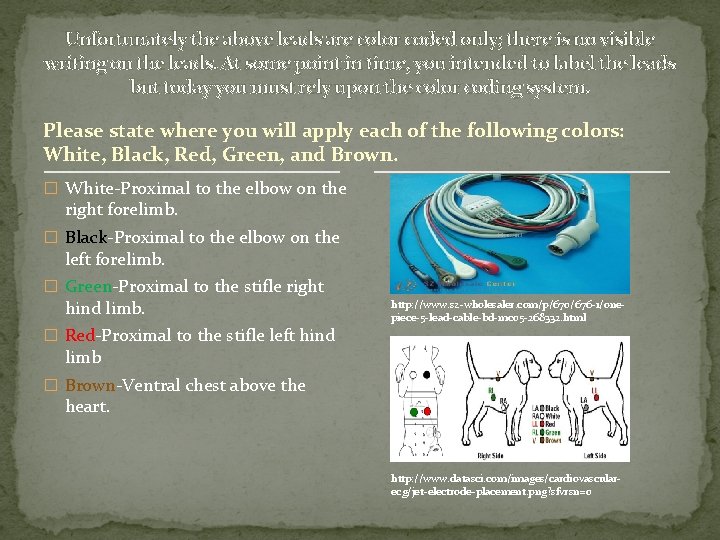
As part of your anesthetic monitoring protocol you will use electrocardiography. You have applied the five ECG leads/electrodes to the dog. Please state the locations of the lead application � White – Right Forelimb proximal to elbow � Black – Left hind limb proximal to elbow � Red – Left hind limb proximal to stifle � Green – Right hind limb proximal to stifle � Brown – Ventral chest above the heart http: //vetgirlontherun. com/wp-content/uploads/2014/04/Opt. ECG 2300 x 225. jpg
Unfortunately the above leads are color coded only; there is no visible writing on the leads. At some point in time, you intended to label the leads but today you must rely upon the color coding system. Please state where you will apply each of the following colors: White, Black, Red, Green, and Brown. � White-Proximal to the elbow on the right forelimb. � Black-Proximal to the elbow on the left forelimb. � Green-Proximal to the stifle right hind limb. http: //www. sz-wholesaler. com/p/670/676 -1/onepiece-5 -lead-cable-bd-mc 05 -268332. html � Red-Proximal to the stifle left hind limb � Brown-Ventral chest above the heart. http: //www. datasci. com/images/cardiovascularecg/jet-electrode-placement. png? sfvrsn=0
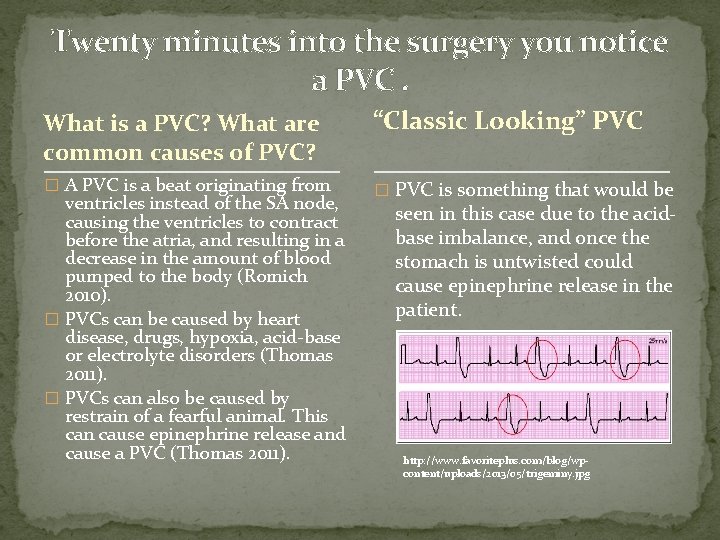
Twenty minutes into the surgery you notice a PVC. What is a PVC? What are common causes of PVC? “Classic Looking” PVC � A PVC is a beat originating from � PVC is something that would be ventricles instead of the SA node, causing the ventricles to contract before the atria, and resulting in a decrease in the amount of blood pumped to the body (Romich 2010). � PVCs can be caused by heart disease, drugs, hypoxia, acid-base or electrolyte disorders (Thomas 2011). � PVCs can also be caused by restrain of a fearful animal. This can cause epinephrine release and cause a PVC (Thomas 2011). seen in this case due to the acidbase imbalance, and once the stomach is untwisted could cause epinephrine release in the patient. http: //www. favoriteplus. com/blog/wpcontent/uploads/2013/05/trigeminy. jpg
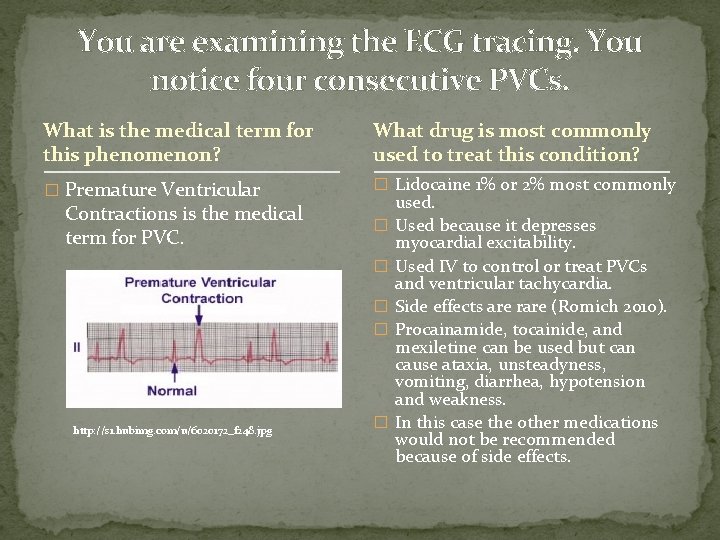
You are examining the ECG tracing. You notice four consecutive PVCs. What is the medical term for this phenomenon? What drug is most commonly used to treat this condition? � Premature Ventricular � Lidocaine 1% 0 r 2% most commonly Contractions is the medical term for PVC. � � http: //s 1. hubimg. com/u/6020172_f 248. jpg � used. Used because it depresses myocardial excitability. Used IV to control or treat PVCs and ventricular tachycardia. Side effects are rare (Romich 2010). Procainamide, tocainide, and mexiletine can be used but can cause ataxia, unsteadyness, vomiting, diarrhea, hypotension and weakness. In this case the other medications would not be recommended because of side effects.
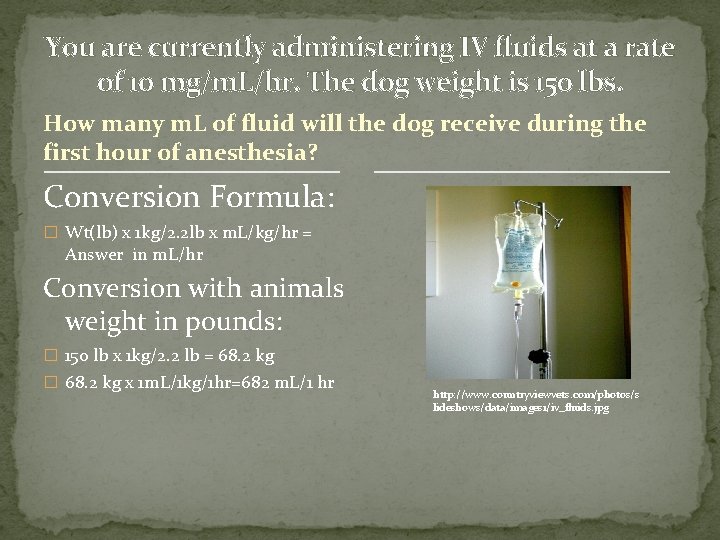
You are currently administering IV fluids at a rate of 10 mg/m. L/hr. The dog weight is 150 lbs. How many m. L of fluid will the dog receive during the first hour of anesthesia? Conversion Formula: � Wt(lb) x 1 kg/2. 2 lb x m. L/kg/hr = Answer in m. L/hr Conversion with animals weight in pounds: � 150 lb x 1 kg/2. 2 lb = 68. 2 kg � 68. 2 kg x 1 m. L/1 kg/1 hr=682 m. L/1 hr http: //www. countryviewvets. com/photos/s lideshows/data/images 1/iv_fluids. jpg
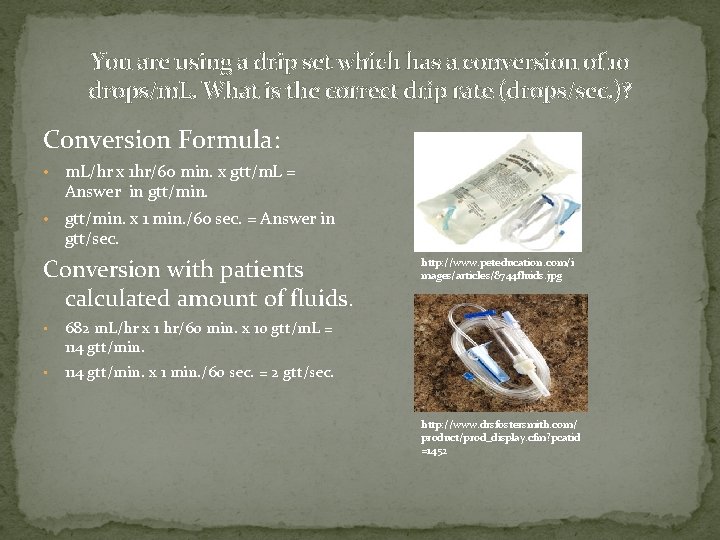
You are using a drip set which has a conversion of 10 drops/m. L. What is the correct drip rate (drops/sec. )? Conversion Formula: • m. L/hr x 1 hr/60 min. x gtt/m. L = Answer in gtt/min. • gtt/min. x 1 min. /60 sec. = Answer in gtt/sec. Conversion with patients calculated amount of fluids. • 682 m. L/hr x 1 hr/60 min. x 10 gtt/m. L = 114 gtt/min. • 114 gtt/min. x 1 min. /60 sec. = 2 gtt/sec. http: //www. peteducation. com/i mages/articles/8744 fluids. jpg http: //www. drsfostersmith. com/ product/prod_display. cfm? pcatid =1452
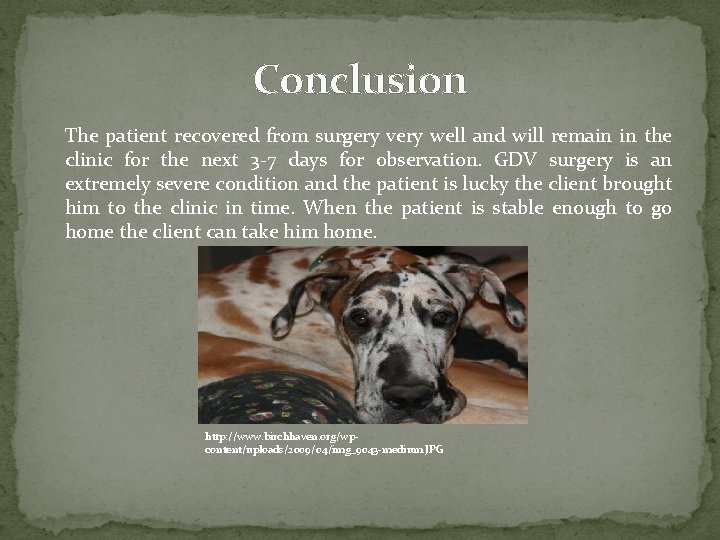
Conclusion The patient recovered from surgery very well and will remain in the clinic for the next 3 -7 days for observation. GDV surgery is an extremely severe condition and the patient is lucky the client brought him to the clinic in time. When the patient is stable enough to go home the client can take him home. http: //www. birchhaven. org/wpcontent/uploads/2009/04/img_9043 -medium. JPG
References Anesthesia Monitoring. (2015, January 1). Retrieved February 23, 2015, from http: //www. ruralaeavet. org/PDF/Anesthesia. Patient_Monitoring. pdf Bauer, M. , (2010). Anesthesia. In The Veterinary Technician’s Pocket Partner. (pp. 8 -16. Clifton Park, NY, Delmar Cengage Learning. Print Ettinger, S. J. , Feldma, E. C. . Textbook of Veterinary Internal Medicine. W. B. Saunders, Philadelphia. Print Romich, Janet, A. (2010). Fundamentals of Pharmacology for Veterinary Technicians Second Edition. Delmar, Cengage Learning. Print Thomas, J. , A. , Lerche, P. , (2011). Anesthesia and Analgesia for Veterinary Technicians Fourth Edition. St. Louis, MO, Mosby Elsevier. Print