
Gasoline Manufacturing Processes Catalytic Reforming Alkylation Polymerisation Isomerisation
- Slides: 21
Gasoline Manufacturing Processes Catalytic Reforming Alkylation Polymerisation Isomerisation
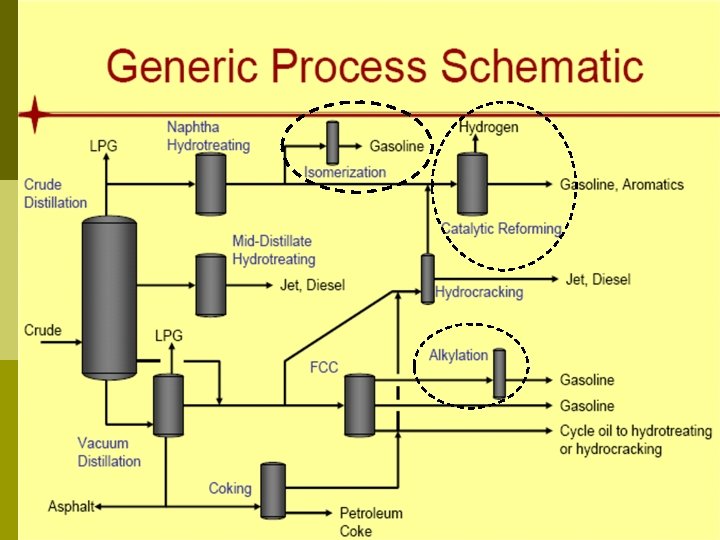
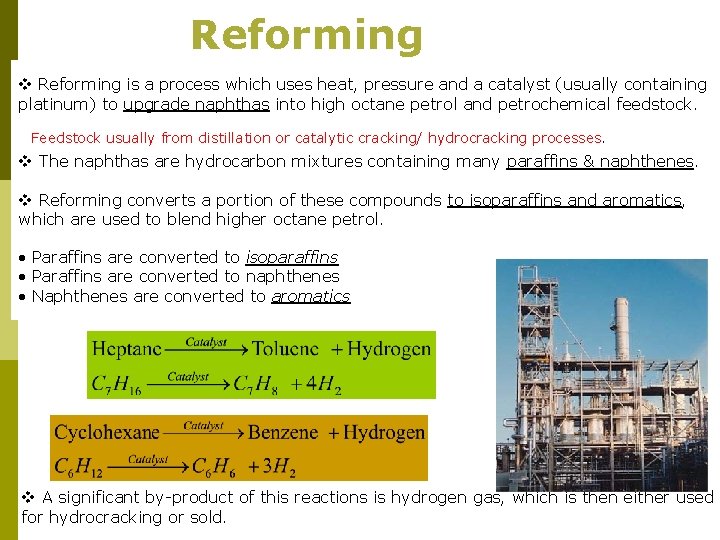
Reforming v Reforming is a process which uses heat, pressure and a catalyst (usually containing platinum) to upgrade naphthas into high octane petrol and petrochemical feedstock. Feedstock usually from distillation or catalytic cracking/ hydrocracking processes. v The naphthas are hydrocarbon mixtures containing many paraffins & naphthenes. v Reforming converts a portion of these compounds to isoparaffins and aromatics, which are used to blend higher octane petrol. Paraffins are converted to isoparaffins Paraffins are converted to naphthenes Naphthenes are converted to aromatics v A significant by-product of this reactions is hydrogen gas, which is then either used for hydrocracking or sold.
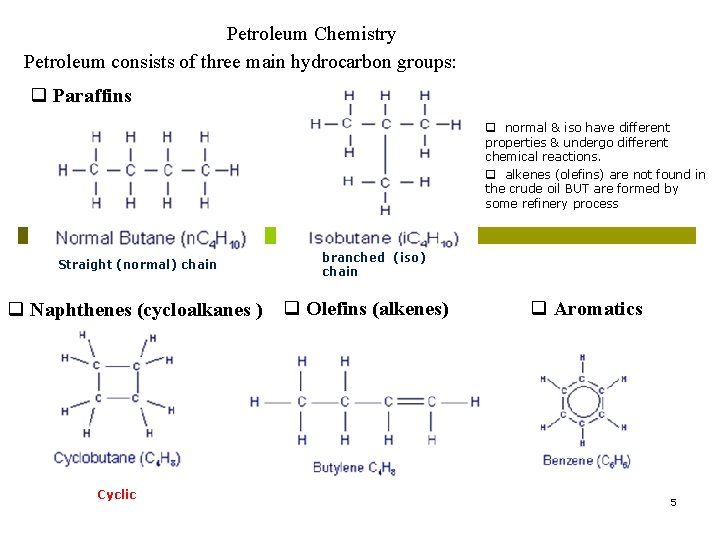
Petroleum Chemistry Petroleum consists of three main hydrocarbon groups: q Paraffins (alkanes) Straight (normal) chain q normal & iso have different properties & undergo different chemical reactions. q alkenes (olefins) are not found in the crude oil BUT are formed by some refinery process branched (iso) chain q Naphthenes (cycloalkanes ) q Olefins (alkenes) Cyclic q Aromatics 5
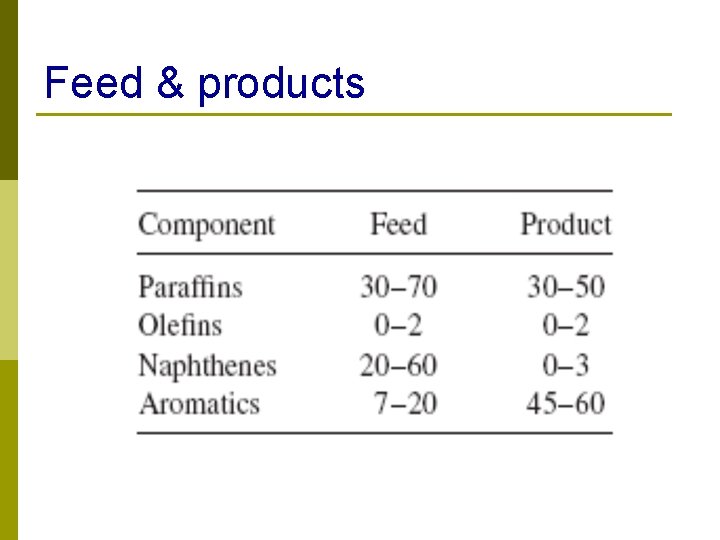
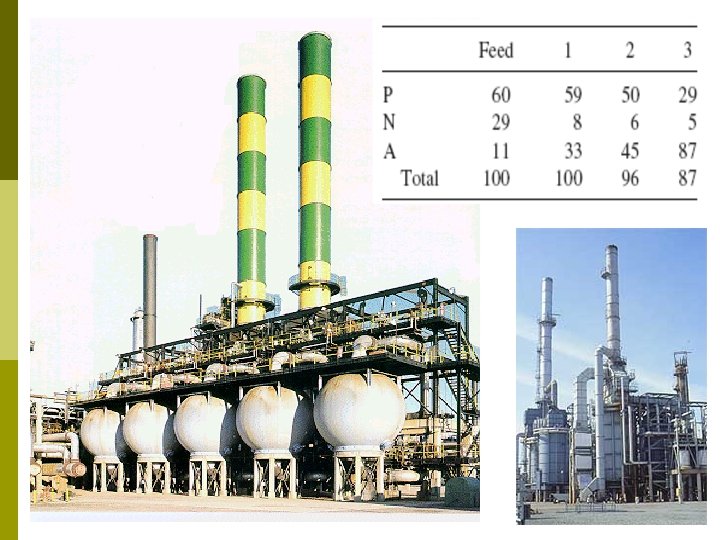
Feed & products
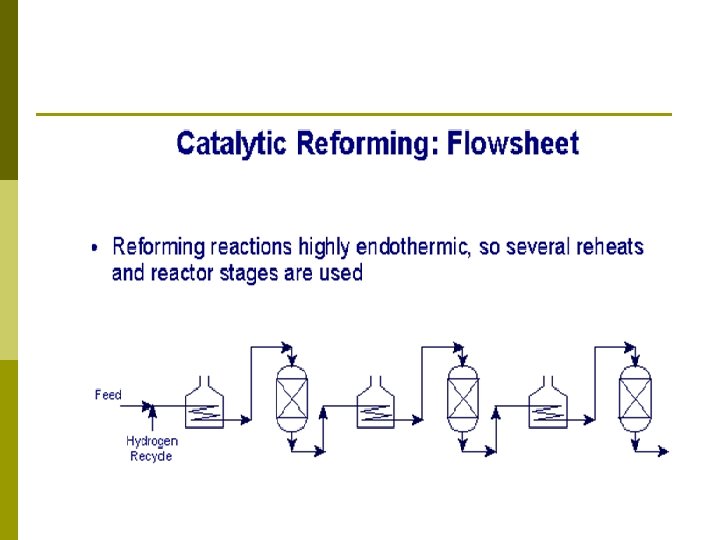
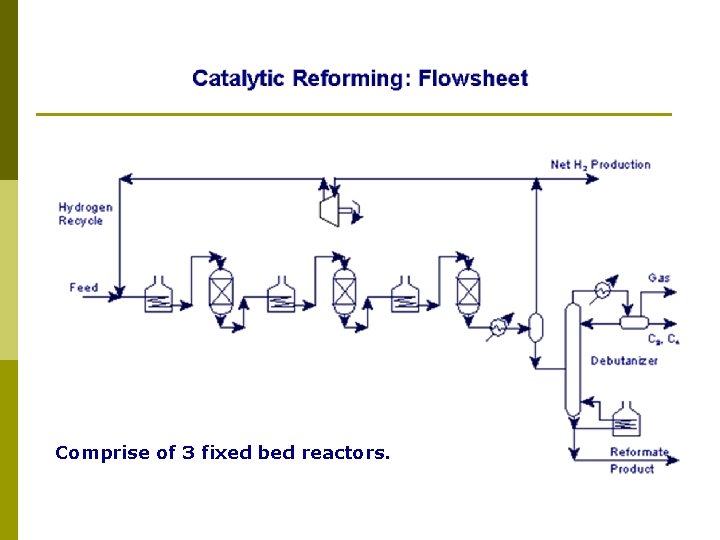
Comprise of 3 fixed bed reactors.
Reforming Process
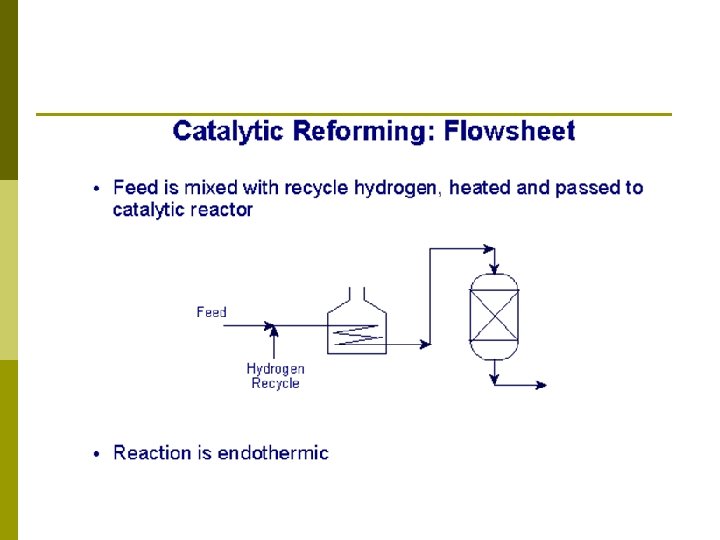
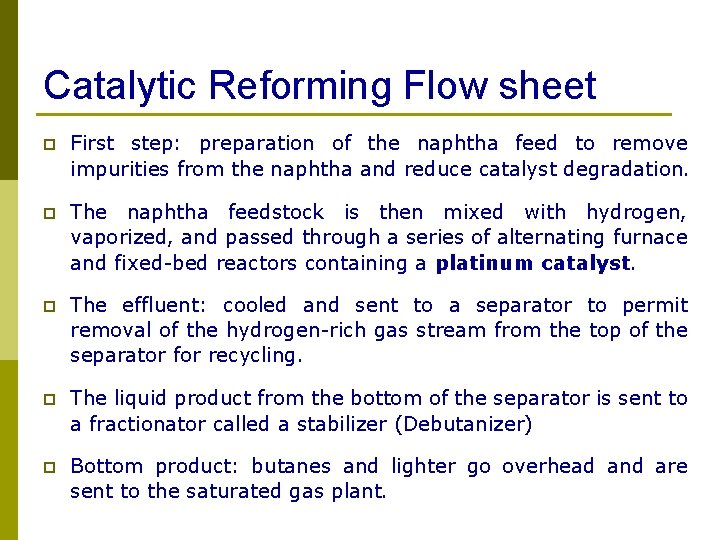
Catalytic Reforming Flow sheet p First step: preparation of the naphtha feed to remove impurities from the naphtha and reduce catalyst degradation. p The naphtha feedstock is then mixed with hydrogen, vaporized, and passed through a series of alternating furnace and fixed-bed reactors containing a platinum catalyst. p The effluent: cooled and sent to a separator to permit removal of the hydrogen-rich gas stream from the top of the separator for recycling. p The liquid product from the bottom of the separator is sent to a fractionator called a stabilizer (Debutanizer) p Bottom product: butanes and lighter go overhead and are sent to the saturated gas plant.
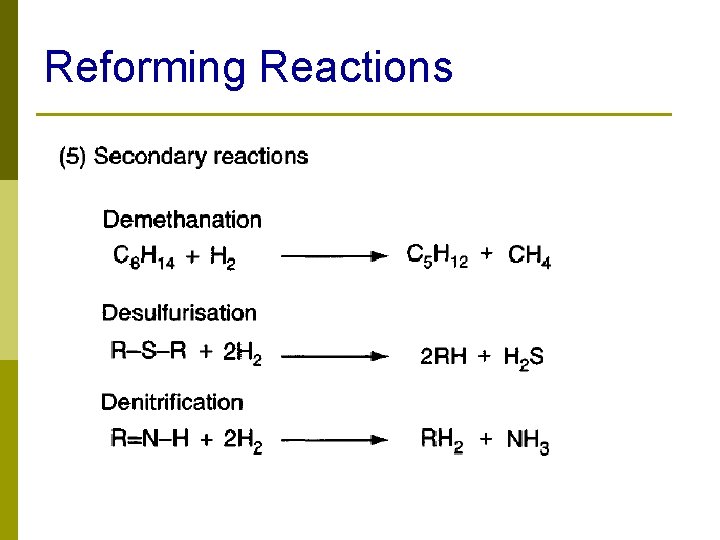
FEED QUALITY p Typically, the feed to a cat reformer unit for gasoline production is a heavy straight-run naphtha with an initial boiling point (IBP) of 194°F and final boiling point (FBP) of 284°F. p Benzene is an undesirable component in the gasoline because of environmental pollution concerns. It is therefore important to minimize or exclude any benzene precursors in the cat reformer feed by keeping the feed IBP higher than 1800 F. p The cat reformer feed is hydrotreated in a naphtha hydrotreater unit to remove any sulfur, nitrogen, and other impurities which can poison the reforming catalyst.
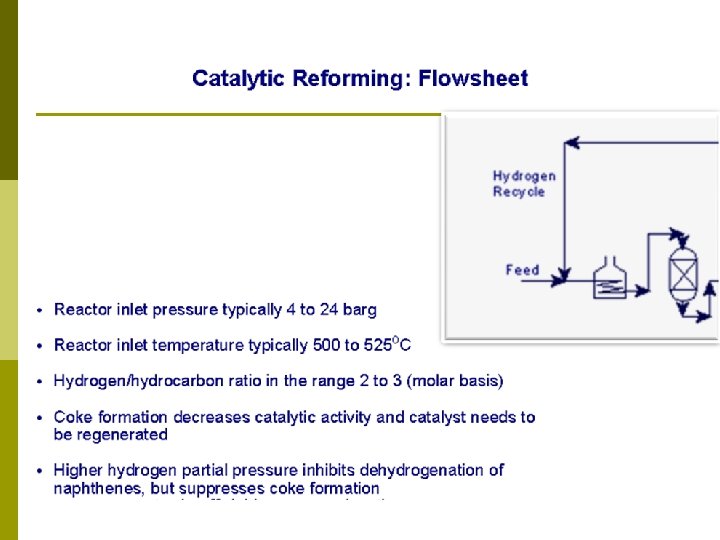
The Effects of Process Variables p Design considerations for improvement in quality will include pressure, recycle ratio, reactor residence time, & catalyst activity » Low reactor pressure increases yield & octane but increases coke make » Increased hydrogen partial pressure due to hydrogen recycle (hydrogen to hydrocarbon ratio) suppresses coke formation, hydrogen yield & octane gain, but promotes hydrocracking » Low space velocity favors aromatics formation but also promotes cracking by operating closer to equilibrium conditions » Higher activity catalysts cost more but increases run lengths and or yields
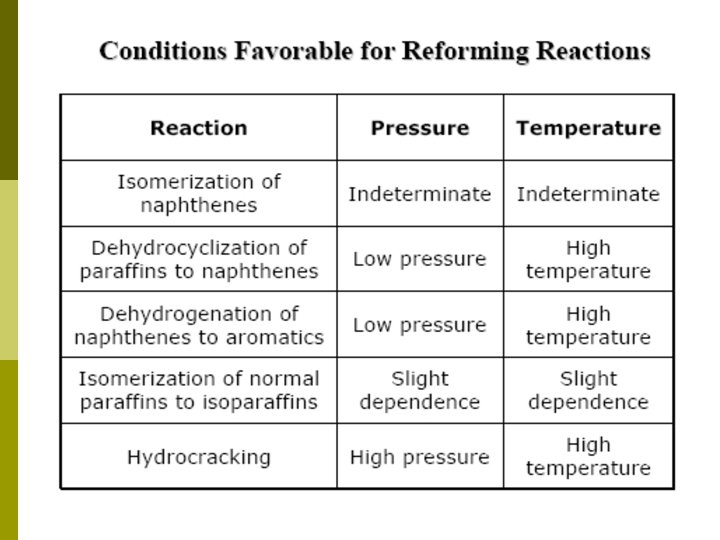
REFORMING REACTIONS p It is a heterogeneous reaction that takes place in a fixed bed of platinum or rhenium catalyst on an alumina support. The reforming reactions can be categorized in to four main groups:
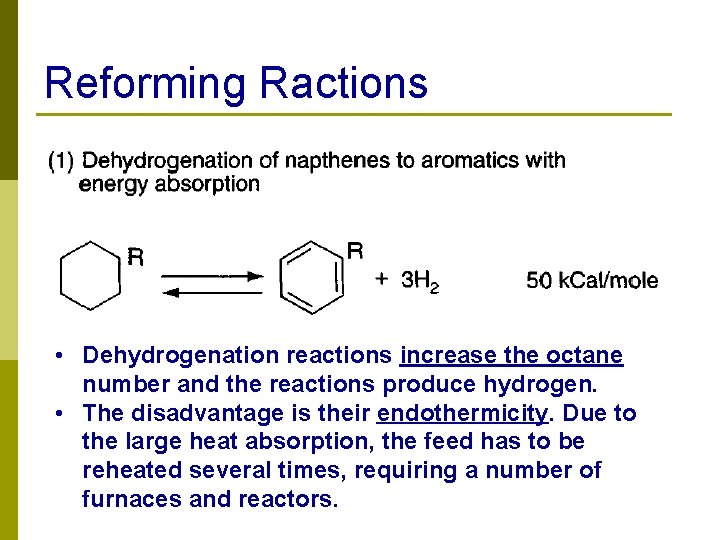
Reforming Ractions • Dehydrogenation reactions increase the octane number and the reactions produce hydrogen. • The disadvantage is their endothermicity. Due to the large heat absorption, the feed has to be reheated several times, requiring a number of furnaces and reactors.
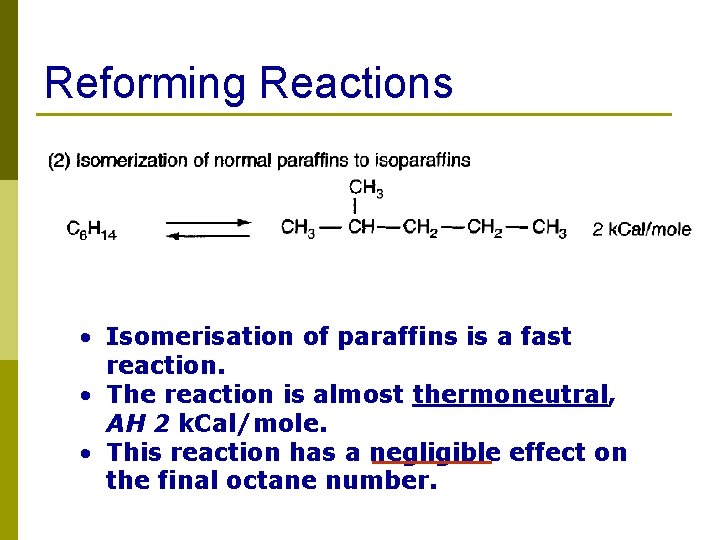
Reforming Reactions • Isomerisation of paraffins is a fast reaction. • The reaction is almost thermoneutral, AH 2 k. Cal/mole. • This reaction has a negligible effect on the final octane number.
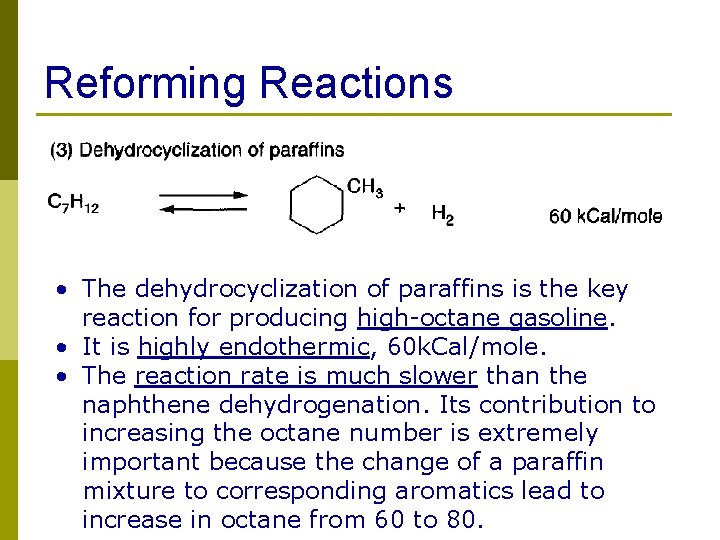
Reforming Reactions • The dehydrocyclization of paraffins is the key reaction for producing high-octane gasoline. • It is highly endothermic, 60 k. Cal/mole. • The reaction rate is much slower than the naphthene dehydrogenation. Its contribution to increasing the octane number is extremely important because the change of a paraffin mixture to corresponding aromatics lead to increase in octane from 60 to 80.
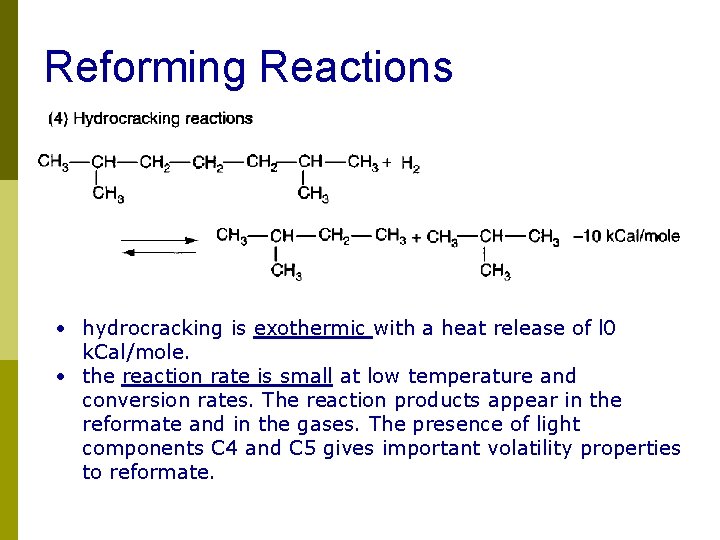
Reforming Reactions • hydrocracking is exothermic with a heat release of l 0 k. Cal/mole. • the reaction rate is small at low temperature and conversion rates. The reaction products appear in the reformate and in the gases. The presence of light components C 4 and C 5 gives important volatility properties to reformate.
Reforming Reactions