
Gasket Fabricators Association Technical Committee Presentation Estimators Guide
Gasket Fabricators Association Technical Committee Presentation Estimator’s Guide to Basic Gasketing Module 2 of 5 Material Selection December 2009
Agenda q Material Selection Criteria q Pros and Cons q PSAs q ASTM F 104 & D 2000 2
Material Selection Criteria q 4 Main Criteria to consider when selecting a gasket material: – Operating Pressure – Bolt Load – Operating Temperature – Media 3
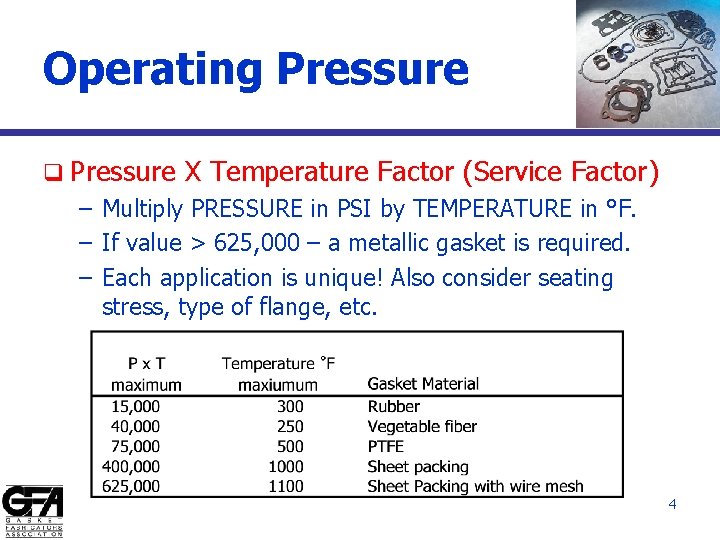
Operating Pressure q Pressure X Temperature Factor (Service Factor) – Multiply PRESSURE in PSI by TEMPERATURE in °F. – If value > 625, 000 – a metallic gasket is required. – Each application is unique! Also consider seating stress, type of flange, etc. 4

Bolt Load q M + Y Values q q M + Y Values not as relevant due to newer gasketing materials. New gasket constants initiated by Pressure Vessel Research Committee. – M = Ratio between residual stress on gasket and internal pressure (Gasket Maintenance Factor). – The higher the “M” value, better against leaks. – Y = minimum gasket seating stress (initial assembly) 5

Operating Temperatures q Elastomers max out at ~ 600° F. q Compressed non-asbestos: 400° F continuous. q Beater-add: 250 -300° F. q Flexible Graphite: 800° F. q Continuous v. Intermittent q Non-standard gasketing materials (high temp paper boards, etc. ) 6
Media q Primarily affects the elastomer… – So different polymers for each application. q Not just for chemicals and oil/fuel – Abrasives, weather, ozone – Food, water, dairy, pharmaceutical products. q Teflon – excellent chemical resistance! – Envelope or encapsulated gaskets q Flexible Graphite – broad range of chemical resistance. 7
Pros & Cons: Elastomers Pros þ Cost effective. þ Wide range of durometers – and sponge. þ Seals under lower compressive loads. þ Wide range of compositions. Cons - Wide range of compositions. - Limits on: – Temperature – Pressure – Compression set 8

Pros & Cons: Compressed Non-Asbestos & Beater Add Pros þ Cost effective þ Higher Pressures. þ Higher Temperatures. þ High resistance to seating stress. Cons q Dust and slivers. q Tool Wear. 9
Pros & Cons: Teflon Pros þ Excellent Chemical Resistance. þ Electrical Insulator. þ Anti-Stick Properties. Cons q Cold Flow. 10

Pros & Cons: Flexible Graphite Pros þ Good with most chemicals. þ Good high temperature gasket – up to 5400° F in vacuum. þ Low creep – reduces retightening. Cons q Fragile. 11
Gaskets with PSAs q Application environments q Adhesive chemistries q Product constructions 12
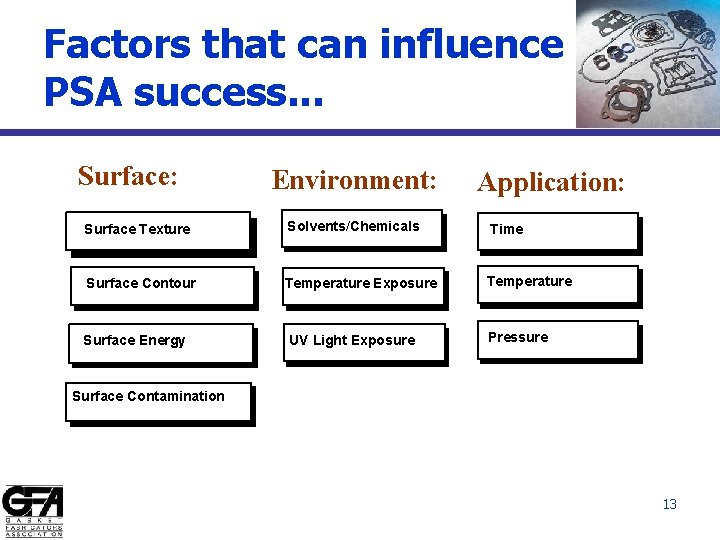
Factors that can influence PSA success. . . Surface: Environment: Application: Surface Texture Solvents/Chemicals Time Surface Contour Temperature Exposure Temperature Surface Energy UV Light Exposure Pressure Surface Contamination 13
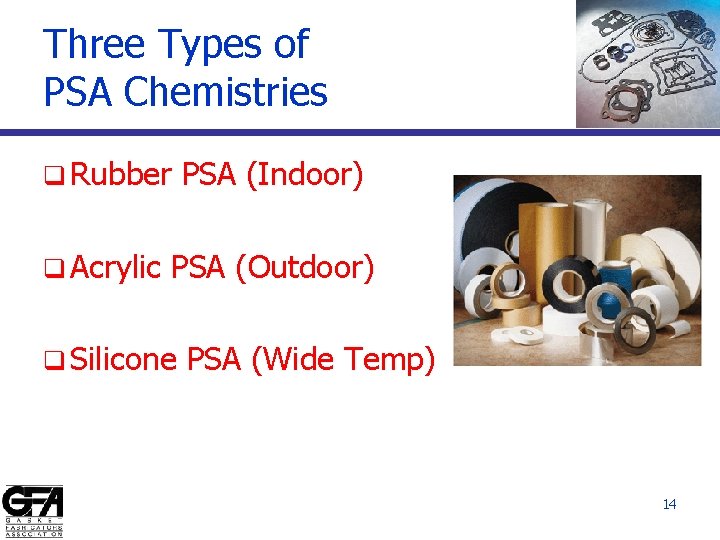
Three Types of PSA Chemistries q Rubber q Acrylic PSA (Indoor) PSA (Outdoor) q Silicone PSA (Wide Temp) 14

Common Constructions --PSA --Liner ç Adhesive Transfer Tape or “Free Film” --PSA (Exposed) ç Double--Carrier Coated Tape --PSA (Liner) --Liner ç Single-Coated --Carrier Tape or Label --PSA stock --Liner (optional) 15

Double-Coated vs. Unsupported Adhesive Double-Coated Tapes – – Less conformable Lower temp resistance “Removable” Reinforces substrate Free Film Adhesive – – More conformable Higher temp resistance “Permanent” Doesn’t reinforce substrate 16
ASTM F 104 & D 2000 q Classification systems specifying properties of non-metallic gasket materials. – Non-metallic gasket materials described by specific physical & mechanical characteristics. – Rubber compounds classified under ASTM D 2000. – Users can specify required properties. – Suppliers can report product properties. – EXAMPLES: • ASTM F 104 F 725400 • ASTM D 2000 -99 M 2 HK 714 A 1 -10 B 38 17
Appendix q ASTM F 104 – Nonmetallic Gasket Classification q ASTM D 2000 q Elastomer Properties 18

ASTM F 104 19
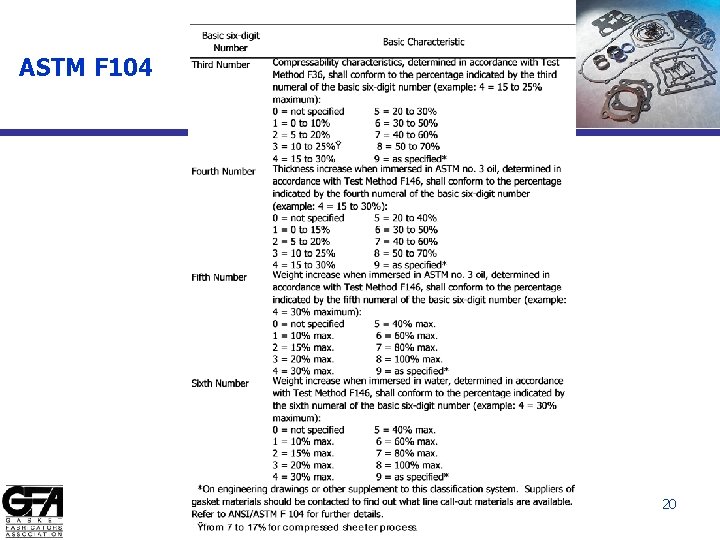
ASTM F 104 20
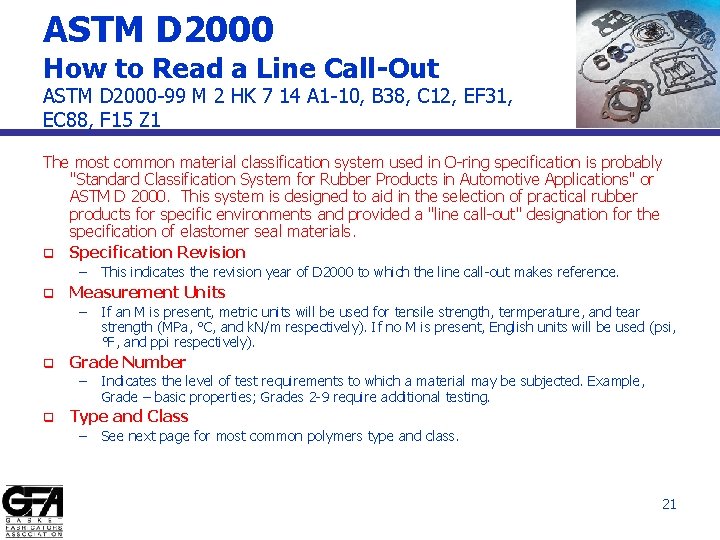
ASTM D 2000 How to Read a Line Call-Out ASTM D 2000 -99 M 2 HK 7 14 A 1 -10, B 38, C 12, EF 31, EC 88, F 15 Z 1 The most common material classification system used in O-ring specification is probably "Standard Classification System for Rubber Products in Automotive Applications" or ASTM D 2000. This system is designed to aid in the selection of practical rubber products for specific environments and provided a "line call-out" designation for the specification of elastomer seal materials. q Specification Revision – q Measurement Units – q If an M is present, metric units will be used for tensile strength, termperature, and tear strength (MPa, °C, and k. N/m respectively). If no M is present, English units will be used (psi, °F, and ppi respectively). Grade Number – q This indicates the revision year of D 2000 to which the line call-out makes reference. Indicates the level of test requirements to which a material may be subjected. Example, Grade – basic properties; Grades 2 -9 require additional testing. Type and Class – See next page for most common polymers type and class. 21
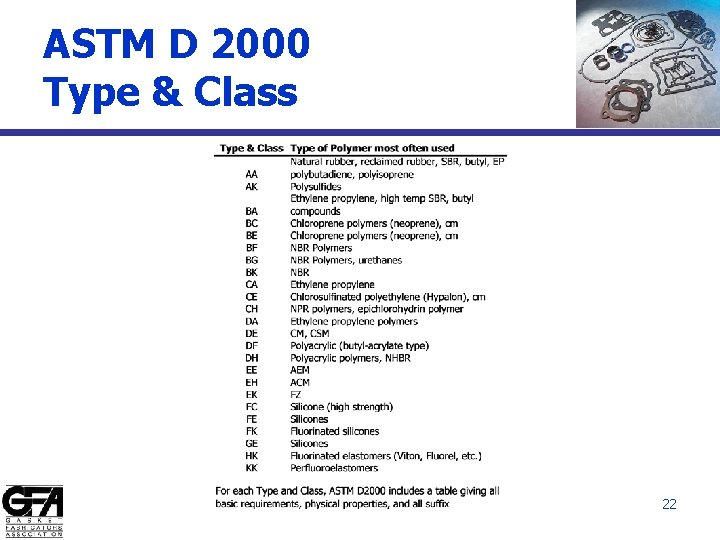
ASTM D 2000 Type & Class 22
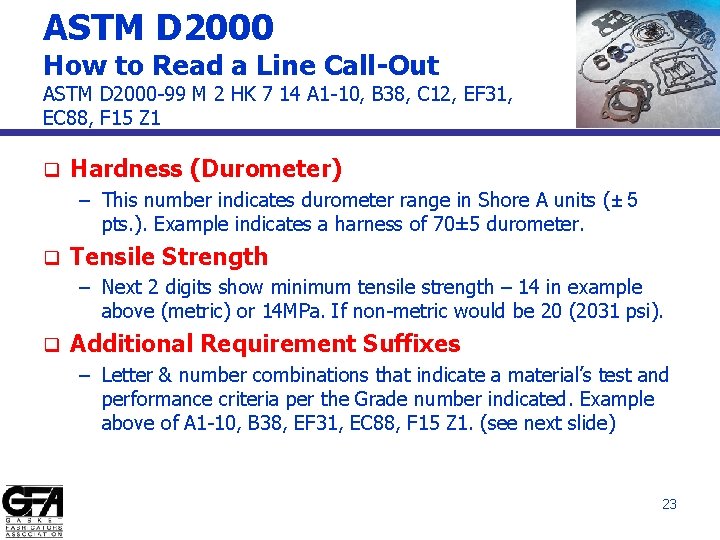
ASTM D 2000 How to Read a Line Call-Out ASTM D 2000 -99 M 2 HK 7 14 A 1 -10, B 38, C 12, EF 31, EC 88, F 15 Z 1 q Hardness (Durometer) – This number indicates durometer range in Shore A units (± 5 pts. ). Example indicates a harness of 70± 5 durometer. q Tensile Strength – Next 2 digits show minimum tensile strength – 14 in example above (metric) or 14 MPa. If non-metric would be 20 (2031 psi). q Additional Requirement Suffixes – Letter & number combinations that indicate a material’s test and performance criteria per the Grade number indicated. Example above of A 1 -10, B 38, EF 31, EC 88, F 15 Z 1. (see next slide) 23
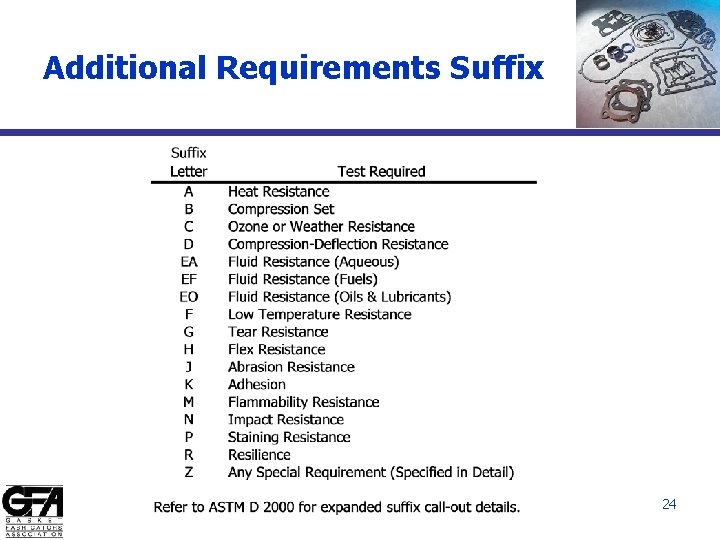
Additional Requirements Suffix 24
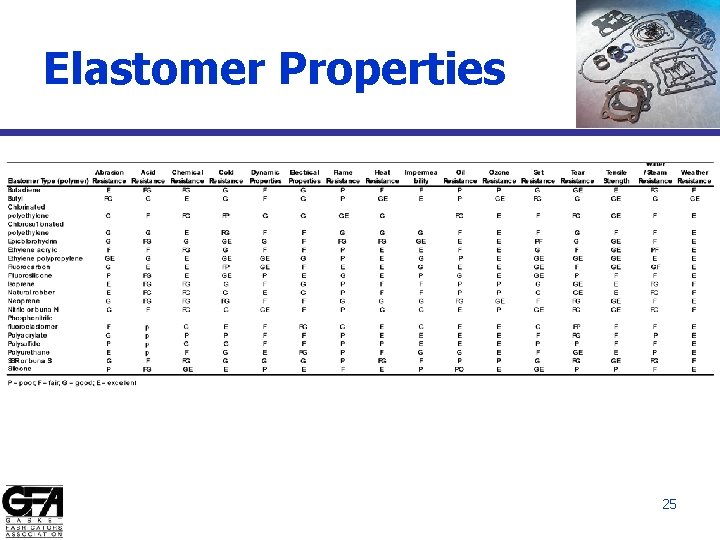
Elastomer Properties 25

More to Come! ü Module 1: Understanding the Application ü Module 2: Material Selection q Module 3: Cutting/Processing Techniques q Module 4: Value Adding q Module 5: Monday Morning Quarterback: Actual Results vs. Estimation 26

Thank You! We appreciate your time and attention. Questions? 27
- Slides: 27