
Gasgrain Modeling of HNCO HOCN HCNO and HONC

- Slides: 13
Gas-grain Modeling of HNCO, HOCN, HCNO, and HONC Donghui Quan & Eric Herbst The Ohio State University
Outline Observational Results Modeling Method Essential Reactions Results and Discussion Conclusion
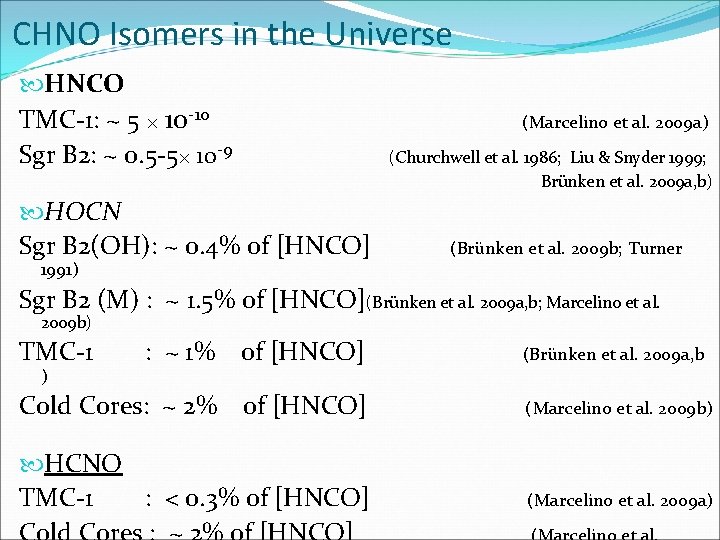
CHNO Isomers in the Universe HNCO TMC 1: ~ 5 × 10 10 Sgr B 2: ~ 0. 5 5× 10 9 (Marcelino et al. 2009 a) (Churchwell et al. 1986; Liu & Snyder 1999; Brünken et al. 2009 a, b) HOCN Sgr B 2(OH): ~ 0. 4% of [HNCO] 1991) (Brünken et al. 2009 b; Turner Sgr B 2 (M) : ~ 1. 5% of [HNCO](Brünken et al. 2009 a, b; Marcelino et al. 2009 b) TMC 1 : ~ 1% of [HNCO] (Brünken et al. 2009 a, b Cold Cores: ~ 2% of [HNCO] (Marcelino et al. 2009 b) HCNO TMC 1 : < 0. 3% of [HNCO] (Marcelino et al. 2009 a) )
Why different?
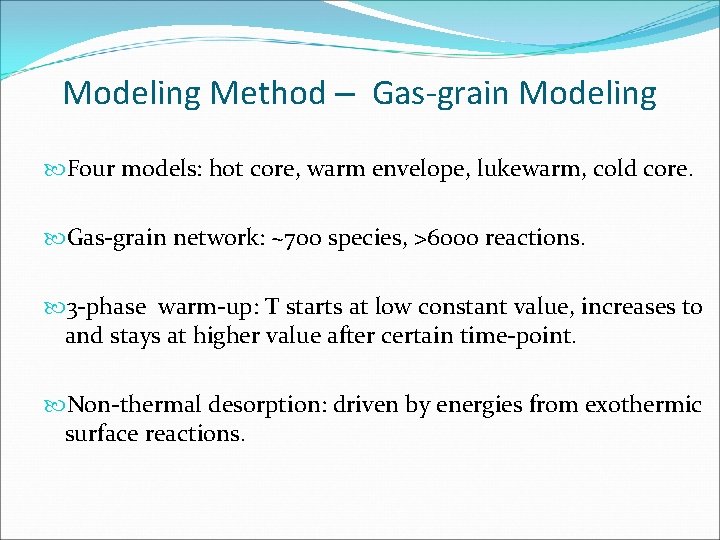
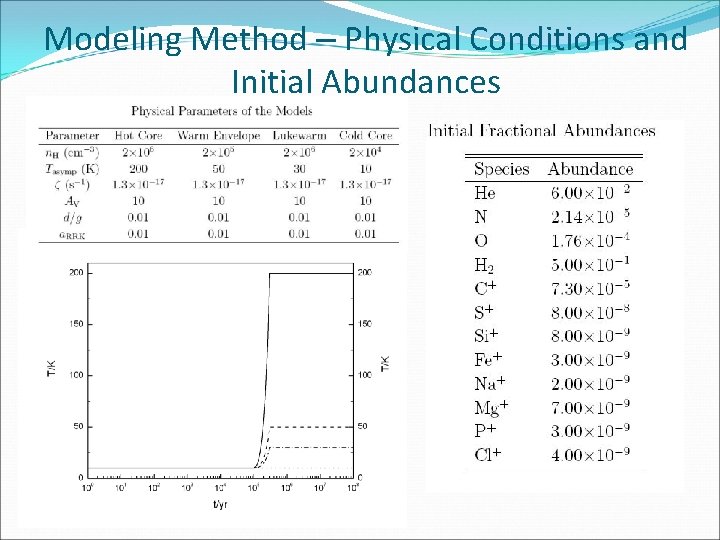
Modeling Method – Gas-grain Modeling Four models: hot core, warm envelope, lukewarm, cold core. Gas grain network: ~700 species, >6000 reactions. 3 phase warm up: T starts at low constant value, increases to and stays at higher value after certain time point. Non thermal desorption: driven by energies from exothermic surface reactions.
Modeling Method – Physical Conditions and Initial Abundances
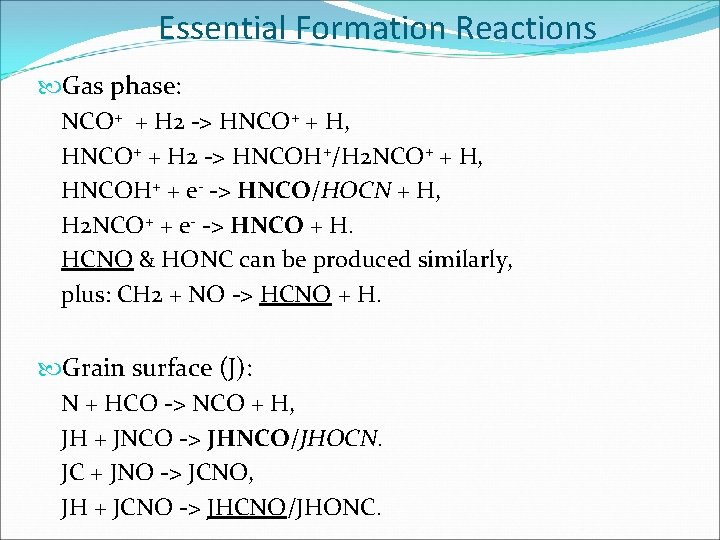
Essential Formation Reactions Gas phase: NCO+ + H 2 > HNCO+ + H, HNCO+ + H 2 > HNCOH+/H 2 NCO+ + H, HNCOH+ + e > HNCO/HOCN + H, H 2 NCO+ + e > HNCO + H. HCNO & HONC can be produced similarly, plus: CH 2 + NO > HCNO + H. Grain surface (J): N + HCO > NCO + H, JH + JNCO > JHNCO/JHOCN. JC + JNO > JCNO, JH + JCNO > JHCNO/JHONC.
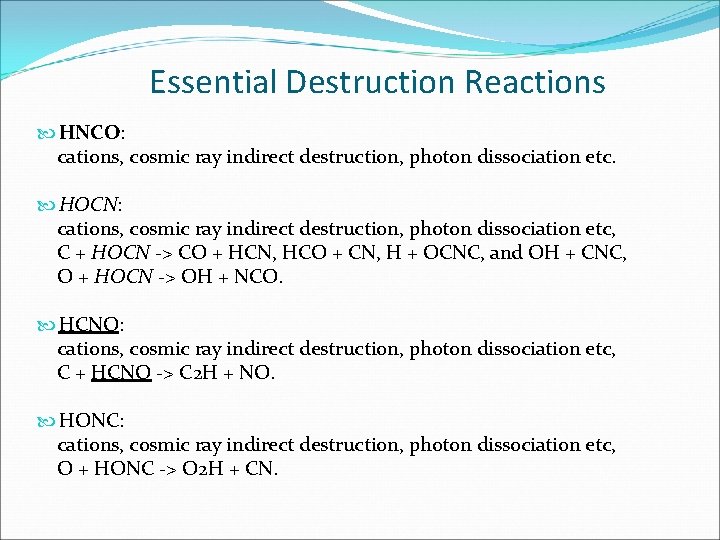
Essential Destruction Reactions HNCO: cations, cosmic ray indirect destruction, photon dissociation etc. HOCN: cations, cosmic ray indirect destruction, photon dissociation etc, C + HOCN > CO + HCN, HCO + CN, H + OCNC, and OH + CNC, O + HOCN > OH + NCO. HCNO: cations, cosmic ray indirect destruction, photon dissociation etc, C + HCNO > C 2 H + NO. HONC: cations, cosmic ray indirect destruction, photon dissociation etc, O + HONC > O 2 H + CN.
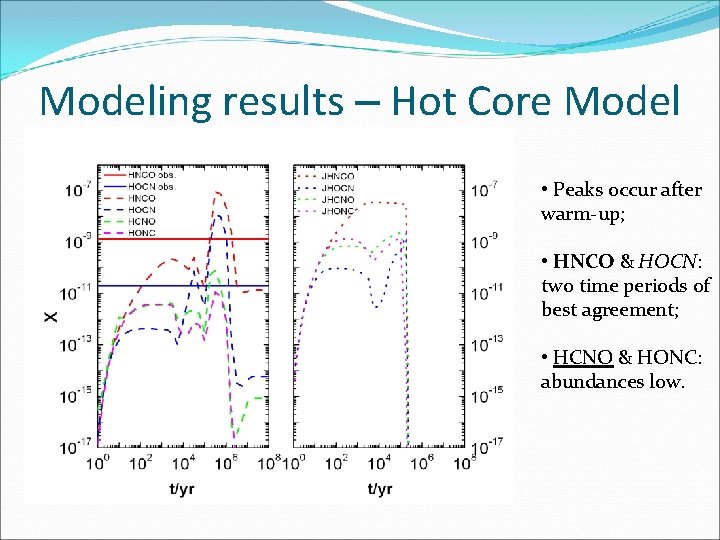
Modeling results – Hot Core Model • Peaks occur after warm up; • HNCO & HOCN: two time periods of best agreement; • HCNO & HONC: abundances low.
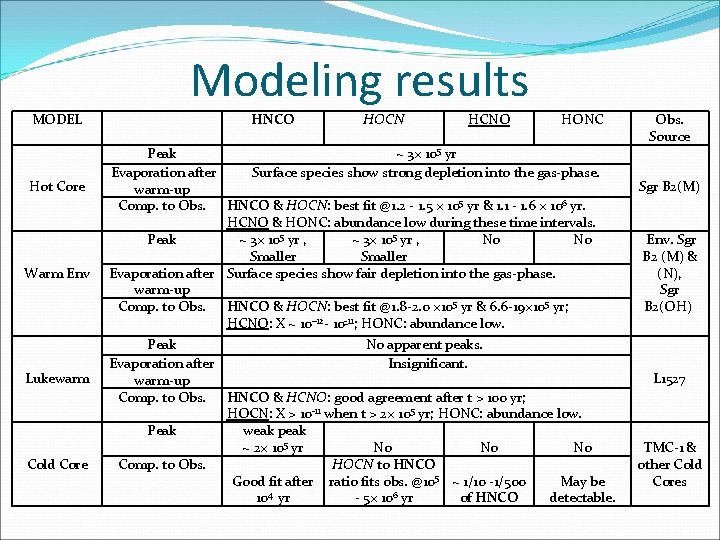
Modeling results MODEL Hot Core Warm Env Lukewarm Cold Core HNCO HOCN HCNO HONC Peak ~ 3× 10⁵ yr Evaporation after Surface species show strong depletion into the gas phase. warm up Comp. to Obs. HNCO & HOCN: best fit @1. 2 1. 5 × 10⁵ yr & 1. 1 1. 6 × 10⁶ yr. HCNO & HONC: abundance low during these time intervals. Peak ~ 3× 10⁵ yr , No No Smaller Evaporation after Surface species show fair depletion into the gas phase. warm up Comp. to Obs. HNCO & HOCN: best fit @1. 8 2. 0 × 105 yr & 6. 6 19× 105 yr; HCNO: X ~ 10− 12 10 11; HONC: abundance low. Peak No apparent peaks. Evaporation after Insignificant. warm up Comp. to Obs. HNCO & HCNO: good agreement after t > 100 yr; HOCN: X > 10 11 when t > 2× 10⁵ yr; HONC: abundance low. Peak weak peak ~ 2× 10⁵ yr No No No Comp. to Obs. HOCN to HNCO Good fit after ratio fits obs. @105 ~ 1/10 1/500 May be 4 6 10 yr 5× 10 yr of HNCO detectable. Obs. Source Sgr B 2(M) Env. Sgr B 2 (M) & (N), Sgr B 2(OH) L 1527 TMC 1 & other Cold Cores
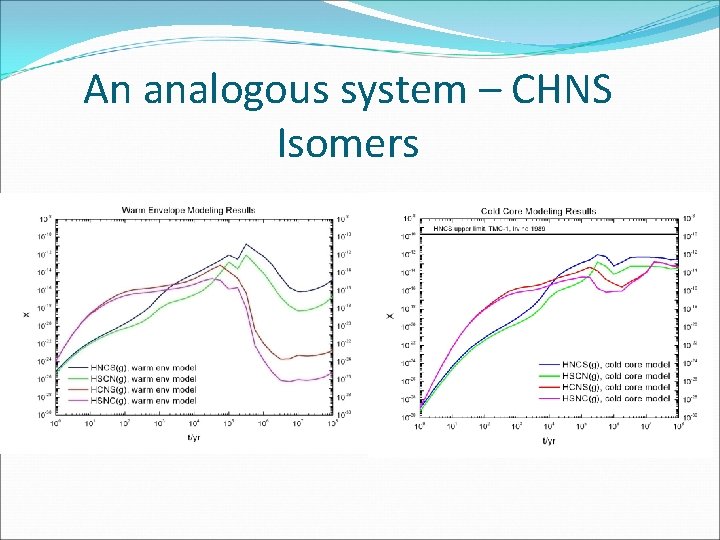
An analogous system – CHNS Isomers
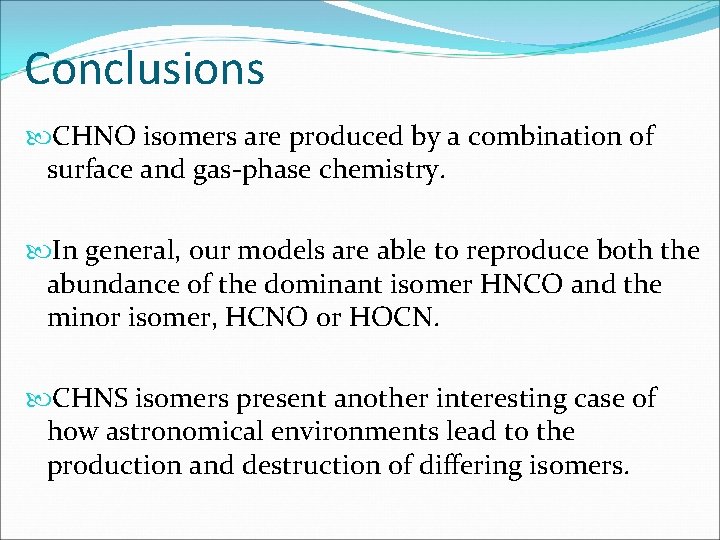
Conclusions CHNO isomers are produced by a combination of surface and gas phase chemistry. In general, our models are able to reproduce both the abundance of the dominant isomer HNCO and the minor isomer, HCNO or HOCN. CHNS isomers present another interesting case of how astronomical environments lead to the production and destruction of differing isomers.
Acknowledgement Dr. Yoshihiro Osamura Dr. David Woon Dr. Sandra Brünken NSF funding Thank you all!