
GASES Kinetic Theory of Gases Explains Gas behavior
GASES
Kinetic Theory of Gases Explains Gas behavior 4 parts: 1) Gas particles do not attract or repel each other. 2) Gas particles are much smaller than the space between them. 3) Gas particles are in constant, random motion. 4) Collisions between gas particles are elastic.

Temperature: Measures the average kinetic energy of a gas. Temperature and Average Kinetic Energy are DIRECTLY proportional. At the same temperature all gases have the same average kinetic energy.
Pressure: Created by the collision of particles with each other and objects. Elevation and Atmospheric Pressure are INVERSELY proportional. Higher elevation = less pressure Lower elevation = higher pressure

Equivalent Units of Pressure 1 atm (atmosphere) 760 mm Hg 760 Torr 101. 3 k. Pa (kilopascals) (*SI unit = Pascal) 14. 7 psi (pounds/square inch) (STP) Standard Temp. & Pressure = 1 atm @ 0 o. C

Temperature Conversion All gas temperatures are calculated using Kelvin. K = o. C + 273 OR o. C = K – 273 Absolute Zero = Temperature at which all molecular motion ceases. *Occurs at 0 K or -273 o. C
Pressure Conversions To convert from one pressure unit to another: 1) Set up a box 2) Choose a conversion factor from the equivalent list. 3) Solve.
Examples 1) What pressure, in atm, is equivalent to 456 mm Hg? 2) How many Torr equal 3. 4 k. Pa?
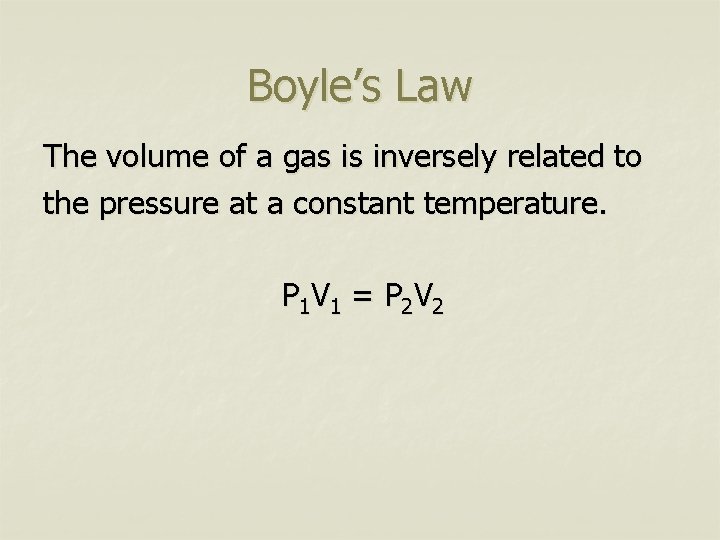
Boyle’s Law The volume of a gas is inversely related to the pressure at a constant temperature. P 1 V 1 = P 2 V 2
Example A sample of helium gas in a balloon is compressed from 4. 0 L to 250 m. L at a constant temperature. If the original pressure of the gas is 210 k. Pa, what will be the pressure of the compressed gas?
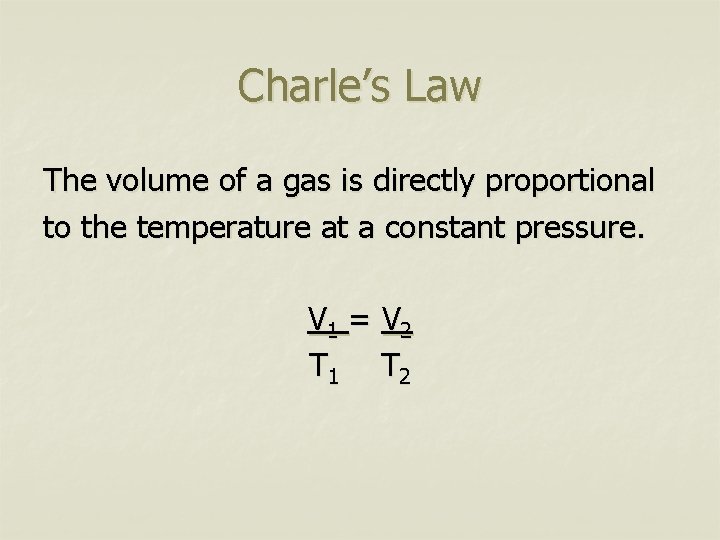
Charle’s Law The volume of a gas is directly proportional to the temperature at a constant pressure. V 1 = V 2 T 1 T 2
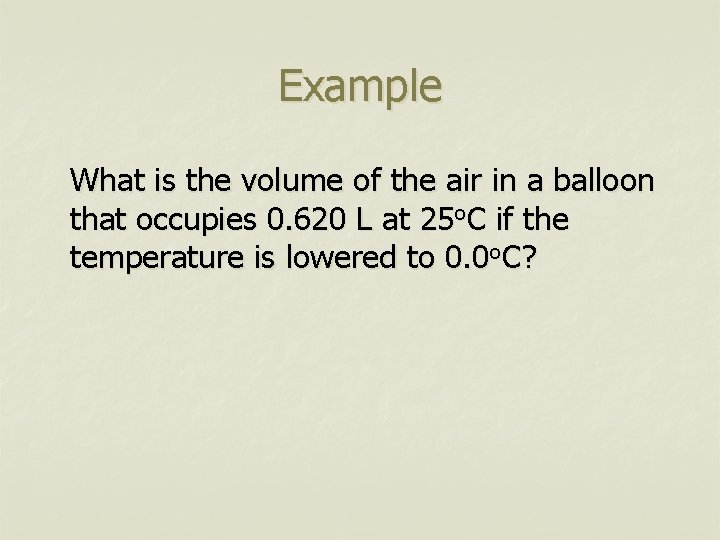
Example What is the volume of the air in a balloon that occupies 0. 620 L at 25 o. C if the temperature is lowered to 0. 0 o. C?
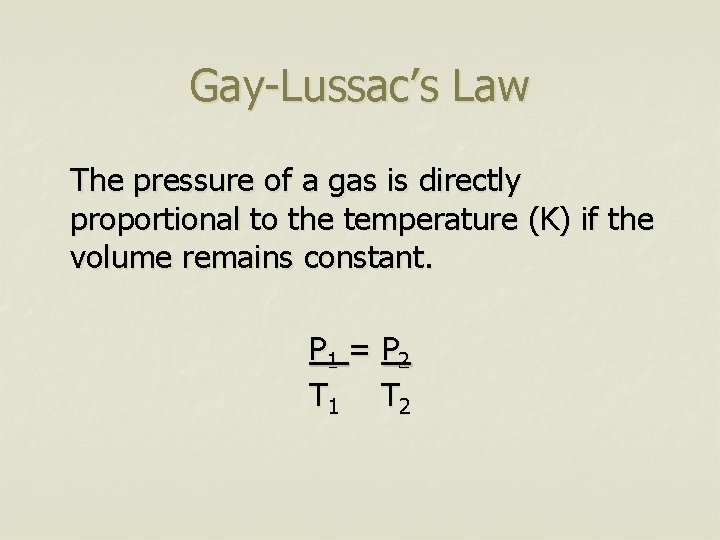
Gay-Lussac’s Law The pressure of a gas is directly proportional to the temperature (K) if the volume remains constant. P 1 = P 2 T 1 T 2
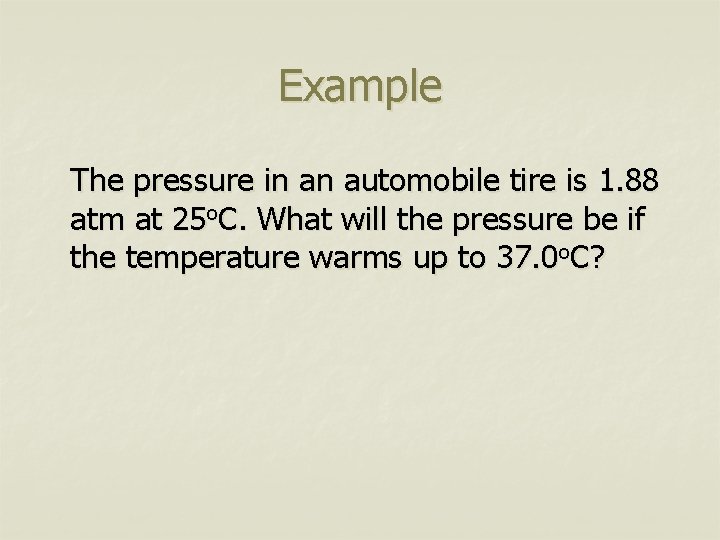
Example The pressure in an automobile tire is 1. 88 atm at 25 o. C. What will the pressure be if the temperature warms up to 37. 0 o. C?
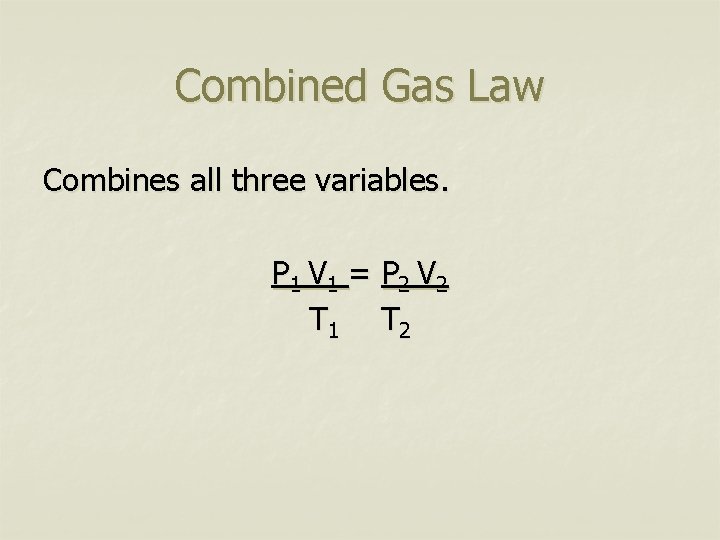
Combined Gas Law Combines all three variables. P 1 V 1 = P 2 V 2 T 1 T 2
Example A sample of gas has a volume of 2050 m. L at 0. 95 atm and 36 o. C. What will be the volume of the gas at STP?
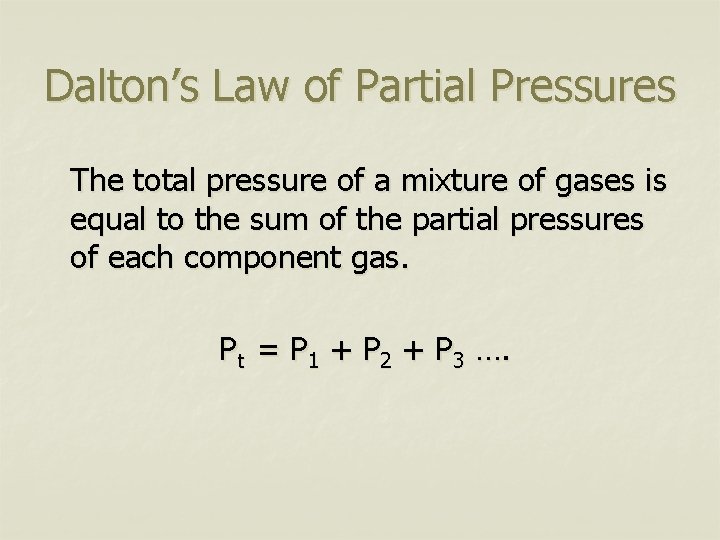
Dalton’s Law of Partial Pressures The total pressure of a mixture of gases is equal to the sum of the partial pressures of each component gas. Pt = P 1 + P 2 + P 3 ….
Example A scuba tank contains a mixture of gases including 0. 42 atm N 2, 205 torr O 2 and 35. 5 k. Pa CO 2. What is the total pressure inside the tank in atmospheres?
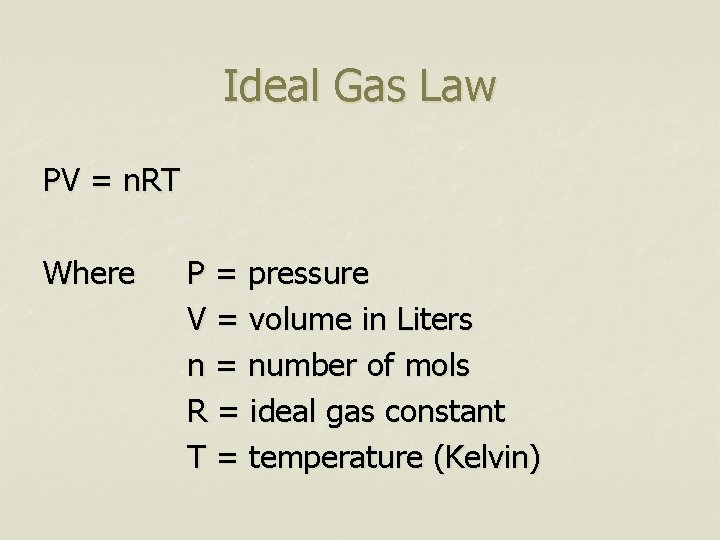
Ideal Gas Law PV = n. RT Where P = pressure V = volume in Liters n = number of mols R = ideal gas constant T = temperature (Kelvin)
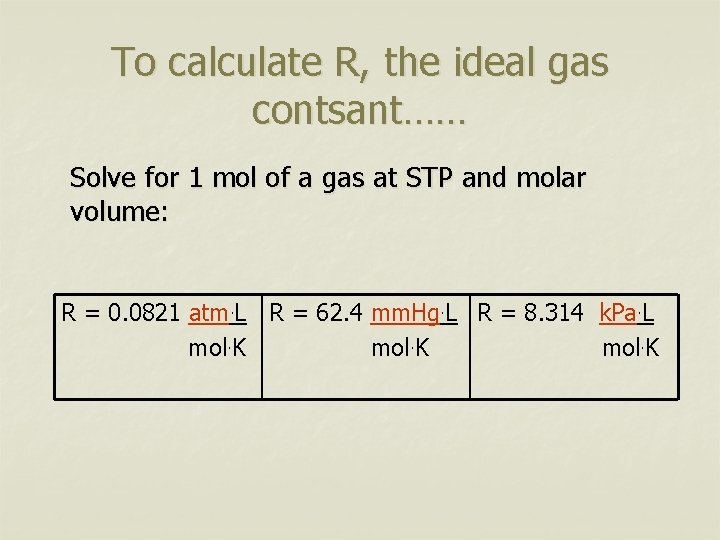
To calculate R, the ideal gas contsant…… Solve for 1 mol of a gas at STP and molar volume: R = 0. 0821 atm. L R = 62. 4 mm. Hg. L R = 8. 314 k. Pa. L mol. K
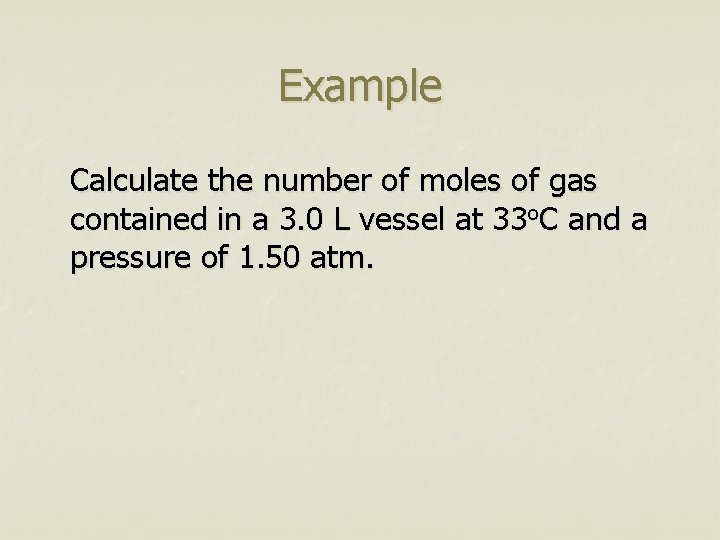
Example Calculate the number of moles of gas contained in a 3. 0 L vessel at 33 o. C and a pressure of 1. 50 atm.
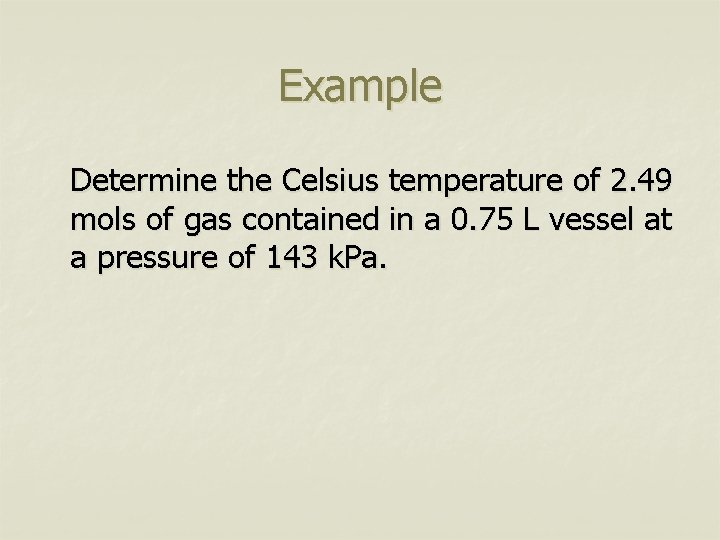
Example Determine the Celsius temperature of 2. 49 mols of gas contained in a 0. 75 L vessel at a pressure of 143 k. Pa.
- Slides: 22