Gases have nonzero volume at low T and
- Slides: 10
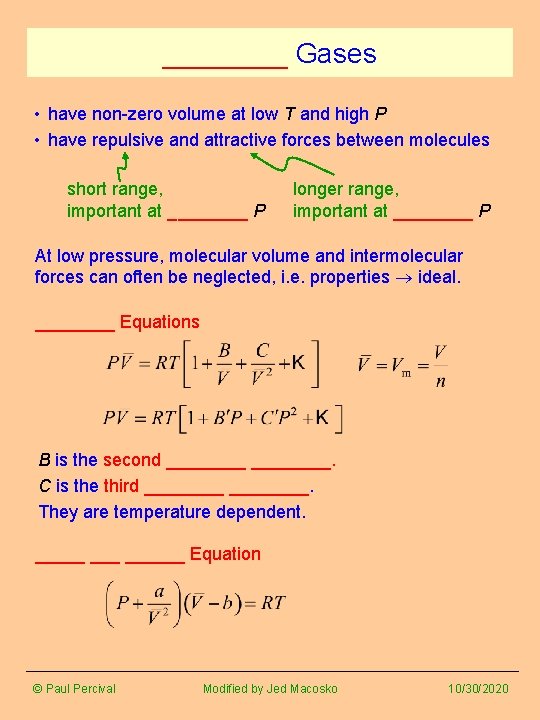
____ Gases • have non-zero volume at low T and high P • have repulsive and attractive forces between molecules short range, important at ____ P longer range, important at ____ P At low pressure, molecular volume and intermolecular forces can often be neglected, i. e. properties ideal. ____ Equations B is the second ________. C is the third ________. They are temperature dependent. ______ Equation © Paul Percival Modified by Jed Macosko 10/30/2020
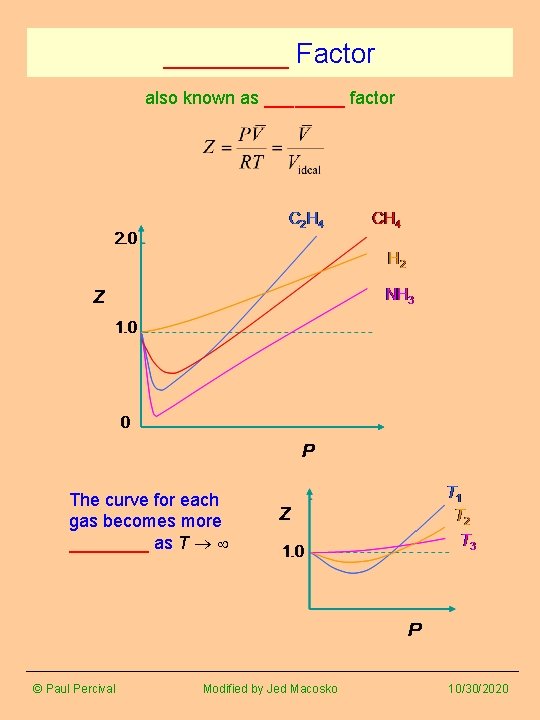
____ Factor also known as ____ factor The curve for each gas becomes more ____ as T © Paul Percival Modified by Jed Macosko 10/30/2020
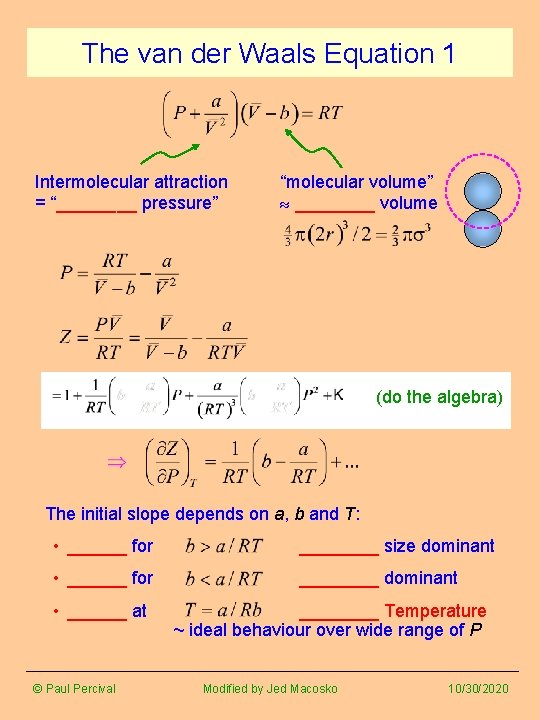
The van der Waals Equation 1 Intermolecular attraction = “____ pressure” “molecular volume” ____ volume (do the algebra) The initial slope depends on a, b and T: • ______ for ____ size dominant • ______ for ____ dominant • ______ at © Paul Percival ____ Temperature ~ ideal behaviour over wide range of P Modified by Jed Macosko 10/30/2020
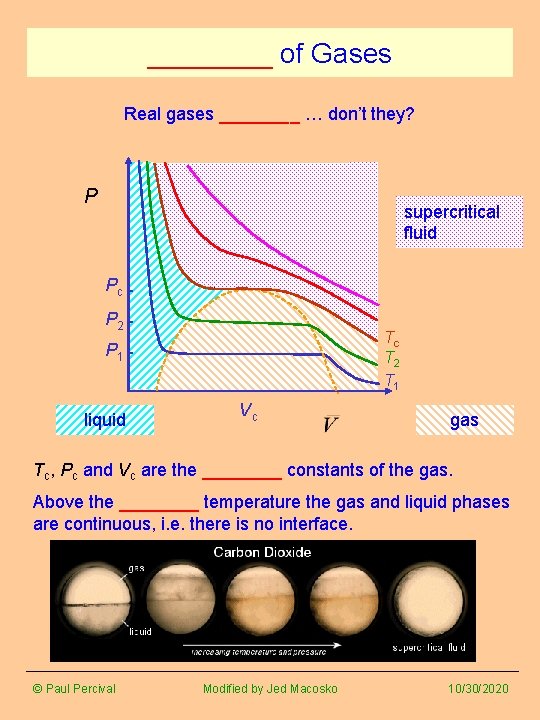
____ of Gases Real gases ____ … don’t they? P supercritical fluid Pc P 2 Tc T 2 T 1 P 1 liquid Vc gas Tc, Pc and Vc are the ____ constants of the gas. Above the ____ temperature the gas and liquid phases are continuous, i. e. there is no interface. © Paul Percival Modified by Jed Macosko 10/30/2020
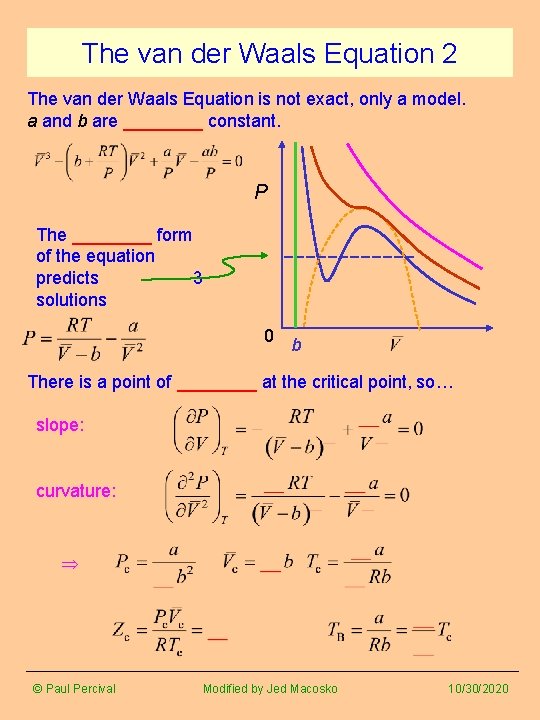
The van der Waals Equation 2 The van der Waals Equation is not exact, only a model. a and b are ____ constant. P The ____ form of the equation predicts 3 solutions 0 b There is a point of ____ at the critical point, so… slope: curvature: © Paul Percival Modified by Jed Macosko 10/30/2020
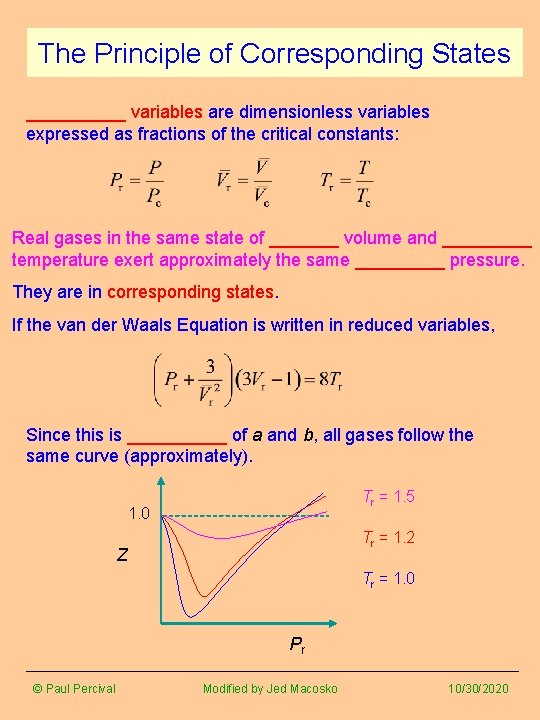
The Principle of Corresponding States _____ variables are dimensionless variables expressed as fractions of the critical constants: Real gases in the same state of _______ volume and _____ temperature exert approximately the same _____ pressure. They are in corresponding states. If the van der Waals Equation is written in reduced variables, Since this is _____ of a and b, all gases follow the same curve (approximately). Tr = 1. 5 1. 0 Tr = 1. 2 Z Tr = 1. 0 Pr © Paul Percival Modified by Jed Macosko 10/30/2020
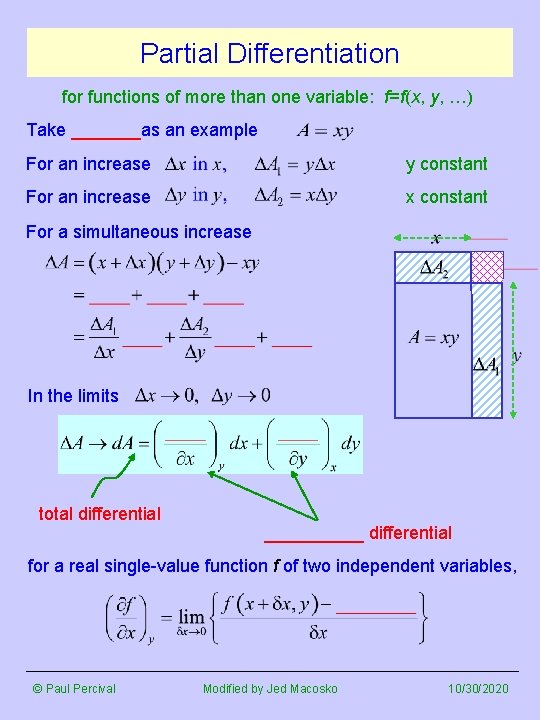
Partial Differentiation for functions of more than one variable: f=f(x, y, …) Take _______as an example For an increase y constant For an increase x constant For a simultaneous increase In the limits total differential _____ differential for a real single-value function f of two independent variables, © Paul Percival Modified by Jed Macosko 10/30/2020
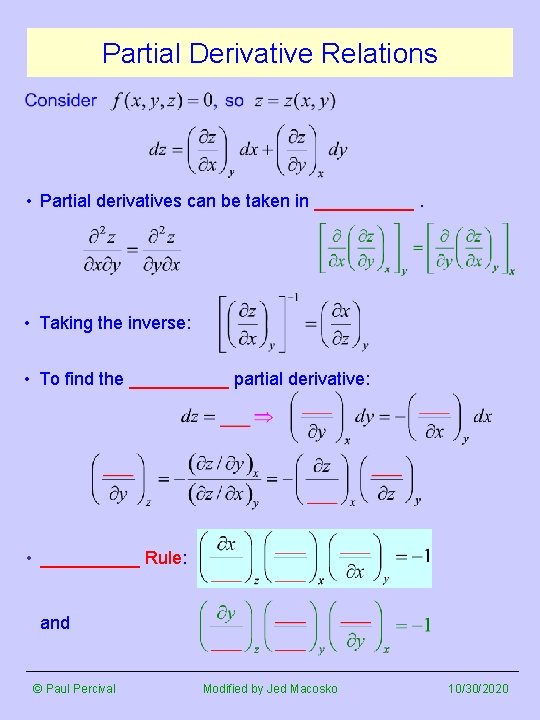
Partial Derivative Relations • Partial derivatives can be taken in _____. • Taking the inverse: • To find the _____ partial derivative: • _____ Rule: and © Paul Percival Modified by Jed Macosko 10/30/2020
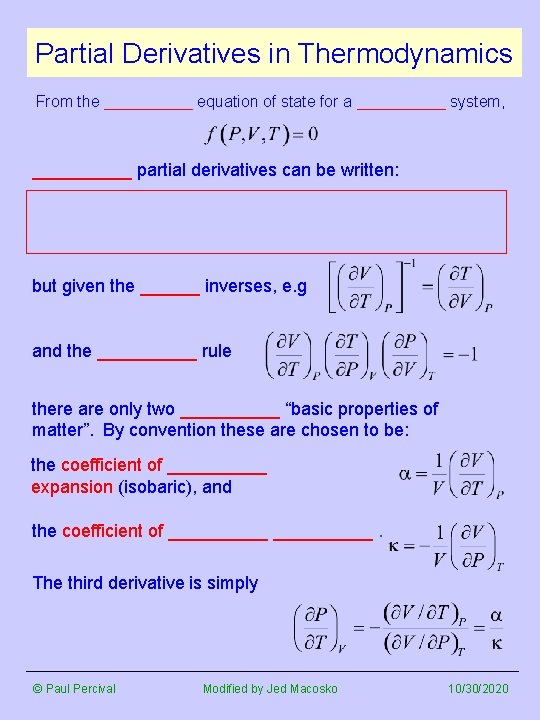
Partial Derivatives in Thermodynamics From the _____ equation of state for a _____ system, _____ partial derivatives can be written: but given the ______ inverses, e. g and the _____ rule there are only two _____ “basic properties of matter”. By convention these are chosen to be: the coefficient of _____ expansion (isobaric), and the coefficient of __________. The third derivative is simply © Paul Percival Modified by Jed Macosko 10/30/2020
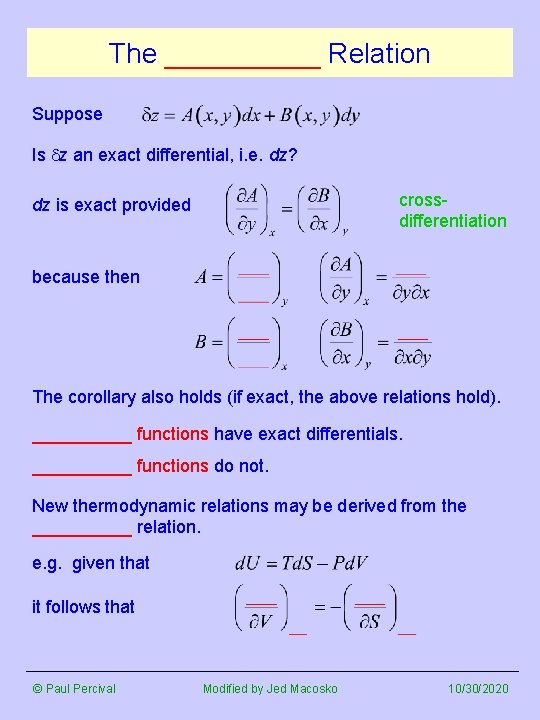
The _____ Relation Suppose Is z an exact differential, i. e. dz? crossdifferentiation dz is exact provided because then The corollary also holds (if exact, the above relations hold). _____ functions have exact differentials. _____ functions do not. New thermodynamic relations may be derived from the _____ relation. e. g. given that it follows that © Paul Percival Modified by Jed Macosko 10/30/2020