
Gases Charles Law Charles Law As the temperature
- Slides: 7
Gases Charles’ Law
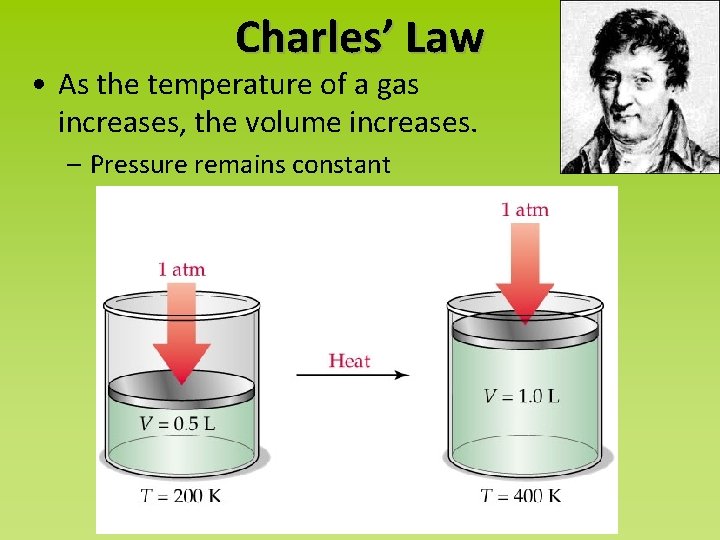
Charles’ Law • As the temperature of a gas increases, the volume increases. – Pressure remains constant
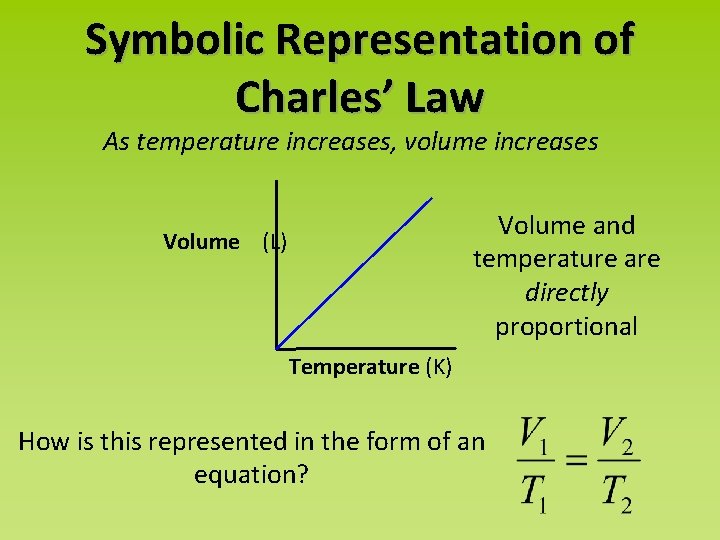
Symbolic Representation of Charles’ Law As temperature increases, volume increases Volume and temperature are directly proportional Volume (L) Temperature (K) How is this represented in the form of an equation?
Measuring Temperature • Fahrenheit (o. F): – based on the freezing and melting point of water • Celsius (o. C): – based on the freezing and melting point of water, but in base 10 • Kelvin (K): – based on the idea that at 0 Kelvin or absolute zero, atoms are NOT in motion
Converting between Celsius and Kelvin Example: K = o. C + 273 The melting point of mercury is -39 o. C. What is this temperature in Kelvin?
Charles’ Law Example #1 A balloon has a volume of 1. 00 L. The temperature of the room where the balloon is located is 273 K. If the room is heated to 300 K, what happens to the volume of the balloon? Step #1: Qualitative Assessment of the Problem Step #2: Quantitative Assessment of the Problem
Charles’ Law Example #2 Exactly 5. 00 L of air at -50. 0 o. C is warmed to 100. 0 o. C. What is the new volume of the air if the pressure remains constant? Step #1: Qualitative Assessment of the Problem Step #2: Quantitative Assessment of the Problem