
Gaseous Phases in Galaxies Uli Klein Univ Bonn
Gaseous Phases in Galaxies Uli Klein Univ. Bonn 1. Introduction 5. Hot gas 2. Atomic gas 6. Heating and cooling 3. Molecular gas 7. Galactic Winds 4. Dust 8. Gas mass and b 1 Cetraro, Giugno 3 - 7, 2002
Guess what and where! 2 Cetraro, Giugno 3 - 7, 2002
. . . G as ph as es 3 . . . in th e. L M C Cetraro, Giugno 3 - 7, 2002
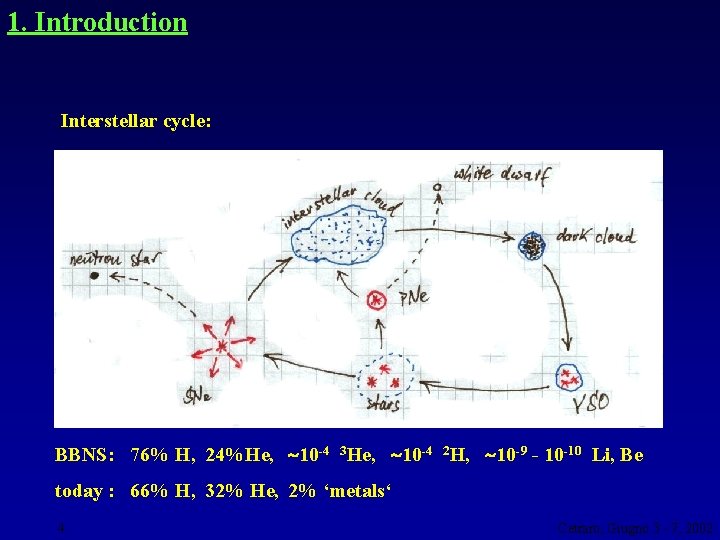
1. Introduction Interstellar cycle: BBNS: 76% H, 24%He, 10 -4 3 He, 10 -4 2 H, 10 -9 - 10 -10 Li, Be today : 66% H, 32% He, 2% ‘metals‘ 4 Cetraro, Giugno 3 - 7, 2002
![Gas phases: Phase n [cm-3] T [K] f. V [%] molecular 102 ··· 105](http://slidetodoc.com/presentation_image_h2/d008c81f2524408286d091ac788ec826/image-5.jpg "Gas phases: Phase n [cm-3] T [K] f. V [%] molecular 102 ··· 105")
Gas phases: Phase n [cm-3] T [K] f. V [%] molecular 102 ··· 105 10 ··· 50 cold neutral 40 ··· 80 50 ··· 200 warm neutral 0. 1 ··· 0. 6 warm ionized ~0. 2 hot ionized 5 10 -3 ··· 10 -2 fm [%] h [pc] Tracer <1 ~20 ~70 CO 2 ··· 4 ~40 ~140 HI (absorpt. ) 5500 ··· 8500 ~30 ~400 HI (emission) ~8000 ~20 ~10 ~900 H radio ~50 ~1 1000 [OVI] X-rays 105 ··· 107 Cetraro, Giugno 3 - 7, 2002

ISM consists of different gas phases, i. e. components with different temperatures and pressures. Most of them are in mutual pressure equilibrium: P =n k T [P] = dyn cm-2 or P/k = n T [P/k] = K cm-3 Molecular clouds and dust do not participate in pressure equilibrium. Molecular clouds are self-gravitating behave like stars Dust has fm 1% and T 20 ··· 30 K Relativistic component: cosmic rays, in pressure equilibrium with the gas, coupled to it via magnetic fields; CRs have fm 10 -6 Average energy density of each component participating in pressure equilibrium: ‹u› = 1. 6 10 -12 erg cm-3 = 1 e. V cm-3 6 Cetraro, Giugno 3 - 7, 2002
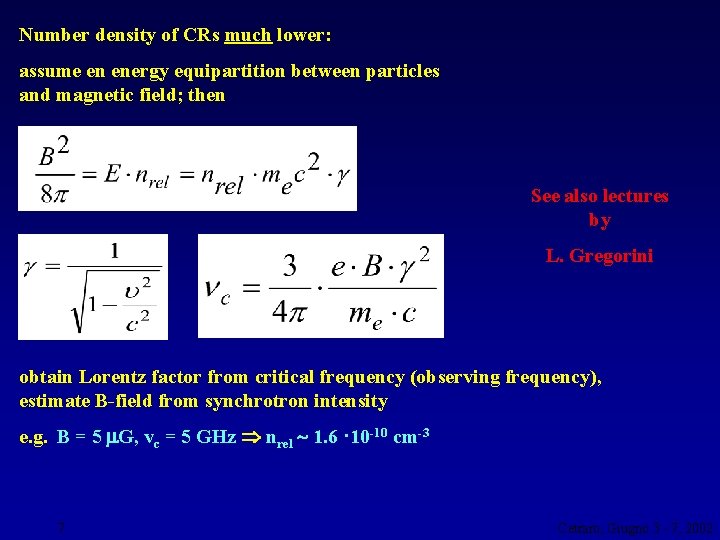
Number density of CRs much lower: assume en energy equipartition between particles and magnetic field; then See also lectures by L. Gregorini obtain Lorentz factor from critical frequency (observing frequency), estimate B-field from synchrotron intensity e. g. B = 5 G, vc = 5 GHz nrel 1. 6 · 10 -10 cm-3 7 Cetraro, Giugno 3 - 7, 2002
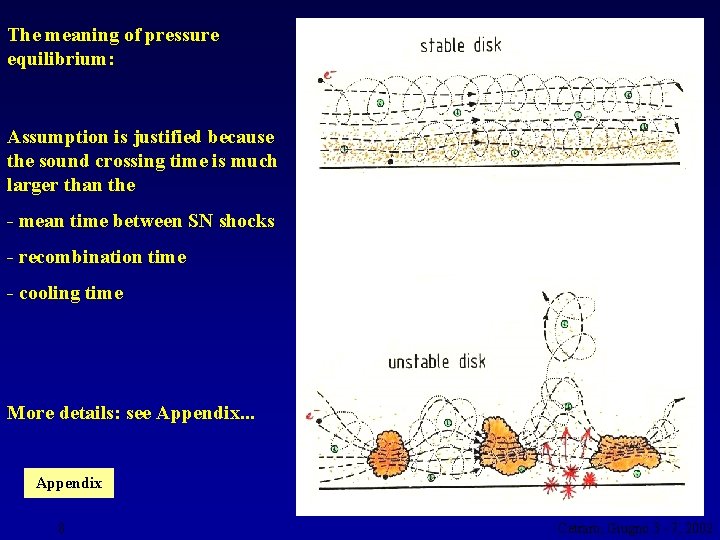
The meaning of pressure equilibrium: Assumption is justified because the sound crossing time is much larger than the - mean time between SN shocks - recombination time - cooling time More details: see Appendix. . . Appendix 8 Cetraro, Giugno 3 - 7, 2002
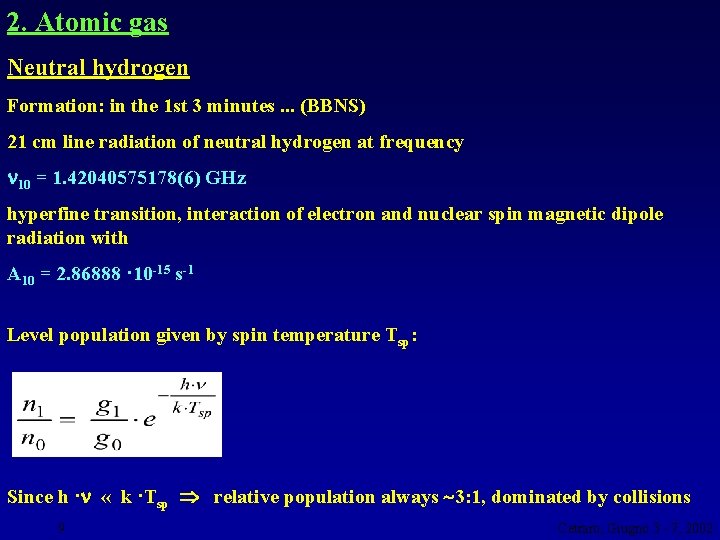
2. Atomic gas Neutral hydrogen Formation: in the 1 st 3 minutes. . . (BBNS) 21 cm line radiation of neutral hydrogen at frequency 10 = 1. 42040575178(6) GHz hyperfine transition, interaction of electron and nuclear spin magnetic dipole radiation with A 10 = 2. 86888 · 10 -15 s-1 Level population given by spin temperature Tsp: Since h · « k ·Tsp relative population always 3: 1, dominated by collisions 9 Cetraro, Giugno 3 - 7, 2002
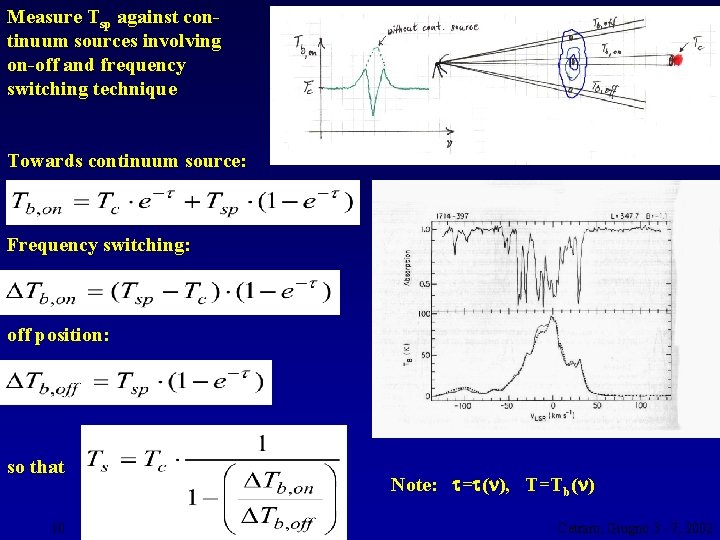
Measure Tsp against continuum sources involving on-off and frequency switching technique Towards continuum source: Frequency switching: off position: so that 10 Note: = ( ), T=Tb( ) Cetraro, Giugno 3 - 7, 2002
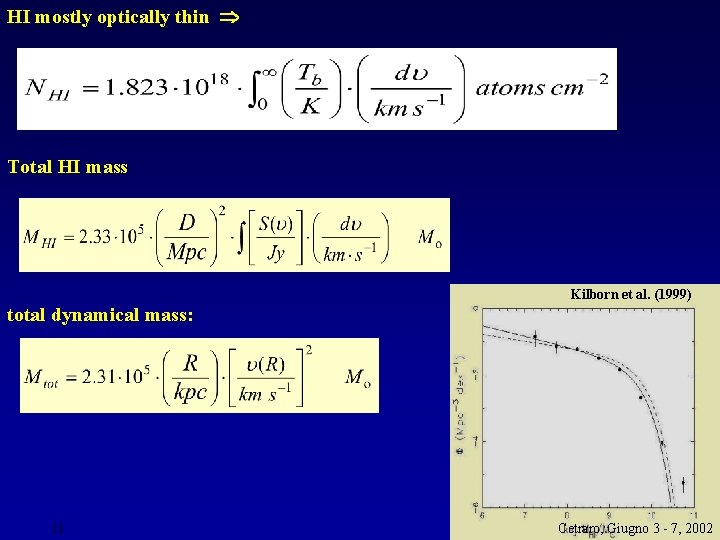
HI mostly optically thin Total HI mass Kilborn et al. (1999) total dynamical mass: 11 Cetraro, Giugno 3 - 7, 2002
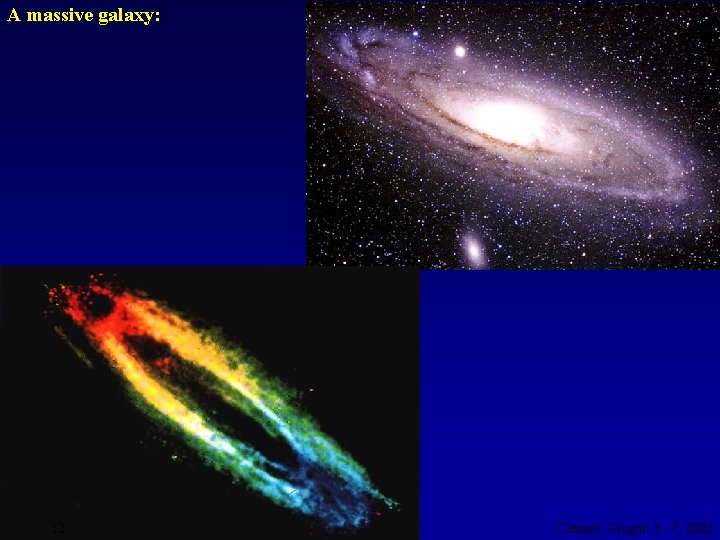
A massive galaxy: 12 Cetraro, Giugno 3 - 7, 2002
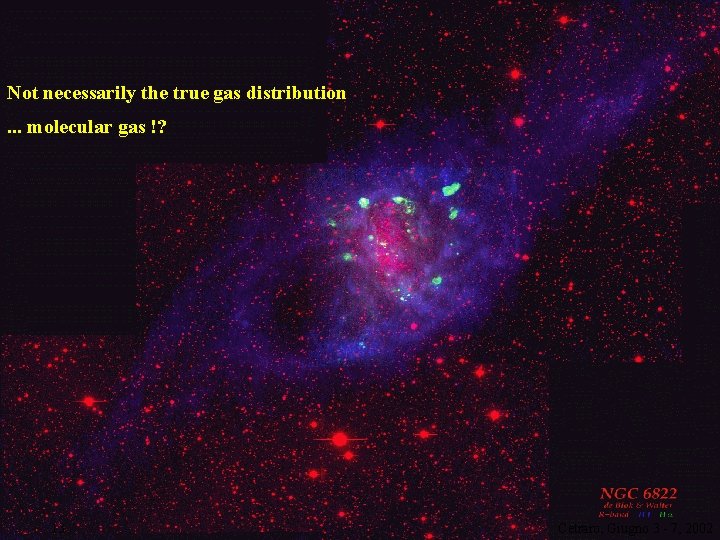
A dwarf galaxy ( 1/100 M 31): Not necessarily the true gas distribution. . . molecular gas !? 13 Cetraro, Giugno 3 - 7, 2002
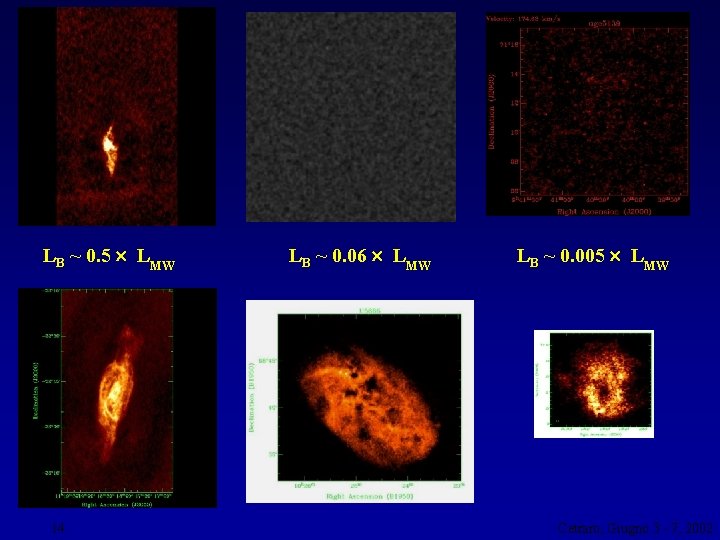
LB ~ 0. 5 LMW 14 LB ~ 0. 06 LMW LB ~ 0. 005 LMW Cetraro, Giugno 3 - 7, 2002
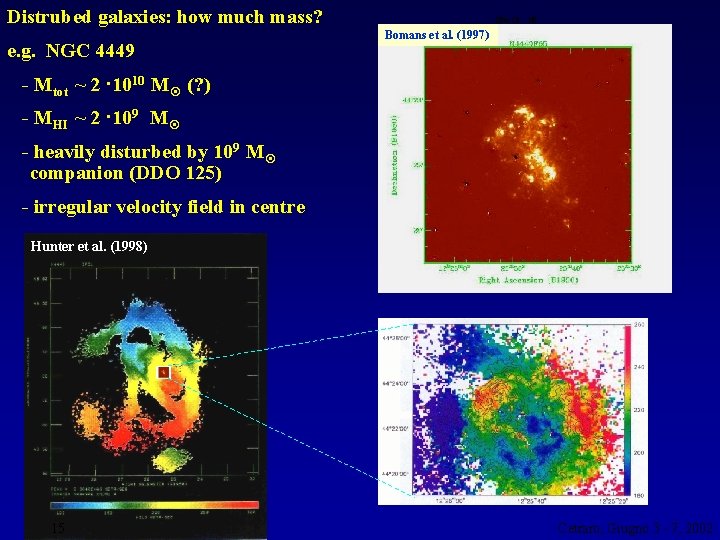
Distrubed galaxies: how much mass? e. g. NGC 4449 IZw 18 HI Bomans et al. (1997) - Mtot ~ 2 · 1010 M (? ) - MHI ~ 2 · 109 M - heavily disturbed by 109 M companion (DDO 125) - irregular velocity field in centre Hunter et al. (1998) 15 Cetraro, Giugno 3 - 7, 2002
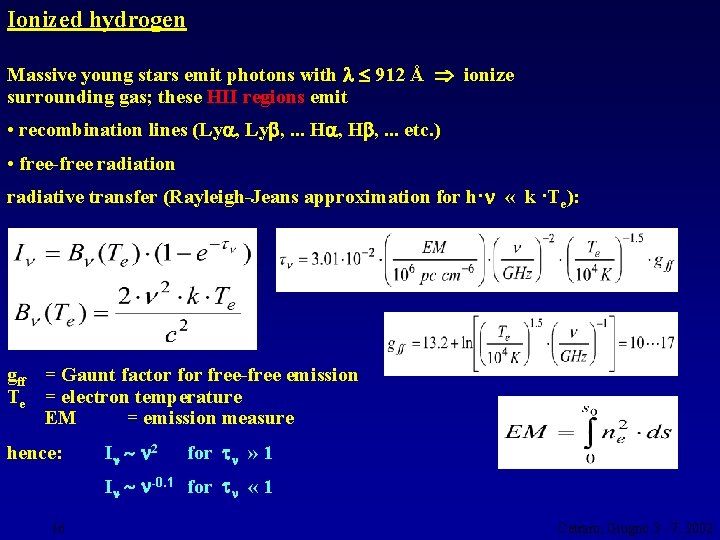
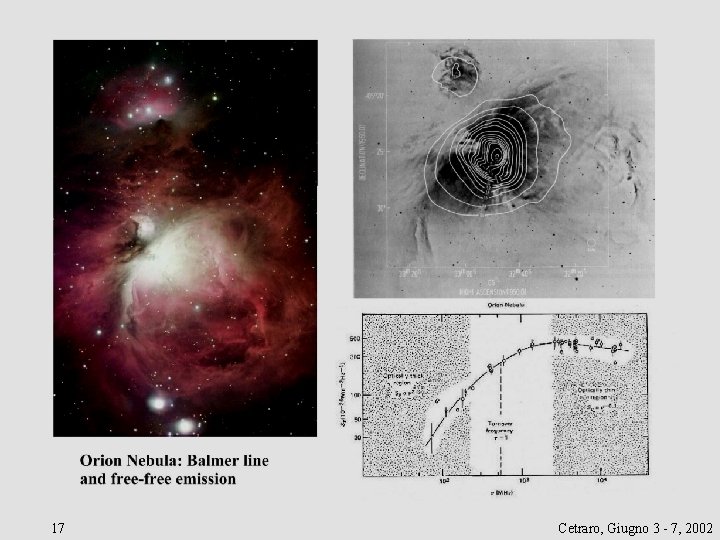
Ionized hydrogen Massive young stars emit photons with 912 Å ionize surrounding gas; these HII regions emit • recombination lines (Ly , . . . H , . . . etc. ) • free-free radiation radiative transfer (Rayleigh-Jeans approximation for h· « k ·Te): gff = Gaunt factor free-free emission Te = electron temperature EM = emission measure hence: I 2 for » 1 I -0. 1 for « 1 16 Cetraro, Giugno 3 - 7, 2002
17 Cetraro, Giugno 3 - 7, 2002
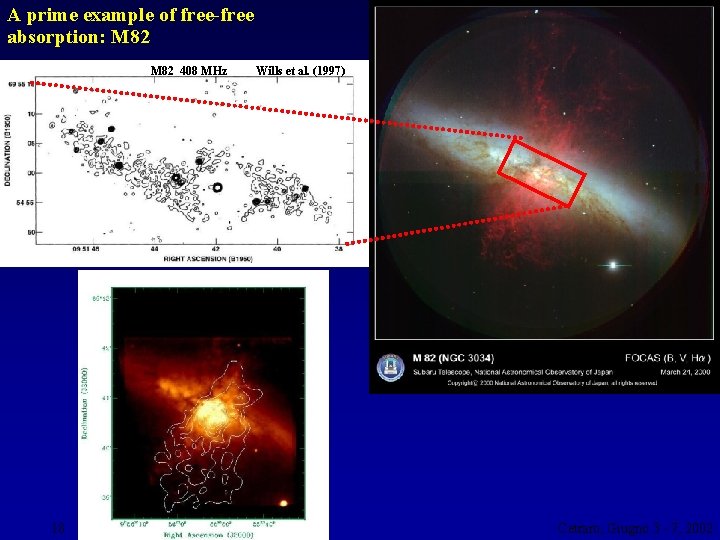
A prime example of free-free absorption: M 82 408 MHz 18 Wills et al. (1997) Cetraro, Giugno 3 - 7, 2002
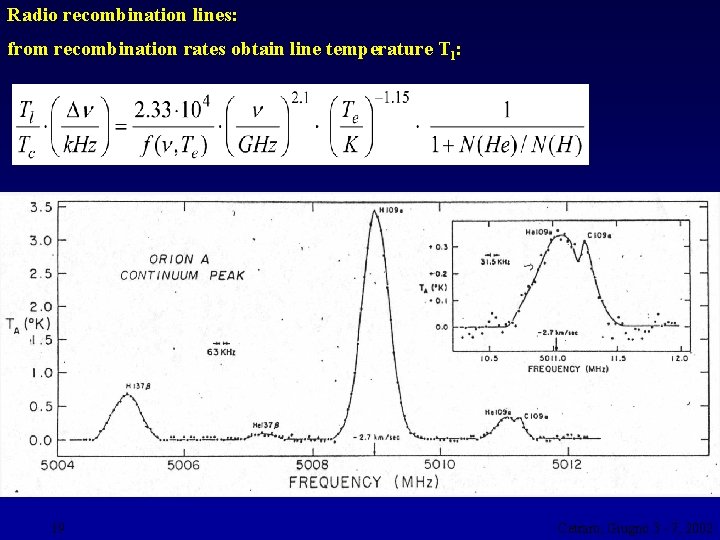
Radio recombination lines: from recombination rates obtain line temperature Tl: 19 Cetraro, Giugno 3 - 7, 2002
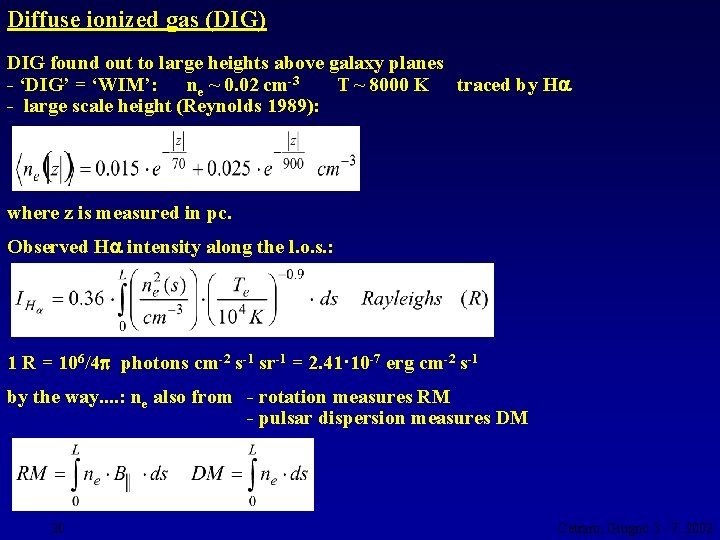
Diffuse ionized gas (DIG) DIG found out to large heights above galaxy planes - ‘DIG’ = ‘WIM’: ne ~ 0. 02 cm-3 T ~ 8000 K traced by H - large scale height (Reynolds 1989): where z is measured in pc. Observed H intensity along the l. o. s. : 1 R = 106/4 photons cm-2 s-1 sr-1 = 2. 41· 10 -7 erg cm-2 s-1 by the way. . : ne also from - rotation measures RM - pulsar dispersion measures DM 20 Cetraro, Giugno 3 - 7, 2002
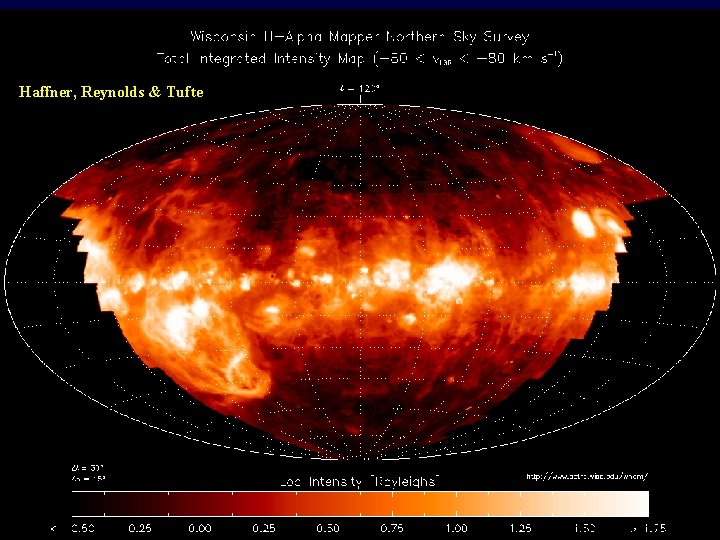
Haffner, Reynolds & Tufte 21 Cetraro, Giugno 3 - 7, 2002
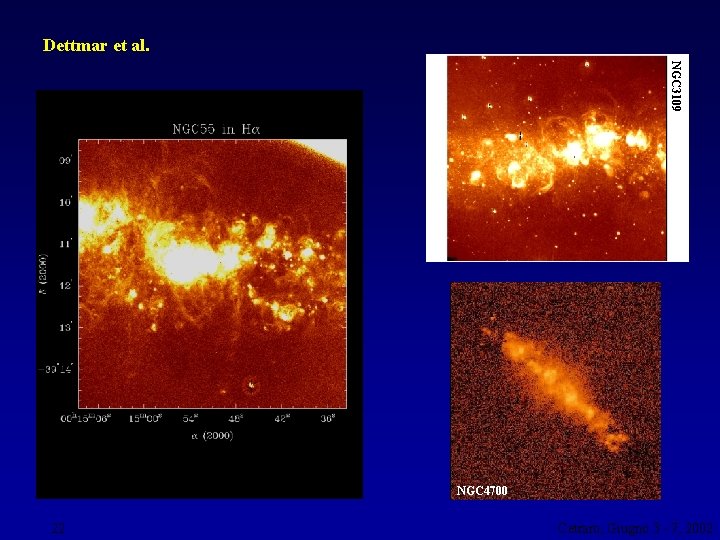
Dettmar et al. NGC 3109 NGC 4700 22 Cetraro, Giugno 3 - 7, 2002
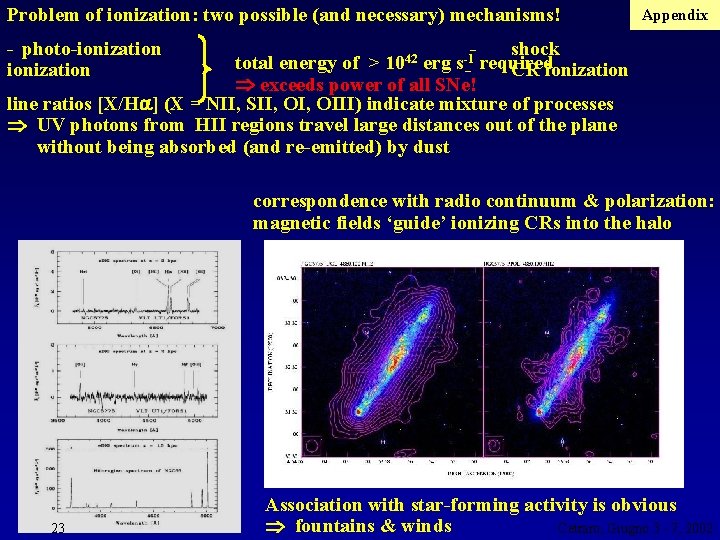
Problem of ionization: two possible (and necessary) mechanisms! - photo-ionization Appendix shock total energy of > erg - required CR ionization exceeds power of all SNe! line ratios [X/H ] (X = NII, SII, OIII) indicate mixture of processes UV photons from HII regions travel large distances out of the plane without being absorbed (and re-emitted) by dust 1042 s-1 correspondence with radio continuum & polarization: magnetic fields ‘guide’ ionizing CRs into the halo 23 Association with star-forming activity is obvious fountains & winds Cetraro, Giugno 3 - 7, 2002
3. Molecular gas Molecular hydrogen Since about 20 years it is known that hydrogen in the ISM consists at least as much of H 2 as of HI! maps of neutral hydrogen at = 21 cm yield an incomplete picture! However: direct measurement of H 2 difficult; symmetric molecule, lacks permanent dipole moment Ground state 1 +: both electrons in lowest orbital Energy spectrum given by - vibration Ev = e (v + ½) - rotation Ev = Bv J(J + 1) - D J 2(J+1)2 Bv = h/(8 · ) e vibration frequency D stretching constant Bv rotation constant 24 moment of inertia Cetraro, Giugno 3 - 7, 2002
Selection rules between radiative and collisional transitions even (para H 2 , J = 0, 2, 4, . . . ) and odd (ortho H 2 , J = 1, 3, 5, . . . ) levels strictly forbidden. Transitions within each species allowed, in particular electric quadrupole transitions within v = 0, obeying J = 28 m, T = 512 K emission only in hot regions (shocks, stellar vicinity) otherwise absorption against (few) bright sources molecular clouds have T 10 ··· 50 K (cold), 80 ··· 100 K (warm) IR emission of H 2 not representative for general ISM? 25 Cetraro, Giugno 3 - 7, 2002
Significance of H 2: • H 2 is the most abundant molecule in the universe • a significant fraction of non-stellar baryonic matter in spiral galaxies is in H 2 • H 2 is an important coolant of diffuse gas from T 104 K down to T 100 K • H 2 cooling influenced structure formation in the early universe • H 2 infrared emission traces warm gas, collisionally and/or radiatively excited • H 2 promotes all interstellar chemistry H 2 in galaxies: pervasive Tk ~ 10 ··· 30 K n. H 2 1000 cm-3 GMCs Tk ~ 20 K n. H 2 ~ 10 2 cm-3 dark clouds Tk ~ 10 K n. H 2 ~ 10 3 ··· 10 4 cm-3 cores Tk 40 K n. H 2 10 4 cm-3 26 Cetraro, Giugno 3 - 7, 2002
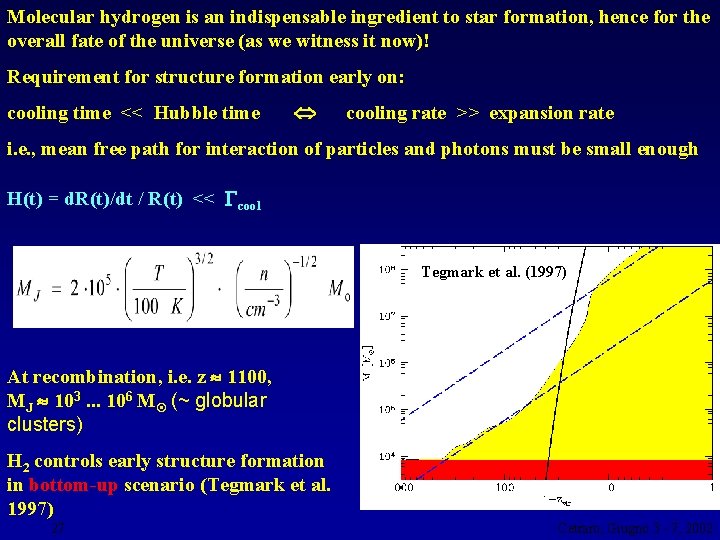
Molecular hydrogen is an indispensable ingredient to star formation, hence for the overall fate of the universe (as we witness it now)! Requirement for structure formation early on: cooling time << Hubble time cooling rate >> expansion rate i. e. , mean free path for interaction of particles and photons must be small enough H(t) = d. R(t)/dt / R(t) << cool Tegmark et al. (1997) At recombination, i. e. z 1100, MJ 103. . . 106 M (~ globular clusters) H 2 controls early structure formation in bottom-up scenario (Tegmark et al. 1997) 27 Cetraro, Giugno 3 - 7, 2002
Formation of molecular hydrogen: Simply by ‘gluing together’ 2 hydrogen atoms? Basically yes, as coll 1010 · (n/cm-3) s clouds with n 10 ··· 100 cm-3 this would imply coll 103 yr However, simple 2 -atom collisions cannot form H 2, since the formation energy (4. 5 e. V in the ground state) must be expelled. Emission of photon not possible, since the only repulsive state with energy close to zero, the 3 + state, is not radiatively connected to the 1 + state; this would require a change of electronic spin! How, then, dows it work? 28 Cetraro, Giugno 3 - 7, 2002
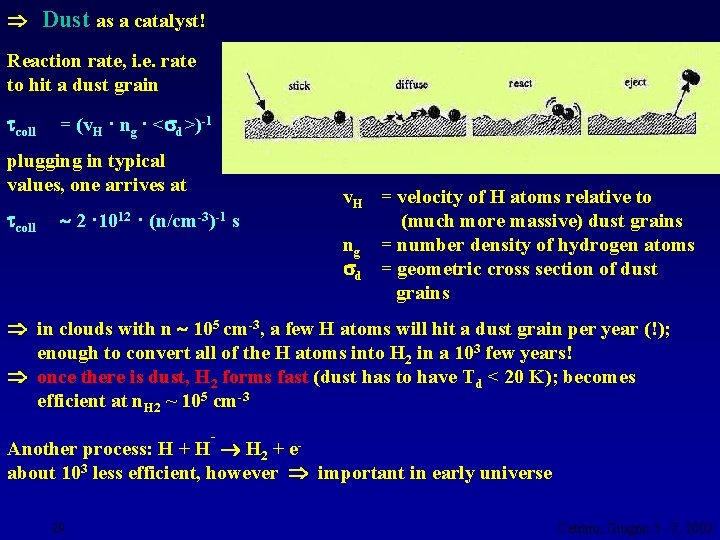
Dust as a catalyst! Reaction rate, i. e. rate to hit a dust grain coll = (v. H · ng · < d>)-1 plugging in typical values, one arrives at coll 2 · 1012 · (n/cm-3)-1 s v. H = velocity of H atoms relative to (much more massive) dust grains ng = number density of hydrogen atoms d = geometric cross section of dust grains in clouds with n 105 cm-3, a few H atoms will hit a dust grain per year (!); enough to convert all of the H atoms into H 2 in a 103 few years! once there is dust, H 2 forms fast (dust has to have Td < 20 K); becomes efficient at n. H 2 ~ 105 cm-3 - Another process: H + H H 2 + eabout 103 less efficient, however important in early universe 29 Cetraro, Giugno 3 - 7, 2002
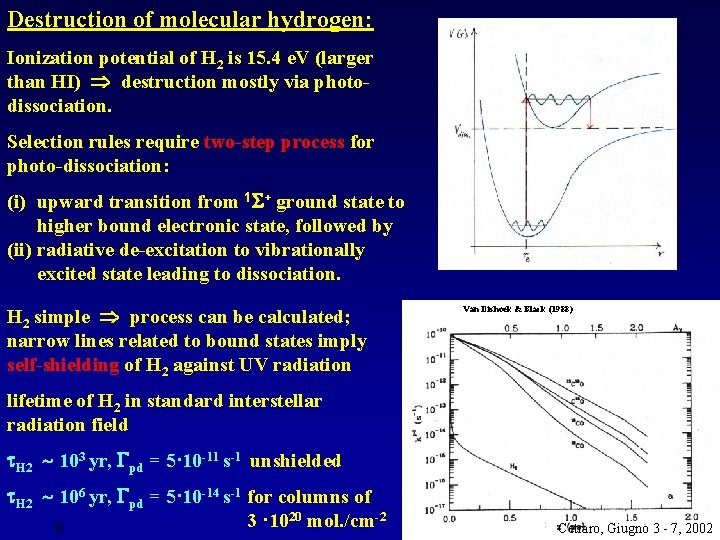
Destruction of molecular hydrogen: Ionization potential of H 2 is 15. 4 e. V (larger than HI) destruction mostly via photodissociation. Selection rules require two-step process for photo-dissociation: (i) upward transition from 1 + ground state to higher bound electronic state, followed by (ii) radiative de-excitation to vibrationally excited state leading to dissociation. H 2 simple process can be calculated; narrow lines related to bound states imply self-shielding of H 2 against UV radiation Van Dishoek & Black (1988) lifetime of H 2 in standard interstellar radiation field H 2 103 yr, pd = 5· 10 -11 s-1 unshielded H 2 106 yr, pd = 5· 10 -14 s-1 for columns of 3 · 1020 mol. /cm-2 30 Cetraro, Giugno 3 - 7, 2002
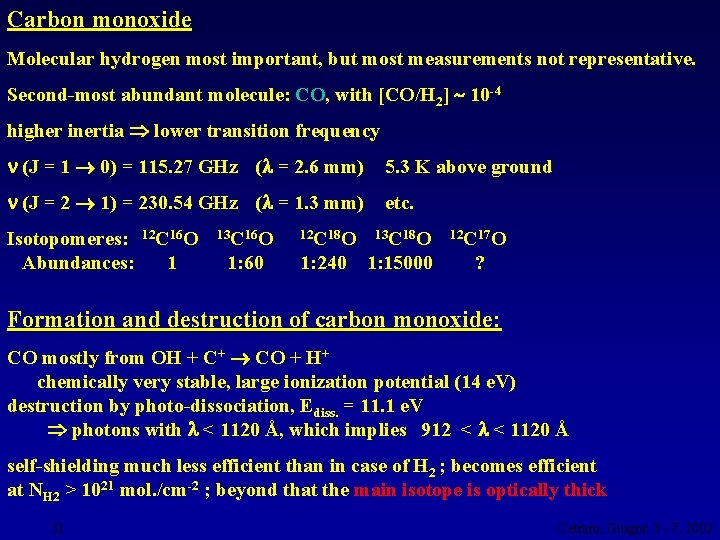
Carbon monoxide Molecular hydrogen most important, but most measurements not representative. Second-most abundant molecule: CO, with [CO/H 2] 10 -4 higher inertia lower transition frequency (J = 1 0) = 115. 27 GHz ( = 2. 6 mm) 5. 3 K above ground (J = 2 1) = 230. 54 GHz ( = 1. 3 mm) etc. Isotopomeres: Abundances: 12 C 16 O 13 C 16 O 1 1: 60 12 C 18 O 1: 240 13 C 18 O 12 C 17 O 1: 15000 ? Formation and destruction of carbon monoxide: CO mostly from OH + C+ CO + H+ chemically very stable, large ionization potential (14 e. V) destruction by photo-dissociation, Ediss. = 11. 1 e. V photons with < 1120 Å, which implies 912 < < 1120 Å self-shielding much less efficient than in case of H 2 ; becomes efficient at NH 2 > 1021 mol. /cm-2 ; beyond that the main isotope is optically thick 31 Cetraro, Giugno 3 - 7, 2002
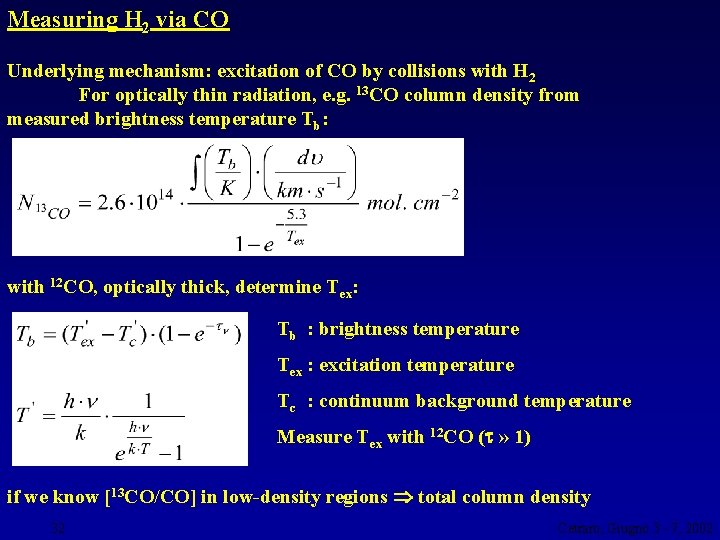
Measuring H 2 via CO Underlying mechanism: excitation of CO by collisions with H 2 For optically thin radiation, e. g. 13 CO column density from measured brightness temperature Tb: with 12 CO, optically thick, determine Tex: Tb : brightness temperature Tex : excitation temperature Tc : continuum background temperature Measure Tex with 12 CO ( » 1) if we know [13 CO/CO] in low-density regions total column density 32 Cetraro, Giugno 3 - 7, 2002
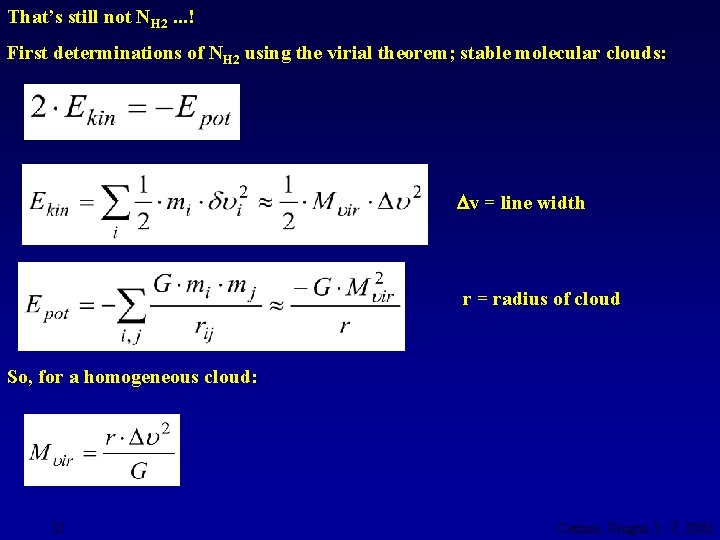
That’s still not NH 2. . . ! First determinations of NH 2 using the virial theorem; stable molecular clouds: v = line width r = radius of cloud So, for a homogeneous cloud: 33 Cetraro, Giugno 3 - 7, 2002
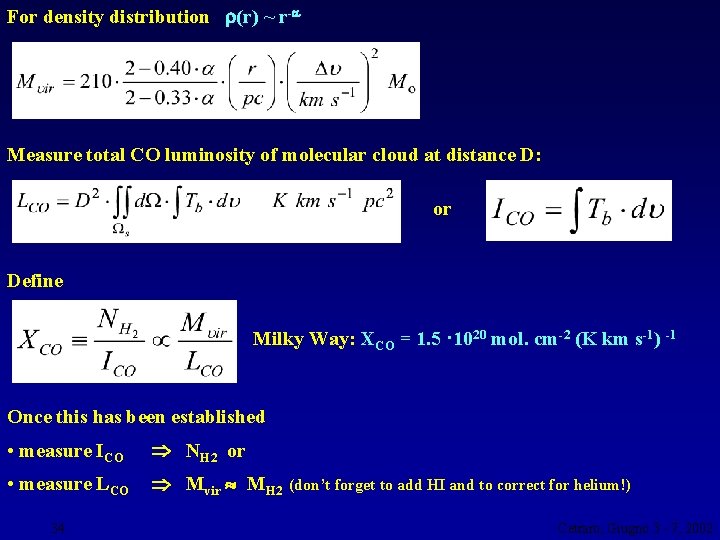
For density distribution (r) ~ r- Measure total CO luminosity of molecular cloud at distance D: or Define Milky Way: XCO = 1. 5 · 1020 mol. cm-2 (K km s-1) -1 Once this has been established • measure ICO NH 2 or • measure LCO Mvir MH 2 34 (don’t forget to add HI and to correct for helium!) Cetraro, Giugno 3 - 7, 2002
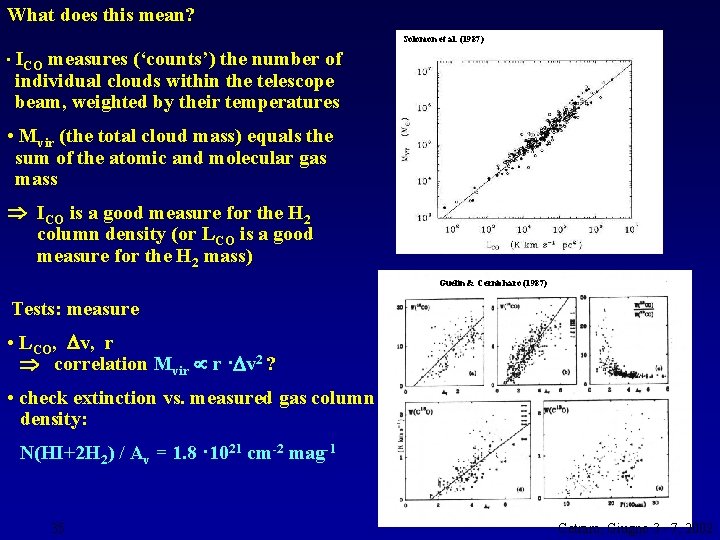
What does this mean? Solomon et al. (1987) • ICO measures (‘counts’) the number of individual clouds within the telescope beam, weighted by their temperatures • Mvir (the total cloud mass) equals the sum of the atomic and molecular gas mass ICO is a good measure for the H 2 column density (or LCO is a good measure for the H 2 mass) Guelin & Cernicharo (1987) Tests: measure • LCO, v, r correlation Mvir r · v 2 ? • check extinction vs. measured gas column density: N(HI+2 H 2) / Av = 1. 8 · 1021 cm-2 mag-1 35 Cetraro, Giugno 3 - 7, 2002
Other methods/checks: Other methods: • FIR & submm emission (Thronson 1986) S ~ NHI + 2 · NH 2 • -rays: interaction of CRs with hydrogen nuclei, subsequent 0 decay (Bloemen et al. 1986) I ~ NHI + 2 · NH 2 ~ NHI + 2 · XCO · ICO inelastic collision of CR protons with hydrogen, roughly 1/3 of resulting pions are neutral, decaying into two -rays with mean energy of 180 Me. V n. H 1 cm-3 36 predicts L 1039 erg s-1, close to what is measured! Cetraro, Giugno 3 - 7, 2002
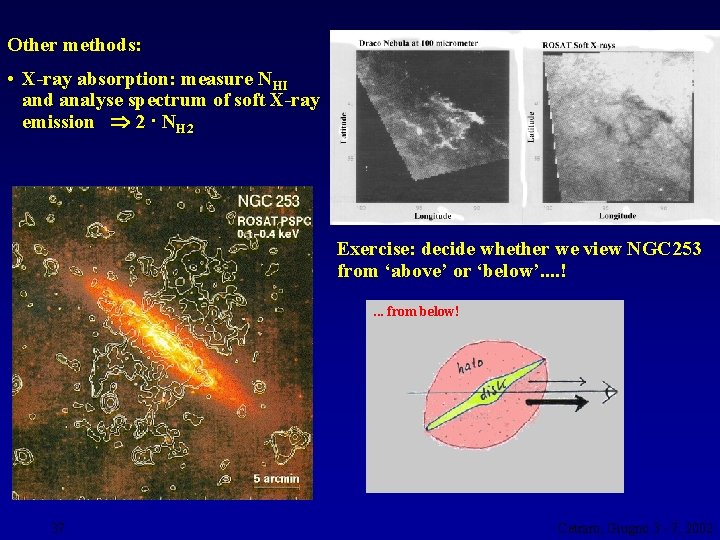
Other methods: • X-ray absorption: measure NHI and analyse spectrum of soft X-ray emission 2 · NH 2 Exercise: decide whether we view NGC 253 from ‘above’ or ‘below’. . !. . . from below! 37 Cetraro, Giugno 3 - 7, 2002
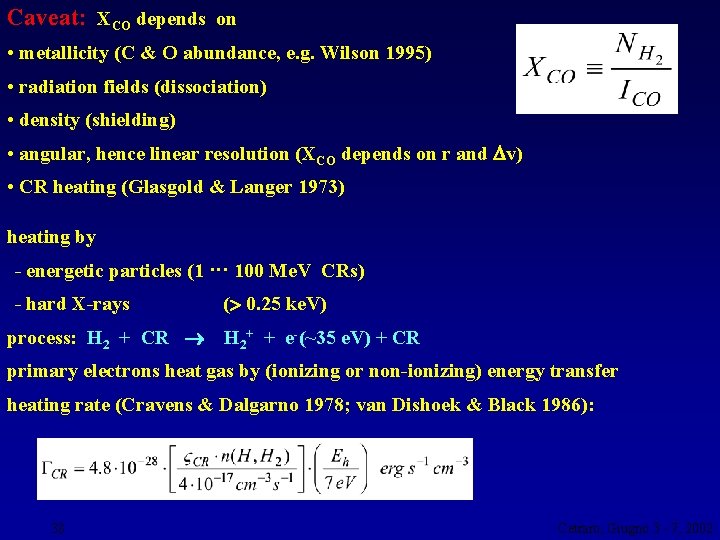
Caveat: XCO depends on • metallicity (C & O abundance, e. g. Wilson 1995) • radiation fields (dissociation) • density (shielding) • angular, hence linear resolution (XCO depends on r and v) • CR heating (Glasgold & Langer 1973) heating by - energetic particles (1 ··· 100 Me. V CRs) - hard X-rays process: H 2 + CR ( 0. 25 ke. V) H 2+ + e-(~35 e. V) + CR primary electrons heat gas by (ionizing or non-ionizing) energy transfer heating rate (Cravens & Dalgarno 1978; van Dishoek & Black 1986): 38 Cetraro, Giugno 3 - 7, 2002
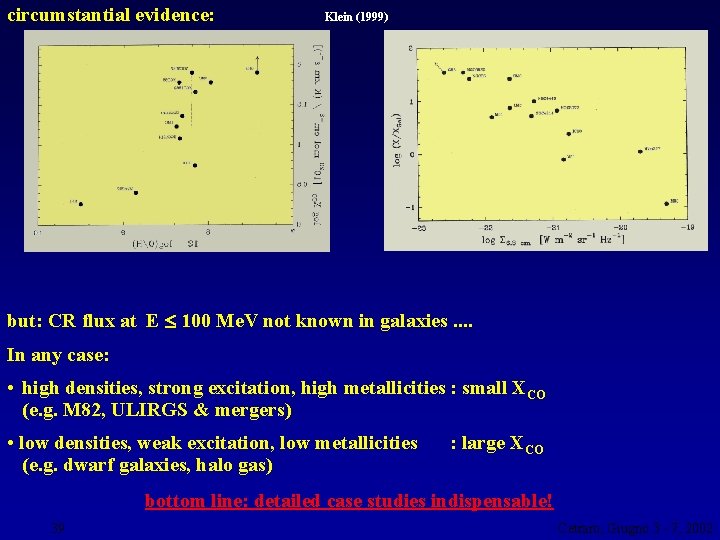
circumstantial evidence: Klein (1999) but: CR flux at E 100 Me. V not known in galaxies. . In any case: • high densities, strong excitation, high metallicities : small XCO (e. g. M 82, ULIRGS & mergers) • low densities, weak excitation, low metallicities (e. g. dwarf galaxies, halo gas) : large XCO bottom line: detailed case studies indispensable! 39 Cetraro, Giugno 3 - 7, 2002
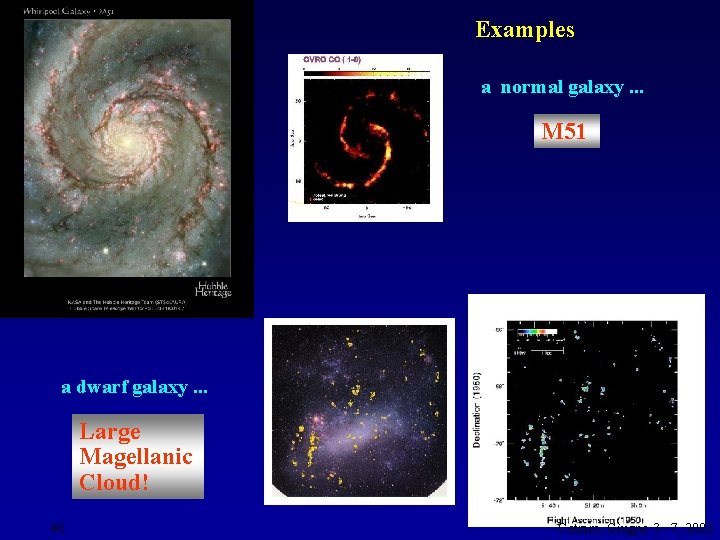
Examples a normal galaxy. . . M 51 a dwarf galaxy. . . Large Magellanic Cloud! 40 Cetraro, Giugno 3 - 7, 2002
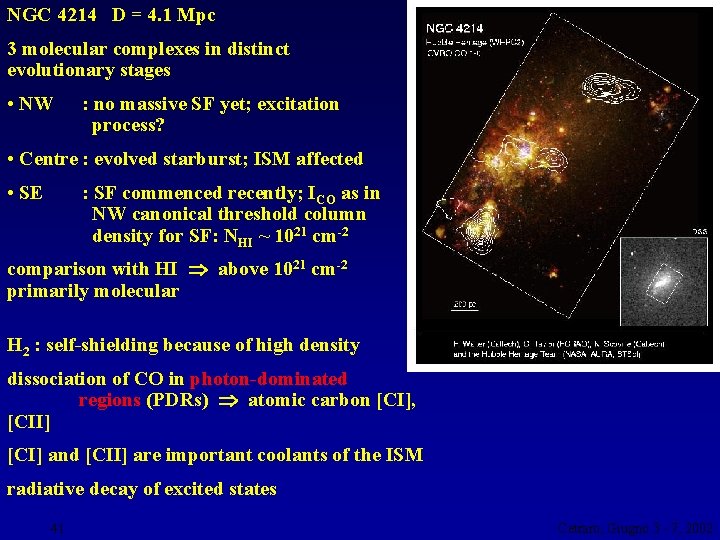
NGC 4214 D = 4. 1 Mpc 3 molecular complexes in distinct evolutionary stages • NW : no massive SF yet; excitation process? • Centre : evolved starburst; ISM affected • SE : SF commenced recently; ICO as in NW canonical threshold column density for SF: NHI ~ 1021 cm-2 comparison with HI above 1021 cm-2 primarily molecular H 2 : self-shielding because of high density dissociation of CO in photon-dominated regions (PDRs) atomic carbon [CI], [CII] [CI] and [CII] are important coolants of the ISM radiative decay of excited states 41 Cetraro, Giugno 3 - 7, 2002
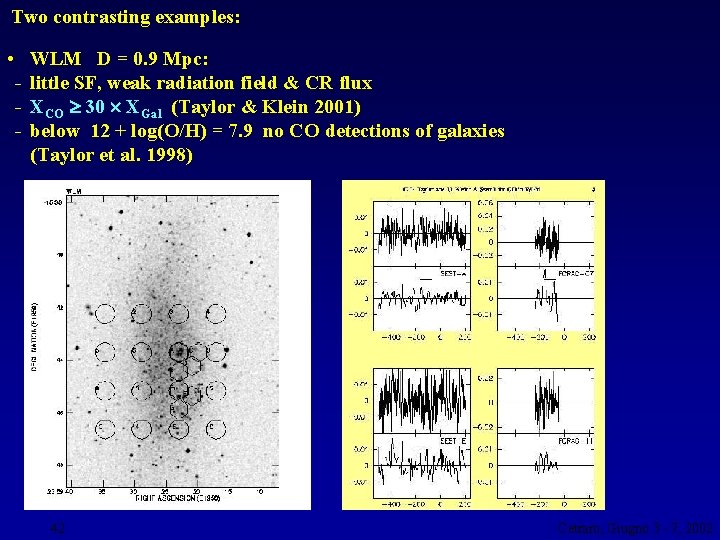
Two contrasting examples: • WLM D = 0. 9 Mpc: - little SF, weak radiation field & CR flux - XCO 30 XGal (Taylor & Klein 2001) - below 12 + log(O/H) = 7. 9 no CO detections of galaxies (Taylor et al. 1998) 42 Cetraro, Giugno 3 - 7, 2002
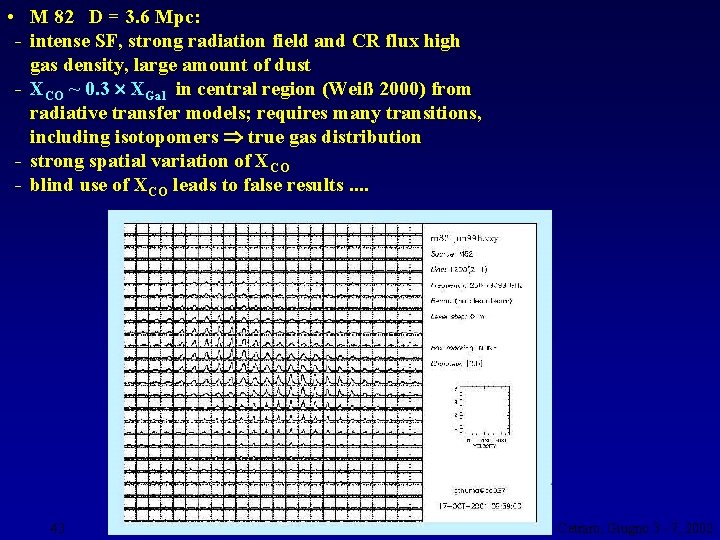
• M 82 D = 3. 6 Mpc: - intense SF, strong radiation field and CR flux high gas density, large amount of dust - XCO ~ 0. 3 XGal in central region (Weiß 2000) from radiative transfer models; requires many transitions, including isotopomers true gas distribution - strong spatial variation of XCO - blind use of XCO leads to false results. . 43 Cetraro, Giugno 3 - 7, 2002
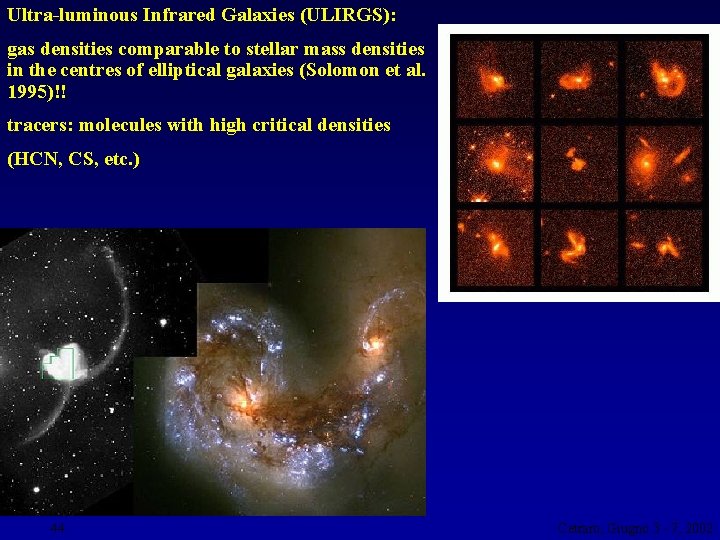
Ultra-luminous Infrared Galaxies (ULIRGS): gas densities comparable to stellar mass densities in the centres of elliptical galaxies (Solomon et al. 1995)!! tracers: molecules with high critical densities (HCN, CS, etc. ) 44 Cetraro, Giugno 3 - 7, 2002
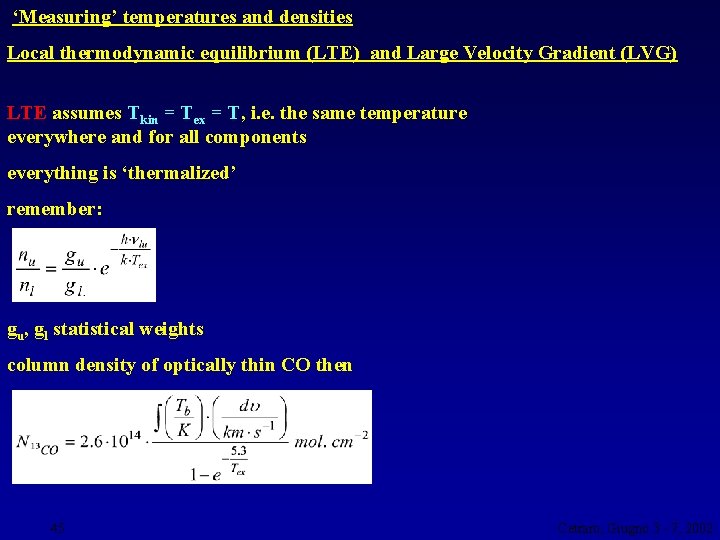
‘Measuring’ temperatures and densities Local thermodynamic equilibrium (LTE) and Large Velocity Gradient (LVG) LTE assumes Tkin = Tex = T, i. e. the same temperature everywhere and for all components everything is ‘thermalized’ remember: gu, gl statistical weights column density of optically thin CO then 45 Cetraro, Giugno 3 - 7, 2002
LVG approach: different molecular species may have different excitation temperatures - assumes that optical thinness is provided by turbulence - rotating clouds, spherical symmetry velocity is a function of distance from centre of a cloud, i. e. V = V 0 · r/r 0 - this avoids ‘line trapping’, i. e. photons emitted by certain molecular species in certain transition gets absorbed by the same species - assuming the turbulence v » natural line width, then the photons emitted somewhere in the cloud can only interact with nearby molecules, reducing the global problem of photon transport to a local one 46 Cetraro, Giugno 3 - 7, 2002
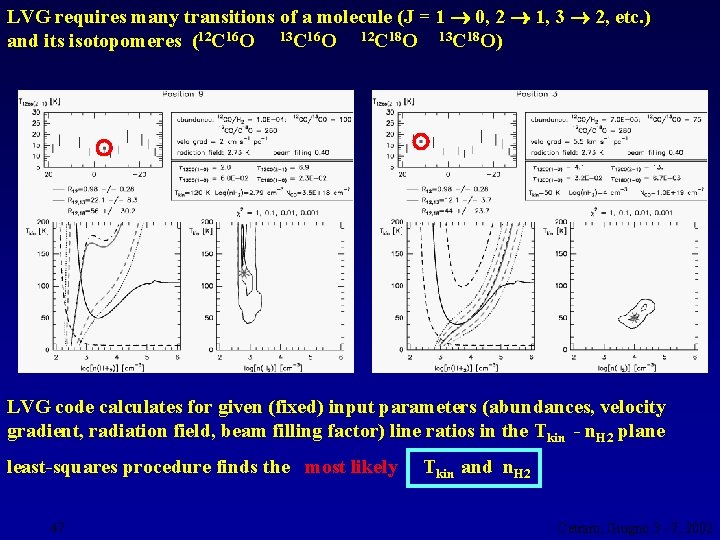
LVG requires many transitions of a molecule (J = 1 0, 2 1, 3 2, etc. ) and its isotopomeres (12 C 16 O 13 C 16 O 12 C 18 O 13 C 18 O) LVG code calculates for given (fixed) input parameters (abundances, velocity gradient, radiation field, beam filling factor) line ratios in the Tkin - n. H 2 plane least-squares procedure finds the most likely 47 Tkin and n. H 2 Cetraro, Giugno 3 - 7, 2002
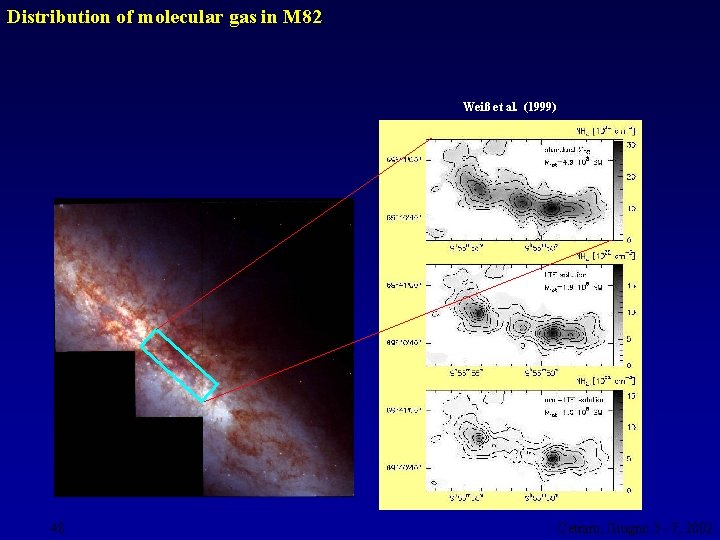
Distribution of molecular gas in M 82 Weiß et al. (1999) 48 Cetraro, Giugno 3 - 7, 2002
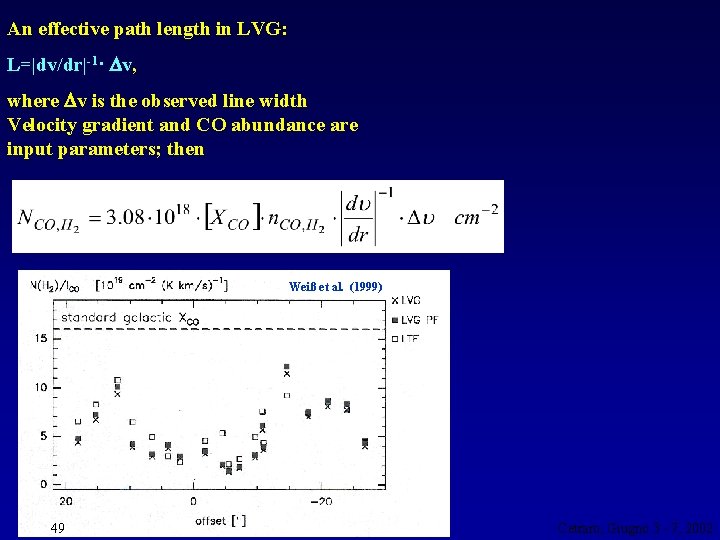
An effective path length in LVG: L=|dv/dr|-1· v, where v is the observed line width Velocity gradient and CO abundance are input parameters; then Weiß et al. (1999) 49 Cetraro, Giugno 3 - 7, 2002
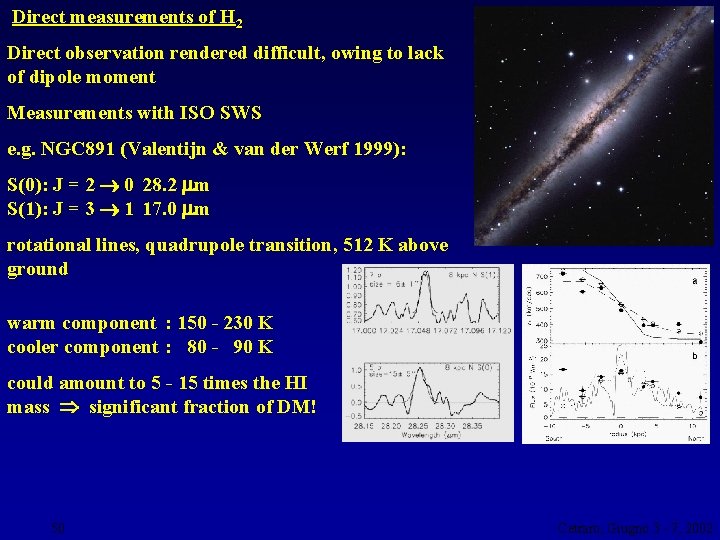
Direct measurements of H 2 Direct observation rendered difficult, owing to lack of dipole moment Measurements with ISO SWS e. g. NGC 891 (Valentijn & van der Werf 1999): S(0): J = 2 0 28. 2 m S(1): J = 3 1 17. 0 m rotational lines, quadrupole transition, 512 K above ground warm component : 150 - 230 K cooler component : 80 - 90 K could amount to 5 - 15 times the HI mass significant fraction of DM! 50 Cetraro, Giugno 3 - 7, 2002
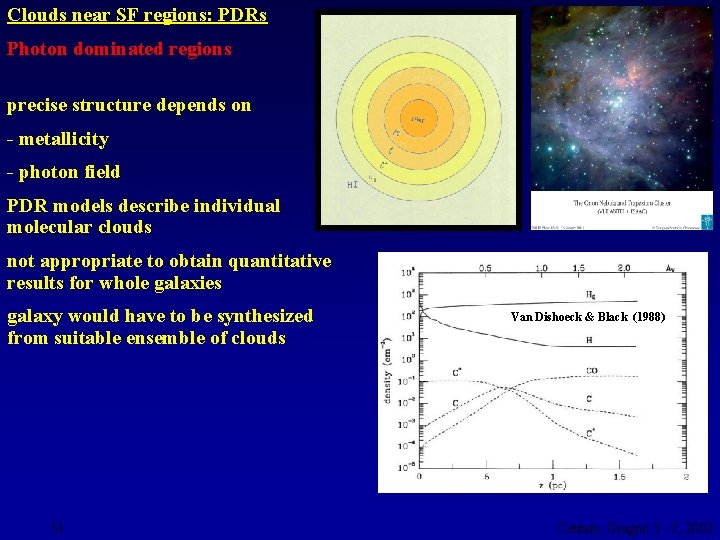
Clouds near SF regions: PDRs Photon dominated regions precise structure depends on - metallicity - photon field PDR models describe individual molecular clouds not appropriate to obtain quantitative results for whole galaxies galaxy would have to be synthesized from suitable ensemble of clouds 51 Van Dishoeck & Black (1988) Cetraro, Giugno 3 - 7, 2002
![[CI], [CII] lines are tracers of dissociation of CO [CII] line very important to](http://slidetodoc.com/presentation_image_h2/d008c81f2524408286d091ac788ec826/image-52.jpg "[CI], [CII] lines are tracers of dissociation of CO [CII] line very important to")
[CI], [CII] lines are tracers of dissociation of CO [CII] line very important to study distant galaxies: - high radiation fields - quasi independent of metallicity Transition [CI] 3 P 3 P 1 2 3 P 0 3 P 1 [CII] 2 P 1/2 [OI] 3 P 2 2 P 3/2 3 P 1 3 P 63 1 J= 1 0 CO 52 [ m ] [GHz] Tcool [K] ncrit [cm-3] Layer 610 371 492 809 24 39 3· 103 surface 158 1899 92 3· 103 surface 185 4757 1620 228 98 115 > 5. 3 2600 > 105 3· 103 3 P 2 intermed. core Cetraro, Giugno 3 - 7, 2002
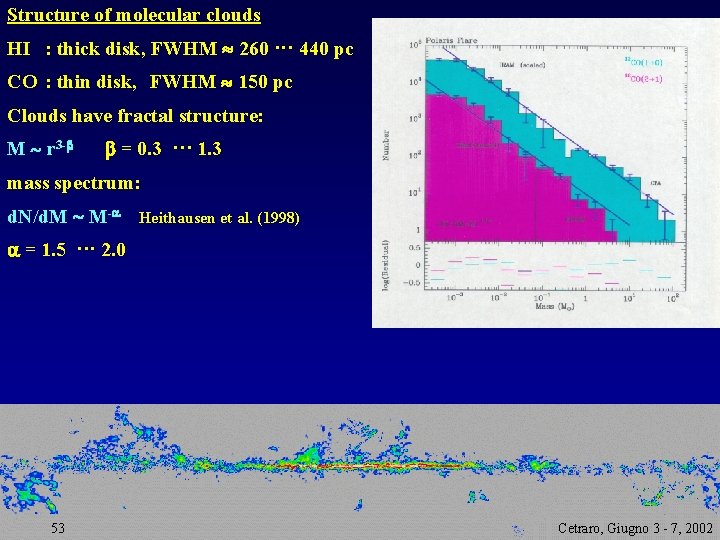
Structure of molecular clouds HI : thick disk, FWHM 260 ··· 440 pc CO : thin disk, FWHM 150 pc Clouds have fractal structure: M r 3 - = 0. 3 ··· 1. 3 mass spectrum: d. N/d. M M- Heithausen et al. (1998) = 1. 5 ··· 2. 0 53 Cetraro, Giugno 3 - 7, 2002
4. Dust has cardinal importance for the evolution of the ISM • catalyst in formation of H 2 • fate of molecular gas in star-forming regions regulates strength of radiation field influences star formation Formation: gas shed by red giant stars; gas cools and forms mostly oxygen-rich molecules seed molecules coalesce to dust particles; at high gas densities, material condenses out onto dust particle growth Composition: Graphites : at pressures of 102 ··· 103 dyn cm-2 free carbon (i. e. C, C 2, C 3 etc. ) condenses and grows to unisotropic graphite particles, i. e. Cn, n » 1. Silicates 54 : heat-resistent silicates condense at temperatures below 1600 K, e. g. Ca 2 Si. O 4, Al 2 Si. O 4, Mg 2 Si. O 4 Cetraro, Giugno 3 - 7, 2002
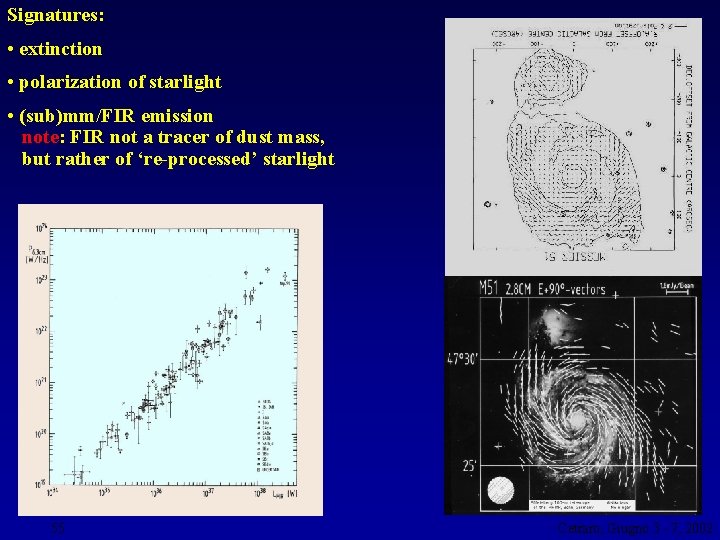
Signatures: • extinction • polarization of starlight • (sub)mm/FIR emission note: FIR not a tracer of dust mass, but rather of ‘re-processed’ starlight 55 Cetraro, Giugno 3 - 7, 2002
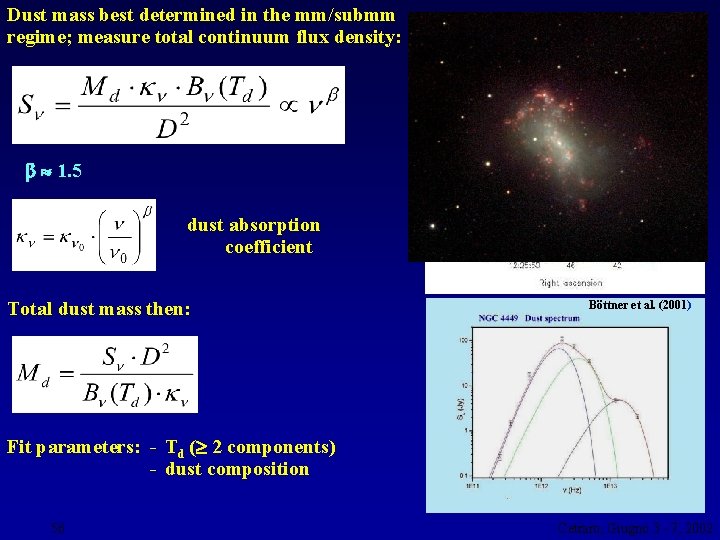
Dust mass best determined in the mm/submm regime; measure total continuum flux density: 1. 5 dust absorption coefficient Total dust mass then: Böttner et al. (2001) Fit parameters: - Td ( 2 components) - dust composition 56 Cetraro, Giugno 3 - 7, 2002
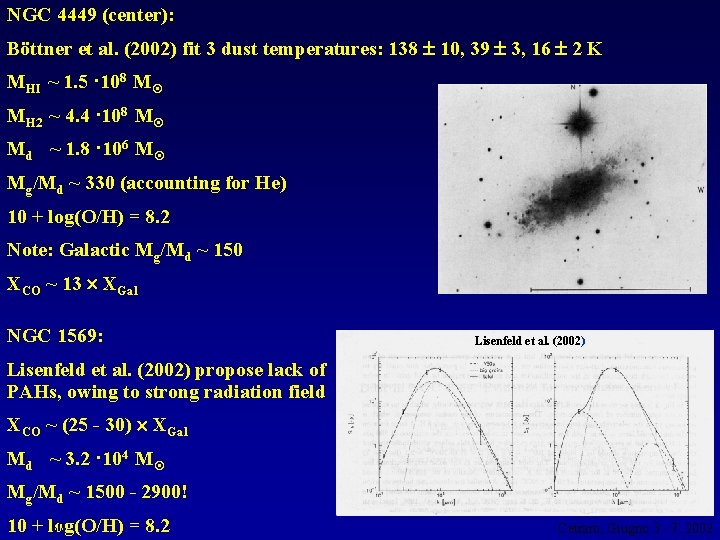
NGC 4449 (center): Böttner et al. (2002) fit 3 dust temperatures: 138 10, 39 3, 16 2 K MHI ~ 1. 5 · 108 M MH 2 ~ 4. 4 · 108 M Md ~ 1. 8 · 106 M Mg/Md ~ 330 (accounting for He) 10 + log(O/H) = 8. 2 Note: Galactic Mg/Md ~ 150 XCO ~ 13 XGal NGC 1569: Lisenfeld et al. (2002) propose lack of PAHs, owing to strong radiation field XCO ~ (25 - 30) XGal Md ~ 3. 2 · 104 M Mg/Md ~ 1500 - 2900! 10 + log(O/H) = 8. 2 57 Cetraro, Giugno 3 - 7, 2002
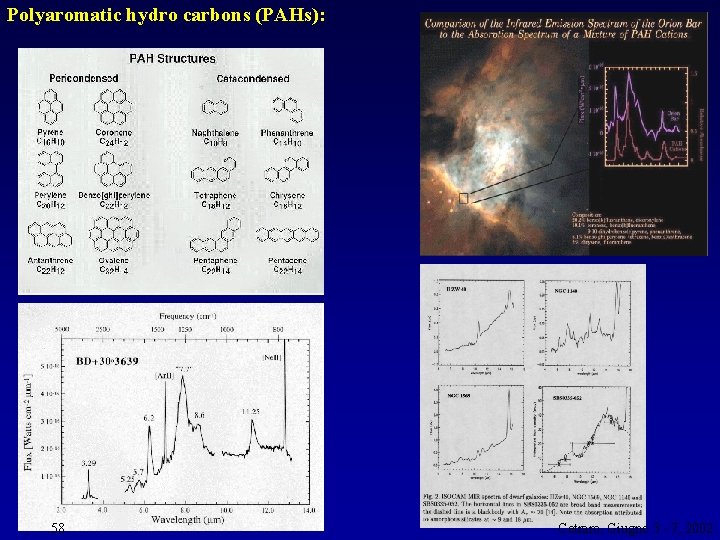
Polyaromatic hydro carbons (PAHs): 58 Cetraro, Giugno 3 - 7, 2002
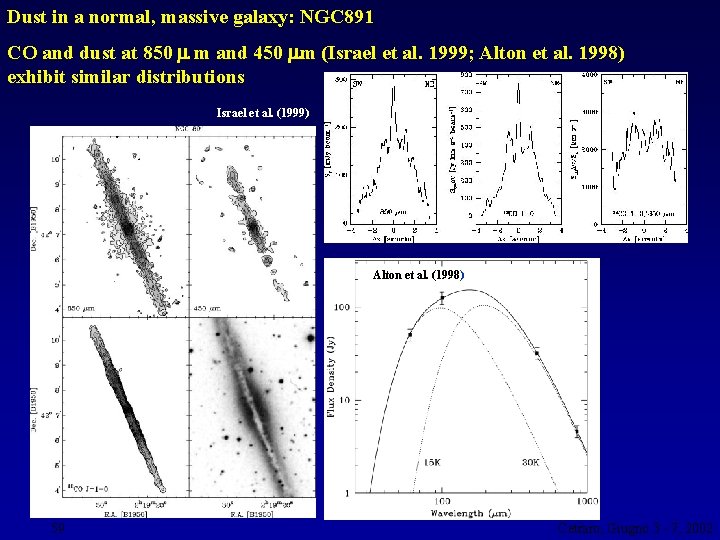
Dust in a normal, massive galaxy: NGC 891 CO and dust at 850 m and 450 m (Israel et al. 1999; Alton et al. 1998) exhibit similar distributions Israel et al. (1999) Alton et al. (1998) 59 Cetraro, Giugno 3 - 7, 2002
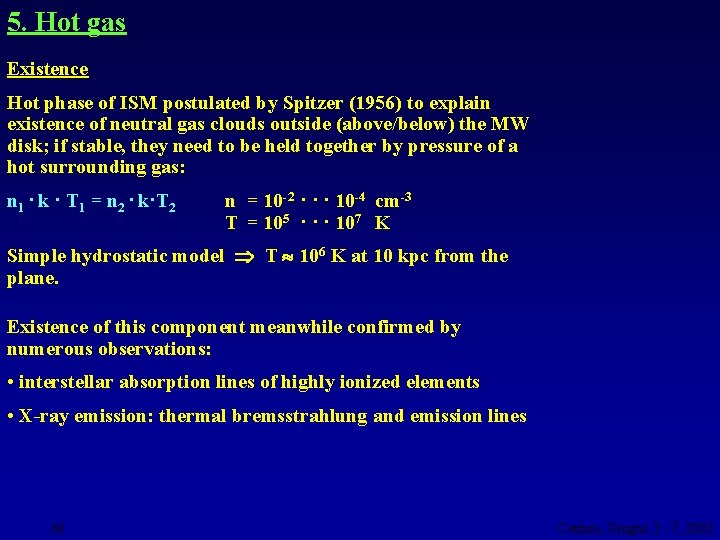
5. Hot gas Existence Hot phase of ISM postulated by Spitzer (1956) to explain existence of neutral gas clouds outside (above/below) the MW disk; if stable, they need to be held together by pressure of a hot surrounding gas: n 1 · k · T 1 = n 2 · k·T 2 n = 10 -2 · · · 10 -4 cm-3 T = 105 · · · 107 K Simple hydrostatic model T 106 K at 10 kpc from the plane. Existence of this component meanwhile confirmed by numerous observations: • interstellar absorption lines of highly ionized elements • X-ray emission: thermal bremsstrahlung and emission lines 60 Cetraro, Giugno 3 - 7, 2002
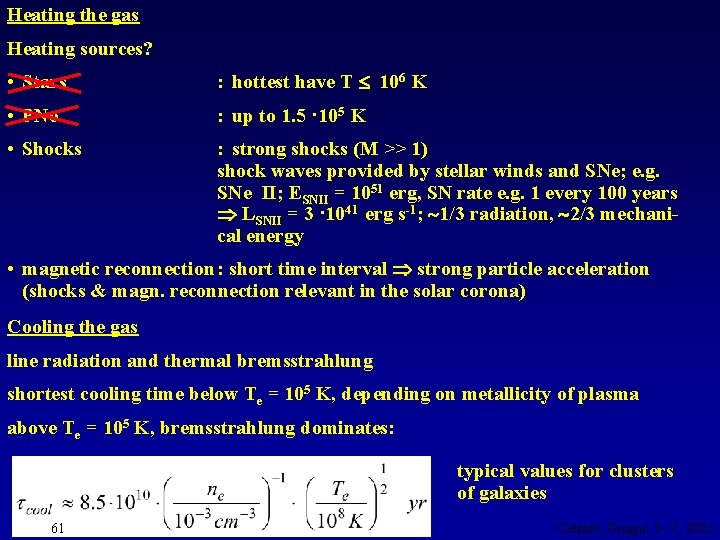
Heating the gas Heating sources? • Stars : hottest have T 106 K • PNe : up to 1. 5 · 105 K • Shocks : strong shocks (M >> 1) shock waves provided by stellar winds and SNe; e. g. SNe II; ESNII = 1051 erg, SN rate e. g. 1 every 100 years LSNII = 3 · 1041 erg s-1; 1/3 radiation, 2/3 mechanical energy • magnetic reconnection : short time interval strong particle acceleration (shocks & magn. reconnection relevant in the solar corona) Cooling the gas line radiation and thermal bremsstrahlung shortest cooling time below Te = 105 K, depending on metallicity of plasma above Te = 105 K, bremsstrahlung dominates: typical values for clusters of galaxies 61 Cetraro, Giugno 3 - 7, 2002
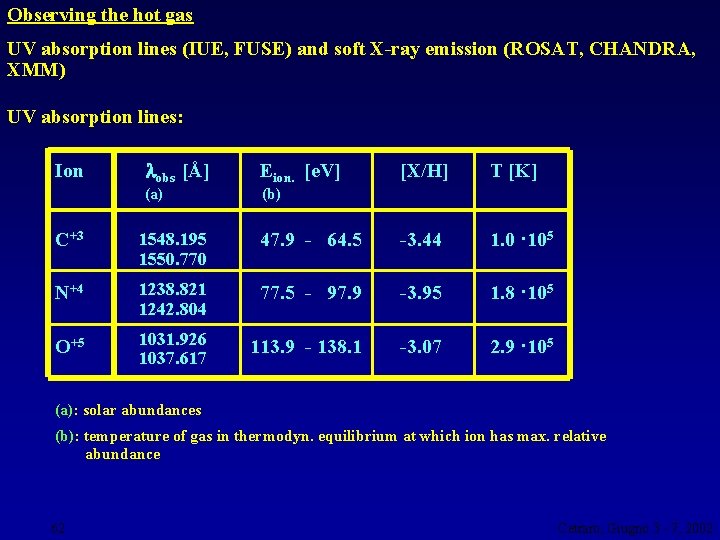
Observing the hot gas UV absorption lines (IUE, FUSE) and soft X-ray emission (ROSAT, CHANDRA, XMM) UV absorption lines: Ion obs [Å] (a) Eion. [e. V] [X/H] T [K] (b) C+3 1548. 195 1550. 770 47. 9 - 64. 5 -3. 44 1. 0 · 105 N+4 1238. 821 1242. 804 77. 5 - 97. 9 -3. 95 1. 8 · 105 O+5 1031. 926 1037. 617 113. 9 - 138. 1 -3. 07 2. 9 · 105 (a): solar abundances (b): temperature of gas in thermodyn. equilibrium at which ion has max. relative abundance 62 Cetraro, Giugno 3 - 7, 2002
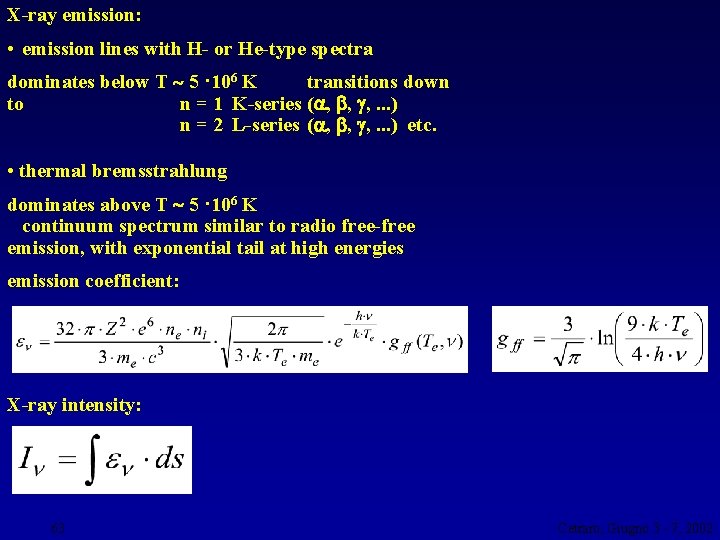
X-ray emission: • emission lines with H- or He-type spectra dominates below T 5 · 106 K transitions down to n = 1 K-series ( , , , . . . ) n = 2 L-series ( , , , . . . ) etc. • thermal bremsstrahlung dominates above T 5 · 106 K continuum spectrum similar to radio free-free emission, with exponential tail at high energies emission coefficient: X-ray intensity: 63 Cetraro, Giugno 3 - 7, 2002
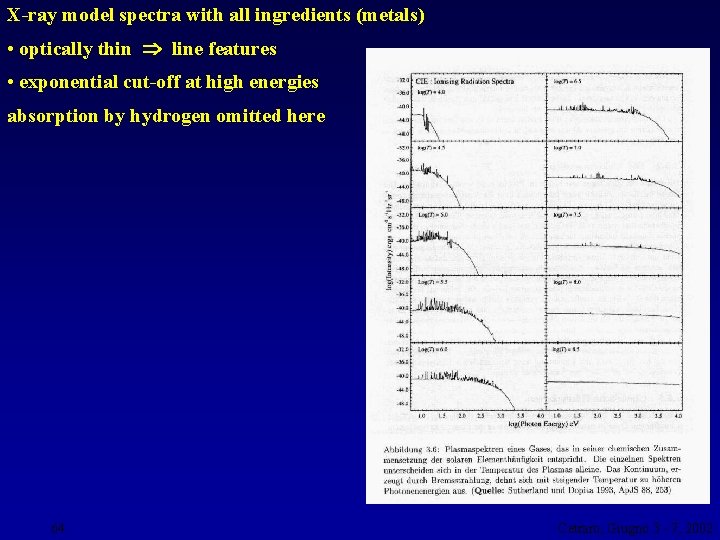
X-ray model spectra with all ingredients (metals) • optically thin line features • exponential cut-off at high energies absorption by hydrogen omitted here 64 Cetraro, Giugno 3 - 7, 2002
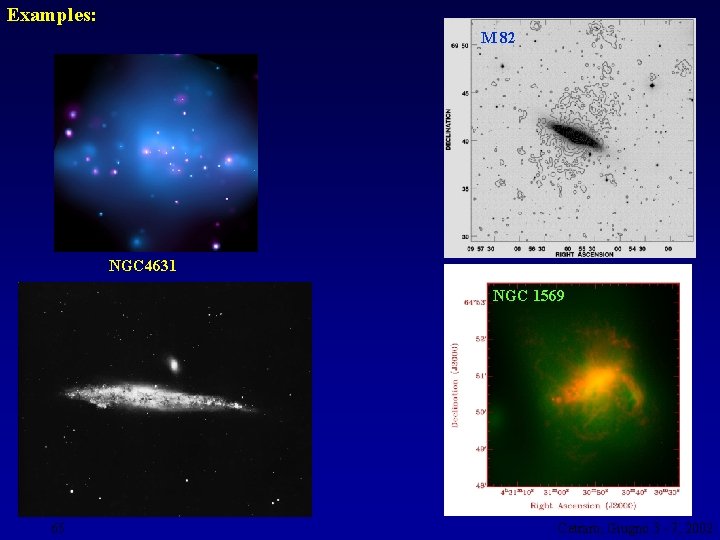
Examples: M 82 NGC 4631 NGC 1569 65 Cetraro, Giugno 3 - 7, 2002
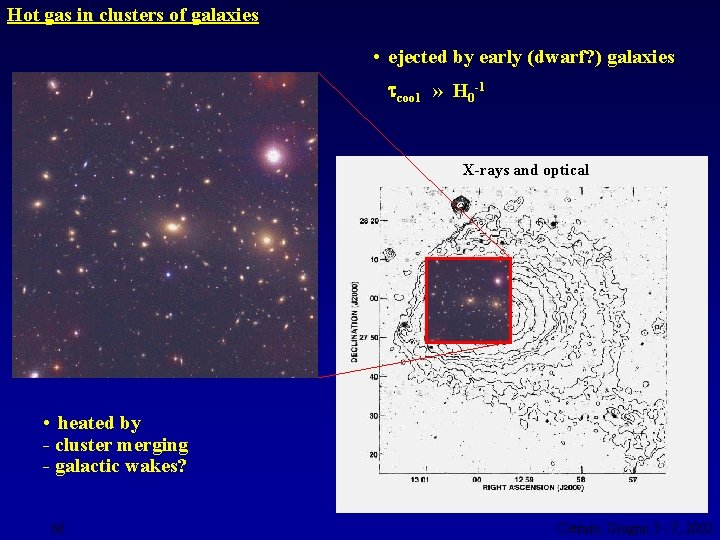
Hot gas in clusters of galaxies • ejected by early (dwarf? ) galaxies cool » H 0 -1 X-rays and optical • heated by - cluster merging - galactic wakes? 66 Cetraro, Giugno 3 - 7, 2002
6. Heating and cooling Here: the neutral atomic phase in galaxies ISM expected in stable disk configuration if all phases cool as quickly as they are being heated if heating rate » cooling rate expansion of gas, blow-out and winds; worth reading: Wolfire et al. (1995) Heating processes: deposit kinetic (thermal) energy in the gas • photo-electric heating of small grains & PAHs; main heating process of diffuse ISM, UV photons absorbed by dust grains dislodge electrons, some make it to the surface and can be ejected; small grains and PAHs have low binding energies; without grains, there would be solely C, N, O, with high binding energies (difficult to heat) • photo-ionization via species with ionization potentials below 13. 6 e. V (mainly CI) h · + X X+ + e- + Ekin • CR heating H + CR(1 - 100 Me. V) H+ + e-(Ekin 35 e. V) + CR • X-rays (similar to CRs) 67 Cetraro, Giugno 3 - 7, 2002
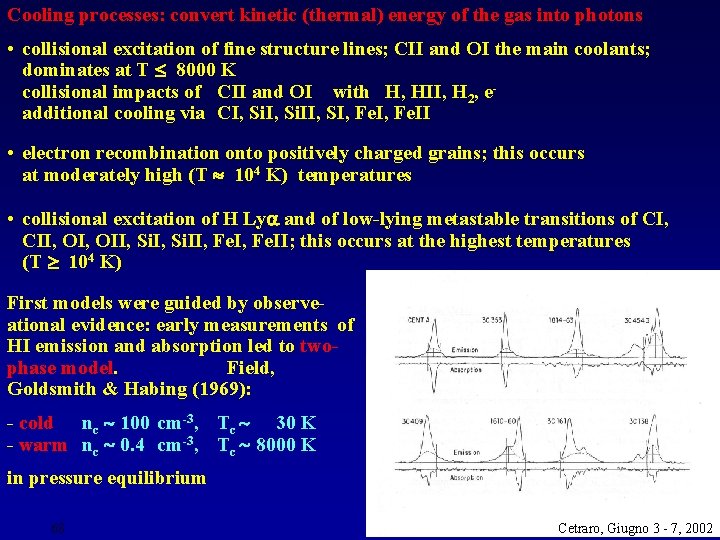
Cooling processes: convert kinetic (thermal) energy of the gas into photons • collisional excitation of fine structure lines; CII and OI the main coolants; dominates at T 8000 K collisional impacts of CII and OI with H, HII, H 2, eadditional cooling via CI, Si. II, SI, Fe. II • electron recombination onto positively charged grains; this occurs at moderately high (T 104 K) temperatures • collisional excitation of H Ly and of low-lying metastable transitions of CI, CII, OII, Si. II, Fe. II; this occurs at the highest temperatures (T 104 K) First models were guided by observeational evidence: early measurements of HI emission and absorption led to twophase model. Field, Goldsmith & Habing (1969): - cold nc 100 cm-3, Tc 30 K - warm nc 0. 4 cm-3, Tc 8000 K in pressure equilibrium 68 Cetraro, Giugno 3 - 7, 2002
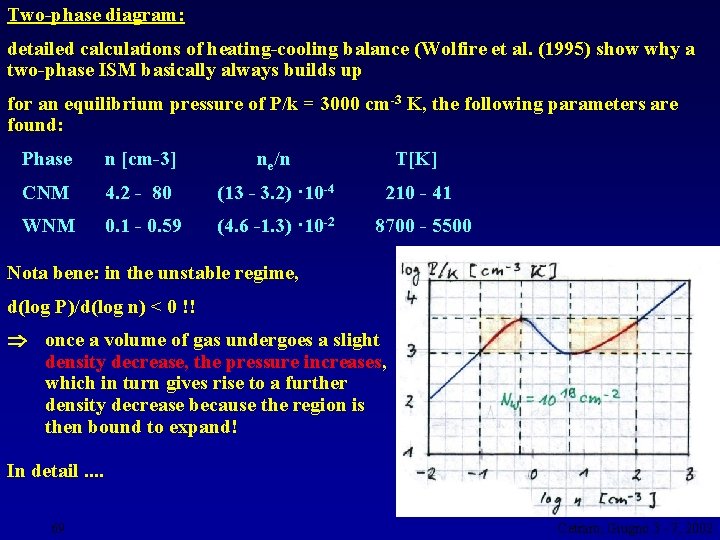
Two-phase diagram: detailed calculations of heating-cooling balance (Wolfire et al. (1995) show why a two-phase ISM basically always builds up for an equilibrium pressure of P/k = 3000 cm-3 K, the following parameters are found: Phase n [cm-3] ne/n T[K] CNM 4. 2 - 80 (13 - 3. 2) · 10 -4 210 - 41 WNM 0. 1 - 0. 59 (4. 6 -1. 3) · 10 -2 8700 - 5500 Nota bene: in the unstable regime, d(log P)/d(log n) < 0 !! once a volume of gas undergoes a slight density decrease, the pressure increases, which in turn gives rise to a further density decrease because the region is then bound to expand! In detail. . 69 Cetraro, Giugno 3 - 7, 2002
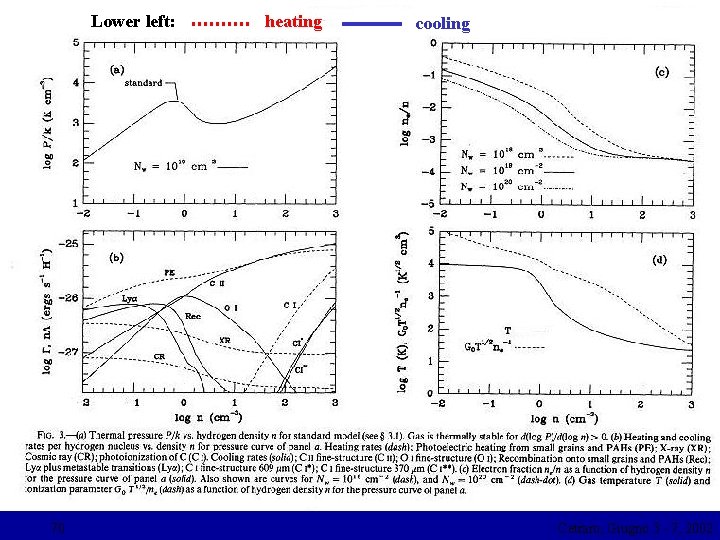
Lower left: 70 heating cooling Cetraro, Giugno 3 - 7, 2002
![Main coolants: Tcool [K]* Fe. VIII 6374 Å 106 OI 5003 Å 2 ·](http://slidetodoc.com/presentation_image_h2/d008c81f2524408286d091ac788ec826/image-71.jpg "Main coolants: Tcool [K]* Fe. VIII 6374 Å 106 OI 5003 Å 2 ·")
Main coolants: Tcool [K]* Fe. VIII 6374 Å 106 OI 5003 Å 2 · 105 ionized CI 610 m 371 m 24 39 neutral “ CII 158 m 92 “ OI 185 m 63 m 98 228 “ “ HI 21 cm 20 “ H 2 28 m 500 Element CO 2. 6 mm > 5. 5 phase hot ionized molecular “ * optimum temperature for coolant to work 71 Cetraro, Giugno 3 - 7, 2002
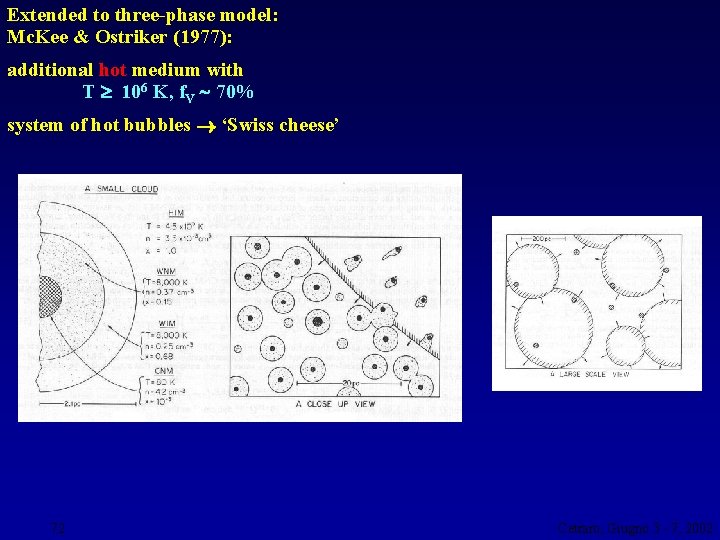
Extended to three-phase model: Mc. Kee & Ostriker (1977): additional hot medium with T 106 K, f. V 70% system of hot bubbles ‘Swiss cheese’ 72 Cetraro, Giugno 3 - 7, 2002
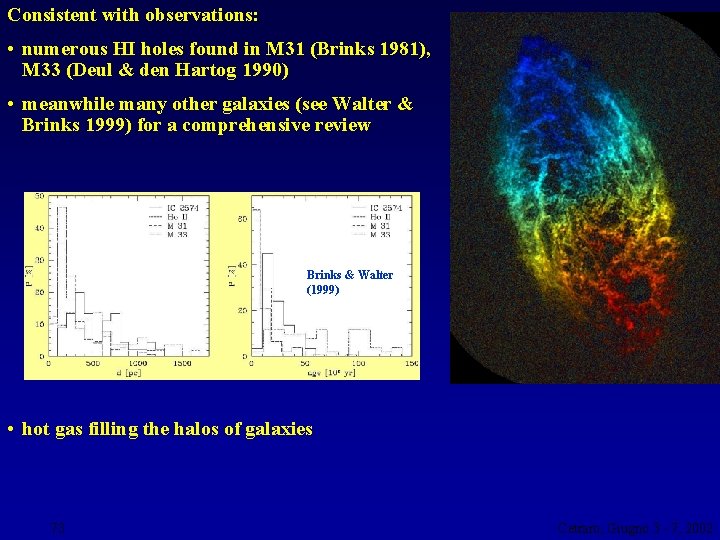
Consistent with observations: • numerous HI holes found in M 31 (Brinks 1981), M 33 (Deul & den Hartog 1990) • meanwhile many other galaxies (see Walter & Brinks 1999) for a comprehensive review Brinks & Walter (1999) • hot gas filling the halos of galaxies 73 Cetraro, Giugno 3 - 7, 2002
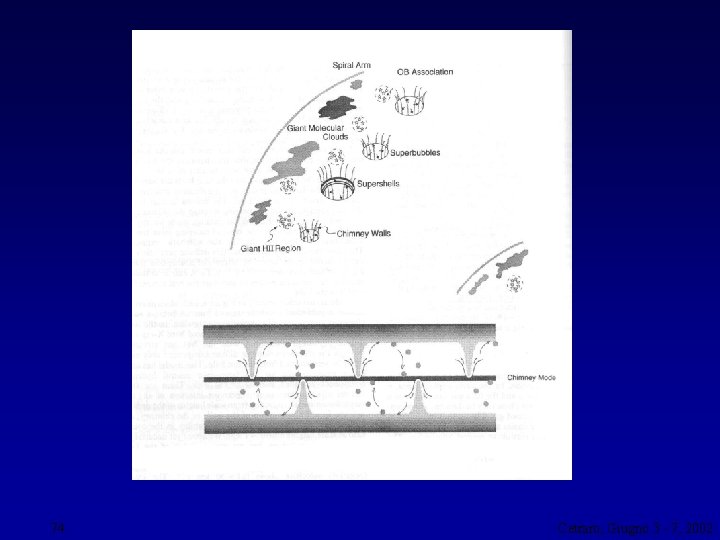
74 Cetraro, Giugno 3 - 7, 2002
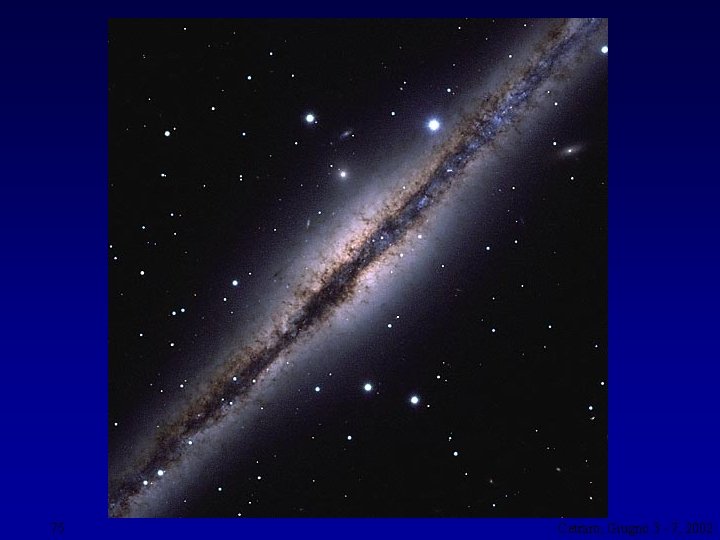
75 Cetraro, Giugno 3 - 7, 2002
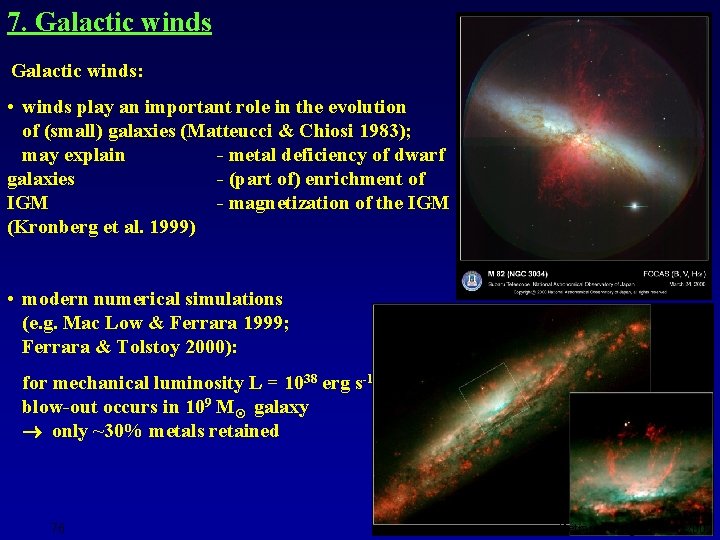
7. Galactic winds: • winds play an important role in the evolution of (small) galaxies (Matteucci & Chiosi 1983); may explain - metal deficiency of dwarf galaxies - (part of) enrichment of IGM - magnetization of the IGM (Kronberg et al. 1999) • modern numerical simulations (e. g. Mac Low & Ferrara 1999; Ferrara & Tolstoy 2000): for mechanical luminosity L = 1038 erg s-1 blow-out occurs in 109 M galaxy only ~30% metals retained 76 Cetraro, Giugno 3 - 7, 2002
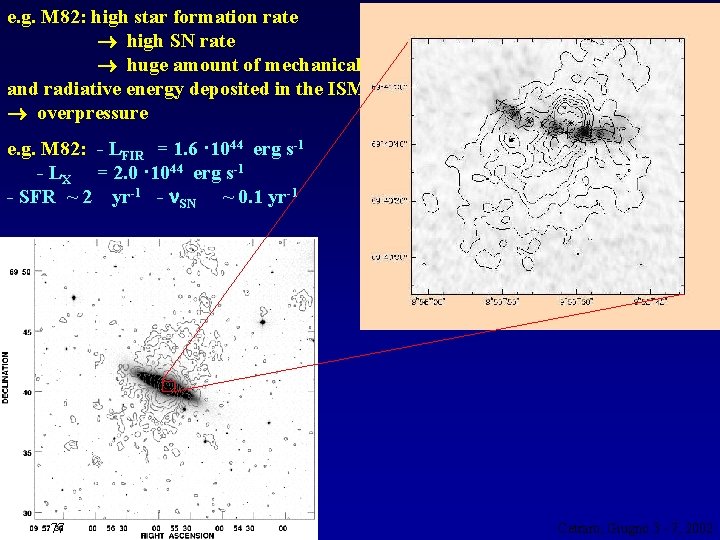
e. g. M 82: high star formation rate high SN rate huge amount of mechanical and radiative energy deposited in the ISM overpressure e. g. M 82: - LFIR = 1. 6 · 1044 erg s-1 - LX = 2. 0 · 1044 erg s-1 - SFR ~ 2 yr-1 - SN ~ 0. 1 yr-1 77 Cetraro, Giugno 3 - 7, 2002
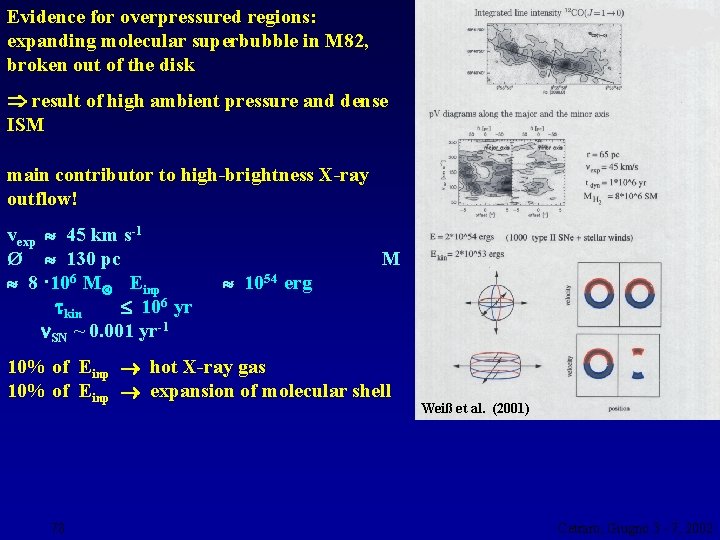
Evidence for overpressured regions: expanding molecular superbubble in M 82, broken out of the disk result of high ambient pressure and dense ISM main contributor to high-brightness X-ray outflow! vexp 45 km s-1 Ø 130 pc 8 · 106 M Einp kin 106 yr SN ~ 0. 001 yr-1 1054 erg M 10% of Einp hot X-ray gas 10% of Einp expansion of molecular shell 78 Weiß et al. (2001) Cetraro, Giugno 3 - 7, 2002
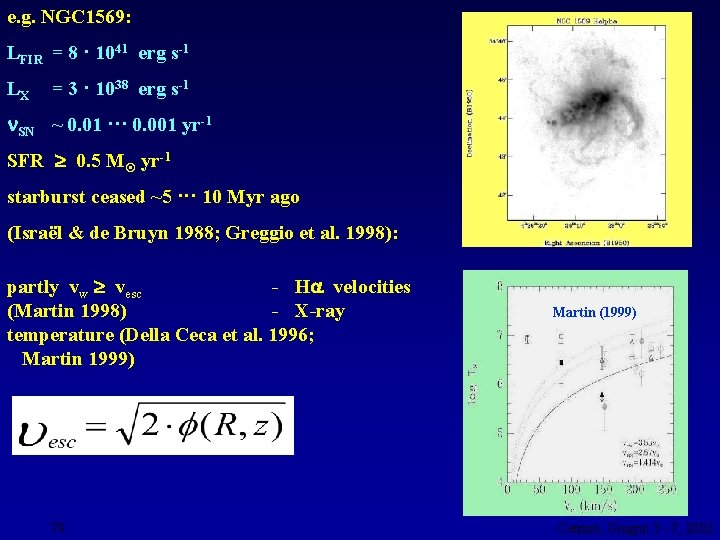
e. g. NGC 1569: LFIR = 8 · 1041 erg s-1 LX = 3 · 1038 erg s-1 SN ~ 0. 01 ··· 0. 001 yr-1 SFR 0. 5 M yr-1 starburst ceased ~5 ··· 10 Myr ago (Israël & de Bruyn 1988; Greggio et al. 1998): partly vw vesc - H velocities (Martin 1998) - X-ray temperature (Della Ceca et al. 1996; Martin 1999) 79 Martin (1999) Cetraro, Giugno 3 - 7, 2002
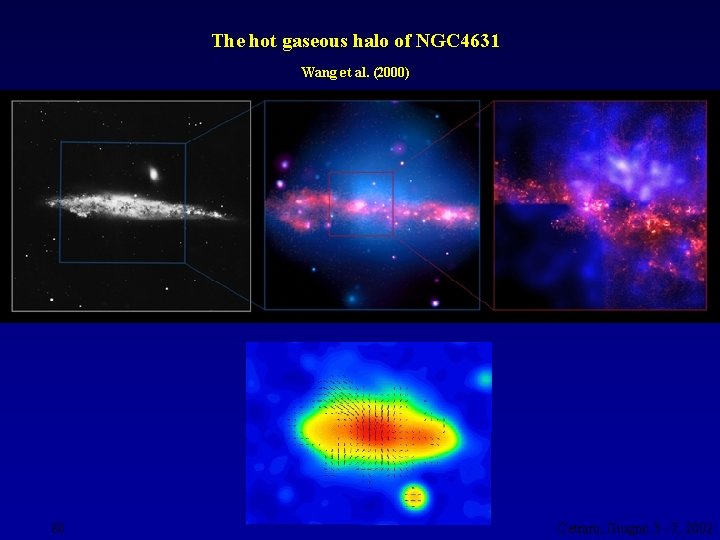
The hot gaseous halo of NGC 4631 Wang et al. (2000) 80 Cetraro, Giugno 3 - 7, 2002
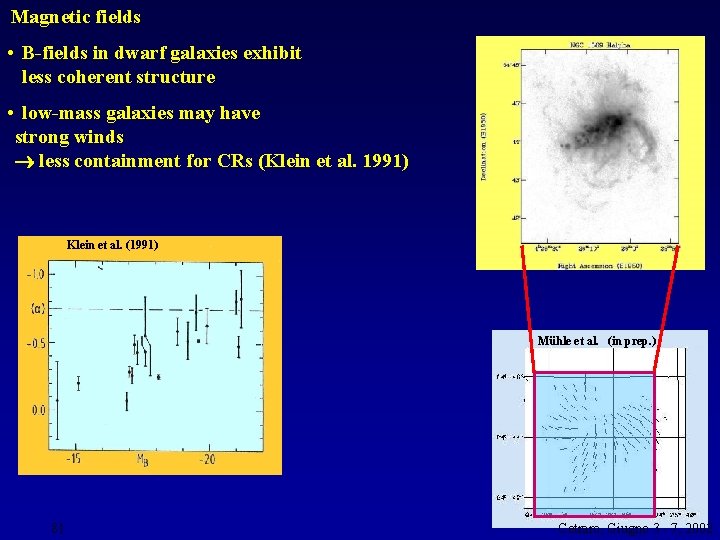
Magnetic fields • B-fields in dwarf galaxies exhibit less coherent structure • low-mass galaxies may have strong winds less containment for CRs (Klein et al. 1991) Klein et al. (1991) Mühle et al. (in prep. ) 81 Cetraro, Giugno 3 - 7, 2002
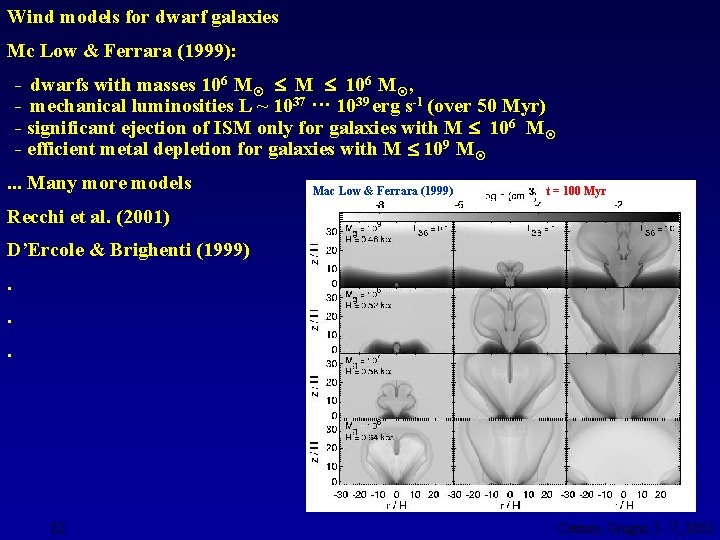
Wind models for dwarf galaxies Mc Low & Ferrara (1999): - dwarfs with masses 106 M M 106 M , - mechanical luminosities L ~ 1037 ··· 1039 erg s-1 (over 50 Myr) - significant ejection of ISM only for galaxies with M 106 M - efficient metal depletion for galaxies with M 109 M . . . Many more models Mac Low & Ferrara (1999) t = 100 Myr Recchi et al. (2001) D’Ercole & Brighenti (1999). . . 82 Cetraro, Giugno 3 - 7, 2002
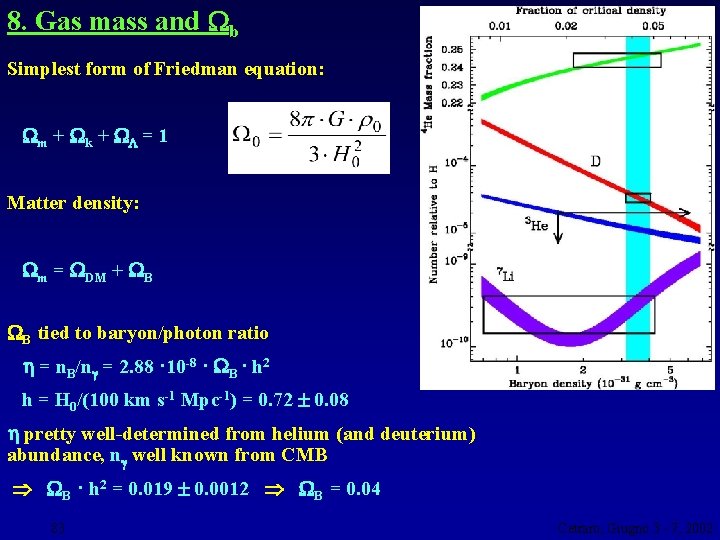
8. Gas mass and b Simplest form of Friedman equation: m + k + = 1 Matter density: m = DM + B B tied to baryon/photon ratio = n. B/n = 2. 88 · 10 -8 · B · h 2 h = H 0/(100 km s-1 Mpc-1) = 0. 72 0. 08 pretty well-determined from helium (and deuterium) abundance, n well known from CMB B · h 2 = 0. 019 0. 0012 B = 0. 04 83 Cetraro, Giugno 3 - 7, 2002
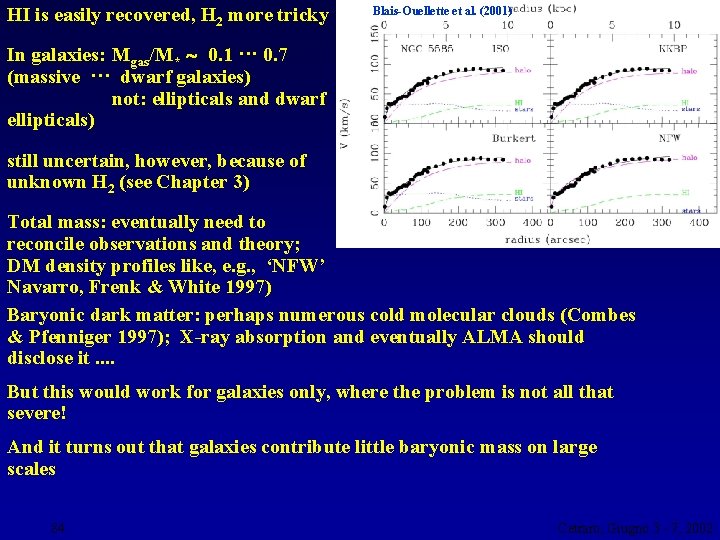
HI is easily recovered, H 2 more tricky Blais-Ouellette et al. (2001) In galaxies: Mgas/M* 0. 1 ··· 0. 7 (massive ··· dwarf galaxies) not: ellipticals and dwarf ellipticals) still uncertain, however, because of unknown H 2 (see Chapter 3) Total mass: eventually need to reconcile observations and theory; DM density profiles like, e. g. , ‘NFW’ Navarro, Frenk & White 1997) Baryonic dark matter: perhaps numerous cold molecular clouds (Combes & Pfenniger 1997); X-ray absorption and eventually ALMA should disclose it. . But this would work for galaxies only, where the problem is not all that severe! And it turns out that galaxies contribute little baryonic mass on large scales 84 Cetraro, Giugno 3 - 7, 2002
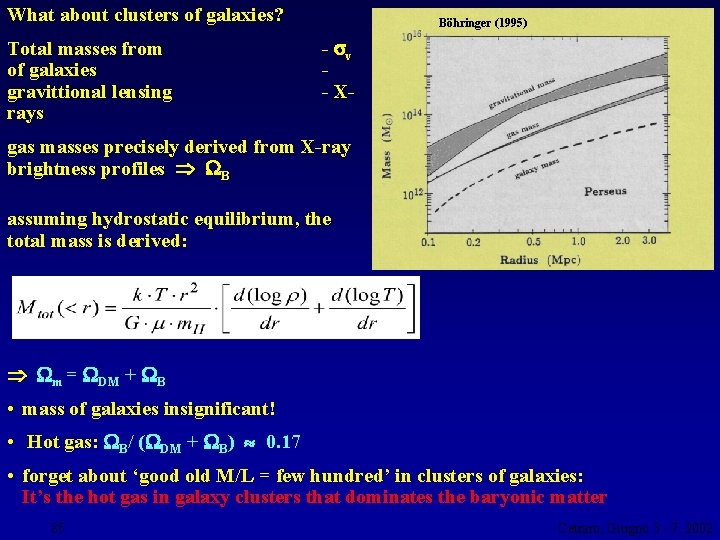
What about clusters of galaxies? Total masses from of galaxies gravittional lensing rays Böhringer (1995) - v - X- gas masses precisely derived from X-ray brightness profiles B assuming hydrostatic equilibrium, the total mass is derived: m = DM + B • mass of galaxies insignificant! • Hot gas: B/ ( DM + B) 0. 17 • forget about ‘good old M/L = few hundred’ in clusters of galaxies: It’s the hot gas in galaxy clusters that dominates the baryonic matter 85 Cetraro, Giugno 3 - 7, 2002
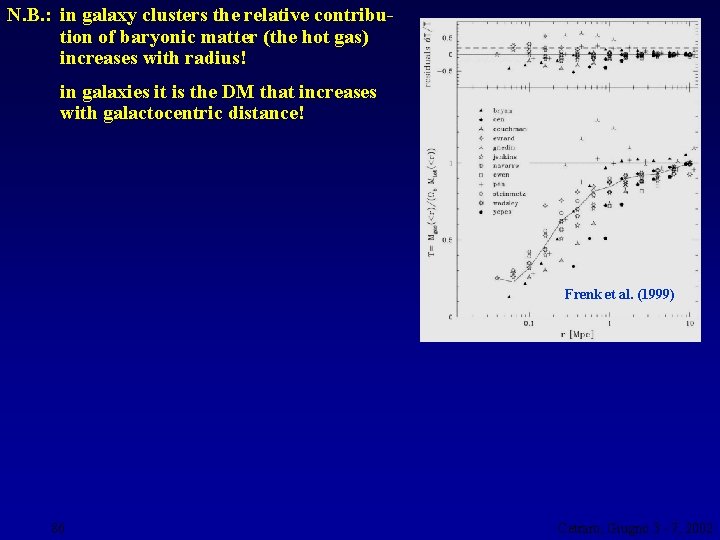
N. B. : in galaxy clusters the relative contribution of baryonic matter (the hot gas) increases with radius! in galaxies it is the DM that increases with galactocentric distance! Frenk et al. (1999) 86 Cetraro, Giugno 3 - 7, 2002

87 Cetraro, Giugno 3 - 7, 2002
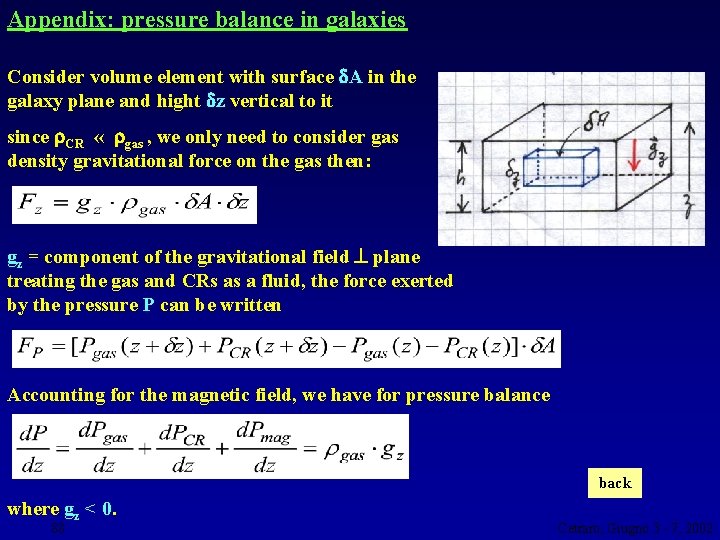
Appendix: pressure balance in galaxies Consider volume element with surface A in the galaxy plane and hight z vertical to it since CR « gas , we only need to consider gas density gravitational force on the gas then: gz = component of the gravitational field plane treating the gas and CRs as a fluid, the force exerted by the pressure P can be written Accounting for the magnetic field, we have for pressure balance back where gz < 0. 88 Cetraro, Giugno 3 - 7, 2002
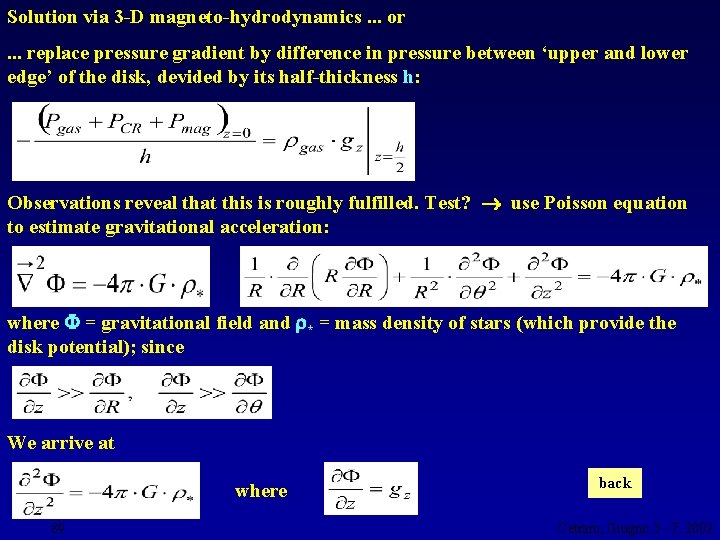
Solution via 3 -D magneto-hydrodynamics. . . or. . . replace pressure gradient by difference in pressure between ‘upper and lower edge’ of the disk, devided by its half-thickness h: Observations reveal that this is roughly fulfilled. Test? use Poisson equation to estimate gravitational acceleration: where = gravitational field and * = mass density of stars (which provide the disk potential); since We arrive at where 89 back Cetraro, Giugno 3 - 7, 2002
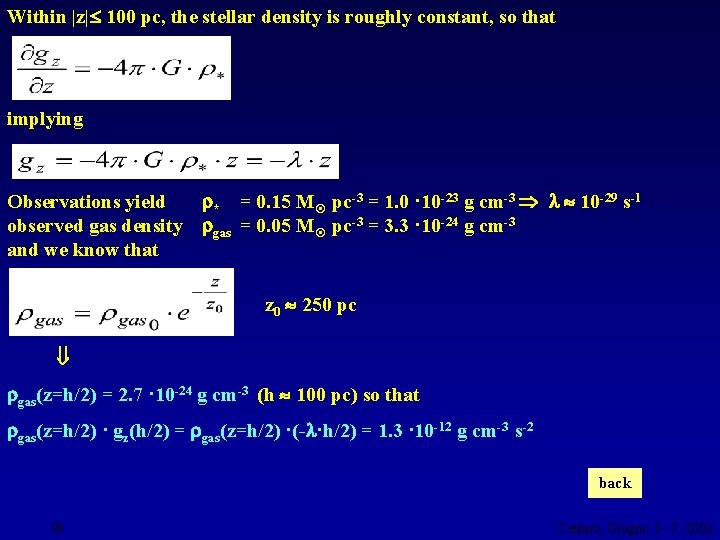
Within |z| 100 pc, the stellar density is roughly constant, so that implying Observations yield * = 0. 15 M pc-3 = 1. 0 · 10 -23 g cm-3 10 -29 s-1 observed gas density gas = 0. 05 M pc-3 = 3. 3 · 10 -24 g cm-3 and we know that z 0 250 pc gas(z=h/2) = 2. 7 · 10 -24 g cm-3 (h 100 pc) so that gas(z=h/2) · gz(h/2) = gas(z=h/2) ·(- ·h/2) = 1. 3 · 10 -12 g cm-3 s-2 back 90 Cetraro, Giugno 3 - 7, 2002
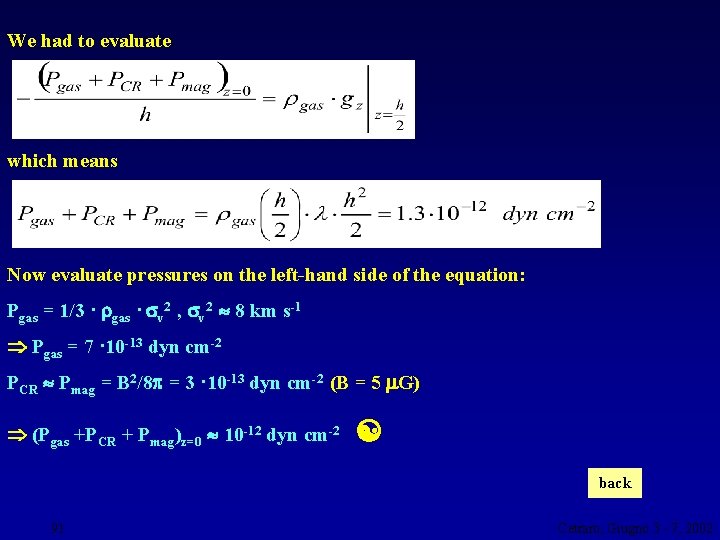
We had to evaluate which means Now evaluate pressures on the left-hand side of the equation: Pgas = 1/3 · gas · v 2 , v 2 8 km s-1 Pgas = 7 · 10 -13 dyn cm-2 PCR Pmag = B 2/8 = 3 · 10 -13 dyn cm-2 (B = 5 G) (Pgas +PCR + Pmag)z=0 10 -12 dyn cm-2 back 91 Cetraro, Giugno 3 - 7, 2002
- Slides: 91