
GASB Implementation Update CSMFO Palm Springs CA February
GASB Implementation Update CSMFO Palm Springs, CA February 22, 2006
New guidance to be covered Capital asset impairments (GASB 42) n Statistical reporting (GASB 44) n n Detailed session later Restrictions associated with enabling legislation (GASB 46) n Termination benefits (GASB 47) n

Capital Asset Impairments GASB Statement No. 42
Key issue n Accounting for assets that are impaired, but still in service
Private-sector n Authoritative guidance n n FASB Statement No. 144 Approach Identify circumstances indicative of potential asset impairment n Apply “recoverability” test n

Example of recoverability test Carrying value $50, 000 Estimated future cash inflows Use of asset $ 27, 000 Salvage value $10, 000 Total estimated future inflows $37, 000 Carrying value over inflows$13, 000 Result: Write down to fair value
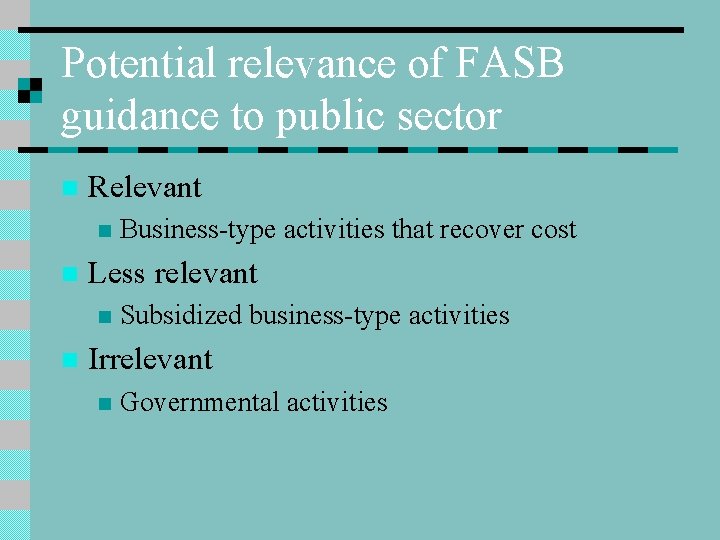
Potential relevance of FASB guidance to public sector n Relevant n n Less relevant n n Business-type activities that recover cost Subsidized business-type activities Irrelevant n Governmental activities
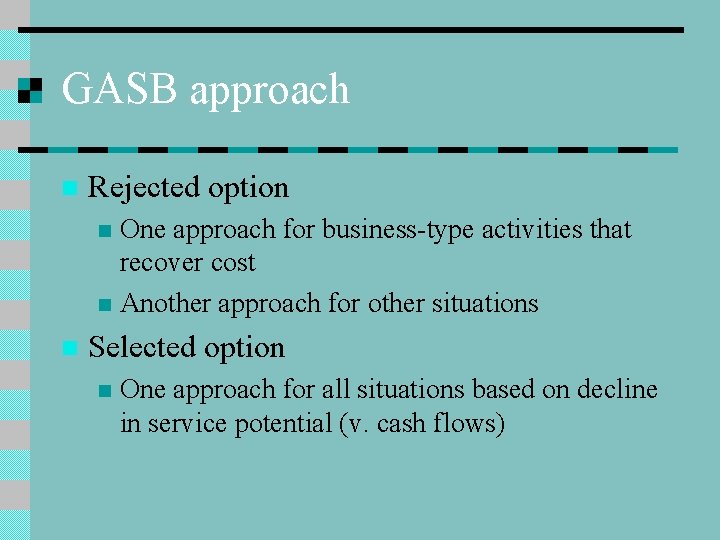
GASB approach n Rejected option One approach for business-type activities that recover cost n Another approach for other situations n n Selected option n One approach for all situations based on decline in service potential (v. cash flows)
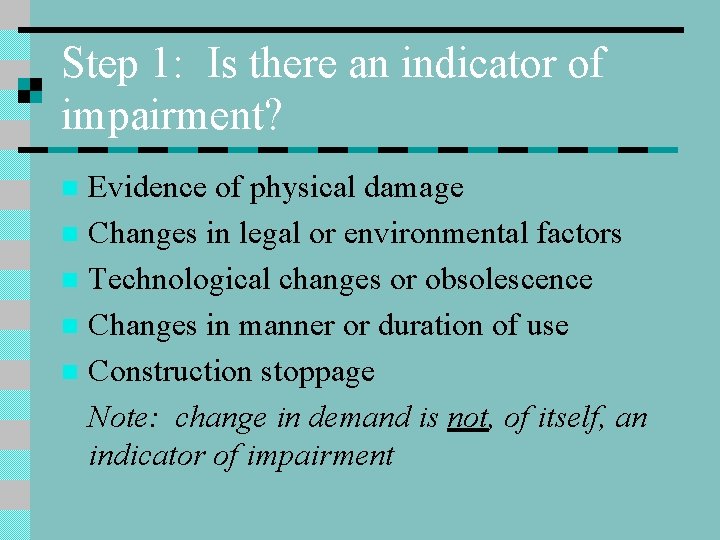
Step 1: Is there an indicator of impairment? Evidence of physical damage n Changes in legal or environmental factors n Technological changes or obsolescence n Changes in manner or duration of use n Construction stoppage Note: change in demand is not, of itself, an indicator of impairment n
Step 2: Is the impairment permanent? n Only permanent impairments recognized n All impairments presumed to be permanent
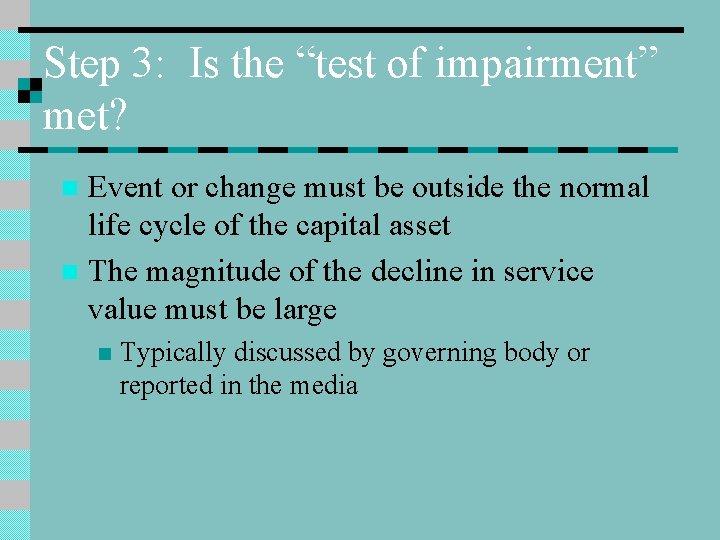
Step 3: Is the “test of impairment” met? Event or change must be outside the normal life cycle of the capital asset n The magnitude of the decline in service value must be large n n Typically discussed by governing body or reported in the media
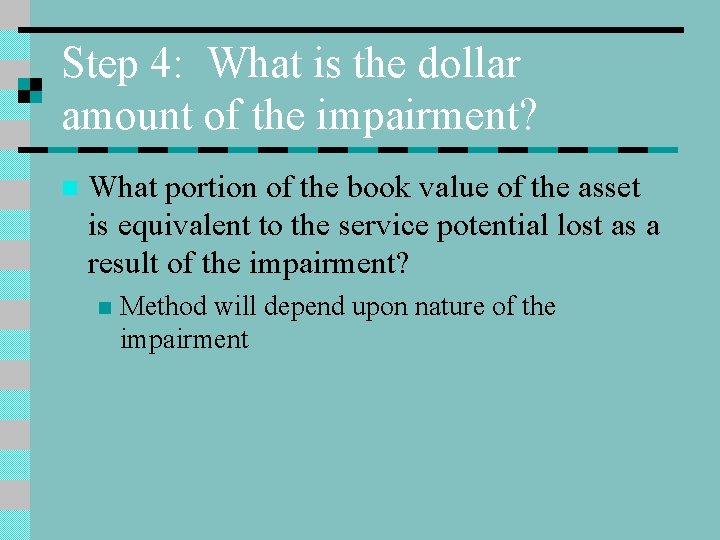
Step 4: What is the dollar amount of the impairment? n What portion of the book value of the asset is equivalent to the service potential lost as a result of the impairment? n Method will depend upon nature of the impairment
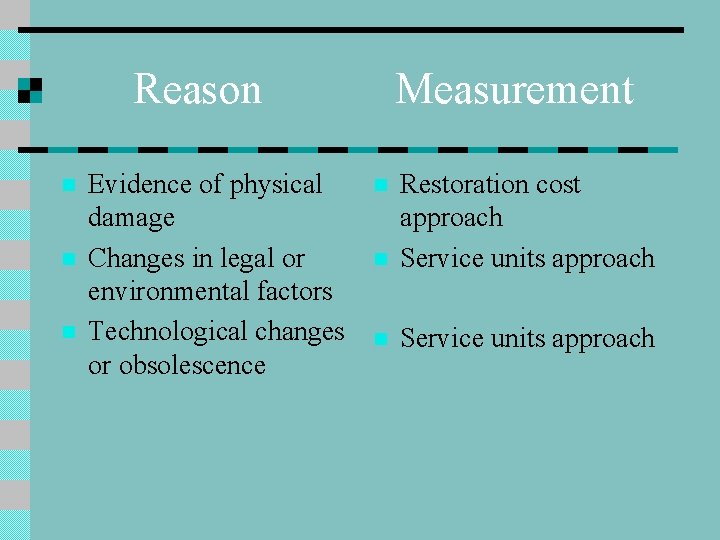
Reason n Evidence of physical damage Changes in legal or environmental factors Technological changes or obsolescence Measurement n Restoration cost approach Service units approach n
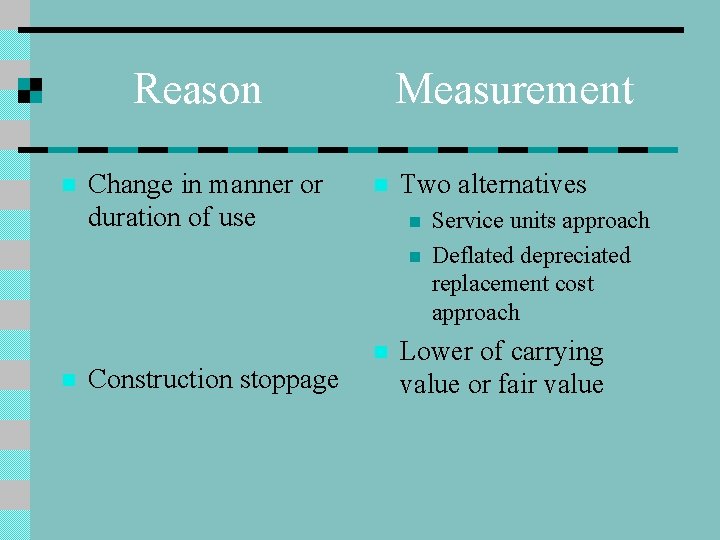
Reason n Change in manner or duration of use Measurement n Two alternatives n n n Construction stoppage n Service units approach Deflated depreciated replacement cost approach Lower of carrying value or fair value
Restoration cost approach Used when evidence of physical damage n Create ratio: n Restoration cost/replacement cost n Deflated restoration cost/historical cost n n Apply to carrying value
Service units approach n Used for Changes in legal or environmental factors n Technological changes or obsolescence n Changes in manner or duration of use n n Compare previous service potential to current service potential Ratio n Remaining units at original unit cost n
Deflated depreciated replacement cost approach Used for change in manner or duration of use n Compare book value of asset with what would have been the book value of an asset acquired for the purpose for which now used n
Lower of carrying value or fair value approach n Construction stoppage (other than temporary)
Subsequent recoveries May not be recognized, even to the extent of previously recognized losses
Step 5: How should insurance recoveries be handled Applicable generally n Treatment n Only recognize when realized or realizable n Same year as loss? Net (as in examples) n Restoration/replacement is a separate transaction (as in examples) n n Other financing source in govt. funds n Potentially extraordinary item
Step 6: How should the impairment be reported? n Three possibilities Extraordinary item n Special item n n n Must be subject to management control Program/operating expense
Effective date n Fiscal periods starting after 12/15/04 n Earlier application encouraged
Statistical Reporting GASB Statement No. 44
Financial position v. economic condition n Financial position Assets n Liabilities n Difference n n Economic condition Financial position n Fiscal capacity n Service capacity n
Need for change Existing authoritative guidance framed too narrowly n Inconsistent application n Lack of description in NCGA Statement 1 n Lack of examples in NCGA Statement 1 n n Newly available information
Basic changes Organize guidance based on objectives that are generally applicable n Detailed descriptions and illustrative material n Incorporation of data from SGAS 34 n
Five objectives Provide information on financial trends. How has a government's financial position changed over time? n Provide information on revenue capacity. What is the government's ability to generate own-source revenues? n
Five objectives (cont. ) Provide information on debt capacity. What is a government's debt burden and is it able to issue additional debt? n Provide demographic and economic information. What is the government's socioeconomic environment and how does the government compare to past periods and other governments? n
Five objectives (cont. ) n Provide operating information. How does the government operate? n What are its resources? n What is the context for understanding and assessing its economic condition? n
Financial Trend Data
Specific presentations Information about net assets (10 years) n Information about changes in net assets (10 years) n Information about fund balances (10 years) n Information about changes in fund balances (10 years) n

Information on Revenue Capacity
Specific presentations Information about the revenue base (10 years) n Information about revenue rates (10 years) n Information about principal payers or remitters (current year and 9 years previous) n Information about property tax levies and collections (10 years) n

Debt Capacity Information
Specific presentations Ratios of outstanding debt (10 years) n Ratios of general bonded debt (10 years) n Information about direct and overlapping debt (current year) n Information about debt limitations (current year and 9 years previous) n Information about pledged revenue coverage ( 10 years) n

Demographic and Economic Information
Specific presentations Demographic and economic indicators (10 years) n Information on principal employers (current year and 9 years previous) n

Operating Information
Specific presentations Number of government employees (10 years) n Demand for or level of service (10 years) n Indicators of volume, nature, or use of capital assets (10 years) n

Effective date n Periods beginning after 6/15/05
Restrictions Associated with Enabling Legislation GASB Statement 46
Definition of enabling legislation n Two elements Authorization to raise resources n Legally enforceable requirement that those resources be used for the purpose for which raised n
Are such resources “restricted”? n Local level n n Typically there is legal enforceability by the state State level n Sovereignty means there is nothing to stop a state from subsequently unilaterally changing the law n Compare to other types of legal restrictions
Treatment – general rule “Tantamount to a legally binding agreement between the government and the resource providers (the taxpayers)” n Normally properly classified as “restricted, ” but should be reported separately within the restricted net assets category (compare expendable and nonexpendable) n
Potential reclassification n May be needed if… Resources subsequently spent for some other purpose n Subsequent legislation specifically changed the purpose for which existing balances may be spent n n Compare changes for resources raised subsequently Never automatic n Always judged separately by source n
Effective date Fiscal years beginning after 6/15/05 n Early implementation encouraged n

Termination Benefits GASB Statement No. 47
Definition Incentive for voluntary early termination n Settlement for involuntary early termination n
Termination benefits v. postemployment benefits n Post-employment benefits (pensions/OPEB) Related to the past n Compensation for prior service n n Termination benefits Related to the present n Cost of discontinuing future service n
Change from scope of prior guidance n Previous guidance limited to special termination benefits Voluntary n Short duration n n Now extended to all types of termination benefits Voluntary and involuntary n Regardless of duration n
Examples (voluntary) Cash payments n Enhancements to existing pension and other postemployment benefits (OPEB) n Healthcare that otherwise would not be provided n COBRA n
Examples (involuntary) Severance pay n Continued access to health insurance through the employer’s group insurance n Career counseling and outplacement services n COBRA n
Distinguishing termination from post-employment benefits Intended or viewed as compensation or as incentive to terminate? n Conditioned on termination prior to normal retirement age? n Duration so long as to function in essence as part of the post-employment package? n
Elements of cost Benefits themselves n Related fringe benefits n Indirect effect upon other types of benefits n n Exception for effect on defined benefit pension benefits and OPEB
Measurement target n Discounted present value of expected future benefit payments n Application differs depending upon whether benefit relates to healthcare
Measurement of healthcarerelated benefits n Two approaches Total claims costs n Age-adjusted premiums approximating claims costs n n n Option = unadjusted premiums (if neither large-scale nor age-related) Use OPEB guidance if benefits offered through existing defined benefit OPEB plan
Measurement of benefits not related to healthcare n Option = current cost levels (if specific amounts not payable on fixed or determinable dates)
Recognition – accrual basis n Voluntary termination benefits Offer accepted n Measurable n n Involuntary termination benefits Plan approved and communicated n Measurable n Defer and amortize amounts related to services yet to be provided n
Recognition – modified accrual basis n When due and payable
Note disclosure n Description Year employer becomes obligated n Each year service must be performed in connection with involuntary plans n n Cost and change in actuarial accrued liability n Year employer becomes obligated
Note disclosure (cont. ) n Significant methods and assumptions used n n As long as liability reported Amounts not recognized because not measurable


Effective date n Portions related to OPEB n n Simultaneous with implementation of GASB 45 Other provisions n Fiscal years beginning after 6/15/05 n n Early implementation encouraged Applicable to all unpaid amounts at transition
- Slides: 64