
GASB 87 Leases Agenda Objective Definition of a

GASB 87 Leases
Agenda ü ü ü ü ü Objective Definition of a lease Exclusions Lessor/Lessee Reporting Multiple Components Combination Leases Renewal Options Intergovernmental Agreements Thresholds Things to Consider
Objectives ü Be in compliance with GASB 87, effective beginning July 1, 2020 (FY 21) ü Establishes a single model for lease accounting based on the foundational principle that leases are financings of the right to use an underlying asset.
GASB 87 Implementation Process of Implementation: • • GASB 87 Workshop (6/4/19) July 1, 2020 – New accounting for leases begins CAFR FY 2021 – New reporting requirement changes Operating leases population analysis • These leases will now become capital • Copiers & postage meters • Threshold determination – TBD
Definition of Lease ü Old lease definition: § A lease is defined as an agreement between a lessor (vendor) and a lessee (State/agency) that conveys the lessee the right to use property or equipment for a specified period of time for predetermined cash payments (rents). A lease agreement must be evaluated to determine whether the transaction and related disclosures should be reported as a capital or operating lease. ü New definition of a lease: § A contract that conveys control of the right to use another entity’s nonfinancial asset (underlying asset) as specified in the contract for a period of time in an exchange or exchange-like transaction § Conveying control requires both of the following: • the right to obtain the present service capacity from use of the underlying asset, and • the right to determine the nature and manner of use of the underlying asset ü Significant difference – no operating leases anymore
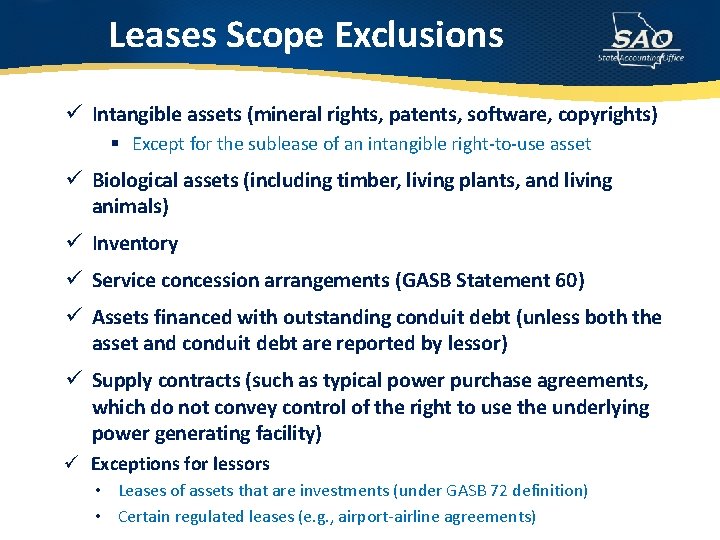
Leases Scope Exclusions ü Intangible assets (mineral rights, patents, software, copyrights) § Except for the sublease of an intangible right-to-use asset ü Biological assets (including timber, living plants, and living animals) ü Inventory ü Service concession arrangements (GASB Statement 60) ü Assets financed with outstanding conduit debt (unless both the asset and conduit debt are reported by lessor) ü Supply contracts (such as typical power purchase agreements, which do not convey control of the right to use the underlying power generating facility) ü Exceptions for lessors • Leases of assets that are investments (under GASB 72 definition) • Certain regulated leases (e. g. , airport-airline agreements)
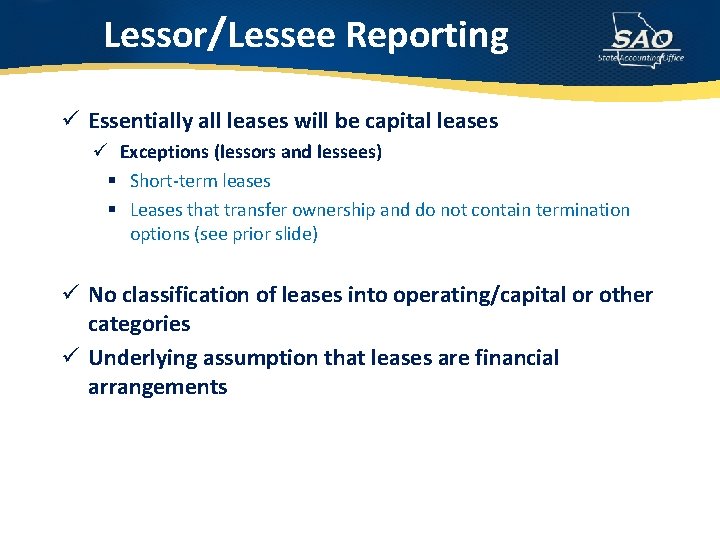
Lessor/Lessee Reporting ü Essentially all leases will be capital leases ü Exceptions (lessors and lessees) § Short-term leases § Leases that transfer ownership and do not contain termination options (see prior slide) ü No classification of leases into operating/capital or other categories ü Underlying assumption that leases are financial arrangements
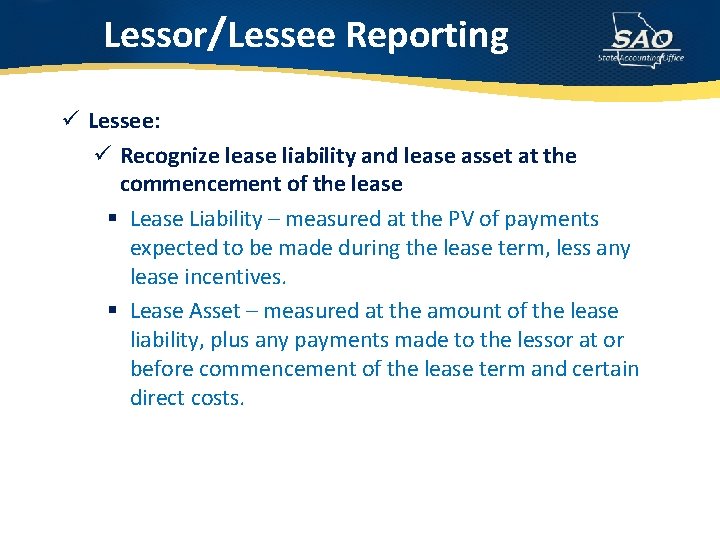
Lessor/Lessee Reporting ü Lessee: ü Recognize lease liability and lease asset at the commencement of the lease § Lease Liability – measured at the PV of payments expected to be made during the lease term, less any lease incentives. § Lease Asset – measured at the amount of the lease liability, plus any payments made to the lessor at or before commencement of the lease term and certain direct costs.
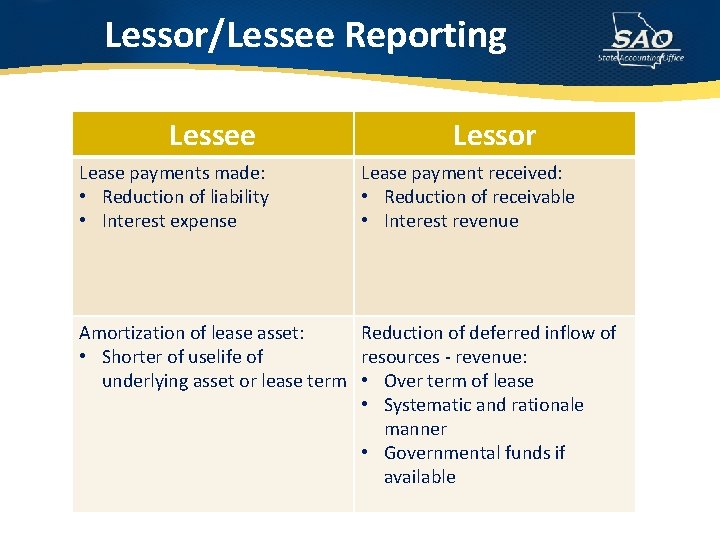
Lessor/Lessee Reporting Lessee Lease payments made: • Reduction of liability • Interest expense Lessor Lease payment received: • Reduction of receivable • Interest revenue Amortization of lease asset: Reduction of deferred inflow of • Shorter of uselife of resources - revenue: underlying asset or lease term • Over term of lease • Systematic and rationale manner • Governmental funds if available
Lessor/Lessee Reporting ü Remeasure Lease Liability if one or more of the following changes has occurred: • Change in lease term • Residual value guarantee being paid has changed in certainty • Assessment of likelihood of exercising option has changed • a change in estimated amounts of payments • Change in the interest rate the lessor charges the lessee • A change in the variable payments such that they now meet the criteria for measuring the lease liability.
Lessor/Lessee Reporting ü Lease term - period during which a lessee has a noncancelable right to use an underlying asset § Plus the following periods if applicable: • • Lessee’s option to extend if it is reasonably certain Lessee’s option to terminate the lease if it is reasonably certain Lessor’s option to extend the lease if it is reasonably certain Lessor’s option to terminate the lease if it is reasonably certain § Reassess term only if: • the reasonably certain conclusion on options were wrong • An event that requires an extension or termination takes place
Short-term leases ü Accounting for Short-term Leases: ü Short-term is defined as a lease that, at the commencement of the lease, has a maximum possible lease term of 12 months, including any options to extend regardless of their probability of being exercised. ü For a lease that is cancelable by both the lessee or the lessor, such as a rolling month-to-month lease or a yearto-year lease, the maximum possible term is the noncancelable period, including any notice periods.
Short-term leases ü Accounting for Short-term Leases: • LESSEE — lease payments recognized as expenses/expenditures based on the payment provisions of the contract • No recognition of assets or liabilities associated with the right to use the underlying asset for short-term leases • LESSOR — lease payments recognized as revenue based on the payment provisions of the contract • No recognition of receivables or deferred inflows associated with the lease • No resource flows recognized during rent holiday periods • No required disclosures
Leases – Basis of Accounting • LESSEE—Recognition & Measurement • Budgetary basis – no impact • Modified accrual - Governmental funds • Report payables when due • Don’t report lease (capital) assets • Full accrual accounting – Entity-Wide, Proprietary, Component Units • Recognize a liability for future lease payments (the “lease liability”) and an intangible capital asset for the right to use the underlying asset (the “lease asset”) • Lease data to be submitted on Lease Agreement Data form at year-end (FY 21 form will be updated as needed for GASB 87)
Borrowing rate ü Incremental Borrowing rate: § It is required that the lessee will use the State's (lessee's) own incremental borrowing rate as a discount rate used to calculate the present value unless the lessee is aware of the lessor's implicit rate of return. § The State’s rate is based on bond sale rates during the fiscal year • This determination is made only in the year of the lease's inception and does not need to be updated annually. • The rate that combines the fiscal year the lease began and the number of years that is closest to the number of years in the lease term should be listed on the year end form • For example, if the lease began in FY 2009 and was for a term of 9 years, select the 10 -year rate of 4. 0024% as the rate
Multiple Components ü Contract with lease and nonlease components • Separate lease component from nonlease component ü Example: Allocate cost of toner vs copier • Treat as separate contracts ü Multiple underlying assets in same lease and assets have different lease terms • Each underlying asset treated as separate component (lessee and lessor) • Allocate contract price to each component using reasonableness and professional judgment – Prices for each component in the contract (if available) – Stand-alone prices for similar assets ü If cannot determine allocation, treat as a single-lease unit
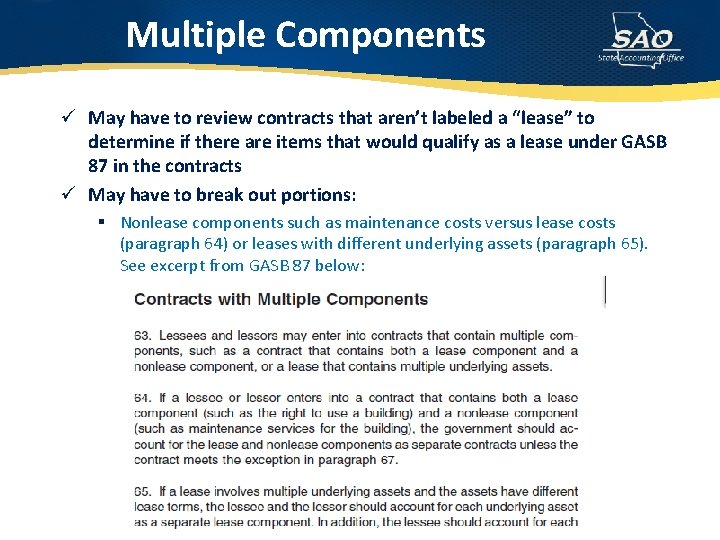
Multiple Components ü May have to review contracts that aren’t labeled a “lease” to determine if there are items that would qualify as a lease under GASB 87 in the contracts ü May have to break out portions: § Nonlease components such as maintenance costs versus lease costs (paragraph 64) or leases with different underlying assets (paragraph 65). See excerpt from GASB 87 below:
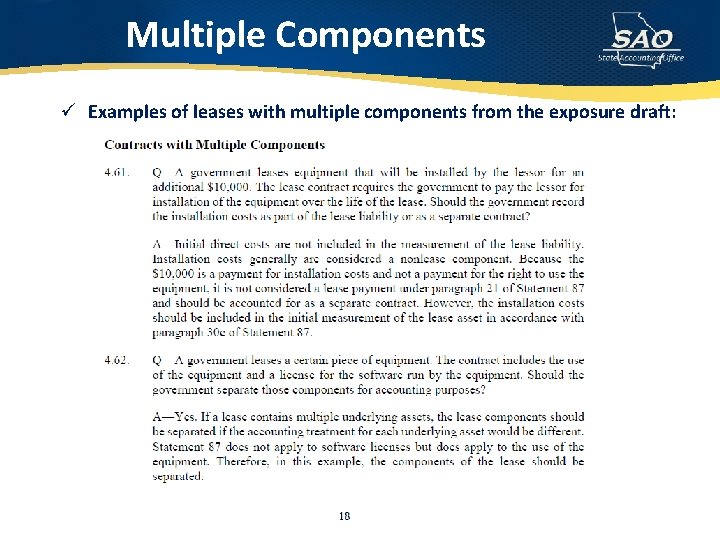
Multiple Components ü Examples of leases with multiple components from the exposure draft:
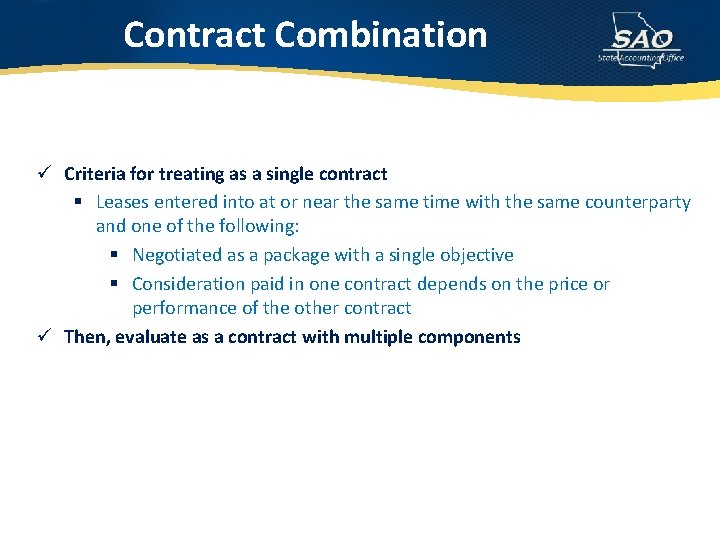
Contract Combination ü Criteria for treating as a single contract § Leases entered into at or near the same time with the same counterparty and one of the following: § Negotiated as a package with a single objective § Consideration paid in one contract depends on the price or performance of the other contract ü Then, evaluate as a contract with multiple components
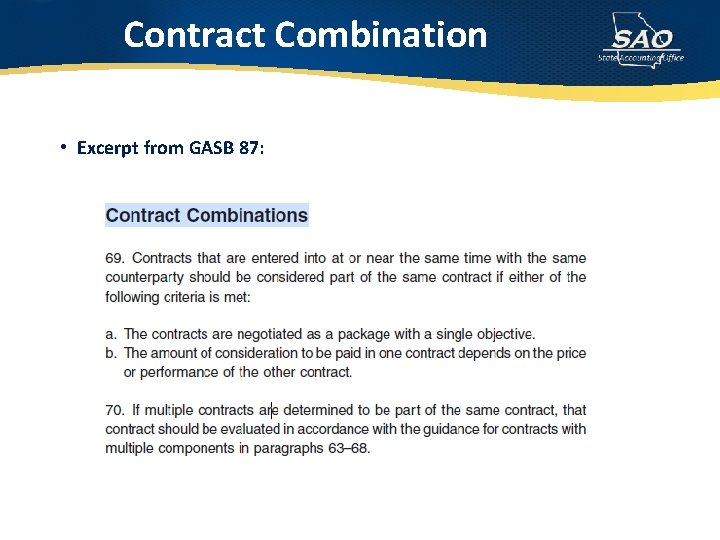
Contract Combination • Excerpt from GASB 87:
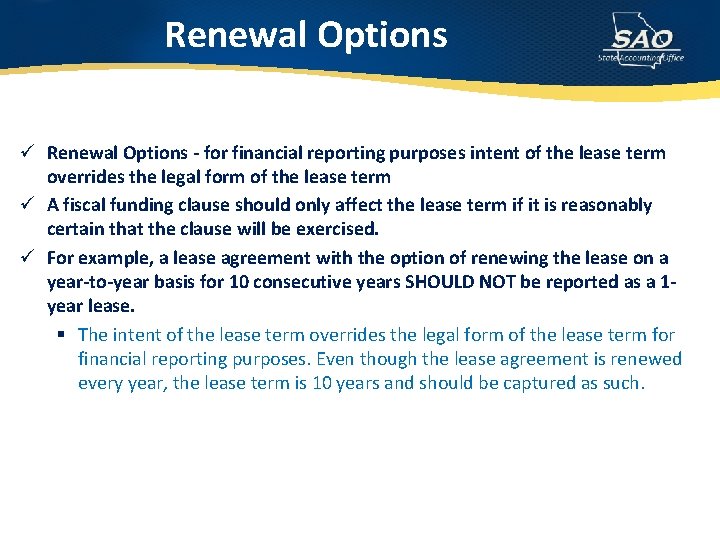
Renewal Options ü Renewal Options - for financial reporting purposes intent of the lease term overrides the legal form of the lease term ü A fiscal funding clause should only affect the lease term if it is reasonably certain that the clause will be exercised. ü For example, a lease agreement with the option of renewing the lease on a year-to-year basis for 10 consecutive years SHOULD NOT be reported as a 1 year lease. § The intent of the lease term overrides the legal form of the lease term for financial reporting purposes. Even though the lease agreement is renewed every year, the lease term is 10 years and should be captured as such.
Renewal Options ü The determination of the likelihood of a renewal or termination option being exercised applies only if that option pertains to the lessee alone. ü If either the lessee or the lessor has the option to cancel a lease without permission from the other party (or if both parties have to agree to renew), an enforceable contract does not exist beyond that point.
Subleases ü Treated as a separate transaction § Lessee now also the lessor § No offset of transactions • Original lessee – Right to use asset and liability (original lease) – Receivable and deferred inflow of resources (sublease)
Intergovernmental Agreements ü If a State organization is part of the primary government for financial reporting purposes and enters into a lease agreement where the lessor entity (public authority, department, agency, division, etc. ) is also part of the primary government, then the lease should not be reported as either an operating or capital lease. § The payments for these agreements should be considered ordinary operating expenditures/expenses by the lessee organization. § For example, agreements between Georgia Building Authority (GBA) and other organizations included in the State’s primary government should not be reported as leases in the statewide CAFR. ü If any State organization enters into a lease agreement where the lessor is either a) a discretely presented component unit or b) a public organization that is not part of the governmental unit entity for financial reporting purposes, then the lease should be treated in the same manner as any other lease agreement of the State ü Organization chart may be found on SAO’s website
Thresholds - TBD ü SAO is currently determining thresholds for low dollar leases such as copiers & postage meters
Start thinking now about: ü Leases with multiple components ü Leases previously reported as Operating leases that will now be reported as Capital leases § Additional information may be required for these leases ü Upcoming changes to the lease agreement data form for FY 21 ü Lessor reporting changes ü Future training considerations § § Lease incentives Leases with variable payments Renewal periods Lease form
Start thinking now about: ü Factors to consider: § A significant economic incentive § A significant economic disincentive § A history of exercising options to extend or terminate § The extent to which the underlying asset is essential to the government services
Where to Find Information ü SAO’s Website: § https: //sao. georgia. gov/ ü Contact information: § Chelsea. bennett@sao. ga. gov § Amanda. brock@sao. ga. gov ü GASB 87 can be found on GASB’s website at gasb. org and linked below: § https: //www. gasb. org/jsp/GASB/Page/GASBSection. Page &cid=1176160042391 ü GASB 87 implementation guide can be found: § https: //www. gasb. org/jsp/GASB/Page/GASBSection. Page &cid=1176160042391#gig
GASB 87 - Leases Q&A
- Slides: 29