
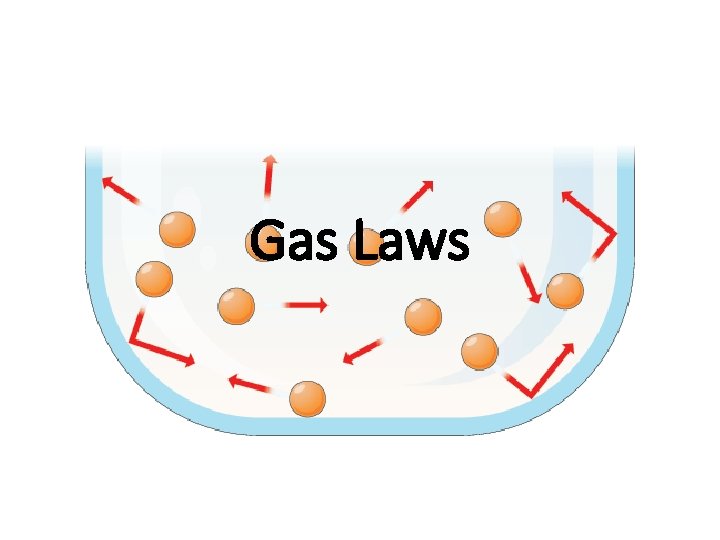
Gas Laws Gases No definite shape or volume
- Slides: 41
Gas Laws
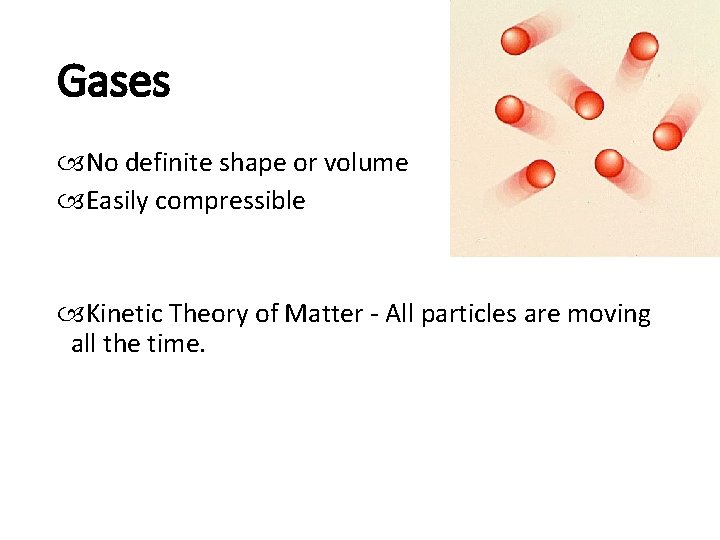
Gases No definite shape or volume Easily compressible Kinetic Theory of Matter - All particles are moving all the time.
What do we know about gas particles? Can be either molecules or atoms; e. g. He, O 2, C 3 H 8 Very far apart from one another. Between particles is empty space. No attractive or repulsive forces between particles. Move randomly. Move at high speeds (O 2 at 20 o. C moves at 1700 km/h). Travel in straight paths. Only change direction when collide with another particle/object. Collide elastically (no kinetic energy lost). Ideal Gas
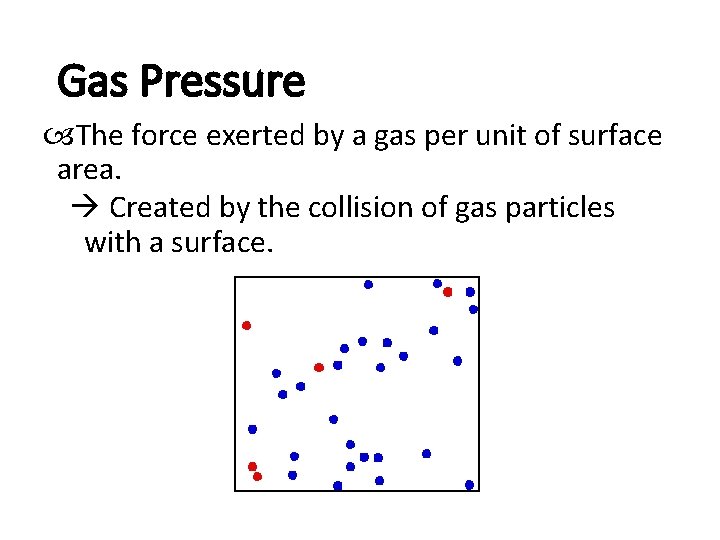
Gas Pressure The force exerted by a gas per unit of surface area. Created by the collision of gas particles with a surface.
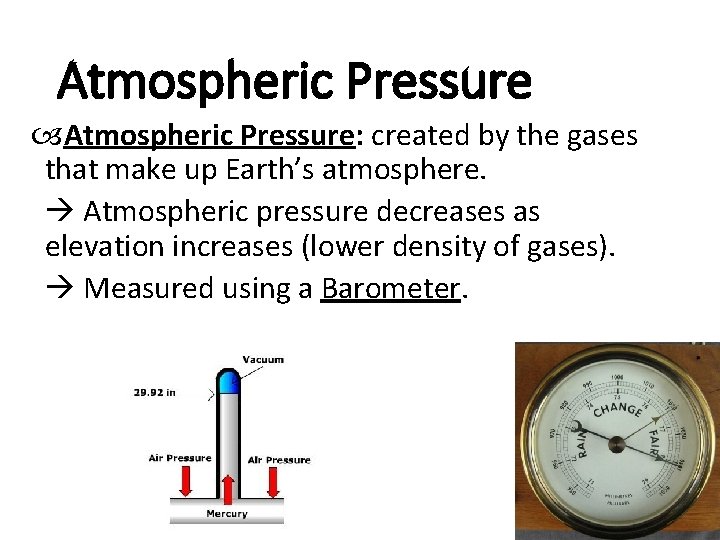
Atmospheric Pressure: created by the gases that make up Earth’s atmosphere. Atmospheric pressure decreases as elevation increases (lower density of gases). Measured using a Barometer.
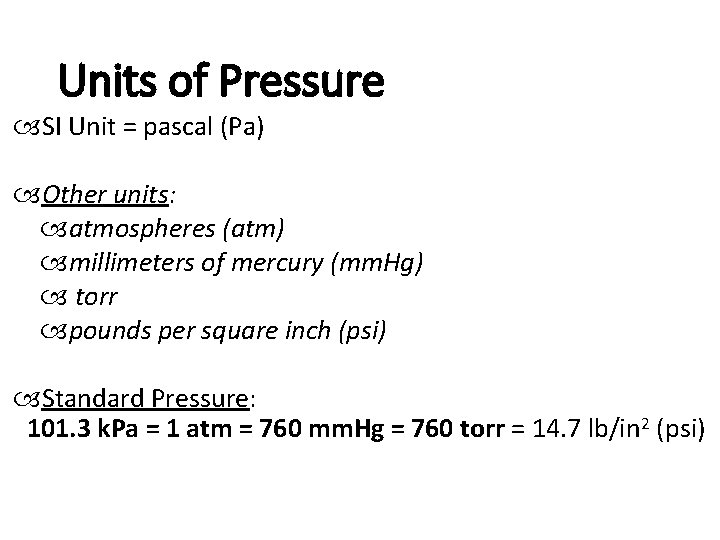
Units of Pressure SI Unit = pascal (Pa) Other units: atmospheres (atm) millimeters of mercury (mm. Hg) torr pounds per square inch (psi) Standard Pressure: 101. 3 k. Pa = 1 atm = 760 mm. Hg = 760 torr = 14. 7 lb/in 2 (psi)
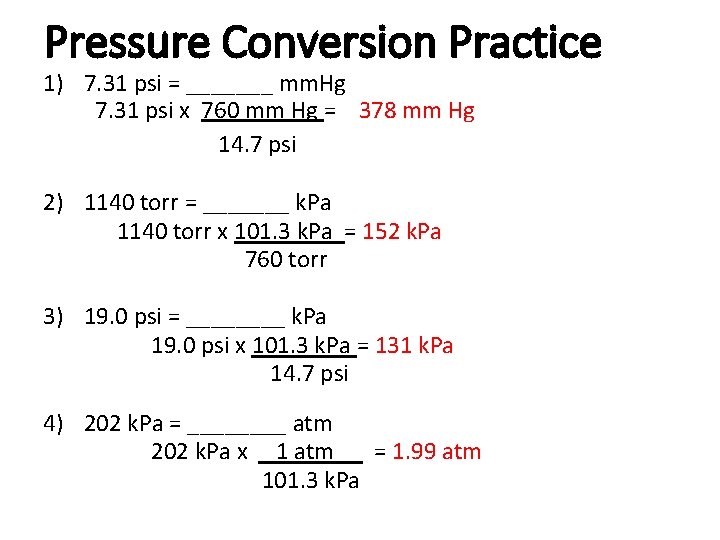
Pressure Conversion Practice 1) 7. 31 psi = _______ mm. Hg 7. 31 psi x 760 mm Hg = 378 mm Hg 14. 7 psi 2) 1140 torr = _______ k. Pa 1140 torr x 101. 3 k. Pa = 152 k. Pa 760 torr 3) 19. 0 psi = ____ k. Pa 19. 0 psi x 101. 3 k. Pa = 131 k. Pa 14. 7 psi 4) 202 k. Pa = ____ atm 202 k. Pa x 1 atm = 1. 99 atm 101. 3 k. Pa
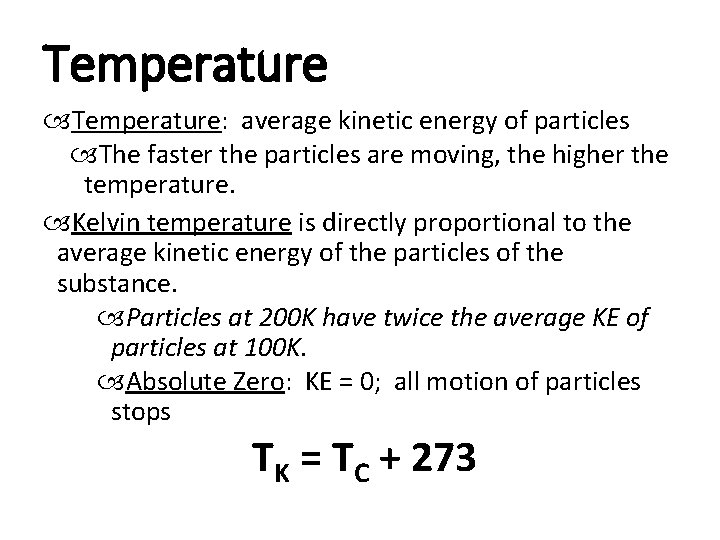
Temperature: average kinetic energy of particles The faster the particles are moving, the higher the temperature. Kelvin temperature is directly proportional to the average kinetic energy of the particles of the substance. Particles at 200 K have twice the average KE of particles at 100 K. Absolute Zero: KE = 0; all motion of particles stops TK = TC + 273
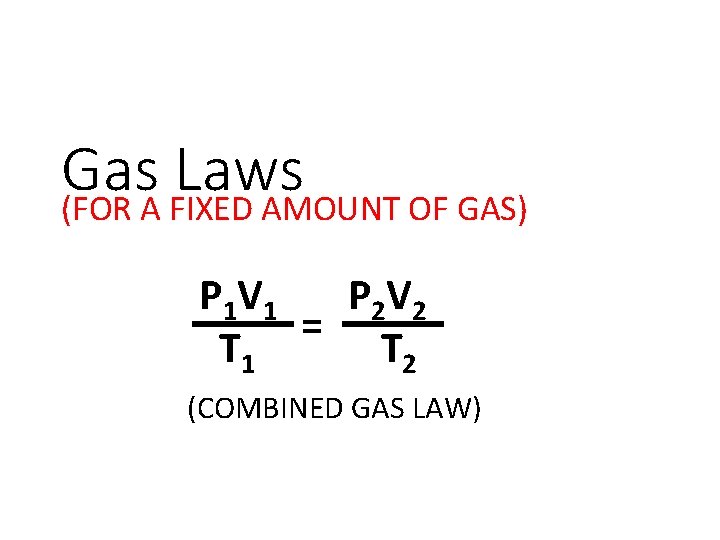
Gas Laws (FOR A FIXED AMOUNT OF GAS) P 1 V 1 P 2 V 2 = T 1 T 2 (COMBINED GAS LAW)
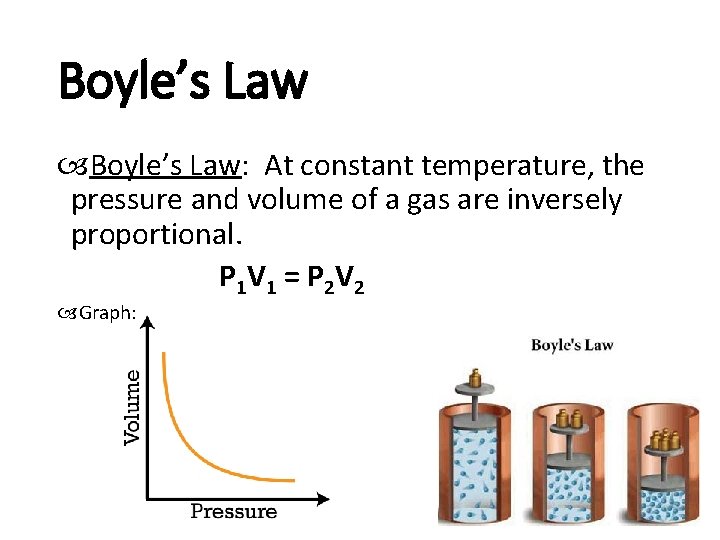
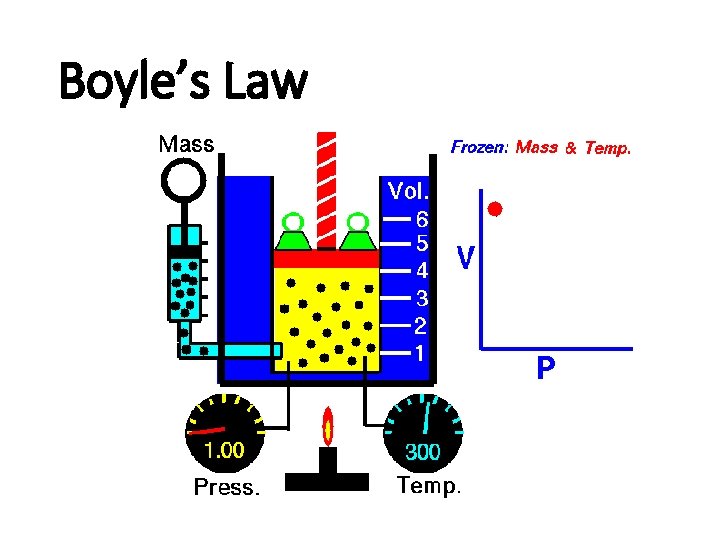
Boyle’s Law: At constant temperature, the pressure and volume of a gas are inversely proportional. P 1 V 1 = P 2 V 2 Graph:
Boyle’s Law
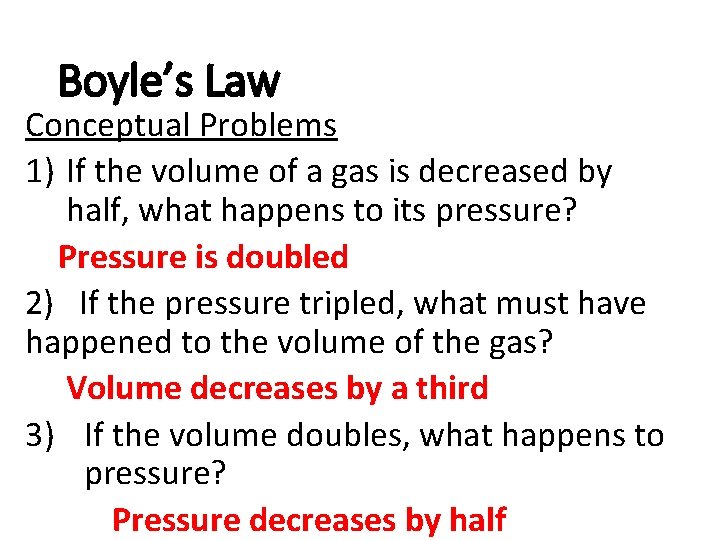
Boyle’s Law Conceptual Problems 1) If the volume of a gas is decreased by half, what happens to its pressure? Pressure is doubled 2) If the pressure tripled, what must have happened to the volume of the gas? Volume decreases by a third 3) If the volume doubles, what happens to pressure? Pressure decreases by half
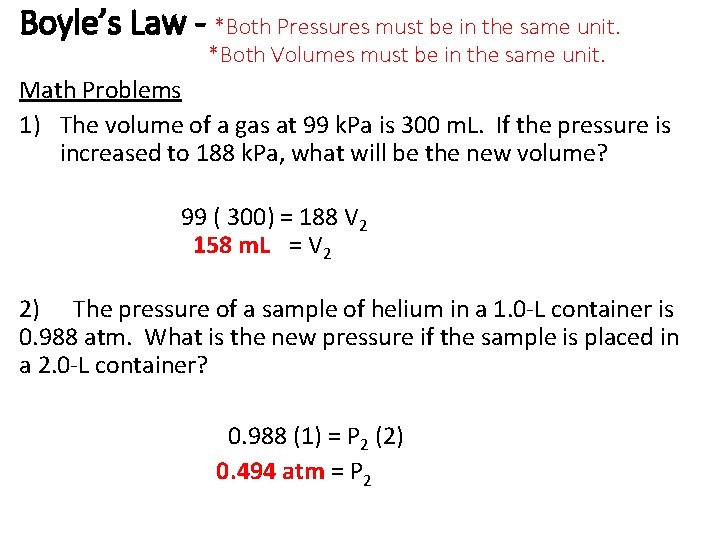
Boyle’s Law - *Both Pressures must be in the same unit. *Both Volumes must be in the same unit. Math Problems 1) The volume of a gas at 99 k. Pa is 300 m. L. If the pressure is increased to 188 k. Pa, what will be the new volume? 99 ( 300) = 188 V 2 158 m. L = V 2 2) The pressure of a sample of helium in a 1. 0 -L container is 0. 988 atm. What is the new pressure if the sample is placed in a 2. 0 -L container? 0. 988 (1) = P 2 (2) 0. 494 atm = P 2
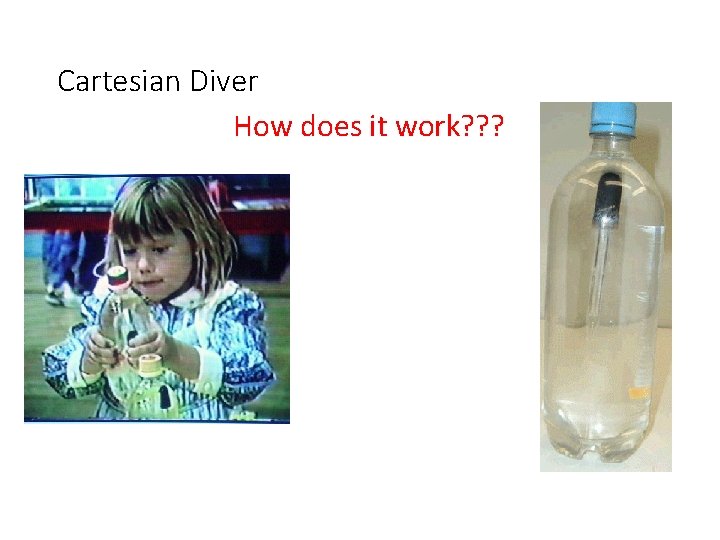
Cartesian Diver How does it work? ? ?
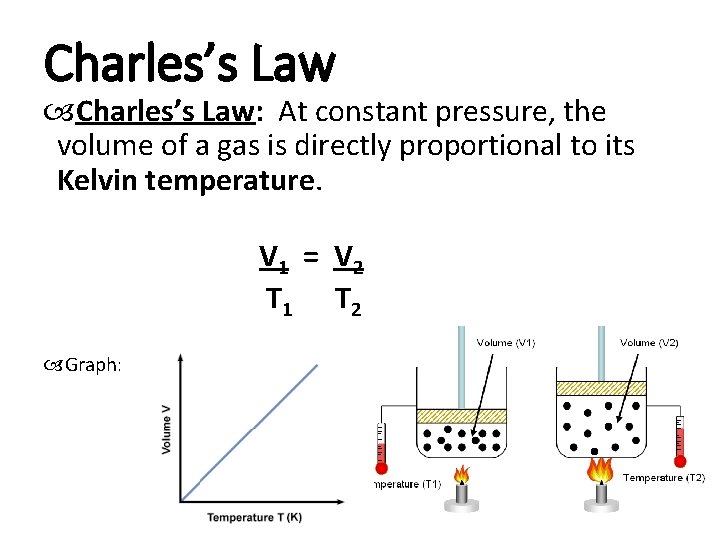
Charles’s Law Charles’s Law: At constant pressure, the volume of a gas is directly proportional to its Kelvin temperature. Graph: V 1 = V 2 T 1 T 2
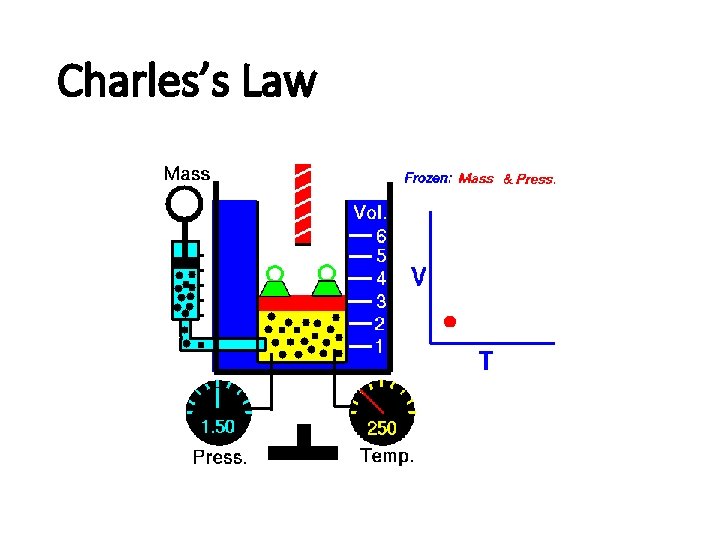
Charles’s Law
Liquid Nitrogen
Charles’s Law Conceptual Problems 1) If the temperature of a gas is doubled, what must happen to volume in order for pressure to remain constant? Pressure is doubled 2) If the volume of a gas decreases to one-third its original volume, what happens to the temperature in order for pressure to remain constant? Temperature decreases one-third
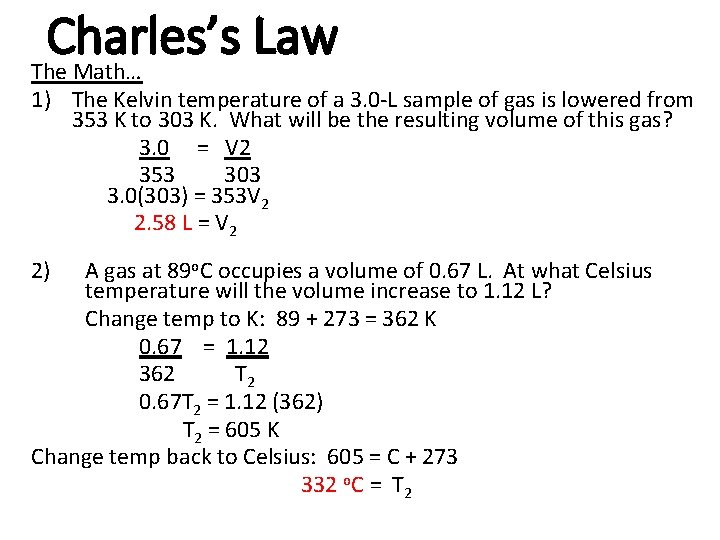
Charles’s Law The Math… 1) The Kelvin temperature of a 3. 0 -L sample of gas is lowered from 353 K to 303 K. What will be the resulting volume of this gas? 3. 0 = V 2 353 303 3. 0(303) = 353 V 2 2. 58 L = V 2 2) A gas at 89 o. C occupies a volume of 0. 67 L. At what Celsius temperature will the volume increase to 1. 12 L? Change temp to K: 89 + 273 = 362 K 0. 67 = 1. 12 362 T 2 0. 67 T 2 = 1. 12 (362) T 2 = 605 K Change temp back to Celsius: 605 = C + 273 332 o. C = T 2
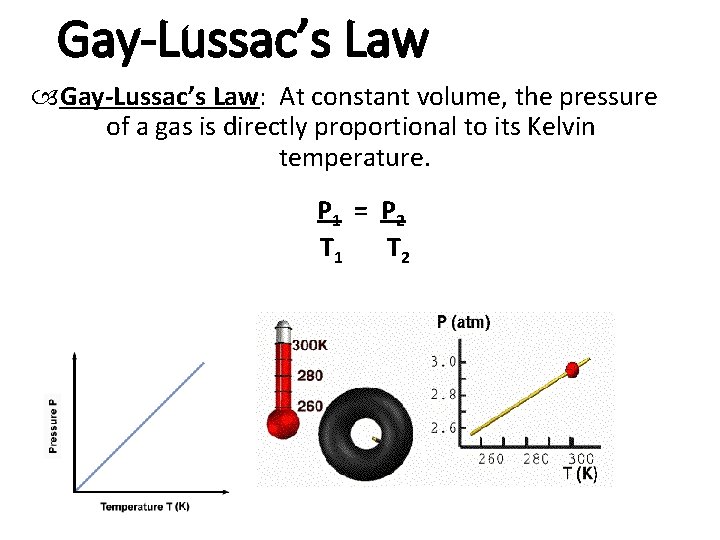
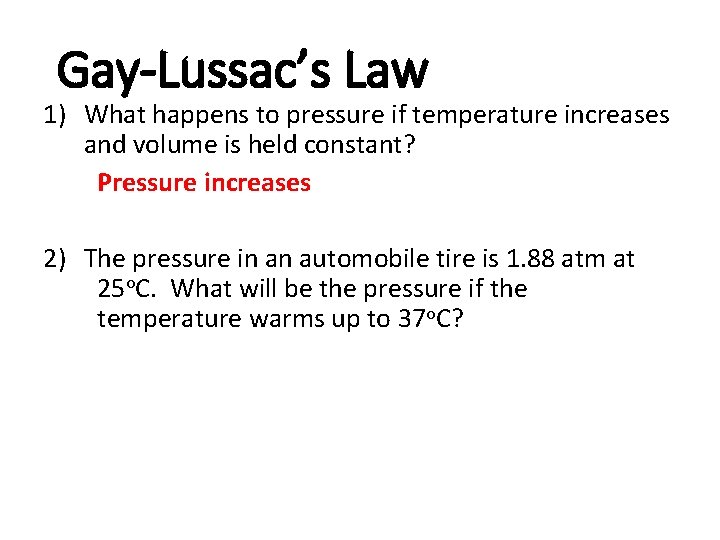
Gay-Lussac’s Law: At constant volume, the pressure of a gas is directly proportional to its Kelvin temperature. P 1 = P 2 T 1 T 2
Gay-Lussac’s Law 1) What happens to pressure if temperature increases and volume is held constant? Pressure increases 2) The pressure in an automobile tire is 1. 88 atm at 25 o. C. What will be the pressure if the temperature warms up to 37 o. C?
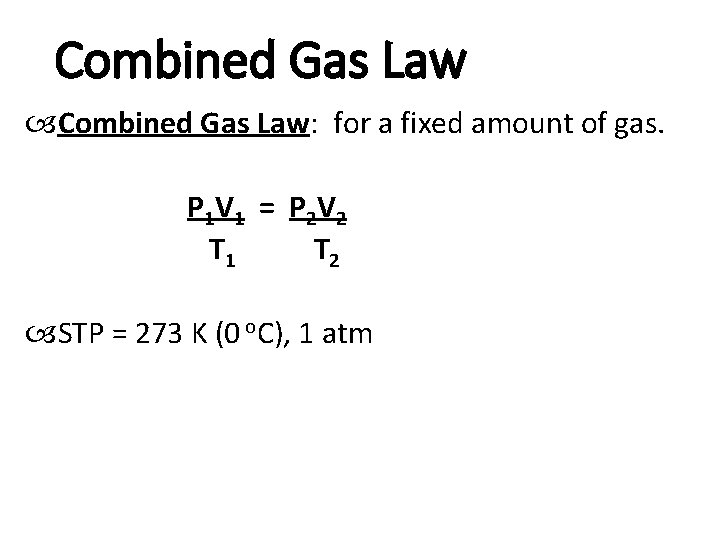
Combined Gas Law: for a fixed amount of gas. P 1 V 1 = P 2 V 2 T 1 T 2 STP = 273 K (0 o. C), 1 atm
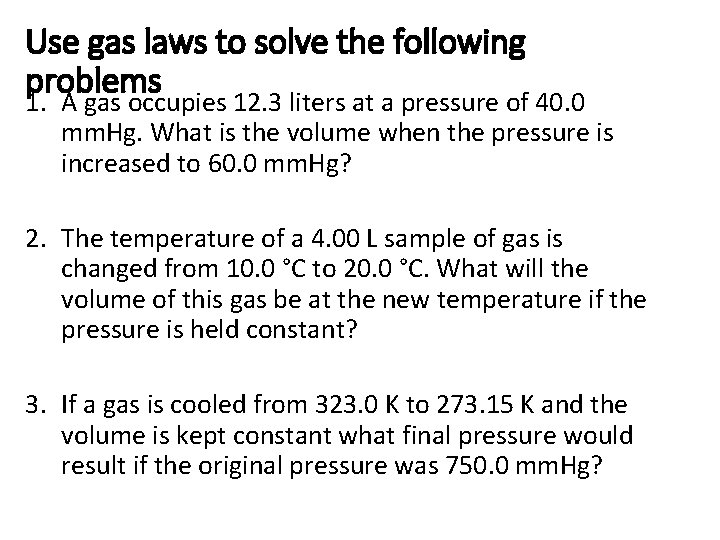
Use gas laws to solve the following problems 1. A gas occupies 12. 3 liters at a pressure of 40. 0 mm. Hg. What is the volume when the pressure is increased to 60. 0 mm. Hg? 2. The temperature of a 4. 00 L sample of gas is changed from 10. 0 °C to 20. 0 °C. What will the volume of this gas be at the new temperature if the pressure is held constant? 3. If a gas is cooled from 323. 0 K to 273. 15 K and the volume is kept constant what final pressure would result if the original pressure was 750. 0 mm. Hg?
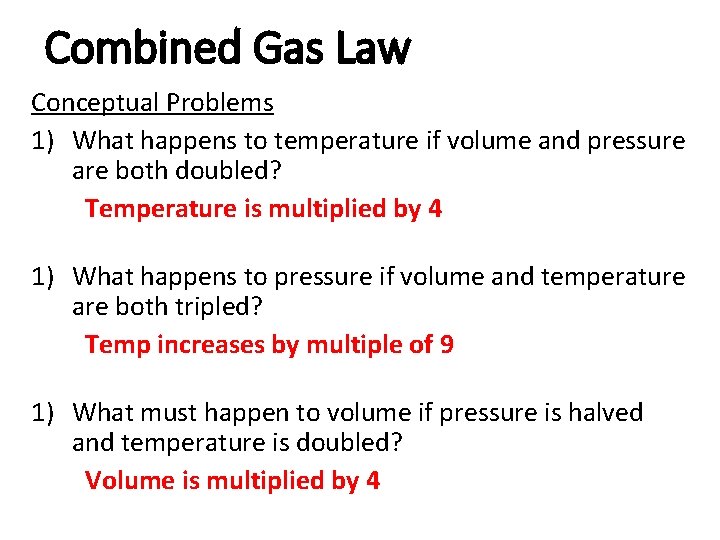
Combined Gas Law Conceptual Problems 1) What happens to temperature if volume and pressure are both doubled? Temperature is multiplied by 4 1) What happens to pressure if volume and temperature are both tripled? Temp increases by multiple of 9 1) What must happen to volume if pressure is halved and temperature is doubled? Volume is multiplied by 4
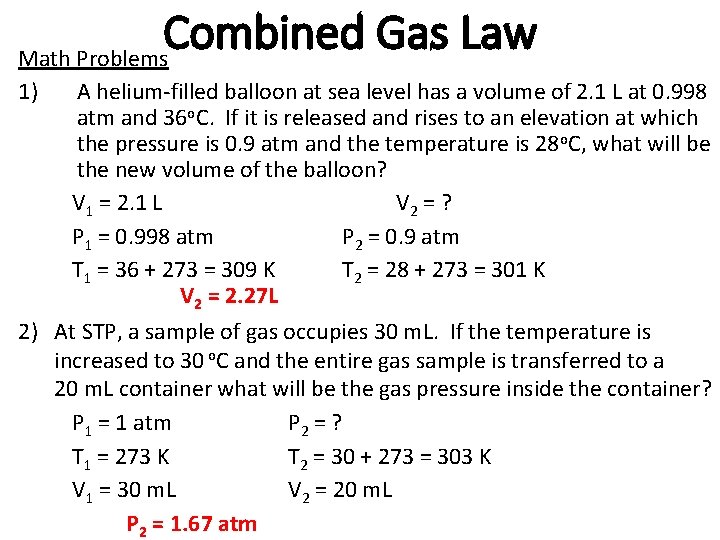
Combined Gas Law Math Problems 1) A helium-filled balloon at sea level has a volume of 2. 1 L at 0. 998 atm and 36 o. C. If it is released and rises to an elevation at which the pressure is 0. 9 atm and the temperature is 28 o. C, what will be the new volume of the balloon? V 1 = 2. 1 L V 2 = ? P 1 = 0. 998 atm P 2 = 0. 9 atm T 1 = 36 + 273 = 309 K T 2 = 28 + 273 = 301 K V 2 = 2. 27 L 2) At STP, a sample of gas occupies 30 m. L. If the temperature is increased to 30 o. C and the entire gas sample is transferred to a 20 m. L container what will be the gas pressure inside the container? P 1 = 1 atm P 2 = ? T 1 = 273 K T 2 = 30 + 273 = 303 K V 1 = 30 m. L V 2 = 20 m. L P 2 = 1. 67 atm
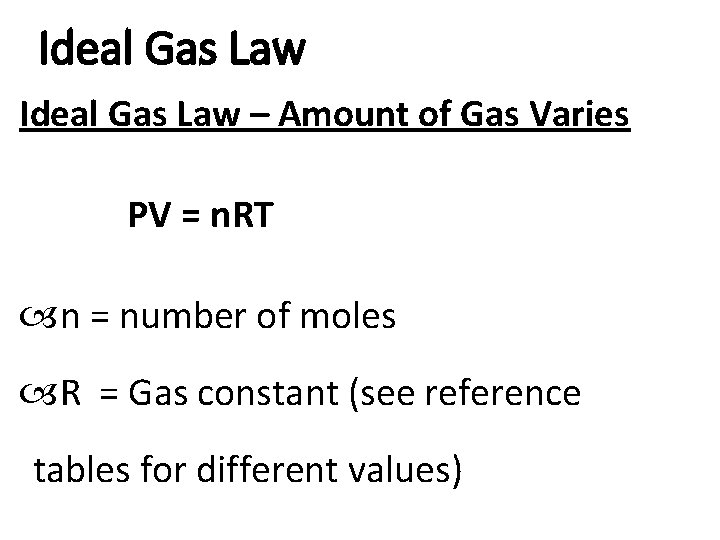
Ideal Gas Law – Amount of Gas Varies PV = n. RT n = number of moles R = Gas constant (see reference tables for different values)
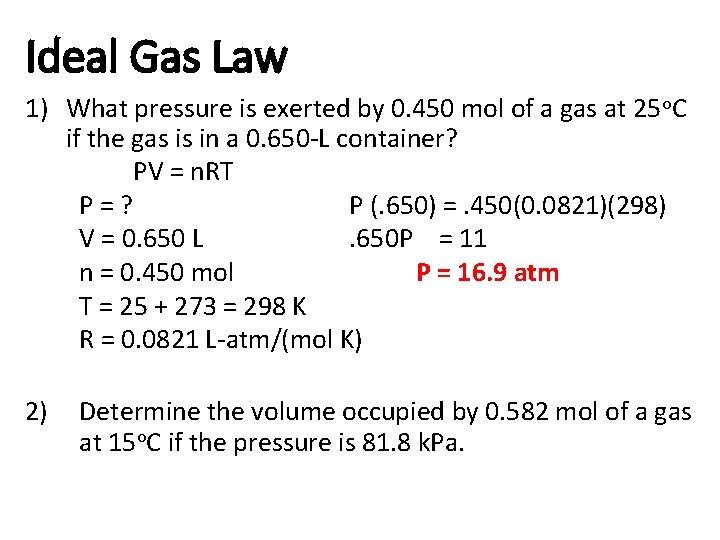
Ideal Gas Law 1) What pressure is exerted by 0. 450 mol of a gas at 25 o. C if the gas is in a 0. 650 -L container? PV = n. RT P = ? P (. 650) =. 450(0. 0821)(298) V = 0. 650 L. 650 P = 11 n = 0. 450 mol P = 16. 9 atm T = 25 + 273 = 298 K R = 0. 0821 L-atm/(mol K) 2) Determine the volume occupied by 0. 582 mol of a gas at 15 o. C if the pressure is 81. 8 k. Pa.
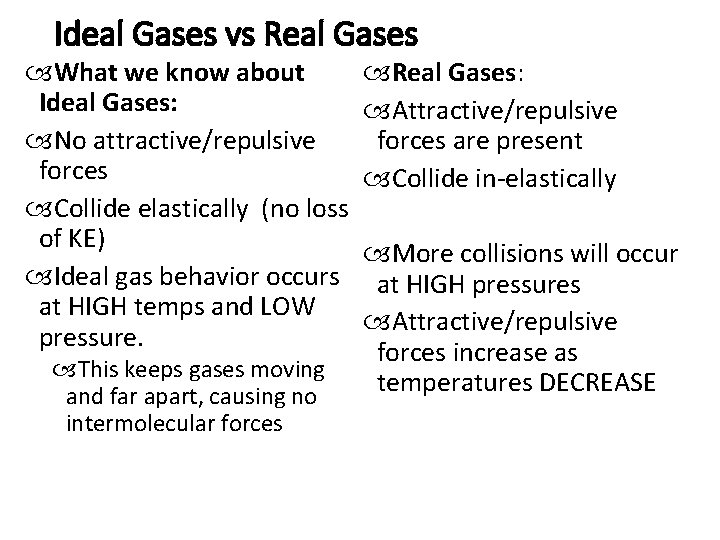
Ideal Gases vs Real Gases What we know about Real Gases: Ideal Gases: Attractive/repulsive No attractive/repulsive forces are present forces Collide in-elastically Collide elastically (no loss of KE) More collisions will occur Ideal gas behavior occurs at HIGH pressures at HIGH temps and LOW Attractive/repulsive pressure. forces increase as This keeps gases moving temperatures DECREASE and far apart, causing no intermolecular forces
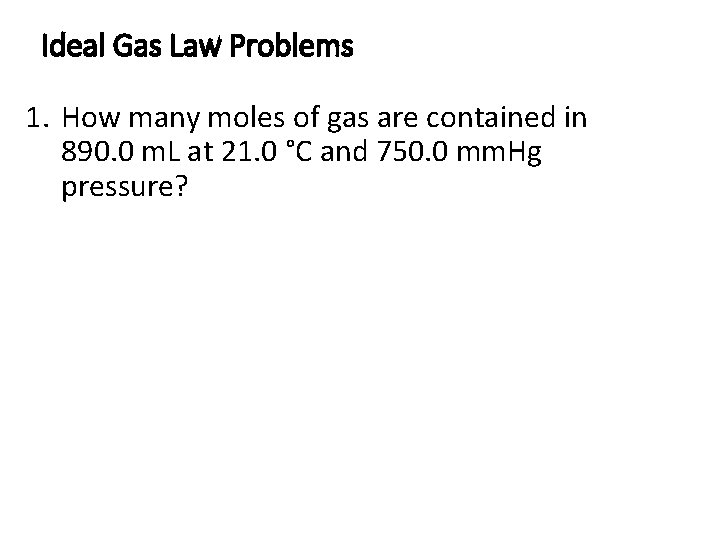
Ideal Gas Law Problems 1. How many moles of gas are contained in 890. 0 m. L at 21. 0 °C and 750. 0 mm. Hg pressure?
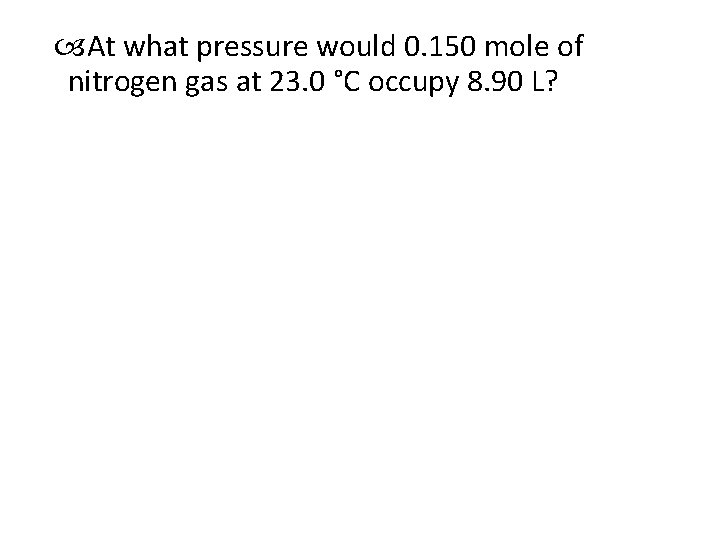
At what pressure would 0. 150 mole of nitrogen gas at 23. 0 °C occupy 8. 90 L?
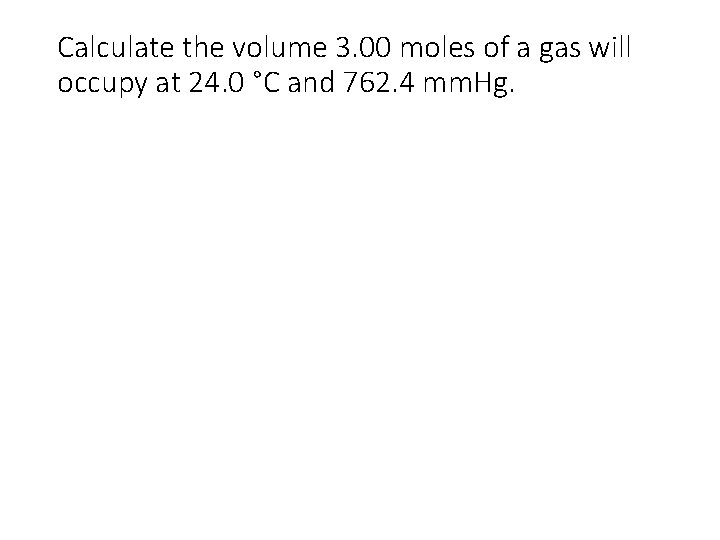
Calculate the volume 3. 00 moles of a gas will occupy at 24. 0 °C and 762. 4 mm. Hg.
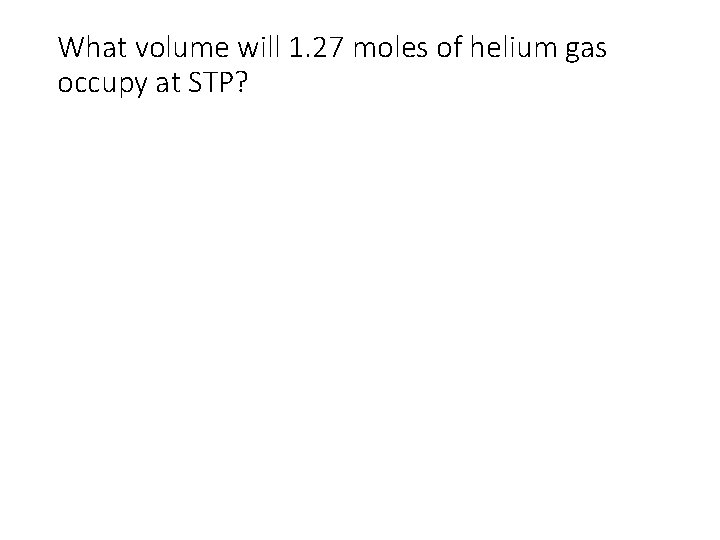
What volume will 1. 27 moles of helium gas occupy at STP?
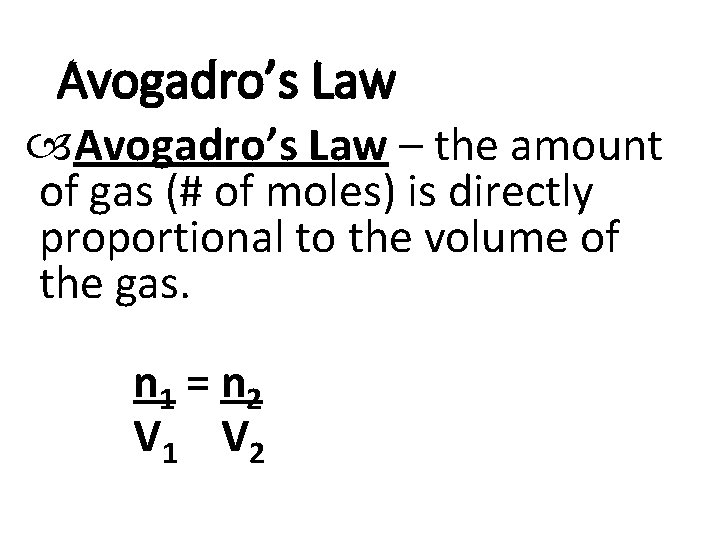
Avogadro’s Law – the amount of gas (# of moles) is directly proportional to the volume of the gas. n 1 = n 2 V 1 V 2
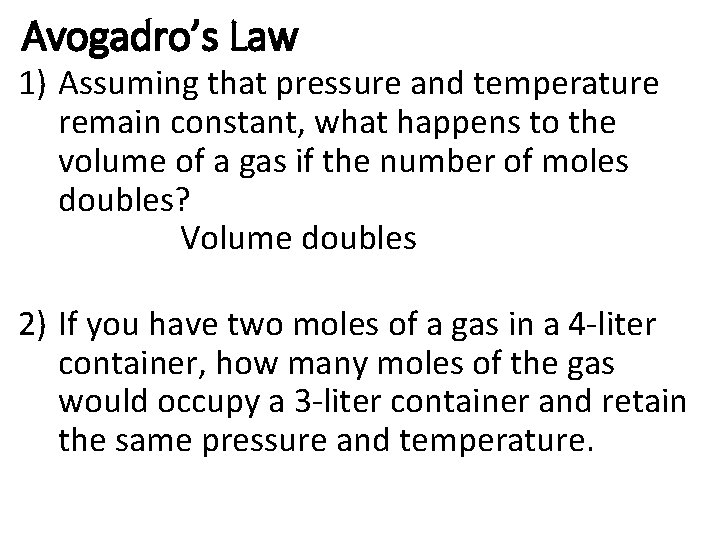
Avogadro’s Law 1) Assuming that pressure and temperature remain constant, what happens to the volume of a gas if the number of moles doubles? Volume doubles 2) If you have two moles of a gas in a 4 -liter container, how many moles of the gas would occupy a 3 -liter container and retain the same pressure and temperature.
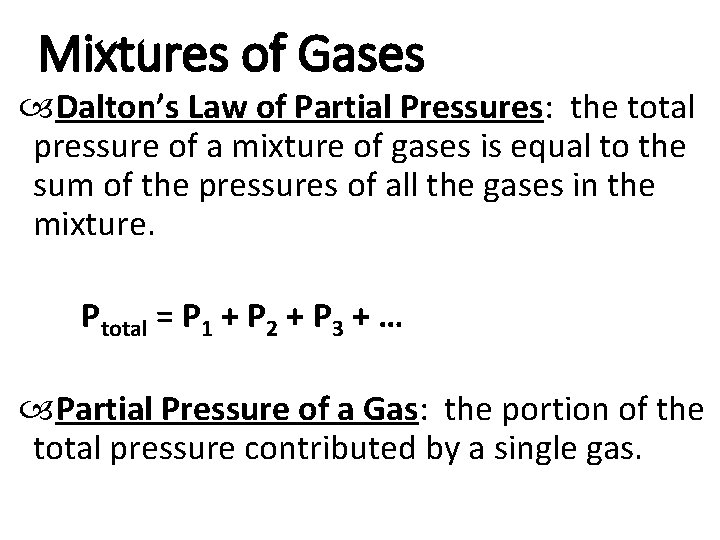
Mixtures of Gases Dalton’s Law of Partial Pressures: the total pressure of a mixture of gases is equal to the sum of the pressures of all the gases in the mixture. Ptotal = P 1 + P 2 + P 3 + … Partial Pressure of a Gas: the portion of the total pressure contributed by a single gas.
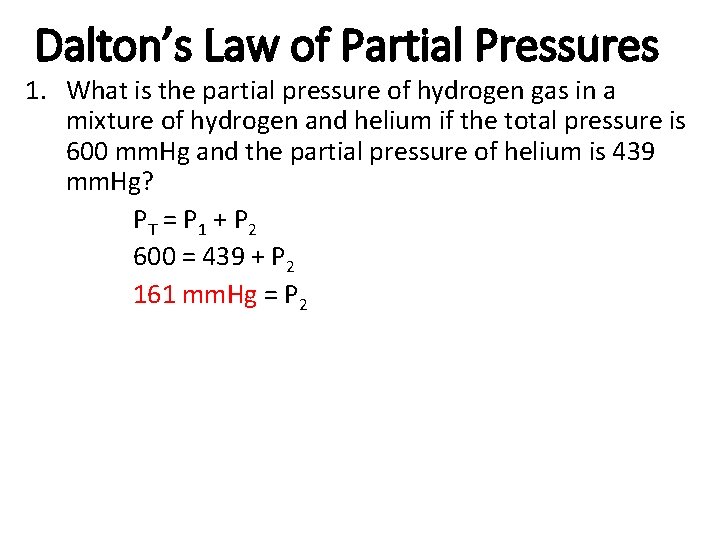
Dalton’s Law of Partial Pressures 1. What is the partial pressure of hydrogen gas in a mixture of hydrogen and helium if the total pressure is 600 mm. Hg and the partial pressure of helium is 439 mm. Hg? PT = P 1 + P 2 600 = 439 + P 2 161 mm. Hg = P 2
Dalton’s Law Problem Ex. A mixture of neon and argon gases exerts a total pressure of 2. 39 atm. The partial pressure of the neon alone is 1. 84 atm, what is the partial pressure of the argon?
Dalton’s Partial Pressure Example A synthetic atmosphere is created by blending 2 mol percent CO 2, 0. 2 mol O 2 and 1. 5 mol N 2. If the total pressure is 750 torr, calculate the partial pressure of each component. (Hint: What percent of the mixture is each gas? )
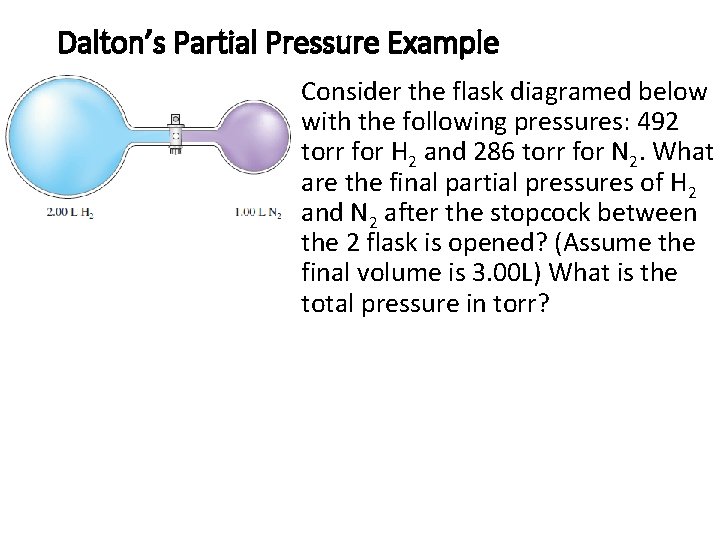
Dalton’s Partial Pressure Example Consider the flask diagramed below with the following pressures: 492 torr for H 2 and 286 torr for N 2. What are the final partial pressures of H 2 and N 2 after the stopcock between the 2 flask is opened? (Assume the final volume is 3. 00 L) What is the total pressure in torr?
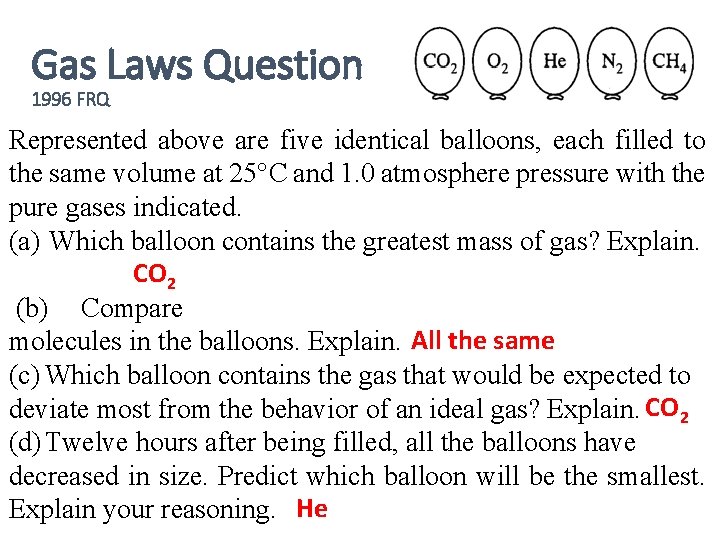
Gas Laws Question 1996 FRQ Represented above are five identical balloons, each filled to the same volume at 25°C and 1. 0 atmosphere pressure with the pure gases indicated. (a) Which balloon contains the greatest mass of gas? Explain. CO 2 (b) Compare All the same molecules in the balloons. Explain. (c) Which balloon contains the gas that would be expected to CO deviate most from the behavior of an ideal gas? Explain. 2 hours after being filled, all the balloons have (d) Twelve decreased in size. Predict which balloon will be the smallest. He Explain your reasoning.
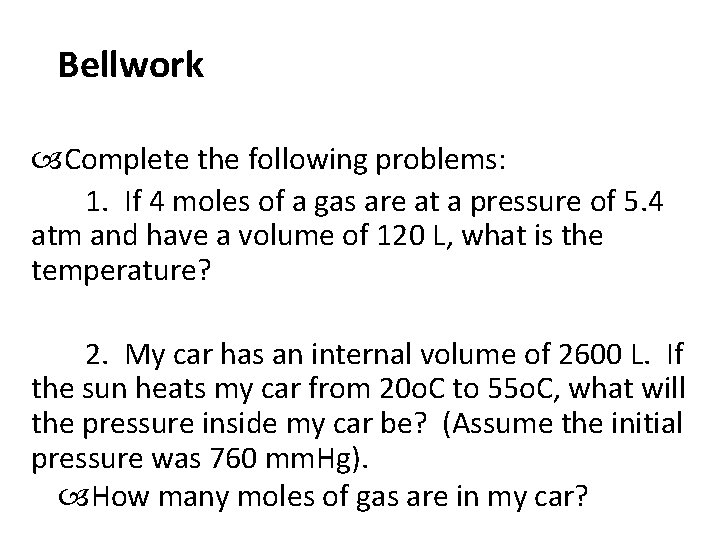
Bellwork Complete the following problems: 1. If 4 moles of a gas are at a pressure of 5. 4 atm and have a volume of 120 L, what is the temperature? 2. My car has an internal volume of 2600 L. If the sun heats my car from 20 o. C to 55 o. C, what will the pressure inside my car be? (Assume the initial pressure was 760 mm. Hg). How many moles of gas are in my car?