
Gas Exchange in Lungs Prof K Sivapalan Properties
![Factors Affecting Gas Exchange • Thickness of the Membrane- oedema [cardiac, inflammatory], fibrosis •](https://slidetodoc.com/presentation_image_h2/67eef378598307d8b41317203857dd0b/image-13.jpg "Factors Affecting Gas Exchange • Thickness of the Membrane- oedema [cardiac, inflammatory], fibrosis •")
- Slides: 13
Gas Exchange in Lungs Prof. K. Sivapalan
Properties of Gases • Gases diffuse in the direction of concentration gradient • PARTIAL PRESSURE exerted by each gas in a mixture of gasses is proportional to its concentration. • Gases in Solution: the amount dissolved depends on solubility, temperature and the partial pressure of the gas in contact with the surface • Exchange of gases in lungs is determined by the partial pressure gradient. • Gases exchanged include oxygen, carbon dioxide, nitrogen, all volatile gases in blood such as alcohole and acetone and all soluble gases in air such as anesthetics and carbon monoxide 2013 Gas Exchange 2
Water Vapor Pressure • Water behaves like other gases until it becomes saturated. • Saturated water pressure is 47 mm. Hg at 37ºC. 2013 Gas Exchange 3
Diffusion of Gases in Liquids • Rate of Gas diffusion in fluid depends on: – Partial pressure gradeance – Solubility of the gas – Surface area for diffusion – Distance – Molecular weight of the gas – The temperature of the fluid 2013 Gas Exchange 4
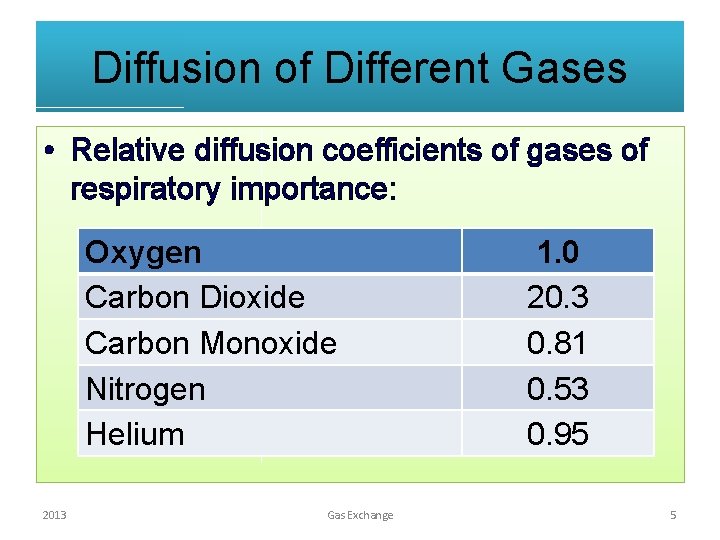
Diffusion of Different Gases • Relative diffusion coefficients of gases of respiratory importance: Oxygen Carbon Dioxide Carbon Monoxide Nitrogen Helium 2013 Gas Exchange 1. 0 20. 3 0. 81 0. 53 0. 95 5
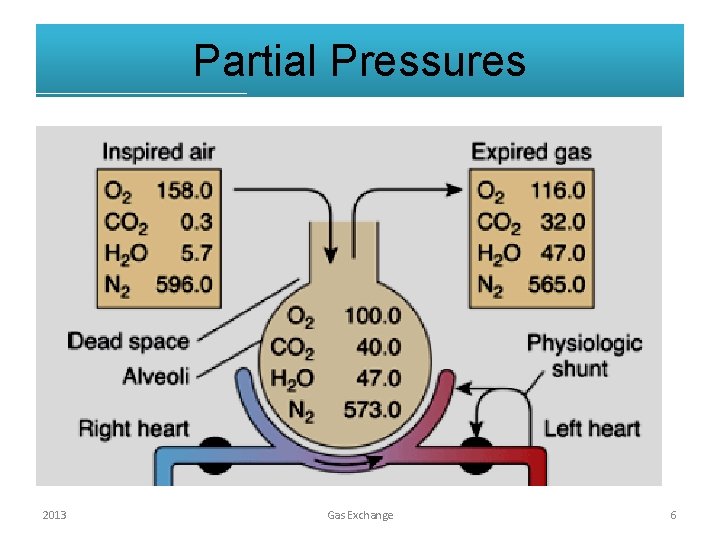
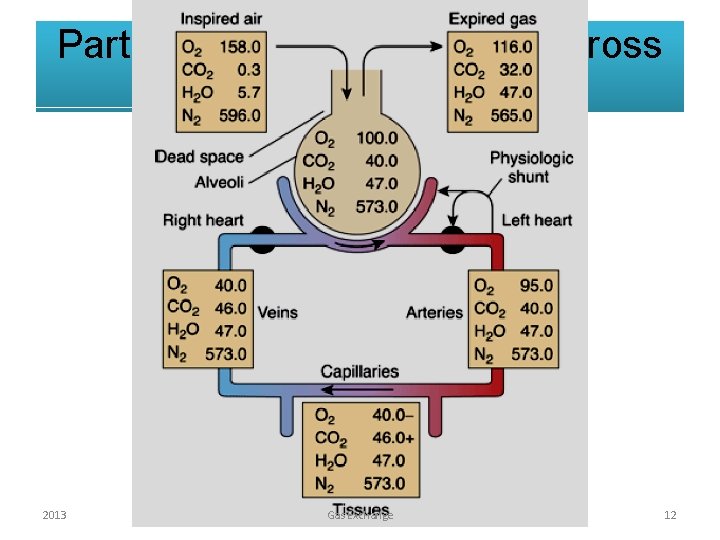
Partial Pressures 2013 Gas Exchange 6
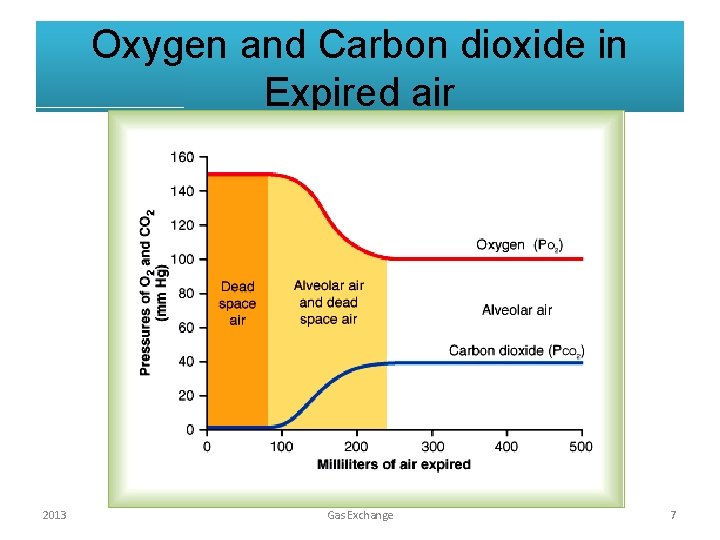
Oxygen and Carbon dioxide in Expired air 2013 Gas Exchange 7
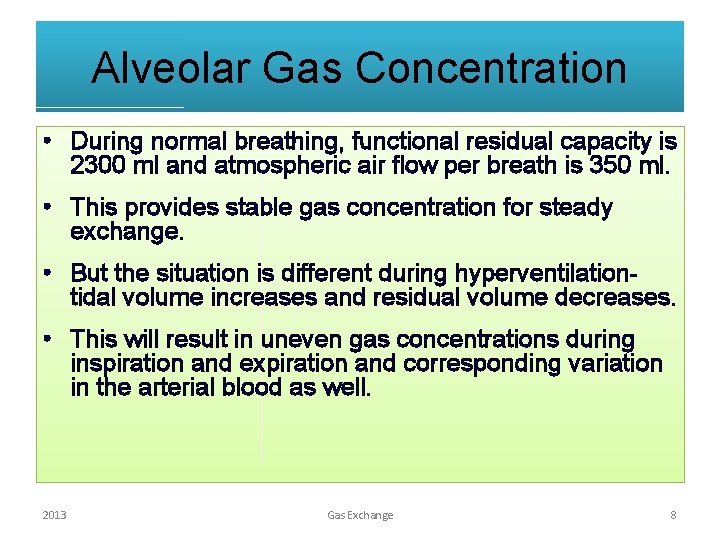
Alveolar Gas Concentration • During normal breathing, functional residual capacity is 2300 ml and atmospheric air flow per breath is 350 ml. • This provides stable gas concentration for steady exchange. • But the situation is different during hyperventilationtidal volume increases and residual volume decreases. • This will result in uneven gas concentrations during inspiration and expiration and corresponding variation in the arterial blood as well. 2013 Gas Exchange 8
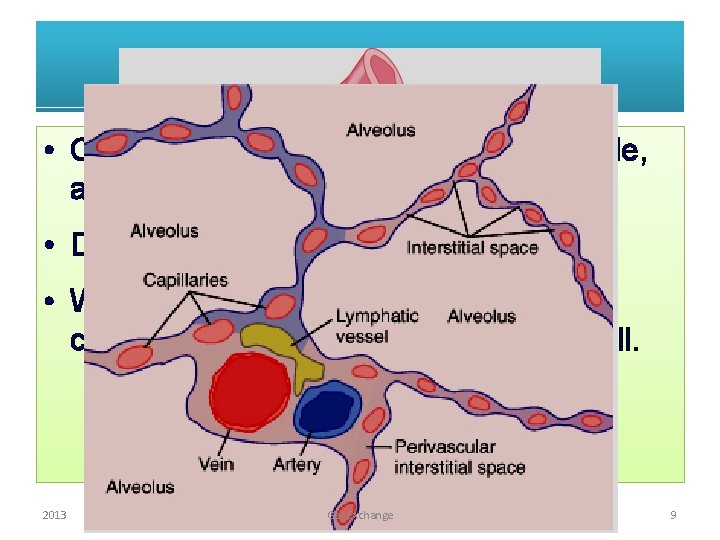
Respiratory Unit • Composed of one respiratory bronchiole, alveolar ducts, atria and alveoli. • Diameter of alveoli is 0. 2 mm. • Walls are extremely thin with inter connecting capillary net work in the wall. 2013 Gas Exchange 9
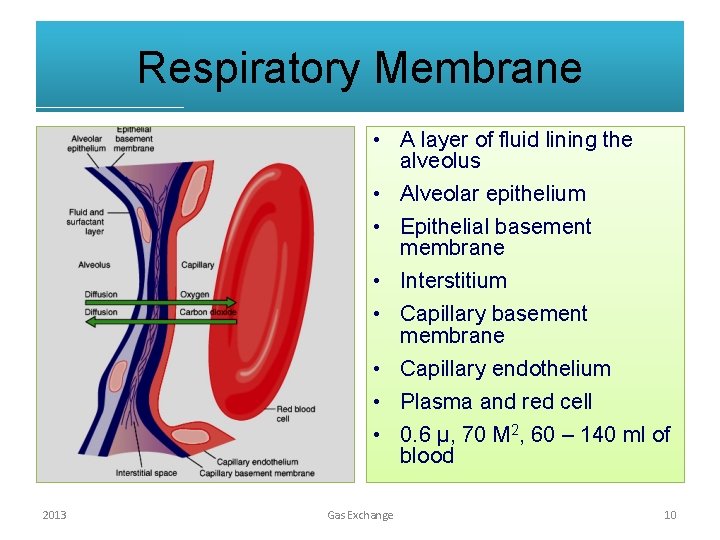
Respiratory Membrane • A layer of fluid lining the alveolus • Alveolar epithelium • Epithelial basement membrane • Interstitium • Capillary basement membrane • Capillary endothelium • Plasma and red cell • 0. 6 µ, 70 M 2, 60 – 140 ml of blood 2013 Gas Exchange 10
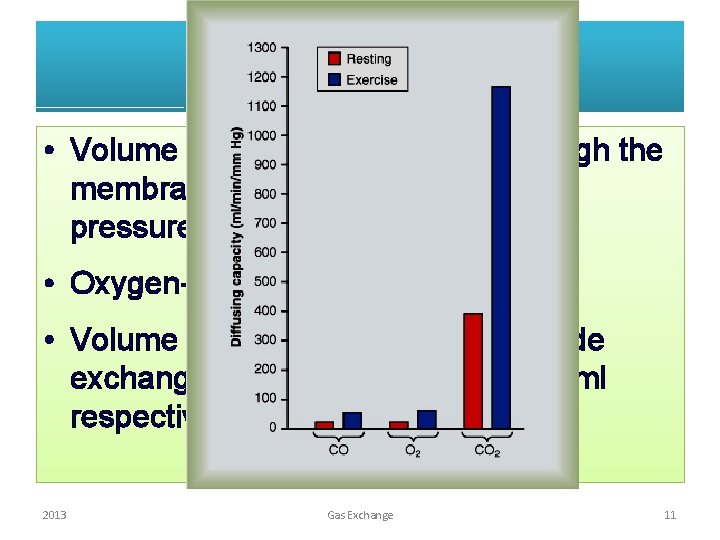
Diffusing Capacity • Volume of gas that will diffuse through the membrane in one minute for partial pressure difference of 1 mm. Hg. • Oxygen- 21 ml/min/mm Hg • Volume of oxygen and carbon dioxide exchanged by at rest- 250 and 200 ml respectively 2013 Gas Exchange 11
Partial Pressure Difference across respiratory membrane 2013 Gas Exchange 12
Factors Affecting Gas Exchange • Thickness of the Membrane- oedema [cardiac, inflammatory], fibrosis • Surface area- pulmonetomy, emphysema • Diffusion coefficient- O 2, CO 2, anesthetics • Pressure difference- composition, obstruction, ventilation perfusion ratio, altitude 2013 Gas Exchange 13