
Gas Electron Multiplier Technology Brian Clark North Carolina
Gas Electron Multiplier Technology Brian Clark North Carolina State University, USA Work conducted under the supervision of Professor Vladimir Peskov (CERN). 7/5/2007 B. Clark NCSU 1
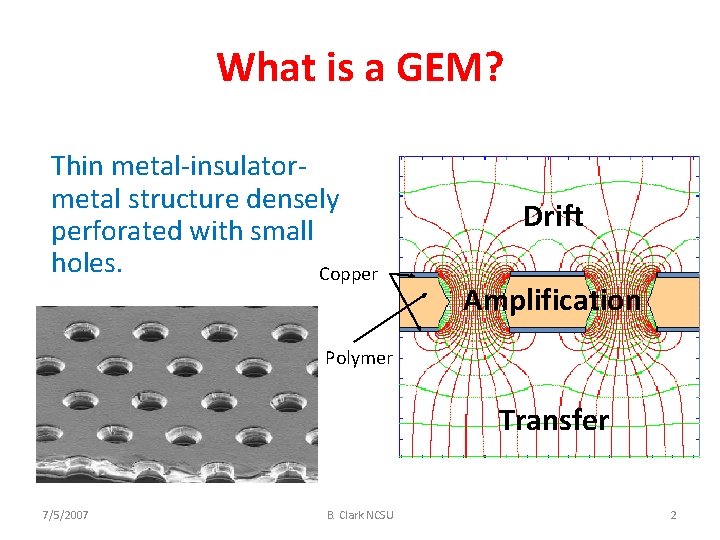
What is a GEM? Thin metal-insulatormetal structure densely perforated with small holes. Copper Drift Amplification Polymer Transfer 7/5/2007 B. Clark NCSU 2
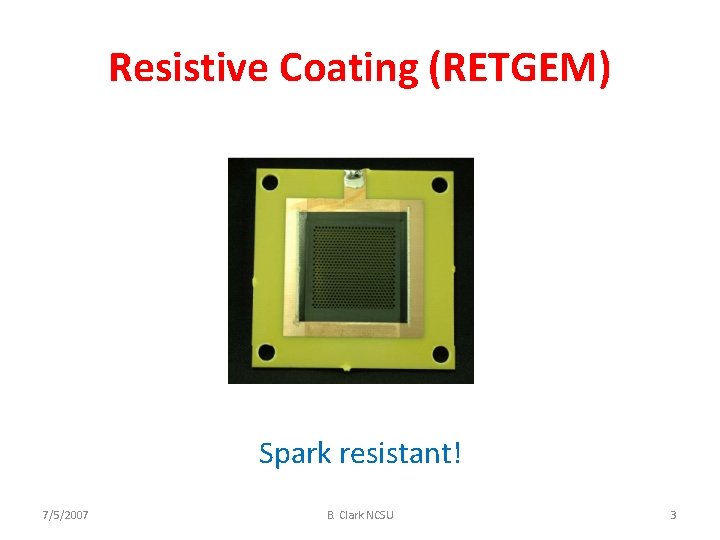
Resistive Coating (RETGEM) Spark resistant! 7/5/2007 B. Clark NCSU 3
Benefits • Geometric quenching suppresses feedback. • Great for noble gaseous detectors. • Manufactured by microelectronic technology which offers high granularity. • Relatively cheap to produce in comparison to solid state detectors. • Cost-effectiveness makes GEM ideal for experiments requiring a large detection area. 7/5/2007 B. Clark NCSU 4
Applications ICARUS XENON LHCb COMPASS HERA-B TOTEM ALICE 7/5/2007 B. Clark NCSU 5

7/5/2007 B. Clark NCSU 6
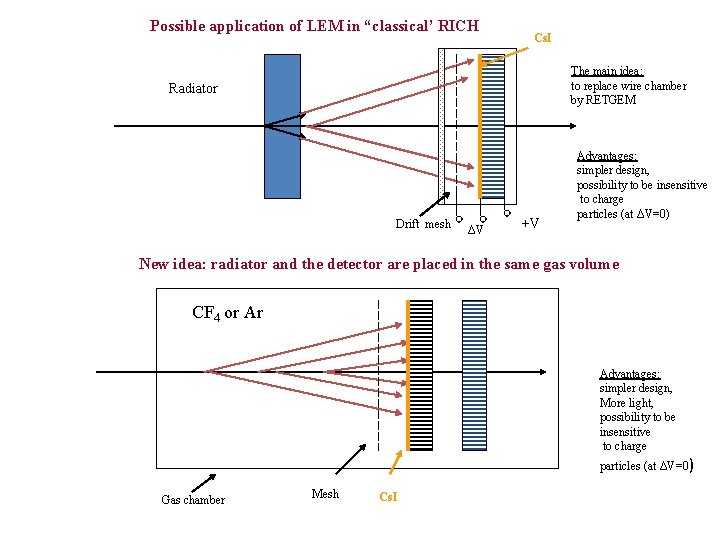
Possible application of LEM in “classical’ RICH Cs. I The main idea: to replace wire chamber by RETGEM Radiator Drift mesh ΔV +V Advantages: simpler design, possibility to be insensitive to charge particles (at ΔV=0) New idea: radiator and the detector are placed in the same gas volume CF 4 or Ar Advantages: simpler design, More light, possibility to be insensitive to charge particles (at ΔV=0) Gas chamber Mesh Cs. I
My Role • Understand the basic operating principles of the detector. • Confirm previous measurements using the RETGEM. • Confirm previous QE measurements of the Cs. Icoating often applied to GEM. • Test RETGEM at cryogenic temperatures. • Test GEM for RICH applications. 7/5/2007 B. Clark NCSU 8
- Slides: 8