
Gas Chromatography What is Chromatography color writing the

- Slides: 24
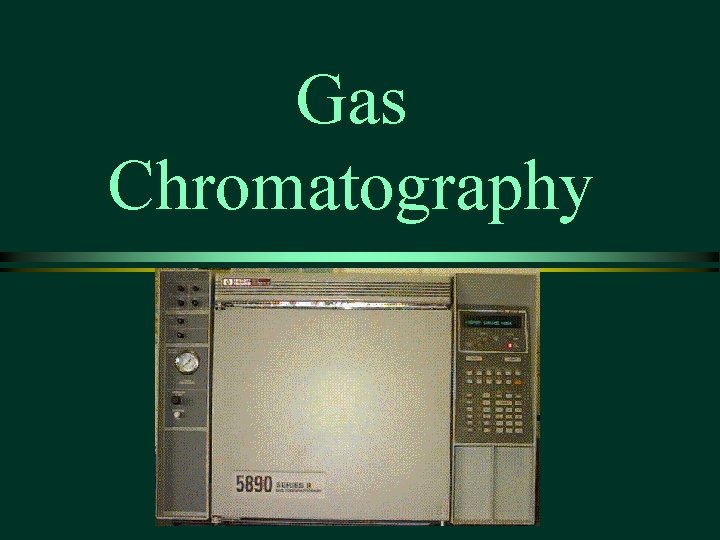
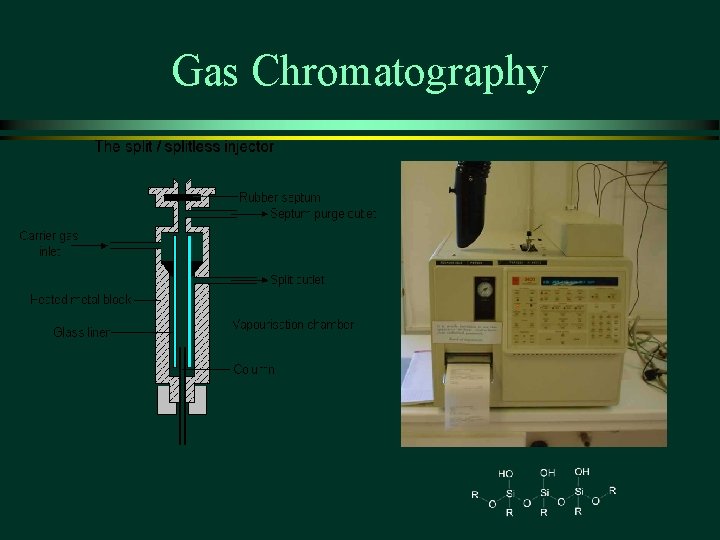
Gas Chromatography
What is “Chromatography” “color writing” ä the separation of mixtures into their constituents by preferential adsorption by a solid” (Random House College Dictionary, 1988) ä “Chromatography is a physical method of separation in which the components to be separated are distributed between two phases, one of the phases constituting a _______ stationary bed of large surface area, the other being a ______ fluid that percolates through or along the stationary bed. ” (Ettre & Zlatkis, 1967, “The Practice of Gas Chromatography) ä
Applications Compound must exist as a ____ gas at a temperature that can be produced by the GC and withstood by the column (up to 450°C) ä Alcohols in blood ä Aromatics (benzene, toluene, ethylbenzene, xylene) ä Flavors and Fragrances ä Permanent gases (H 2, N 2, O 2, Ar, CO 2, CO, CH 4) ä Hydrocarbons ä Pesticides, Herbicides, PCBs, and Dioxins ä Solvents ä
Advantages of Gas Chromatography Requires only very small samples with little preparation ä Good at separating complex mixtures into components ä Results are rapidly obtained (1 to 100 minutes) ä Very high precision ä Only instrument with the sensitivity to detect volatile organic mixtures of low concentrations ä Equipment is not very complex (sophisticated oven) ä
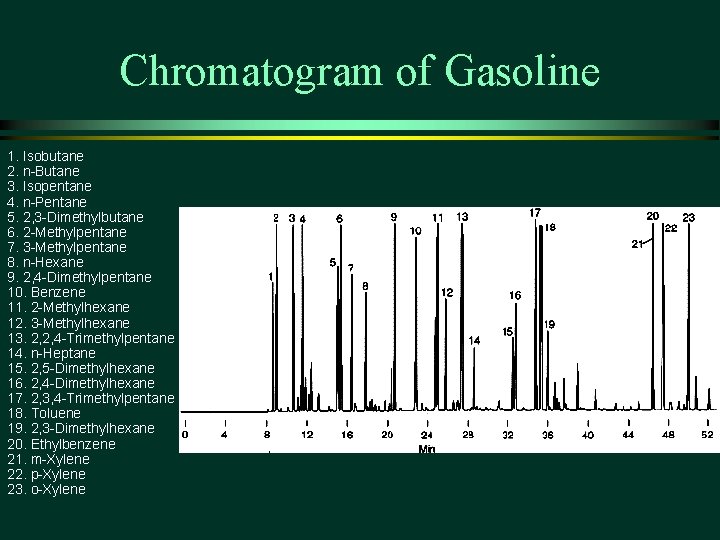
Chromatogram of Gasoline 1. Isobutane 2. n-Butane 3. Isopentane 4. n-Pentane 5. 2, 3 -Dimethylbutane 6. 2 -Methylpentane 7. 3 -Methylpentane 8. n-Hexane 9. 2, 4 -Dimethylpentane 10. Benzene 11. 2 -Methylhexane 12. 3 -Methylhexane 13. 2, 2, 4 -Trimethylpentane 14. n-Heptane 15. 2, 5 -Dimethylhexane 16. 2, 4 -Dimethylhexane 17. 2, 3, 4 -Trimethylpentane 18. Toluene 19. 2, 3 -Dimethylhexane 20. Ethylbenzene 21. m-Xylene 22. p-Xylene 23. o-Xylene
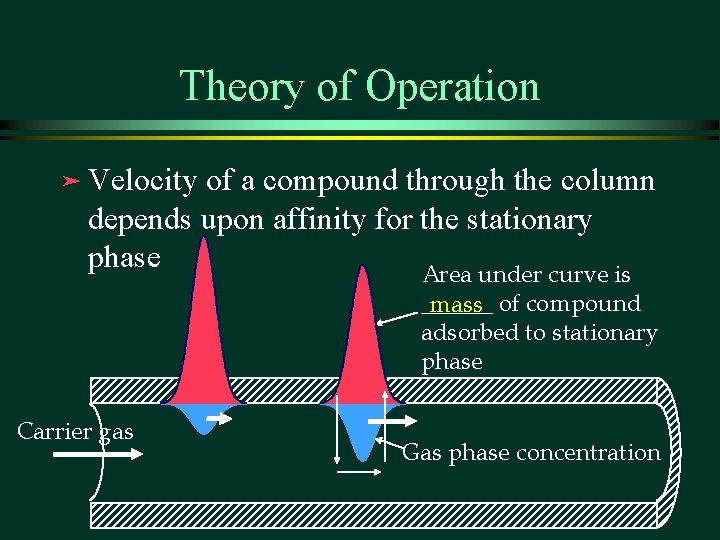
Theory of Operation ä Velocity of a compound through the column depends upon affinity for the stationary phase Area under curve is ______ mass of compound adsorbed to stationary phase Carrier gas Gas phase concentration
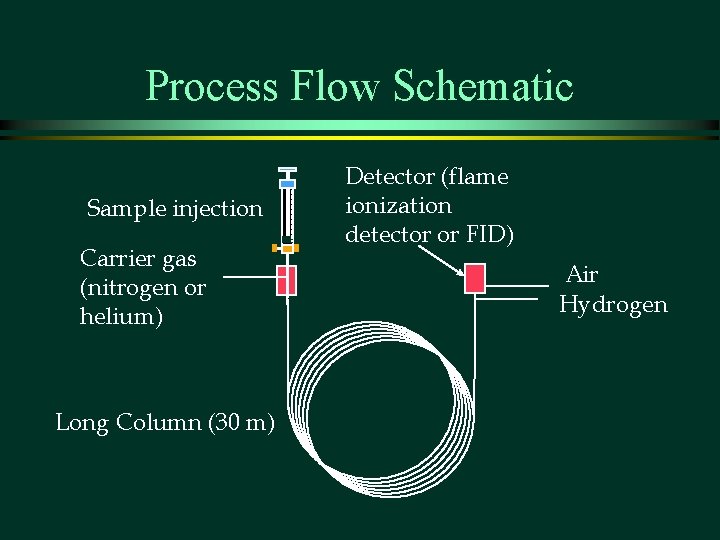
Process Flow Schematic Sample injection Carrier gas (nitrogen or helium) Long Column (30 m) Detector (flame ionization detector or FID) Air Hydrogen
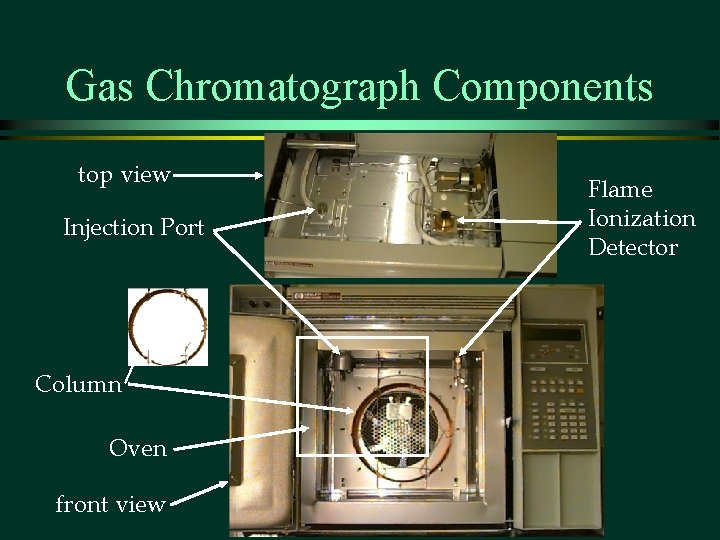
Gas Chromatograph Components top view Injection Port Column Oven front view Flame Ionization Detector
Gas Chromatography
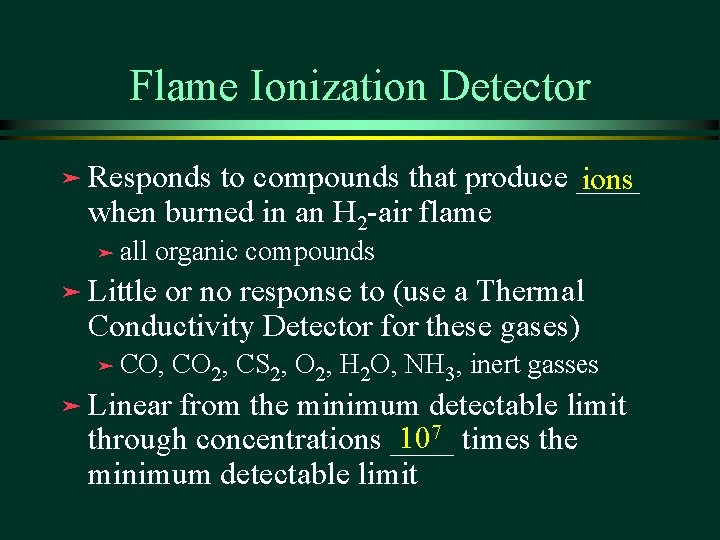
Flame Ionization Detector ä Responds to compounds that produce ____ ions when burned in an H 2 -air flame ä all organic compounds ä Little or no response to (use a Thermal Conductivity Detector for these gases) ä CO, ä Linear CO 2, CS 2, O 2, H 2 O, NH 3, inert gasses from the minimum detectable limit 107 times the through concentrations ____ minimum detectable limit
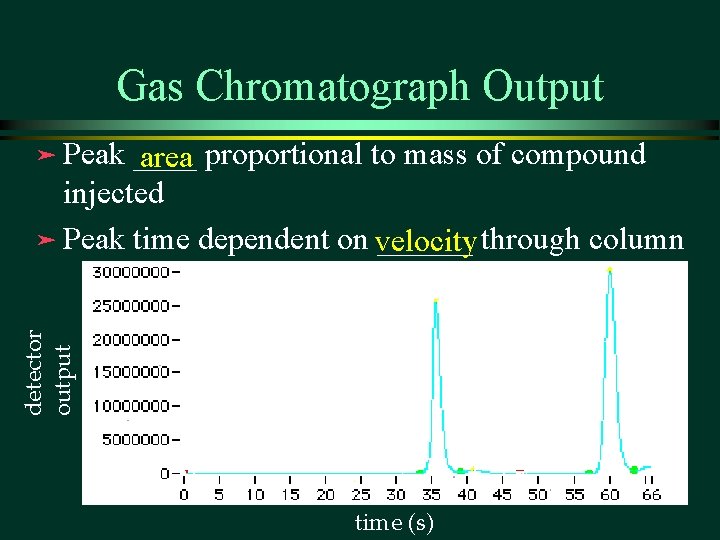
Gas Chromatograph Output ____ area proportional to mass of compound injected ä Peak time dependent on velocity ______ through column detector output ä Peak time (s)
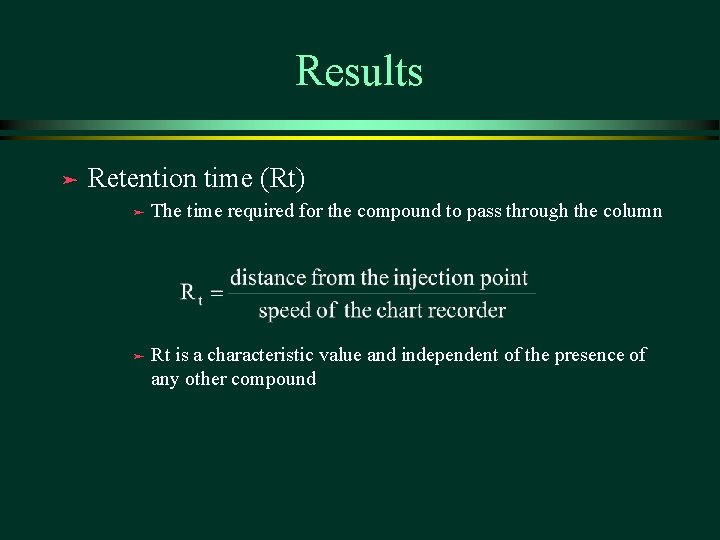
Results ä Retention time (Rt) ä ä The time required for the compound to pass through the column Rt is a characteristic value and independent of the presence of any other compound
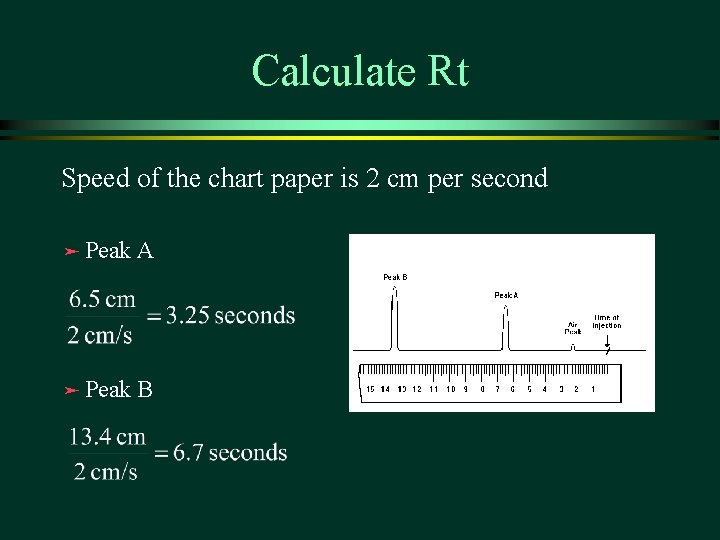
Calculate Rt Speed of the chart paper is 2 cm per second ä Peak A ä Peak B
Results ä Qualitative ä If the sample is suspected to be a certain compound, the sample can be “spiked” with said compound. In the read out, if there is no new peak for the “spiked” compound, the sample and the compound are the same. ä Quantitative ä In the read out, the area under the curve is the amount of the compound (integrate the peak)
Results ä Quantitative ä Two measurement Type of Peaks Asymmetric peak ä Cut the area under the peak out of the read out and mass the weight. For this to be accurate the GC must be calibrated. ä Symmetric peak ä Measure the height and the width at half of the height ä
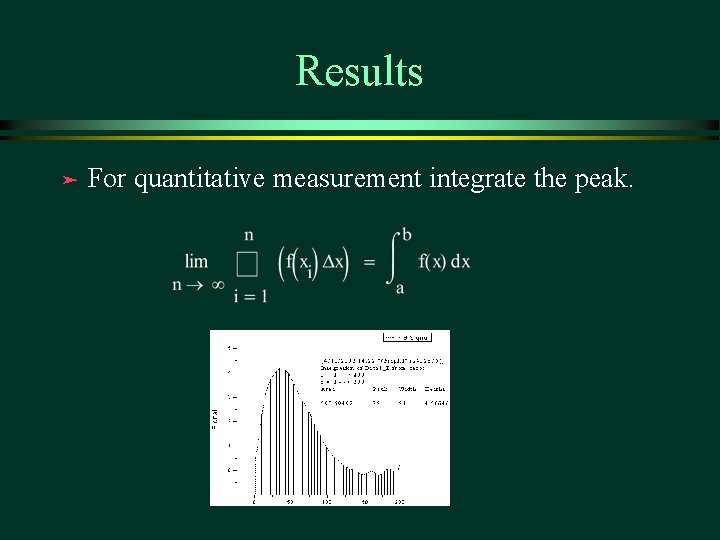
Results ä For quantitative measurement integrate the peak.
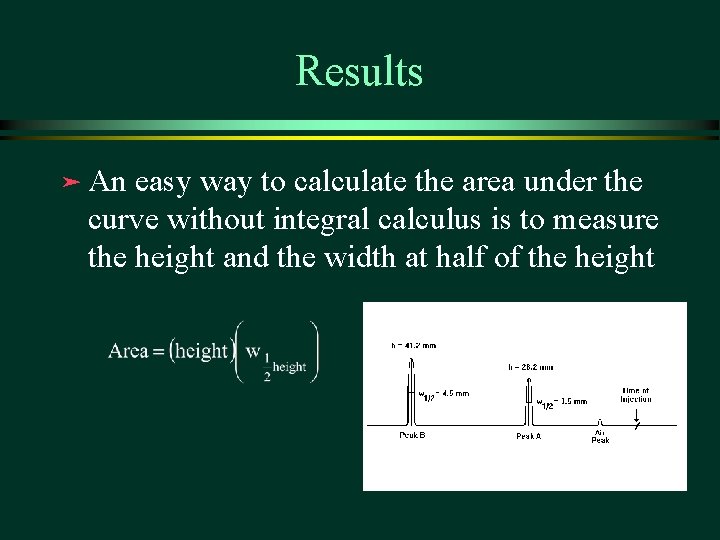
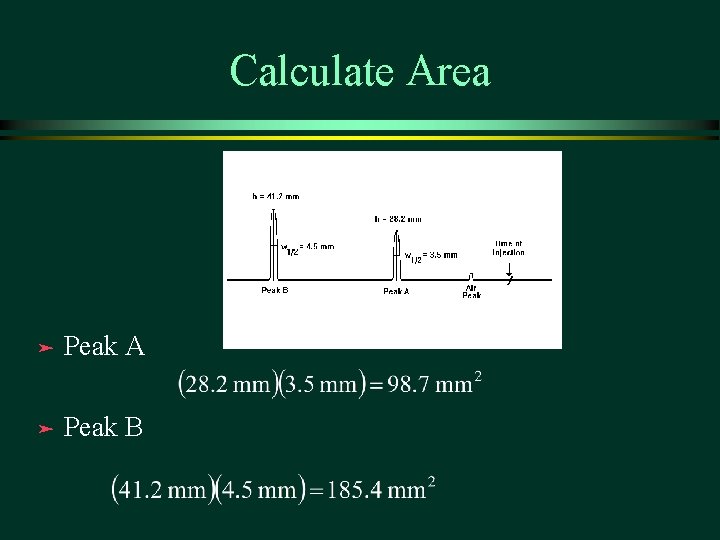
Results ä An easy way to calculate the area under the curve without integral calculus is to measure the height and the width at half of the height
Calculate Area ä Peak A ä Peak B
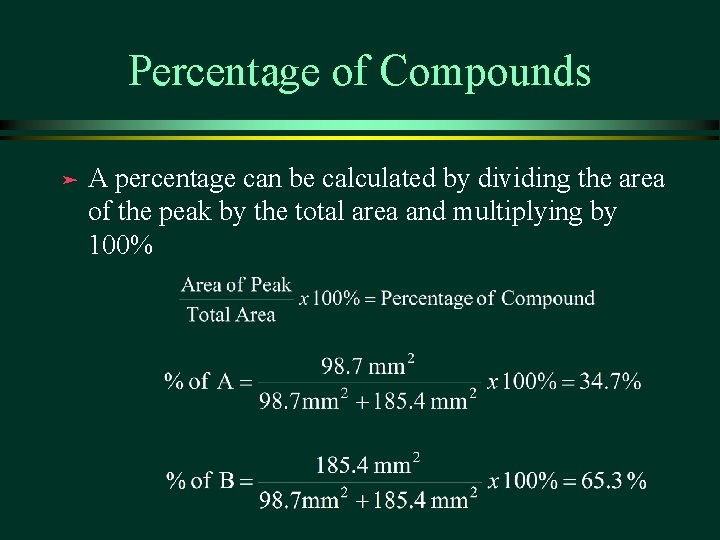
Percentage of Compounds ä A percentage can be calculated by dividing the area of the peak by the total area and multiplying by 100%
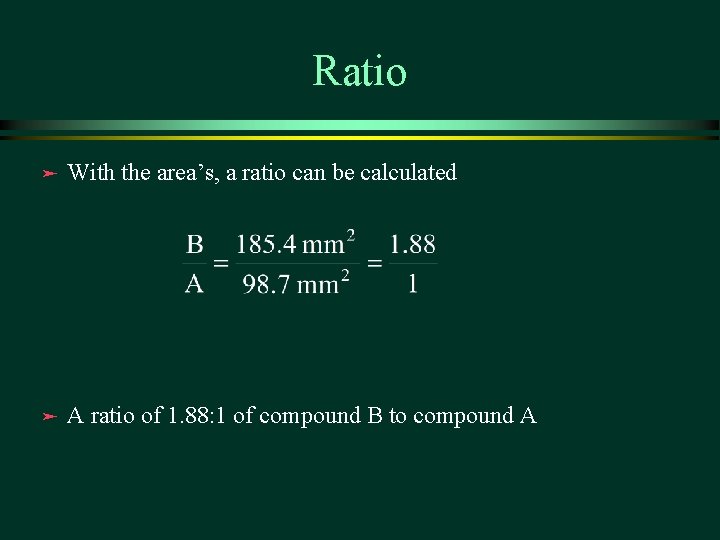
Ratio ä With the area’s, a ratio can be calculated ä A ratio of 1. 88: 1 of compound B to compound A
Pros for GC ä Speed ä Resolution ä Qualitative analysis ä Quantitative analysis
Pros for GC cont… ä Sensitivity ä Simplicity ä Inexpensive
Cons for GC ä Can be slow ä Quantitative analysis ä Destructive ä Volatility
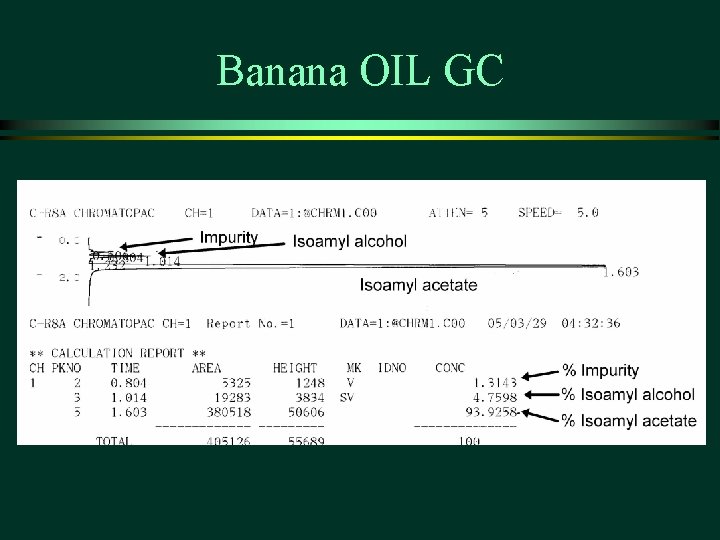
Banana OIL GC