
Garbage Collection CS 537 Introduction to Operating Systems
Garbage Collection CS 537 - Introduction to Operating Systems
Freeing Memory • Some systems require user to call free when finished with memory – C / C++ – reason for destructors in C++ • Other systems detect unused memory and reclaim it – Garbage Collection – this is what Java does
Garbage Collection • Basic idea – keep track of what memory is referenced and when it is no longer accessible, reclaim the memory • Example – linked list
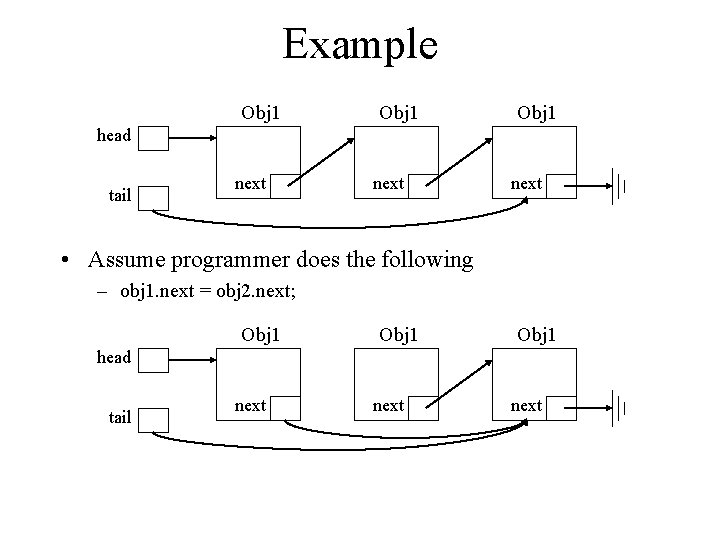
Example Obj 1 head tail next • Assume programmer does the following – obj 1. next = obj 2. next; Obj 1 head tail next
Example • Now there is no way for programmer to reference obj 2 – it’s garbage • In system without garbage collection this is called a memory leak – location can’t be used but can’t be reallocated – waste of memory and can eventually crash a program • In system with garbage collection this chunk will be found and reclaimed
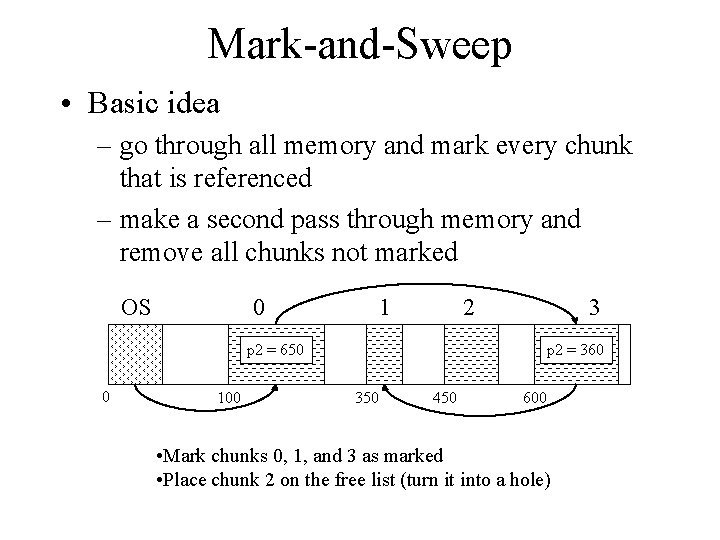
Mark-and-Sweep • Basic idea – go through all memory and mark every chunk that is referenced – make a second pass through memory and remove all chunks not marked OS 0 1 2 3 p 2 = 650 0 100 p 2 = 360 350 450 600 • Mark chunks 0, 1, and 3 as marked • Place chunk 2 on the free list (turn it into a hole)
Mark-and-Sweep Issues • Have to be able to identify all references – this is difficult in some languages – similar to compaction • Requires jumping all over memory – terrible for performance • cache hits • virtual memory • Have to stop everything else to do • Search time proportional to non-garbage – may require lots of work for little reward
Reference Counting • Basic idea – give each chunk a special field that is the number of references to chunk – whenever a new reference is made, increment field by 1 – whenever a reference is removed, decrement field by 1 – when reference count goes to zero, collect chunk • Requires compiler support
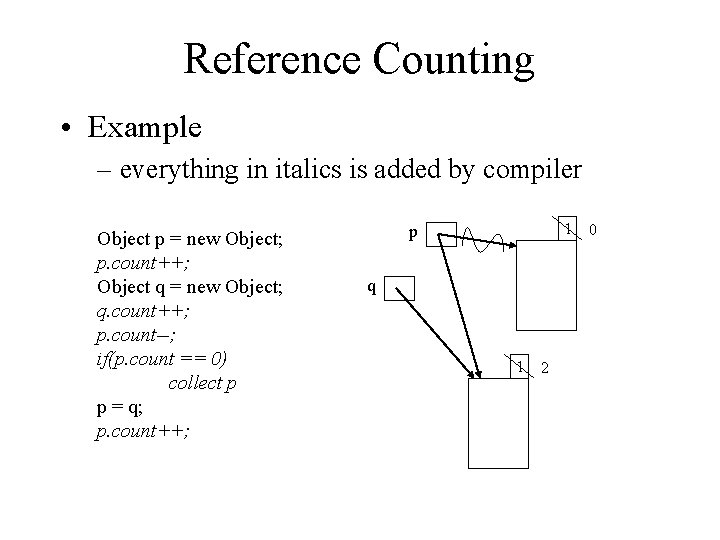
Reference Counting • Example – everything in italics is added by compiler Object p = new Object; p. count++; Object q = new Object; q. count++; p. count--; if(p. count == 0) collect p p = q; p. count++; 1 p q 1 2 0
Reference Counting • Above example does not check for NULL reference Object p = new Object p. count++; p. count--; p = NULL; if(p != NULL) p. count++;
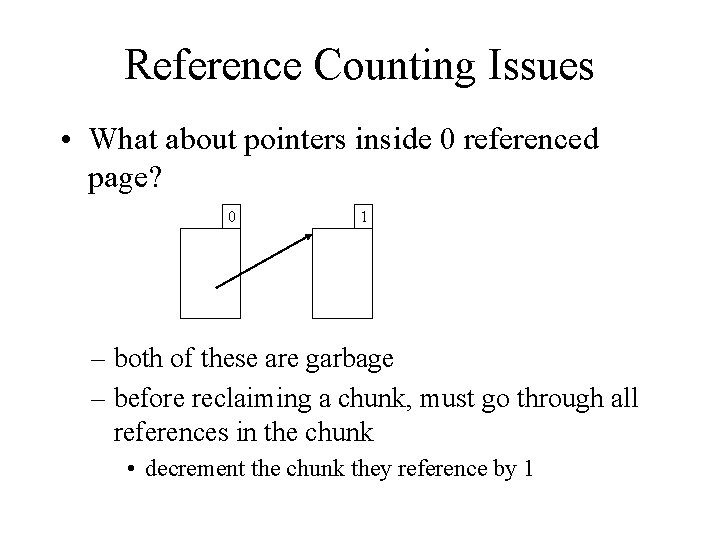
Reference Counting Issues • What about pointers inside 0 referenced page? 0 1 – both of these are garbage – before reclaiming a chunk, must go through all references in the chunk • decrement the chunk they reference by 1
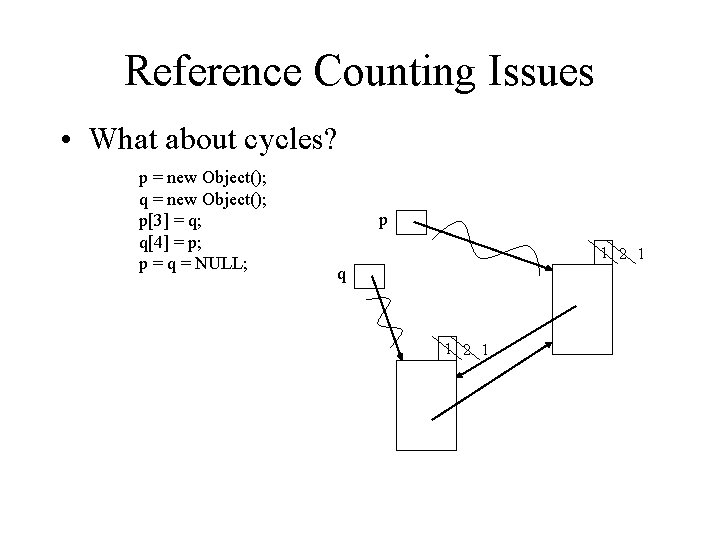
Reference Counting Issues • What about cycles? p = new Object(); q = new Object(); p[3] = q; q[4] = p; p = q = NULL; p 1 2 1 q 1 2 1
Reference Counting Issues • Both of the chunks above are garbage • Both of the chunks above have a reference count of 1 • Neither chunk will be reclaimed • Reference counting fails conservatively – it may not collect all the garbage – but it will never throw away non-garbage
Reference Counting Issues • Final conclusions – relatively fast • it does collection immediately on garbage – safe • never throws away non-garbage – mostly works • has problems with cycles
Generational Garbage Collection • Basic idea – occasionally create a new area in memory – every time an object is referenced, move it to that new area – when the original area becomes sparse, run mark-and-sweep on it • move surviving chunks to the new area • This method also compacts data in new region
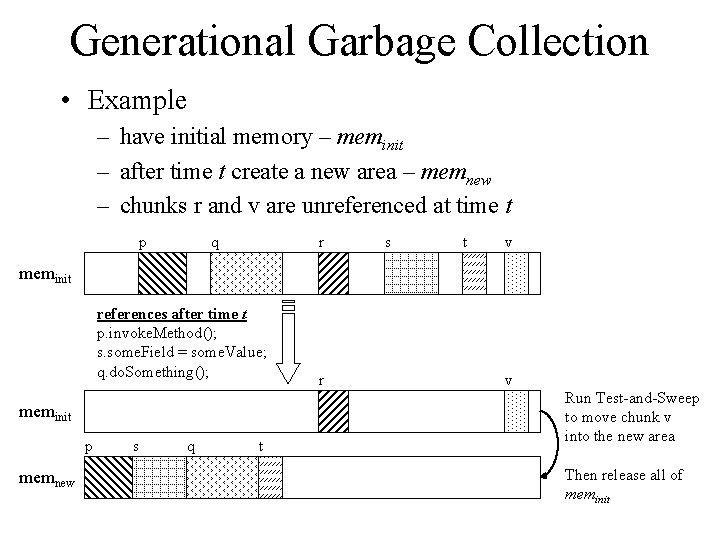
Generational Garbage Collection • Example – have initial memory – meminit – after time t create a new area – memnew – chunks r and v are unreferenced at time t p q r s t v meminit references after time t p. invoke. Method(); s. some. Field = some. Value; q. do. Something(); meminit p memnew s q t r v Run Test-and-Sweep to move chunk v into the new area Then release all of meminit
Generational Garbage Collection • After running for awhile, there should be multiple memory areas – some of these areas will consist of long lived chunks • do collection on these areas infrequently – some of these areas will consist of short lived chunks • do collection on these areas frequently • This is where the name of the algorithm comes from
Generational Collection Issues • Same issues as those for compaction – identifying pointers – overhead of copying data – must interrupt the system to run the algorithm • On the good side – much faster than mark-and-sweep – collects all the garbage • unlike reference counting • This is the method of choice in today’s world
- Slides: 18