
GAPD Photon detection efficiency Simonetta Gentile 1 F
![G-APD Photon detection efficiency Simonetta Gentile 1 F. Meddi 1 E. Kuznetsova 2 [1]Università](https://slidetodoc.com/presentation_image/b09737ccf43123fe4bb5e2aaad953261/image-1.jpg "G-APD Photon detection efficiency Simonetta Gentile 1 F. Meddi 1 E. Kuznetsova 2 [1]Università")

![PDE CPTA Ignoring Events/bin CPTA charge [ADC counts] Preliminary results Thermogeneration contribution. AP considered](https://slidetodoc.com/presentation_image/b09737ccf43123fe4bb5e2aaad953261/image-23.jpg "PDE CPTA Ignoring Events/bin CPTA charge [ADC counts] Preliminary results Thermogeneration contribution. AP considered")
![Events/bin CPTA Crosstalk Average x-talk ~ 1. 7% charge [ADC counts] P charge [ADC](https://slidetodoc.com/presentation_image/b09737ccf43123fe4bb5e2aaad953261/image-26.jpg "Events/bin CPTA Crosstalk Average x-talk ~ 1. 7% charge [ADC counts] P charge [ADC")
- Slides: 28
G-APD Photon detection efficiency Simonetta Gentile 1 F. Meddi 1 E. Kuznetsova 2 [1]Università di Roma, La Sapienza, INFN [2 ]curremtly DESY Simonetta Gentile, LCWS 10, 26 -30 March 2010, Beijing, China. 1
Outline Motivation Measurements Setup Samples Fitting Procedureses Results Conclusions The results presented are preliminary. Simonetta Gentile, LCWS 10, 26 -30 March 2010, Beijing, China. 2
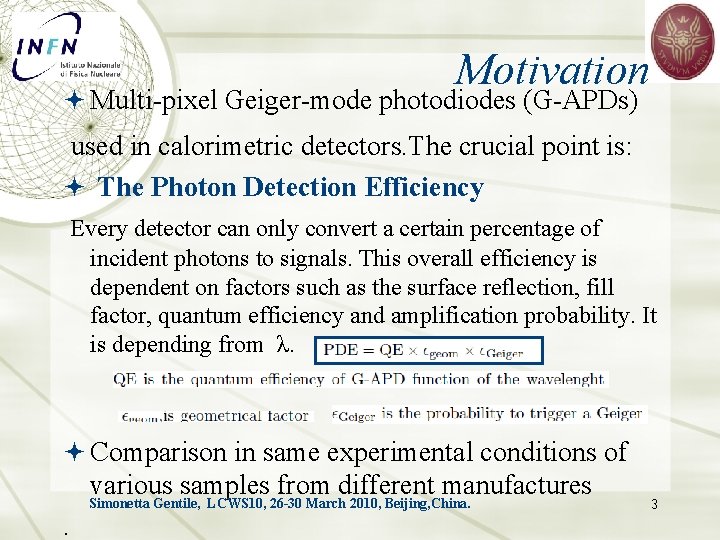
Motivation Multi-pixel Geiger-mode photodiodes (G-APDs) used in calorimetric detectors. The crucial point is: The Photon Detection Efficiency Every detector can only convert a certain percentage of incident photons to signals. This overall efficiency is dependent on factors such as the surface reflection, fill factor, quantum efficiency and amplification probability. It is depending from λ. Comparison in same experimental conditions of . various samples from different manufactures Simonetta Gentile, LCWS 10, 26 -30 March 2010, Beijing, China. 3
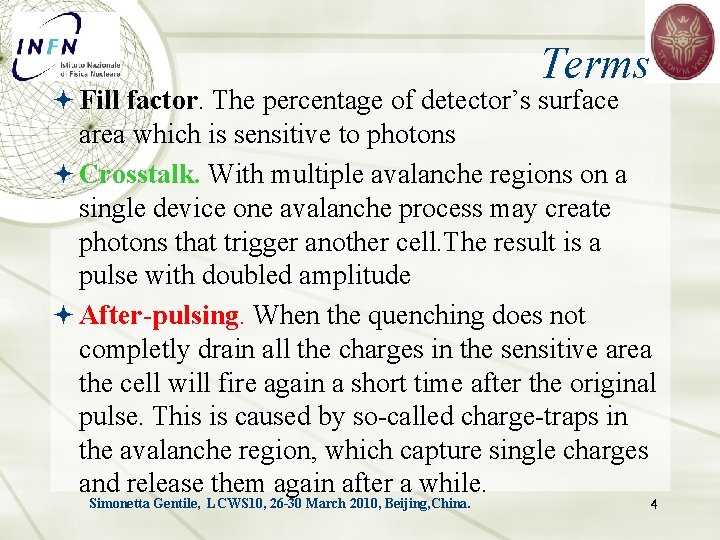
Terms Fill factor. The percentage of detector’s surface area which is sensitive to photons Crosstalk. With multiple avalanche regions on a single device one avalanche process may create photons that trigger another cell. The result is a pulse with doubled amplitude After-pulsing. When the quenching does not completly drain all the charges in the sensitive area the cell will fire again a short time after the original pulse. This is caused by so-called charge-traps in the avalanche region, which capture single charges and release them again after a while. Simonetta Gentile, LCWS 10, 26 -30 March 2010, Beijing, China. 4
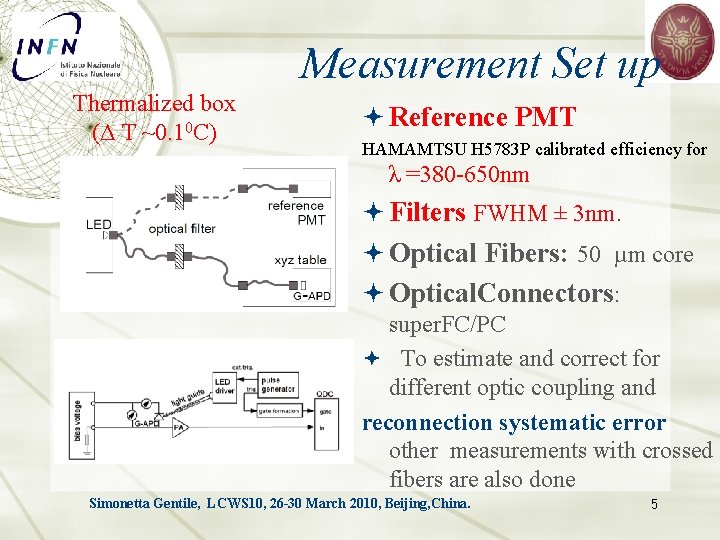
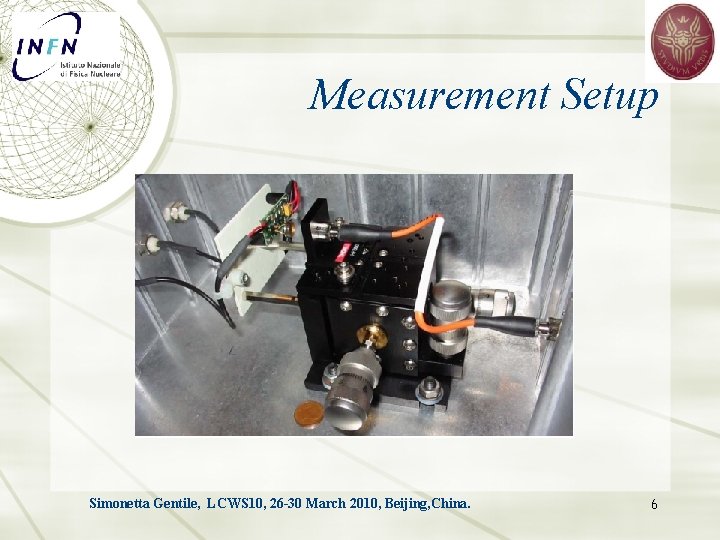
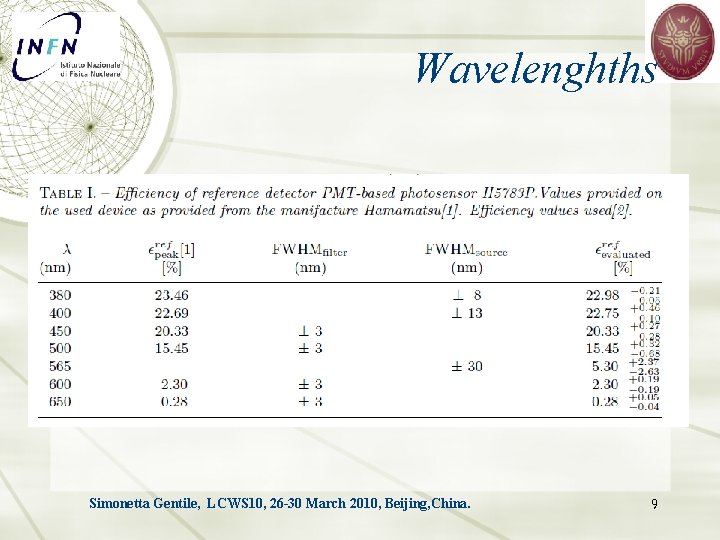
Measurement Set up Thermalized box (Δ T ~0. 10 C) Reference PMT HAMAMTSU H 5783 P calibrated efficiency for λ =380 -650 nm Filters FWHM ± 3 nm. Optical Fibers: 50 µm core Optical. Connectors: super. FC/PC To estimate and correct for different optic coupling and reconnection systematic error other measurements with crossed fibers are also done Simonetta Gentile, LCWS 10, 26 -30 March 2010, Beijing, China. 5
Measurement Setup Simonetta Gentile, LCWS 10, 26 -30 March 2010, Beijing, China. 6
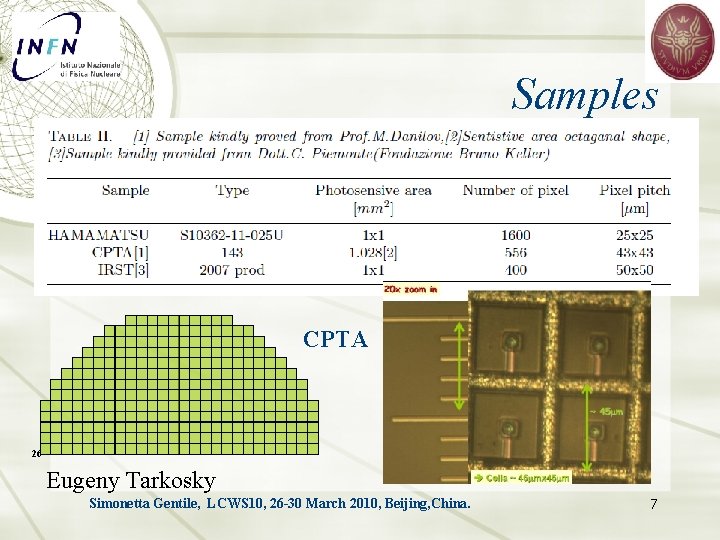
Samples CPTA 26 Eugeny Tarkosky Simonetta Gentile, LCWS 10, 26 -30 March 2010, Beijing, China. 7
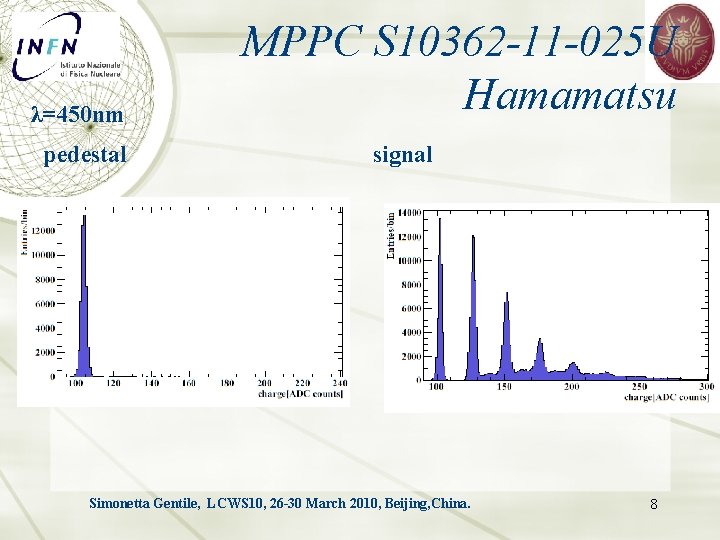
λ=450 nm pedestal MPPC S 10362 -11 -025 U Hamamatsu signal Simonetta Gentile, LCWS 10, 26 -30 March 2010, Beijing, China. 8
Wavelenghths Simonetta Gentile, LCWS 10, 26 -30 March 2010, Beijing, China. 9
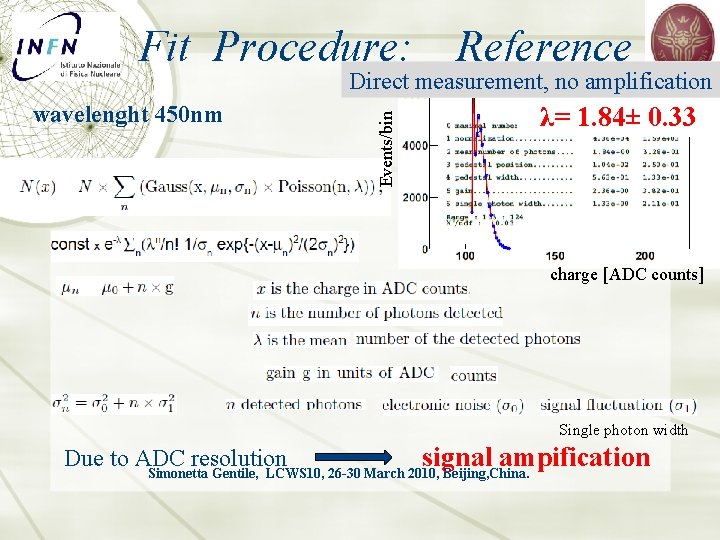
Fit Procedure: Reference Direct measurement, no amplification λ= 1. 84± 0. 33 Events/bin wavelenght 450 nm charge [ADC counts] Single photon width Due to ADC resolution signal ampification Simonetta Gentile, LCWS 10, 26 -30 March 2010, Beijing, China.
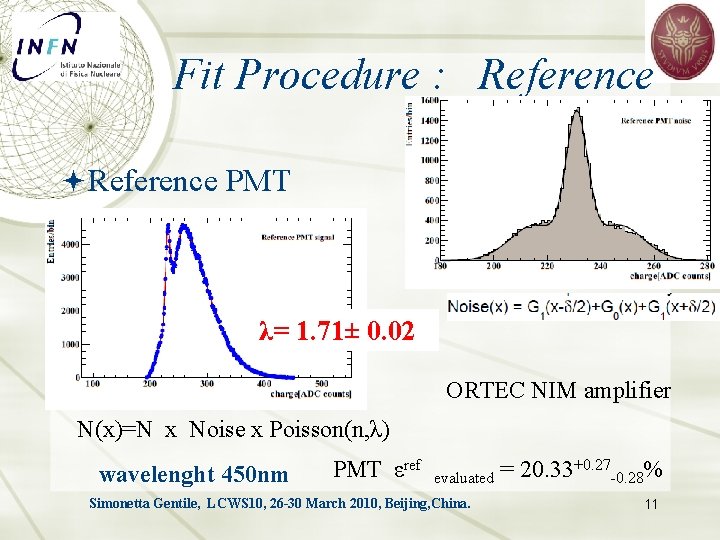
Fit Procedure : Reference PMT λ= 1. 71± 0. 02 ORTEC NIM amplifier N(x)=N x Noise x Poisson(n, λ) wavelenght 450 nm PMT εref evaluated Simonetta Gentile, LCWS 10, 26 -30 March 2010, Beijing, China. = 20. 33+0. 27 -0. 28% 11
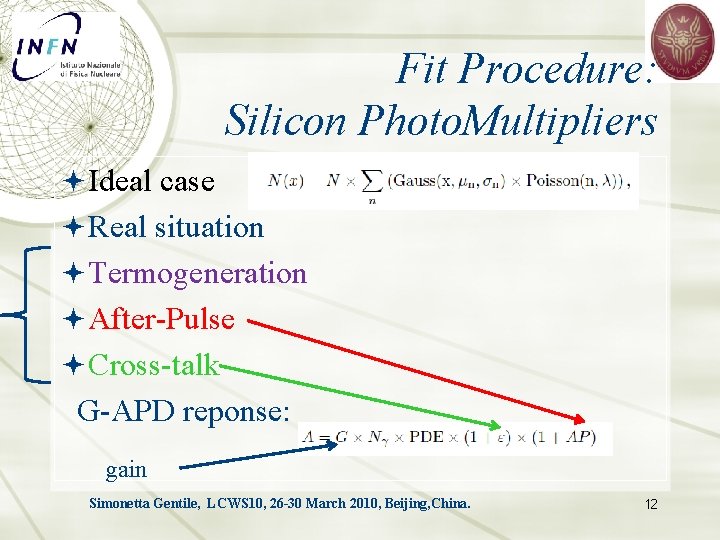
Fit Procedure: Silicon Photo. Multipliers Ideal case Real situation Termogeneration After-Pulse Cross-talk G-APD reponse: gain Simonetta Gentile, LCWS 10, 26 -30 March 2010, Beijing, China. 12
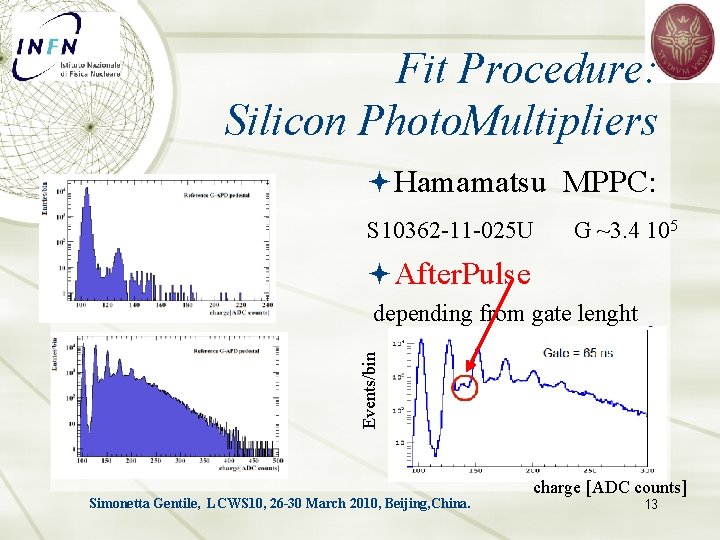
Fit Procedure: Silicon Photo. Multipliers Hamamatsu MPPC: S 10362 -11 -025 U G ~3. 4 105 After. Pulse Events/bin depending from gate lenght Simonetta Gentile, LCWS 10, 26 -30 March 2010, Beijing, China. charge [ADC counts] 13
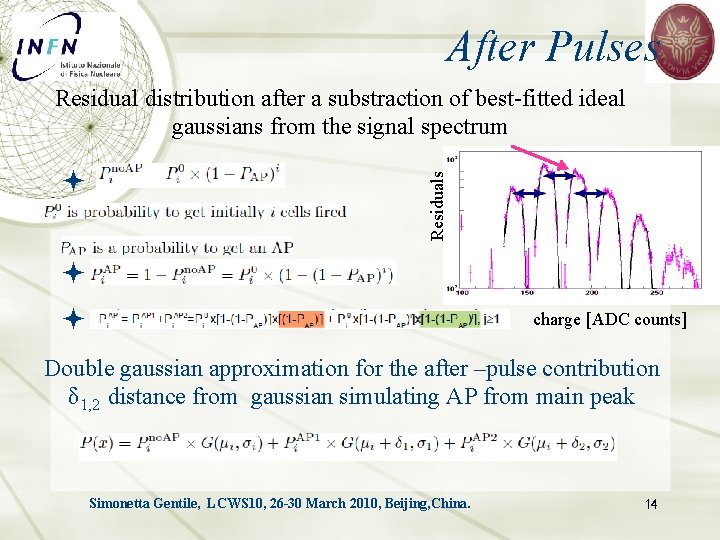
After Pulses Residuals Residual distribution after a substraction of best-fitted ideal gaussians from the signal spectrum charge [ADC counts] Double gaussian approximation for the after –pulse contribution δ 1, 2 distance from gaussian simulating AP from main peak Simonetta Gentile, LCWS 10, 26 -30 March 2010, Beijing, China. 14
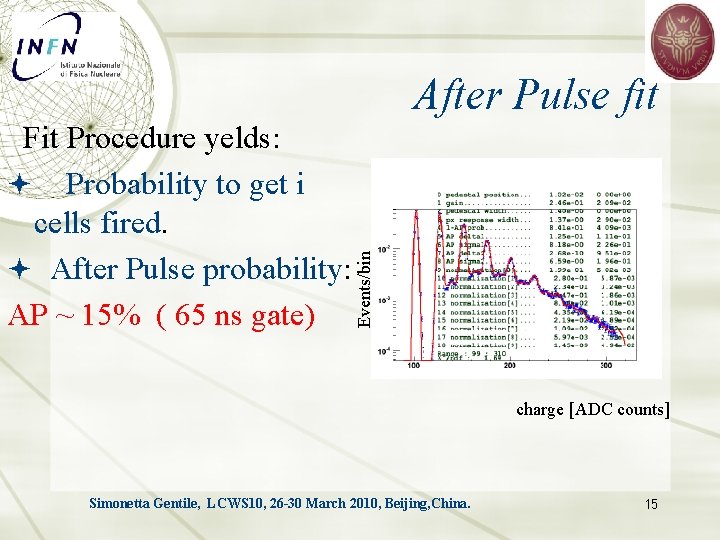
Fit Procedure yelds: Probability to get i cells fired. After Pulse probability: AP ~ 15% ( 65 ns gate) Events/bin After Pulse fit charge [ADC counts] Simonetta Gentile, LCWS 10, 26 -30 March 2010, Beijing, China. 15
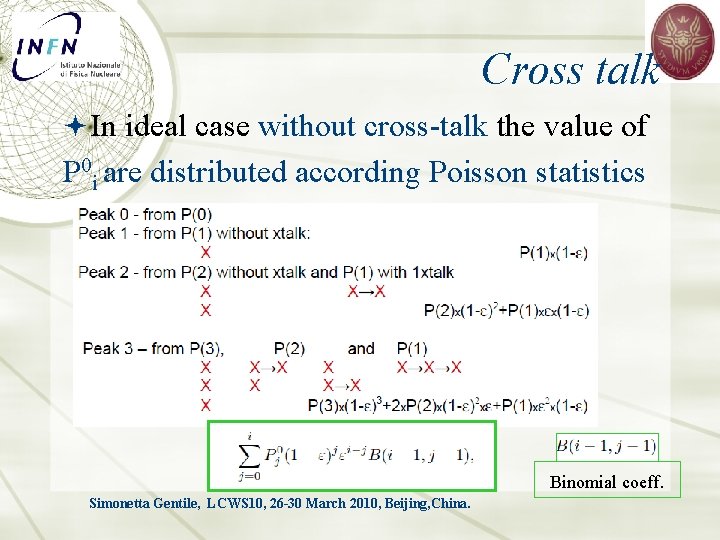
Cross talk In ideal case without cross-talk the value of P 0 i are distributed according Poisson statistics Binomial coeff. Simonetta Gentile, LCWS 10, 26 -30 March 2010, Beijing, China.
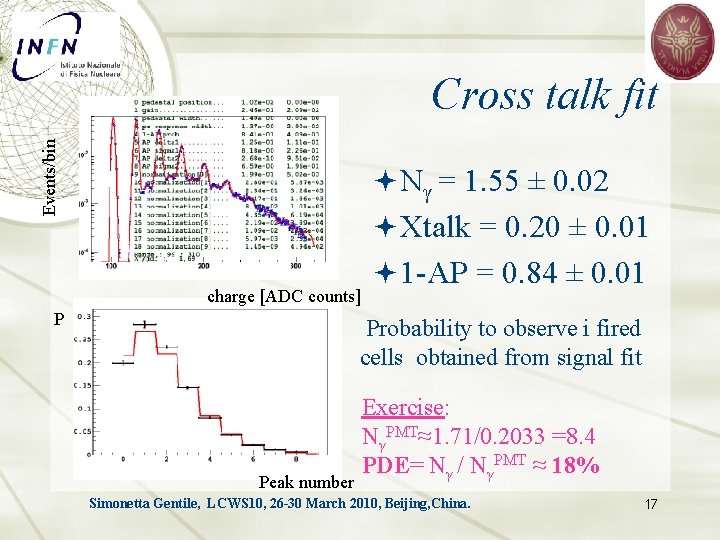
Events/bin Cross talk fit Nγ = 1. 55 ± 0. 02 Xtalk = 0. 20 ± 0. 01 charge [ADC counts] P 1 -AP = 0. 84 ± 0. 01 Probability to observe i fired cells obtained from signal fit Peak number Exercise: NγPMT≈1. 71/0. 2033 =8. 4 PDE= Nγ / NγPMT ≈ 18% Simonetta Gentile, LCWS 10, 26 -30 March 2010, Beijing, China. 17
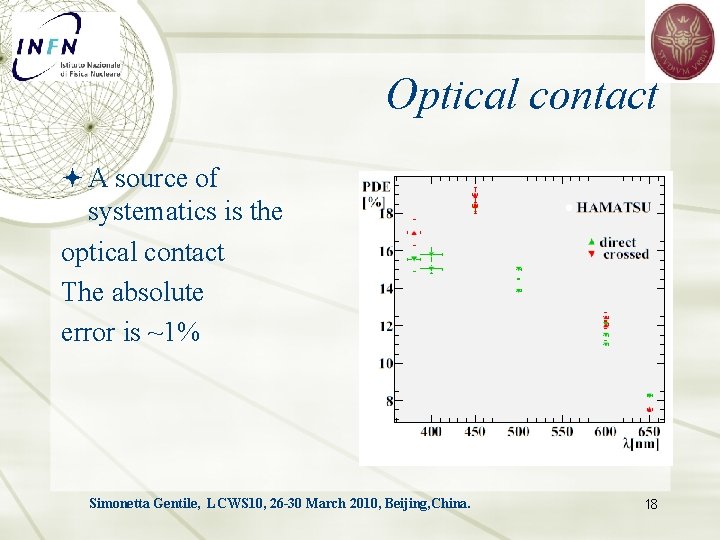
Optical contact A source of systematics is the optical contact The absolute error is ~1% Simonetta Gentile, LCWS 10, 26 -30 March 2010, Beijing, China. 18
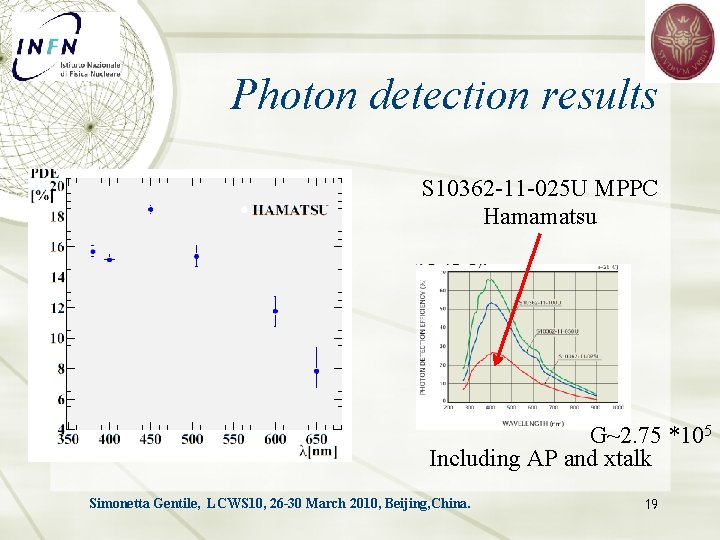
Photon detection results S 10362 -11 -025 U MPPC Hamamatsu G~2. 75 *105 Including AP and xtalk Simonetta Gentile, LCWS 10, 26 -30 March 2010, Beijing, China. 19
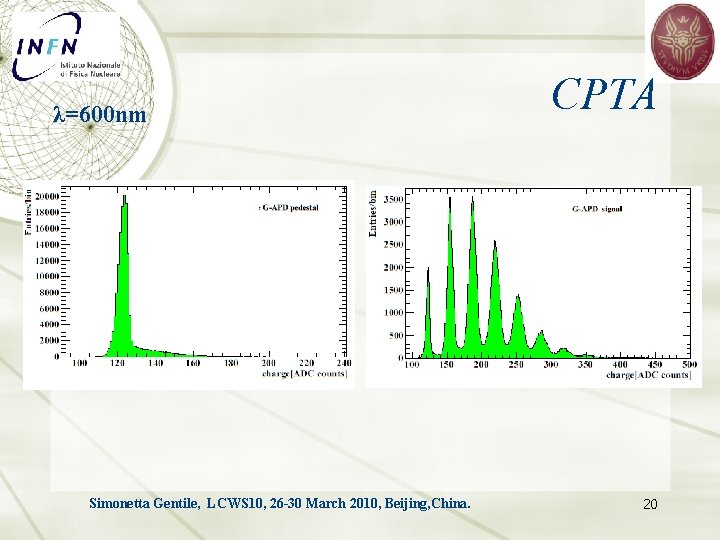
λ=600 nm Simonetta Gentile, LCWS 10, 26 -30 March 2010, Beijing, China. CPTA 20
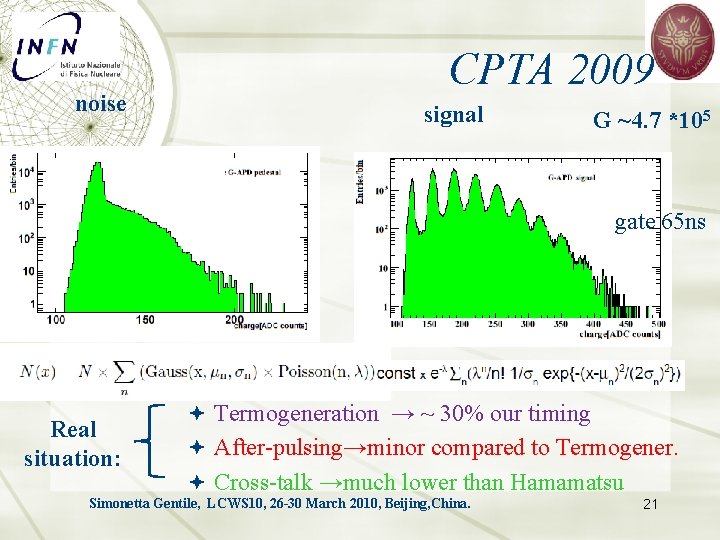
noise CPTA 2009 signal G ~4. 7 *105 gate 65 ns Ideal case: Real situation: Termogeneration → ~ 30% our timing After-pulsing→minor compared to Termogener. Cross-talk →much lower than Hamamatsu Simonetta Gentile, LCWS 10, 26 -30 March 2010, Beijing, China. 21
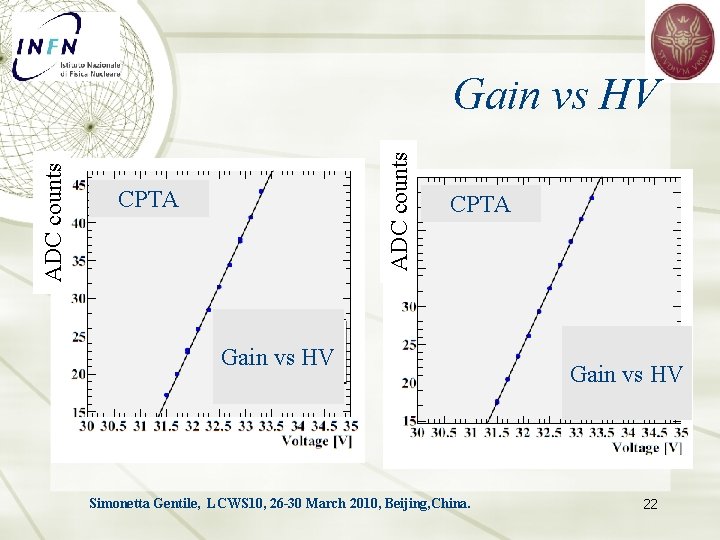
ADC counts Gain vs HV CPTA Gain vs HV Simonetta Gentile, LCWS 10, 26 -30 March 2010, Beijing, China. Gain vs HV 22
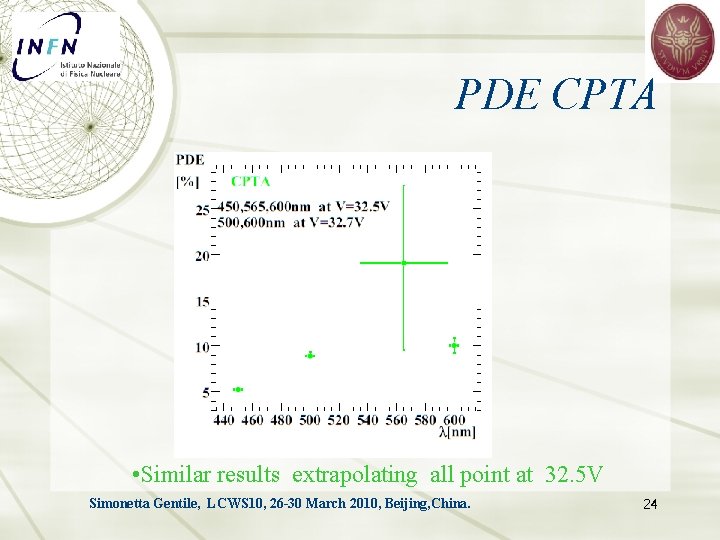
PDE CPTA Ignoring Events/bin CPTA charge [ADC counts] Preliminary results Thermogeneration contribution. AP considered as a correction term taking in account AP and TG Low crosstalk value No sensitivity to crosstalk in the fit Simonetta Gentile, LCWS 10, 26 -30 March 2010, Beijing, China. 23
PDE CPTA • Similar results extrapolating all point at 32. 5 V Simonetta Gentile, LCWS 10, 26 -30 March 2010, Beijing, China. 24
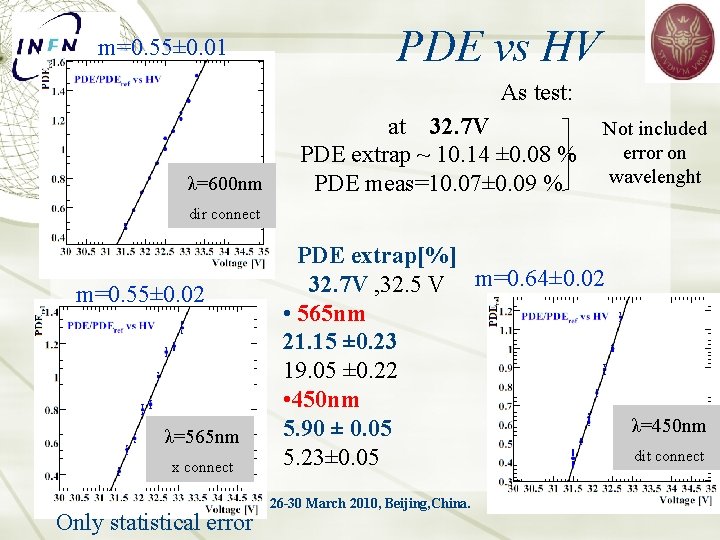
m=0. 55± 0. 01 PDE vs HV As test: λ=600 nm at 32. 7 V PDE extrap ~ 10. 14 ± 0. 08 % PDE meas=10. 07± 0. 09 % Not included error on wavelenght dir connect m=0. 55± 0. 02 λ=565 nm x connect PDE extrap[%] 32. 7 V , 32. 5 V m=0. 64± 0. 02 • 565 nm 21. 15 ± 0. 23 19. 05 ± 0. 22 • 450 nm 5. 90 ± 0. 05 5. 23± 0. 05 Simonetta Gentile, LCWS 10, 26 -30 March 2010, Beijing, China. Only statistical error λ=450 nm dit connect 25
Events/bin CPTA Crosstalk Average x-talk ~ 1. 7% charge [ADC counts] P charge [ADC counts] Thermogeneration taken in account Asymmetric shape AP Peak number Simonetta Gentile, LCWS 10, 26 -30 March 2010, Beijing, China. γ=1/ (α τ -1) τ trap life time α recovery 26 time
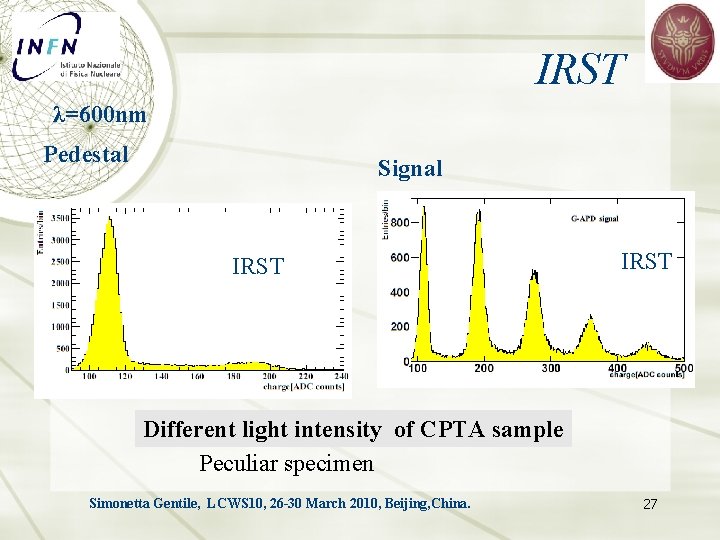
IRST λ=600 nm Pedestal Signal IRST Different light intensity of CPTA sample Peculiar specimen Simonetta Gentile, LCWS 10, 26 -30 March 2010, Beijing, China. 27
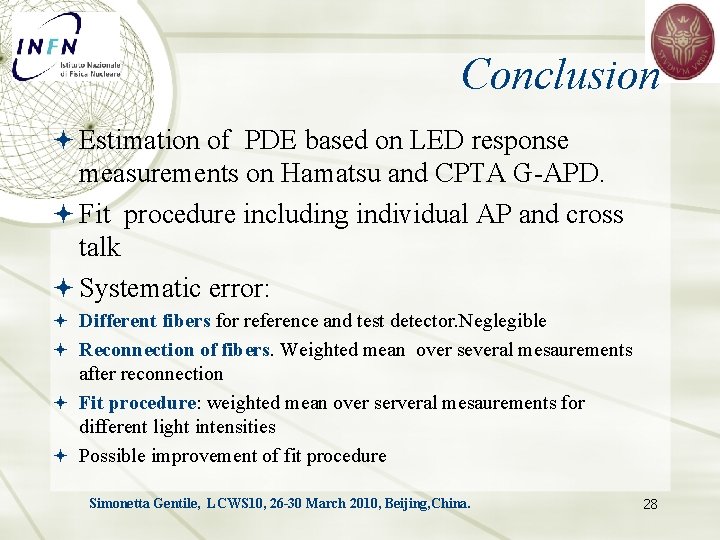
Conclusion Estimation of PDE based on LED response measurements on Hamatsu and CPTA G-APD. Fit procedure including individual AP and cross talk Systematic error: Different fibers for reference and test detector. Neglegible Reconnection of fibers. Weighted mean over several mesaurements after reconnection Fit procedure: weighted mean over serveral mesaurements for different light intensities Possible improvement of fit procedure Simonetta Gentile, LCWS 10, 26 -30 March 2010, Beijing, China. 28