
Gap Year Jackie Kay You are going to
- Slides: 64
‘Gap Year’ Jackie Kay
You are going to watch some clips about parenthood: Becoming a dad at 15 One Born Every Minute – becoming a mum Musician Jed Milroy on becoming a dad • Why do you think people want to become parents? • What do you think are the challenges and rewards of being a parent? • What do you think it’s like as a parent to watch your child grow up and leave home?
‘Gap Year’ portrays the close bond of a mother and son. It is written in the voice of the poet and dedicated to her son, Matthew. It describes Kay’s son’s adventures when he leaves her to travel during his gap year. It leads to reflections on her feelings about his childhood and newfound independence. At home, she follows his journey and awaits his return. The poem explores themes of motherhood, closeness and distance, and the passage of time.
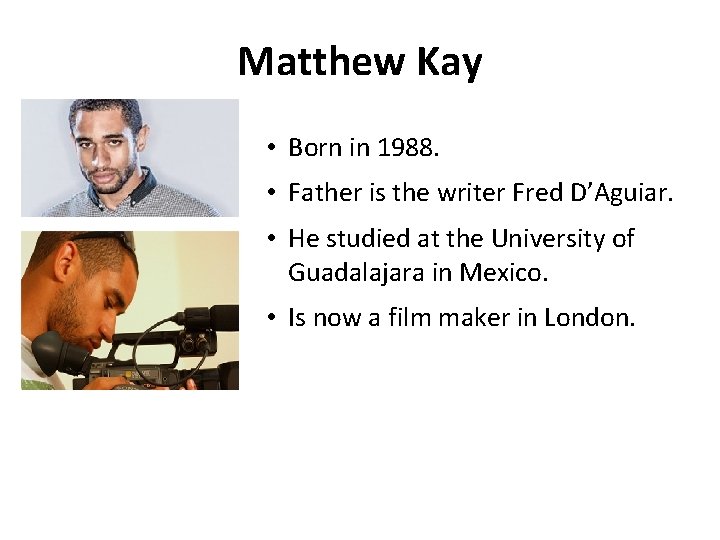
Matthew Kay • Born in 1988. • Father is the writer Fred D’Aguiar. • He studied at the University of Guadalajara in Mexico. • Is now a film maker in London.
Form: Poem of Address • Poems of address speak to (or address) a particular person, usually not the reader. • In ‘Gap Year’, Kay addresses her 18 year old son Matthew. • The following slides are an extract from Kay’s blog, written about her son’s Gap Year.
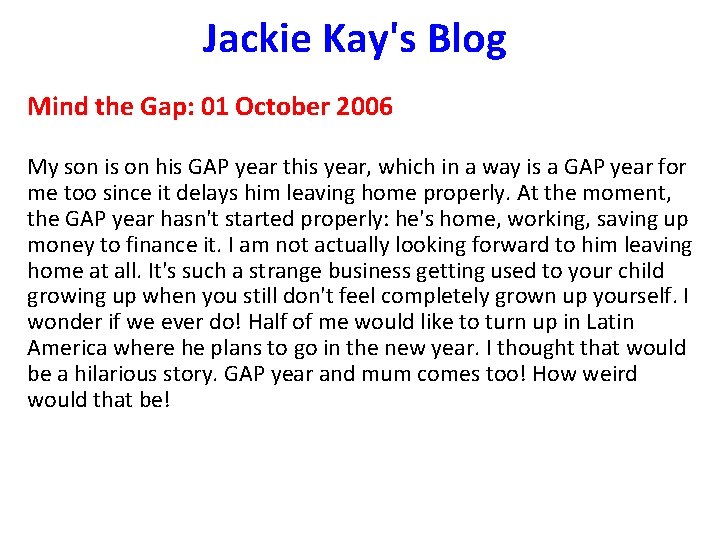
Jackie Kay's Blog Mind the Gap: 01 October 2006 My son is on his GAP year this year, which in a way is a GAP year for me too since it delays him leaving home properly. At the moment, the GAP year hasn't started properly: he's home, working, saving up money to finance it. I am not actually looking forward to him leaving home at all. It's such a strange business getting used to your child growing up when you still don't feel completely grown up yourself. I wonder if we ever do! Half of me would like to turn up in Latin America where he plans to go in the new year. I thought that would be a hilarious story. GAP year and mum comes too! How weird would that be!
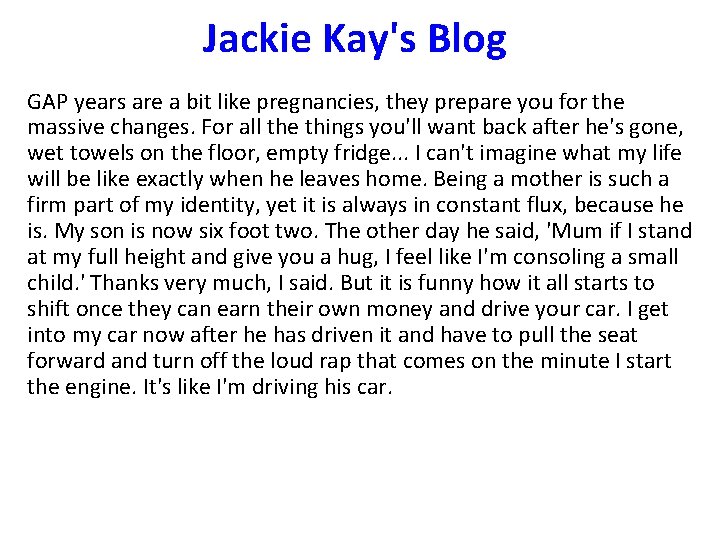
Jackie Kay's Blog GAP years are a bit like pregnancies, they prepare you for the massive changes. For all the things you'll want back after he's gone, wet towels on the floor, empty fridge. . . I can't imagine what my life will be like exactly when he leaves home. Being a mother is such a firm part of my identity, yet it is always in constant flux, because he is. My son is now six foot two. The other day he said, 'Mum if I stand at my full height and give you a hug, I feel like I'm consoling a small child. ' Thanks very much, I said. But it is funny how it all starts to shift once they can earn their own money and drive your car. I get into my car now after he has driven it and have to pull the seat forward and turn off the loud rap that comes on the minute I start the engine. It's like I'm driving his car.
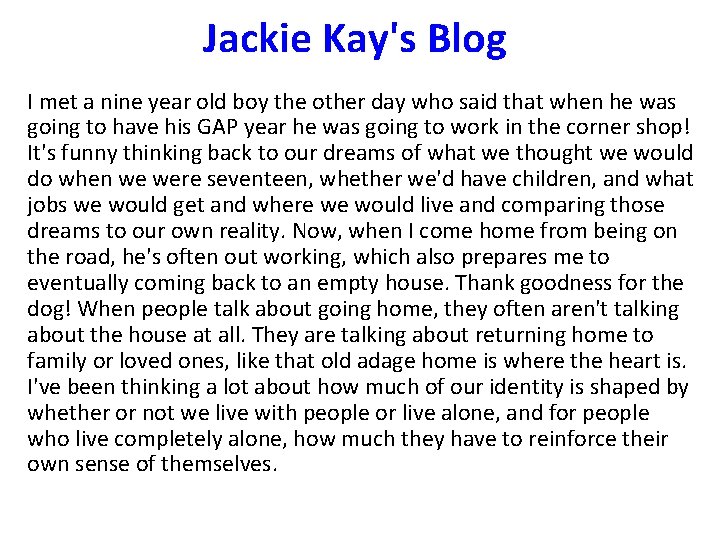
Jackie Kay's Blog I met a nine year old boy the other day who said that when he was going to have his GAP year he was going to work in the corner shop! It's funny thinking back to our dreams of what we thought we would do when we were seventeen, whether we'd have children, and what jobs we would get and where we would live and comparing those dreams to our own reality. Now, when I come home from being on the road, he's often out working, which also prepares me to eventually coming back to an empty house. Thank goodness for the dog! When people talk about going home, they often aren't talking about the house at all. They are talking about returning home to family or loved ones, like that old adage home is where the heart is. I've been thinking a lot about how much of our identity is shaped by whether or not we live with people or live alone, and for people who live completely alone, how much they have to reinforce their own sense of themselves.
Jackie Kay's Blog I wonder what a GAP year for mothers would actually consist of. It's impossible to think of really because being a mother is a constant. Actually, if you are lucky, there are no gaps. No hems or facings just a seamless, changing, colourful cloth. I remember once years ago being with my mum and my gran in Majorca. My mum was in her sixties then and my gran in her eighties. My gran pointed to her drooping breasts and declared, 'See they, she did that to me!' And my mum said, 'Oh Mum!' My gran didn't put the change in her body down to old age. No. It was the fault of her sixty year old daughter!
Jackie Kay's Blog I'm trying to imagine what I'll be like as a mother at sixty and what it will be like having a son in his thirties, but I can't get there really. Because you do live in the present tense when you are a mother and only really get as far as the end of one GAP year to the next. Friends who are mothers, and have already had their children flee the nest describe it in very different ways. Some say it is like a grief. Others that it is a relief. And others offer up the sad consolation prize, 'They never really leave home. They'll still come back to get their washing done. ' Others say, being a good mother is helping them to leave home. My son does all his own washing already though, so he'll have to come back just to see me!
Jackie Kay's Blog I wonder how many mothers and fathers feel like they are good mothers and fathers or if they had a shot at it to do it again how much they'd change. I have a wonderful dad, but I remember being really touched when he said if he was a father again he'd be much less bad tempered. I don't remember him as being bad tempered at all. Perhaps being a parent is the one thing we are constantly selfcritical about, the one thing we can never get completely right. I never knew guilt properly until I became a mother and had in my head such an ideal picture of a mother, actually quite a silly, stereotypical one, a mother who baked cakes and sewed! Ridiculous, I know. But then, there's always a huge GAP between what kind of mother or father we think we should be and what kind we actually are!
‘Gap Year’ Structure Overview Written in 2 defined sections with four line stanzas throughout. Kay uses free verse with only the odd moment of rhyme to convey the sense that she is speaking to her son. Section I: • The first section of the poem charts Kay’s pregnancy and the birth of Matthew. It is only four stanzas in length. This suggests the brevity of babyhood and how it is quickly over. • The section begins with Kay staring at the empty Moses basket awaiting her baby’s arrival and ends with Kay laying her new son in the basket. This suggests completion and contentment.
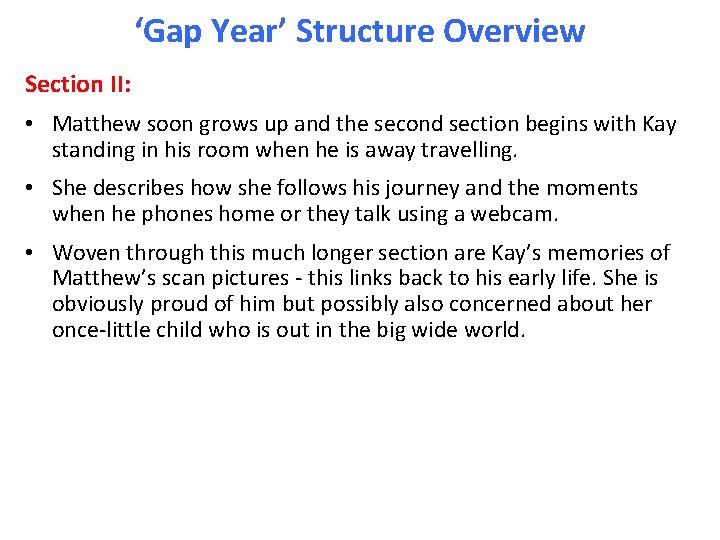
‘Gap Year’ Structure Overview Section II: • Matthew soon grows up and the second section begins with Kay standing in his room when he is away travelling. • She describes how she follows his journey and the moments when he phones home or they talk using a webcam. • Woven through this much longer section are Kay’s memories of Matthew’s scan pictures - this links back to his early life. She is obviously proud of him but possibly also concerned about her once-little child who is out in the big wide world.
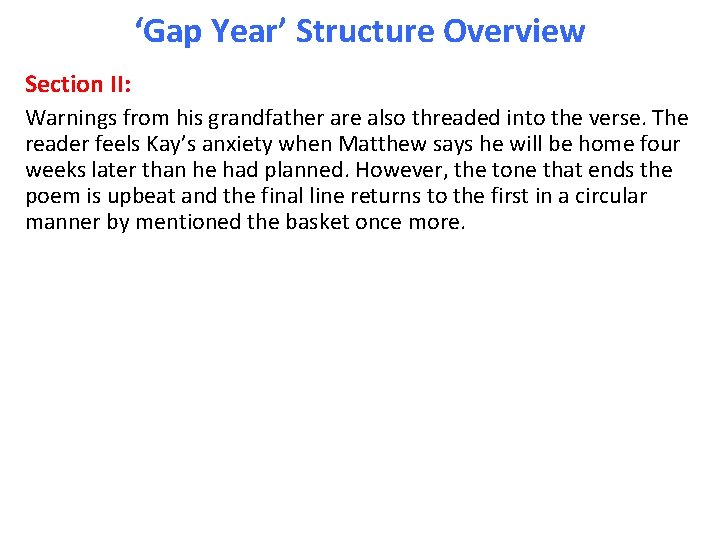
‘Gap Year’ Structure Overview Section II: Warnings from his grandfather are also threaded into the verse. The reader feels Kay’s anxiety when Matthew says he will be home four weeks later than he had planned. However, the tone that ends the poem is upbeat and the final line returns to the first in a circular manner by mentioned the basket once more.
Can you put the stanzas in the correct order?
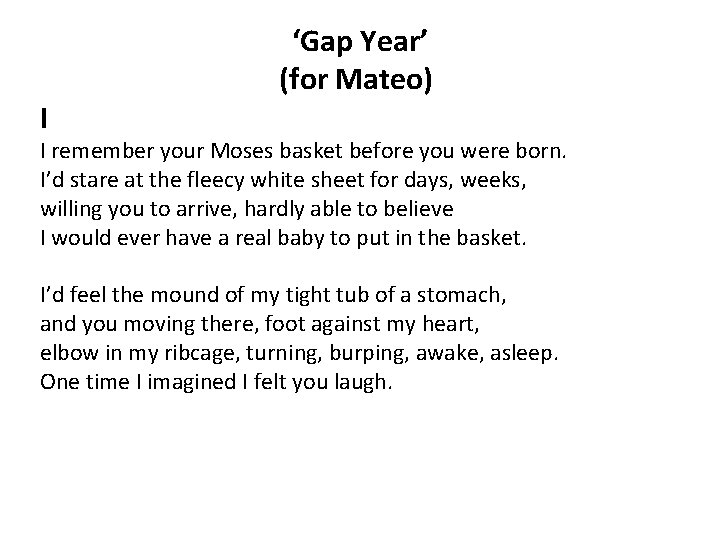
I ‘Gap Year’ (for Mateo) I remember your Moses basket before you were born. I’d stare at the fleecy white sheet for days, weeks, willing you to arrive, hardly able to believe I would ever have a real baby to put in the basket. I’d feel the mound of my tight tub of a stomach, and you moving there, foot against my heart, elbow in my ribcage, turning, burping, awake, asleep. One time I imagined I felt you laugh.
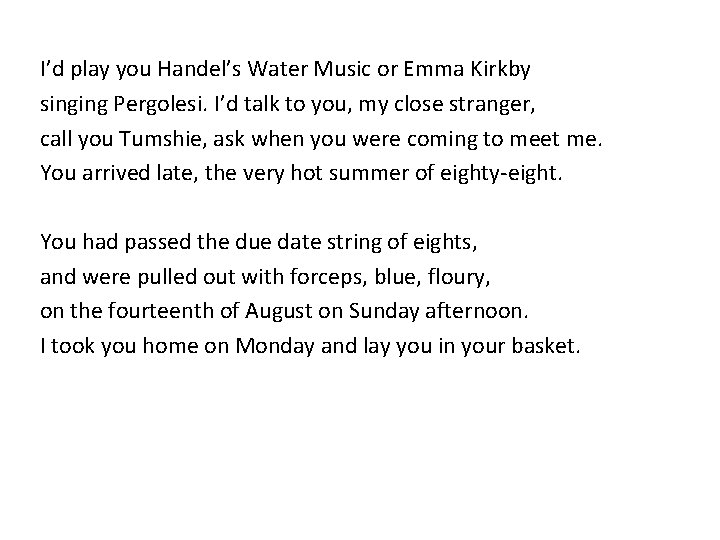
I’d play you Handel’s Water Music or Emma Kirkby singing Pergolesi. I’d talk to you, my close stranger, call you Tumshie, ask when you were coming to meet me. You arrived late, the very hot summer of eighty-eight. You had passed the due date string of eights, and were pulled out with forceps, blue, floury, on the fourteenth of August on Sunday afternoon. I took you home on Monday and lay you in your basket.
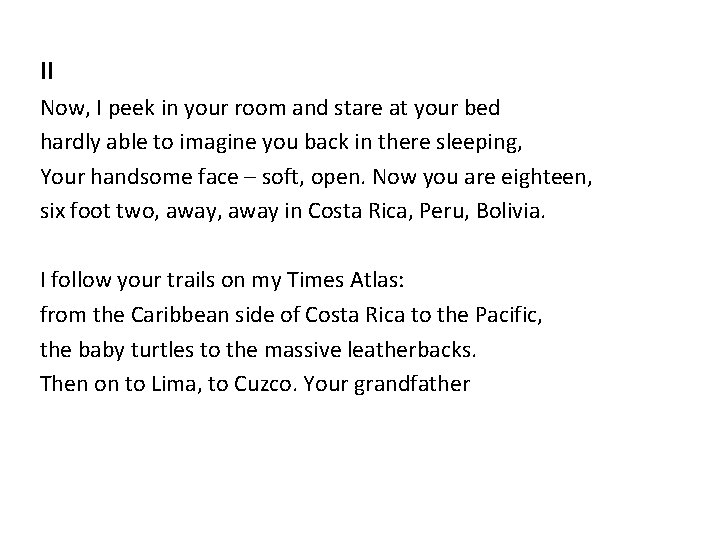
II Now, I peek in your room and stare at your bed hardly able to imagine you back in there sleeping, Your handsome face – soft, open. Now you are eighteen, six foot two, away in Costa Rica, Peru, Bolivia. I follow your trails on my Times Atlas: from the Caribbean side of Costa Rica to the Pacific, the baby turtles to the massive leatherbacks. Then on to Lima, to Cuzco. Your grandfather
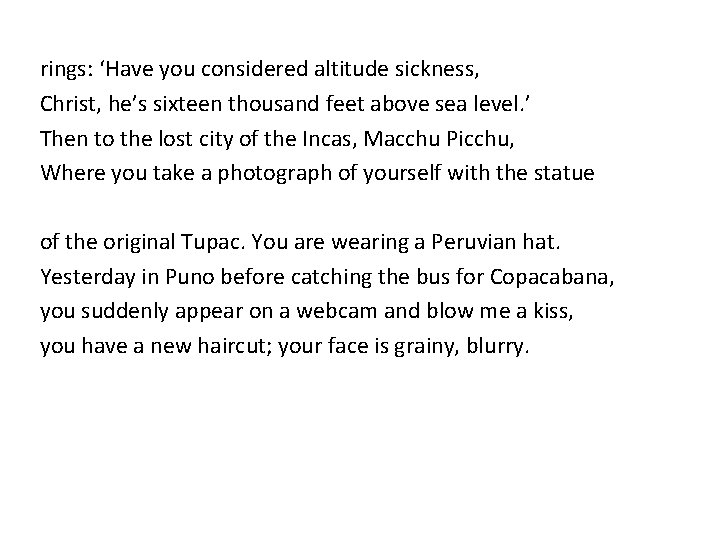
rings: ‘Have you considered altitude sickness, Christ, he’s sixteen thousand feet above sea level. ’ Then to the lost city of the Incas, Macchu Picchu, Where you take a photograph of yourself with the statue of the original Tupac. You are wearing a Peruvian hat. Yesterday in Puno before catching the bus for Copacabana, you suddenly appear on a webcam and blow me a kiss, you have a new haircut; your face is grainy, blurry.
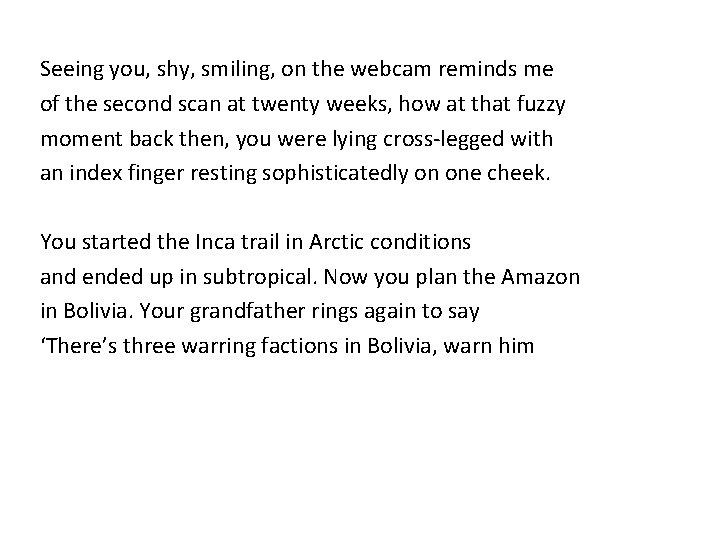
Seeing you, shy, smiling, on the webcam reminds me of the second scan at twenty weeks, how at that fuzzy moment back then, you were lying cross-legged with an index finger resting sophisticatedly on one cheek. You started the Inca trail in Arctic conditions and ended up in subtropical. Now you plan the Amazon in Bolivia. Your grandfather rings again to say ‘There’s three warring factions in Bolivia, warn him
against it. He canny see everything. Tell him to come home. ’ But you say all the travellers you meet rave about Bolivia. You want to see the Salar de Uyuni, the world’s largest salt-flats, the Amazonian rainforest. And now you are not coming home till four weeks after your due date. After Bolivia, you plan to stay with a friend’s Auntie in Argentina. Then – to Chile where you’ll stay with friends of Diane’s.
And maybe work for the Victor Jara Foundation. I feel like a home-alone mother; all the lights have gone out in the hall, and now I am wearing your large black slippers, flip-flopping into your empty bedroom, trying to imagine you in your bed. I stare at the photos you send by messenger: you on the top of the world, arms outstretched, eager. Blue sky, white snow; you by Lake Tararhua, beaming.
My heart soars like the birds in your bright blue skies. My love glows like the sunrise over the lost city. I sing along to Ella Fitzgerald, A tisket A tasket. I have a son out in the big wide world. A flip and a skip ago, you were dreaming in your basket.
In pairs, discuss these questions: • What are your initial thoughts on the poem? • What language techniques does the writer use? • What is she trying to say by using these techniques?
Gap Year • Think about your relationship with your own parents. • How has it changed from when you were a small child until now?
The Important Bits • Use a highlighter to mark each time Kay uses the word “I” in the first section of the poem. • With a different colour, highlight each time she uses the word “You” in the first section. • Can they think of a reason or reasons why she has used these short simple words so often? • Taking into account what you have discovered so far, can you decide why Jackie Kay chose “Gap Year” as the title for this work? Can you detect a double-meaning?
The Important Bits The Title A gap year is usually a year taken off between finishing school and going to university or college. • Gap: a space or interval; a break in continuity. literally a physical gap between mother and son. • Year: the period of 365 days. suggests that the 18 years have felt like no time at all to his mother.
The Important Bits As we read over the poem, pay attention to: • the many parallels and connections between past and present – Matthew’s childhood and adulthood. • how the poem both celebrates and laments his independence. • the contrast between the speaker at home, and the son exploring and investigating. • How section II allows the reader to track his adventures as the speaker does.
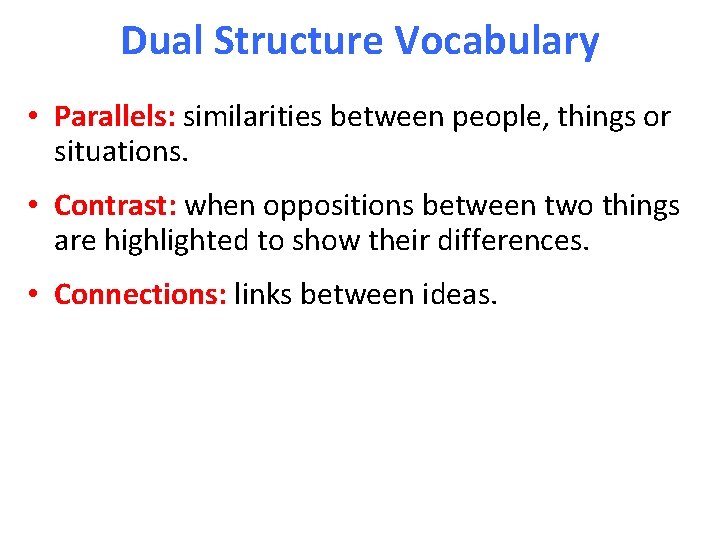
Dual Structure Vocabulary • Parallels: similarities between people, things or situations. • Contrast: when oppositions between two things are highlighted to show their differences. • Connections: links between ideas.
We are now going to look at the poem with annotations. Colour code the relevant part of the poem and the comments which go with it.
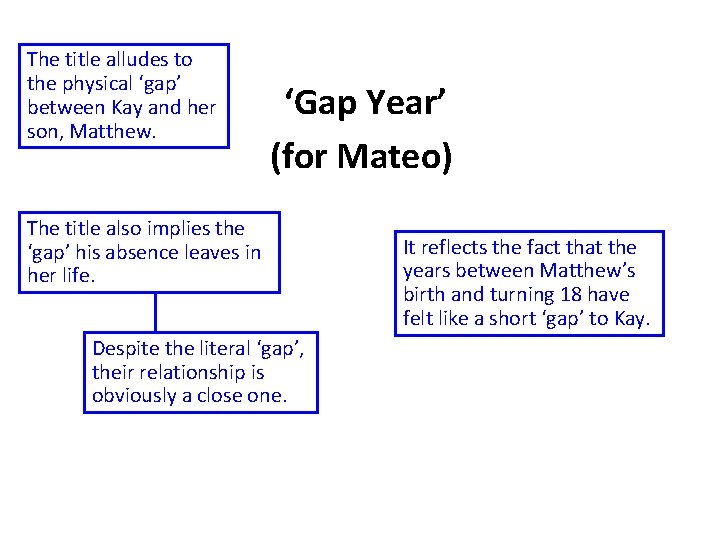
The title alludes to the physical ‘gap’ between Kay and her son, Matthew. ‘Gap Year’ (for Mateo) The title also implies the ‘gap’ his absence leaves in her life. Despite the literal ‘gap’, their relationship is obviously a close one. It reflects the fact that the years between Matthew’s birth and turning 18 have felt like a short ‘gap’ to Kay.
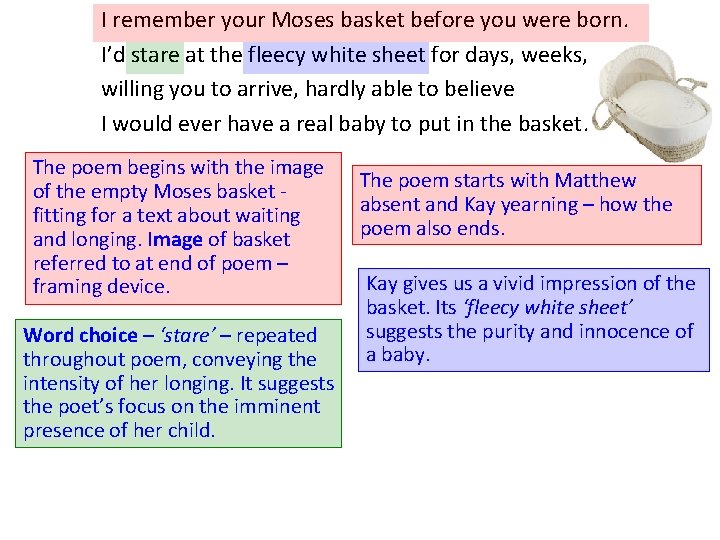
I remember your Moses basket before you were born. I’d stare at the fleecy white sheet for days, weeks, willing you to arrive, hardly able to believe I would ever have a real baby to put in the basket. The poem begins with the image of the empty Moses basket fitting for a text about waiting and longing. Image of basket referred to at end of poem – framing device. Word choice – ‘stare’ – repeated throughout poem, conveying the intensity of her longing. It suggests the poet’s focus on the imminent presence of her child. The poem starts with Matthew absent and Kay yearning – how the poem also ends. Kay gives us a vivid impression of the basket. Its ‘fleecy white sheet’ suggests the purity and innocence of a baby.
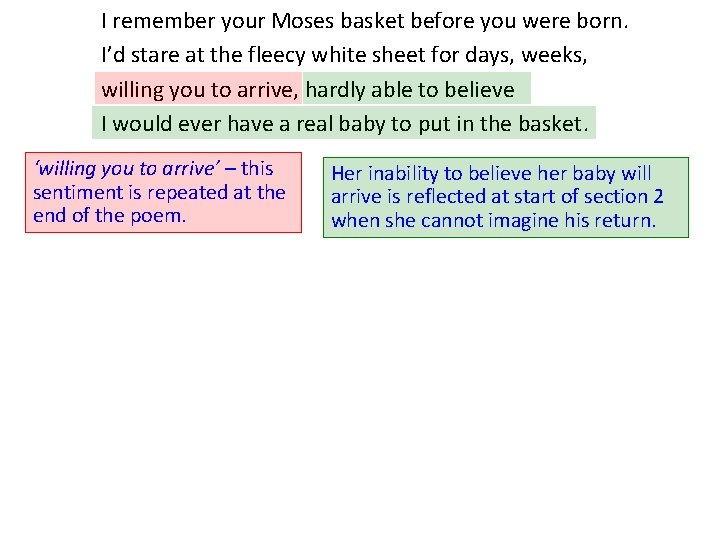
I remember your Moses basket before you were born. I’d stare at the fleecy white sheet for days, weeks, willing you to arrive, hardly able to believe I would ever have a real baby to put in the basket. ‘willing you to arrive’ – this sentiment is repeated at the end of the poem. Her inability to believe her baby will arrive is reflected at start of section 2 when she cannot imagine his return.
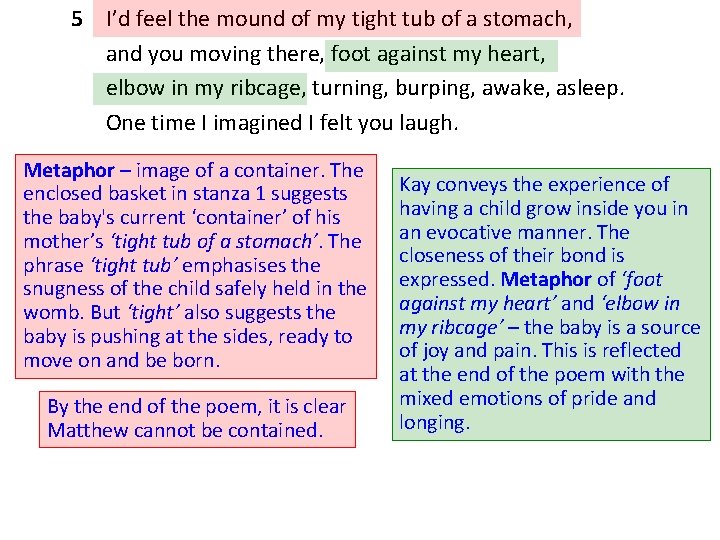
5 I’d feel the mound of my tight tub of a stomach, and you moving there, foot against my heart, elbow in my ribcage, turning, burping, awake, asleep. One time I imagined I felt you laugh. Metaphor – image of a container. The enclosed basket in stanza 1 suggests the baby's current ‘container’ of his mother’s ‘tight tub of a stomach’. The phrase ‘tight tub’ emphasises the snugness of the child safely held in the womb. But ‘tight’ also suggests the baby is pushing at the sides, ready to move on and be born. By the end of the poem, it is clear Matthew cannot be contained. Kay conveys the experience of having a child grow inside you in an evocative manner. The closeness of their bond is expressed. Metaphor of ‘foot against my heart’ and ‘elbow in my ribcage’ – the baby is a source of joy and pain. This is reflected at the end of the poem with the mixed emotions of pride and longing.
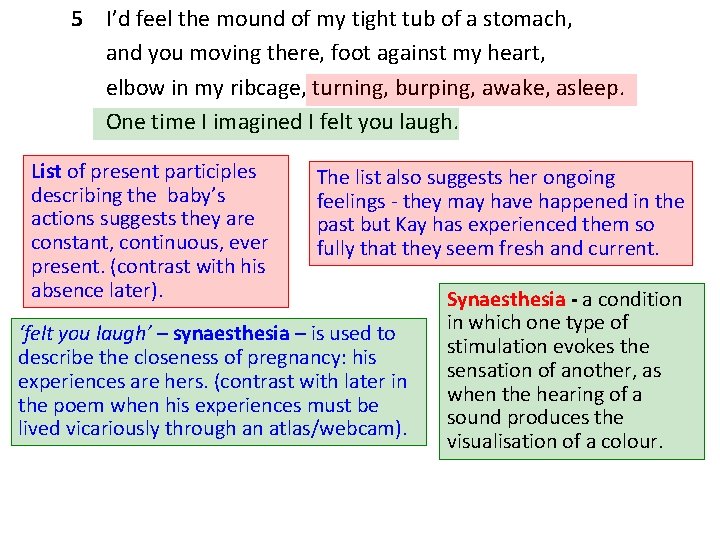
5 I’d feel the mound of my tight tub of a stomach, and you moving there, foot against my heart, elbow in my ribcage, turning, burping, awake, asleep. One time I imagined I felt you laugh. List of present participles describing the baby’s actions suggests they are constant, continuous, ever present. (contrast with his absence later). The list also suggests her ongoing feelings - they may have happened in the past but Kay has experienced them so fully that they seem fresh and current. ‘felt you laugh’ – synaesthesia – is used to describe the closeness of pregnancy: his experiences are hers. (contrast with later in the poem when his experiences must be lived vicariously through an atlas/webcam). Synaesthesia - a condition in which one type of stimulation evokes the sensation of another, as when the hearing of a sound produces the visualisation of a colour.
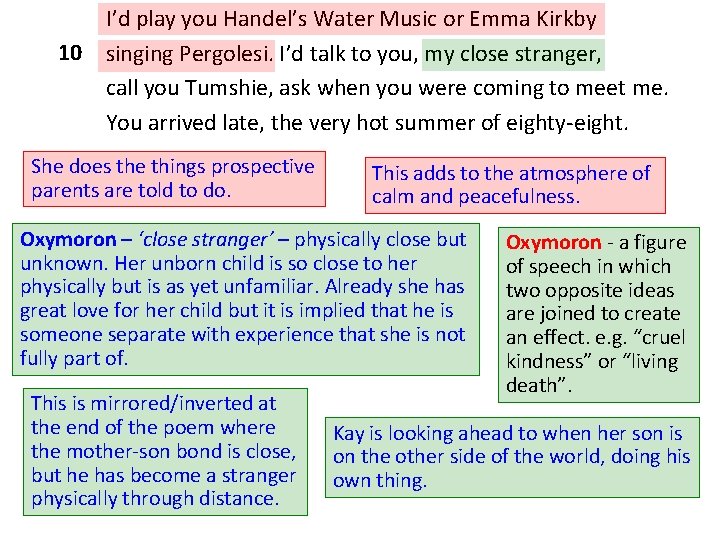
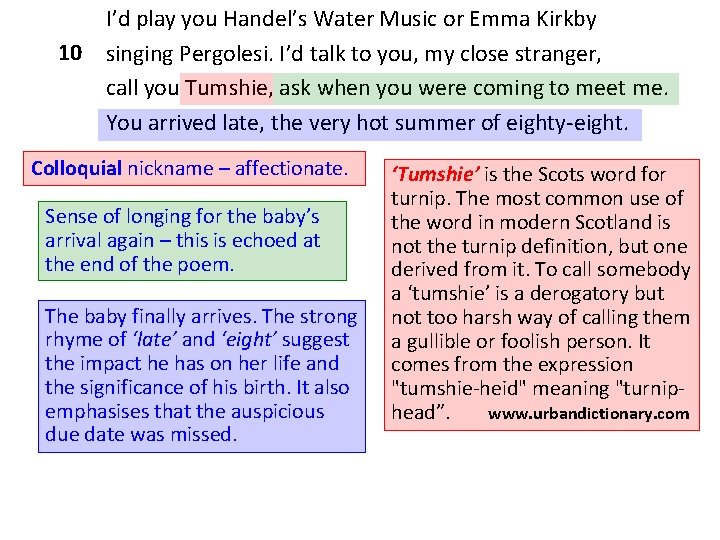
I’d play you Handel’s Water Music or Emma Kirkby 10 singing Pergolesi. I’d talk to you, my close stranger, call you Tumshie, ask when you were coming to meet me. You arrived late, the very hot summer of eighty-eight. She does the things prospective parents are told to do. This adds to the atmosphere of calm and peacefulness. Oxymoron – ‘close stranger’ – physically close but unknown. Her unborn child is so close to her physically but is as yet unfamiliar. Already she has great love for her child but it is implied that he is someone separate with experience that she is not fully part of. This is mirrored/inverted at the end of the poem where the mother-son bond is close, but he has become a stranger physically through distance. Oxymoron - a figure of speech in which two opposite ideas are joined to create an effect. e. g. “cruel kindness” or “living death”. Kay is looking ahead to when her son is on the other side of the world, doing his own thing.
I’d play you Handel’s Water Music or Emma Kirkby 10 singing Pergolesi. I’d talk to you, my close stranger, call you Tumshie, ask when you were coming to meet me. You arrived late, the very hot summer of eighty-eight. Colloquial nickname – affectionate. Sense of longing for the baby’s arrival again – this is echoed at the end of the poem. The baby finally arrives. The strong rhyme of ‘late’ and ‘eight’ suggest the impact he has on her life and the significance of his birth. It also emphasises that the auspicious due date was missed. ‘Tumshie’ is the Scots word for turnip. The most common use of the word in modern Scotland is not the turnip definition, but one derived from it. To call somebody a ‘tumshie’ is a derogatory but not too harsh way of calling them a gullible or foolish person. It comes from the expression "tumshie-heid" meaning "turniphead”. www. urbandictionary. com
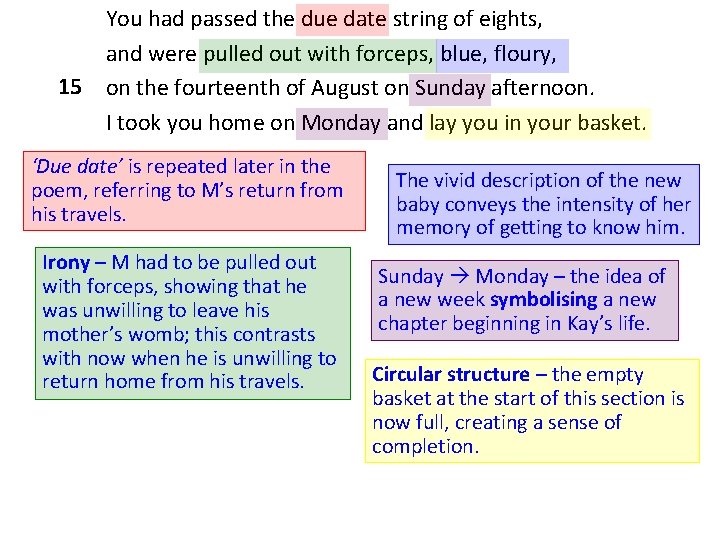
You had passed the due date string of eights, and were pulled out with forceps, blue, floury, 15 on the fourteenth of August on Sunday afternoon. I took you home on Monday and lay you in your basket. ‘Due date’ is repeated later in the poem, referring to M’s return from his travels. Irony – M had to be pulled out with forceps, showing that he was unwilling to leave his mother’s womb; this contrasts with now when he is unwilling to return home from his travels. The vivid description of the new baby conveys the intensity of her memory of getting to know him. Sunday Monday – the idea of a new week symbolising a new chapter beginning in Kay’s life. Circular structure – the empty basket at the start of this section is now full, creating a sense of completion.
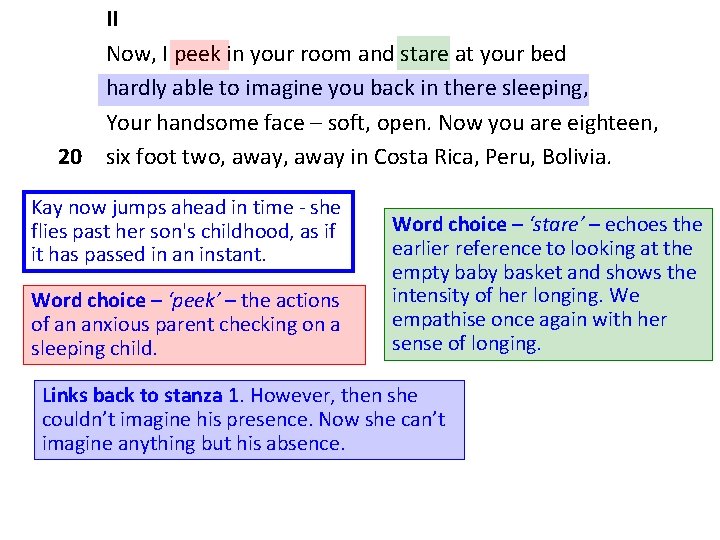
II Now, I peek in your room and stare at your bed hardly able to imagine you back in there sleeping, Your handsome face – soft, open. Now you are eighteen, 20 six foot two, away in Costa Rica, Peru, Bolivia. Kay now jumps ahead in time - she flies past her son's childhood, as if it has passed in an instant. Word choice – ‘peek’ – the actions of an anxious parent checking on a sleeping child. Word choice – ‘stare’ – echoes the earlier reference to looking at the empty baby basket and shows the intensity of her longing. We empathise once again with her sense of longing. Links back to stanza 1. However, then she couldn’t imagine his presence. Now she can’t imagine anything but his absence.
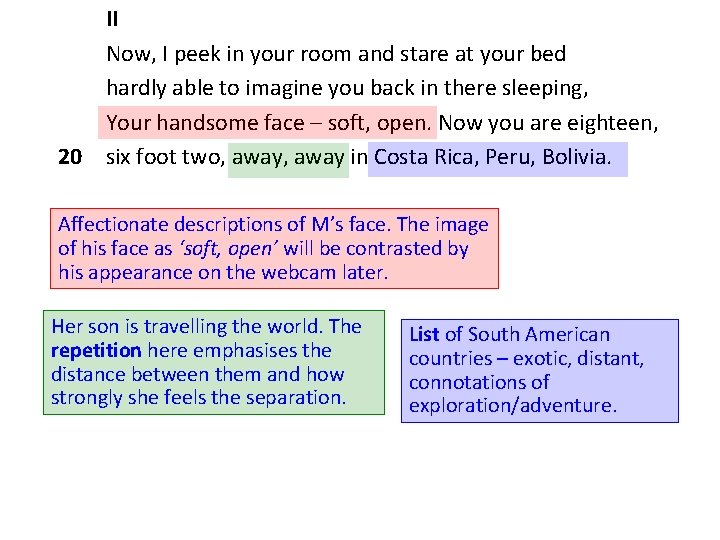
II Now, I peek in your room and stare at your bed hardly able to imagine you back in there sleeping, Your handsome face – soft, open. Now you are eighteen, 20 six foot two, away in Costa Rica, Peru, Bolivia. Affectionate descriptions of M’s face. The image of his face as ‘soft, open’ will be contrasted by his appearance on the webcam later. Her son is travelling the world. The repetition here emphasises the distance between them and how strongly she feels the separation. List of South American countries – exotic, distant, connotations of exploration/adventure.
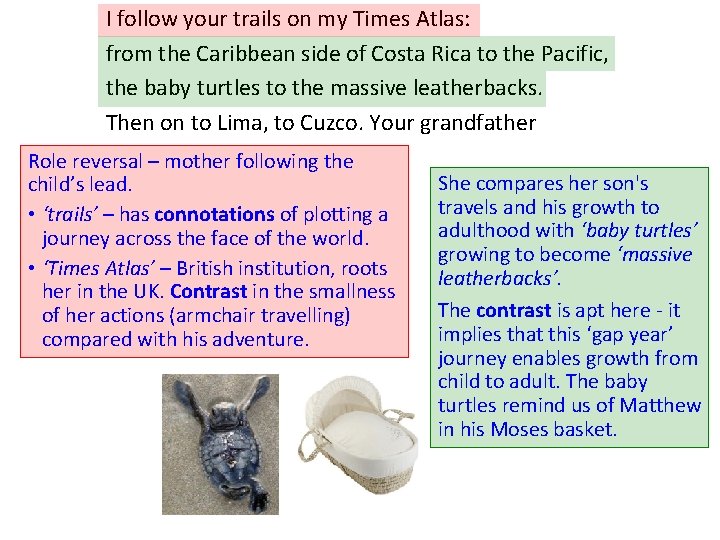
I follow your trails on my Times Atlas: from the Caribbean side of Costa Rica to the Pacific, the baby turtles to the massive leatherbacks. Then on to Lima, to Cuzco. Your grandfather Role reversal – mother following the child’s lead. • ‘trails’ – has connotations of plotting a journey across the face of the world. • ‘Times Atlas’ – British institution, roots her in the UK. Contrast in the smallness of her actions (armchair travelling) compared with his adventure. She compares her son's travels and his growth to adulthood with ‘baby turtles’ growing to become ‘massive leatherbacks’. The contrast is apt here - it implies that this ‘gap year’ journey enables growth from child to adult. The baby turtles remind us of Matthew in his Moses basket.
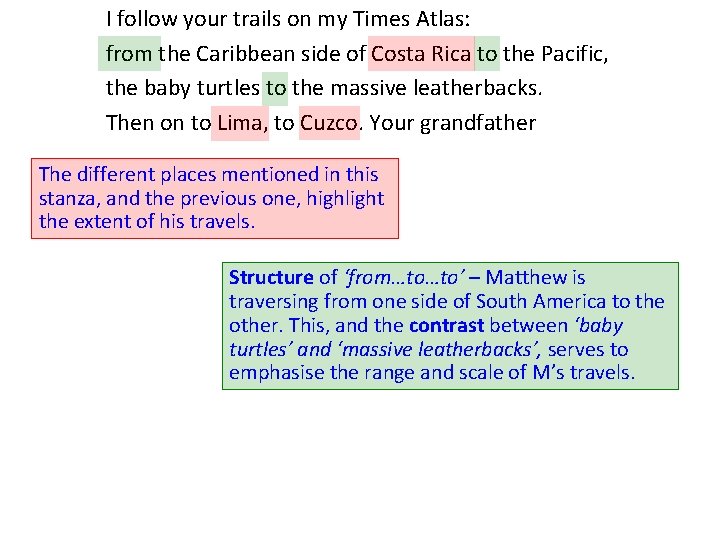
I follow your trails on my Times Atlas: from the Caribbean side of Costa Rica to the Pacific, the baby turtles to the massive leatherbacks. Then on to Lima, to Cuzco. Your grandfather The different places mentioned in this stanza, and the previous one, highlight the extent of his travels. Structure of ‘from…to…to’ – Matthew is traversing from one side of South America to the other. This, and the contrast between ‘baby turtles’ and ‘massive leatherbacks’, serves to emphasise the range and scale of M’s travels.
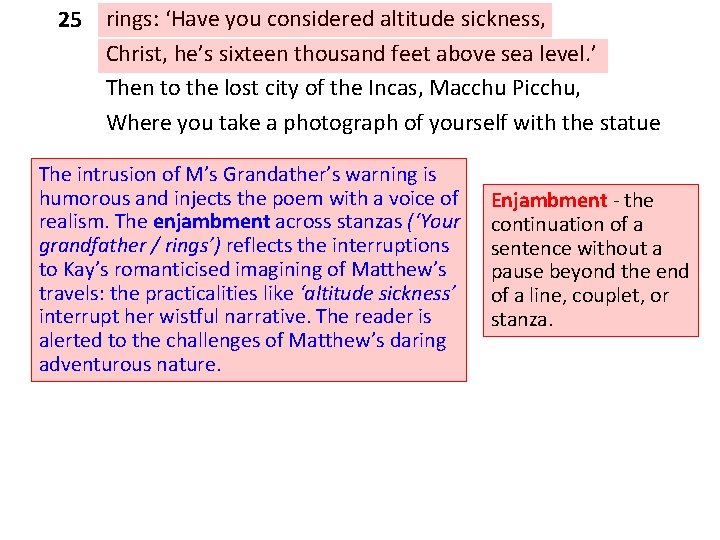
25 rings: ‘Have you considered altitude sickness, Christ, he’s sixteen thousand feet above sea level. ’ Then to the lost city of the Incas, Macchu Picchu, Where you take a photograph of yourself with the statue The intrusion of M’s Grandather’s warning is humorous and injects the poem with a voice of realism. The enjambment across stanzas (‘Your grandfather / rings’) reflects the interruptions to Kay’s romanticised imagining of Matthew’s travels: the practicalities like ‘altitude sickness’ interrupt her wistful narrative. The reader is alerted to the challenges of Matthew’s daring adventurous nature. Enjambment - the continuation of a sentence without a pause beyond the end of a line, couplet, or stanza.
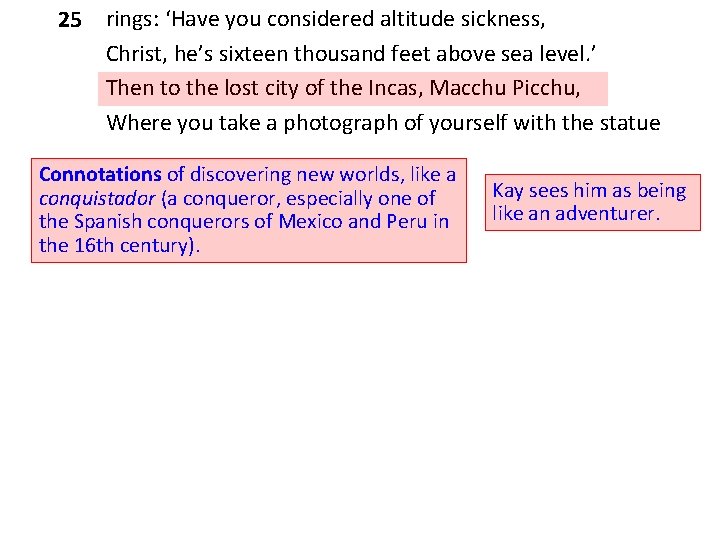
25 rings: ‘Have you considered altitude sickness, Christ, he’s sixteen thousand feet above sea level. ’ Then to the lost city of the Incas, Macchu Picchu, Where you take a photograph of yourself with the statue Connotations of discovering new worlds, like a conquistador (a conqueror, especially one of the Spanish conquerors of Mexico and Peru in the 16 th century). Kay sees him as being like an adventurer.
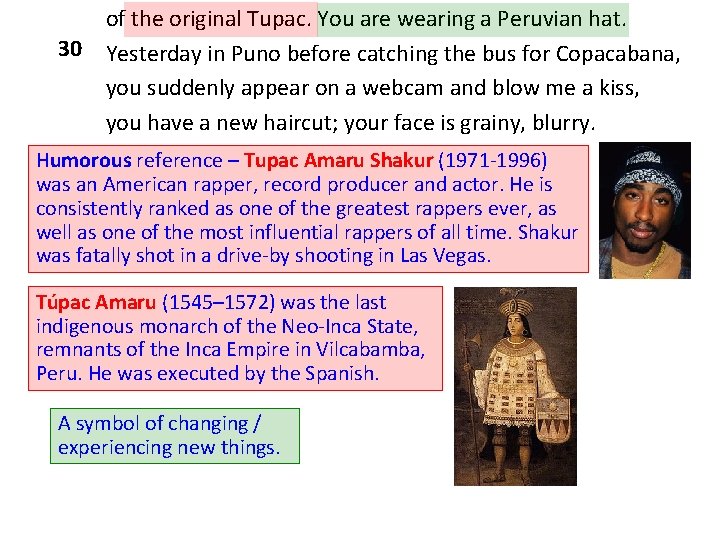
of the original Tupac. You are wearing a Peruvian hat. 30 Yesterday in Puno before catching the bus for Copacabana, you suddenly appear on a webcam and blow me a kiss, you have a new haircut; your face is grainy, blurry. Humorous reference – Tupac Amaru Shakur (1971 -1996) was an American rapper, record producer and actor. He is consistently ranked as one of the greatest rappers ever, as well as one of the most influential rappers of all time. Shakur was fatally shot in a drive-by shooting in Las Vegas. Túpac Amaru (1545– 1572) was the last indigenous monarch of the Neo-Inca State, remnants of the Inca Empire in Vilcabamba, Peru. He was executed by the Spanish. A symbol of changing / experiencing new things.
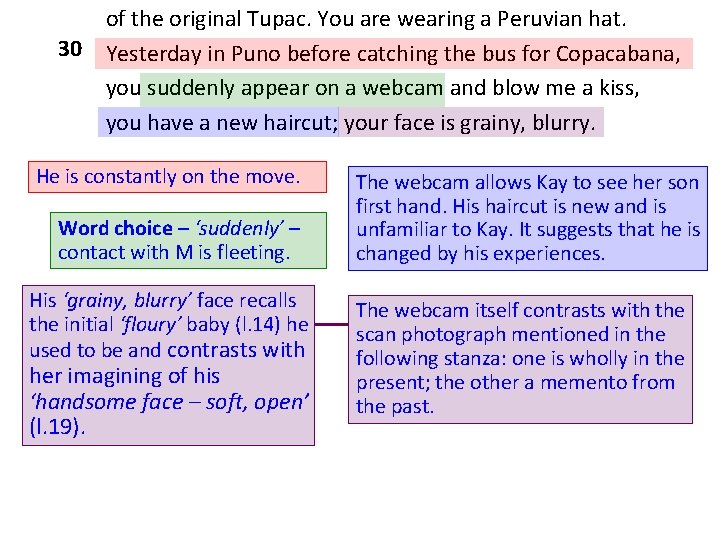
of the original Tupac. You are wearing a Peruvian hat. 30 Yesterday in Puno before catching the bus for Copacabana, you suddenly appear on a webcam and blow me a kiss, you have a new haircut; your face is grainy, blurry. He is constantly on the move. Word choice – ‘suddenly’ – contact with M is fleeting. His ‘grainy, blurry’ face recalls the initial ‘floury’ baby (l. 14) he used to be and contrasts with her imagining of his ‘handsome face – soft, open’ (l. 19). The webcam allows Kay to see her son first hand. His haircut is new and is unfamiliar to Kay. It suggests that he is changed by his experiences. The webcam itself contrasts with the scan photograph mentioned in the following stanza: one is wholly in the present; the other a memento from the past.
Seeing you, shy, smiling, on the webcam reminds me of the second scan at twenty weeks, how at that fuzzy 35 moment back then, you were lying cross-legged with an index finger resting sophisticatedly on one cheek. Comparison between present (webcam) and past (prenatal scan). Even in the womb, Kay implies, he had maturity and eloquence. This grown up posture adds humour to the image. It suggests character and confirms Kay’s affection for her son.
You started the Inca trail in Arctic conditions and ended up in subtropical. Now you plan the Amazon in Bolivia. Your grandfather rings again to say 40 ‘There’s three warring factions in Bolivia, warn him Emphasises the range / diversity of his travels Ambitious, broad, sweeping plans – continues the image of Matthew as explorer / conquistador. The grandfather warns once again of conflict in Bolivia - suggesting the (grand)parental urge to protect. The grandfather represents the voice of age: limitation, fear, worry, caution.
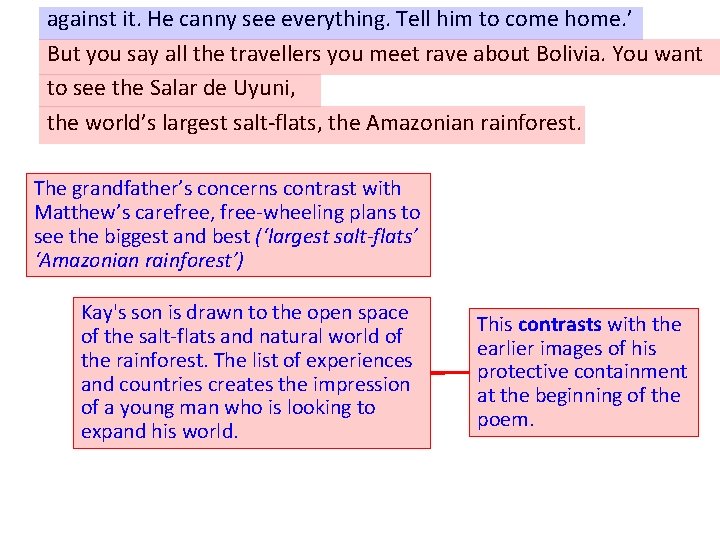
against it. He canny see everything. Tell him to come home. ’ But you say all the travellers you meet rave about Bolivia. You want to see the Salar de Uyuni, the world’s largest salt-flats, the Amazonian rainforest. The grandfather’s concerns contrast with Matthew’s carefree, free-wheeling plans to see the biggest and best (‘largest salt-flats’ ‘Amazonian rainforest’) Kay's son is drawn to the open space of the salt-flats and natural world of the rainforest. The list of experiences and countries creates the impression of a young man who is looking to expand his world. This contrasts with the earlier images of his protective containment at the beginning of the poem.
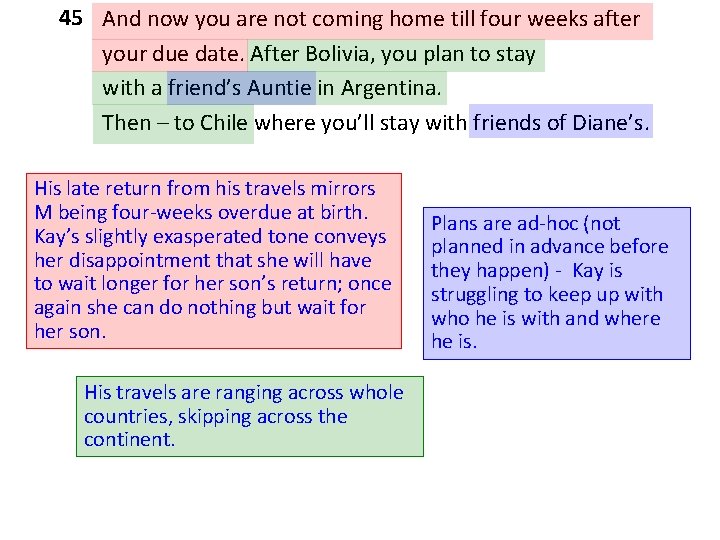
45 And now you are not coming home till four weeks after your due date. After Bolivia, you plan to stay with a friend’s Auntie in Argentina. Then – to Chile where you’ll stay with friends of Diane’s. His late return from his travels mirrors M being four-weeks overdue at birth. Kay’s slightly exasperated tone conveys her disappointment that she will have to wait longer for her son’s return; once again she can do nothing but wait for her son. His travels are ranging across whole countries, skipping across the continent. Plans are ad-hoc (not planned in advance before they happen) - Kay is struggling to keep up with who he is with and where he is.
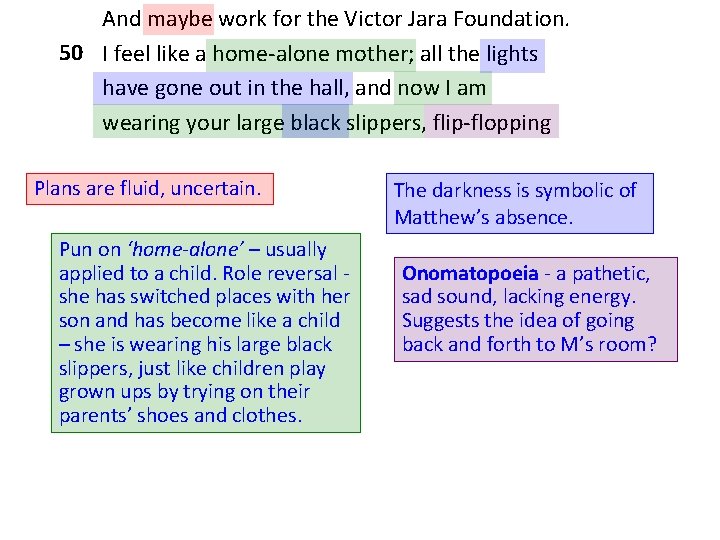
And maybe work for the Victor Jara Foundation. 50 I feel like a home-alone mother; all the lights have gone out in the hall, and now I am wearing your large black slippers, flip-flopping Plans are fluid, uncertain. Pun on ‘home-alone’ – usually applied to a child. Role reversal she has switched places with her son and has become like a child – she is wearing his large black slippers, just like children play grown ups by trying on their parents’ shoes and clothes. The darkness is symbolic of Matthew’s absence. Onomatopoeia - a pathetic, sad sound, lacking energy. Suggests the idea of going back and forth to M’s room?
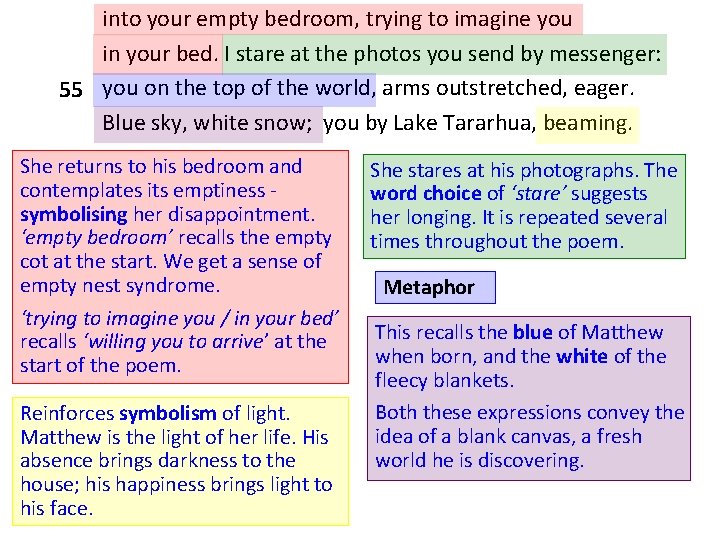
into your empty bedroom, trying to imagine you in your bed. I stare at the photos you send by messenger: 55 you on the top of the world, arms outstretched, eager. Blue sky, white snow; you by Lake Tararhua, beaming. She returns to his bedroom and contemplates its emptiness symbolising her disappointment. ‘empty bedroom’ recalls the empty cot at the start. We get a sense of empty nest syndrome. ‘trying to imagine you / in your bed’ recalls ‘willing you to arrive’ at the start of the poem. Reinforces symbolism of light. Matthew is the light of her life. His absence brings darkness to the house; his happiness brings light to his face. She stares at his photographs. The word choice of ‘stare’ suggests her longing. It is repeated several times throughout the poem. Metaphor This recalls the blue of Matthew when born, and the white of the fleecy blankets. Both these expressions convey the idea of a blank canvas, a fresh world he is discovering.
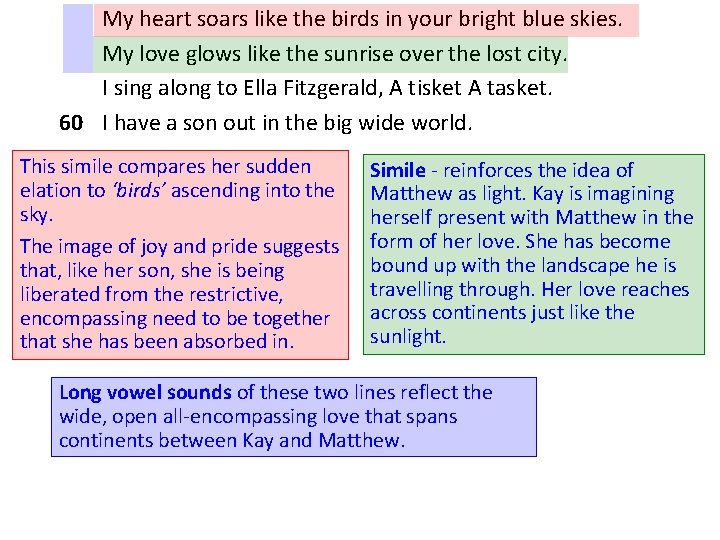
My heart soars like the birds in your bright blue skies. My love glows like the sunrise over the lost city. I sing along to Ella Fitzgerald, A tisket A tasket. 60 I have a son out in the big wide world. This simile compares her sudden elation to ‘birds’ ascending into the sky. The image of joy and pride suggests that, like her son, she is being liberated from the restrictive, encompassing need to be together that she has been absorbed in. Simile - reinforces the idea of Matthew as light. Kay is imagining herself present with Matthew in the form of her love. She has become bound up with the landscape he is travelling through. Her love reaches across continents just like the sunlight. Long vowel sounds of these two lines reflect the wide, open all-encompassing love that spans continents between Kay and Matthew.
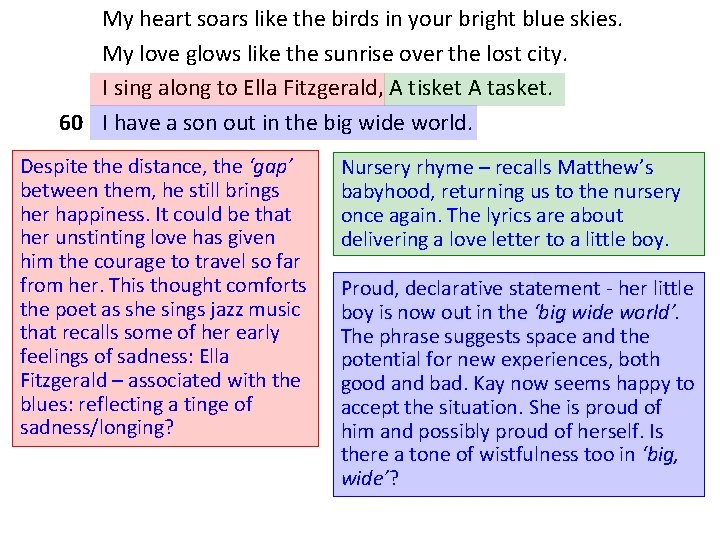
My heart soars like the birds in your bright blue skies. My love glows like the sunrise over the lost city. I sing along to Ella Fitzgerald, A tisket A tasket. 60 I have a son out in the big wide world. Despite the distance, the ‘gap’ between them, he still brings her happiness. It could be that her unstinting love has given him the courage to travel so far from her. This thought comforts the poet as she sings jazz music that recalls some of her early feelings of sadness: Ella Fitzgerald – associated with the blues: reflecting a tinge of sadness/longing? Nursery rhyme – recalls Matthew’s babyhood, returning us to the nursery once again. The lyrics are about delivering a love letter to a little boy. Proud, declarative statement - her little boy is now out in the ‘big wide world’. The phrase suggests space and the potential for new experiences, both good and bad. Kay now seems happy to accept the situation. She is proud of him and possibly proud of herself. Is there a tone of wistfulness too in ‘big, wide’?
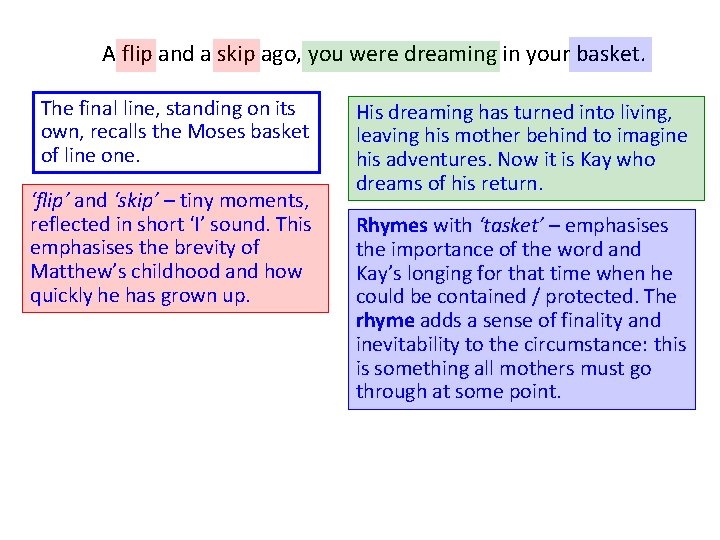
A flip and a skip ago, you were dreaming in your basket. The final line, standing on its own, recalls the Moses basket of line one. ‘flip’ and ‘skip’ – tiny moments, reflected in short ‘I’ sound. This emphasises the brevity of Matthew’s childhood and how quickly he has grown up. His dreaming has turned into living, leaving his mother behind to imagine his adventures. Now it is Kay who dreams of his return. Rhymes with ‘tasket’ – emphasises the importance of the word and Kay’s longing for that time when he could be contained / protected. The rhyme adds a sense of finality and inevitability to the circumstance: this is something all mothers must go through at some point.
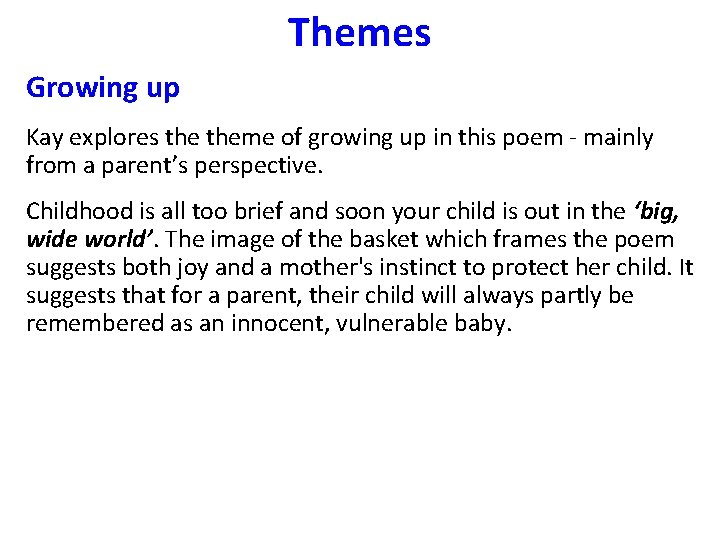
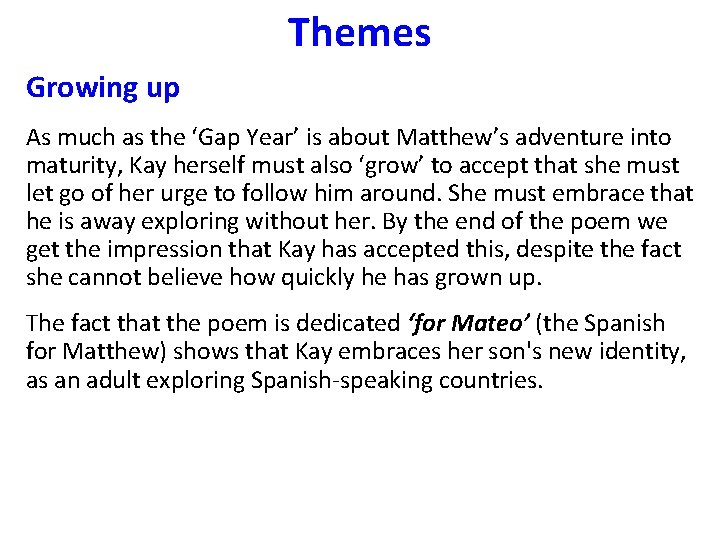
Themes Growing up Kay explores theme of growing up in this poem - mainly from a parent’s perspective. Childhood is all too brief and soon your child is out in the ‘big, wide world’. The image of the basket which frames the poem suggests both joy and a mother's instinct to protect her child. It suggests that for a parent, their child will always partly be remembered as an innocent, vulnerable baby.
Themes Growing up As much as the ‘Gap Year’ is about Matthew’s adventure into maturity, Kay herself must also ‘grow’ to accept that she must let go of her urge to follow him around. She must embrace that he is away exploring without her. By the end of the poem we get the impression that Kay has accepted this, despite the fact she cannot believe how quickly he has grown up. The fact that the poem is dedicated ‘for Mateo’ (the Spanish for Matthew) shows that Kay embraces her son's new identity, as an adult exploring Spanish-speaking countries.
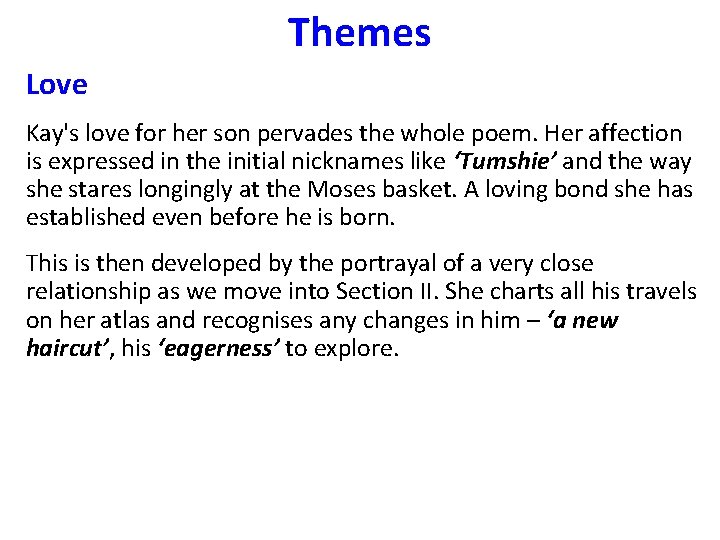
Themes Love Kay's love for her son pervades the whole poem. Her affection is expressed in the initial nicknames like ‘Tumshie’ and the way she stares longingly at the Moses basket. A loving bond she has established even before he is born. This is then developed by the portrayal of a very close relationship as we move into Section II. She charts all his travels on her atlas and recognises any changes in him – ‘a new haircut’, his ‘eagerness’ to explore.
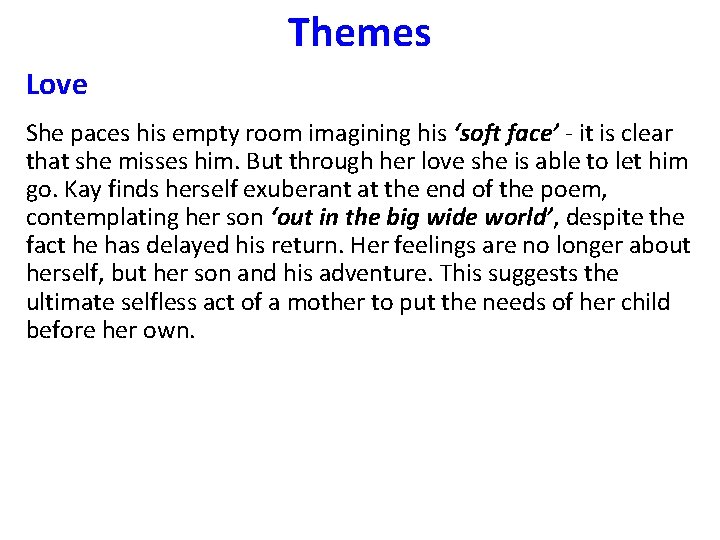
Themes Love She paces his empty room imagining his ‘soft face’ - it is clear that she misses him. But through her love she is able to let him go. Kay finds herself exuberant at the end of the poem, contemplating her son ‘out in the big wide world’, despite the fact he has delayed his return. Her feelings are no longer about herself, but her son and his adventure. This suggests the ultimate selfless act of a mother to put the needs of her child before her own.
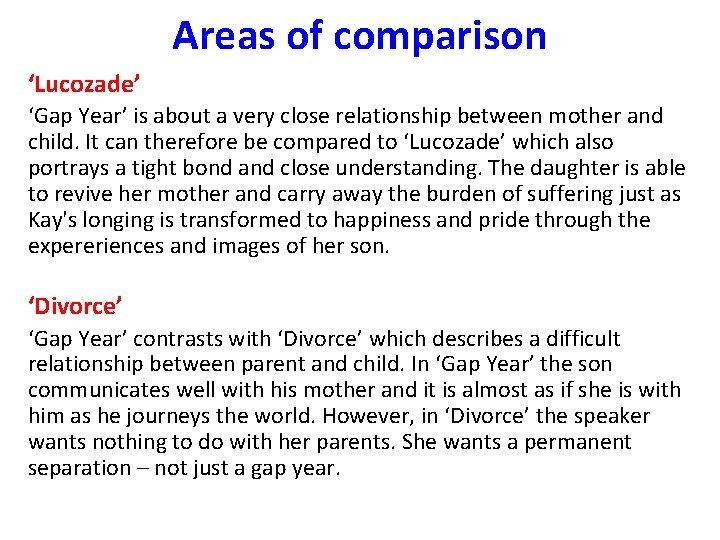
Areas of comparison ‘Lucozade’ ‘Gap Year’ is about a very close relationship between mother and child. It can therefore be compared to ‘Lucozade’ which also portrays a tight bond and close understanding. The daughter is able to revive her mother and carry away the burden of suffering just as Kay's longing is transformed to happiness and pride through the expereriences and images of her son. ‘Divorce’ ‘Gap Year’ contrasts with ‘Divorce’ which describes a difficult relationship between parent and child. In ‘Gap Year’ the son communicates well with his mother and it is almost as if she is with him as he journeys the world. However, in ‘Divorce’ the speaker wants nothing to do with her parents. She wants a permanent separation – not just a gap year.
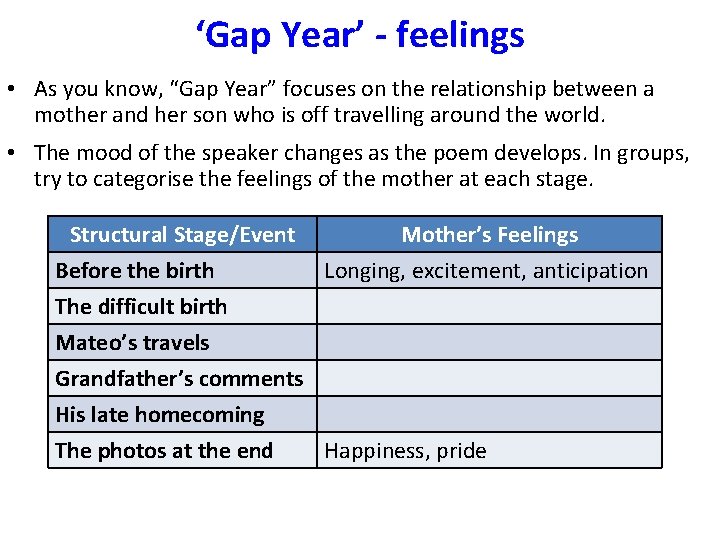
‘Gap Year’ - feelings • As you know, “Gap Year” focuses on the relationship between a mother and her son who is off travelling around the world. • The mood of the speaker changes as the poem develops. In groups, try to categorise the feelings of the mother at each stage. Structural Stage/Event Before the birth The difficult birth Mateo’s travels Mother’s Feelings Longing, excitement, anticipation Grandfather’s comments His late homecoming The photos at the end Happiness, pride
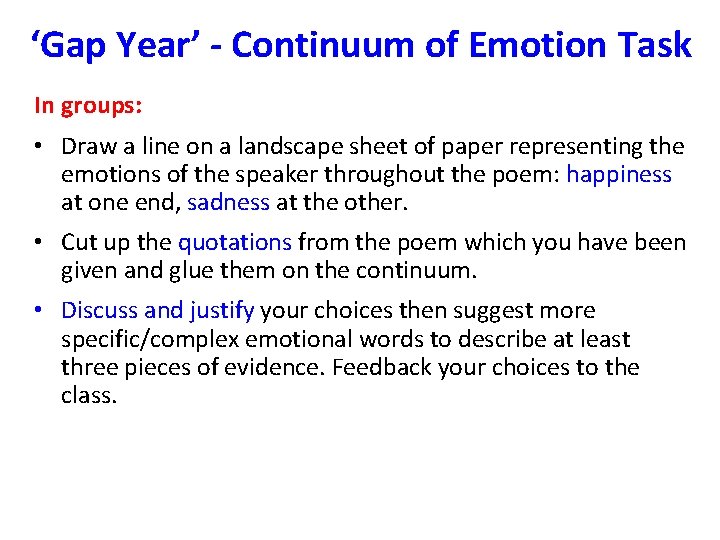
‘Gap Year’ - Continuum of Emotion Task In groups: • Draw a line on a landscape sheet of paper representing the emotions of the speaker throughout the poem: happiness at one end, sadness at the other. • Cut up the quotations from the poem which you have been given and glue them on the continuum. • Discuss and justify your choices then suggest more specific/complex emotional words to describe at least three pieces of evidence. Feedback your choices to the class.
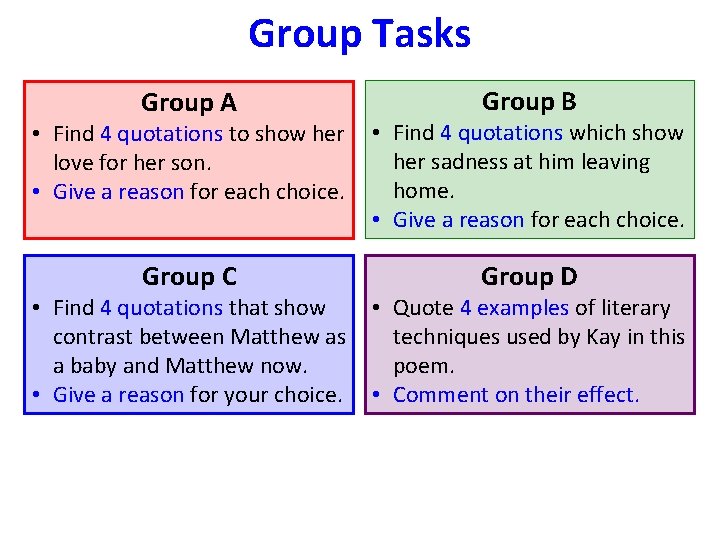
Group Tasks Group A Group B • Find 4 quotations to show her love for her son. • Give a reason for each choice. • Find 4 quotations which show her sadness at him leaving home. • Give a reason for each choice. Group C Group D • Find 4 quotations that show contrast between Matthew as a baby and Matthew now. • Give a reason for your choice. • Quote 4 examples of literary techniques used by Kay in this poem. • Comment on their effect.
Complete the test on the poem in your booklet