
GAP Implementation Issues Challenges and Areas for Future


- Slides: 24
GAP Implementation Issues , Challenges and Areas for Future Action Kit Chan APO E-Learning Course on Good Agriculture Practice (GAP) for Greater Market Access 4 th – 6 th November 2015, APO Secretariat Video Conferencing Center (Session 2)
Constraints of the Smallholder Farmer 2
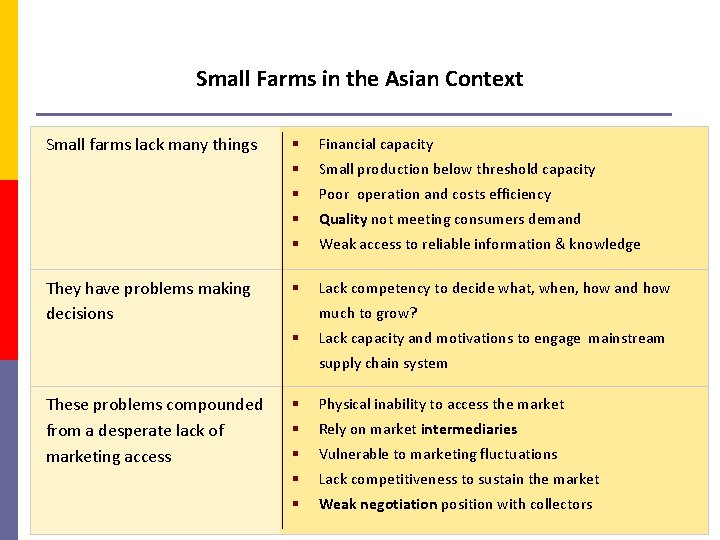
Small Farms in the Asian Context Small farms lack many things They have problems making decisions § Financial capacity § Small production below threshold capacity § Poor operation and costs efficiency § Quality not meeting consumers demand § Weak access to reliable information & knowledge § Lack competency to decide what, when, how and how much to grow? § Lack capacity and motivations to engage mainstream supply chain system These problems compounded from a desperate lack of marketing access § Physical inability to access the market § Rely on market intermediaries § Vulnerable to marketing fluctuations § Lack competitiveness to sustain the market § Weak negotiation position with collectors 3
Formulating a GAP Plan for Small Farm Cluster 4
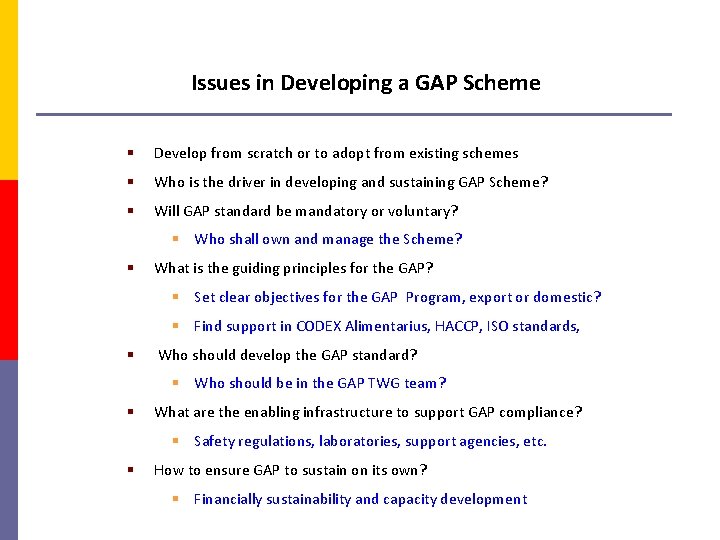
Issues in Developing a GAP Scheme § Develop from scratch or to adopt from existing schemes § Who is the driver in developing and sustaining GAP Scheme? § Will GAP standard be mandatory or voluntary? § Who shall own and manage the Scheme? § What is the guiding principles for the GAP? § Set clear objectives for the GAP Program, export or domestic? § Find support in CODEX Alimentarius, HACCP, ISO standards, § Who should develop the GAP standard? § Who should be in the GAP TWG team? § What are the enabling infrastructure to support GAP compliance? § Safety regulations, laboratories, support agencies, etc. § How to ensure GAP to sustain on its own? § Financially sustainability and capacity development
Issues in Implementing the GAP Scheme § How to convince members to adopt and comply GAP standards? v Develop the incentives and benefits first. v Communicate clearly with the stakeholders § Do stakeholders have the knowledge and financial capacity to understand the standard and to comply? § What level of compliance should be set for the standard? § Does the GAP Scheme owner have capacity to train GAP trainers? § What Codes of Practice of the farms that extension trainers could use? § Tackle immediate issues on food safety first, – pesticides residue? § How to promote the GAP scheme in the market in the producer country and in the export destination?
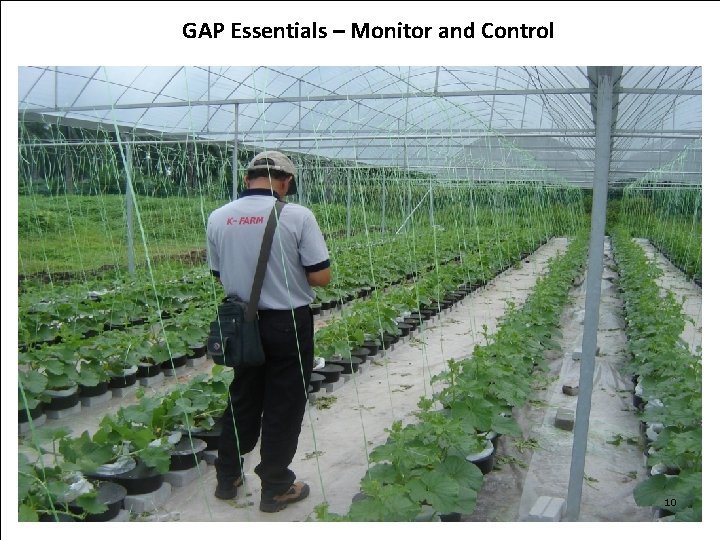
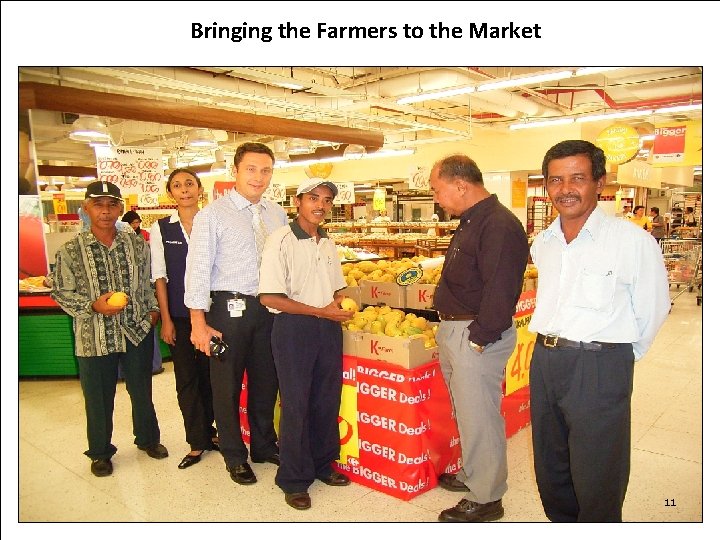
Considerations in developing the GAP Agenda in Asia - 1 § It is possible to reach out to small farmers § It is essential to exert monitoring and control of farms § The Contract between GAP owner and the Farmers is binding § Financial returns for practicing GAP is not from higher farm gate prices – it is through increase in productivity § Farm extension training for farmers is essential § Need to develop inclusive connectivity with the farmers: § Bring farmers to the market 7
Considerations in developing the GAP Agenda in Asia - 2 1. Specific standards shall apply to specific country and client 2. Consideration for China and India to become focus of Asian Trade and greater South – South trade direction 3. Standard certification is not just for export trade to Europe and USA 4. The benefits to market access, competitiveness must be priority v But there is No guarantee of better retail prices 5. Can Asian countries attain a common level of production capacity? 6. Standards requirement in global trade will become more stringent 7. Standards requirement will cover larger scope of production process 8. Countries must upgrade all farms or face alienation from market 9. Is it possible to develop a harmonized GAP scheme for Asia? 10. The benefits of GAP implementation is a reality. 8
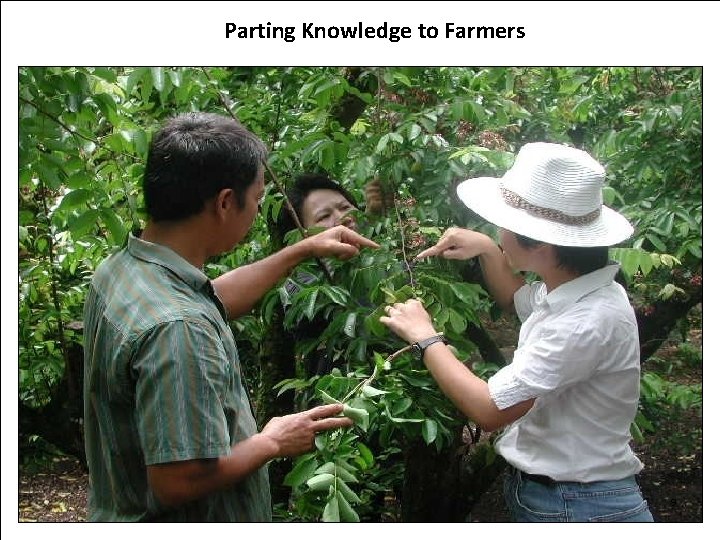
Parting Knowledge to Farmers 9
GAP Essentials – Monitor and Control 10
Bringing the Farmers to the Market 11
GAP Practices in Asia 12
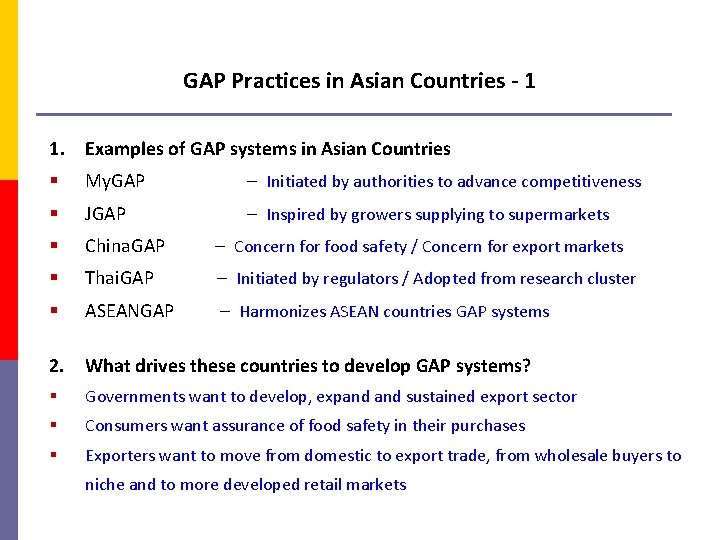
GAP Practices in Asian Countries - 1 1. Examples of GAP systems in Asian Countries § My. GAP – Initiated by authorities to advance competitiveness § JGAP – Inspired by growers supplying to supermarkets § China. GAP – Concern for food safety / Concern for export markets § Thai. GAP – Initiated by regulators / Adopted from research cluster § ASEANGAP – Harmonizes ASEAN countries GAP systems 2. What drives these countries to develop GAP systems? § Governments want to develop, expand sustained export sector § Consumers want assurance of food safety in their purchases § Exporters want to move from domestic to export trade, from wholesale buyers to niche and to more developed retail markets
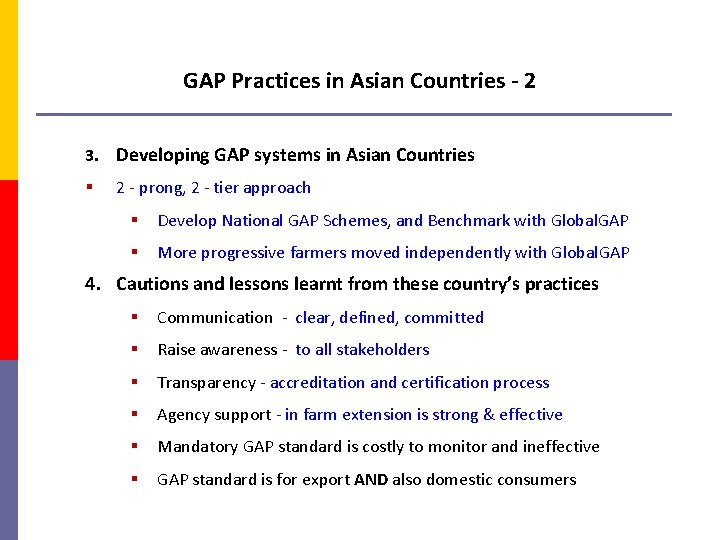
GAP Practices in Asian Countries - 2 3. Developing GAP systems in Asian Countries § 2 - prong, 2 - tier approach § Develop National GAP Schemes, and Benchmark with Global. GAP § More progressive farmers moved independently with Global. GAP 4. Cautions and lessons learnt from these country’s practices § Communication - clear, defined, committed § Raise awareness - to all stakeholders § Transparency - accreditation and certification process § Agency support - in farm extension is strong & effective § Mandatory GAP standard is costly to monitor and ineffective § GAP standard is for export AND also domestic consumers
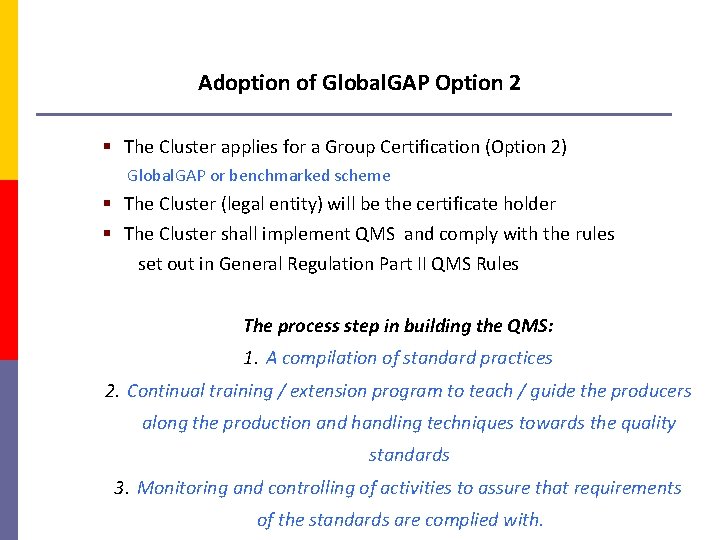
Adoption of Global. GAP Option 2 § The Cluster applies for a Group Certification (Option 2) Global. GAP or benchmarked scheme § The Cluster (legal entity) will be the certificate holder § The Cluster shall implement QMS and comply with the rules set out in General Regulation Part II QMS Rules The process step in building the QMS: 1. A compilation of standard practices 2. Continual training / extension program to teach / guide the producers along the production and handling techniques towards the quality standards 3. Monitoring and controlling of activities to assure that requirements of the standards are complied with.
Way Forward in Developing GAP 16
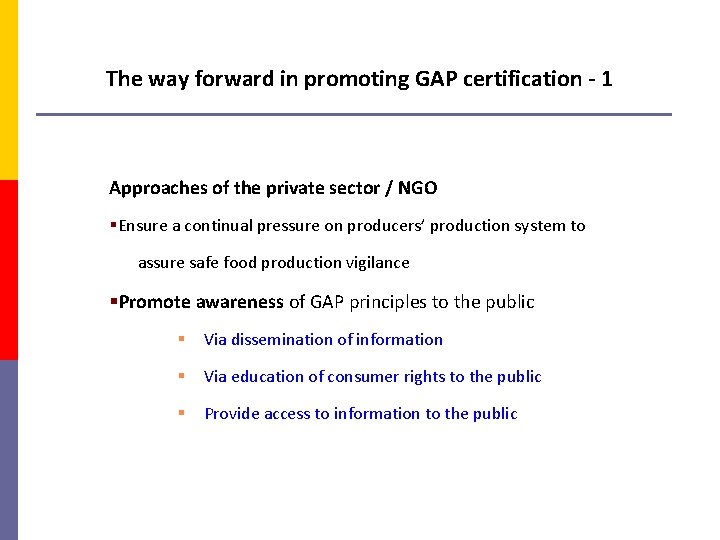
The way forward in promoting GAP certification - 1 Approaches of the private sector / NGO §Ensure a continual pressure on producers’ production system to assure safe food production vigilance §Promote awareness of GAP principles to the public § Via dissemination of information § Via education of consumer rights to the public § Provide access to information to the public
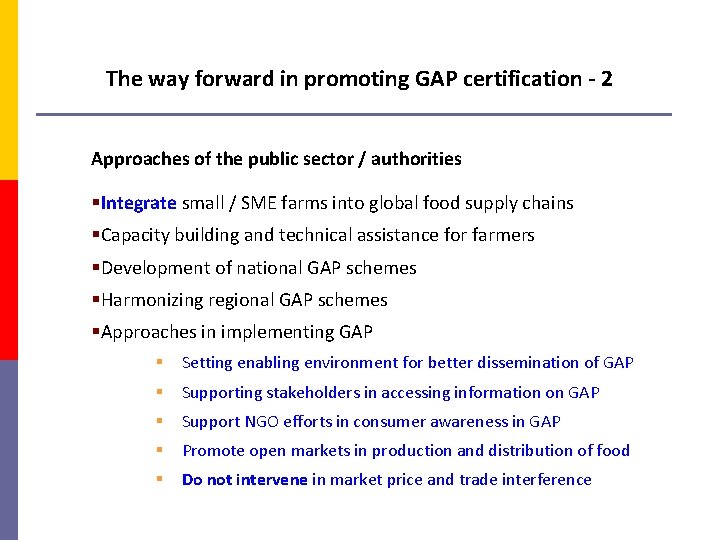
The way forward in promoting GAP certification - 2 Approaches of the public sector / authorities §Integrate small / SME farms into global food supply chains §Capacity building and technical assistance for farmers §Development of national GAP schemes §Harmonizing regional GAP schemes §Approaches in implementing GAP § Setting enabling environment for better dissemination of GAP § Supporting stakeholders in accessing information on GAP § Support NGO efforts in consumer awareness in GAP § Promote open markets in production and distribution of food § Do not intervene in market price and trade interference
The way forward in promoting GAP certification - 3 GAP development for Asia Pacific § Shift of global trade from South – North to South – South § Trade competition among countries will increase § There is No reversal for high standards and high quality § Trading countries will demand reciprocal standards and qualities § Eventual harmonization of international GAP standard of a high level § Slow reformers will be left behind
Thank you For more enquiries please write to kitchan@kfarm. com or visit us @ www. kfarm. com
Small Farm Safe Food GAP Program 21
Developing a Safe Food GAP for the Small holder - 1 Problem: Non compliance of production safety standards of the domestic / export markets Scale: Work with contracted existing small holder Cluster farms Solutions: Adoption of a Food Safety Standards Protocol into current farm practices Objective: Seek certification for the farms Immediate action: Ensure that MRL pesticide residue of final crop in the market is not breached 22
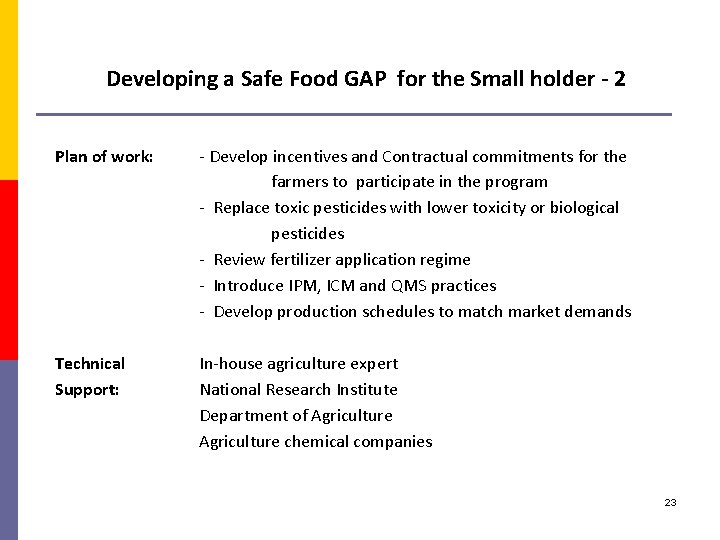
Developing a Safe Food GAP for the Small holder - 2 Plan of work: - Develop incentives and Contractual commitments for the farmers to participate in the program - Replace toxic pesticides with lower toxicity or biological pesticides - Review fertilizer application regime - Introduce IPM, ICM and QMS practices - Develop production schedules to match market demands Technical Support: In-house agriculture expert National Research Institute Department of Agriculture chemical companies 23
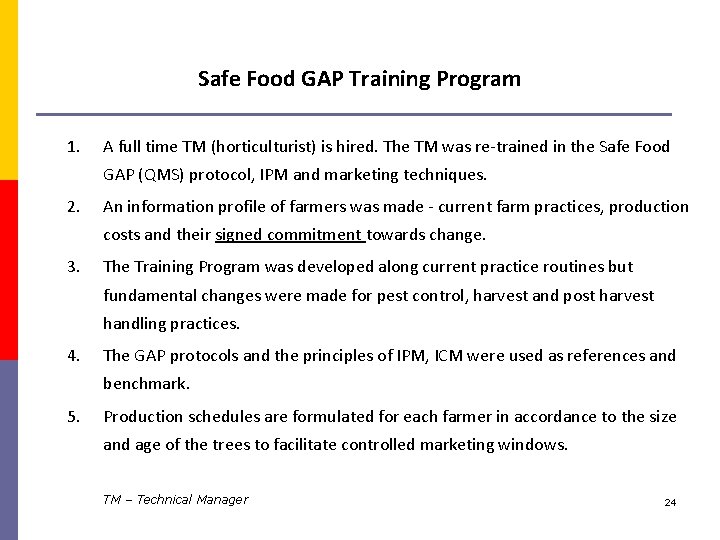
Safe Food GAP Training Program 1. A full time TM (horticulturist) is hired. The TM was re-trained in the Safe Food GAP (QMS) protocol, IPM and marketing techniques. 2. An information profile of farmers was made - current farm practices, production costs and their signed commitment towards change. 3. The Training Program was developed along current practice routines but fundamental changes were made for pest control, harvest and post harvest handling practices. 4. The GAP protocols and the principles of IPM, ICM were used as references and benchmark. 5. Production schedules are formulated for each farmer in accordance to the size and age of the trees to facilitate controlled marketing windows. TM – Technical Manager 24