
GAO Cost Assessment Guide Best Practices for Estimating
GAO Cost Assessment Guide: Best Practices for Estimating and Managing Program Costs by Karen Richey July 22, 2008
Outline l Why is the GAO Cost Assessment Guide important? l How the Guide was developed l An overview of the Guide l Invitation to participate in future expert meetings at GAO to discuss follow-on development of the Guide 10/24/2021 2
Why is the GAO Cost Assessment Guide important? l GAO assists Congress in its oversight of the federal government including agencies’ stewardship of public funds • • l Legislators, government officials, and the public want to know • • Whether government programs are achieving their goals What these programs are expected to cost Developing reliable program cost estimates is critical to • • • Effectively using public funds Meeting OMB’s capital programming process Avoiding cost overruns, missed deadlines, and performance shortfalls • Many of our program assessments find that unreliable estimates are the cause We developed this Guide to • Establish a consistent methodology based on best practices to be used across federal government for the development and management of its program cost estimates 10/24/2021 3
Why is the GAO Cost Assessment Guide important? (continued) l Original intent was to provide auditors with a standardized approach for analyzing program costs • • l Our research, however, found federal guidelines to be limited on the processes, procedures, and practices for ensuring credible cost estimates We decided to fill the gap and shifted the intent of the Guide from an auditor’s manual to a best-practice manual Purpose of the Guide is to • • Address best practices for ensuring credible program cost estimates for both government and industry Provide a detailed link between cost estimating and Earned Value Management (EVM) • • OMB has endorsed EVM for measuring cost, schedule, and technical performance Guide demonstrates how realistic cost and schedule estimates are necessary for setting achievable program baselines and managing risk 10/24/2021 4
Why is the GAO Cost Assessment Guide important? (continued) l Managers and auditors alike should find this Guide to be a useful manual as they assess: • • l The credibility of a program’s cost estimate for budget and decision -making purposes Program status using EVM To help GAO auditors fully utilize this Guide, we are including a number of “auditor checklists” for use on program assessments • These checklists will assist auditors in • • Identifying whether a program meets best practices Looking for common pitfalls that may undermine the reliability of cost estimates and program baselines 10/24/2021 5
How the Guide Was Developed l We developed this Guide in consultation with a “community of experts” from the federal government and industry. • • Formal kick-off began at the Society of Cost Estimating and Analysis conference in June 2005 Since then, the community of experts helping to review and comment on the Guide has grown • l Their contributions have been invaluable both in • • Providing historical information and experience Keeping the guide current with industry trends Together with these experts, we have developed a Guide which • • Clearly outlines GAO’s criteria for assessing cost estimates and EVM during audits Has been endorsed by OMB and cited as a key reference document for use by federal agencies in its June 2006 Capital Programming Guide 10/24/2021 6
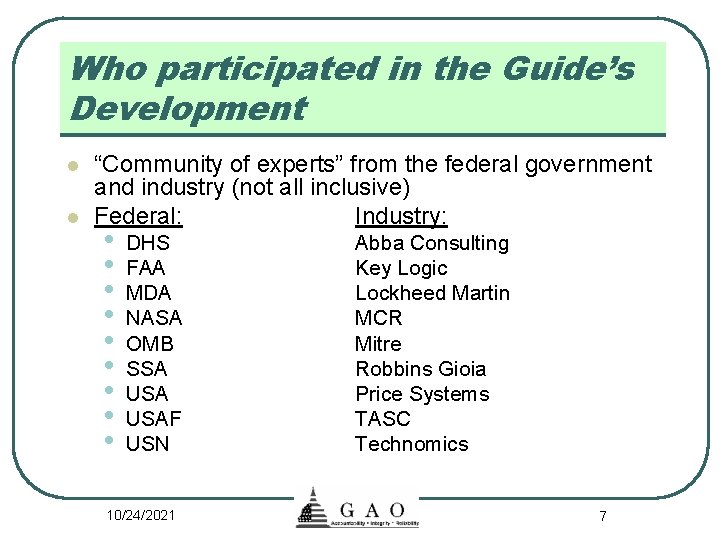
Who participated in the Guide’s Development l l “Community of experts” from the federal government and industry (not all inclusive) Federal: Industry: • • • DHS FAA MDA NASA OMB SSA USAF USN 10/24/2021 Abba Consulting Key Logic Lockheed Martin MCR Mitre Robbins Gioia Price Systems TASC Technomics 7
GAO Cost Assessment Guide: Best Practices for Estimating and Managing Program Costs An Overview of the Guide
Where can I find the Guide? l l l The Guide is available on GAO’s website as a one year exposure draft. WWW. GAO. GOV Search on the report number GAO-07 -1134 SP A comment tool is available on page 4 10/24/2021 9
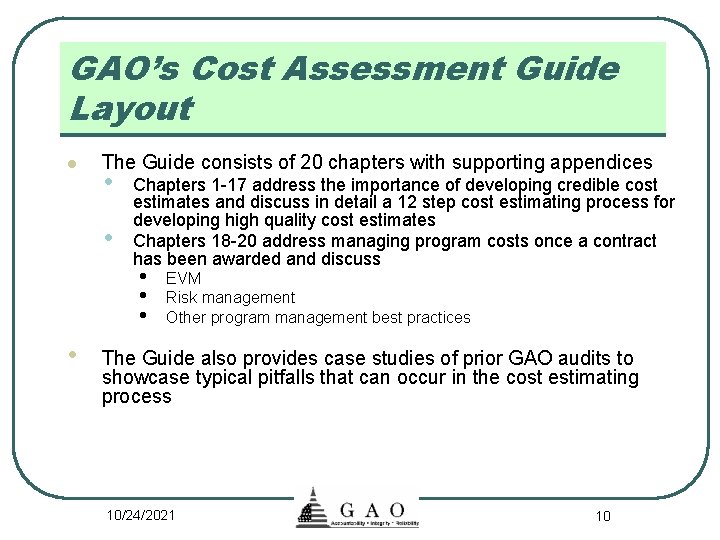
GAO’s Cost Assessment Guide Layout l The Guide consists of 20 chapters with supporting appendices • • Chapters 1 -17 address the importance of developing credible cost estimates and discuss in detail a 12 step cost estimating process for developing high quality cost estimates Chapters 18 -20 address managing program costs once a contract has been awarded and discuss • • EVM Risk management Other program management best practices The Guide also provides case studies of prior GAO audits to showcase typical pitfalls that can occur in the cost estimating process 10/24/2021 10
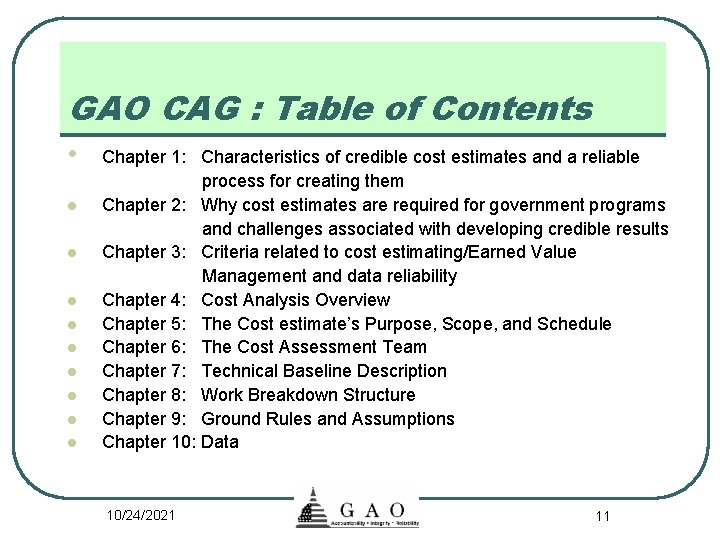
GAO CAG : Table of Contents • l l l l l Chapter 1: Characteristics of credible cost estimates and a reliable process for creating them Chapter 2: Why cost estimates are required for government programs and challenges associated with developing credible results Chapter 3: Criteria related to cost estimating/Earned Value Management and data reliability Chapter 4: Cost Analysis Overview Chapter 5: The Cost estimate’s Purpose, Scope, and Schedule Chapter 6: The Cost Assessment Team Chapter 7: Technical Baseline Description Chapter 8: Work Breakdown Structure Chapter 9: Ground Rules and Assumptions Chapter 10: Data 10/24/2021 11
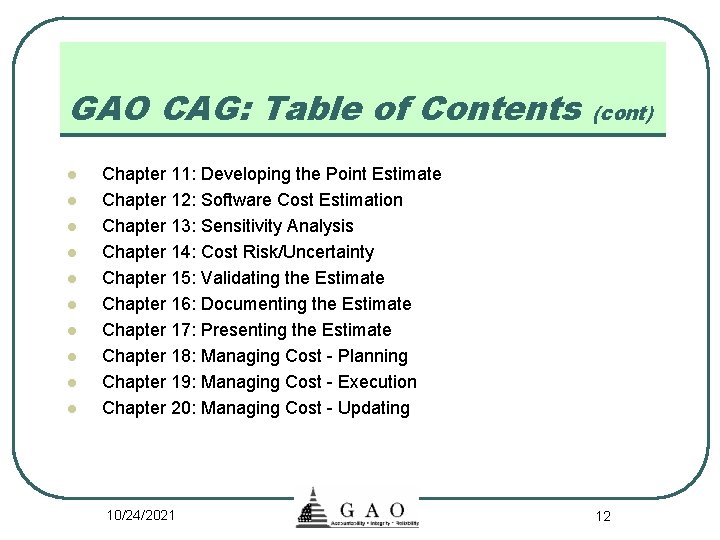
GAO CAG: Table of Contents l l l l l (cont) Chapter 11: Developing the Point Estimate Chapter 12: Software Cost Estimation Chapter 13: Sensitivity Analysis Chapter 14: Cost Risk/Uncertainty Chapter 15: Validating the Estimate Chapter 16: Documenting the Estimate Chapter 17: Presenting the Estimate Chapter 18: Managing Cost - Planning Chapter 19: Managing Cost - Execution Chapter 20: Managing Cost - Updating 10/24/2021 12
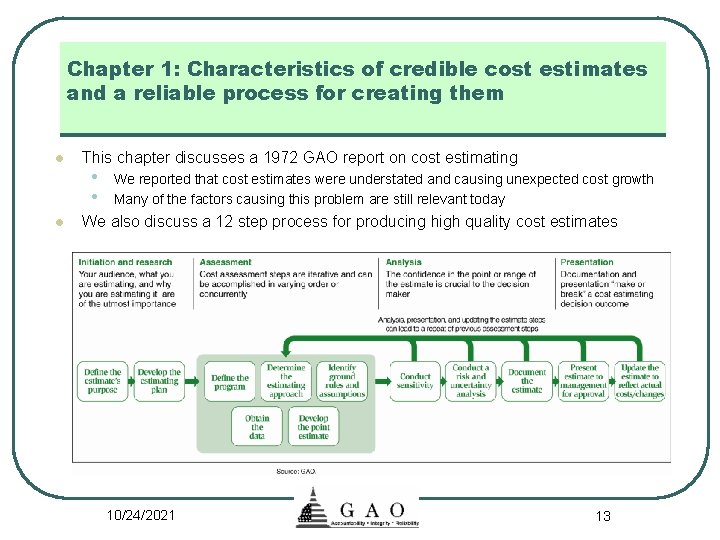
Chapter 1: Characteristics of credible cost estimates and a reliable process for creating them l l This chapter discusses a 1972 GAO report on cost estimating • • We reported that cost estimates were understated and causing unexpected cost growth Many of the factors causing this problem are still relevant today We also discuss a 12 step process for producing high quality cost estimates 10/24/2021 13
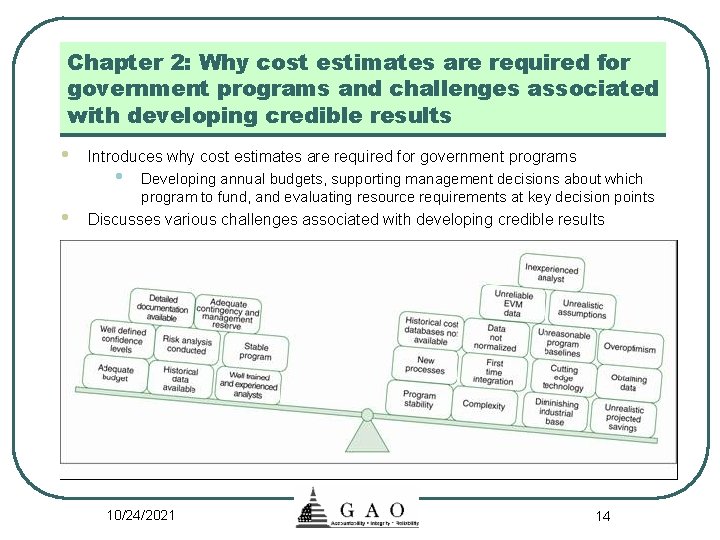
Chapter 2: Why cost estimates are required for government programs and challenges associated with developing credible results • • Introduces why cost estimates are required for government programs • Developing annual budgets, supporting management decisions about which program to fund, and evaluating resource requirements at key decision points Discusses various challenges associated with developing credible results 10/24/2021 14
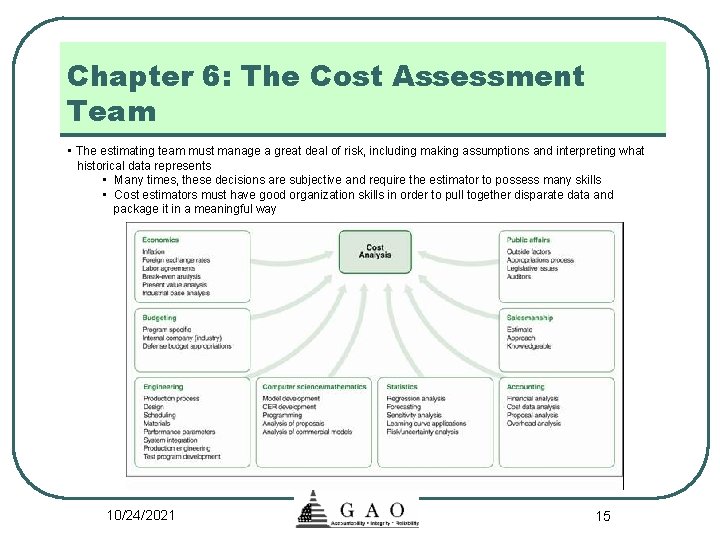
Chapter 6: The Cost Assessment Team • The estimating team must manage a great deal of risk, including making assumptions and interpreting what historical data represents • Many times, these decisions are subjective and require the estimator to possess many skills • Cost estimators must have good organization skills in order to pull together disparate data and package it in a meaningful way 10/24/2021 15
Chapter 6: The Cost Assessment Team (continued) l l The size of the team is driven by the estimate type • A ROM estimate requires less skill and time than a LCCE Enough time should be allotted for • • Collecting and understanding historical data Clarifying technical program aspects with experts A best practice is centralizing the cost estimating team and process • • Facilitates the use of standard processes Results in a strong organizational structure and leadership support Allows for the identification of resident experts Enables better sharing of resources Encourages commonality of tools and training for cost estimating Provides for more independence and less bias Presents opportunities for advancement within the cost estimating field Certifications, training, and practical experience are necessary for cost estimators and EVM analysts to effectively perform their job 10/24/2021 16
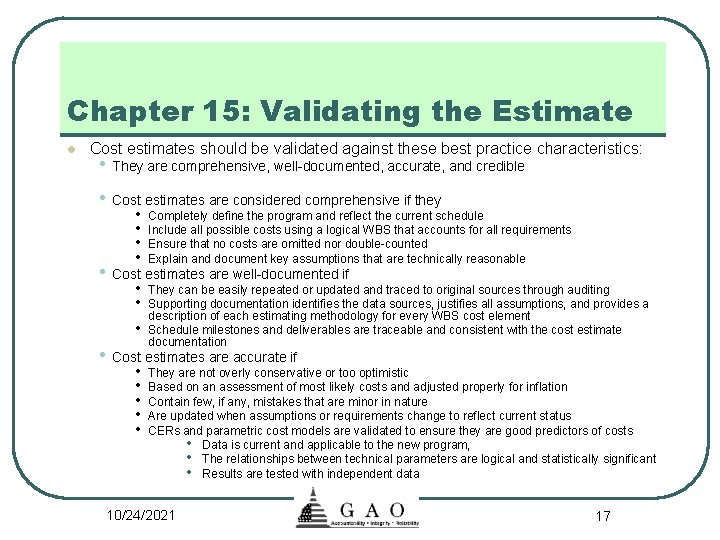
Chapter 15: Validating the Estimate l Cost estimates should be validated against these best practice characteristics: • They are comprehensive, well-documented, accurate, and credible • Cost estimates are considered comprehensive if they • • Completely define the program and reflect the current schedule Include all possible costs using a logical WBS that accounts for all requirements Ensure that no costs are omitted nor double-counted Explain and document key assumptions that are technically reasonable • • • They can be easily repeated or updated and traced to original sources through auditing Supporting documentation identifies the data sources, justifies all assumptions, and provides a description of each estimating methodology for every WBS cost element Schedule milestones and deliverables are traceable and consistent with the cost estimate documentation • Cost estimates are well-documented if • Cost estimates are accurate if • • • They are not overly conservative or too optimistic Based on an assessment of most likely costs and adjusted properly for inflation Contain few, if any, mistakes that are minor in nature Are updated when assumptions or requirements change to reflect current status CERs and parametric cost models are validated to ensure they are good predictors of costs • Data is current and applicable to the new program, • The relationships between technical parameters are logical and statistically significant • Results are tested with independent data 10/24/2021 17
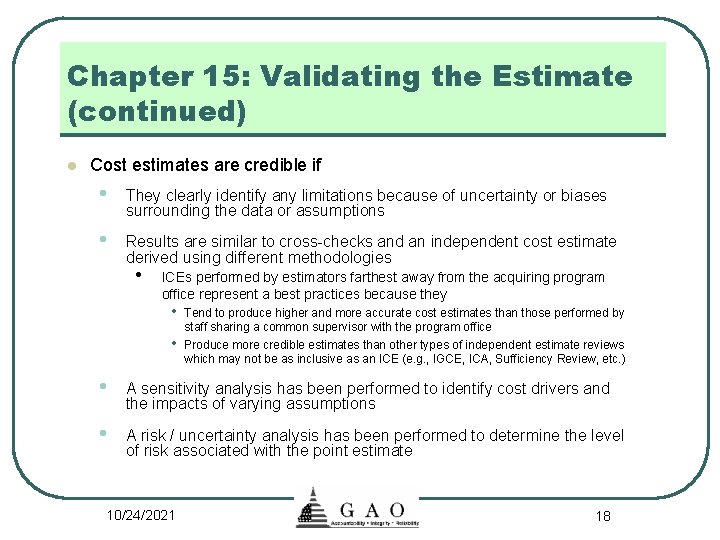
Chapter 15: Validating the Estimate (continued) l Cost estimates are credible if • They clearly identify any limitations because of uncertainty or biases surrounding the data or assumptions • Results are similar to cross-checks and an independent cost estimate derived using different methodologies • ICEs performed by estimators farthest away from the acquiring program office represent a best practices because they • • Tend to produce higher and more accurate cost estimates than those performed by staff sharing a common supervisor with the program office Produce more credible estimates than other types of independent estimate reviews which may not be as inclusive as an ICE (e. g. , IGCE, ICA, Sufficiency Review, etc. ) • A sensitivity analysis has been performed to identify cost drivers and the impacts of varying assumptions • A risk / uncertainty analysis has been performed to determine the level of risk associated with the point estimate 10/24/2021 18
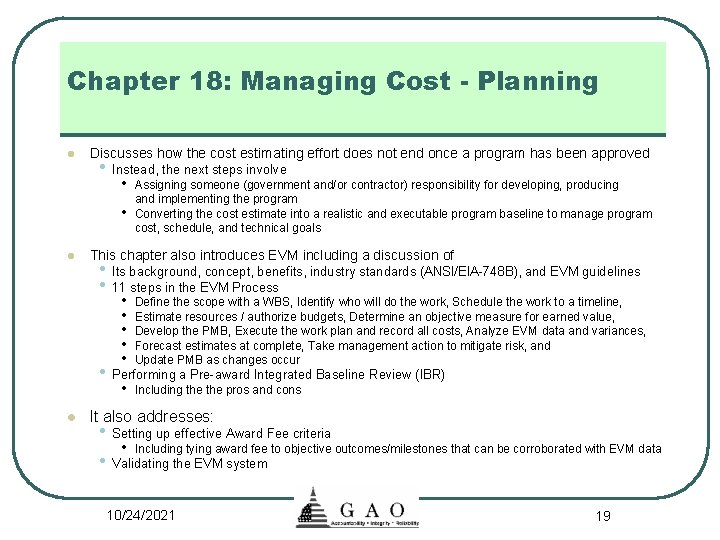
Chapter 18: Managing Cost - Planning l Discusses how the cost estimating effort does not end once a program has been approved • Instead, the next steps involve • • l l Assigning someone (government and/or contractor) responsibility for developing, producing and implementing the program Converting the cost estimate into a realistic and executable program baseline to manage program cost, schedule, and technical goals This chapter also introduces EVM including a discussion of • • Its background, concept, benefits, industry standards (ANSI/EIA-748 B), and EVM guidelines 11 steps in the EVM Process • Performing a Pre-award Integrated Baseline Review (IBR) • • • Define the scope with a WBS, Identify who will do the work, Schedule the work to a timeline, Estimate resources / authorize budgets, Determine an objective measure for earned value, Develop the PMB, Execute the work plan and record all costs, Analyze EVM data and variances, Forecast estimates at complete, Take management action to mitigate risk, and Update PMB as changes occur • Including the pros and cons It also addresses: • Setting up effective Award Fee criteria • Validating the EVM system • Including tying award fee to objective outcomes/milestones that can be corroborated with EVM data 10/24/2021 19
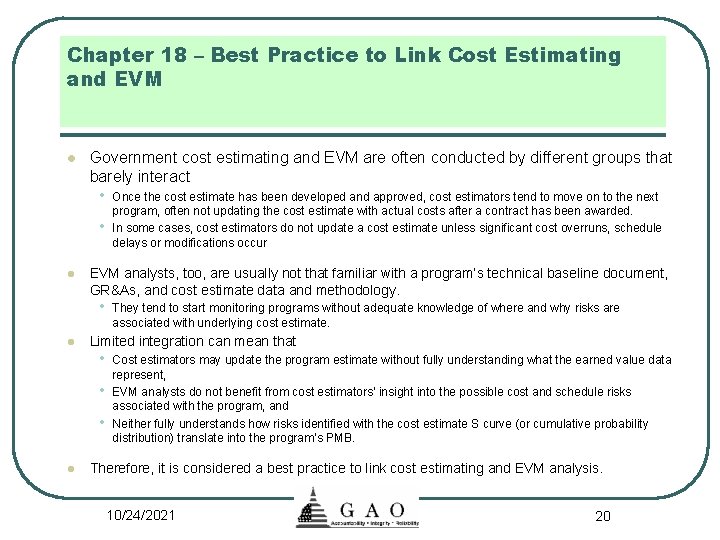
Chapter 18 – Best Practice to Link Cost Estimating and EVM l Government cost estimating and EVM are often conducted by different groups that barely interact • • l EVM analysts, too, are usually not that familiar with a program’s technical baseline document, GR&As, and cost estimate data and methodology. • l They tend to start monitoring programs without adequate knowledge of where and why risks are associated with underlying cost estimate. Limited integration can mean that • • • l Once the cost estimate has been developed and approved, cost estimators tend to move on to the next program, often not updating the cost estimate with actual costs after a contract has been awarded. In some cases, cost estimators do not update a cost estimate unless significant cost overruns, schedule delays or modifications occur Cost estimators may update the program estimate without fully understanding what the earned value data represent, EVM analysts do not benefit from cost estimators’ insight into the possible cost and schedule risks associated with the program, and Neither fully understands how risks identified with the cost estimate S curve (or cumulative probability distribution) translate into the program’s PMB. Therefore, it is considered a best practice to link cost estimating and EVM analysis. 10/24/2021 20
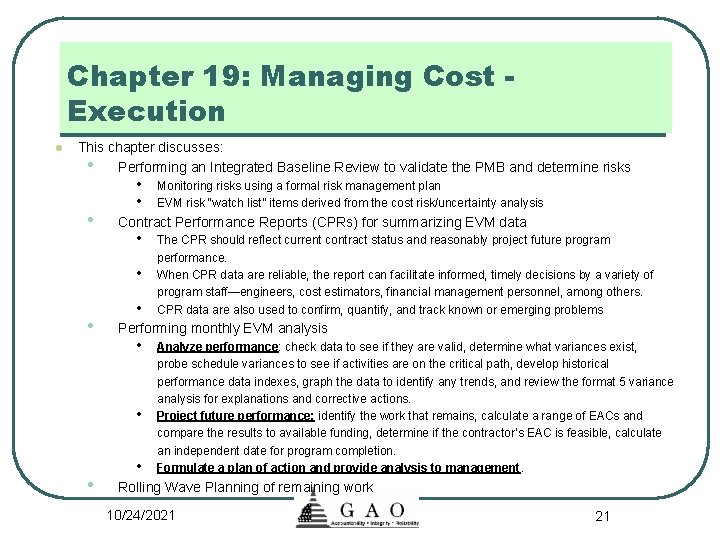
Chapter 19: Managing Cost Execution l This chapter discusses: • Performing an Integrated Baseline Review to validate the PMB and determine risks • • • Contract Performance Reports (CPRs) for summarizing EVM data • • The CPR should reflect current contract status and reasonably project future program performance. When CPR data are reliable, the report can facilitate informed, timely decisions by a variety of program staff—engineers, cost estimators, financial management personnel, among others. CPR data are also used to confirm, quantify, and track known or emerging problems Performing monthly EVM analysis • • • Monitoring risks using a formal risk management plan EVM risk “watch list” items derived from the cost risk/uncertainty analysis • Analyze performance: check data to see if they are valid, determine what variances exist, probe schedule variances to see if activities are on the critical path, develop historical performance data indexes, graph the data to identify any trends, and review the format 5 variance analysis for explanations and corrective actions. Project future performance: identify the work that remains, calculate a range of EACs and compare the results to available funding, determine if the contractor’s EAC is feasible, calculate an independent date for program completion. Formulate a plan of action and provide analysis to management. Rolling Wave Planning of remaining work 10/24/2021 21
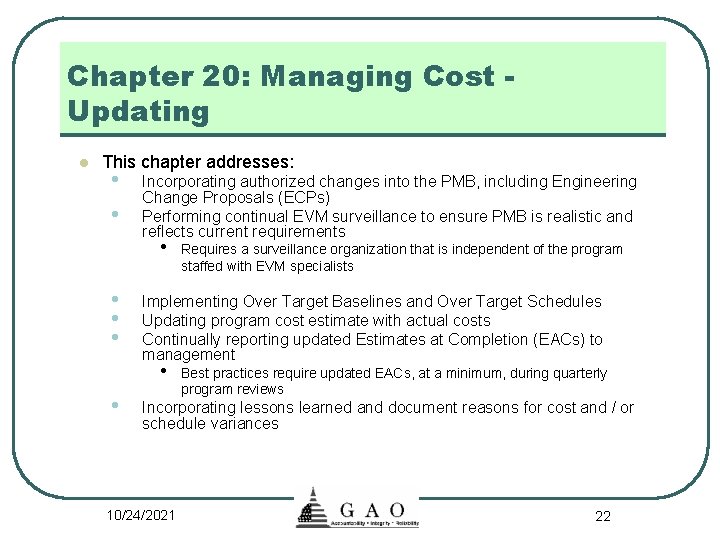
Chapter 20: Managing Cost Updating l This chapter addresses: • • Incorporating authorized changes into the PMB, including Engineering Change Proposals (ECPs) Performing continual EVM surveillance to ensure PMB is realistic and reflects current requirements • • Implementing Over Target Baselines and Over Target Schedules Updating program cost estimate with actual costs Continually reporting updated Estimates at Completion (EACs) to management • • Requires a surveillance organization that is independent of the program staffed with EVM specialists Best practices require updated EACs, at a minimum, during quarterly program reviews Incorporating lessons learned and document reasons for cost and / or schedule variances 10/24/2021 22

Invitation to Participate in Further Development of the Guide l GAO invites interested parties to meet with us and other experts to discuss further development of the Guide during the year long exposure draft period • If interested, please e-mail your contact info to: • • • 10/24/2021 Karen Richey - richeyk@gao. gov Jennifer Echard – echardj@gao. gov Carol Cha – chac@gao. gov 23
- Slides: 23