
Gangs are not a new phenomenon in the



- Slides: 29
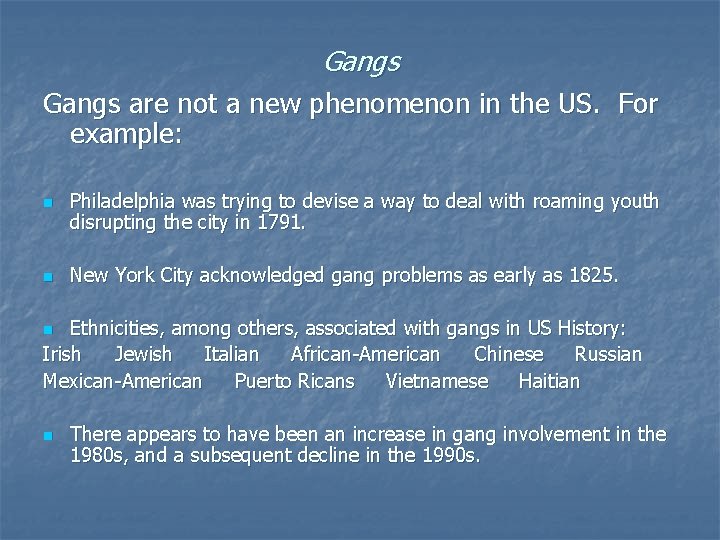
Gangs are not a new phenomenon in the US. For example: n n Philadelphia was trying to devise a way to deal with roaming youth disrupting the city in 1791. New York City acknowledged gang problems as early as 1825. Ethnicities, among others, associated with gangs in US History: Irish Jewish Italian African-American Chinese Russian Mexican-American Puerto Ricans Vietnamese Haitian n n There appears to have been an increase in gang involvement in the 1980 s, and a subsequent decline in the 1990 s.
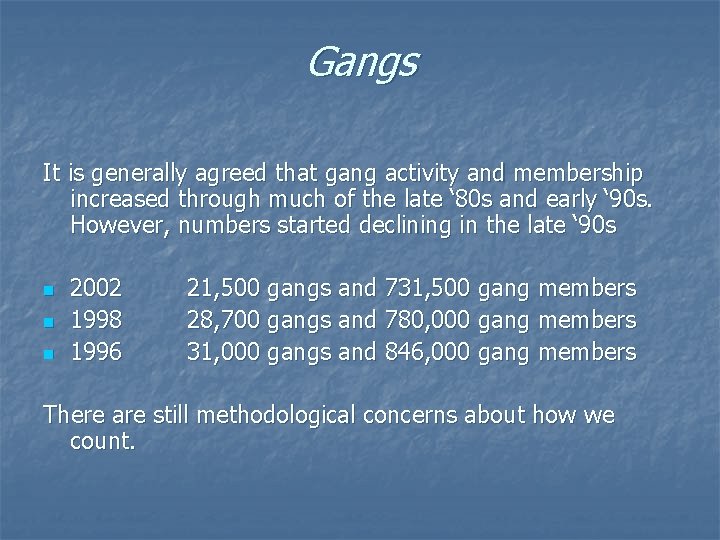
Gangs It is generally agreed that gang activity and membership increased through much of the late ‘ 80 s and early ‘ 90 s. However, numbers started declining in the late ‘ 90 s n n n 2002 1998 1996 21, 500 gangs and 731, 500 gang members 28, 700 gangs and 780, 000 gang members 31, 000 gangs and 846, 000 gang members There are still methodological concerns about how we count.
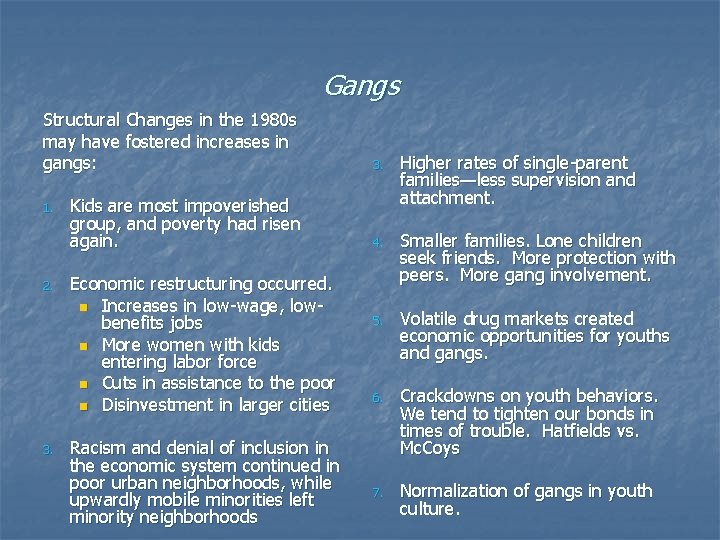
Gangs Conditions that foster gangs—Structural Changes in the 1980 s that may have fostered increases in gangs: 1. Kids are most impoverished group, and poverty had risen again. 2. Economic restructuring occurred. n Increases in low-wage, lowbenefits jobs n More women with kids entering labor force n Cuts in assistance to the poor n Disinvestment in larger cities 3. Racism and denial of inclusion in the economic system continued in poor urban neighborhoods, while upwardly mobile minorities left minority neighborhoods
Gangs Structural Changes in the 1980 s may have fostered increases in gangs: 3. Kids are most impoverished group, and poverty had risen again. Higher rates of single-parent families—less supervision and attachment. 4. Smaller families. Lone children seek friends. More protection with peers. More gang involvement. 5. Volatile drug markets created economic opportunities for youths and gangs. 6. Crackdowns on youth behaviors. We tend to tighten our bonds in times of trouble. Hatfields vs. Mc. Coys 7. Normalization of gangs in youth culture. 1. 2. 3. Economic restructuring occurred. n Increases in low-wage, lowbenefits jobs n More women with kids entering labor force n Cuts in assistance to the poor n Disinvestment in larger cities Racism and denial of inclusion in the economic system continued in poor urban neighborhoods, while upwardly mobile minorities left minority neighborhoods
Gangs n Normalization
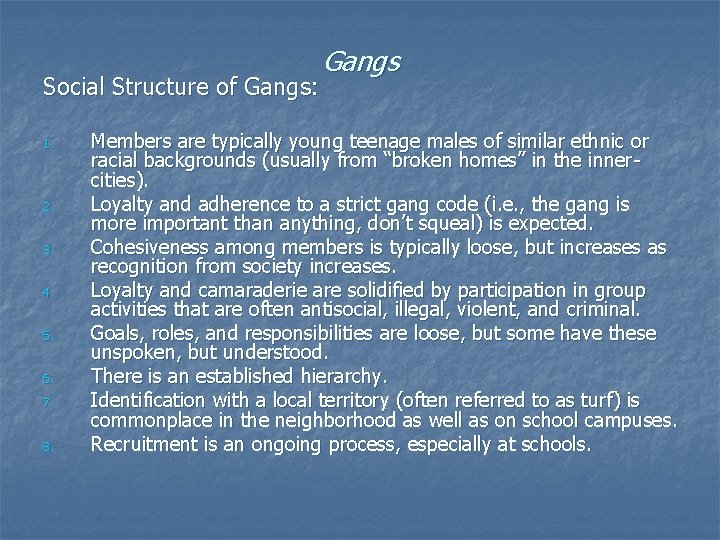
Social Structure of Gangs: 1. 2. 3. 4. 5. 6. 7. 8. Gangs Members are typically young teenage males of similar ethnic or racial backgrounds (usually from “broken homes” in the innercities). Loyalty and adherence to a strict gang code (i. e. , the gang is more important than anything, don’t squeal) is expected. Cohesiveness among members is typically loose, but increases as recognition from society increases. Loyalty and camaraderie are solidified by participation in group activities that are often antisocial, illegal, violent, and criminal. Goals, roles, and responsibilities are loose, but some have these unspoken, but understood. There is an established hierarchy. Identification with a local territory (often referred to as turf) is commonplace in the neighborhood as well as on school campuses. Recruitment is an ongoing process, especially at schools.
Gangs How were gangs transformed in the late 1980 s? 1. 2. 3. 4. 5. 6. 7. 8. 9. Younger active members (some as young as eight- or nine-yearsold) Evidence of ethnic and racial crossover in multiethnic neighborhoods Growth in female gangs Established cliques or sets in smaller cities and suburban communities Acquisition of large sums of money from illegal drug markets and prostitution for some gangs Frequent use of drugs and alcohol More violence Use of sophisticated communications devices and automatic weapons Employment of guerrilla warfare-like tactics
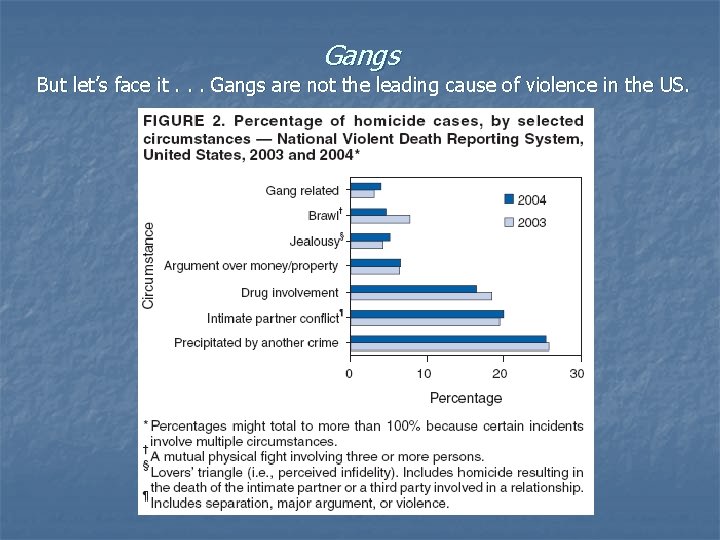
Gangs But let’s face it. . . Gangs are not the leading cause of violence in the US.
Gangs According to Research, Reasons for Gang Involvement are: 1. A search for love, structure and discipline 2. A sense of belonging, commitment, acceptance 3. The need for recognition and power, self-worth and status 4. Training, excitement and activities
Gangs According to Research, Reasons for Gang Involvement are: 1. 2. A search for love, structure and discipline 5. To make money 6. The need for physical Safety and protection 7. A family/neighborhood tradition A sense of belonging, commitment, acceptance 3. The need for recognition and power, self-worth and status 4. Training, excitement and activities
According to Research, Reasons for Gang Involvement are: Gangs To sum it up, people are gregarious and join groups for psychological security, resource security and for emotionally satisfying bonds. These reasons for joining gangs sound like reasons people join any other organization.
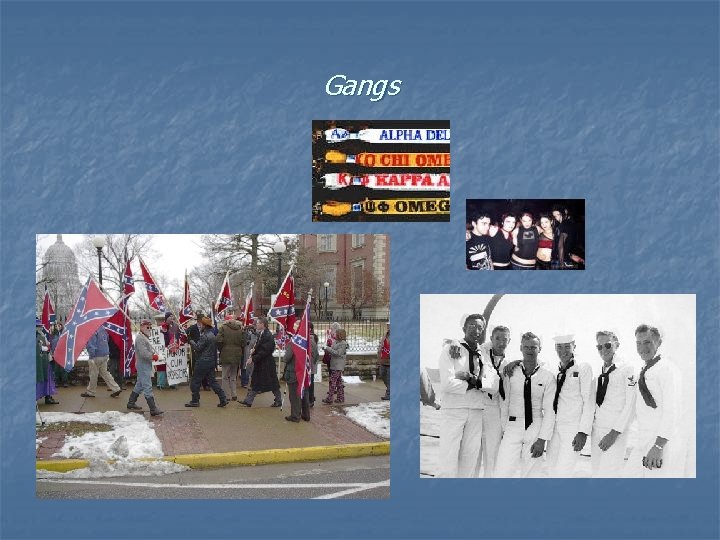
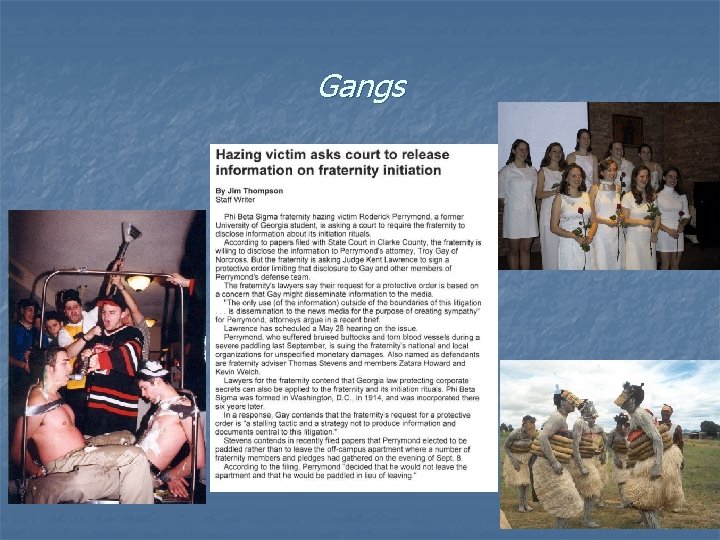
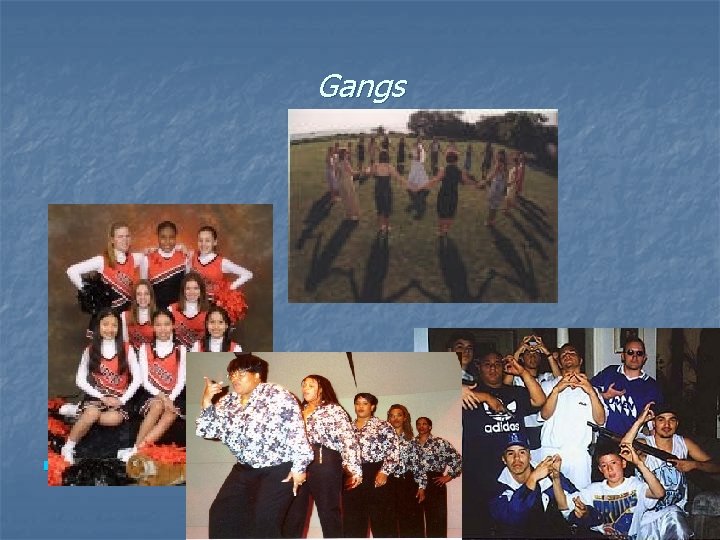
Gangs are not “Abnormal” Gangs are like: n n Fraternities & Sororities Lodges Sports Organizations Political Groups How?
Gangs n Colors or Logos
Gangs n Initiation
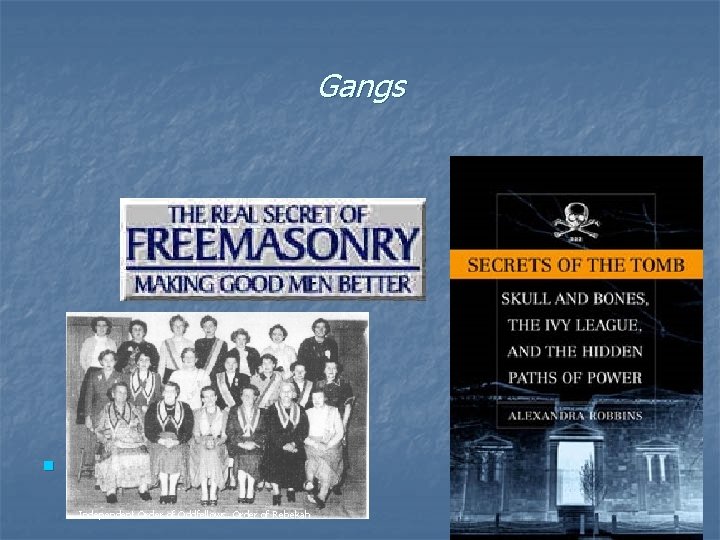
Gangs n Secret Societies Independent Order of Oddfellows, Order of Rebekah
Gangs n Conformity
Gangs n Homogeneity
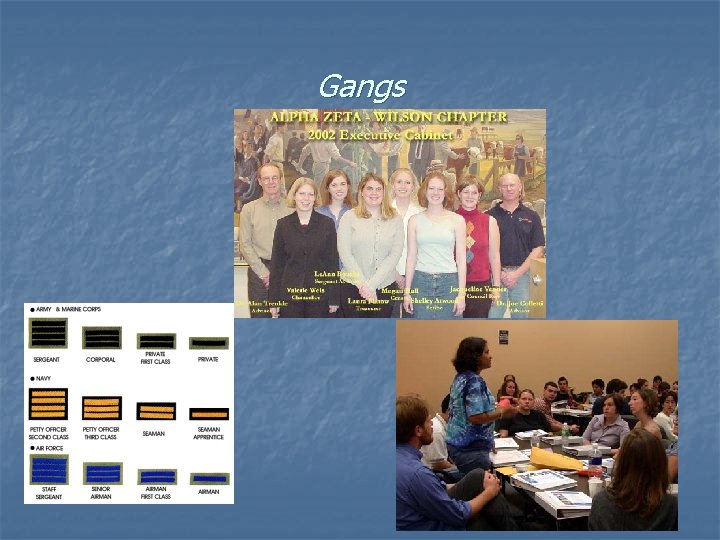
Gangs n Hierarchy
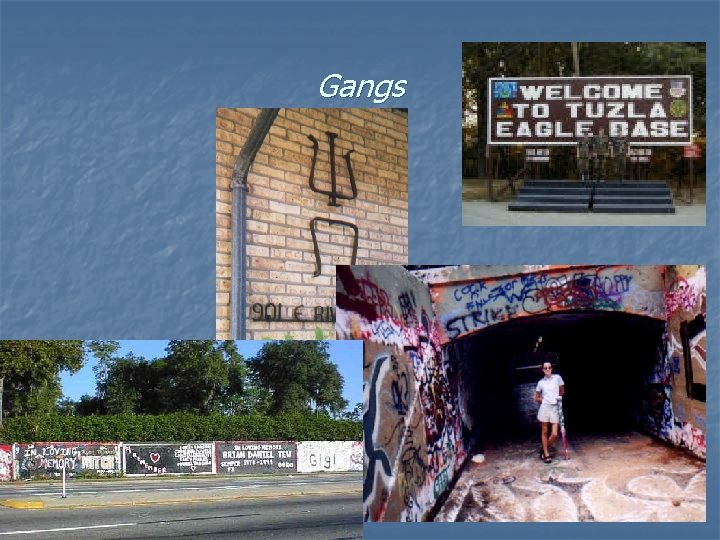
Gangs n Marking Turf
Gangs n Competition
Gangs n Recruitment
Gangs are not “Abnormal” Gangs are like: How? n n n Fraternities & Sororities Lodges Sports Organizations Political Groups n n n n Colors or logos Initiations Secret Society Demand for Conformity and Loyalty Homogeneity of Membership Hierarchy Marking Territory with Symbols or Objects Competition with other organizations Recruitment
Gangs Gang Prevention Strategies: 1. More satisfying families and communities. If the family or significant others are the source of love, guidance, and protection that youths seek, they are not forced to search for these basic needs from a gang.
Gangs Gang Prevention Strategies: 1. More satisfying families and communities. If the family or significant others are the source of love, guidance, and protection that youths seek, they are not forced to search for these basic needs from a gang. 2. Educational attachment. Young people who successfully participate in and complete education have greater opportunities to participate as rewarded and contributing adults.
Gangs Gang Prevention Strategies: 2. Educational attachment. Young people who successfully participate in and complete education have greater opportunities to participate as rewarded and contributing adults. 3. Graffiti removal. Removal reduces the chance that crimes will be committed. Since gangs use graffiti to mark their turf, advertise themselves, and claim credit for a crime, quick removal is essential.
Gangs Gang Prevention Strategies: 3. Graffiti removal. Removal reduces the chance that crimes will be committed. Since gangs use graffiti to mark their turf, advertise themselves, and claim credit for a crime, quick removal is essential. 4. Recreational programs. Can get youths involved in activities and belonging that would serve the same kind of function that gangs serve.
Gangs Gang Prevention Strategies: 4. Recreational programs. Can get youths involved in activities and belonging that would serve the same kind of function that gangs serve. 5. Conflict resolution programs. Can teach potential gangsters how to better deal with conflicts and help reduce gang intimidation tactics.
Gangs Gang Prevention Strategies: 5. Conflict resolution programs. Can teach potential 6. Fight high-density poverty and hopelessness. gangsters how to better deal with conflicts and help reduce gang intimidation tactics. Combating conditions of urban slums removes the structural conditions conducive to gangs. “The chief problem in any community cursed with crime is not the punishment of the criminals, but the preventing of the young from being trained to crime. ” — WEB Dubois
Gangs