
GammaRay Bursts An observational perspective of the prompt
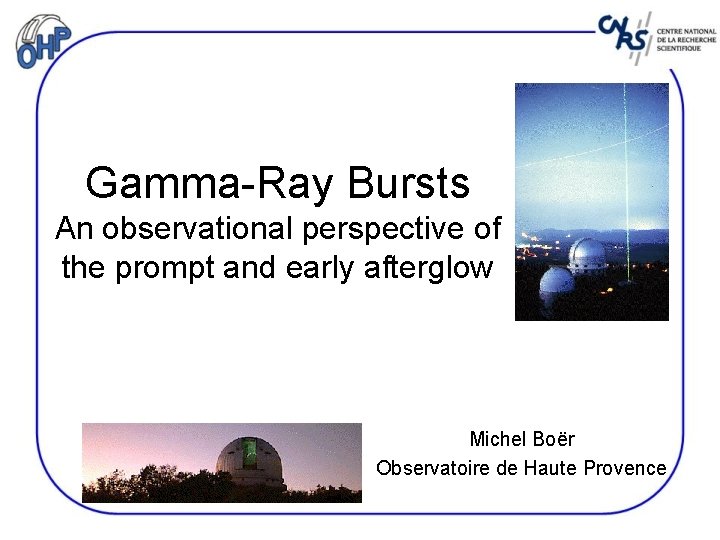
Gamma-Ray Bursts An observational perspective of the prompt and early afterglow Michel Boër Observatoire de Haute Provence
Discovered fortuitously • First observed in 1969 – VELA military satellites – Monitoring of atmospheric nuclear explosions, to enforce application of the nuclear test-ban treaty between USA and USSR – Unclassified in 1973 • Since then, many space experiments – USSR/Russia – USA – France – Italy Germany 7/04/2009 Roma-La Sapienza
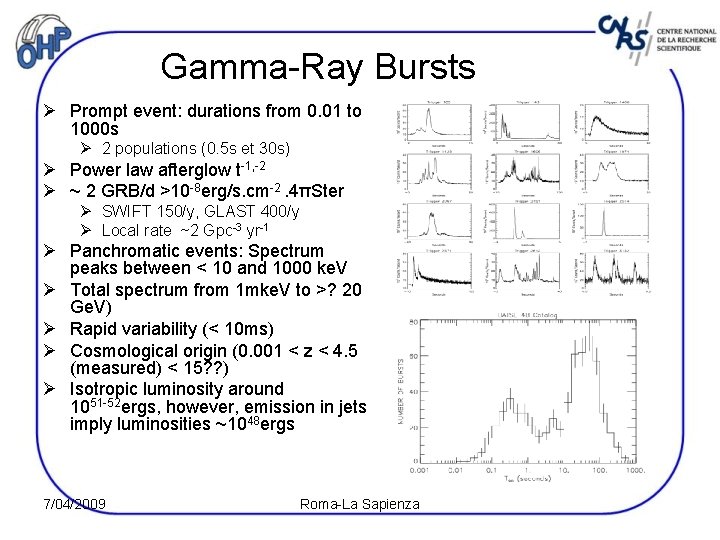
Gamma-Ray Bursts Ø Prompt event: durations from 0. 01 to 1000 s Ø 2 populations (0. 5 s et 30 s) Ø Power law afterglow t-1, -2 Ø ~ 2 GRB/d >10 -8 erg/s. cm-2. 4πSter Ø SWIFT 150/y, GLAST 400/y Ø Local rate ~2 Gpc-3 yr-1 Ø Panchromatic events: Spectrum peaks between < 10 and 1000 ke. V Ø Total spectrum from 1 mke. V to >? 20 Ge. V) Ø Rapid variability (< 10 ms) Ø Cosmological origin (0. 001 < z < 4. 5 (measured) < 15? ? ) Ø Isotropic luminosity around 1051 -52 ergs, however, emission in jets imply luminosities ~1048 ergs 7/04/2009 Roma-La Sapienza
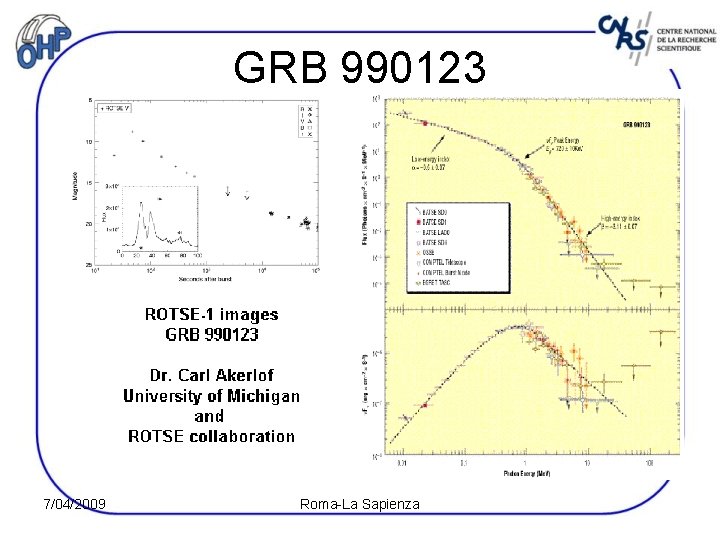
GRB 990123 7/04/2009 Roma-La Sapienza
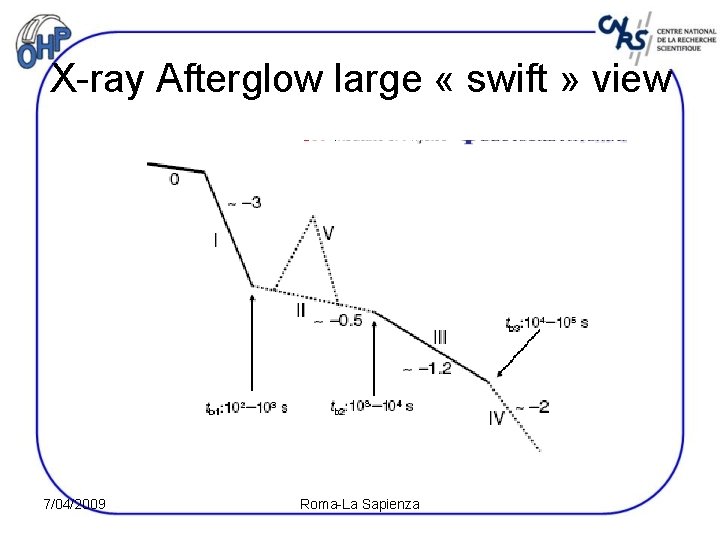
X-ray Afterglow large « swift » view 7/04/2009 Roma-La Sapienza
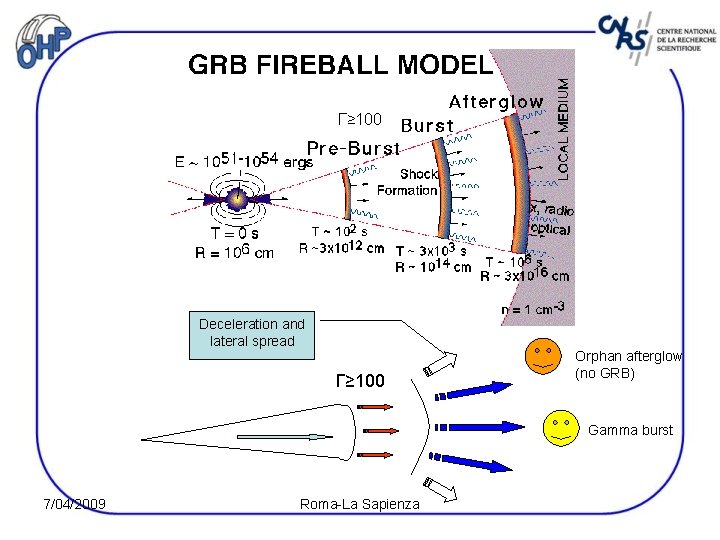
Γ≥ 100 Deceleration and lateral spread Γ≥ 100 Orphan afterglow (no GRB) Gamma burst 7/04/2009 Roma-La Sapienza
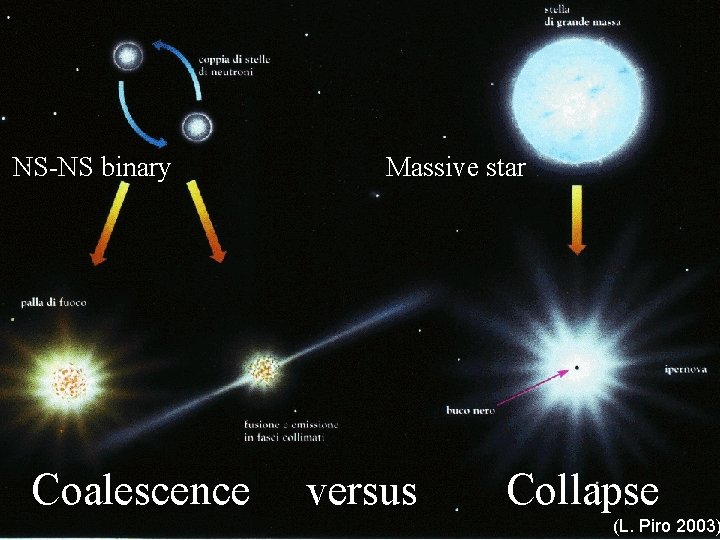
NS-NS binary Coalescence 7/04/2009 Massive star versus Roma-La Sapienza Collapse (L. Piro 2003)
Why all this excitement about GRBs • GRBs involve the fastest motion observed so far (Γ > 100) • They signal the formation of a newborn black hole • They are sources of nonphotonic radiation (ν, gravitationnal) • They are the best cosmological probes of the early universe (z = 510) 7/04/2009 • Most relativistic objects known to date Roma-La Sapienza
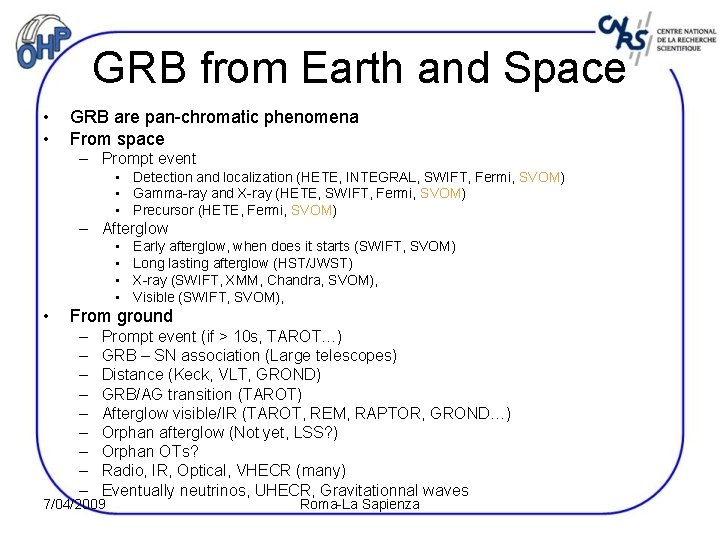
GRB from Earth and Space • • GRB are pan-chromatic phenomena From space – Prompt event • Detection and localization (HETE, INTEGRAL, SWIFT, Fermi, SVOM) • Gamma-ray and X-ray (HETE, SWIFT, Fermi, SVOM) • Precursor (HETE, Fermi, SVOM) – Afterglow • • • Early afterglow, when does it starts (SWIFT, SVOM) Long lasting afterglow (HST/JWST) X-ray (SWIFT, XMM, Chandra, SVOM), Visible (SWIFT, SVOM), From ground – – – – – Prompt event (if > 10 s, TAROT…) GRB – SN association (Large telescopes) Distance (Keck, VLT, GROND) GRB/AG transition (TAROT) Afterglow visible/IR (TAROT, REM, RAPTOR, GROND…) Orphan afterglow (Not yet, LSS? ) Orphan OTs? Radio, IR, Optical, VHECR (many) Eventually neutrinos, UHECR, Gravitationnal waves 7/04/2009 Roma-La Sapienza
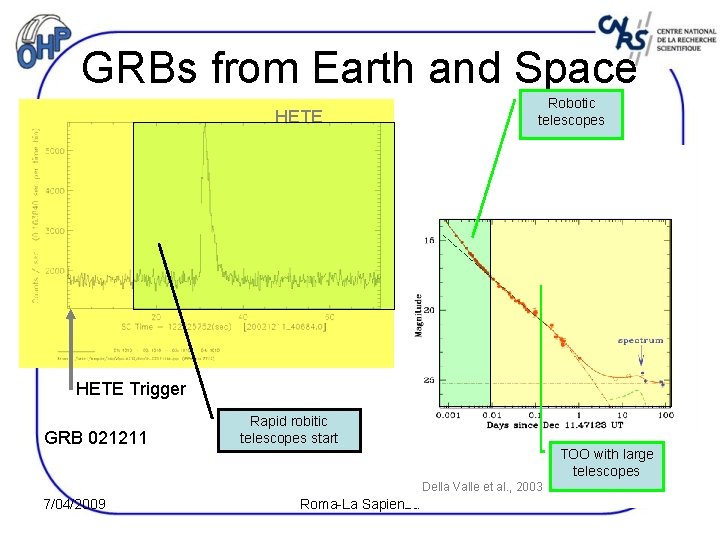
GRBs from Earth and Space HETE Robotic telescopes HETE Trigger GRB 021211 Rapid robitic telescopes start TOO with large telescopes Della Valle et al. , 2003 7/04/2009 Roma-La Sapienza
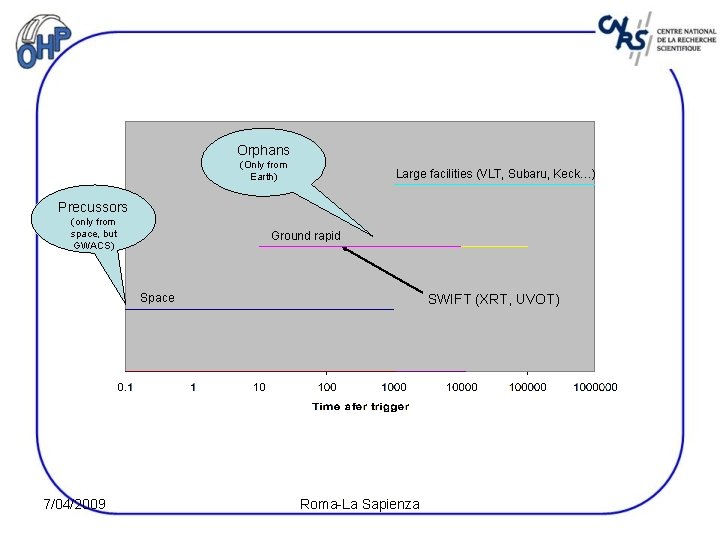
Orphans (Only from Earth) Large facilities (VLT, Subaru, Keck…) Precussors (only from space, but GWACS) Ground rapid Space 7/04/2009 SWIFT (XRT, UVOT) Roma-La Sapienza
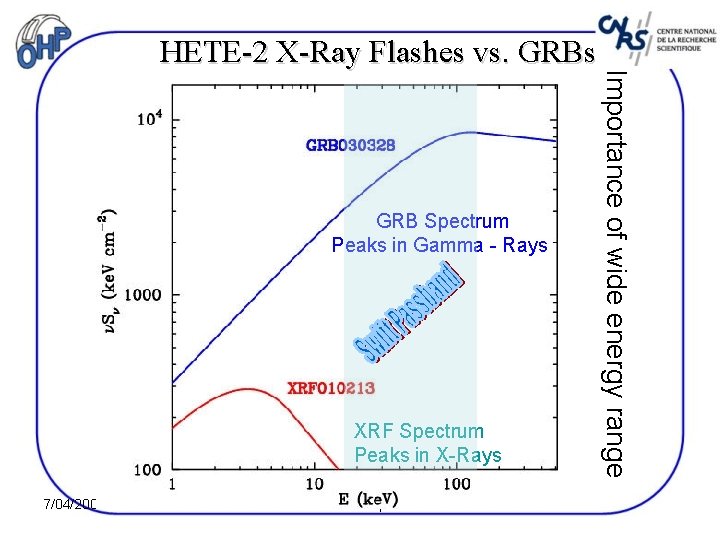
GRB Spectrum Peaks in Gamma - Rays XRF Spectrum Peaks in X-Rays 7/04/2009 Roma-La Sapienza Importance of wide energy range HETE-2 X-Ray Flashes vs. GRBs
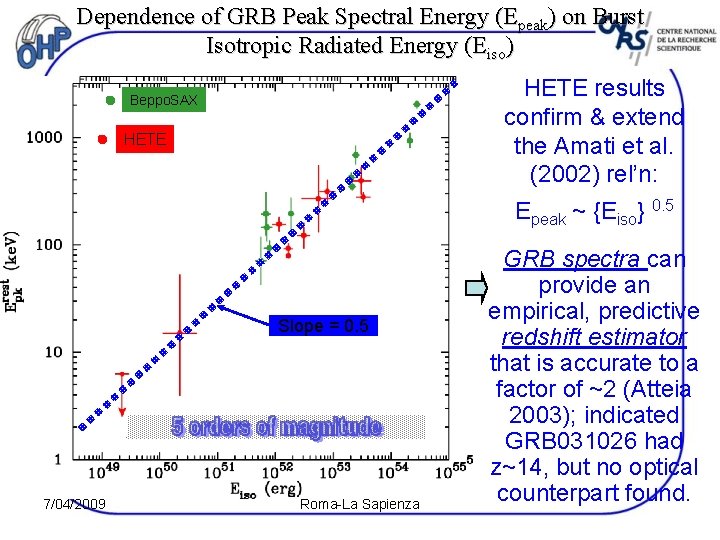
Dependence of GRB Peak Spectral Energy (Epeak) on Burst Isotropic Radiated Energy (Eiso) HETE results confirm & extend the Amati et al. (2002) rel’n: Beppo. SAX HETE Epeak ~ {Eiso} 0. 5 Slope = 0. 5 7/04/2009 Roma-La Sapienza GRB spectra can provide an empirical, predictive redshift estimator that is accurate to a factor of ~2 (Atteia 2003); indicated GRB 031026 had z~14, but no optical counterpart found.
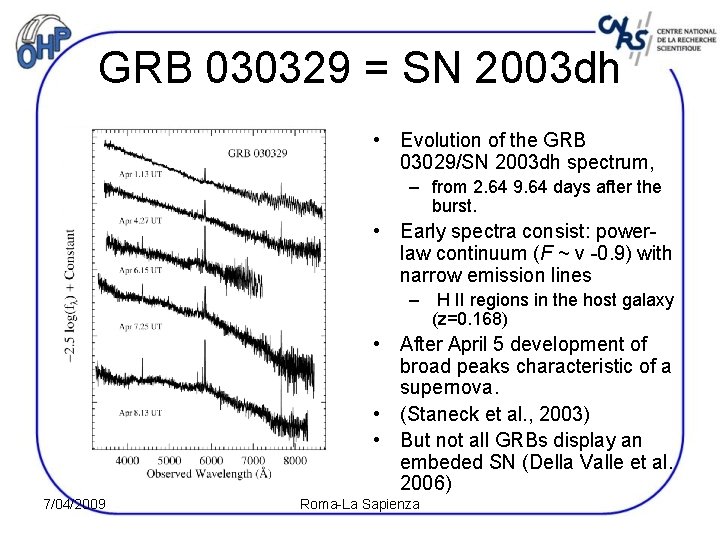
GRB 030329 = SN 2003 dh • Evolution of the GRB 03029/SN 2003 dh spectrum, – from 2. 64 9. 64 days after the burst. • Early spectra consist: powerlaw continuum (F ~ ν -0. 9) with narrow emission lines – H II regions in the host galaxy (z=0. 168) • After April 5 development of broad peaks characteristic of a supernova. • (Staneck et al. , 2003) • But not all GRBs display an embeded SN (Della Valle et al. 2006) 7/04/2009 Roma-La Sapienza
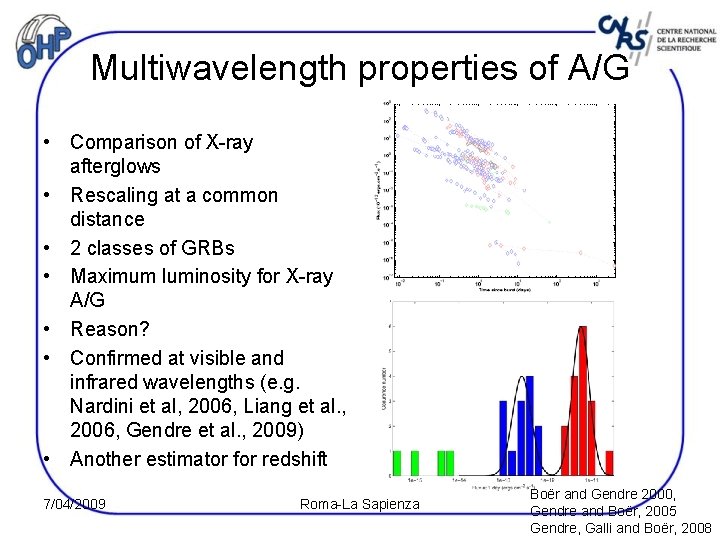
Multiwavelength properties of A/G • Comparison of X-ray afterglows • Rescaling at a common distance • 2 classes of GRBs • Maximum luminosity for X-ray A/G • Reason? • Confirmed at visible and infrared wavelengths (e. g. Nardini et al, 2006, Liang et al. , 2006, Gendre et al. , 2009) • Another estimator for redshift 7/04/2009 Roma-La Sapienza Boër and Gendre 2000, Gendre and Boër, 2005 Gendre, Galli and Boër, 2008
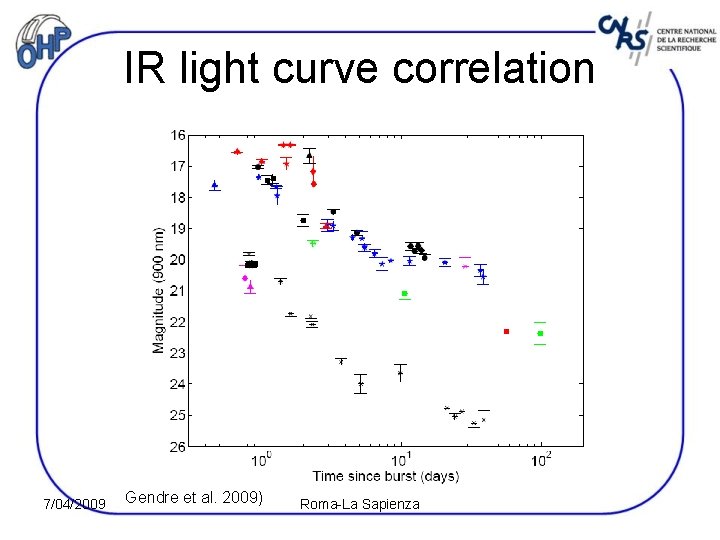
IR light curve correlation 7/04/2009 Gendre et al. 2009) Roma-La Sapienza
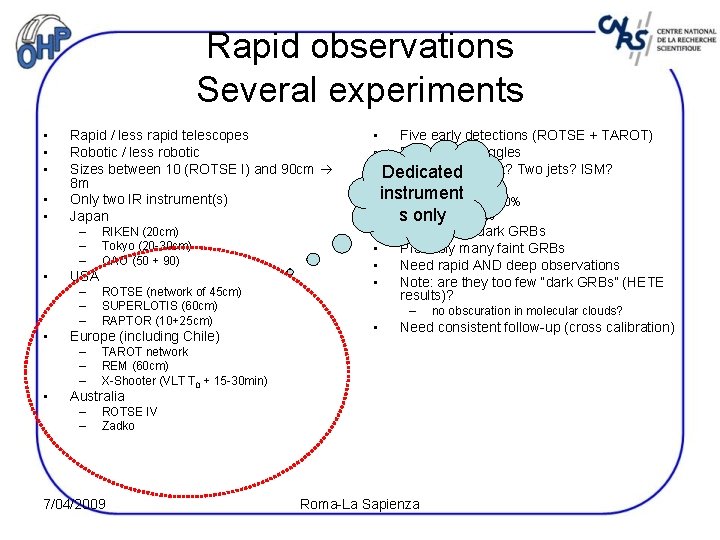
Rapid observations Several experiments • • • Rapid / less rapid telescopes Robotic / less robotic Sizes between 10 (ROTSE I) and 90 cm 8 m Only two IR instrument(s) Japan – – – • USA – – – • ROTSE (network of 45 cm) SUPERLOTIS (60 cm) RAPTOR (10+25 cm) Europe (including Chile) – – – • RIKEN (20 cm) Tokyo (20 -30 cm) OAO (50 + 90) • Five early detections (ROTSE + TAROT) • Bumps and wiggles • Dedicated Refreshed shock? Two jets? ISM? • Dark GRBs • • instrument – Beppo. SAX: 60% HETE: 15% s –only Few (if any) dark GRBs Probably many faint GRBs Need rapid AND deep observations Note: are they too few “dark GRBs” (HETE results)? – • Need consistent follow-up (cross calibration) TAROT network REM (60 cm) X-Shooter (VLT T 0 + 15 -30 min) Australia – – ROTSE IV Zadko 7/04/2009 no obscuration in molecular clouds? Roma-La Sapienza
TAROTs 7/04/2009 Roma-La Sapienza
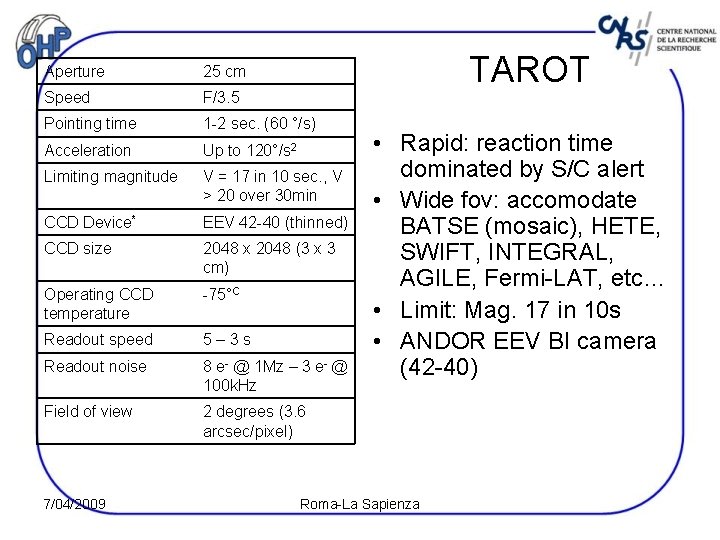
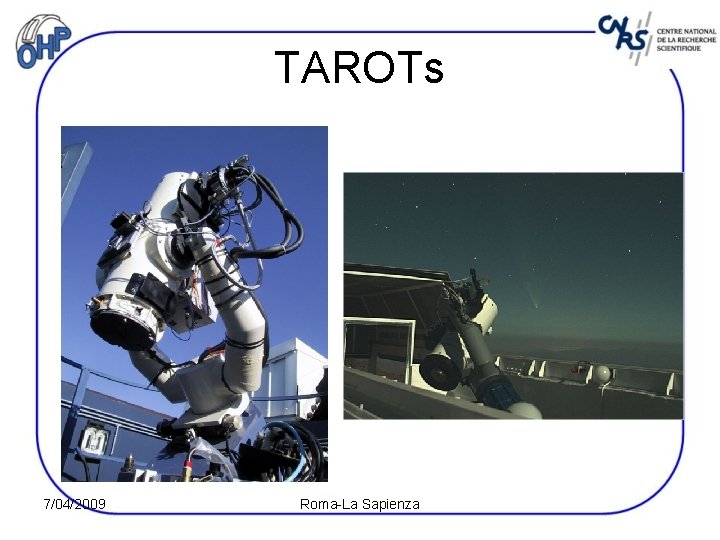
TAROT Aperture 25 cm Speed F/3. 5 Pointing time 1 -2 sec. (60 °/s) Acceleration Up to 120°/s 2 Limiting magnitude V = 17 in 10 sec. , V > 20 over 30 min CCD Device* EEV 42 -40 (thinned) CCD size 2048 x 2048 (3 x 3 cm) Operating CCD temperature -75°C Readout speed 5– 3 s Readout noise 8 e- @ 1 Mz – 3 e- @ 100 k. Hz Field of view 2 degrees (3. 6 arcsec/pixel) 7/04/2009 • Rapid: reaction time dominated by S/C alert • Wide fov: accomodate BATSE (mosaic), HETE, SWIFT, INTEGRAL, AGILE, Fermi-LAT, etc… • Limit: Mag. 17 in 10 s • ANDOR EEV BI camera (42 -40) Roma-La Sapienza
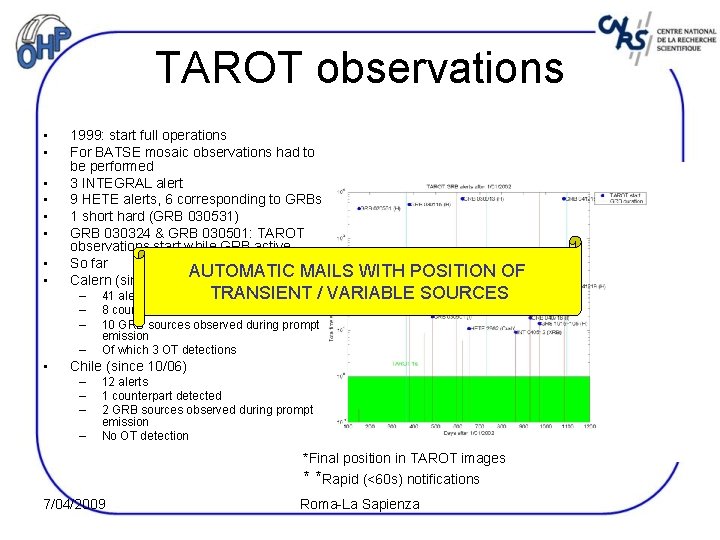
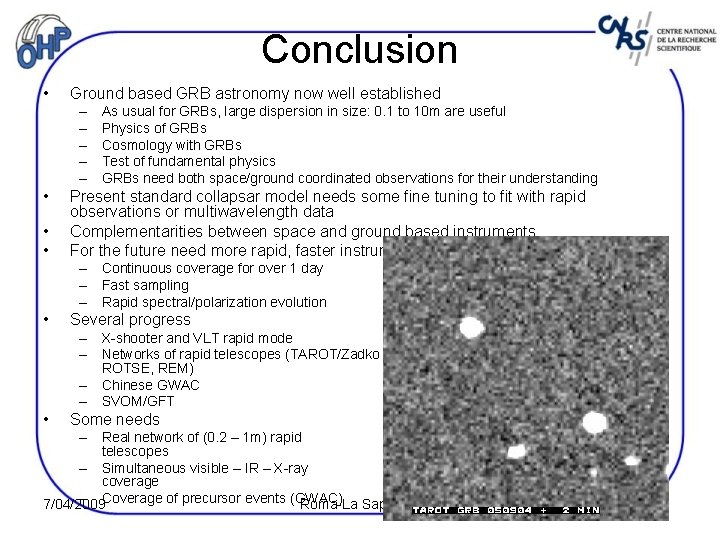
TAROT observations • • 1999: start full operations For BATSE mosaic observations had to be performed 3 INTEGRAL alert 9 HETE alerts, 6 corresponding to GRBs 1 short hard (GRB 030531) GRB 030324 & GRB 030501: TAROT observations start while GRB active So far AUTOMATIC MAILS Calern (since 99) – – • WITH POSITION OF TRANSIENT / VARIABLE SOURCES 41 alerts 8 counterparts detected 10 GRB sources observed during prompt emission Of which 3 OT detections Chile (since 10/06) – – 12 alerts 1 counterpart detected 2 GRB sources observed during prompt emission No OT detection *Final position in TAROT images * *Rapid (<60 s) notifications 7/04/2009 Roma-La Sapienza
TAROT, astronomy while you sleep • TAROT gets you up in the middle of the night • Example: yesterday, 02: 37 am Boer, M. and Klotz, A. , on behalf of a larger coordination communicate: Following an alert SWIFT GRB 070913 (received at 00: 37: 02 UT) TAROT La Silla observatory, Chile observed the field. Candidate list will be send later if found. See: Individual images : http: //195. 221. 212. 76/ros/GRB 070913_003702_SWIFT Sum of images http: //195. 221. 212. 76/ros/GRB 070913_003702_SWIFT/sum. html Differential photometry http: //195. 221. 212. 76/ros/GRB 070913_003702_SWIFT/photometry. html GRB parameters are in http: //195. 221. 212. 76/ros/GRB 070913_003702_SWIFT. txt 7/04/2009 Roma-La Sapienza
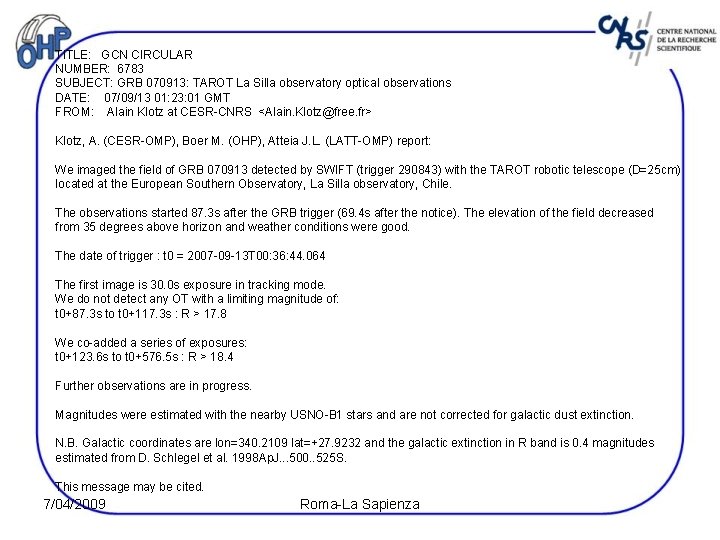
TITLE: GCN CIRCULAR NUMBER: 6783 SUBJECT: GRB 070913: TAROT La Silla observatory optical observations DATE: 07/09/13 01: 23: 01 GMT FROM: Alain Klotz at CESR-CNRS <Alain. Klotz@free. fr> Klotz, A. (CESR-OMP), Boer M. (OHP), Atteia J. L. (LATT-OMP) report: We imaged the field of GRB 070913 detected by SWIFT (trigger 290843) with the TAROT robotic telescope (D=25 cm) located at the European Southern Observatory, La Silla observatory, Chile. The observations started 87. 3 s after the GRB trigger (69. 4 s after the notice). The elevation of the field decreased from 35 degrees above horizon and weather conditions were good. The date of trigger : t 0 = 2007 -09 -13 T 00: 36: 44. 064 The first image is 30. 0 s exposure in tracking mode. We do not detect any OT with a limiting magnitude of: t 0+87. 3 s to t 0+117. 3 s : R > 17. 8 We co-added a series of exposures: t 0+123. 6 s to t 0+576. 5 s : R > 18. 4 Further observations are in progress. Magnitudes were estimated with the nearby USNO-B 1 stars and are not corrected for galactic dust extinction. N. B. Galactic coordinates are lon=340. 2109 lat=+27. 9232 and the galactic extinction in R band is 0. 4 magnitudes estimated from D. Schlegel et al. 1998 Ap. J. . . 500. . 525 S. This message may be cited. 7/04/2009 Roma-La Sapienza
Prompt emission • Access to source dynamics • Signature of forward internal and reverse shock • Ground observations give extended spectrum (e. g. synchroton peak vs. time) • Evolution of light curve GRB vs. OT • Absolute need of more detaille OT l. c. • Transition from prompt to A/G: tomography of material surrounding GRB, and of material left by precursor – When does the afterglow start ? – Polarization of GRBs? – E. g. GRB 050904 at z = 6. 4: evidences for interaction of fireball with stellar wind (Boër et al. , 2006; Gendre et al. , 2006) • Difference in arrival time between HE GRB and OT may probe quantum gravity • Neutrinos (km 3, Ice 3) gravitational radiation (VIRGO, LIGO), prompt VHE 7/04/2009 Roma-La Sapienza
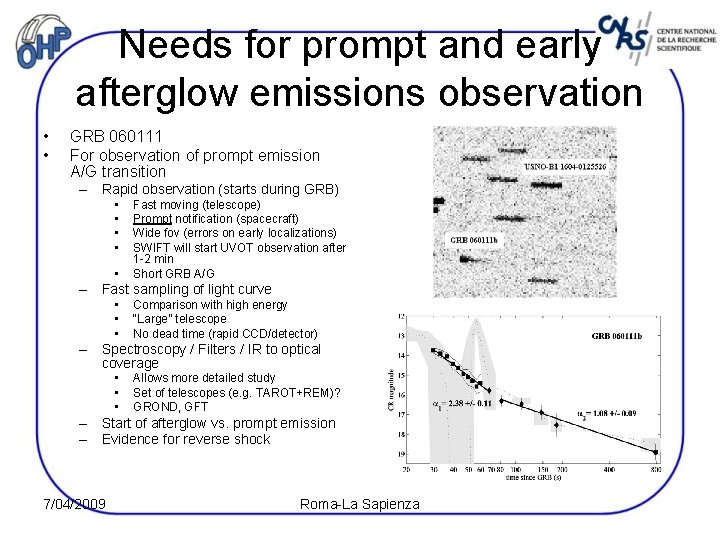
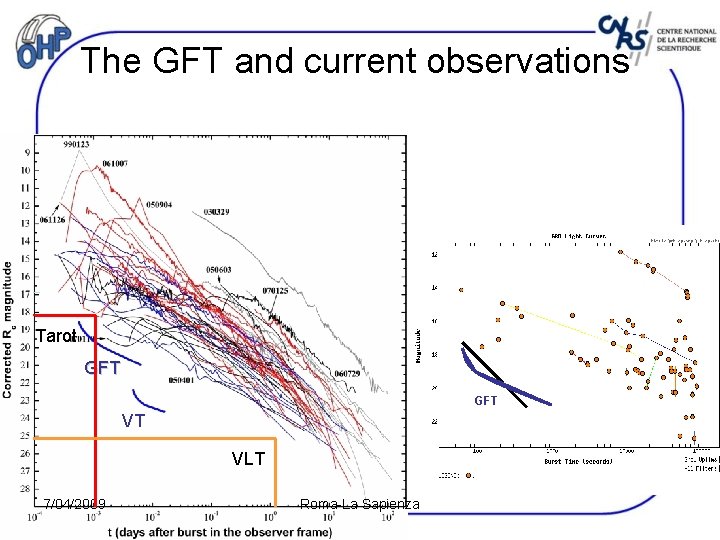
Needs for prompt and early afterglow emissions observation • • GRB 060111 For observation of prompt emission A/G transition – Rapid observation (starts during GRB) • • • Fast moving (telescope) Prompt notification (spacecraft) Wide fov (errors on early localizations) SWIFT will start UVOT observation after 1 -2 min Short GRB A/G – Fast sampling of light curve • • • Comparison with high energy “Large” telescope No dead time (rapid CCD/detector) – Spectroscopy / Filters / IR to optical coverage • • • Allows more detailed study Set of telescopes (e. g. TAROT+REM)? GROND, GFT – Start of afterglow vs. prompt emission – Evidence for reverse shock 7/04/2009 Roma-La Sapienza
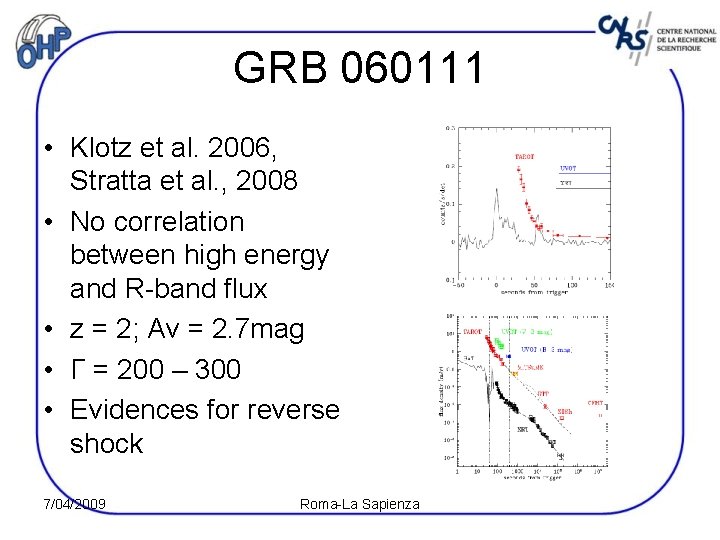
GRB 060111 • Klotz et al. 2006, Stratta et al. , 2008 • No correlation between high energy and R-band flux • z = 2; Av = 2. 7 mag • Γ = 200 – 300 • Evidences for reverse shock 7/04/2009 Roma-La Sapienza
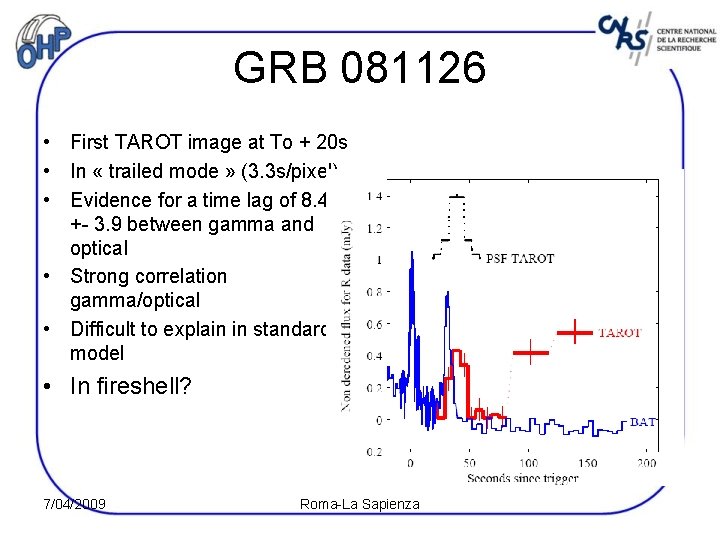
GRB 081126 • First TAROT image at To + 20 s • In « trailed mode » (3. 3 s/pixel) • Evidence for a time lag of 8. 4 s +- 3. 9 between gamma and optical • Strong correlation gamma/optical • Difficult to explain in standard model • In fireshell? 7/04/2009 Roma-La Sapienza
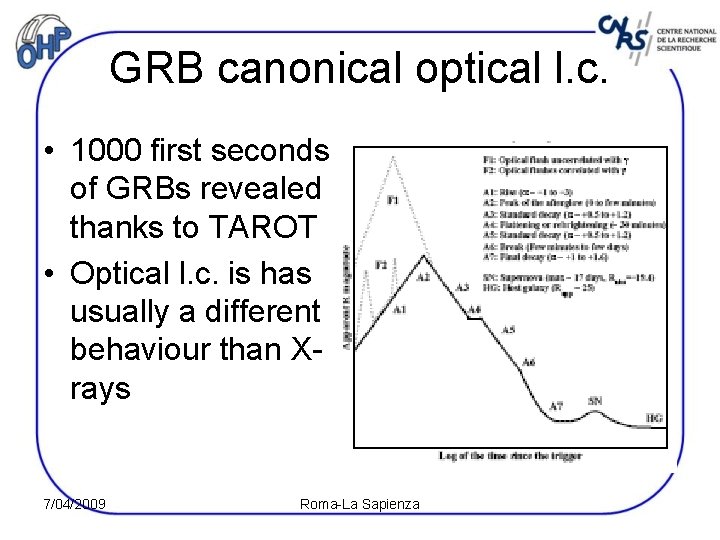
GRB canonical optical l. c. • 1000 first seconds of GRBs revealed thanks to TAROT • Optical l. c. is has usually a different behaviour than Xrays 7/04/2009 Roma-La Sapienza
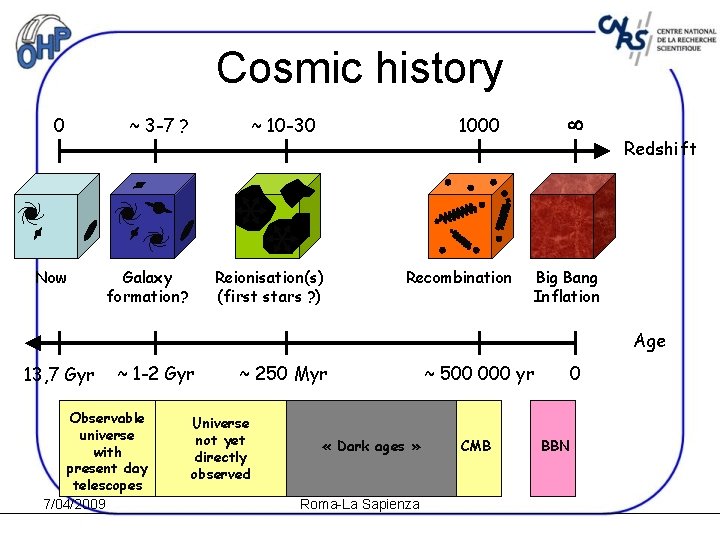
Cosmic history 0 ~ 3 -7 ? Now Galaxy formation? ~ 10 -30 1000 Reionisation(s) (first stars ? ) Recombination Redshift Big Bang Inflation Age 13, 7 Gyr ~ 1 -2 Gyr Observable universe with present day telescopes 7/04/2009 ~ 250 Myr Universe not yet directly observed « Dark ages » Roma-La Sapienza ~ 500 000 yr CMB 0 BBN
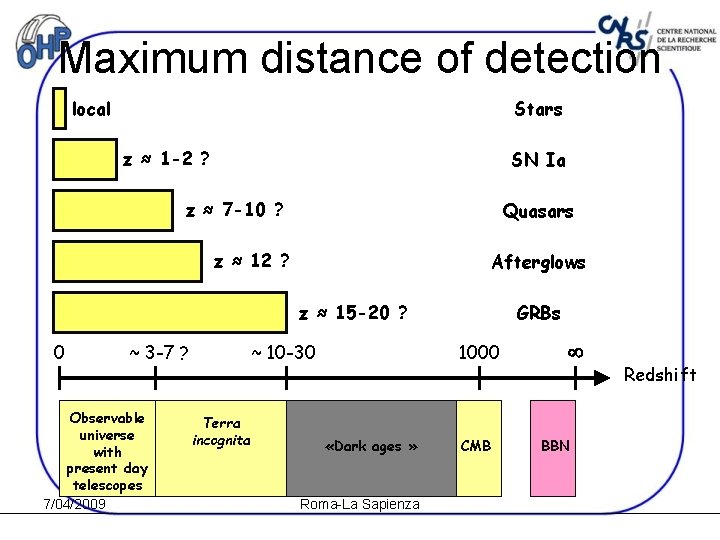
Maximum distance of detection local Stars z ≈ 1 -2 ? SN Ia z ≈ 7 -10 ? Quasars z ≈ 12 ? Afterglows z ≈ 15 -20 ? 0 ~ 3 -7 ? Observable universe with present day telescopes 7/04/2009 ~ 10 -30 Terra incognita GRBs 1000 «Dark ages » Roma-La Sapienza CMB BBN Redshift
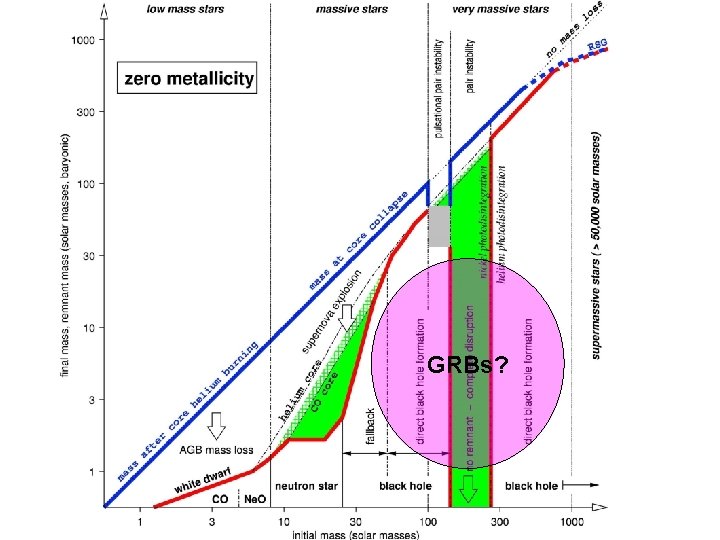
GRBs? 7/04/2009 Roma-La Sapienza
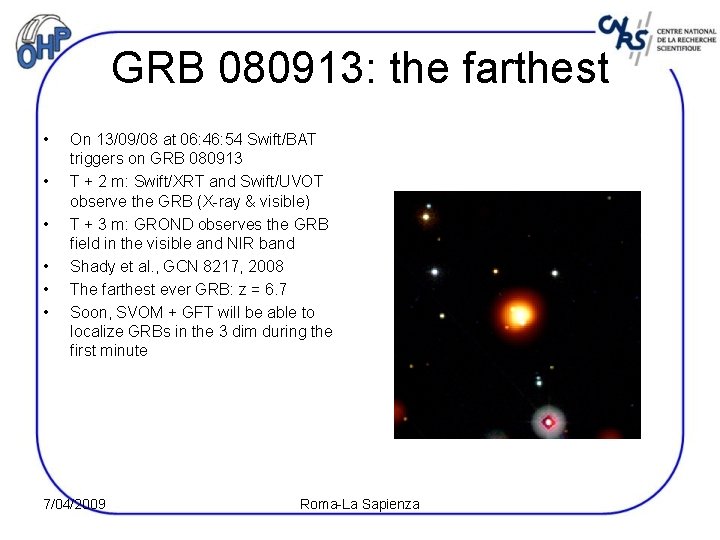
GRB 080913: the farthest • • • On 13/09/08 at 06: 46: 54 Swift/BAT triggers on GRB 080913 T + 2 m: Swift/XRT and Swift/UVOT observe the GRB (X-ray & visible) T + 3 m: GROND observes the GRB field in the visible and NIR band Shady et al. , GCN 8217, 2008 The farthest ever GRB: z = 6. 7 Soon, SVOM + GFT will be able to localize GRBs in the 3 dim during the first minute 7/04/2009 Roma-La Sapienza
![SVOM Fast and panchromatic A wide field-of-view camera [R 1] to trigger on GRBs](http://slidetodoc.com/presentation_image_h2/14ce8a5190e5dbb6b07036ebc9f4e506/image-32.jpg "SVOM Fast and panchromatic A wide field-of-view camera [R 1] to trigger on GRBs")
SVOM Fast and panchromatic A wide field-of-view camera [R 1] to trigger on GRBs present within its field-of-view in the X-ray and soft gamma-ray band [R 2, R 3, R 6] A spectro-photometer to observe simultaneously in the gamma-ray band the trigger camera field-of-view [R 3] A narrow field-of-view telescope to quickly observe in the soft X-ray band the error box provided by the trigger camera [R 5, R 7] A narrow field-of-view telescope to quickly observe in the visible band the error box provided by the trigger camera [R 5, R 7 b] A set of ground-based wide field-of-view cameras to observe simultaneously in the visible band the trigger camera field-of-view [R 4] Two ground-based narrow field-of-view telescopes to quickly observe in the visible and near infrared bands the error box provided by the trigger camera [R 9] 7/04/2009 Roma-La Sapienza Jacques Paul SVOM – Instituto de Astronomia Colloquium – UNAM – 11 February 2009 Slide 32
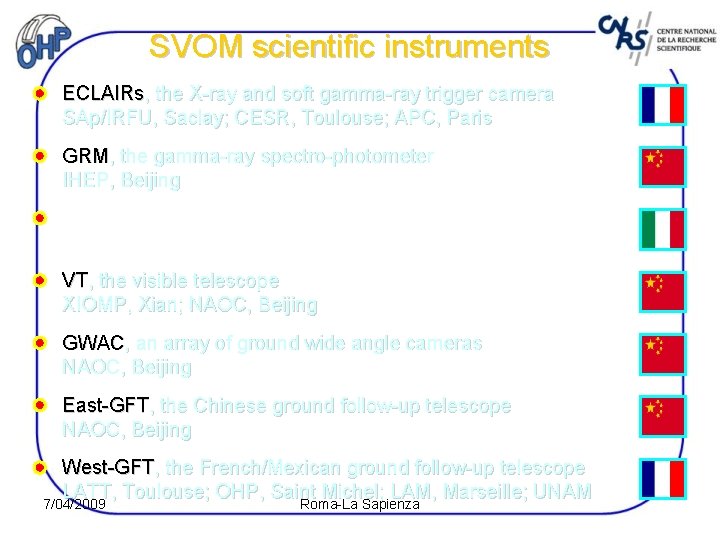
SVOM scientific instruments ECLAIRs, the X-ray and soft gamma-ray trigger camera SAp/IRFU, Saclay; CESR, Toulouse; APC, Paris GRM, the gamma-ray spectro-photometer IHEP, Beijing VT, the visible telescope XIOMP, Xian; NAOC, Beijing GWAC, an array of ground wide angle cameras NAOC, Beijing East-GFT, the Chinese ground follow-up telescope NAOC, Beijing West-GFT, the French/Mexican ground follow-up telescope LATT, Toulouse; OHP, Saint Michel; LAM, Marseille; UNAM 7/04/2009 Roma-La Sapienza Jacques Paul SVOM – Instituto de Astronomia Colloquium – UNAM – 11 February 2009 Slide 33
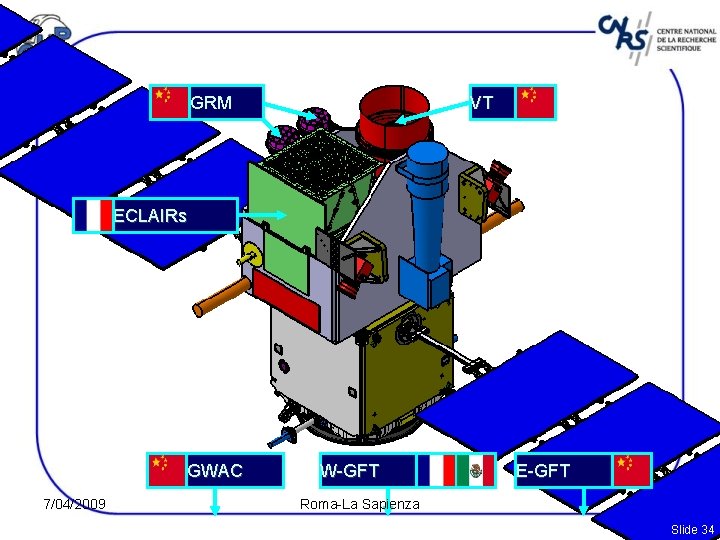
GRM VT ECLAIRs GWAC 7/04/2009 W-GFT E-GFT Roma-La Sapienza Jacques Paul SVOM – Instituto de Astronomia Colloquium – UNAM – 11 February 2009 Slide 34
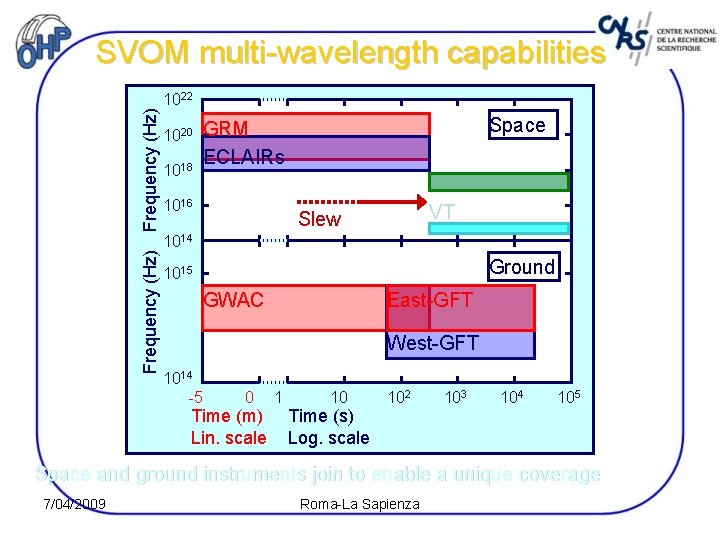
Frequency (Hz) SVOM multi-wavelength capabilities 1022 1020 1018 Space GRM ECLAIRs 1016 VT Slew 1014 Ground 1015 GWAC East-GFT West-GFT 1014 -5 0 Time (m) Lin. scale 1 10 Time (s) Log. scale 102 103 104 105 Space and ground instruments join to enable a unique coverage 7/04/2009 Roma-La Sapienza Jacques Paul SVOM – Instituto de Astronomia Colloquium – UNAM – 11 February 2009 Slide 35
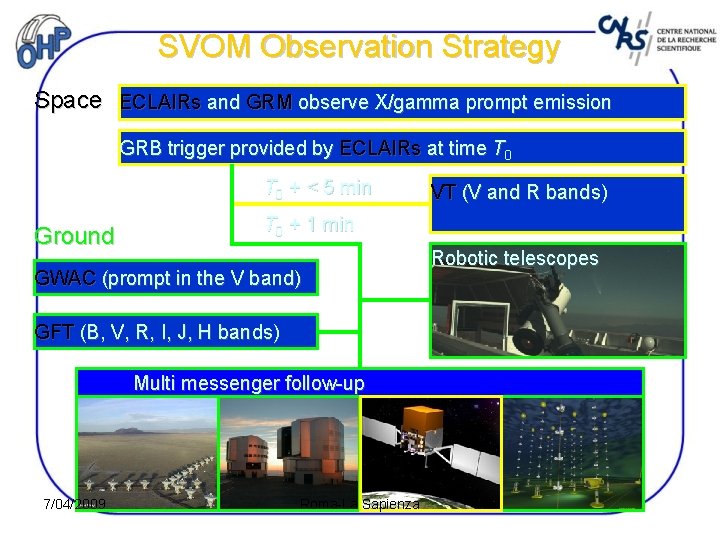
SVOM Observation Strategy Space ECLAIRs and GRM observe X/gamma prompt emission GRB trigger provided by ECLAIRs at time T 0 + < 5 min Ground VT (V and R bands) T 0 + 1 min GWAC (prompt in the V band) Robotic telescopes GFT (B, V, R, I, J, H bands) Multi messenger follow-up 7/04/2009 Roma-La Sapienza Jacques Paul SVOM – Instituto de Astronomia Colloquium – UNAM – 11 February 2009 Slide 36
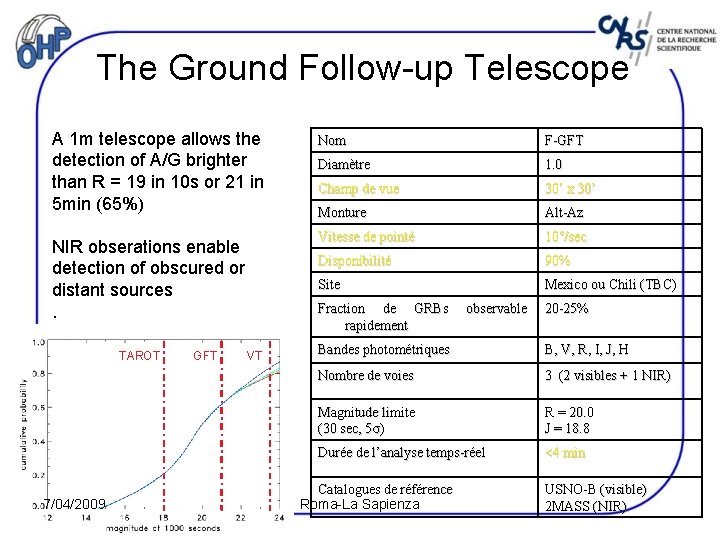
The Ground Follow-up Telescope A 1 m telescope allows the detection of A/G brighter than R = 19 in 10 s or 21 in 5 min (65%) NIR obserations enable detection of obscured or distant sources. TAROT 7/04/2009 GFT Nom F-GFT Diamètre 1. 0 Champ de vue 30’ x 30’ Monture Alt-Az Vitesse de pointé 10°/sec Disponibilité 90% Site Mexico ou Chili (TBC) Fraction de GRBs rapidement VT observable 20 -25% Bandes photométriques B, V, R, I, J, H Nombre de voies 3 (2 visibles + 1 NIR) Magnitude limite (30 sec, 5σ) R = 20. 0 J = 18. 8 Durée de l’analyse temps-réel <4 min Catalogues de référence Roma-La Sapienza USNO-B (visible) 2 MASS (NIR)
The GFT and current observations Tarot GFT VT VLT 7/04/2009 Roma-La Sapienza
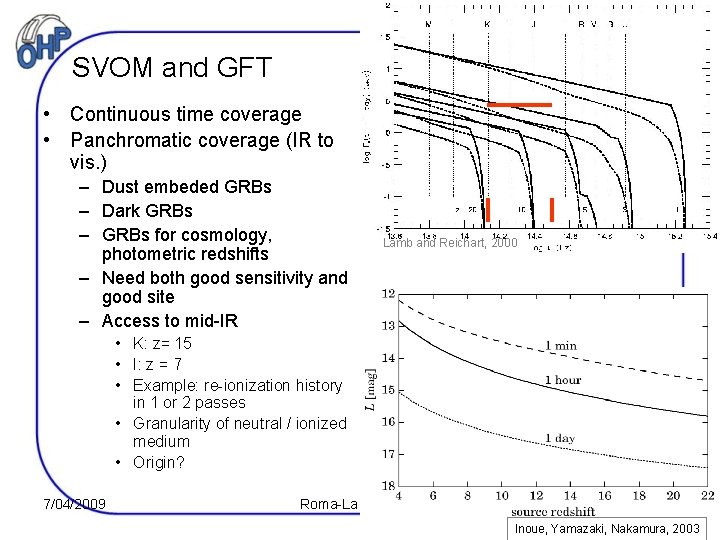
SVOM and GFT • Continuous time coverage • Panchromatic coverage (IR to vis. ) – Dust embeded GRBs – Dark GRBs – GRBs for cosmology, photometric redshifts – Need both good sensitivity and good site – Access to mid-IR Lamb and Reichart, 2000 • K: z= 15 • I: z = 7 • Example: re-ionization history in 1 or 2 passes • Granularity of neutral / ionized medium • Origin? 7/04/2009 Roma-La Sapienza Inoue, Yamazaki, Nakamura, 2003
Conclusion • Ground based GRB astronomy now well established – – – • • • As usual for GRBs, large dispersion in size: 0. 1 to 10 m are useful Physics of GRBs Cosmology with GRBs Test of fundamental physics GRBs need both space/ground coordinated observations for their understanding Present standard collapsar model needs some fine tuning to fit with rapid observations or multiwavelength data Complementarities between space and ground based instruments For the future need more rapid, faster instruments – Continuous coverage for over 1 day – Fast sampling – Rapid spectral/polarization evolution • Several progress – X-shooter and VLT rapid mode – Networks of rapid telescopes (TAROT/Zadko ROTSE, REM) – Chinese GWAC – SVOM/GFT • Some needs – Real network of (0. 2 – 1 m) rapid telescopes – Simultaneous visible – IR – X-ray coverage – Coverage of precursor events (GWAC) 7/04/2009 Roma-La Sapienza
- Slides: 40