
Gamma Scalping Undergraduate Research and Trading Club February
Gamma Scalping Undergraduate Research and Trading Club February 2, 2017
Option valuation depends on: • S = stock (underlying) price • E = exercise (strike) price • T = time to expiration • r = interest rate • σ = stock (underlying) return volatility • D = dividends (I’ll ignore)
Option Greeks • Delta – change in option price as stock price changes • Gamma – change in Delta as stock price changes (second derivative of change in option price as stock price changes) • Theta – change in option price as time to expiration changes • Rho – change in option price as interest rates change • Vega – change in option price as implied volatility changes
Bets with options • Delta is a bet on the direction of the stock price – Long positions in calls have positive deltas and long position in puts have negative deltas. • Gamma – Long positions in options have positive gamma. One form of buying this gamma (it isn’t free) and hedging the directional risk (delta = 0 or delta neutral) is gamma scalping. This is bet on realized volatility (versus implied volatility in Vega). • Theta – Long positions in options are hurt by the passage of time. • Gamma vs. Theta is the typical trade-off with long option positions: you win if realized volatility is large (relative to implied volatility) and lose if realized volatility is small and time passes.

Picture of Call Value as a function of S • Note • Delta is a straight line drawn tangent to the curve at the current S • Gamma is (roughly) the difference between the curve and the straight line • Gamma is a good thing – price increases accelerate and price decreases decelerate • Suggests that it costs • How to see Theta? • What is the option’s value at expiration?
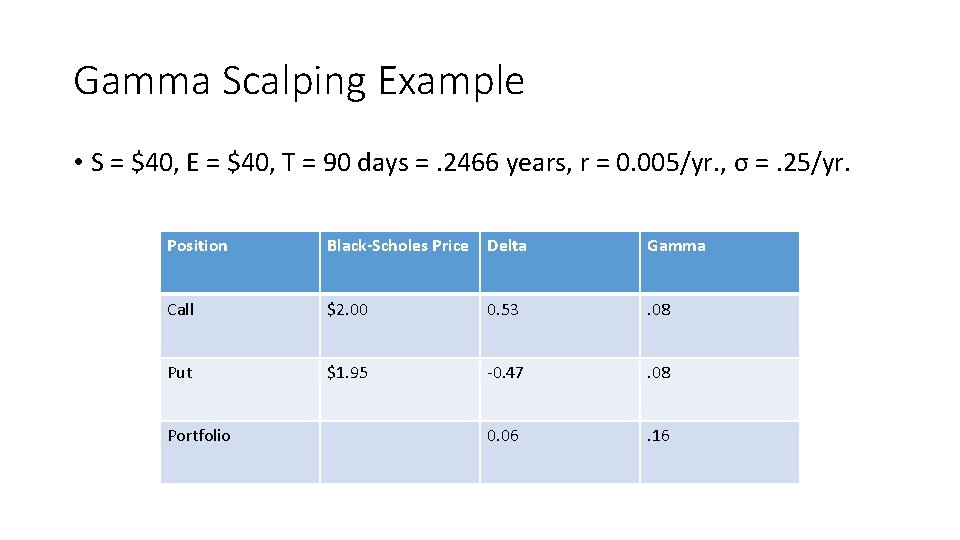
Gamma Scalping Example • S = $40, E = $40, T = 90 days =. 2466 years, r = 0. 005/yr. , σ =. 25/yr. Position Black-Scholes Price Delta Gamma Call $2. 00 0. 53 . 08 Put $1. 95 -0. 47 . 08 0. 06 . 16 Portfolio
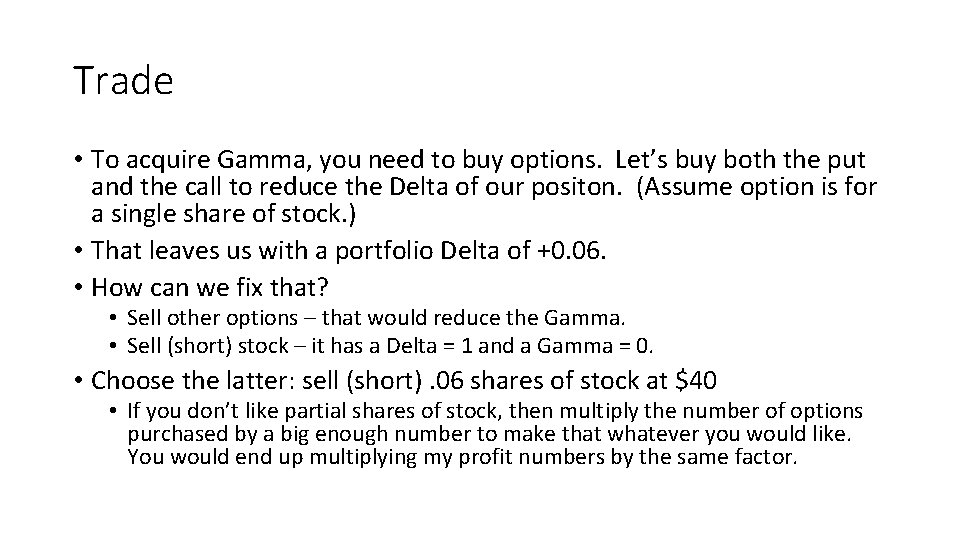
Trade • To acquire Gamma, you need to buy options. Let’s buy both the put and the call to reduce the Delta of our positon. (Assume option is for a single share of stock. ) • That leaves us with a portfolio Delta of +0. 06. • How can we fix that? • Sell other options – that would reduce the Gamma. • Sell (short) stock – it has a Delta = 1 and a Gamma = 0. • Choose the latter: sell (short). 06 shares of stock at $40 • If you don’t like partial shares of stock, then multiply the number of options purchased by a big enough number to make that whatever you would like. You would end up multiplying my profit numbers by the same factor.
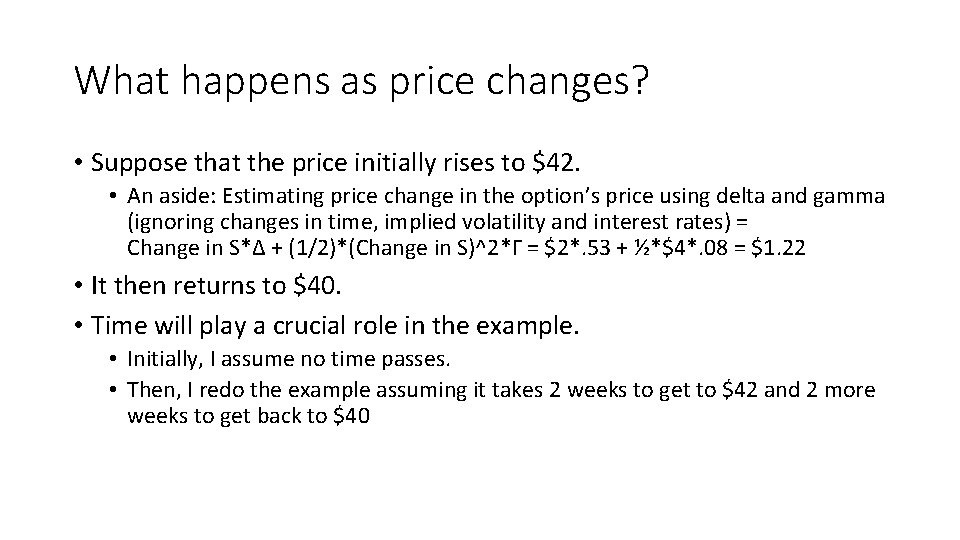
What happens as price changes? • Suppose that the price initially rises to $42. • An aside: Estimating price change in the option’s price using delta and gamma (ignoring changes in time, implied volatility and interest rates) = Change in S*Δ + (1/2)*(Change in S)^2*Γ = $2*. 53 + ½*$4*. 08 = $1. 22 • It then returns to $40. • Time will play a crucial role in the example. • Initially, I assume no time passes. • Then, I redo the example assuming it takes 2 weeks to get to $42 and 2 more weeks to get back to $40
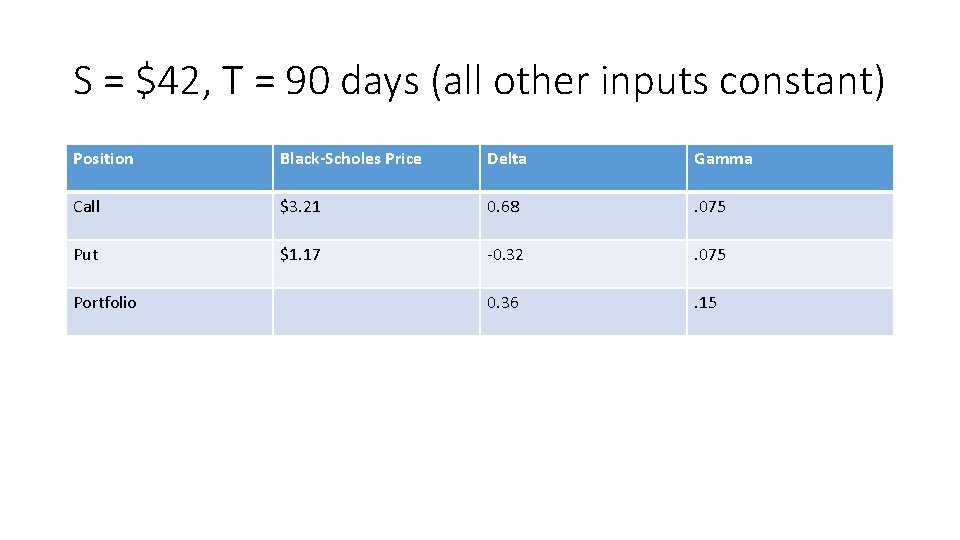
S = $42, T = 90 days (all other inputs constant) Position Black-Scholes Price Delta Gamma Call $3. 21 0. 68 . 075 Put $1. 17 -0. 32 . 075 0. 36 . 15 Portfolio
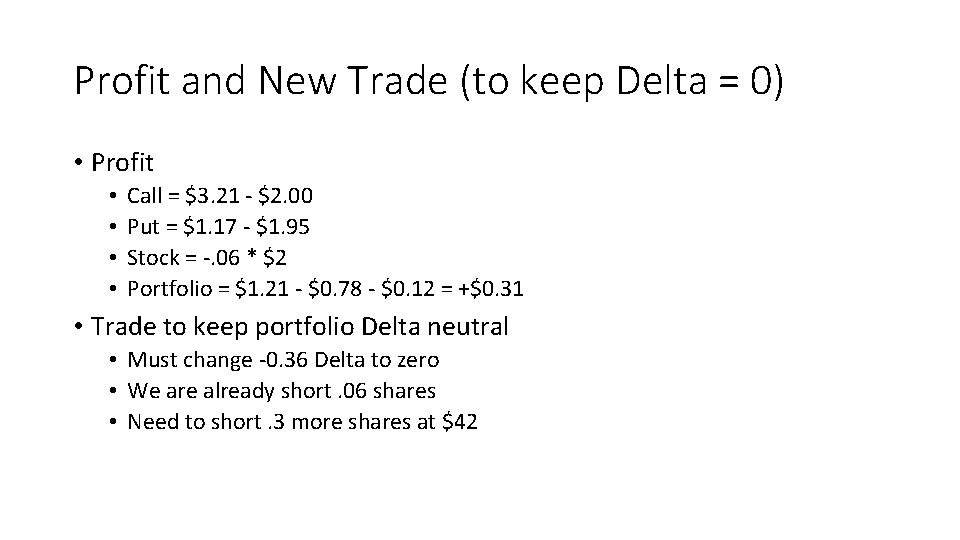
Profit and New Trade (to keep Delta = 0) • Profit • • Call = $3. 21 - $2. 00 Put = $1. 17 - $1. 95 Stock = -. 06 * $2 Portfolio = $1. 21 - $0. 78 - $0. 12 = +$0. 31 • Trade to keep portfolio Delta neutral • Must change -0. 36 Delta to zero • We are already short. 06 shares • Need to short. 3 more shares at $42
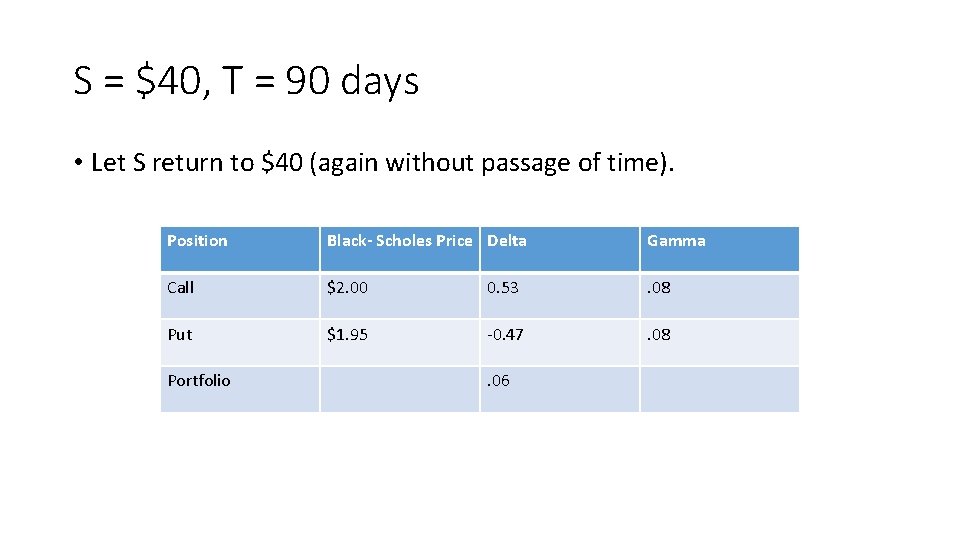
S = $40, T = 90 days • Let S return to $40 (again without passage of time). Position Black- Scholes Price Delta Gamma Call $2. 00 0. 53 . 08 Put $1. 95 -0. 47 . 08 Portfolio . 06
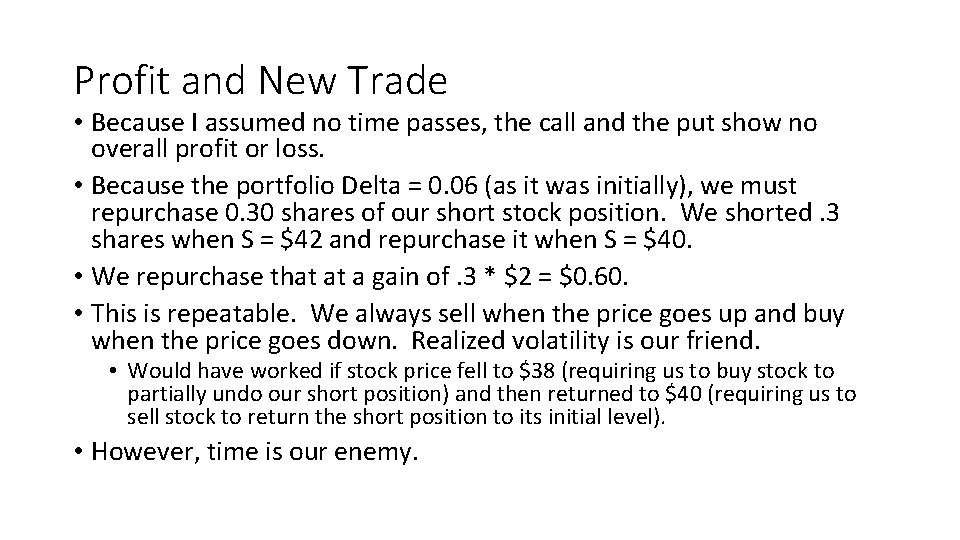
Profit and New Trade • Because I assumed no time passes, the call and the put show no overall profit or loss. • Because the portfolio Delta = 0. 06 (as it was initially), we must repurchase 0. 30 shares of our short stock position. We shorted. 3 shares when S = $42 and repurchase it when S = $40. • We repurchase that at a gain of. 3 * $2 = $0. 60. • This is repeatable. We always sell when the price goes up and buy when the price goes down. Realized volatility is our friend. • Would have worked if stock price fell to $38 (requiring us to buy stock to partially undo our short position) and then returned to $40 (requiring us to sell stock to return the short position to its initial level). • However, time is our enemy.
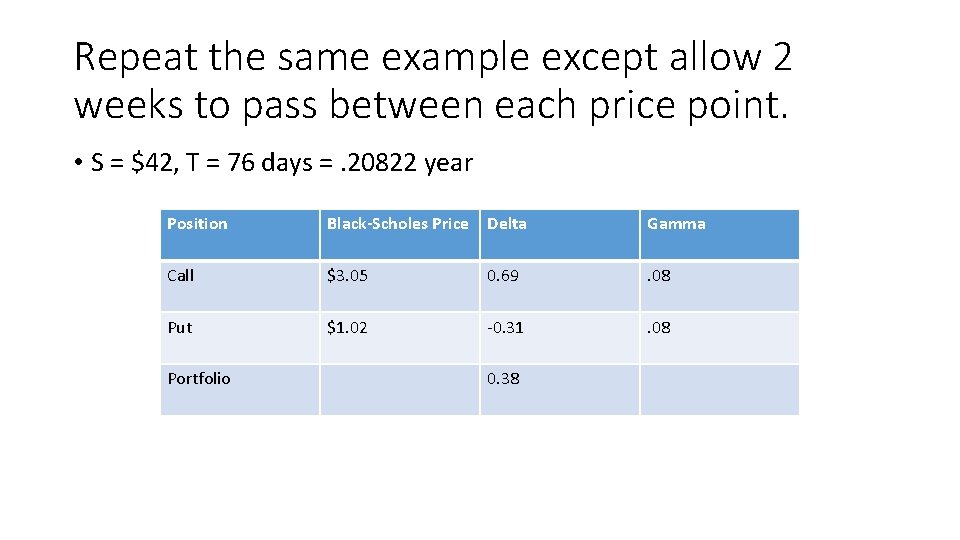
Repeat the same example except allow 2 weeks to pass between each price point. • S = $42, T = 76 days =. 20822 year Position Black-Scholes Price Delta Gamma Call $3. 05 0. 69 . 08 Put $1. 02 -0. 31 . 08 Portfolio 0. 38
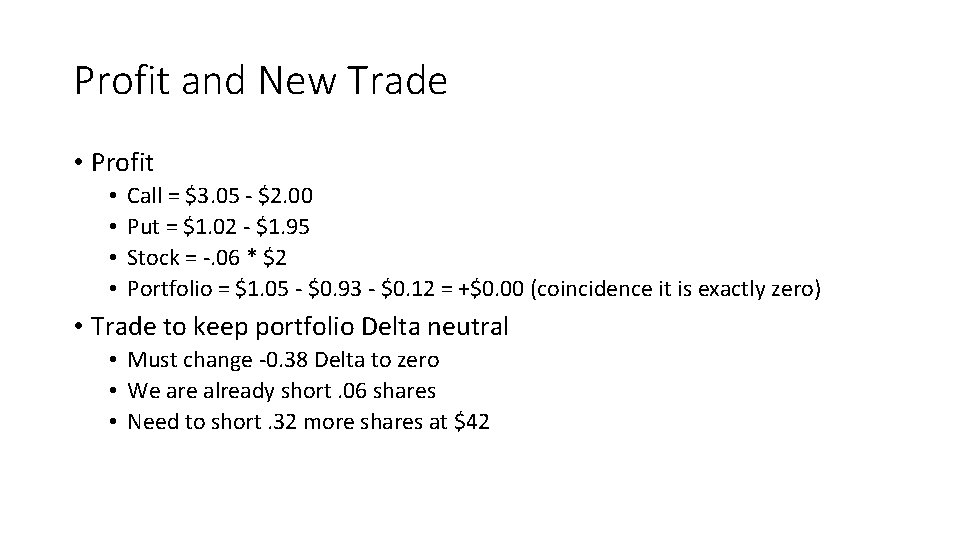
Profit and New Trade • Profit • • Call = $3. 05 - $2. 00 Put = $1. 02 - $1. 95 Stock = -. 06 * $2 Portfolio = $1. 05 - $0. 93 - $0. 12 = +$0. 00 (coincidence it is exactly zero) • Trade to keep portfolio Delta neutral • Must change -0. 38 Delta to zero • We are already short. 06 shares • Need to short. 32 more shares at $42
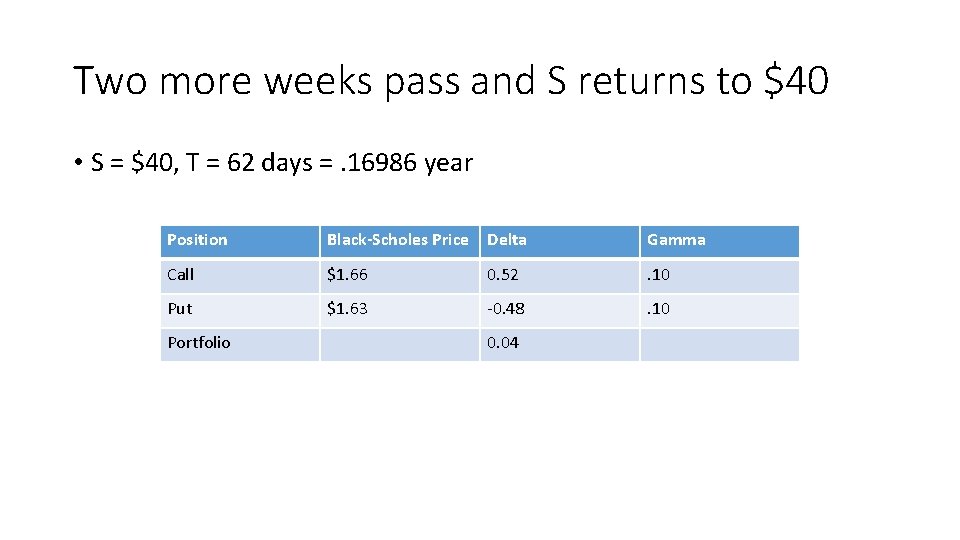
Two more weeks pass and S returns to $40 • S = $40, T = 62 days =. 16986 year Position Black-Scholes Price Delta Gamma Call $1. 66 0. 52 . 10 Put $1. 63 -0. 48 . 10 Portfolio 0. 04
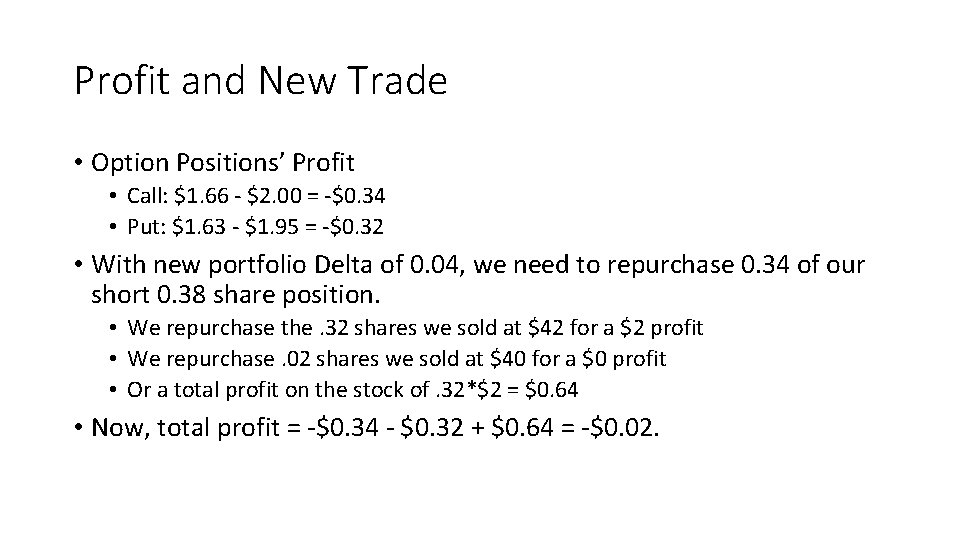
Profit and New Trade • Option Positions’ Profit • Call: $1. 66 - $2. 00 = -$0. 34 • Put: $1. 63 - $1. 95 = -$0. 32 • With new portfolio Delta of 0. 04, we need to repurchase 0. 34 of our short 0. 38 share position. • We repurchase the. 32 shares we sold at $42 for a $2 profit • We repurchase. 02 shares we sold at $40 for a $0 profit • Or a total profit on the stock of. 32*$2 = $0. 64 • Now, total profit = -$0. 34 - $0. 32 + $0. 64 = -$0. 02.
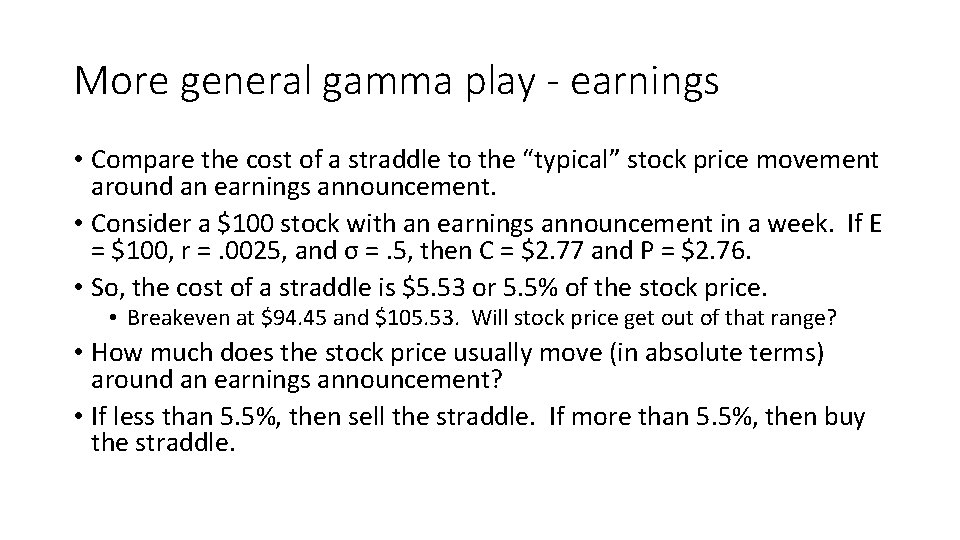
More general gamma play - earnings • Compare the cost of a straddle to the “typical” stock price movement around an earnings announcement. • Consider a $100 stock with an earnings announcement in a week. If E = $100, r =. 0025, and σ =. 5, then C = $2. 77 and P = $2. 76. • So, the cost of a straddle is $5. 53 or 5. 5% of the stock price. • Breakeven at $94. 45 and $105. 53. Will stock price get out of that range? • How much does the stock price usually move (in absolute terms) around an earnings announcement? • If less than 5. 5%, then sell the straddle. If more than 5. 5%, then buy the straddle.
- Slides: 17