
Gamma ray interaction Topics of discussion u Origin


- Slides: 18
Gamma ray interaction
Topics of discussion u Origin of gamma ray u Photoelectric effect u Compton effect u Pair production effect
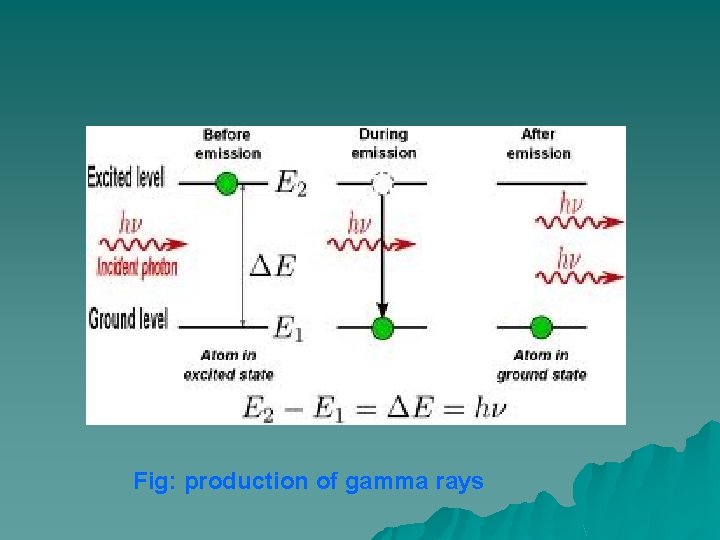
Origin of gamma rays Gamma rays are produced when the nucleus in the excited state makes transition to the ground state, it emit high energy photons called gamma rays or electromagnetic rays
Fig: production of gamma rays
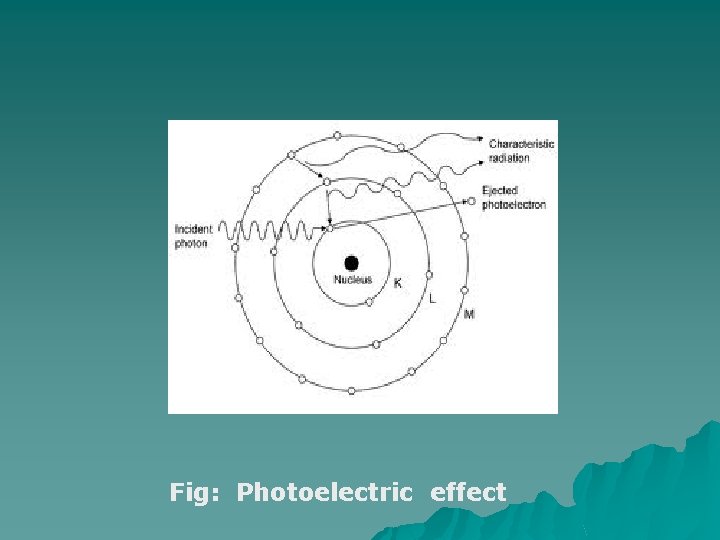
Photoelectric effect When an incident photon collides with an atom , it may impinge upon an orbital electron and transfer its entire energy to this bound electron by ejecting it from atom. This process is called photo electric effect.
Fig: Photoelectric effect
For gamma ray having energy 100 Ke. V to 500 Ke. V, photoelectric effect is dominant mode of interaction of these rays with the material of high atomic number (z). the probability of interaction is maximum between gamma ray photon and most tightly bound electrons. when the energy of incident photon is more than binding energy of electron in k-shell of atom then 80% the absorption of gamma rays takes place by photoelectric absorption. The probability for absorption by photoelectric effect is proportional to Z 5 /(hν)3. 5 i. e.
Compton effect
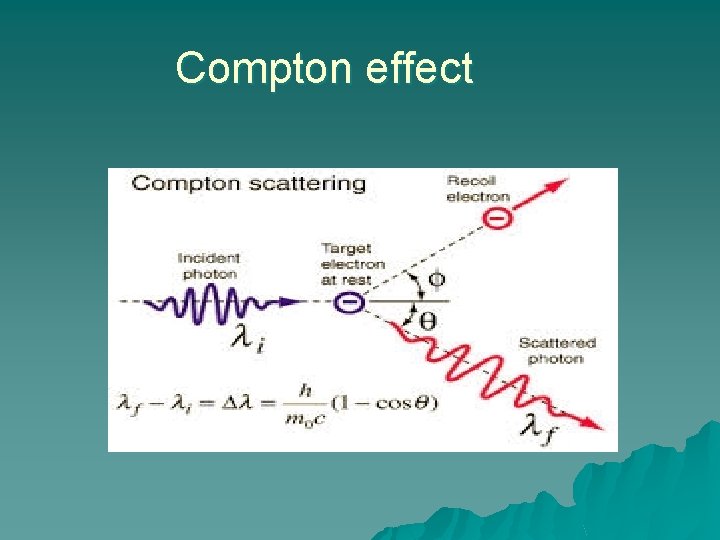
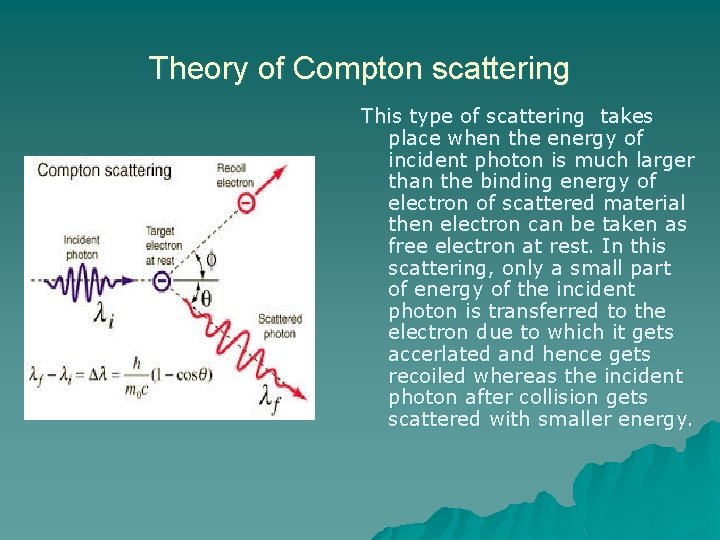
Compton effect It is a process in which an incident photon interacts with a free electron and is scattered with loss of energy. Compton scattering also includes scattering of photons by electrons bound to an atom, because electron binding energy is quite small in comparison to the energy of photon
Theory of Compton scattering This type of scattering takes place when the energy of incident photon is much larger than the binding energy of electron of scattered material then electron can be taken as free electron at rest. In this scattering, only a small part of energy of the incident photon is transferred to the electron due to which it gets accerlated and hence gets recoiled whereas the incident photon after collision gets scattered with smaller energy.
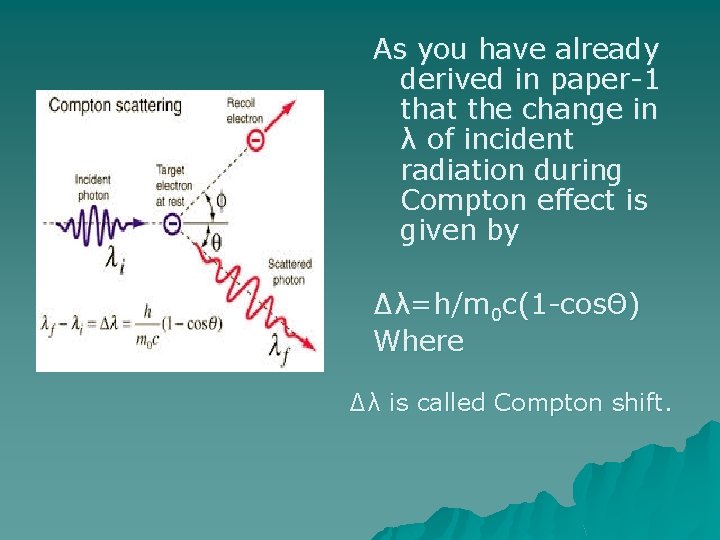
As you have already derived in paper-1 that the change in λ of incident radiation during Compton effect is given by ∆λ=h/m 0 c(1 -cosΘ) Where ∆λ is called Compton shift.
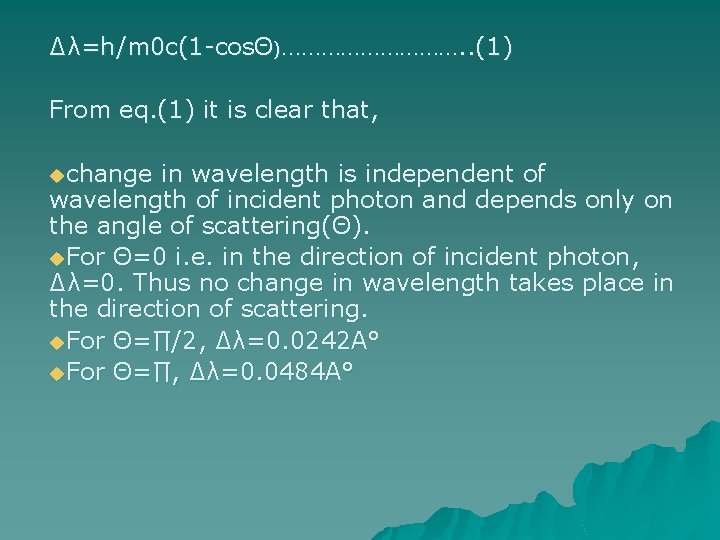
∆λ=h/m 0 c(1 -cosΘ)……………. . (1) From eq. (1) it is clear that, uchange in wavelength is independent of wavelength of incident photon and depends only on the angle of scattering(Θ). u. For Θ=0 i. e. in the direction of incident photon, ∆λ=0. Thus no change in wavelength takes place in the direction of scattering. u. For Θ=∏/2, ∆λ=0. 0242 A° u. For Θ=∏, ∆λ=0. 0484 A°
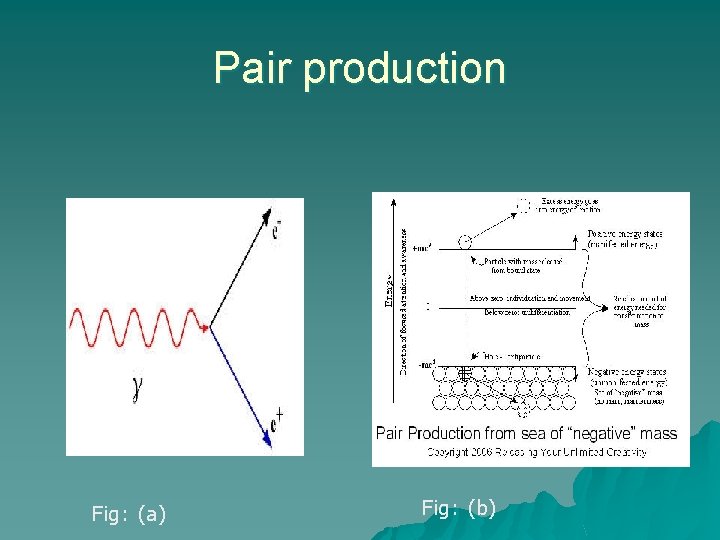
Pair production In this process the production of electron-positron pair takes place when a photon having energy>1. 02 Me. V, strikes a material of high atomic number, the photon is completely absorbed in the field of nucleus and a pair of electron and positron is produced.
Pair production Fig: (a) Fig: (b)
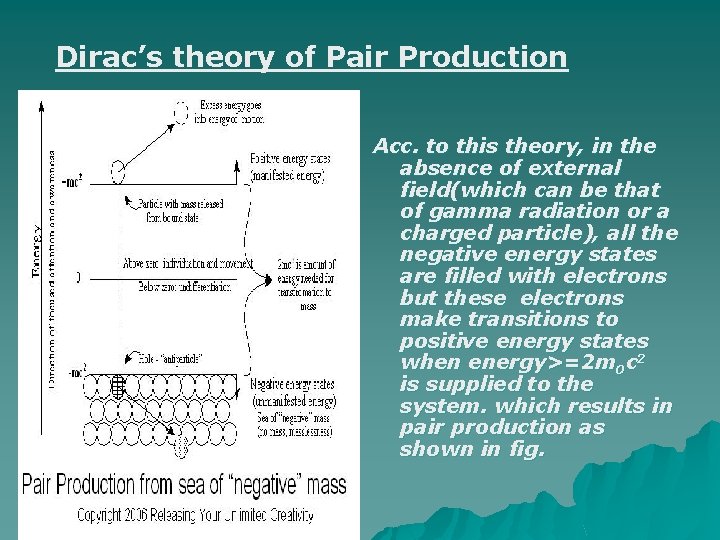
Dirac’s theory of Pair Production Acc. to this theory, in the absence of external field(which can be that of gamma radiation or a charged particle), all the negative energy states are filled with electrons but these electrons make transitions to positive energy states when energy>=2 m 0 c 2 is supplied to the system. which results in pair production as shown in fig.
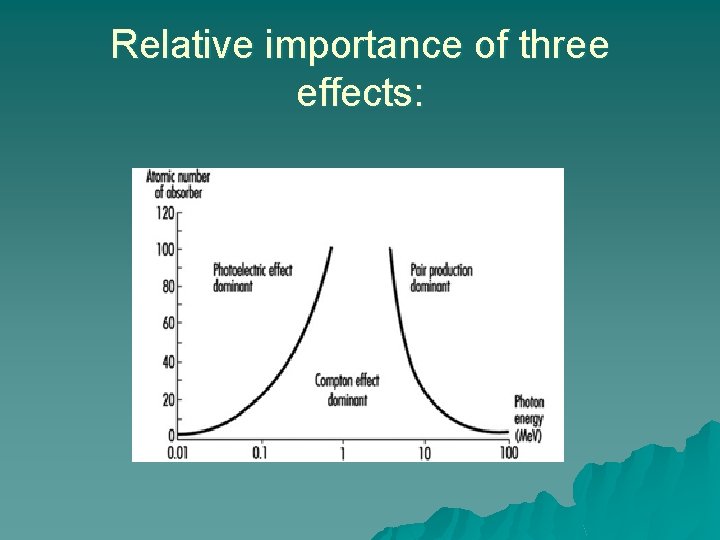
Relative importance of three effects:
Conclusion: u Photoelectric effect is predominant in energy range 100 ke. V to 500 ke. V. u In Compton effect, energy lies in range of 100 ke. V to 1. 0 Me. V. u Pair production takes place when energy is above 1. 02 Me. V.