
Gametogenesis Embryology course 2010 Arrangement of the male

Gametogenesis Embryology course 2010
• • Arrangement of the male gonads Arrangement of the female gonads Spermatogenesis Oogenesis
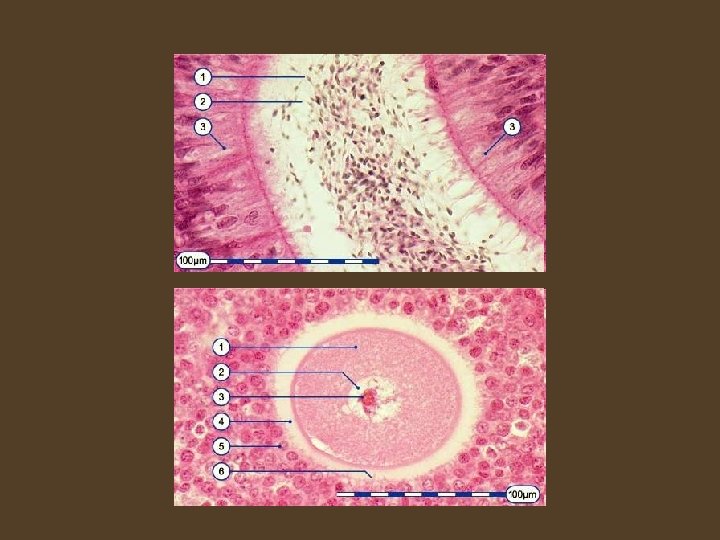

Spermatogenesis

Structure of the germinal epithelium

Developmental stages of spermatogenesis • A-spermatogonium • B-spermatogonium • Primary spermatocyte (= spermatocyte order I) • Secondary spermatocyte (= spermatocyte order II) • Spermatid • Sperm cell (= spermatozoon)

The temporal course of spermatogenesis Mitosis of the spermatogonia 16 days Up to the primary spermatocytes First meiosis 24 days For the division of the primary spermatocytes to form secondary spermatocytes Second meiosis A few hours For engendering the spermatids Spermiogenesis 24 days Up to the completed sperm cells Total ~64 days


Spermatocytogenesis • spermatogonia: • homonymous division • heteronymous division • primary spermatocytes (I): enter into the first meiosis • secondary spermatocytes go directly into the second meiosis • spermatids

Local course of spermatogenesis - the spermatogenesis wave

Structure of the sperm cell • Nuclear condensation: thickening and reduction of the nuclear size, condensation of the nuclear contents into the smallest space. • Acrosome formation: Forming a cap (acrosome) containing enzymes that play an important role in the penetration through the pellucid zone of the oocyte. • Flagellum formation: generation of the sperm cell tail. • Cytoplasma reduction: elimination of all unnecessary cytoplasm.


• The neck contains the two centrioles (proximal and distal) among other things. • The mid piece consists of a sheath of ringshaped mitochondria grouped around the axoneme to provide the energy for the flagellar movement. • The principle piece has a sheath of ring fibers around the axoneme. • The tail consists of only the 9+2 structure of the axoneme

Leydig's interstitial cells and hormonal regulation

Oogenesis

Group type of egg type of cleavage Amphioxus, mammals isolecithal, Oligolecitha or alecithal holoblastic (or complete): initial cleavage planes extend through egg) amphibians, lampreys mesolecithal holoblastic reptiles telolecithal meroblastic (incomplete) : initial cleavages planes limited to animal pole, the region blastula cavity sphere with single layer wall large, central sphere with layered wall small sphere cell disk on surface of yolk, bilaminar flat space between epiblast and hypoblas


developmental sequence • Primordial germ cell - oogonium primary oocyte - primary oocyte in the dictyotene • Birth The continuation of the development / maturation of the oocyte begins again only a few days before ovulation

• The developmental sequence of a follicle goes through various follicle stages: • Primordial follicle - primary follicle secondary follicle - tertiary follicle (graafian follicle) • Since a follicle can die at any moment in its development (= atresia), not all reach the tertiary follicle stage.

The follicle stages from primordial follicle to tertiary follicle


Temporal course of the number of germ cells / follicles • Phase A: Primordial germ cells grow, proliferate 6 th to 8 th week. Phase B: Spurt of growth: cellular clones of the oogonia are formed, whereby the cells remain connected with each other through cellular bridges; 9 th to the 22 nd week. Phase C: The oogonia become primary oocytes that enter the prophase of the first meiosis; 12 th to the 25 th week. Phase D: The primary oocytes become arrested in the prophase: the primordial follicles are created; 16 th to the 29 th week. Phase E: At around the 14 th week a quantitatively increased decline in the number of germ cells commences as well as atresia in all of the follicle stages.

Spermatogenesis Oogenesis Number of gametes Principle: continuous production. Principle: Using up the oocytes Although from puberty to old age generated before birth. sperm cells are constantly being Continual decrease of the oocytes, engendered, the production is beginning with the fetal period. subject to extreme fluctuations Exhaustion of the supply at regarding both quantity and quality. menopause. Meiotic output Four functioning, small (head 4 mm), One large, immotile oocyte (diameter motile spermatozoids at the end of 120 mm) and three shriveled polar the meiosis bodies are left at the end of the meiosis Fetal period No meiotic divisions Entering into meiosis (arrested in the dictyotene stage) No germ cell production Production of the entire supply of germ cells

The ovarian cycle • • the ovarian cycle (follicle maturation) that peaks in the ovulation and the subsequent luteinization of the granulose cells cyclic alterations of the endometrium that prepare the uterine mucosa so fertilized oocytes can "nest" there. In the absence of implantation, the mucosa will be eliminated (menstrual bleeding)

• The control circuit of the hormonal cycle has two essential control elements: – The pulsatile liberation of Gn. RH, as well as FSH and LH – The long-loop feedback-effect of estrogen and progesterone on the hypothalamichypophysial-system (these two hormones are synthesized in the [ready to rupture] follicle and so originate in the ovary, thus the name "long loop").
• Follicle phase: recruitment of a so-called follicle cohort and, within this, the selection of the mature follicle. This phase ends with ovulation. Estradiol is the steering hormone. Normally, it lasts 14 days, but this can vary considerably! • Luteal phase: progesteron production by the "yellow body" (= corpus luteum) and lasts 14 days (relatively constant).

- Slides: 34