
Games that can be adapted to different teaching
Games that can be adapted to different teaching subjects �These games are only examples. They were intended to be played by all teachers, regardless of their specialty. �They have to be adjusted in order to fit specific learning objectives. �The topic of each of the following games (in bold) can be replaced with one that is related to one’s teaching subject.
Amnesia - very active and sometimes noisy �How to play There are many variants of this game, but the principle remains the same. Everyone has the name of a famous person (fictional or real) stuck onto their back (or forehead) in a way that everyone can read all the names except theirs. By asking questions with yes/no answers, everyone has to work out who they are. (Instead of famous people, subject related topics can be used. )
Hedge a bet (good to revise any kind of knowledge – it triggers high involvement from students ) �Students are divided into two groups and they are ‘offered’ a sum of money: 100 Euros �The teacher has a list of questions related to the topic he/she would like to revise. �Students have to bet a part of their money before knowing the question. �If they are right the money adds up to what they already have. If they are wrong the amount of money will decrease with the money they bet. �Bets are done without knowing how much money the other team will bet.
Guess the person (sometimes , according to the group dynamics, more than 3 choices are needed) � Students are asked to write three names of famous people/characters on three different pieces of paper. (any domain, dead or alive. ) � The names are mixed in a bag/hat. � They are divided into two groups and one by one (in turns) have to come pick up a name and describe him/her to the group without saying the name. Time – 1 minute person. If the group guess they have one point and can pick up another one, if they don’t guess, then the group has minus one point and wait for the next turn. Unanswered questions will be introduced back into the bag. � (It can also be used with different topics/teaching subjects. )
Find your half �The teacher writes different statements/formula and separates them in halves on different sticky papers. (post –it paper could work very well. ) �Each half information (any subject related) is stuck on a student’s back. �Then they ar required to find out the other half in order to complete the statement/problem/formula by asking yes/no questions to the other students.
Third part information � � � The teacher prepares the information he would like his students to know/revise. Then he/she separates the information in three equal parts. Students are divided in groups of three and each student of the group is sent to read one piece of information (a third). Time is given. e. g. - 2 minutes. When the two minute period is over they have to come back to the original group of three. Now the teacher gives them a handout with questions/problems/etc. In order to complete the tasks the three students have to collaborate, because only together they can cover the entire information. (A particular example on Fire of London is available on the additional word documents. )
Third part information - I The fire broke out at the end of a hot summer when everything had been dried out by the heat. Most houses were made of wood, and in London they were built very close together. � The fire began in a baker’s shop in Pudding Lane on September 2, 1666. The baker was Thomas Farryner. When asked later how the fire started, he said he had checked that everything was all right before he went to bed but his family was woken in the night by the smoke and they had to climb out of a window and escape on to a neighbour’s roof. � Somebody woke up the Lord Mayor, but he didn’t think the fire was serious and went back to sleep. � Next morning, Samuel Pepys told the King of the danger and the King gave him a message for the Lord Mayor of London. The King said the Lord Mayor must pull down enough houses to make gaps. Then the fire would have nothing to feed it and it might burn out. �
Third part information - II On the same day, John Evelyn went to see the fire. He said it was windy, and the wind fanned the flames so they leapt from house to house and street to street. He said the long hot summer had heated up the air and made everything as dry as firewood. � The King and his brother James, the Duke of York, took charge of the fire -fighting. They ordered their men to blow up houses to make gaps while others pulled down the burning roofs with hooks and poured water on the flames. But the wind continued to blow, and the great fire raged on. � Samuel Pepys was afraid his own house would catch fire, so he took his money and valuables and rode to a friend’s house, where he left them for safe-keeping. Then he returned home and dug a pit in the garden. He buried his wine and some special cheese in it, hoping to save them from the fire. � The next day, the wind dropped. This stopped the fire from spreading and the flames began to die down. Great buildings lay in ruins and there was a smell of smoke everywhere. The St. Paul’s Cathedral was burnt down. Thousands of people were by the roadside with things saved from the fire. �
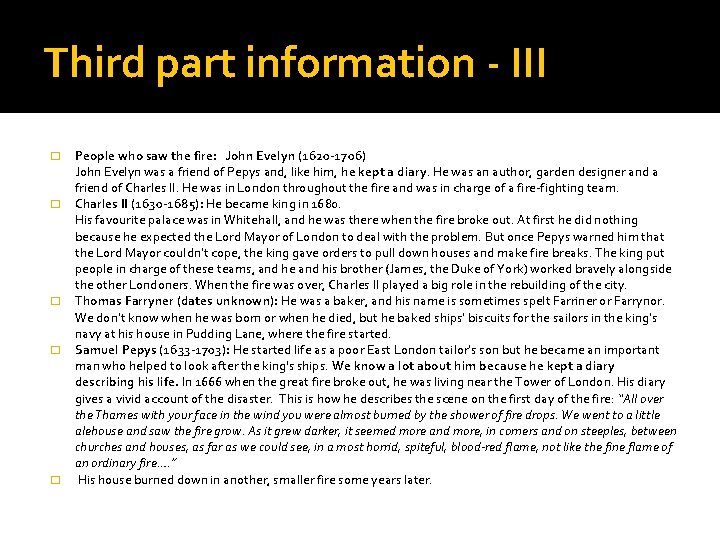
Third part information - III � � � People who saw the fire: John Evelyn (1620 -1706) John Evelyn was a friend of Pepys and, like him, he kept a diary. He was an author, garden designer and a friend of Charles II. He was in London throughout the fire and was in charge of a fire-fighting team. Charles II (1630 -1685): He became king in 1680. His favourite palace was in Whitehall, and he was there when the fire broke out. At first he did nothing because he expected the Lord Mayor of London to deal with the problem. But once Pepys warned him that the Lord Mayor couldn’t cope, the king gave orders to pull down houses and make fire breaks. The king put people in charge of these teams, and he and his brother (James, the Duke of York) worked bravely alongside the other Londoners. When the fire was over, Charles II played a big role in the rebuilding of the city. Thomas Farryner (dates unknown): He was a baker, and his name is sometimes spelt Farriner or Farrynor. We don’t know when he was born or when he died, but he baked ships’ biscuits for the sailors in the king’s navy at his house in Pudding Lane, where the fire started. Samuel Pepys (1633 -1703): He started life as a poor East London tailor’s son but he became an important man who helped to look after the king's ships. We know a lot about him because he kept a diary describing his life. In 1666 when the great fire broke out, he was living near the Tower of London. His diary gives a vivid account of the disaster. This is how he describes the scene on the first day of the fire: “All over the Thames with your face in the wind you were almost burned by the shower of fire drops. We went to a little alehouse and saw the fire grow. As it grew darker, it seemed more and more, in corners and on steeples, between churches and houses, as far as we could see, in a most horrid, spiteful, blood-red flame, not like the fine flame of an ordinary fire…. ” His house burned down in another, smaller fire some years later.
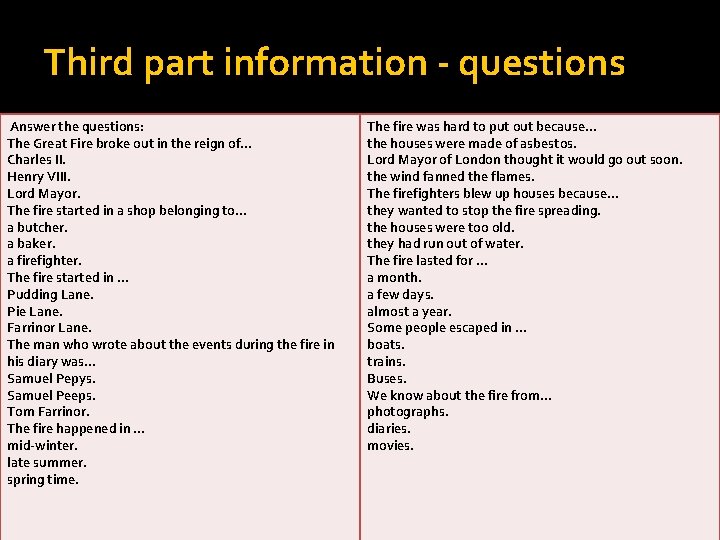
Third part information - questions Answer the questions: The Great Fire broke out in the reign of… Charles II. Henry VIII. Lord Mayor. The fire started in a shop belonging to… a butcher. a baker. a firefighter. The fire started in … Pudding Lane. Pie Lane. Farrinor Lane. The man who wrote about the events during the fire in his diary was… Samuel Pepys. Samuel Peeps. Tom Farrinor. The fire happened in … mid-winter. late summer. spring time. The fire was hard to put out because… the houses were made of asbestos. Lord Mayor of London thought it would go out soon. the wind fanned the flames. The firefighters blew up houses because… they wanted to stop the fire spreading. the houses were too old. they had run out of water. The fire lasted for … a month. a few days. almost a year. Some people escaped in … boats. trains. Buses. We know about the fire from… photographs. diaries. movies.
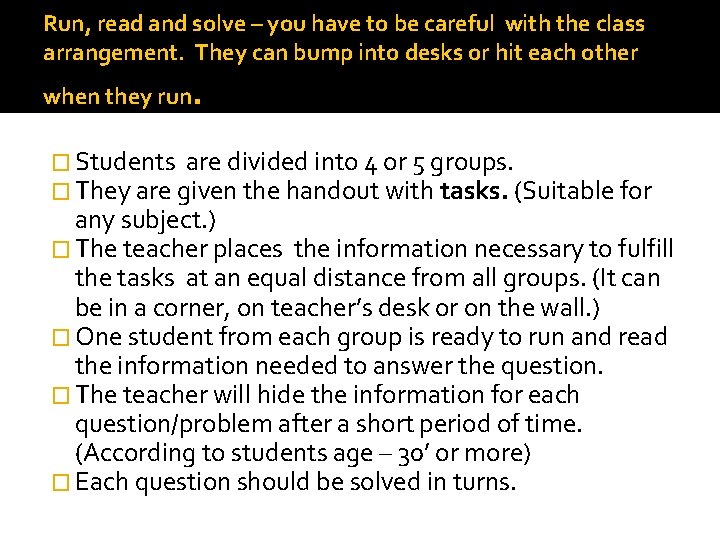
Run, read and solve – you have to be careful with the class arrangement. They can bump into desks or hit each other when they run . � Students are divided into 4 or 5 groups. � They are given the handout with tasks. (Suitable for any subject. ) � The teacher places the information necessary to fulfill the tasks at an equal distance from all groups. (It can be in a corner, on teacher’s desk or on the wall. ) � One student from each group is ready to run and read the information needed to answer the question. � The teacher will hide the information for each question/problem after a short period of time. (According to students age – 30’ or more) � Each question should be solved in turns.
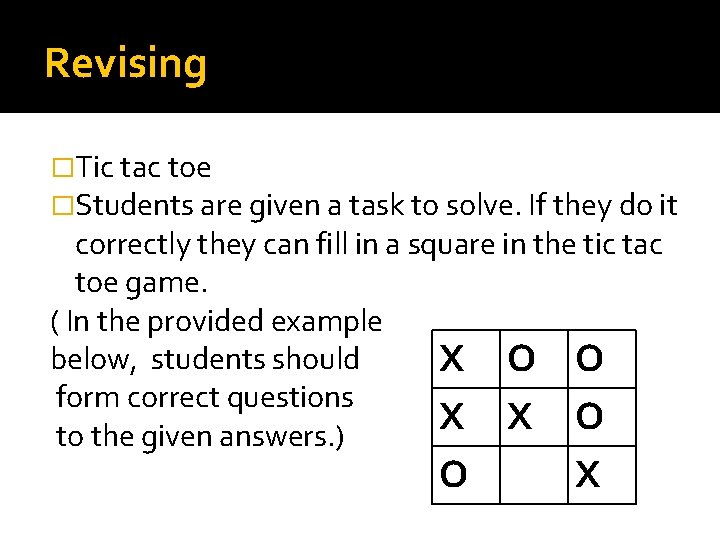
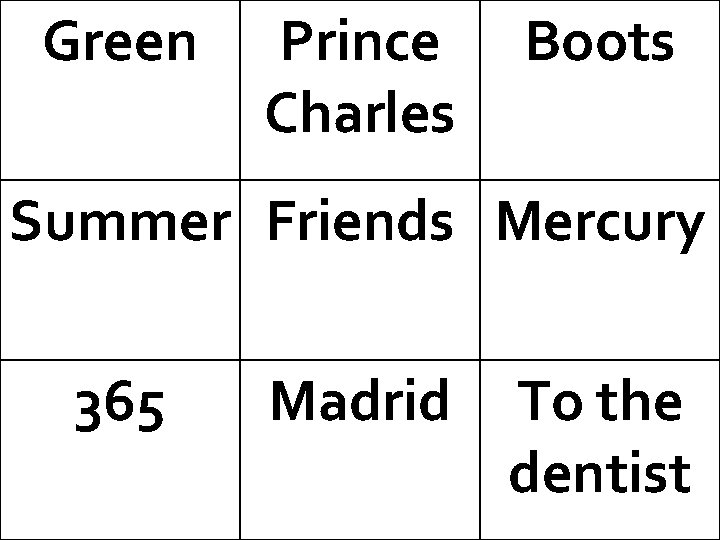
Revising �Tic tac toe �Students are given a task to solve. If they do it correctly they can fill in a square in the tic tac toe game. ( In the provided example below, students should X O O form correct questions X X O to the given answers. ) O X
Green Prince Charles Boots Summer Friends Mercury 365 Madrid To the dentist
The Puzzle – the number of groups can vary � Five topics related to the lesson are prepared � Teacher chooses five students who are able to introduce these topics to their colleagues. Even if they are confident with the topic, they should be given written information, so that they can answer any question from their colleagues. � The rest of the students are divided into five groups. � Then the five students go to one group and introduce the topic and answer their questions. � After 5 minutes they move to the next group. � When they finish the groups/class answer questions/solve a quiz on the topics they previously discussed.
Learn from mistakes � The teacher prepares a piece of information on specific topic which is full of mistakes. Some of them can be funny. � This is a possible example: � How to write a CV: � Create a CV which is full of mistakes: add an inappropriate, crazy photo , choose a childish email address, make plenty of spelling, grammar and register wise mistakes, for references part choose a relative. Print it on a coloured paper, if it scented, it is even more obvious. � Ask the students to identify the mistakes. � They will have a lot of fun and will easily remember it.
Scavenger Hunts �Create questions, fill-in-the-blank exercises etc. � Then hide the answers (or just information from each they can extract the answers) through the classroom. � Divide the students in small groups and ask them to search around the classroom for them. They can also find out the answers in the textbooks, encyclopedias, or online. �Other classrooms can be involved and have students go to visit there for clues. (Outside route can be used, too, but it needs more preparations and attention. )
Silly answer quizzes �Create a quiz on a topic you intend to revise. �Add silly answers (1 multiple choice answer that is obviously not correct) or even a joke to make it a little funnier. Then go over the quiz together to reinforce the correct answers.
Disappearing Cat – works better with younger students �Prepare a set of questions you intend to ask your students. �Divide the board with a vertical line and draw a simple cat in each section. �Tell the students that one cat is theirs- they can even name it – and one is yours. �Ask the students the questions you have prepared. If their answer is wrong you rub out a part of their cat. If their answer is correct you rub out a part of your cat. �Finally, see whose cat disappears first. Yours or the students’.
Search through the Book – Quick reading; Scanning �Tell the students this is an exercise in quick scanning, a useful study skill. �Ask the students a question whose answer they have to find as quickly as possible by browsing their books. When they find the answer they have to tell the page and the place on the page. �Give the students a little time after the quickest student has finished in order to give the others a chance, too. Then ask for the answers. �Can be repeated three or four times.
The disappearing information �When you have written a text on the board and no longer need it, erase a small part of it, not more than one line or two lines. Ask a student to read out the text on the board to the rest of the class. �Then let them try to include the missing word from their memory. �Erase one or two more words. �Continue in this way until the whole text has been erased and remembered.
A Day to Remember �Explain the students that you will read an extract and then you will ask questions about the details mentioned. (The extract can be related to your lesson. ) �They have to listen carefully so as to recall the information. �They can perform the task individually or in groups.
A Day to remember 2 � � � � � “Saturday started well. The sun was shinning when I got up at 8 o’clock. I had a quick shower and got dressed, then made some porridge for my breakfast. I had to meet two friends Joe and Amir at 9 o’clock outside Burger King. We were going to look around the shops together. Joe bought a new sweatshirt and some Nike trainers. We spent a long time looking at games for my PS 4 and I bought a SF game that looked really exciting. Amir spent ages going in every clothes shop. He was looking for a new jacket but he couldn’t find anything that he liked. We went into Mc. Donalds where Joe and I had cheeseburgers and chips, but Amir had a veggie burger. ” Questions: 1. What day was it? 2. What was the weather like? 3. What time did the writer get up? 4. What did he have for breakfast? 5. Where did the three friends meet? 6. What make of trainers did Joe buy? 7. Who had a different burger at Mc. Donalds?
Making Sense �Students have to analyse a piece of text in which all the spaces between words have been removed. �The teacher gives each student the text and ask them to answer the question beneath the texts. It can be more entertaining if the teacher sets time for accomplishing the task.
Making Sense – 2 � Theoldmanlikedeatinggreenapplesfromhisowngarden whiledrinkingacupofteaintheafternoon. � What colour is the food he liked to eat? � Thefilmwasanactionpackedblockbusterandthemainch aracterwasanundercovercop. � What was the profession of the hero? � Iorderedfourburgersthreeportionsofchipstwocolaswit hiceandacoffee. � How many drinks are mentioned all together? � Theplanewasabouttoland. Ilookedoutofthewindowand sawtheseabelow. Thetinyboatswereshininginthesuncre atinganextremelybeautifullandscape. � What was there on the water?
- Slides: 24