
Gamebased learning framework Click on a topic to
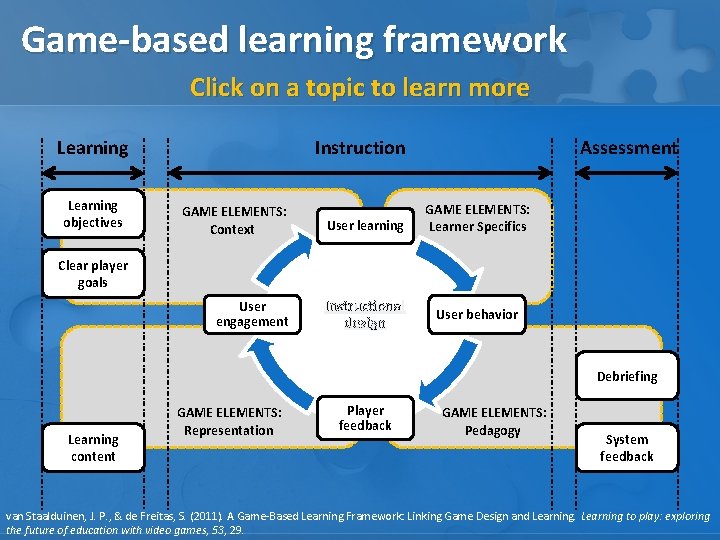
Game-based learning framework Click on a topic to learn more Learning objectives Assessment Instruction GAME ELEMENTS: Context User learning User engagement Instructional design GAME ELEMENTS: Learner Specifics Clear player goals User behavior Debriefing Learning content GAME ELEMENTS: Representation Player feedback GAME ELEMENTS: Pedagogy System feedback van Staalduinen, J. P. , & de Freitas, S. (2011). A Game-Based Learning Framework: Linking Game Design and Learning to play: exploring the future of education with video games, 53, 29.
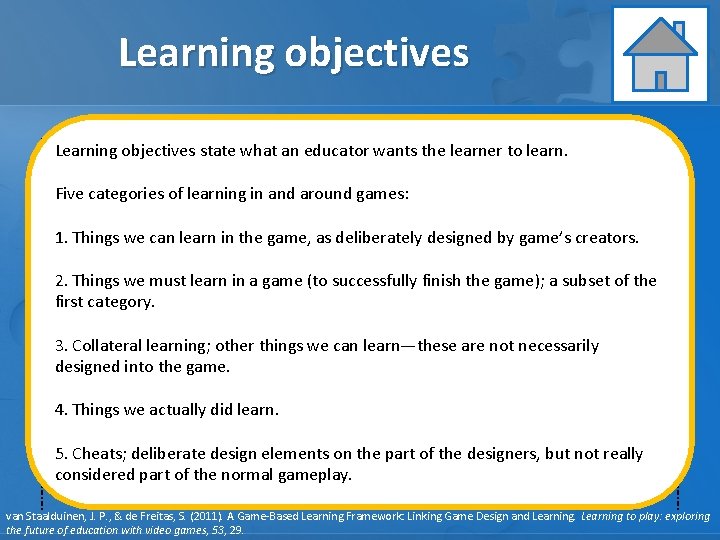
Learning objectives Learning Assessment Instruction Learning objectives state what an educator wants the learner to learn. Five categories of learning in and around games: Learning objectives GAME ELEMENTS: Context User learning GAME ELEMENTS: Learner Specifics 1. Things we can learn in the game, as deliberately designed by game’s creators. Clear player 2. Things we must learn in a game (to successfully finish the game); a subset of the goals first category. User engagement Instructional design User behavior 3. Collateral learning; other things we can learn—these are not necessarily designed into the game. Debriefing 4. Things we actually did learn. GAME ELEMENTS: Player feedback GAME ELEMENTS: Pedagogy Representation Learning System 5. Cheats; deliberate design elements on the part of the designers, but not really content feedback considered part of the normal gameplay. van Staalduinen, J. P. , & de Freitas, S. (2011). A Game-Based Learning Framework: Linking Game Design and Learning to play: exploring the future of education with video games, 53, 29.
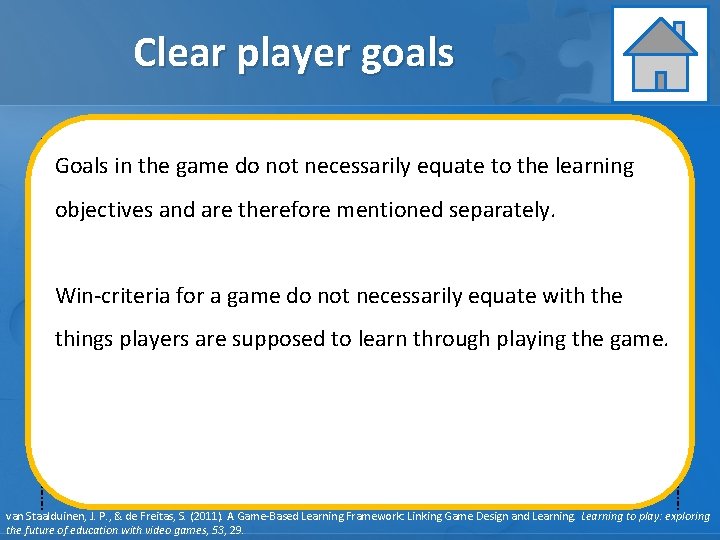
Clear player goals Learning Assessment Instruction Goals in the game do not necessarily equate to the learning Learning GAME ELEMENTS: objectives and are therefore mentioned separately. objectives Context User learning Learner Specifics Clear player goals Win-criteria for a game do not necessarily equate with the Instructional User engagement design User behavior things players are supposed to learn through playing the game. Debriefing Learning content GAME ELEMENTS: Representation Player feedback GAME ELEMENTS: Pedagogy System feedback van Staalduinen, J. P. , & de Freitas, S. (2011). A Game-Based Learning Framework: Linking Game Design and Learning to play: exploring the future of education with video games, 53, 29.
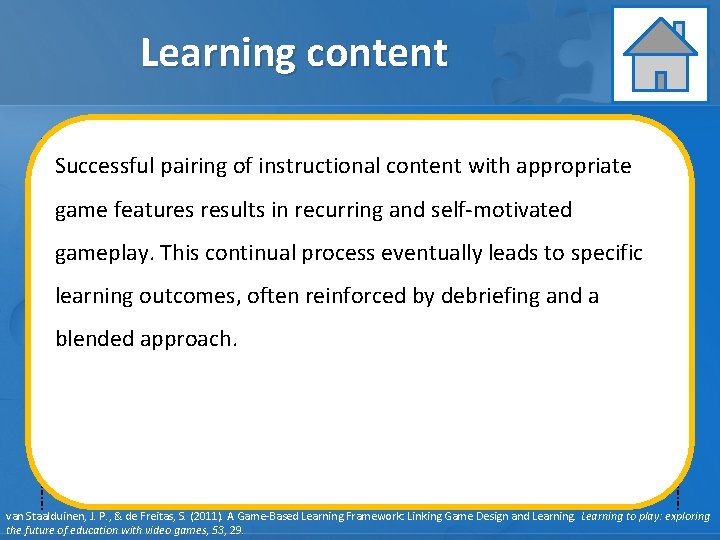
Learning content Learning Assessment Instruction Successful pairing of instructional content with appropriate Learning GAME ELEMENTS: game features results in recurring and self-motivated objectives Context User learning Learner Specifics gameplay. This continual process eventually leads to specific Clear player goals learning outcomes, often reinforced by debriefing and a Instructional User engagement blended approach. design User behavior Debriefing Learning content GAME ELEMENTS: Representation Player feedback GAME ELEMENTS: Pedagogy System feedback van Staalduinen, J. P. , & de Freitas, S. (2011). A Game-Based Learning Framework: Linking Game Design and Learning to play: exploring the future of education with video games, 53, 29.
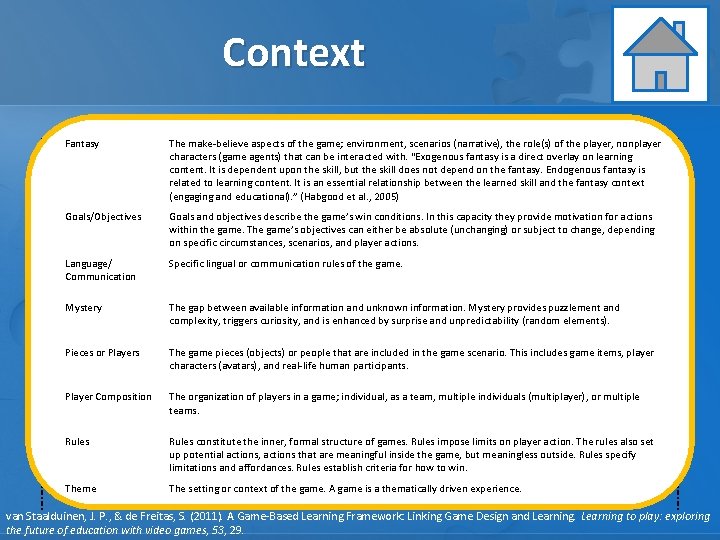
Context Fantasy Learning objectives Goals/Objectives Language/ Clear player Communication goals Assessment Instruction The make-believe aspects of the game; environment, scenarios (narrative), the role(s) of the player, nonplayer characters (game agents) that can be interacted with. “Exogenous fantasy is a direct overlay on learning content. It is dependent upon the skill, but the skill does not depend on the fantasy. Endogenous fantasy is related to learning content. It is an essential relationship between the learned skill and the fantasy context (engaging and educational). ” (Habgood et al. , 2005) GAME ELEMENTS: Goals and objectives describe the game’s win conditions. In this capacity they provide motivation for actions User learning Learner Specifics within the game. The game’s objectives can either be absolute (unchanging) or subject to change, depending Context on specific circumstances, scenarios, and player actions. Specific lingual or communication rules of the game. Mystery Instructional User The gap between available information and unknown information. Mystery provides puzzlement and User behavior complexity, triggers curiosity, and is enhanced by surprise and unpredictability (random elements). engagement design Pieces or Players The game pieces (objects) or people that are included in the game scenario. This includes game items, player characters (avatars), and real-life human participants. Debriefing Player Composition The organization of players in a game; individual, as a team, multiple individuals (multiplayer), or multiple teams. Player GAME ELEMENTS: Representation feedback Pedagogy Learning Rules System Rules constitute the inner, formal structure of games. Rules impose limits on player action. The rules also set up potential actions, actions that are meaningful inside the game, but meaningless outside. Rules specify feedback limitations and affordances. Rules establish criteria for how to win. Theme The setting or context of the game. A game is a thematically driven experience. content van Staalduinen, J. P. , & de Freitas, S. (2011). A Game-Based Learning Framework: Linking Game Design and Learning to play: exploring the future of education with video games, 53, 29.
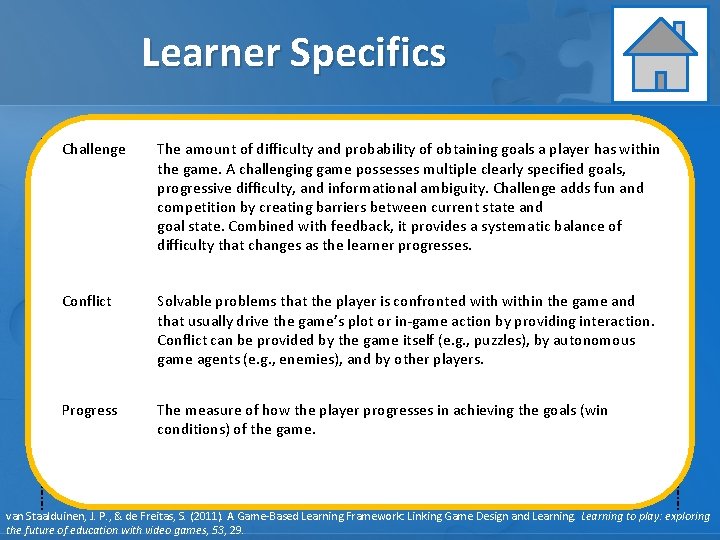
Learner Specifics Learning Challenge Learning objectives Assessment Instruction The amount of difficulty and probability of obtaining goals a player has within the game. A challenging game possesses multiple clearly specified goals, progressive difficulty, and informational ambiguity. Challenge adds fun and competition by creating barriers between current state and GAME ELEMENTS: User learning goal state. Combined with feedback, it provides a systematic balance of Learner Specifics Context difficulty that changes as the learner progresses. Clear player goals Conflict Solvable problems that the player is confronted within the game and Instructional User behavior that usually drive the game’s plot or in-game action by providing interaction. engagement design Conflict can be provided by the game itself (e. g. , puzzles), by autonomous game agents (e. g. , enemies), and by other players. Debriefing Progress Learning content The measure of how the player progresses in achieving the goals (win Player GAME ELEMENTS: feedback conditions) of the game. Representation Pedagogy System feedback van Staalduinen, J. P. , & de Freitas, S. (2011). A Game-Based Learning Framework: Linking Game Design and Learning to play: exploring the future of education with video games, 53, 29.
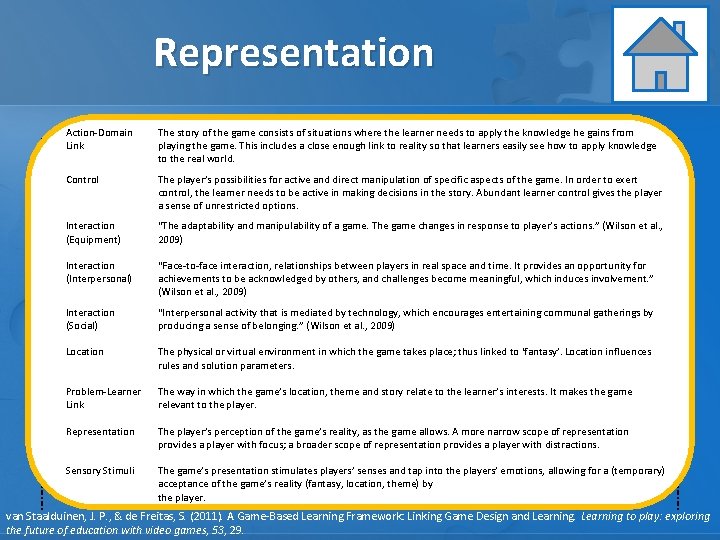
Representation Action-Domain Link The story of the game consists of situations where the learner needs to apply the knowledge he gains from playing the game. This includes a close enough link to reality so that learners easily see how to apply knowledge to the real world. Control The player’s possibilities for active and direct manipulation of specific aspects of the game. In order to exert control, the learner needs to be active in making decisions in the story. Abundant learner control gives the player a sense of unrestricted options. GAME ELEMENTS: Learning objectives Interaction (Equipment) Interaction Clear player (Interpersonal) goals Interaction (Social) Instruction Assessment GAME ELEMENTS: “The adaptability and manipulability of a game. The game changes in response to player’s actions. ” (Wilson et al. , User learning Learner Specifics Context 2009) “Face-to-face interaction, relationships between players in real space and time. It provides an opportunity for achievements to be acknowledged by others, and challenges become meaningful, which induces involvement. ” (Wilson et al. , 2009) Instructional User “Interpersonal activity that is mediated by technology, which encourages entertaining communal gatherings by User behavior engagement design producing a sense of belonging. ” (Wilson et al. , 2009) Location The physical or virtual environment in which the game takes place; thus linked to ‘fantasy’. Location influences rules and solution parameters. Problem-Learner Link The way in which the game’s location, theme and story relate to the learner’s interests. It makes the game relevant to the player. Debriefing Representation Learning content Sensory Stimuli Player GAME ELEMENTS: feedback The player’s perception of the game’s reality, as the game allows. A more narrow scope of representation Representation Pedagogy provides a player with focus; a broader scope of representation provides a player with distractions. System feedback The game’s presentation stimulates players’ senses and tap into the players’ emotions, allowing for a (temporary) acceptance of the game’s reality (fantasy, location, theme) by the player. van Staalduinen, J. P. , & de Freitas, S. (2011). A Game-Based Learning Framework: Linking Game Design and Learning to play: exploring the future of education with video games, 53, 29.
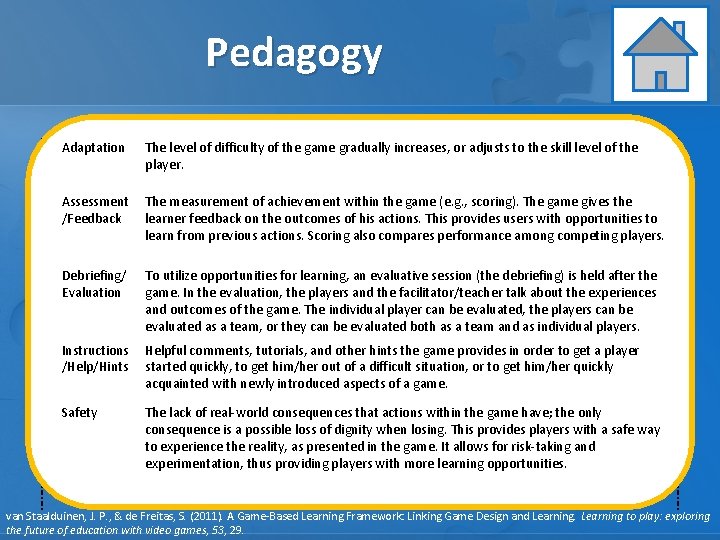
Pedagogy Adaptation Learning Assessment Learning /Feedback objectives Clear player Debriefing/ goals Evaluation The level of difficulty of the game gradually increases, or adjusts to the skill level of the Assessment Instruction player. The measurement of achievement within the game (e. g. , scoring). The game gives the GAME ELEMENTS: learner feedback on the outcomes of his actions. This provides users with opportunities to User learning Learner Specifics Context learn from previous actions. Scoring also compares performance among competing players. To utilize opportunities for learning, an evaluative session (the debriefing) is held after the game. In the evaluation, the players and the facilitator/teacher talk about the experiences Instructional User and outcomes of the game. The individual player can be evaluated, the players can be User behavior engagement design evaluated as a team, or they can be evaluated both as a team and as individual players. Instructions /Help/Hints Helpful comments, tutorials, and other hints the game provides in order to get a player started quickly, to get him/her out of a difficult situation, or to get him/her quickly Debriefing acquainted with newly introduced aspects of a game. Safety Player The lack of real-world consequences that actions within the game have; the only GAME ELEMENTS: feedback consequence is a possible loss of dignity when losing. This provides players with a safe way Representation Pedagogy to experience the reality, as presented in the game. It allows for risk-taking and System feedback experimentation, thus providing players with more learning opportunities. Learning content van Staalduinen, J. P. , & de Freitas, S. (2011). A Game-Based Learning Framework: Linking Game Design and Learning to play: exploring the future of education with video games, 53, 29.
User learning Learning Assessment Instruction Attention needs to be paid to the game learning cycle, which consists of user behavior, user feedback, user engagement, and user learning. The Learning GAME ELEMENTS: User learning Learner Specifics Context instructional design needs to be such that user actions are given sufficient objectives Clear player feedback to trigger engagement, leading to learning. goals User engagement Instructional design User behavior Debriefing Learning content GAME ELEMENTS: Representation Player feedback GAME ELEMENTS: Pedagogy System feedback van Staalduinen, J. P. , & de Freitas, S. (2011). A Game-Based Learning Framework: Linking Game Design and Learning to play: exploring the future of education with video games, 53, 29.
User behavior Learning Assessment Instruction Attention needs to be paid to the game learning cycle, which consists of user behavior, user feedback, user engagement, and user learning. The instructional Learning GAME ELEMENTS: objectives design needs to be such that user actions are given sufficient feedback to trigger User learning Learner Specifics Context engagement, leading to learning. Clear player goals Instructional User behavior engagement An example of user behavior would be time on task. The amount of time a user design spends engaged in a particular task. Debriefing Learning content GAME ELEMENTS: Representation Player feedback GAME ELEMENTS: Pedagogy System feedback van Staalduinen, J. P. , & de Freitas, S. (2011). A Game-Based Learning Framework: Linking Game Design and Learning to play: exploring the future of education with video games, 53, 29.
Player feedback Learning Assessment Instruction The measurement of achievement, progress, and score of the player within a game. The game gives the learner feedback on the outcomes of his Learning GAME ELEMENTS: User learning Learner Specifics Context actions (Salen & Zimmerman, 2004; Juul, 2005; Wilson et al. , 2009). objectives Clear player goals Instructional User The reflective observation of feedback leads to the construction of User behavior engagement design schemata and enables the player to discover new and better solutions to his problems Learning content Debriefing GAME ELEMENTS: Representation Player feedback GAME ELEMENTS: Pedagogy System feedback van Staalduinen, J. P. , & de Freitas, S. (2011). A Game-Based Learning Framework: Linking Game Design and Learning to play: exploring the future of education with video games, 53, 29.
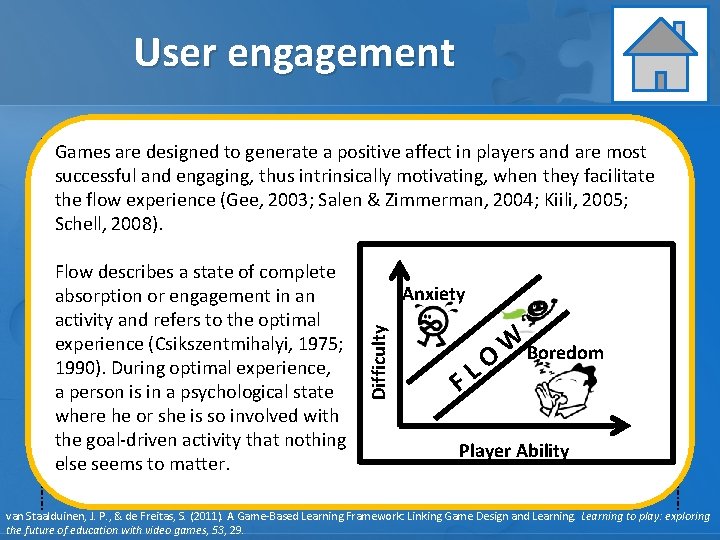
User engagement Learning Assessment Instruction Games are designed to generate a positive affect in players and are most successful and engaging, thus intrinsically motivating, when they facilitate the flow experience (Gee, 2003; Salen & Zimmerman, 2004; Kiili, 2005; Learning GAME ELEMENTS: objectives User learning Schell, 2008). Learner Specifics Context Difficulty Clear player Flow describes a state of complete goals Anxiety absorption or engagement in an Instructional User behavior engagement activity and refers to the optimal design experience (Csikszentmihalyi, 1975; W Boredom O 1990). During optimal experience, L Debriefing F a person is in a psychological state Player GAME ELEMENTS: where he or she is so involved with feedback Representation Pedagogy Learning System the goal-driven activity that nothing Player Ability content feedback else seems to matter. van Staalduinen, J. P. , & de Freitas, S. (2011). A Game-Based Learning Framework: Linking Game Design and Learning to play: exploring the future of education with video games, 53, 29.
Debriefing Learning Assessment Instruction To utilize opportunities for learning, an evaluative session (the debriefing) is held after the game. In the evaluation, the players and the Learning GAME ELEMENTS: User learning Learner Specifics Context facilitator/teacher talk about the experiences and outcomes of the game. objectives Clear player The individual player can be evaluated, the players can be evaluated as a goals Instructional User team, or they can be evaluated both as a team and as individual players. User behavior engagement design Debriefing Learning content GAME ELEMENTS: Representation Player feedback GAME ELEMENTS: Pedagogy System feedback van Staalduinen, J. P. , & de Freitas, S. (2011). A Game-Based Learning Framework: Linking Game Design and Learning to play: exploring the future of education with video games, 53, 29.
System feedback Learning Assessment Instruction The measurement of achievement, progress, and score of the player within a game. The game gives the learner feedback on the outcomes of his actions (Salen & Learning GAME ELEMENTS: objectives Zimmerman, 2004; Juul, 2005; Wilson et al. , 2009). User learning Learner Specifics Context Clear player goals The reflective observation of feedback leads to the construction of schemata and Instructional User behavior engagement enables the player to discover new and better solutions to his problems design Debriefing Learning content GAME ELEMENTS: Representation Player feedback GAME ELEMENTS: Pedagogy System feedback van Staalduinen, J. P. , & de Freitas, S. (2011). A Game-Based Learning Framework: Linking Game Design and Learning to play: exploring the future of education with video games, 53, 29.
- Slides: 14