
Game Theory in Business Collaboration Gabriel Tsang Supervisor
Game Theory in Business Collaboration Gabriel Tsang Supervisor: Jian Yang
Agenda � Initial Problem � Related Work � Approach � Outcome � Conclusion � Future Work 2
Agenda � Initial Problem � Related Work � Approach � Outcome � Conclusion � Future Work 3
Background 4
Initial Problem � business process involves multiple business partners � increasingly outsourcing key operations and interaction � often need to share resources to accomplish a common task � Negotiation of Access Control required � Use Game theory to model � obtain a better strategy 5
Agenda � Initial Problem � Related Work � Approach � Outcome � Conclusion � Future Work 6
Related Work � Business Collaboration ◦ Overview, Characteristics and Challenges � Game Theory ◦ Model Basic elements, Business Applications 7
Business Collaboration Overveiw � Before seeking partners to cooperate with an enterprise will first need to capture its private behavior in the internal business process aspect. � Based on its internal behavior the enterprise can then specify its capabilities in its externally visible behavior in the participant public behavior aspect. � Enterprise negotiates with other parties to establish cooperation. 8
Business Collaboration Characteristics � Long-time execution. � Heterogeneous and autonomous business process communication among multiple business participants. � cross-organisational asynchronous business interaction. � Complex business-oriented transactional semantics. � Cross-organisational policy coordination. 9
Business Collaboration Challenges � Trust � Technologies 10
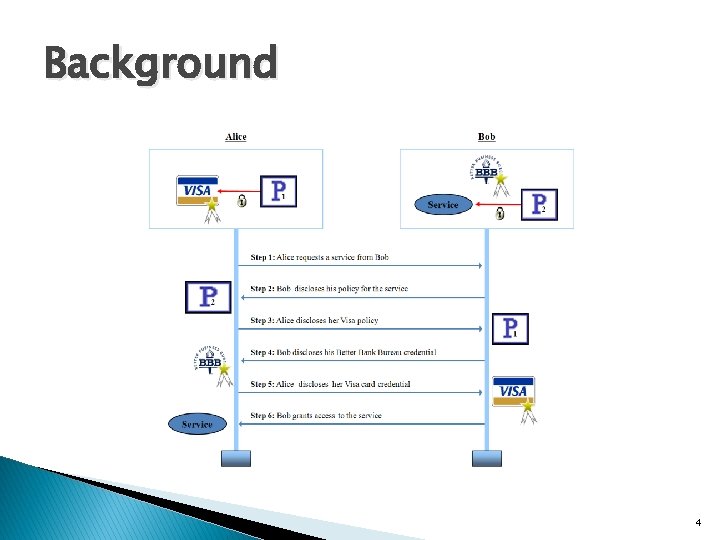
Access Control Policies � Credential disclosure is governed by an access control policy ◦ Specifies credentials that must be received from another party prior to disclosing the sensitive credential to that party 11
Game Theory elements – part 1 � Players: The decision makers in the game. � Actions: Choices available to a player. � Information: Knowledge that a player has when making a decision. � Strategies: Rules that tell a player which action to take at each point of the game. 12
Game Theory elements – part 2 � Outcomes: The results that unfold, such as a price war, world peace, etc. � Payoffs: The utilities (or happiness) that each player realizes for a particular outcome. � Equilibria: An equilibrium is a stable result. 13
Game Theory applications � Supply Chain Management � Wireless Network � Artificial Intelligent 14
Agenda � Initial Problem � Related Work � Approach � Outcome � Conclusion � Future Work 15
Approach � � ◦ � Define Assumptions Analyse Game Model Using the Framework Analyse other Game types characteristics Analyse Critical Factors (business collaboration challenge situation) Map with the Game Model 16
Assumptions � Each decision maker ("PLAYER“) has available to him two or more well-specified choices or sequences of choices. � Every possible combination of plays available to the players leads to a well-defined end-state that terminates the game. � A specified payoff for each player is associated with each end-state. � Each decision maker does not have perfect knowledge of the game and of his opposition; that is, he does not know in full detail the rules of the game as well as the payoffs of all other players. � All decision makers are rational; that is, each player, given two alternatives, will select the one that yields him the greater payoff. 17
Framework 1. Define the problem. 2. Identify the critical factors. 3. Build a model, such as a bimatrix game or an extensive form game. 4. Develop intuition by using the model. 5. Formulate a strategy - cover all possible scenarios. Examples of critical factors include differentiated products, firstmover advantage, entry and exit costs, variable costs, etc. 18
Models � Bi-matrix � Extensive Form � Normal-Form (Strategic Form) 19
Critical Factors – part 1 � Players: How many players will be in this negotiation policy game? � Strategy: In a game each player chooses from a set of possible actions, known as strategies. In this situation would be accepting the policy or denying the policy. 20
Critical Factors – part 2 � Sequential: One player performs her/his actions after another is a sequential game. � Perfect Information: If it is a sequential game and every player knows the strategies chosen by the players who preceded them. � Zero Sum: One gain is the loss of the others. 21
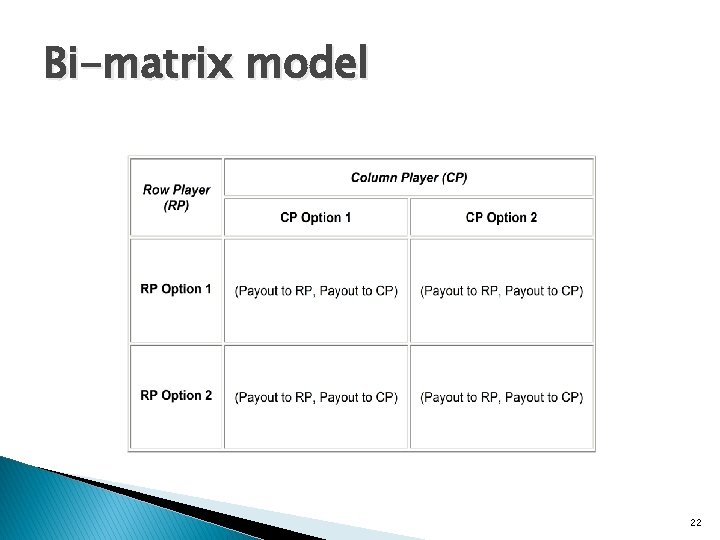
Bi-matrix model 22
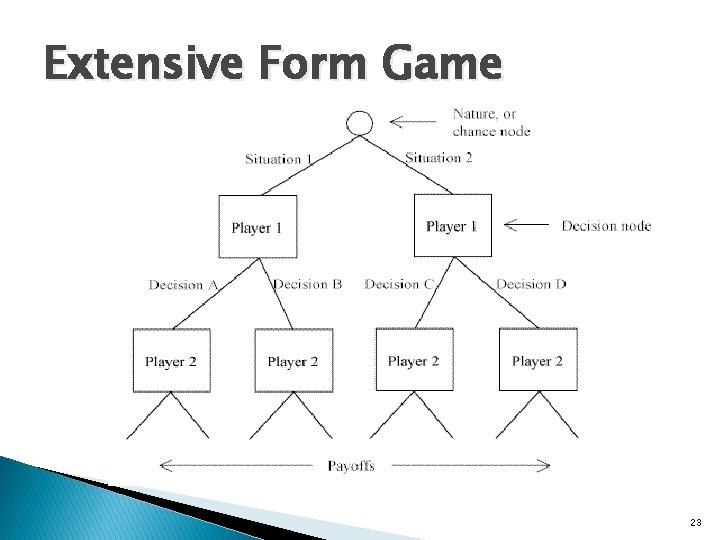
Extensive Form Game 23
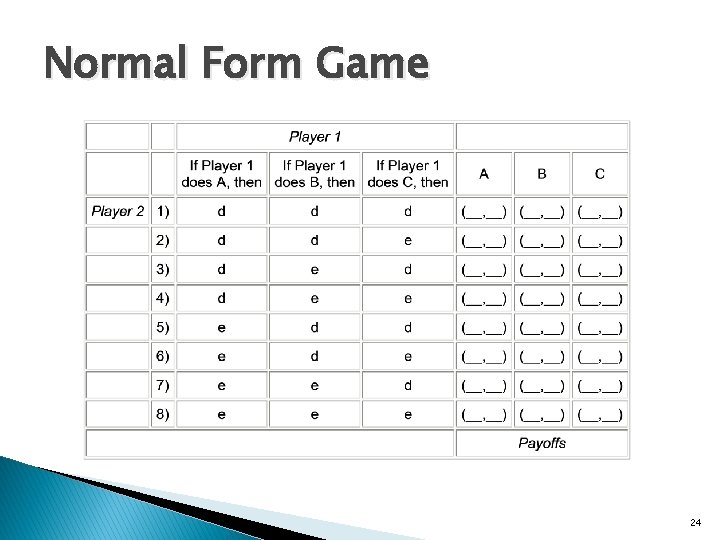
Normal Form Game 24
Agenda � Initial Problem � Related Work � Approach � Outcome � Conclusion � Future Work 25
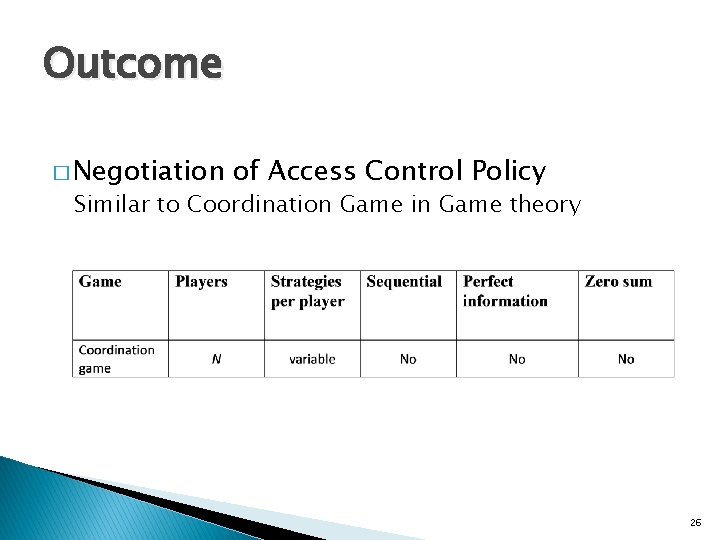
Outcome � Negotiation of Access Control Policy Similar to Coordination Game in Game theory 26
Critical Factors � 2 person game ◦ have many requester to play this negotiation game at the same time. � Incomplete information. ◦ do not have full knowledge about the game � non-cooperative ◦ all requests are sent as individual � sequential game ◦ Negotiation again in the future. � Non-zero Sum 27
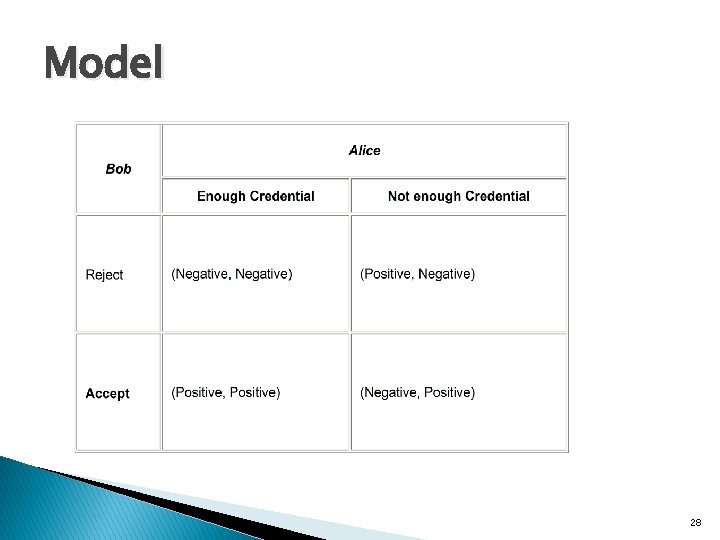
Model 28
Agenda � Initial Problem � Related Work � Approach � Outcome � Conclusion � Future Work 29
Conclusion � Introduced the problem � Overview of business collaboration and game theory � Using game theory framework to model the situation � Successful modeled 30
Future Work � Testing ◦ Right game? Right attributes? � Formula � Strategy � Reuse the framework 31
Thank You � Question ? 32
- Slides: 32