
GAME THEORY Day 9 NON ZERO SUM GAMES
- Slides: 8
GAME THEORY Day 9
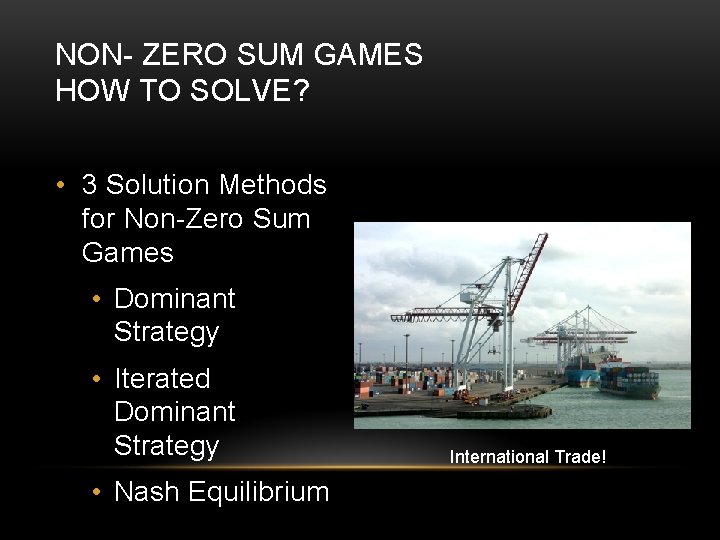
NON- ZERO SUM GAMES HOW TO SOLVE? • 3 Solution Methods for Non-Zero Sum Games • Dominant Strategy • Iterated Dominant Strategy • Nash Equilibrium International Trade!
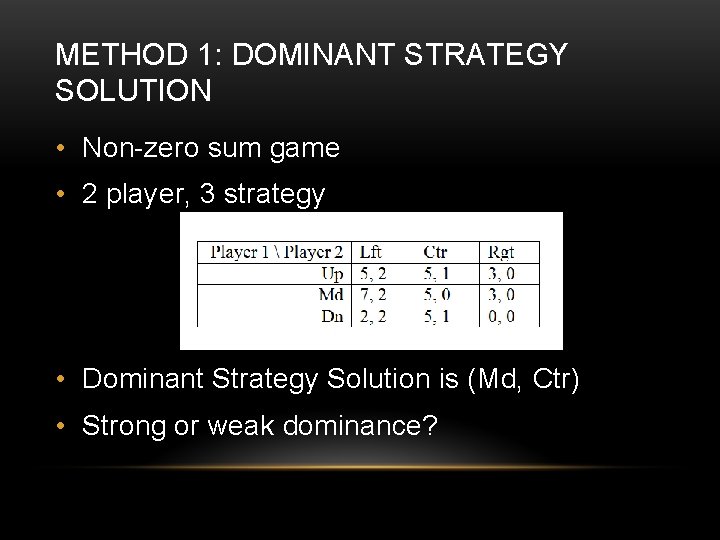
METHOD 1: DOMINANT STRATEGY SOLUTION • Non-zero sum game • 2 player, 3 strategy • Dominant Strategy Solution is (Md, Ctr) • Strong or weak dominance?
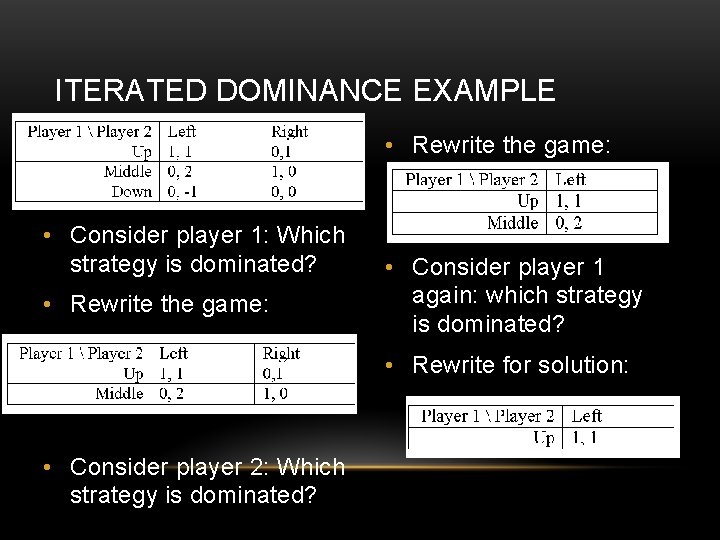
METHOD 2: ITERATED DOMINANCE • Recall the homework problem for zero-sum game where we found dominance over and over again. • We can do the same with a non-zero sum game. • To keep vocab straight: • Dominated strategy -- Bad • Undominated strategy -- Good • Dominant strategy -- Best
ITERATED DOMINANCE EXAMPLE • Rewrite the game: • Consider player 1: Which strategy is dominated? • Rewrite the game: • Consider player 1 again: which strategy is dominated? • Rewrite for solution: • Consider player 2: Which strategy is dominated?
METHOD 3: NASH EQUILIBRIUM Nash Equilibrium is a term used in game theory to describe an equilibrium where each player's strategy is optimal given the strategies of all other players. A Nash Equilibrium exists when there is no unilateral profitable deviation from any of the players involved. In other words, no player in the game would take a different action as long as every other player remains the same. Nash Equilibria are self-enforcing; when players are at a Nash Equilibrium they have no desire to move because they will be worse off.
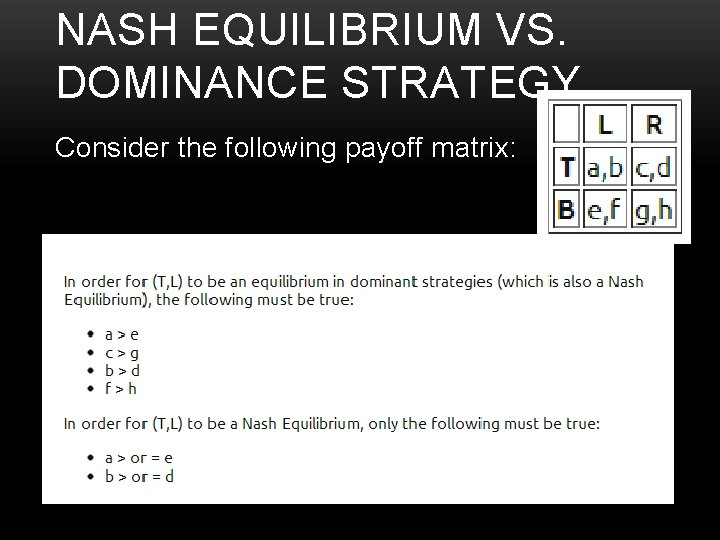
NASH EQUILIBRIUM VS. DOMINANCE STRATEGY Consider the following payoff matrix:
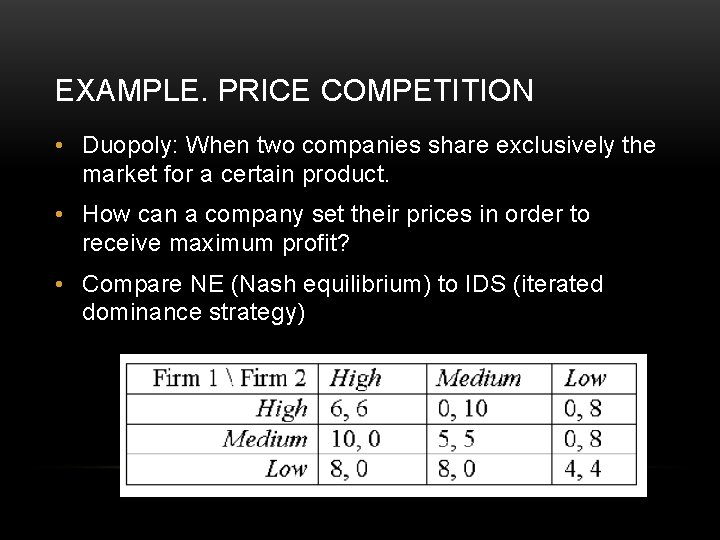
EXAMPLE. PRICE COMPETITION • Duopoly: When two companies share exclusively the market for a certain product. • How can a company set their prices in order to receive maximum profit? • Compare NE (Nash equilibrium) to IDS (iterated dominance strategy)