
Game Theory By Zach Sanoian History Behind Game
Game Theory By Zach Sanoian
History Behind Game Theory Game theory was originally developed by mathematician Jon von Neumann and economist Oskar Morgenstern in 1944. The purpose behind game theory was to solve problems in the world of economics. The two observed that “economics is like a game, wherein players anticipate each other’s moves”. The theory can be applied to a wide variety of situations. Such applications include finding the optimal price to sell a product and who to select for a jury.
What is Game Theory? Game theory is a branch of applied mathematics that provides tools for analyzing situations in which parties make decisions that are interdependent. Each party, referred to as a player, must consider the other player’s possible decisions or strategies while formulating his own strategy. A solution to a game describes the optimal decisions of the players, who may have similar, opposed, or mixed interests, and the outcomes that result from these different decisions.
Important Definitions ● Game- a set of circumstances that has a result dependent on the actions of two or more players ● Players- a strategic decision-maker within the context of the game ● Strategy- a complete plan of action that a player will take given the set of circumstances that may arise within the game ● Payoff- the payout a player receives for arriving at a particular outcome ● Information set- information available at a given point in the game ● Equilibrium- the point in the game where both players have made their decisions and an outcome is reached
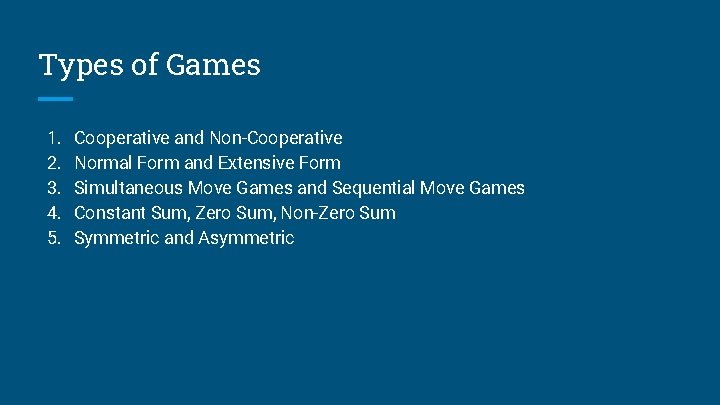
Types of Games 1. 2. 3. 4. 5. Cooperative and Non-Cooperative Normal Form and Extensive Form Simultaneous Move Games and Sequential Move Games Constant Sum, Zero Sum, Non-Zero Sum Symmetric and Asymmetric

The Prisoner’s Dilemma is one of the most well-known concepts of game theory. Ex) Two criminals are arrested for a crime and are interrogated separately. There is not enough evidence to convict the two criminals. The two criminals are unable to communicate with each other and are both presented with four different outcomes.
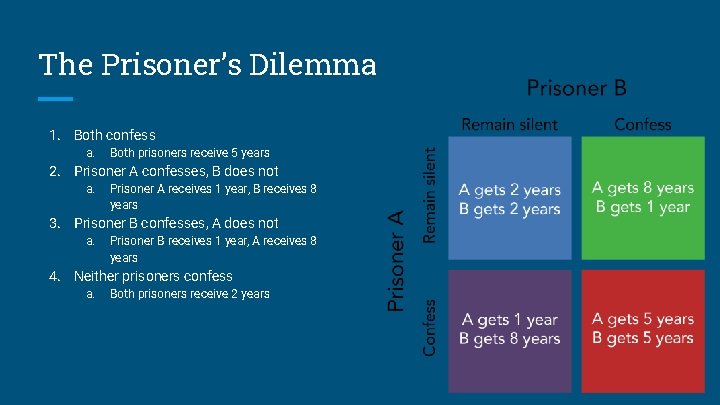
The Prisoner’s Dilemma 1. Both confess a. Both prisoners receive 5 years 2. Prisoner A confesses, B does not a. Prisoner A receives 1 year, B receives 8 years 3. Prisoner B confesses, A does not a. Prisoner B receives 1 year, A receives 8 years 4. Neither prisoners confess a. Both prisoners receive 2 years
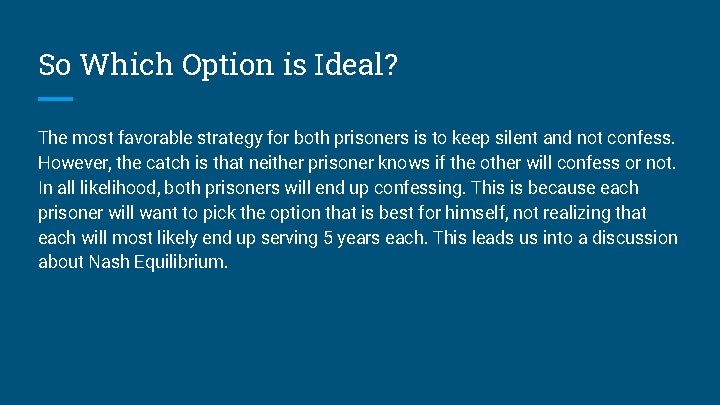
So Which Option is Ideal? The most favorable strategy for both prisoners is to keep silent and not confess. However, the catch is that neither prisoner knows if the other will confess or not. In all likelihood, both prisoners will end up confessing. This is because each prisoner will want to pick the option that is best for himself, not realizing that each will most likely end up serving 5 years each. This leads us into a discussion about Nash Equilibrium.
Nash Equilibrium Nash equilibrium is a concept of game theory developed by mathematician John Nash. The concept is used to determine mathematically and logically the actions that the player of a game should take to secure the best possible outcome for himself. The optimal outcome is one in which no player feels the need to deviate from his chosen strategy after considering his opponent’s strategies and choices.
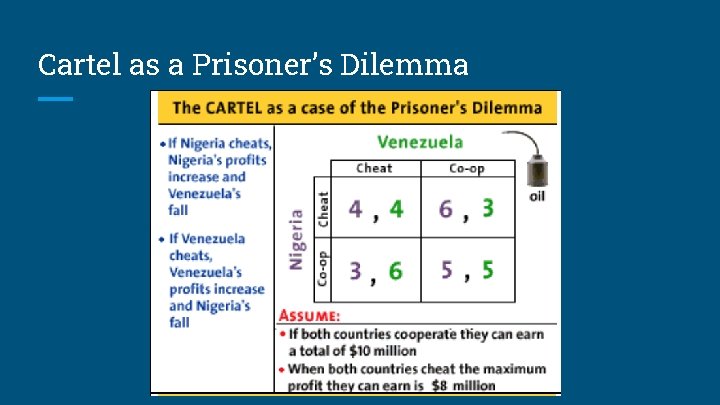
Cartel as a Prisoner’s Dilemma
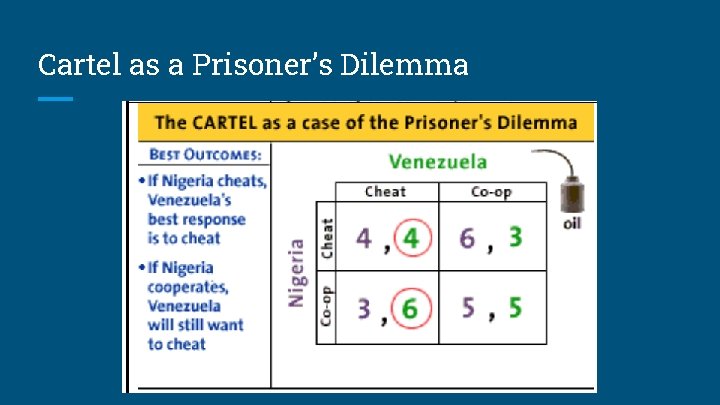
Cartel as a Prisoner’s Dilemma
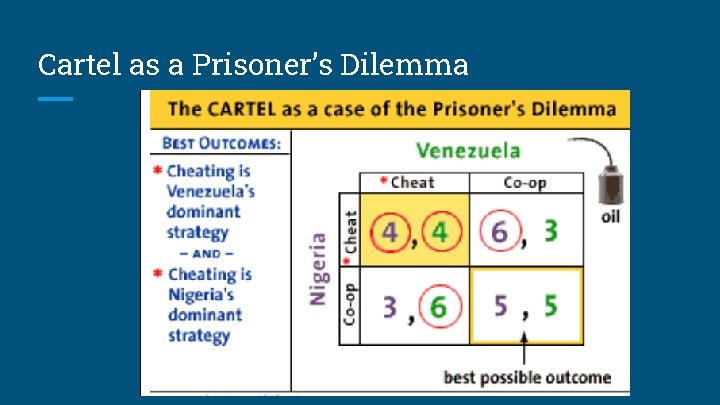
Cartel as a Prisoner’s Dilemma
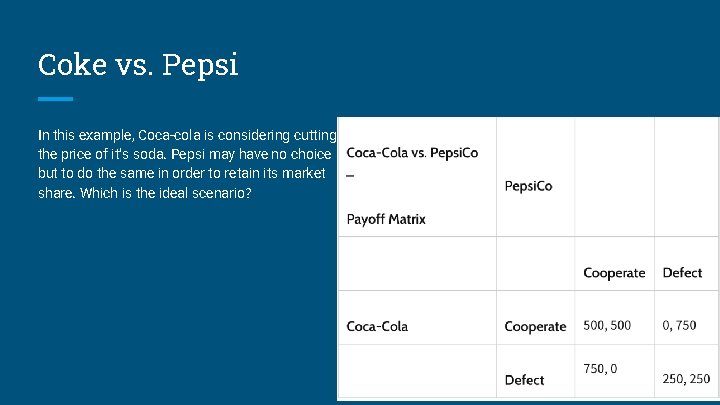
Coke vs. Pepsi In this example, Coca-cola is considering cutting the price of it’s soda. Pepsi may have no choice but to do the same in order to retain its market share. Which is the ideal scenario?
Resources Davis, Morton D. , and Steven J. Brams. “Game Theory. ” Encyclopædia Britannica, Inc. , 10 Jan. 2020, www. britannica. com/science/game-theory. Hayes, Adam. “How Game Theory Works. ” Investopedia, 5 Feb. 2020, www. investopedia. com/terms/g/gametheory. asp. Picardo, Elvis. “The Prisoner's Dilemma in Business and the Economy. ” Investopedia, 4 May 2020, www. investopedia. com/articles/investing/110513/utilizing-prisoners-dilemma-business-and-economy. asp. Tomlinson, Steven. “Understanding a Cartel as A Prisoner's Dilemma. ” Economics with Steven Tomlinson, college. cengage. com/economics/0538797274_mceachern/student/lecture/8432. pdf.
- Slides: 14