
Game Theory Basics 1 Strategic games A strategic
Game Theory Basics 1
Strategic games A strategic game is a model of interacting decisionmakers. A strategic game consists of 2 A set of players For each player, a set of actions. For each player, preferences over the set of action profiles. (payoff function)
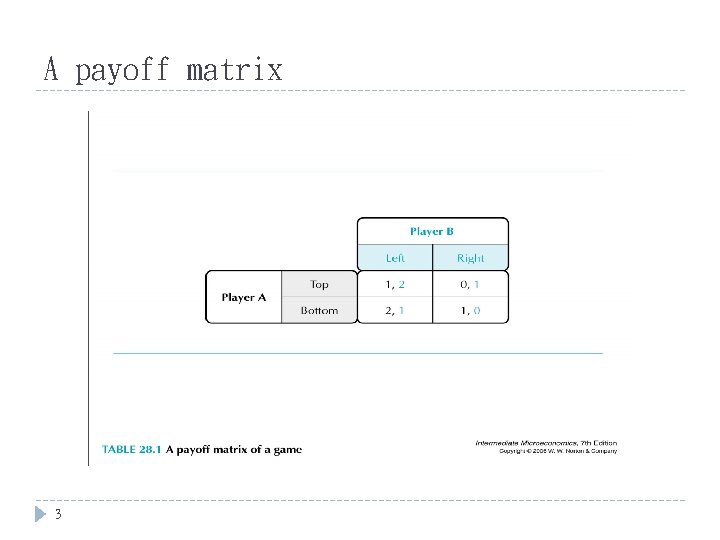
A payoff matrix 3
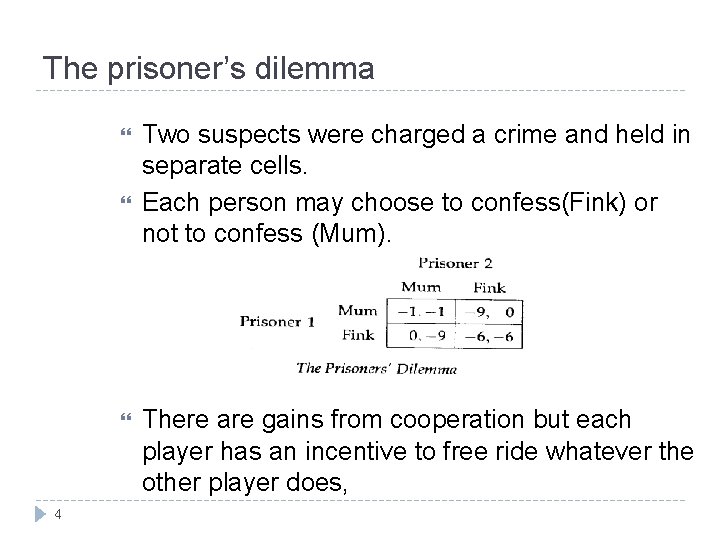
The prisoner’s dilemma 4 Two suspects were charged a crime and held in separate cells. Each person may choose to confess(Fink) or not to confess (Mum). There are gains from cooperation but each player has an incentive to free ride whatever the other player does,

Working on a project 5 Two persons are working on a joint project. Each one can either work hard or goof off.
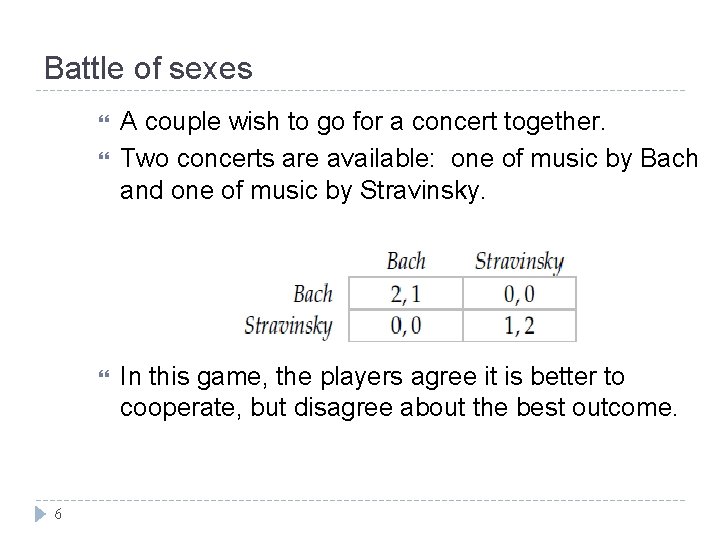
Battle of sexes 6 A couple wish to go for a concert together. Two concerts are available: one of music by Bach and one of music by Stravinsky. In this game, the players agree it is better to cooperate, but disagree about the best outcome.
Example: Merging firms 7 Two merging firms are currently using different computer systems. Both will be better off if they use the same system while each firm prefers that the common system be the one it used in the past.
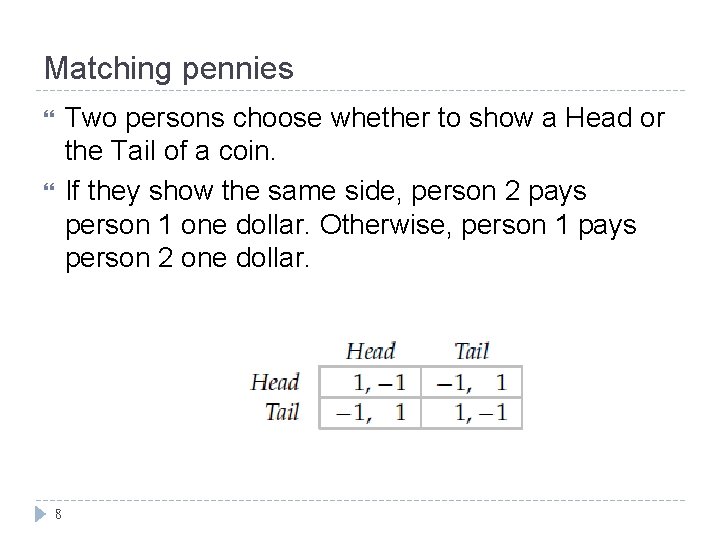
Matching pennies Two persons choose whether to show a Head or the Tail of a coin. If they show the same side, person 2 pays person 1 one dollar. Otherwise, person 1 pays person 2 one dollar. 8
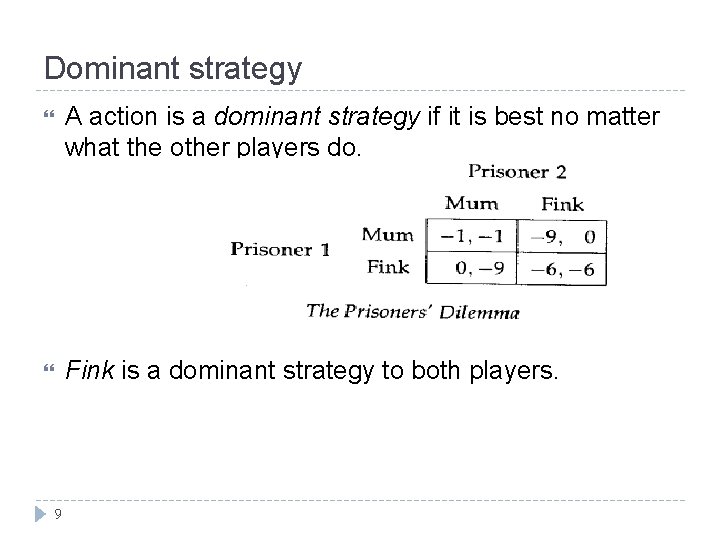
Dominant strategy A action is a dominant strategy if it is best no matter what the other players do. Fink is a dominant strategy to both players. 9
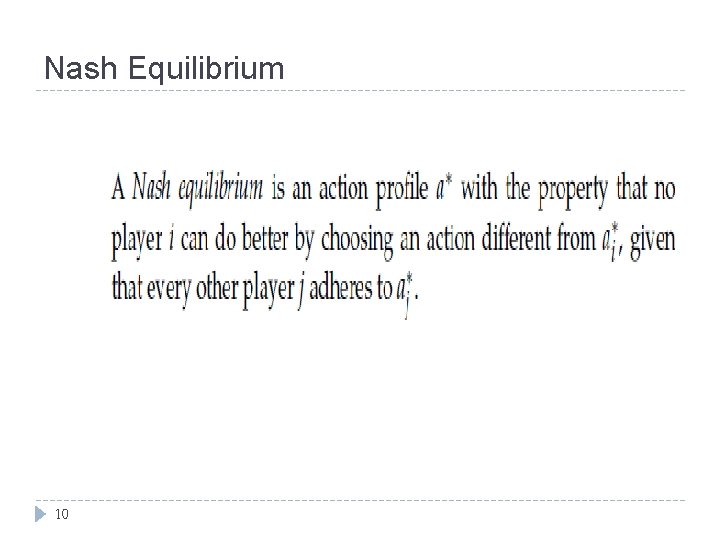
Nash Equilibrium 10
Nash Equilibrium In any Nash equilibrium (NE) each player chooses a “best” response to the choices made by all of the other players. A game may have more than one NE. How can we locate every one of a game’s Nash equilibria? If there is more than one NE, can we argue that one is more likely to occur than another? 11
Games of Coordination Games of coordination are the games where the payoffs to players are highest when they can coordinate their strategies. E. g. , Prisoners Dilemma, Battle of sexes 12
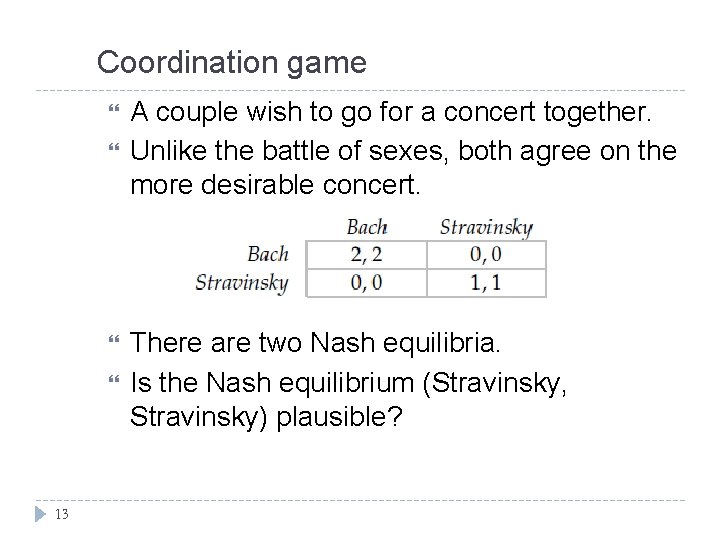
Coordination game 13 A couple wish to go for a concert together. Unlike the battle of sexes, both agree on the more desirable concert. There are two Nash equilibria. Is the Nash equilibrium (Stravinsky, Stravinsky) plausible?
Finding Nash equilibrium In Prisoner’s dilemma, we find that (Fink, Fink) is the unique Nash Equilibrium. In the battle of sexes, there exist two Nash equilibria. 14 Two social norms are all stable. In matching pennies, there exists no Nash equilibrium.
The problems about the Nash Equilibrium Notion A game may have more than one Nash equilibrium. There are games that have no Nash equilibrium does not necessarily lead to Pareto efficient outcome. 15
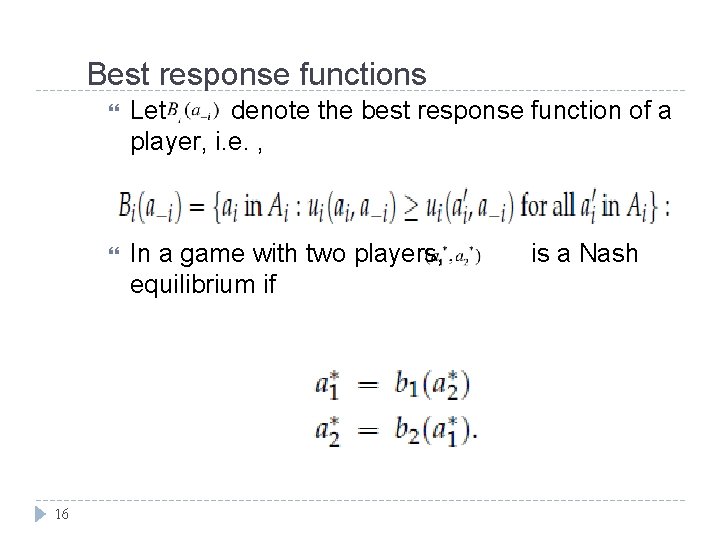
Best response functions 16 Let denote the best response function of a player, i. e. , In a game with two players, equilibrium if is a Nash
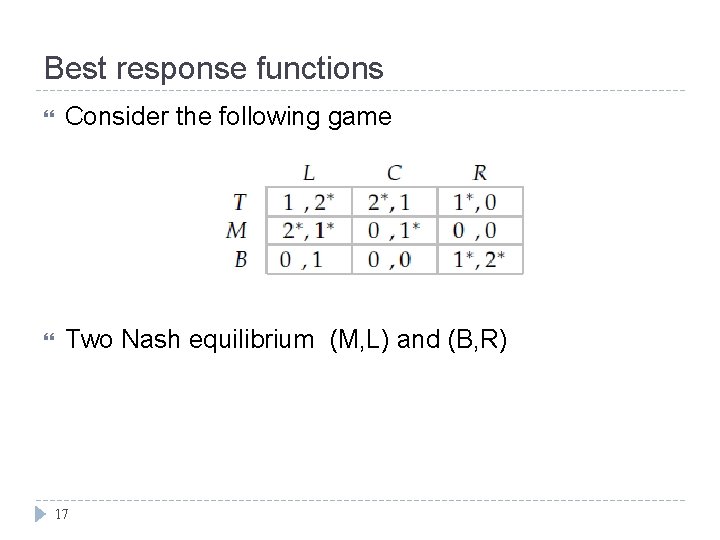
Best response functions Consider the following game Two Nash equilibrium (M, L) and (B, R) 17
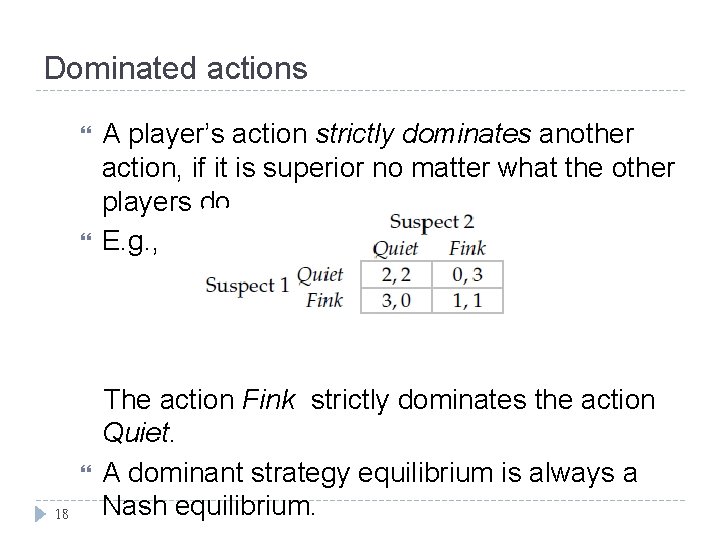
Dominated actions 18 A player’s action strictly dominates another action, if it is superior no matter what the other players do. E. g. , The action Fink strictly dominates the action Quiet. A dominant strategy equilibrium is always a Nash equilibrium.
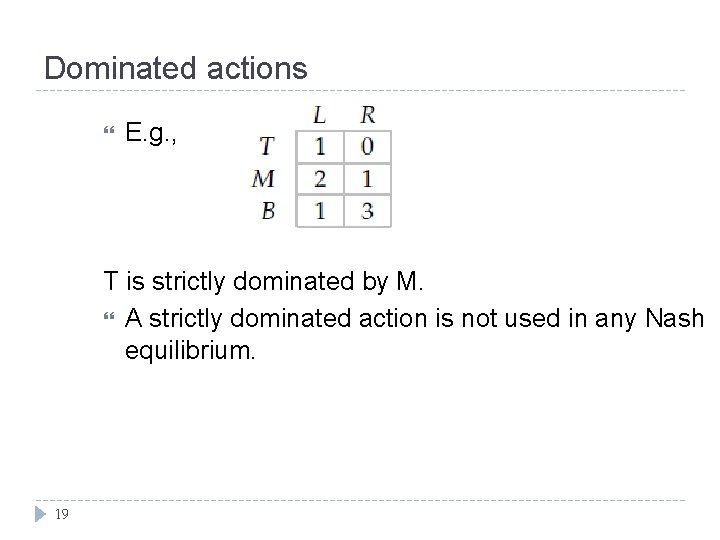
Dominated actions E. g. , T is strictly dominated by M. A strictly dominated action is not used in any Nash equilibrium. 19
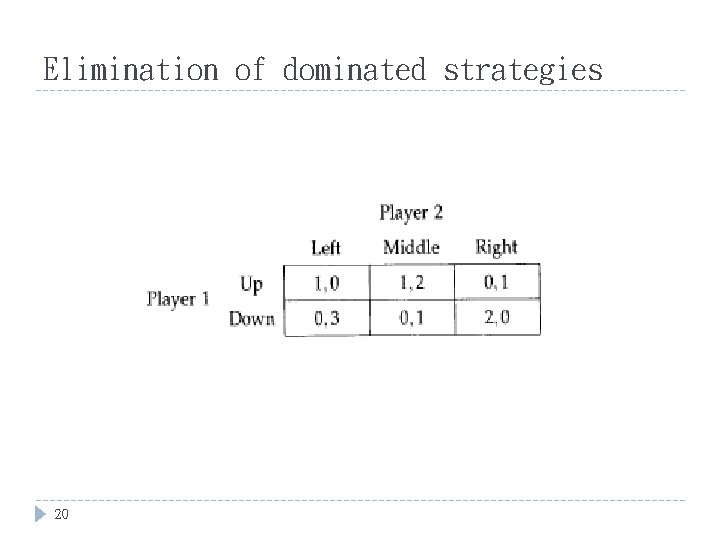
Elimination of dominated strategies 20
Games in extensive form The extensive-form representation of a game specifies 21 The players in the game. When each player has the move, what each player can do at each move, what each player knows at each move. The payoff received by each player for each combination of moves that could be chosen.
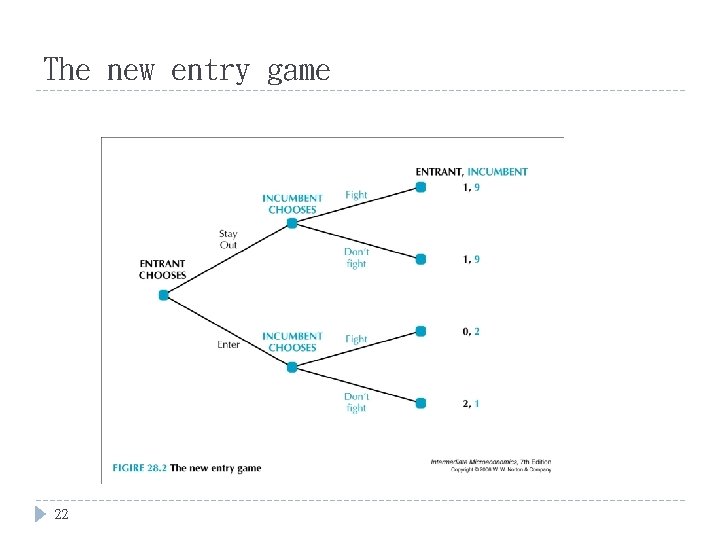
The new entry game 22
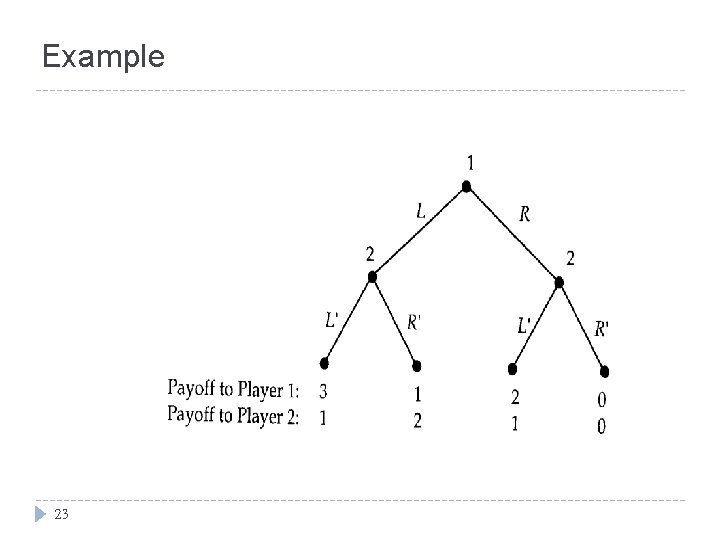
Example 23
Games with complete and perfect information Games with complete information: The players’ payoff functions are common knowledge. Games with perfect information: At each move in the game, the players with the move knows the full history of the game thus far. 24
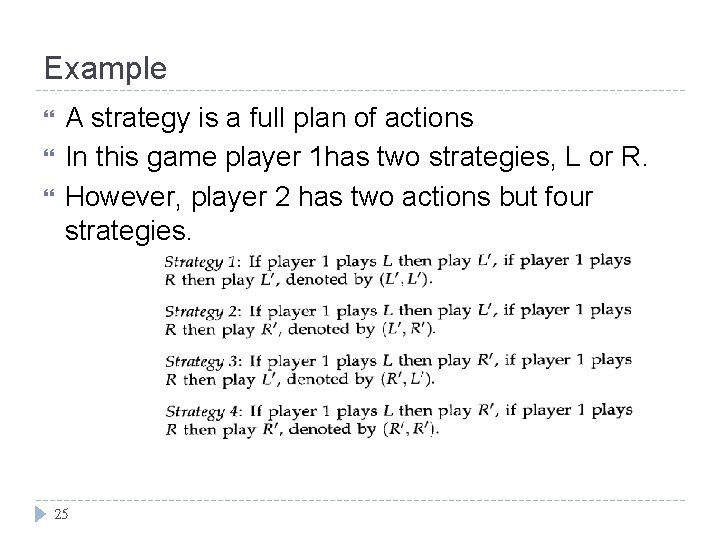
Example A strategy is a full plan of actions In this game player 1 has two strategies, L or R. However, player 2 has two actions but four strategies. 25
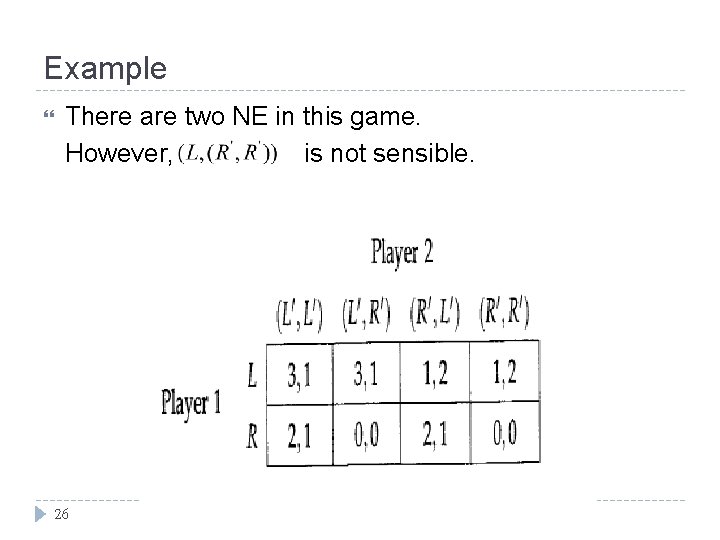
Example There are two NE in this game. However, is not sensible. 26
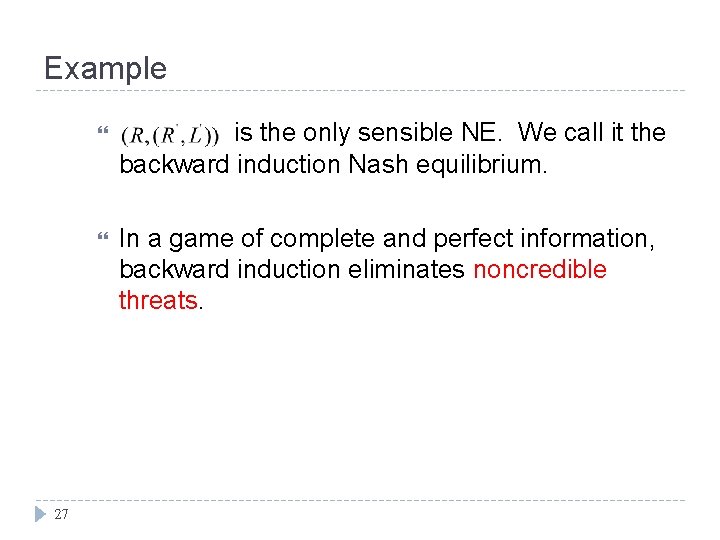
Example 27 is the only sensible NE. We call it the backward induction Nash equilibrium. In a game of complete and perfect information, backward induction eliminates noncredible threats.
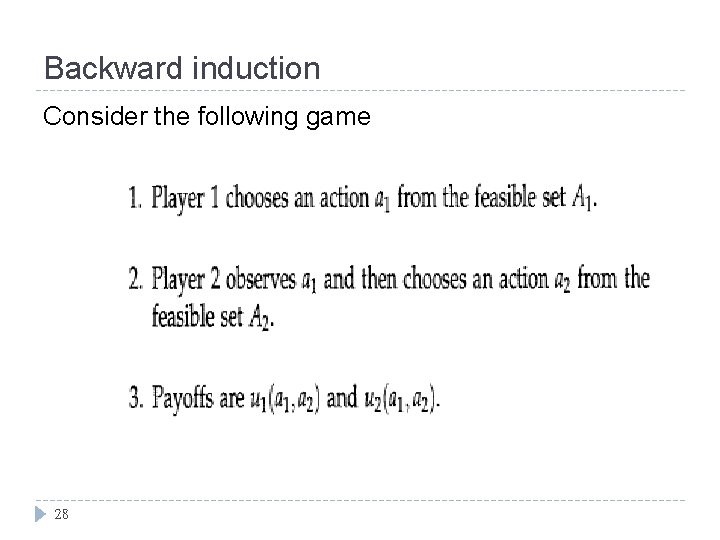
Backward induction Consider the following game 28
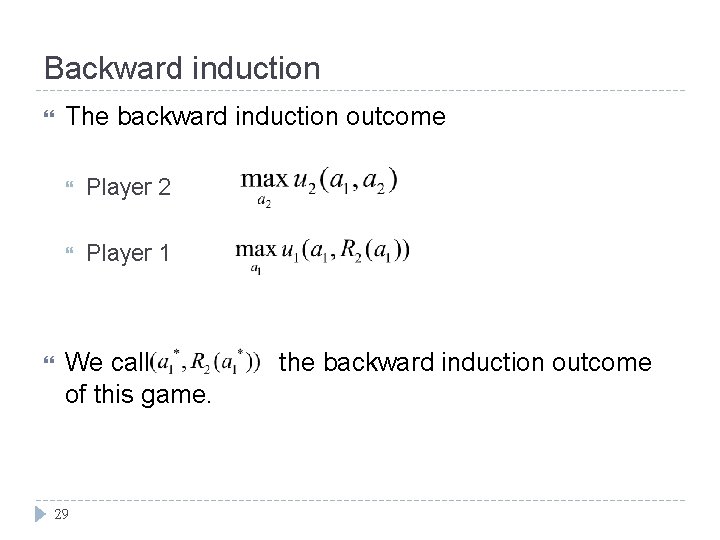
Backward induction The backward induction outcome Player 2 Player 1 We call of this game. 29 the backward induction outcome
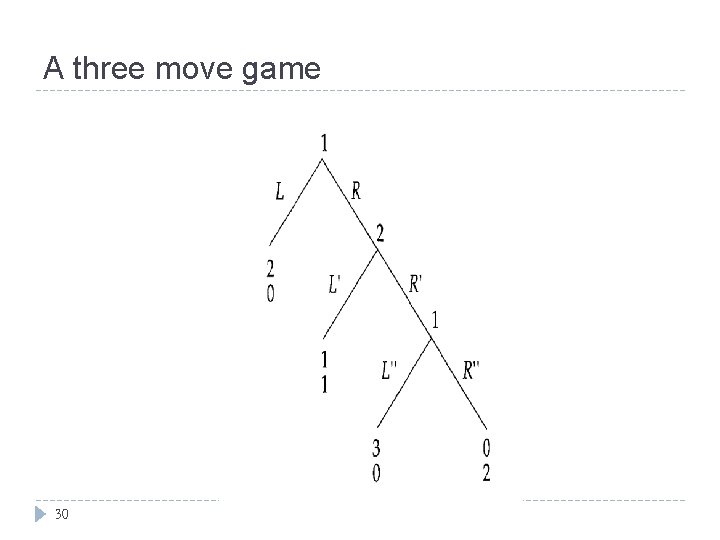
A three move game 30
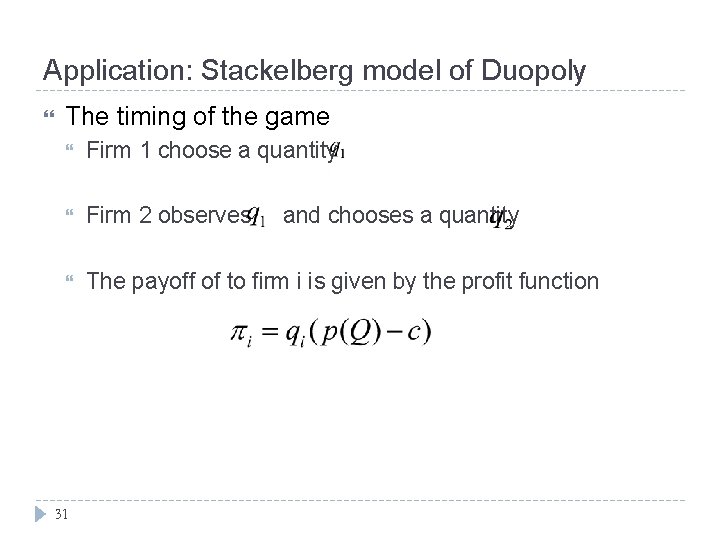
Application: Stackelberg model of Duopoly The timing of the game Firm 1 choose a quantity Firm 2 observes The payoff of to firm i is given by the profit function 31 and chooses a quantity
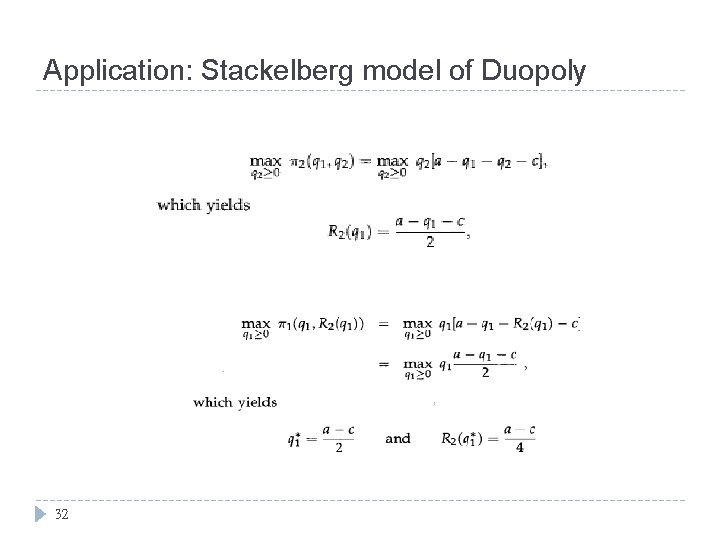
Application: Stackelberg model of Duopoly 32
Application: Stackelberg model of Duopoly Market clearing price is lower in the Stackelberg game. Firm 1’s profit must exceed its profit in the Cournot game. 33
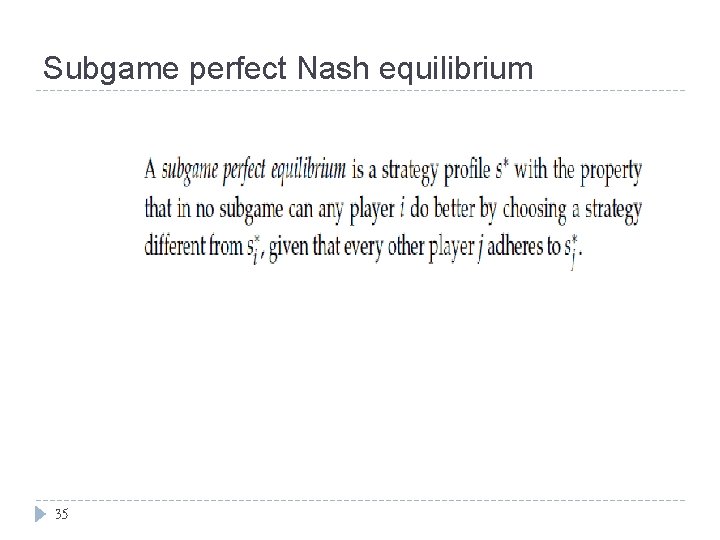
Subgame perfect equilibrium The notation of NE ignores the sequential structure of an extensive game. A new equilibrium notation is necessary to ensure that each player’s strategy is optimal, given the other players’ strategies, not only at the beginning of the game, but also after every possible history. 34
Subgame perfect Nash equilibrium 35
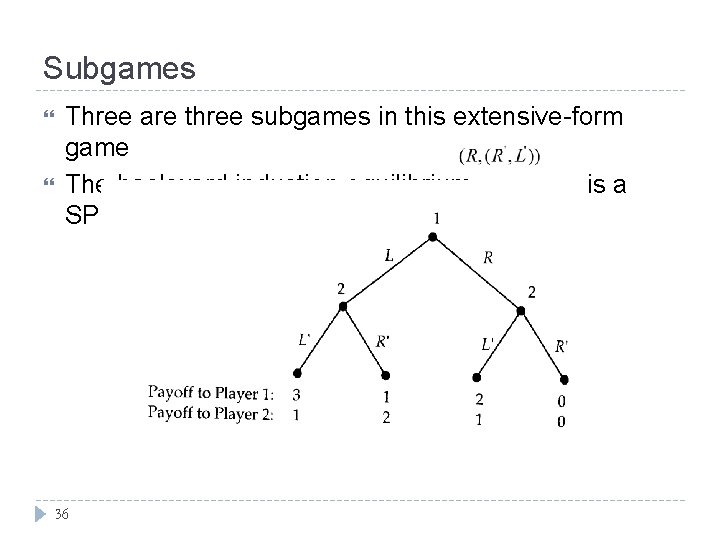
Subgames Three are three subgames in this extensive-form game The backward induction equilibrium is a SPNE. 36
- Slides: 36