
Game Theoretic and Machine Learning Techniques for Efficient
- Slides: 57
Game Theoretic and Machine Learning Techniques for Efficient Resource Allocation in Next Generation Wireless Networks Neetu Raveendran Advisor: Dr. Zhu Han Ph. D. Defense December 2019
Outline • • Introduction Next Generation Wireless Networks Motivations Contributions Resource Allocation Frameworks Conclusions Future Research Directions 2
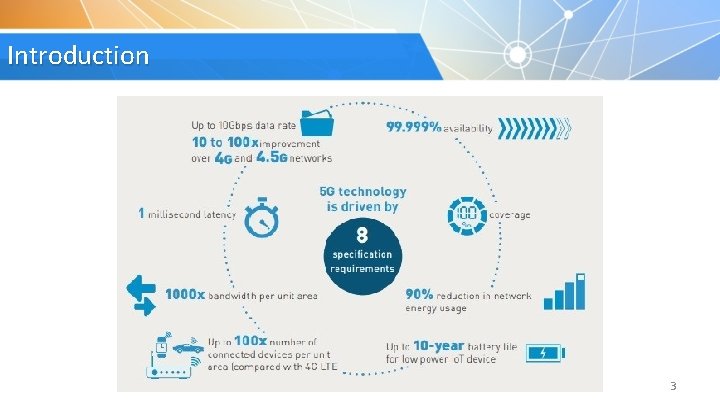
Introduction • Massive growth in number of Machine-to-Machine (M 2 M) connections due to Internet of Things (Io. T) ecosystem 3
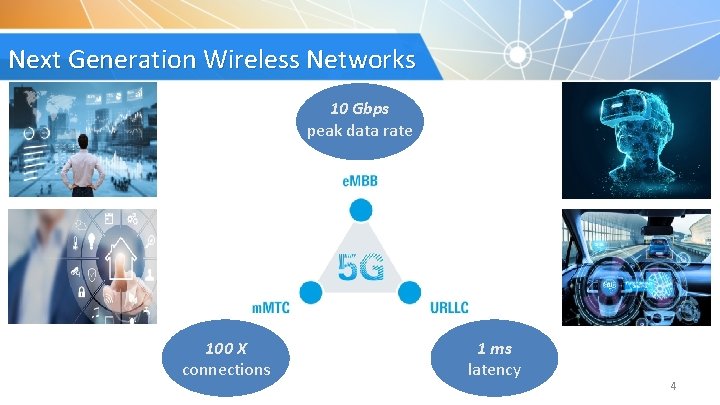
Next Generation Wireless Networks 10 Gbps peak data rate 100 X connections 1 ms latency 4
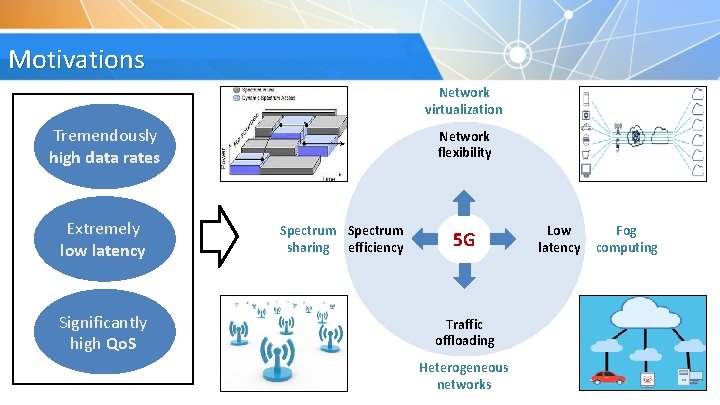
Motivations Network virtualization Tremendously high data rates Extremely low latency Significantly high Qo. S Network flexibility Spectrum sharing efficiency 5 G Low latency Fog computing Traffic offloading Heterogeneous networks 5
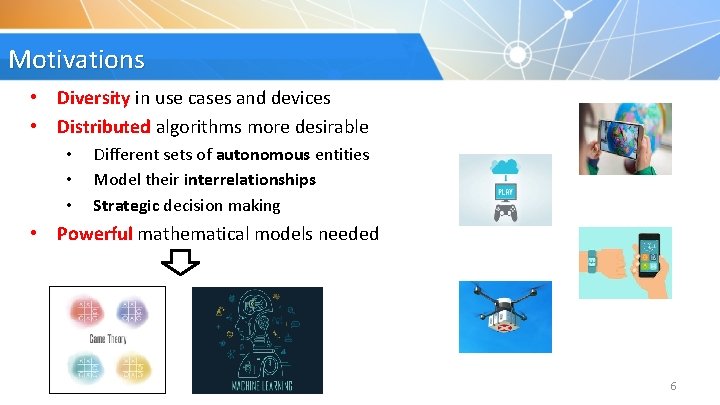
Motivations • Diversity in use cases and devices • Distributed algorithms more desirable • • • Different sets of autonomous entities Model their interrelationships Strategic decision making • Powerful mathematical models needed 6
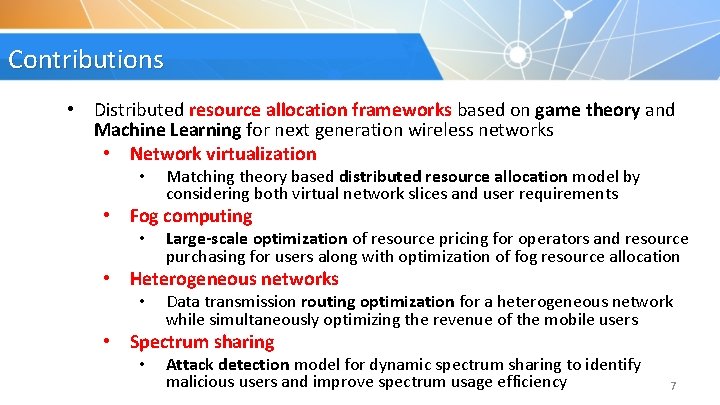
Contributions • Distributed resource allocation frameworks based on game theory and Machine Learning for next generation wireless networks • Network virtualization • Matching theory based distributed resource allocation model by considering both virtual network slices and user requirements • Fog computing • Large-scale optimization of resource pricing for operators and resource purchasing for users along with optimization of fog resource allocation • Heterogeneous networks • Data transmission routing optimization for a heterogeneous network while simultaneously optimizing the revenue of the mobile users • Spectrum sharing • Attack detection model for dynamic spectrum sharing to identify malicious users and improve spectrum usage efficiency 7
1. Network Virtualization 8
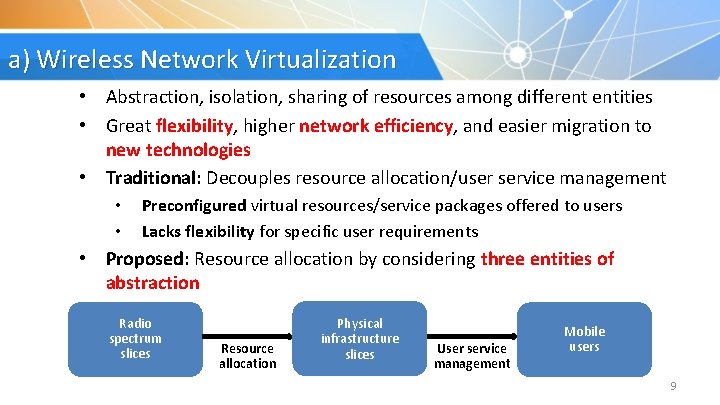
a) Wireless Network Virtualization • Abstraction, isolation, sharing of resources among different entities • Great flexibility, higher network efficiency, and easier migration to new technologies • Traditional: Decouples resource allocation/user service management • • Preconfigured virtual resources/service packages offered to users Lacks flexibility for specific user requirements • Proposed: Resource allocation by considering three entities of abstraction Radio spectrum slices Resource allocation Physical infrastructure slices User service management Mobile users 9
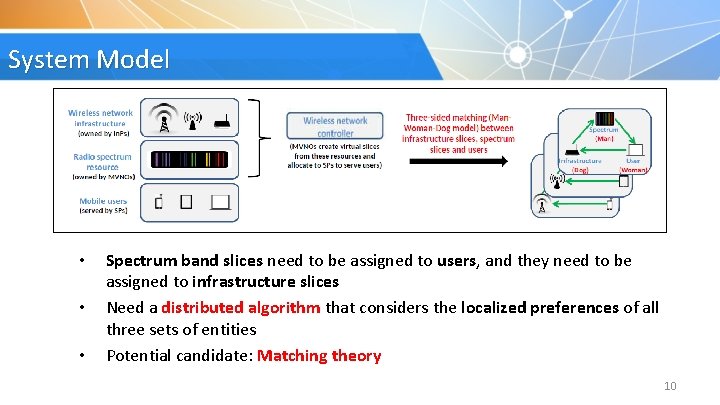
System Model • • • Spectrum band slices need to be assigned to users, and they need to be assigned to infrastructure slices Need a distributed algorithm that considers the localized preferences of all three sets of entities Potential candidate: Matching theory 10
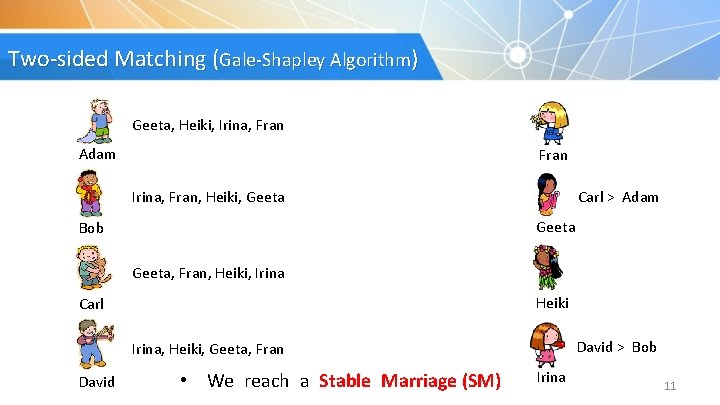
Two-sided Matching (Gale-Shapley Algorithm) Geeta, Heiki, Irina, Fran Adam Fran Irina, Fran, Heiki, Geeta Carl > Adam Geeta Bob Geeta, Fran, Heiki, Irina Heiki Carl David > Bob Irina, Heiki, Geeta, Fran David • We reach a Stable Marriage (SM) Irina 11
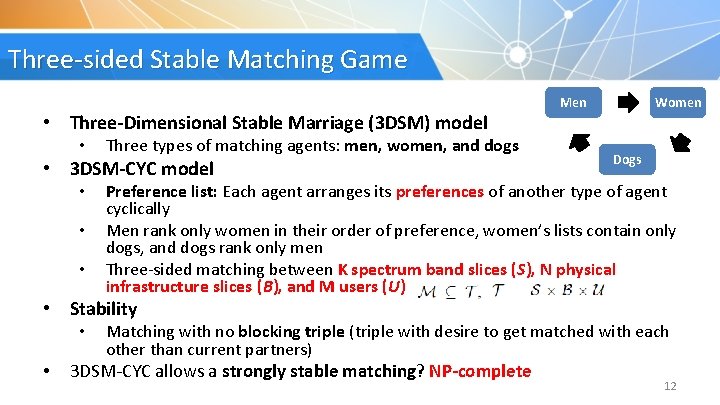
Three-sided Stable Matching Game • Three-Dimensional Stable Marriage (3 DSM) model • Three types of matching agents: men, women, and dogs • 3 DSM-CYC model • • • Women Men Dogs Preference list: Each agent arranges its preferences of another type of agent cyclically Men rank only women in their order of preference, women’s lists contain only dogs, and dogs rank only men Three-sided matching between K spectrum band slices (S), N physical infrastructure slices (B), and M users (U) • Stability • • Matching with no blocking triple (triple with desire to get matched with each other than current partners) 3 DSM-CYC allows a strongly stable matching? NP-complete 12
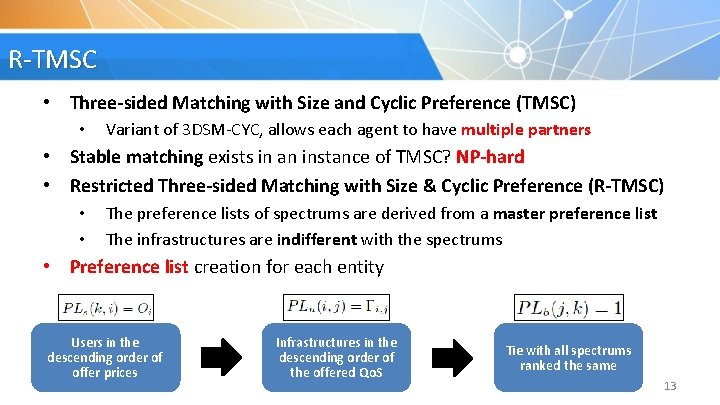
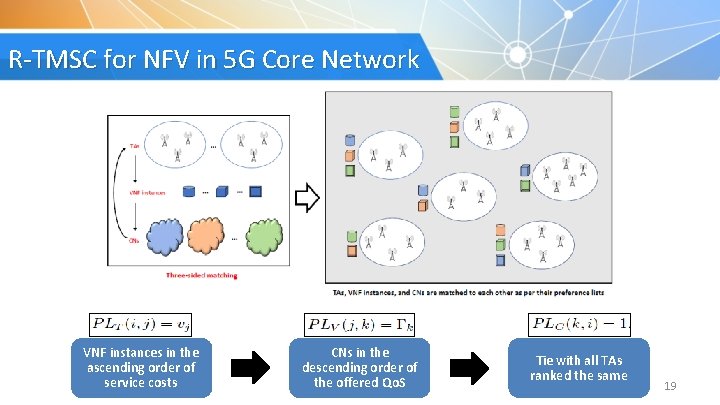
R-TMSC • Three-sided Matching with Size and Cyclic Preference (TMSC) • Variant of 3 DSM-CYC, allows each agent to have multiple partners • Stable matching exists in an instance of TMSC? NP-hard • Restricted Three-sided Matching with Size & Cyclic Preference (R-TMSC) • • The preference lists of spectrums are derived from a master preference list The infrastructures are indifferent with the spectrums • Preference list creation for each entity Users in the descending order of offer prices Infrastructures in the descending order of the offered Qo. S Tie with all spectrums ranked the same 13
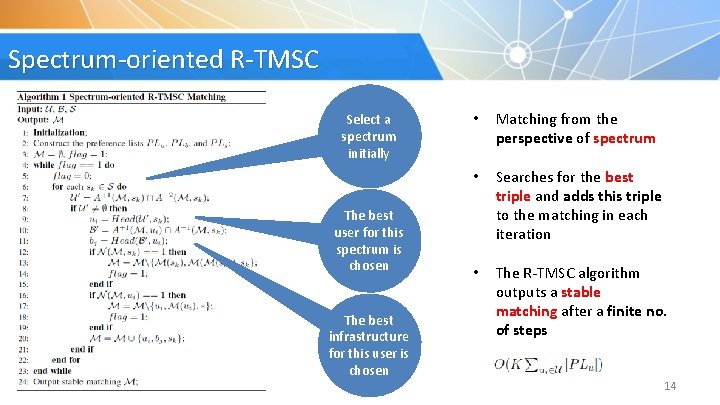
Spectrum-oriented R-TMSC Select a spectrum initially The best user for this spectrum is chosen The best infrastructure for this user is chosen • Matching from the perspective of spectrum • Searches for the best triple and adds this triple to the matching in each iteration • The R-TMSC algorithm outputs a stable matching after a finite no. of steps 14
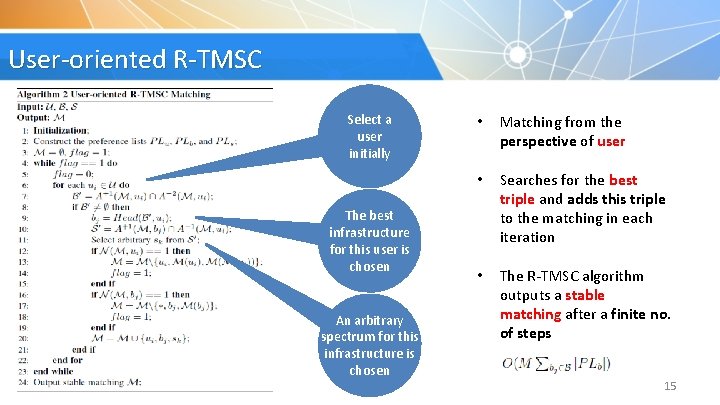
User-oriented R-TMSC Select a user initially The best infrastructure for this user is chosen An arbitrary spectrum for this infrastructure is chosen • Matching from the perspective of user • Searches for the best triple and adds this triple to the matching in each iteration • The R-TMSC algorithm outputs a stable matching after a finite no. of steps 15
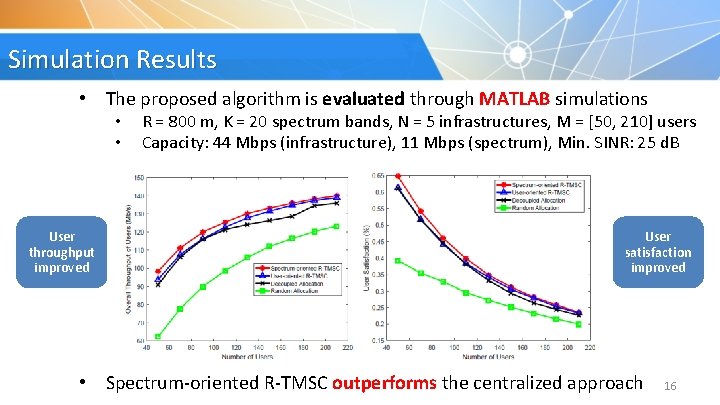
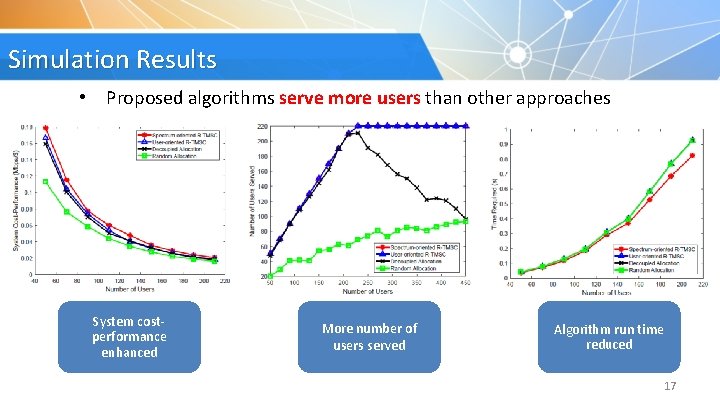
Simulation Results • The proposed algorithm is evaluated through MATLAB simulations • • User throughput improved R = 800 m, K = 20 spectrum bands, N = 5 infrastructures, M = [50, 210] users Capacity: 44 Mbps (infrastructure), 11 Mbps (spectrum), Min. SINR: 25 d. B User satisfaction improved • Spectrum-oriented R-TMSC outperforms the centralized approach 16
Simulation Results • Proposed algorithms serve more users than other approaches System costperformance enhanced More number of users served Algorithm run time reduced 17
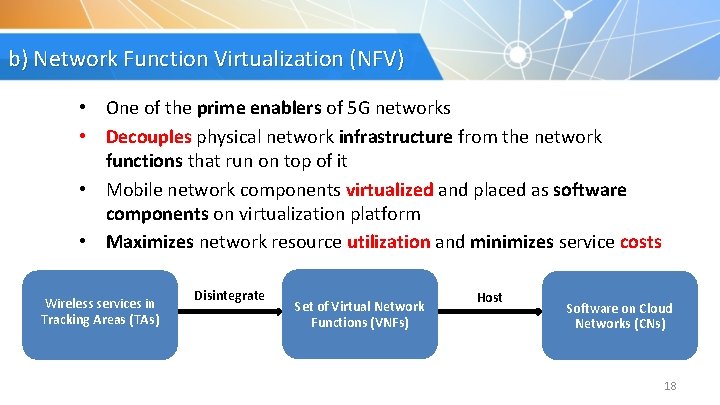
b) Network Function Virtualization (NFV) • One of the prime enablers of 5 G networks • Decouples physical network infrastructure from the network functions that run on top of it • Mobile network components virtualized and placed as software components on virtualization platform • Maximizes network resource utilization and minimizes service costs Wireless services in Tracking Areas (TAs) Disintegrate Set of Virtual Network Functions (VNFs) Host Software on Cloud Networks (CNs) 18
R-TMSC for NFV in 5 G Core Network VNF instances in the ascending order of service costs CNs in the descending order of the offered Qo. S Tie with all TAs ranked the same 19
2. Fog Computing 20
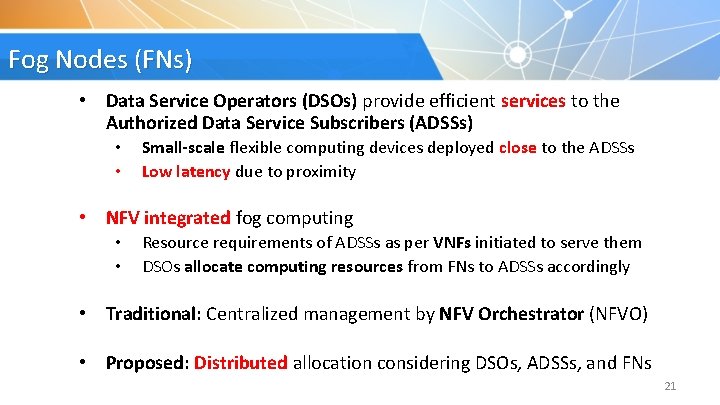
Fog Nodes (FNs) • Data Service Operators (DSOs) provide efficient services to the Authorized Data Service Subscribers (ADSSs) • • Small-scale flexible computing devices deployed close to the ADSSs Low latency due to proximity • NFV integrated fog computing • • Resource requirements of ADSSs as per VNFs initiated to serve them DSOs allocate computing resources from FNs to ADSSs accordingly • Traditional: Centralized management by NFV Orchestrator (NFVO) • Proposed: Distributed allocation considering DSOs, ADSSs, and FNs 21
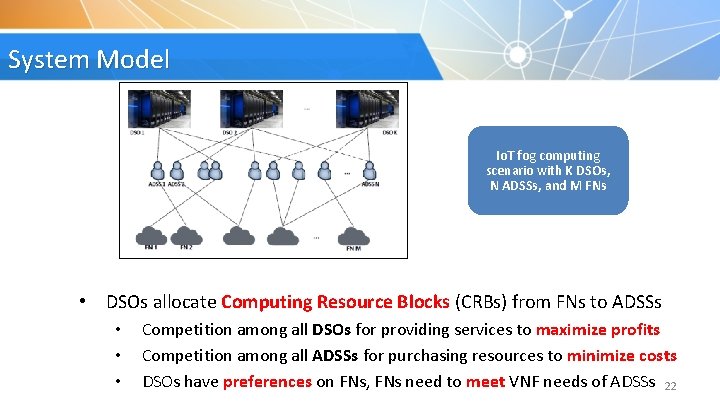
System Model Io. T fog computing scenario with K DSOs, N ADSSs, and M FNs • DSOs allocate Computing Resource Blocks (CRBs) from FNs to ADSSs • • • Competition among all DSOs for providing services to maximize profits Competition among all ADSSs for purchasing resources to minimize costs DSOs have preferences on FNs, FNs need to meet VNF needs of ADSSs 22
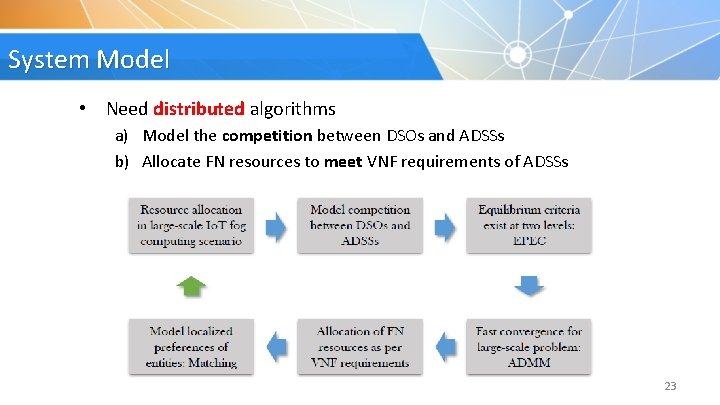
System Model • Need distributed algorithms a) Model the competition between DSOs and ADSSs b) Allocate FN resources to meet VNF requirements of ADSSs 23
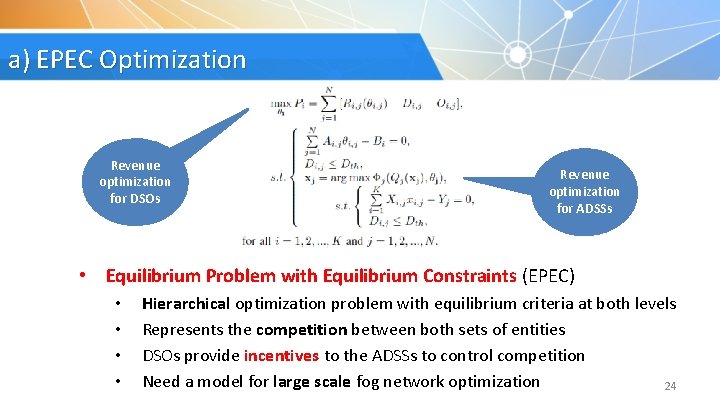
a) EPEC Optimization Revenue optimization for DSOs Revenue optimization for ADSSs • Equilibrium Problem with Equilibrium Constraints (EPEC) • • Hierarchical optimization problem with equilibrium criteria at both levels Represents the competition between both sets of entities DSOs provide incentives to the ADSSs to control competition Need a model for large scale fog network optimization 24
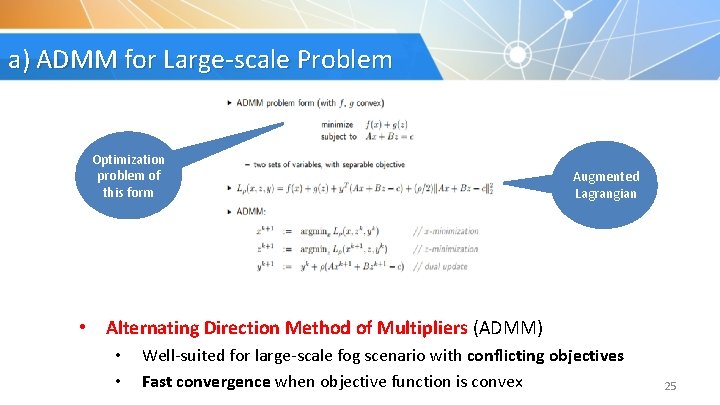
a) ADMM for Large-scale Problem Optimization problem of this form Augmented Lagrangian • Alternating Direction Method of Multipliers (ADMM) • • Well-suited for large-scale fog scenario with conflicting objectives Fast convergence when objective function is convex 25
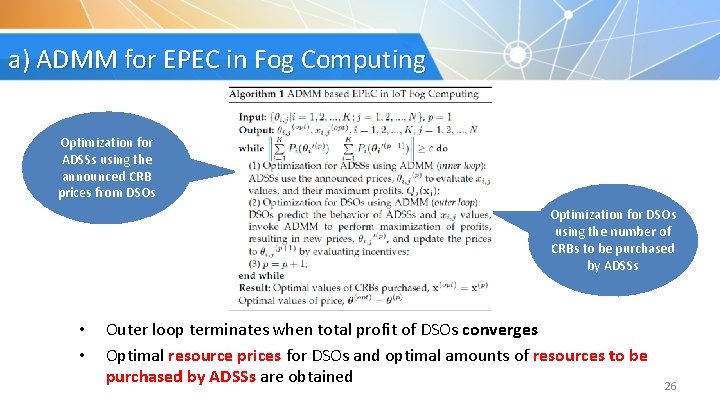
a) ADMM for EPEC in Fog Computing Optimization for ADSSs using the announced CRB prices from DSOs Optimization for DSOs using the number of CRBs to be purchased by ADSSs • • Outer loop terminates when total profit of DSOs converges Optimal resource prices for DSOs and optimal amounts of resources to be purchased by ADSSs are obtained 26
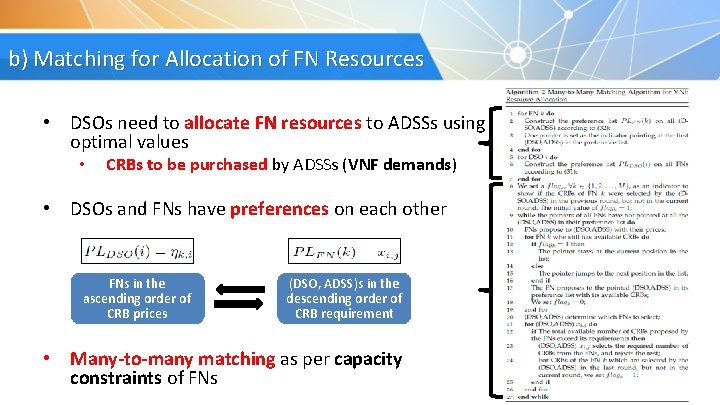
b) Matching for Allocation of FN Resources • DSOs need to allocate FN resources to ADSSs using optimal values • CRBs to be purchased by ADSSs (VNF demands) • DSOs and FNs have preferences on each other FNs in the ascending order of CRB prices (DSO, ADSS)s in the descending order of CRB requirement • Many-to-many matching as per capacity constraints of FNs 27
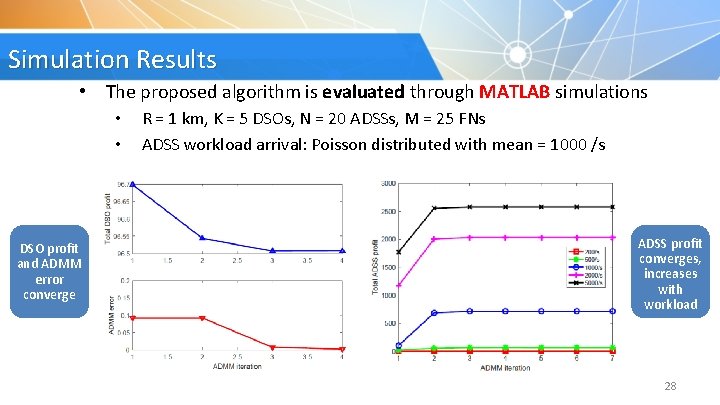
Simulation Results • The proposed algorithm is evaluated through MATLAB simulations • • DSO profit and ADMM error converge R = 1 km, K = 5 DSOs, N = 20 ADSSs, M = 25 FNs ADSS workload arrival: Poisson distributed with mean = 1000 /s ADSS profit converges, increases with workload 28
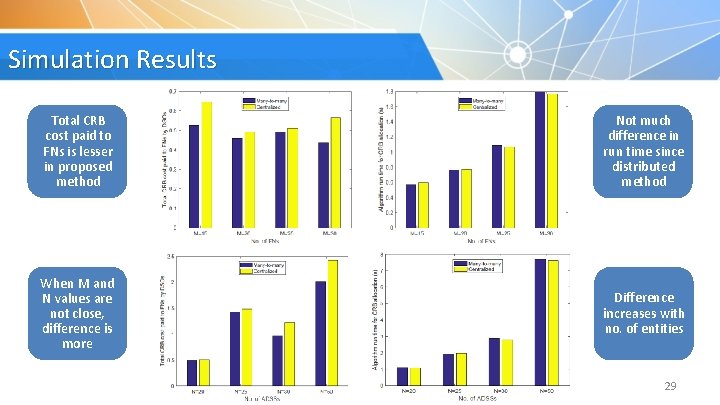
Simulation Results Total CRB cost paid to FNs is lesser in proposed method Not much difference in run time since distributed method When M and N values are not close, difference is more Difference increases with no. of entities 29
3. Heterogeneous Networks 30
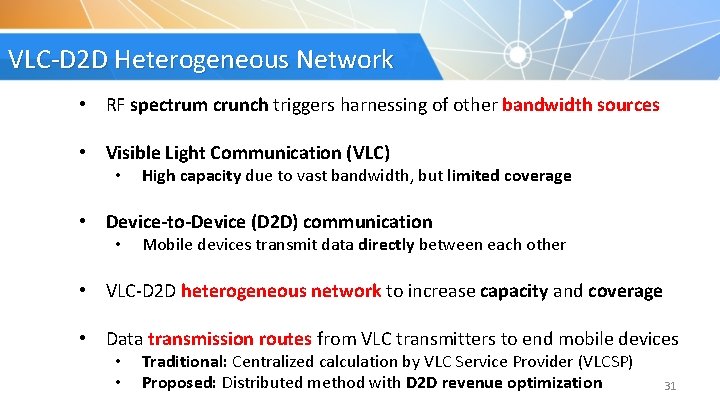
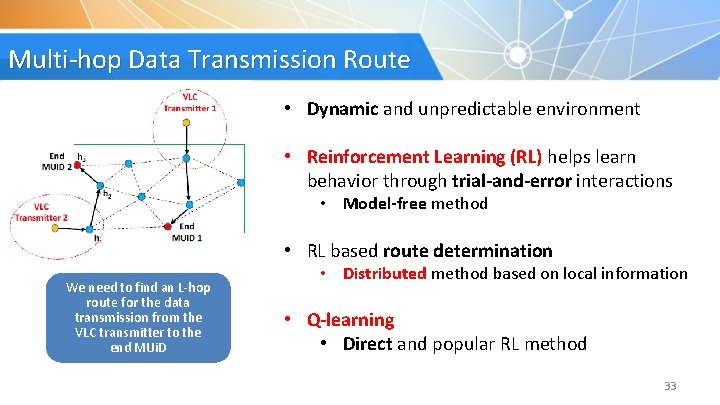
VLC-D 2 D Heterogeneous Network • RF spectrum crunch triggers harnessing of other bandwidth sources • Visible Light Communication (VLC) • High capacity due to vast bandwidth, but limited coverage • Device-to-Device (D 2 D) communication • Mobile devices transmit data directly between each other • VLC-D 2 D heterogeneous network to increase capacity and coverage • Data transmission routes from VLC transmitters to end mobile devices • • Traditional: Centralized calculation by VLC Service Provider (VLCSP) Proposed: Distributed method with D 2 D revenue optimization 31
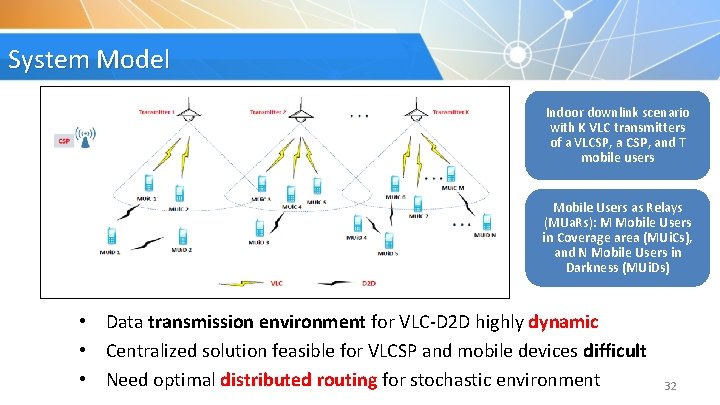
System Model Indoor downlink scenario with K VLC transmitters of a VLCSP, and T mobile users Mobile Users as Relays (MUa. Rs): M Mobile Users in Coverage area (MUi. Cs), and N Mobile Users in Darkness (MUi. Ds) • Data transmission environment for VLC-D 2 D highly dynamic • Centralized solution feasible for VLCSP and mobile devices difficult • Need optimal distributed routing for stochastic environment 32
Multi-hop Data Transmission Route • Dynamic and unpredictable environment • Reinforcement Learning (RL) helps learn behavior through trial-and-error interactions • Model-free method • RL based route determination We need to find an L-hop route for the data transmission from the VLC transmitter to the end MUi. D • Distributed method based on local information • Q-learning • Direct and popular RL method 33
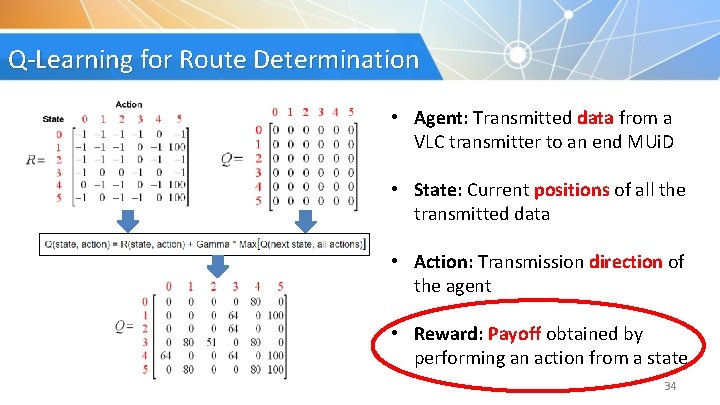
Q-Learning for Route Determination • Agent: Transmitted data from a VLC transmitter to an end MUi. D • State: Current positions of all the transmitted data • Action: Transmission direction of the agent • Reward: Payoff obtained by performing an action from a state 34
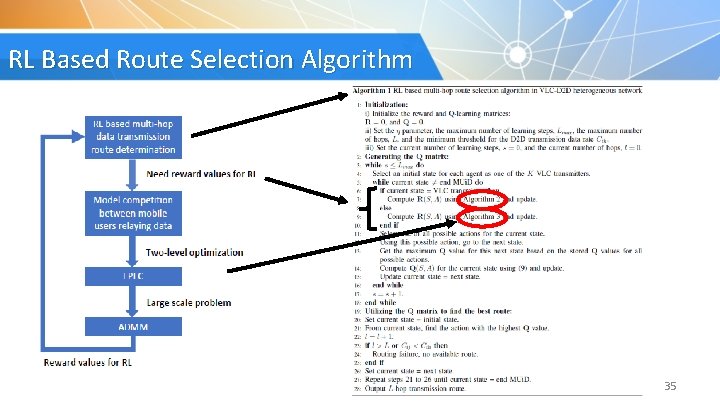
RL Based Route Selection Algorithm 35
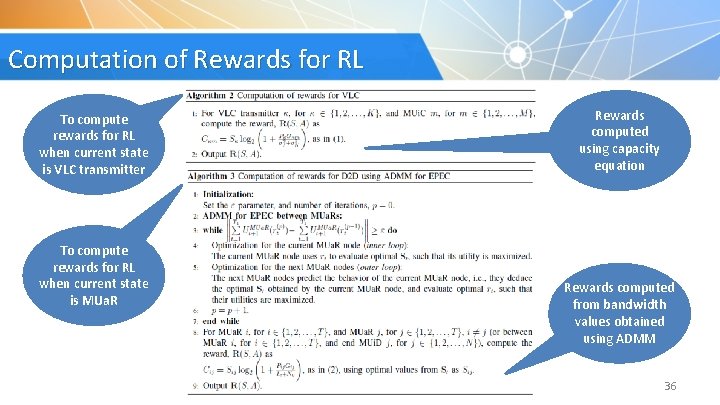
Computation of Rewards for RL To compute rewards for RL when current state is VLC transmitter To compute rewards for RL when current state is MUa. R Rewards computed using capacity equation Rewards computed from bandwidth values obtained using ADMM 36
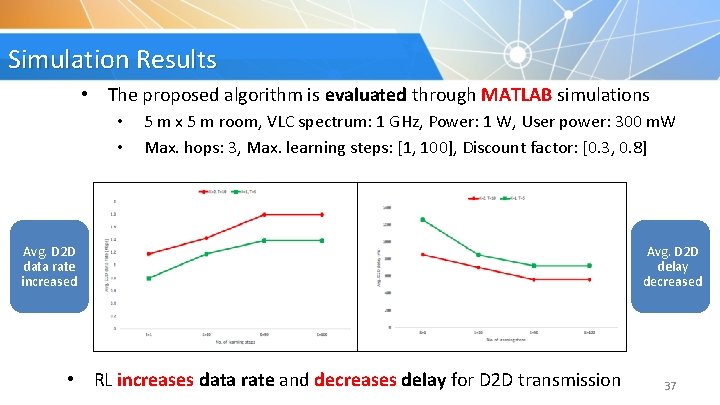
Simulation Results • The proposed algorithm is evaluated through MATLAB simulations • • 5 m x 5 m room, VLC spectrum: 1 GHz, Power: 1 W, User power: 300 m. W Max. hops: 3, Max. learning steps: [1, 100], Discount factor: [0. 3, 0. 8] Avg. D 2 D data rate increased • RL increases data rate and decreases delay for D 2 D transmission Avg. D 2 D delay decreased 37
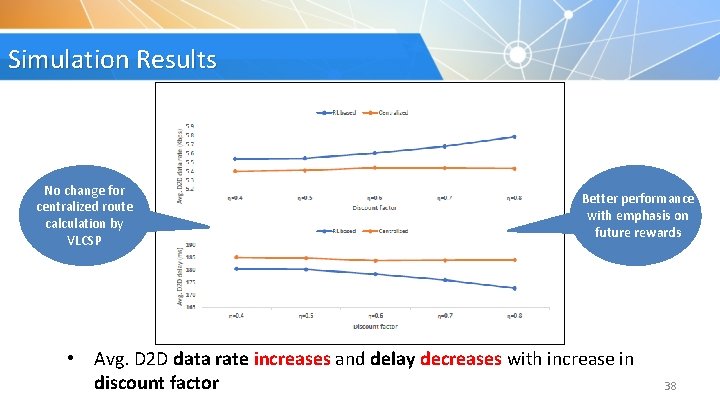
Simulation Results No change for centralized route calculation by VLCSP Better performance with emphasis on future rewards • Avg. D 2 D data rate increases and delay decreases with increase in discount factor 38
4. Spectrum Sharing 39
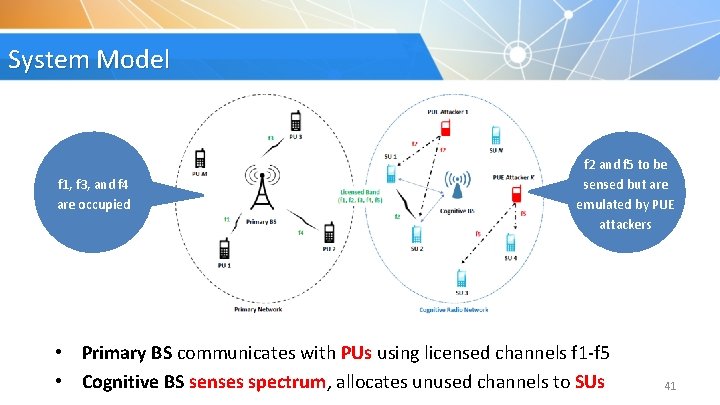
Cognitive Radio Network (CRN) • Intelligent network allowing dynamic configuration of parameters • Communication protocol, frequency band, modulation scheme, etc. • Enables Dynamic Spectrum Access (DSA) for efficient spectrum use • • Unlicensed or Secondary Users (SUs) constantly sense spectrum used by licensed or Primary Users (PUs), to detect and utilize unused bands The bands are vacated by SUs upon sensing the presence of PU signals • Exploited by Primary User Emulation (PUE) attackers • Mislead SUs into leaving the spectrum by emulating PU signals • Need to detect PUE attacks to ensure efficient spectrum utilization 40
System Model f 1, f 3, and f 4 are occupied f 2 and f 5 to be sensed but are emulated by PUE attackers • Primary BS communicates with PUs using licensed channels f 1 -f 5 • Cognitive BS senses spectrum, allocates unused channels to SUs 41
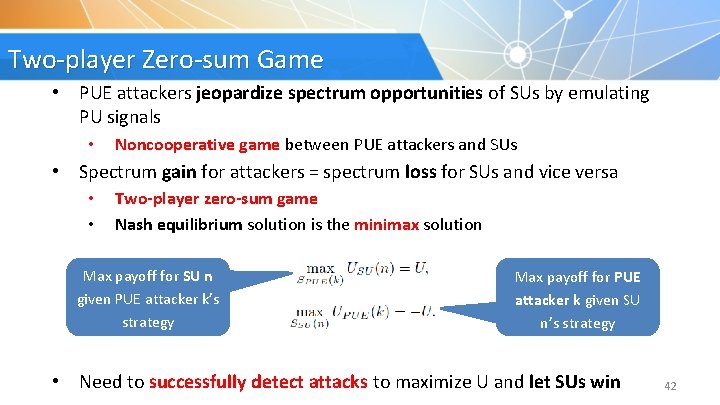
Two-player Zero-sum Game • PUE attackers jeopardize spectrum opportunities of SUs by emulating PU signals • Noncooperative game between PUE attackers and SUs • Spectrum gain for attackers = spectrum loss for SUs and vice versa • • Two-player zero-sum game Nash equilibrium solution is the minimax solution Max payoff for SU n given PUE attacker k’s strategy Max payoff for PUE attacker k given SU n’s strategy • Need to successfully detect attacks to maximize U and let SUs win 42
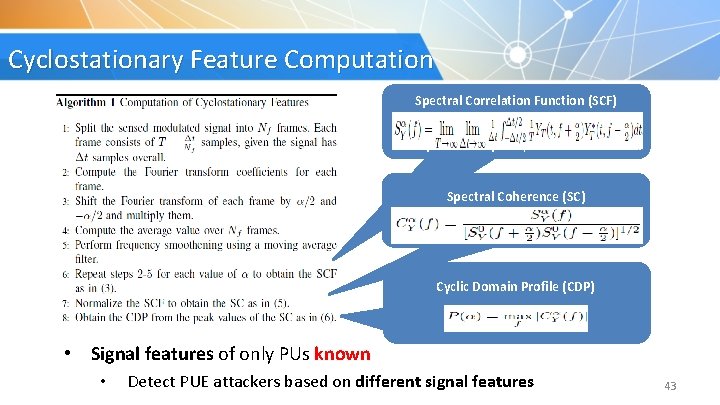
Cyclostationary Feature Computation Spectral Correlation Function (SCF) Describes the cross-spectral density of all pairs of frequency-shifted versions Spectral Coherence (SC) Normalized form of SCF Cyclic Domain Profile (CDP) Max SC for each α value • Signal features of only PUs known • Detect PUE attackers based on different signal features 43
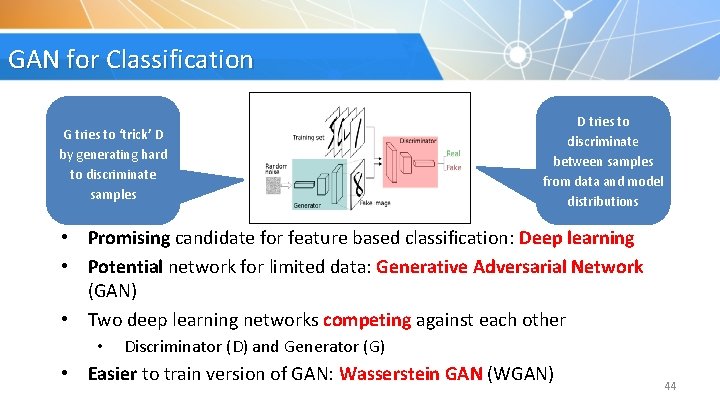
GAN for Classification G tries to ‘trick’ D by generating hard to discriminate samples D tries to discriminate between samples from data and model distributions • Promising candidate for feature based classification: Deep learning • Potential network for limited data: Generative Adversarial Network (GAN) • Two deep learning networks competing against each other • Discriminator (D) and Generator (G) • Easier to train version of GAN: Wasserstein GAN (WGAN) 44
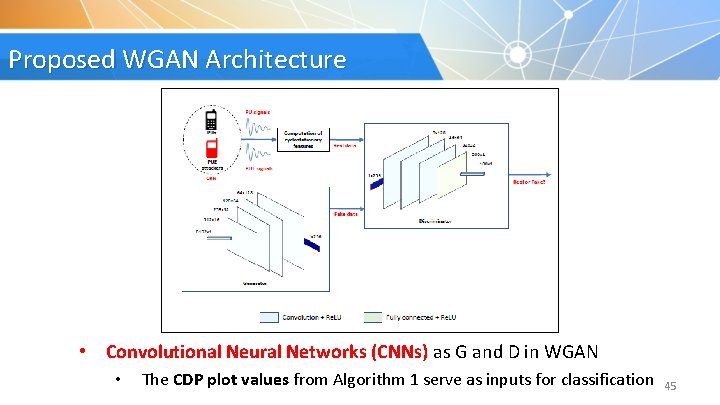
Proposed WGAN Architecture • Convolutional Neural Networks (CNNs) as G and D in WGAN • The CDP plot values from Algorithm 1 serve as inputs for classification 45
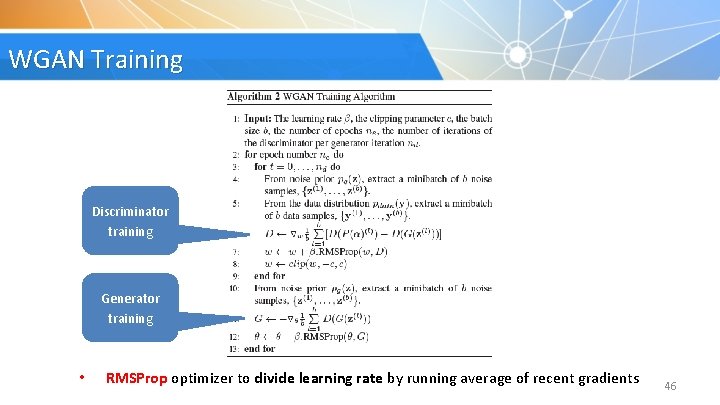
WGAN Training Discriminator training Generator training • RMSProp optimizer to divide learning rate by running average of recent gradients 46
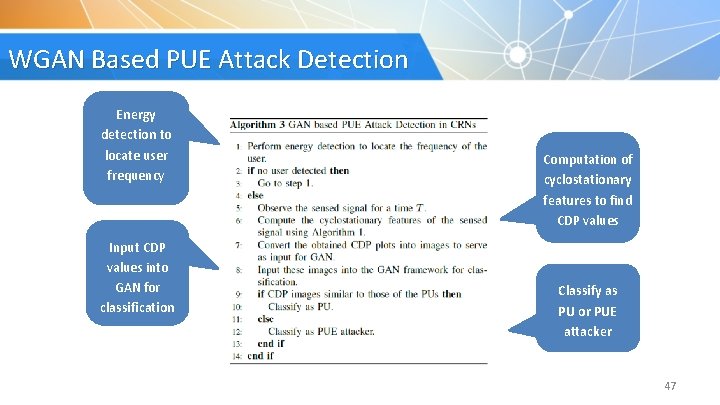
WGAN Based PUE Attack Detection Energy detection to locate user frequency Input CDP values into GAN for classification Computation of cyclostationary features to find CDP values Classify as PU or PUE attacker 47
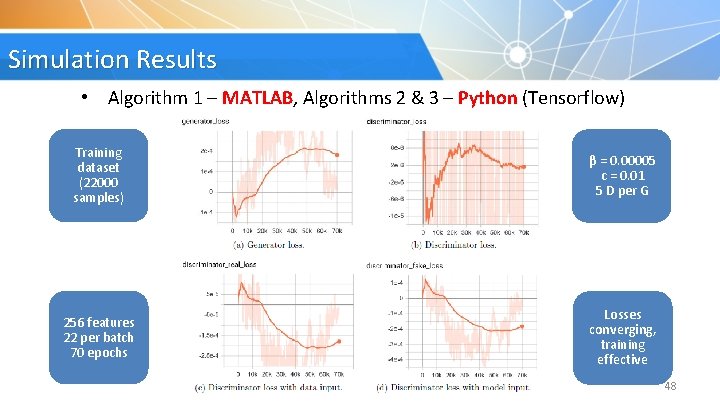
Simulation Results • Algorithm 1 – MATLAB, Algorithms 2 & 3 – Python (Tensorflow) Training dataset (22000 samples) β = 0. 00005 c = 0. 01 5 D per G 256 features 22 per batch 70 epochs Losses converging, training effective 48
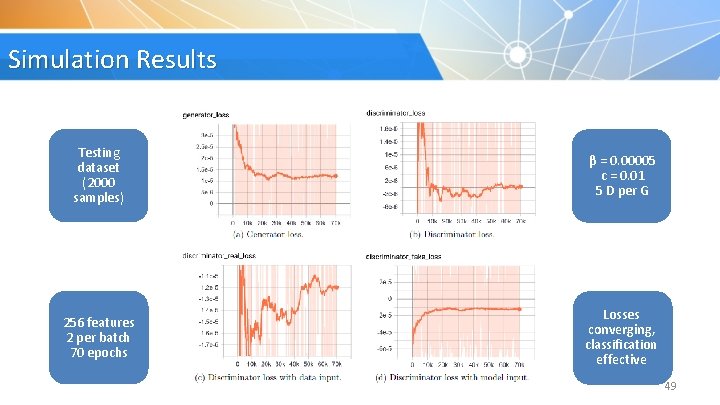
Simulation Results Testing dataset (2000 samples) β = 0. 00005 c = 0. 01 5 D per G 256 features 2 per batch 70 epochs Losses converging, classification effective 49
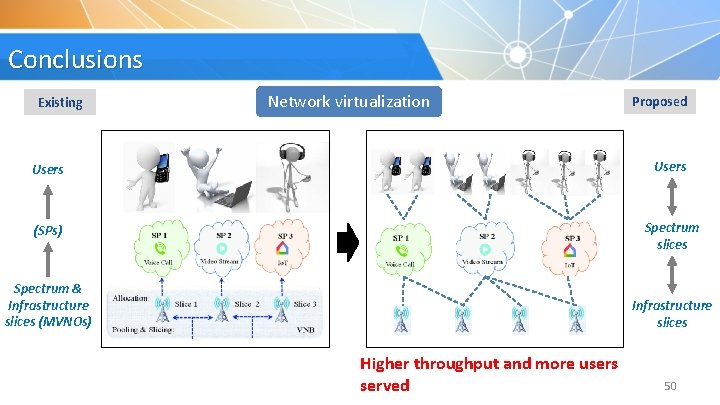
Conclusions Existing Network virtualization Proposed Users (SPs) Spectrum slices Spectrum & Infrastructure slices (MVNOs) Infrastructure slices Higher throughput andrequirements more users More flexibility to user served due to three-sided model 50
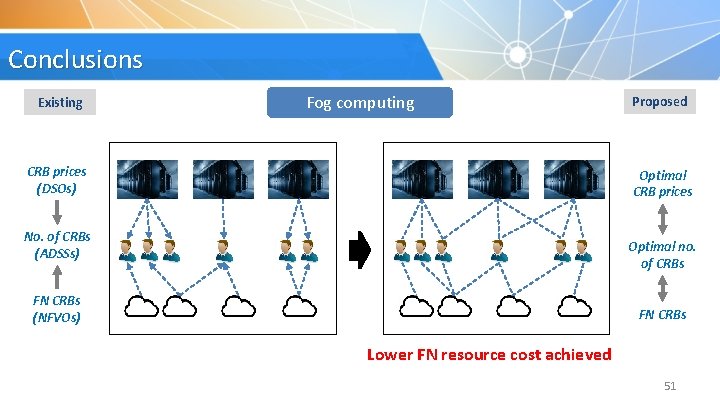
Conclusions Existing Fog computing CRB prices (DSOs) Proposed Optimal CRB prices No. of CRBs (ADSSs) Optimal no. of CRBs FN CRBs (NFVOs) FN CRBs Revenue for both DSOs Lower FNoptimized resource cost achieved and ADSSs 51
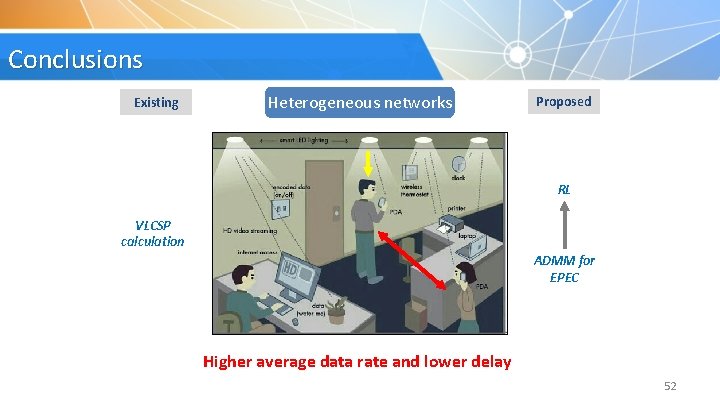
Conclusions Existing Heterogeneous networks Proposed RL VLCSP calculation ADMM for EPEC Revenue optimization users Higher average data ratefor and. D 2 D lower delay 52
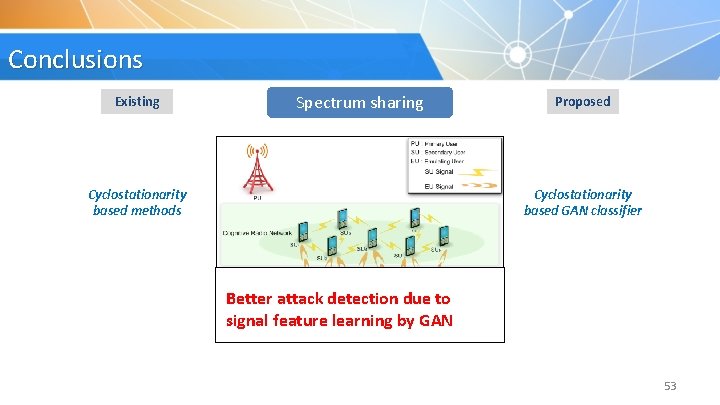
Conclusions Existing Spectrum sharing Cyclostationarity based methods Proposed Cyclostationarity based GAN classifier Better attack detection due to Data augmentation for limited signal feature learning by GAN samples 53
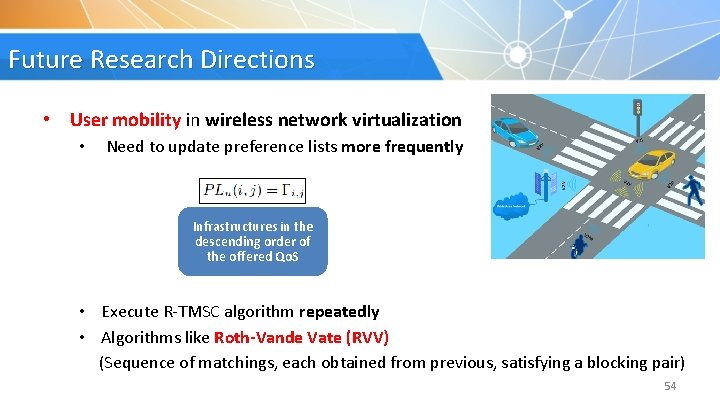
Future Research Directions • User mobility in wireless network virtualization • Need to update preference lists more frequently Infrastructures in the descending order of the offered Qo. S • Execute R-TMSC algorithm repeatedly • Algorithms like Roth-Vande Vate (RVV) (Sequence of matchings, each obtained from previous, satisfying a blocking pair) 54
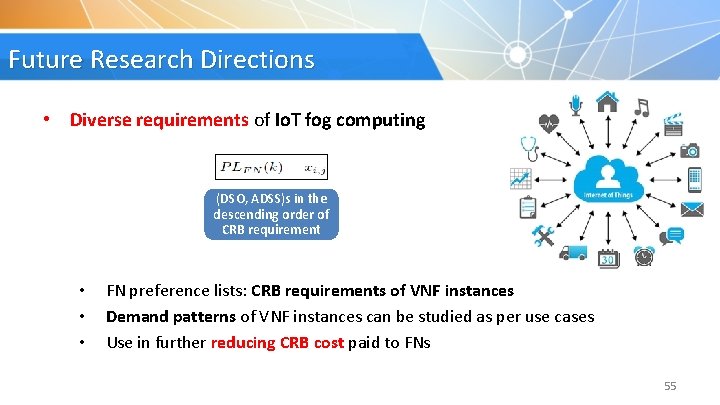
Future Research Directions • Diverse requirements of Io. T fog computing (DSO, ADSS)s in the descending order of CRB requirement • • • FN preference lists: CRB requirements of VNF instances Demand patterns of VNF instances can be studied as per use cases Use in further reducing CRB cost paid to FNs 55
Publications Book Chapters • N. Raveendran, K. Bian, L. Song, and Z. Han, “A Social Choice Theoretic Approach for Analyzing User Behavior in Online Streaming Mobile Applications, ” Game Theory for Networking Applications, EAI/Springer, editors: Ju Bin Song, Husheng Li, and Marceau Coupechoux, 2019. Transactions Publications • N. Raveendran, S. Ahmadian, G. Xue, C. S. Hong, L. -C. Wang, and Z. Han, “Defending Primary User Emulation Attacks in Cognitive Radio Networks by Generative Adversarial Networks, ” submitted to IEEE Transactions on Mobile Computing. • N. Raveendran, H. Zhang, L. Song, L. -C. Wang, C. S. Hong, and Z. Han, “Pricing and Resource Allocation Optimization for Io. T Fog Computing and NFV: An EPEC and Matching Based Perspective, ” submitted to IEEE Transactions on Mobile Computing. • N. Raveendran, Y. Gu, C. Jiang, N. H. Tran, M. Pan, L. Song, and Z. Han, “Cyclic Three-Sided Matching Game Inspired Wireless Network Virtualization, ” IEEE Transactions on Mobile Computing, DOI 10. 1109/TMC. 2019. 2947522. • N. Raveendran, H. Zhang, D. Niyato, F. Yang, J. Song, and Z. Han, “VLC and D 2 D Heterogeneous Network Optimization: Equilibrium Problem with Equilibrium Constraints and Learning Approaches, ” IEEE Transactions on Wireless Communications, vol. 18, no. 2, pp. 1115 -1127, February 2019. Conference Publications • N. Raveendran, Y. Zhang, X. Liu, and Z. Han, “ 5 G Virtual Core Resource Allocation for Cloud Gaming: A Three-Sided Matching and Reinforcement Learning Perspective, ” submitted to IEEE Conference on Computer Communications (INFOCOM), Beijing, China, April 2020. • N. Raveendran, Y. Zhang, X. Liu, and Z. Han, “Virtual Core Network Resource Allocation in 5 G Systems using Three-Sided Matching, ” IEEE International Conference on Communications (ICC), Shanghai, China, May 2019. • N. Raveendran, K. Bian, L. Song, and Z. Han, “A Social Choice Theoretic Approach for Analyzing User Behavior in Online Streaming Mobile Applications, ” invited, 8 th EAI International Conference on Game Theory for Networks (Game. Nets), Seoul, South Korea, May 2018. • N. Raveendran, H. Zhang, Z. Zheng, L. Song, and Z. Han, “Large-Scale Fog Computing Optimization using Equilibrium Problem with Equilibrium Constraints, ” IEEE Global Communications Conference (Globecom), Singapore, December 2017. 56
Thank you! Neetu Raveendran nraveendran@uh. edu