
Game of 2048 J S Roger Jang jangmirlab
Game of 2048 J. -S. Roger Jang (張智星) jang@mirlab. org http: //mirlab. org/jang MIR Lab, CSIE Dept. National Taiwan University
Introduction to 2048 About 2048 � Try out: http: //2048 game. com � Developed by 19 -year-old Italian web developer Gabriele Cirulli � Release date: March 9, 2014 � Goal: for an element to reach 2048 � Reference on Wiki: English, Chinese Your mission � Write a program to find an input sequence to reach the goal based on the concept of stacks for DFS (depth-first search). 2/13
Properties of 2048 About solution � May not be solvable � May have multiple solutions The behavior of the next map is implementation dependent � How to combine same-value elements � Probability of generating 2 and 4 � TA will give you a function to generate the next state 3/13
Solution to 2048 Exhaustive search � 4 m Impossible for a large m! Heuristic search � Conservative: Maximize 2’s coverage � Aggressive: Maximize Number of merges Sum of merges � Many more strategies on the web Search based on maze traversal � DFS (depth-first search) Preferred Quiz! � BFS (breadth-first search) Need much more memory 4/13

Heuristic Search: Examples 5/13
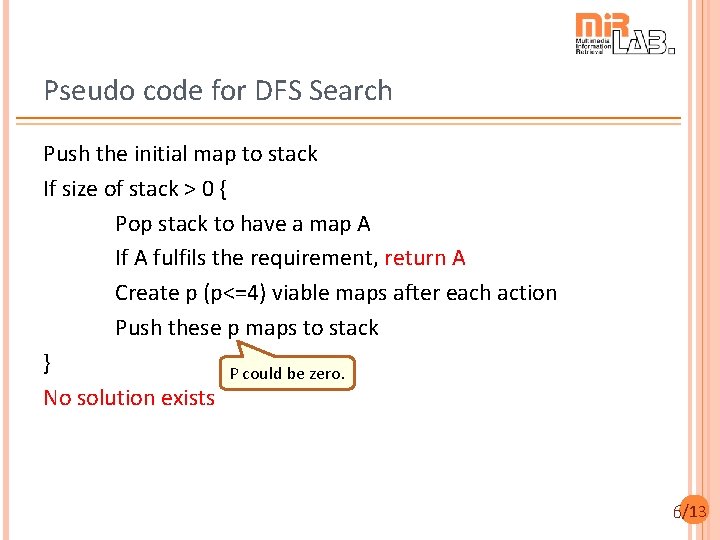
Pseudo code for DFS Search Push the initial map to stack If size of stack > 0 { Pop stack to have a map A If A fulfils the requirement, return A Create p (p<=4) viable maps after each action Push these p maps to stack } P could be zero. No solution exists 6/13
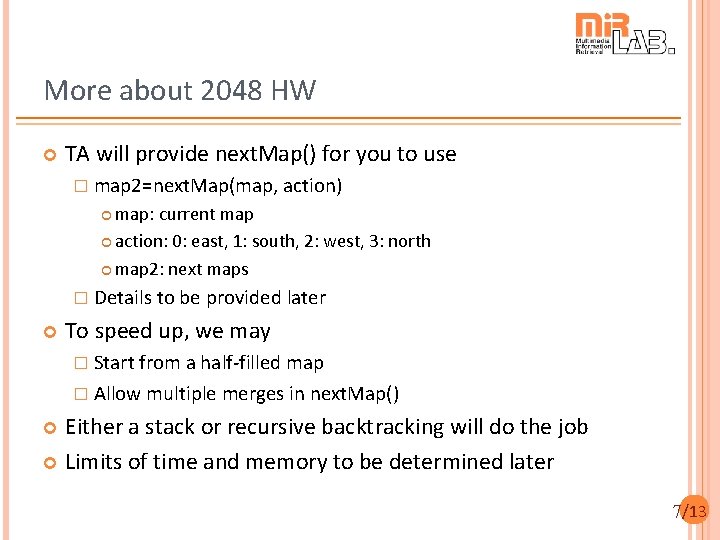
More about 2048 HW TA will provide next. Map() for you to use � map 2=next. Map(map, action) map: current map action: 0: east, 1: south, 2: west, 3: north map 2: next maps � Details to be provided later To speed up, we may � Start from a half-filled map � Allow multiple merges in next. Map() Either a stack or recursive backtracking will do the job Limits of time and memory to be determined later 7/13
- Slides: 7