
Game Design Principles Part 1 Milestone Games and


- Slides: 24
Game Design Principles Part 1 : Milestone Games and Play Jehee Lee Seoul National University
Taxonomy of Creative Expressions Art beauty Creative Expression money Movies, Books, etc. non-interactive Entertainment interactive Toys Puzzles no goals No competitor Playthings goals Challenges competitor Competitions no attacks Conflicts Attacks allowed Games
Definitions • A form of play with goals and structure (Kevin Maroney) • A form of art in which participants, termed players, make decisions in order to manage resources through game tokens in the pursuit of a goal (Greg Costikyan) • An activity with some rules engaged in for an outcome (Eric Zimmerman)
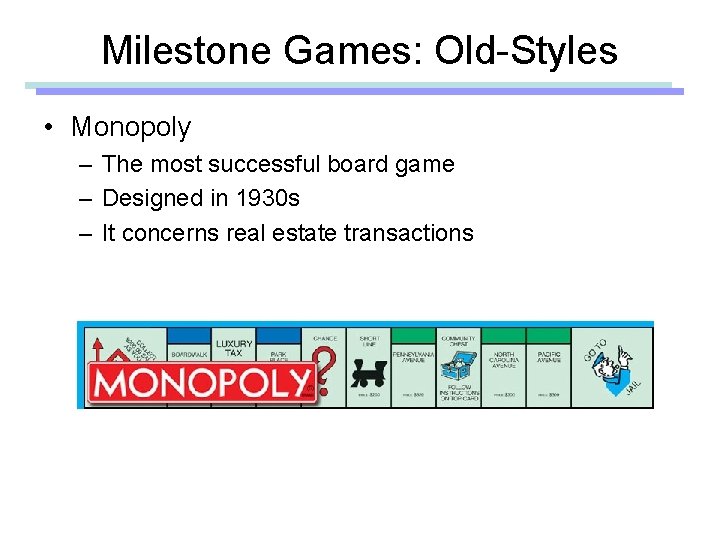
Milestone Games: Old-Styles • Monopoly – The most successful board game – Designed in 1930 s – It concerns real estate transactions
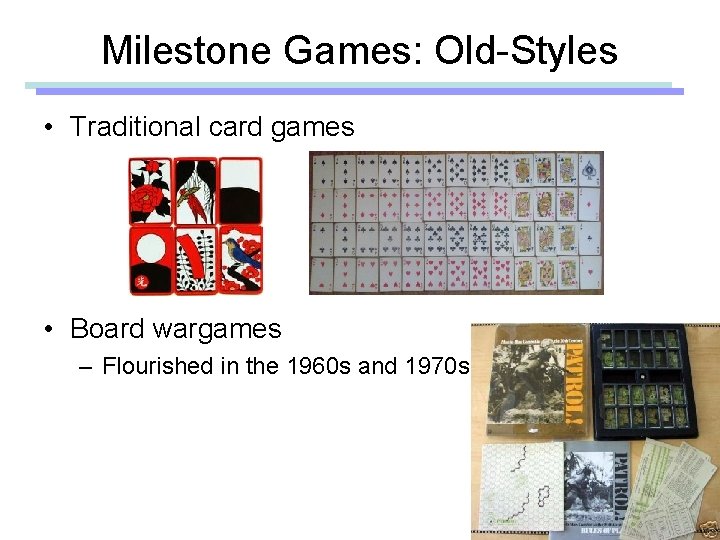
Milestone Games: Old-Styles • Traditional card games • Board wargames – Flourished in the 1960 s and 1970 s
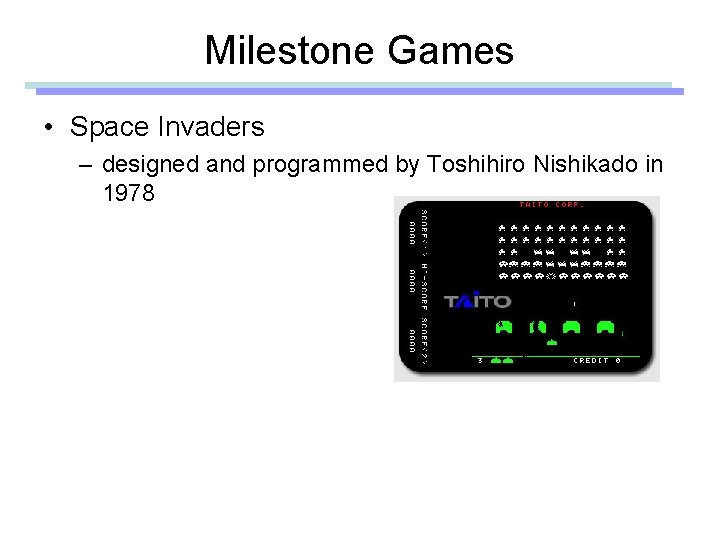
Milestone Games • Space Invaders – designed and programmed by Toshihiro Nishikado in 1978
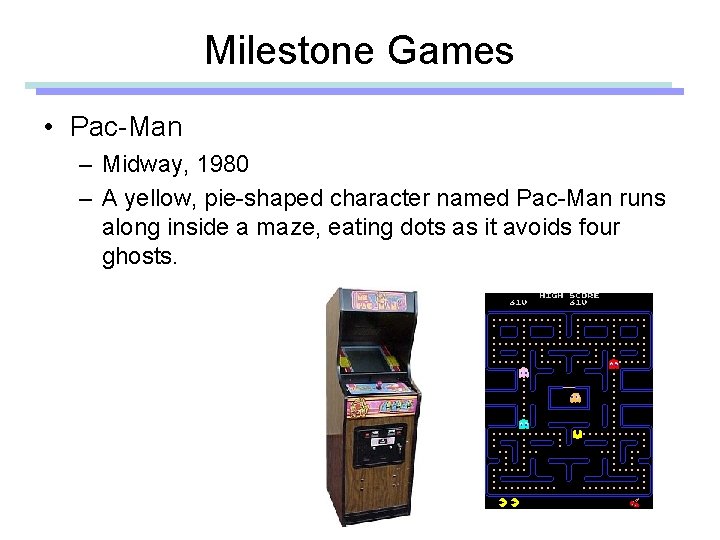
Milestone Games • Pac-Man – Midway, 1980 – A yellow, pie-shaped character named Pac-Man runs along inside a maze, eating dots as it avoids four ghosts.
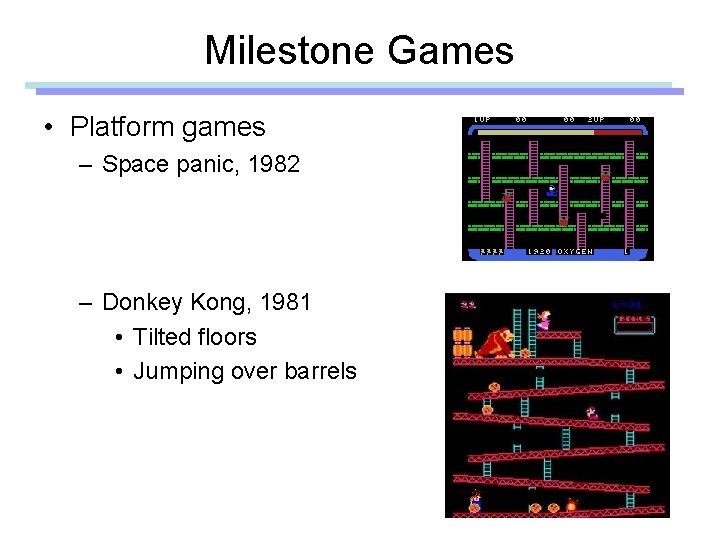
Milestone Games • Platform games – Space panic, 1982 – Donkey Kong, 1981 • Tilted floors • Jumping over barrels
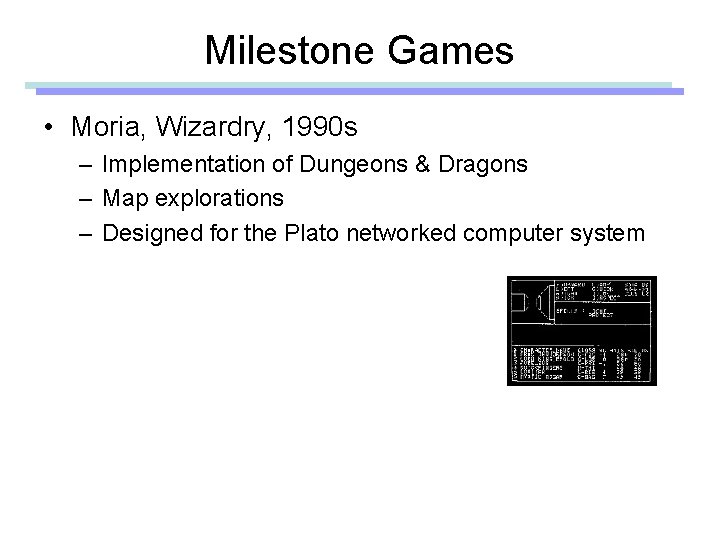
Milestone Games • Moria, Wizardry, 1990 s – Implementation of Dungeons & Dragons – Map explorations – Designed for the Plato networked computer system
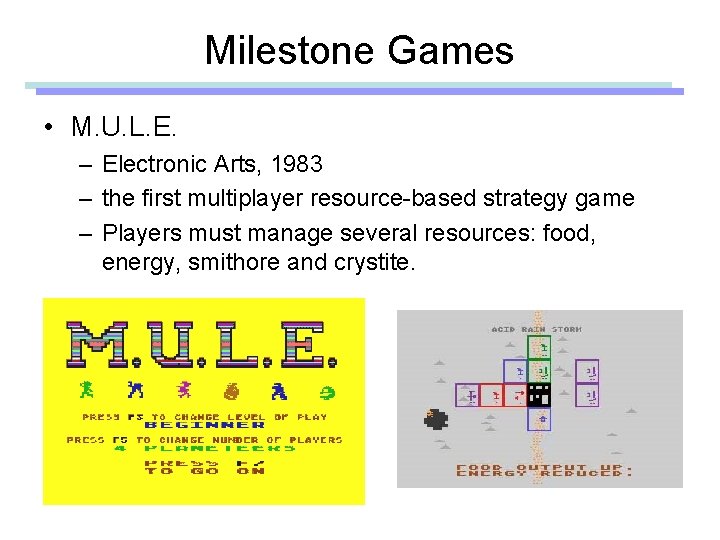
Milestone Games • M. U. L. E. – Electronic Arts, 1983 – the first multiplayer resource-based strategy game – Players must manage several resources: food, energy, smithore and crystite.
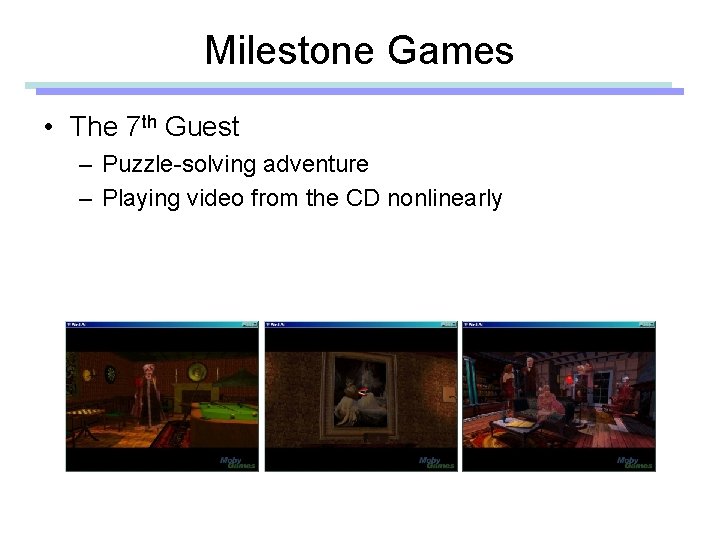
Milestone Games • The 7 th Guest – Puzzle-solving adventure – Playing video from the CD nonlinearly
Some Milestone Games • • • Doom Civilization Sim. City Starcraft Populous 리니지
Play “ A voluntary activity or occupation executed within certain fixed limits of time and place, according to rules freely accepted but absolutely binding, having its aim in itself and accompanied by a feeling of tension, joy, and the consciousness that it is ‘different’ from ‘ordinary life. ’ ”
Play “ A voluntary activity or occupation executed within certain fixed limits of time and place, according to rules freely accepted but absolutely binding, having its aim in itself and accompanied by a feeling of tension, joy, and the consciousness that it is ‘different’ from ‘ordinary life. ’ ”
Play “ A voluntary activity or occupation executed within certain fixed limits of time and place, according to rules freely accepted but absolutely binding, having its aim in itself and accompanied by a feeling of tension, joy, and the consciousness that it is ‘different’ from ‘ordinary life. ’ ”
Play “ A voluntary activity or occupation executed within certain fixed limits of time and place, according to rules freely accepted but absolutely binding, having its aim in itself and accompanied by a feeling of tension, joy, and the consciousness that it is ‘different’ from ‘ordinary life. ’ ”
Play “ A voluntary activity or occupation executed within certain fixed limits of time and place, according to rules freely accepted but absolutely binding, having its aim in itself and accompanied by a feeling of tension, joy, and the consciousness that it is ‘different’ from ‘ordinary life. ’ ”
Play “ A voluntary activity or occupation executed within certain fixed limits of time and place, according to rules freely accepted but absolutely binding, having its aim in itself and accompanied by a feeling of tension, joy, and the consciousness that it is ‘different’ from ‘ordinary life. ’ ”
Play “ A voluntary activity or occupation executed within certain fixed limits of time and place, according to rules freely accepted but absolutely binding, having its aim in itself and accompanied by a feeling of tension, joy, and the consciousness that it is ‘different’ from ‘ordinary life. ’ ”
Play • Early mammals learned to play as a way of polishing the complex neural circuitry that they were born with • Play’s role in our childhood is dominating
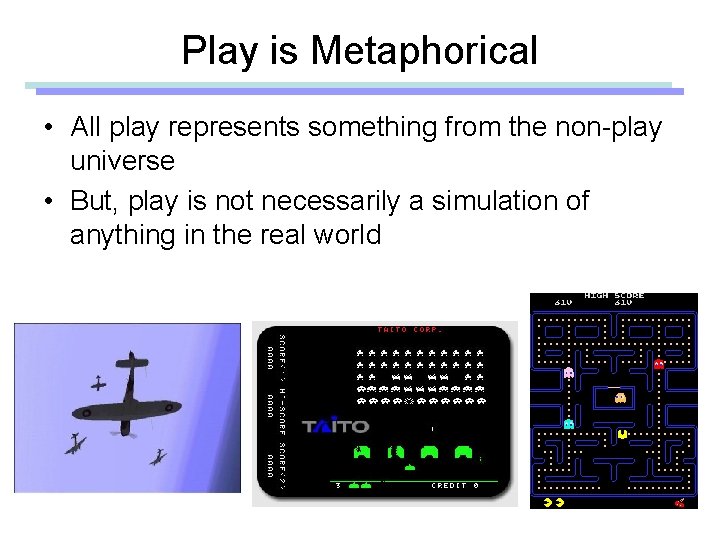
Play is Metaphorical • All play represents something from the non-play universe • But, play is not necessarily a simulation of anything in the real world
Play must be Safe • The whole idea of play is to give the player an experience without the danger that might normally accompany that experience • Frequent game saving in role-playing games – Players want to feel that their investment is safe • The paradox of play is that it provides the player with dangerous experiences that are absolutely safe – Eg) Roller coasters – Eg) Intro of “Raiders of the Lost Ark” by Spielberg
Play Need Not Be Exotic • Players want to face and overcome interesting challenges, but not necessarily be spirited away to an exotic world – Eg) skateboarding in environments forbidden to real skateboarders – Eg) The Sims
Fun Factor • Game : formal activity that you perform • Play : actual behavior that you engage in • Fun : experience or emotion that you derive from that behavior • Fun factor is sometimes ambiguous – Two friends play a hard-fought game of tennis. It is fun? – Do bird watchers brave the elements to have fun ? – How about the lady who putters around in the garden trying to raise the perfect rose?