
Game Design LESSON 8 Introduction to Level Design
- Slides: 13
Game Design LESSON #8: Introduction to Level Design: Micro and Macro level design considerations
PART 1, To Do: Make Final Midterm Project Fixes Congratulations on submitting your full Branching Narrative projects! Now that they have been thoroughly playtested by the class, please go in and make final fixes and post a final build itch. io URL to Piazza. Please do your best to fix any functionality errors and misspellings. And please contact the teacher for help!
PART 1, To Do: Consider Final Project Ideas You final project will start in our next class meeting, when you will brainstorm ideas with classmates, pitch ideas, and then vote with your feet to decide the final project for the rest of the term. Before our next meeting, please post an idea for a final Unity game project to Piazza. You are encouraged to consider a 2 D platformer or 2 D top-down exploration game, or a 2 D puzzle or battle game, with a unique mechanics that can provide a twist on these existing genres. Include a title, genre, and what is unique or interesting to you about this idea. For example: “ 'Red or Blue' is a 2 D platformer where the player is a bullied teenager with the power to switch the lighting between red and blue, making escape platforms appear of the opposite color, and turning off enemy pants. " PLEASE NOTE: You are welcome to pitch any game you want: 2 D, 3 D, single or multiplayer. BUT, if you stick to the above genres, you will minimize the amount of time you can expect to work with the teacher outside of class implementing mechanics
PART 2: Level Design for Player Engagement This week we will take a break from team projects and focus on player engagement through level design. We will use a Unity game made by Digi. Pen called the Basic Level Builder to design platformers in order to experiment with key concepts of player experience: Micro Level Design to support good flow, and Macro Level Design to create rising difficulty in an experience arc. While we will discuss these ideas for platformers, they apply to all games! Start by downloading the BLB from the course site and experimenting with the tools. Make a small level and play! Note also the tools for naming and saving levels to your documents folder.
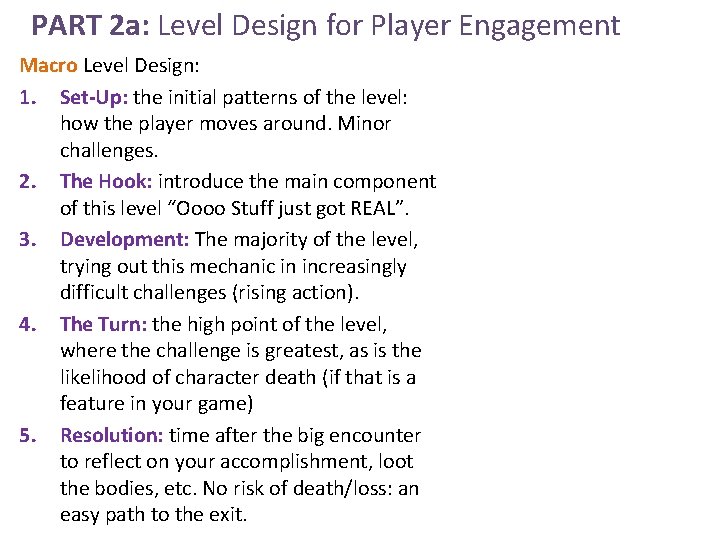
PART 2 a: Level Design for Player Engagement Macro Level Design: 1. Set-Up: the initial patterns of the level: how the player moves around. Minor challenges. 2. The Hook: introduce the main component of this level “Oooo Stuff just got REAL”. 3. Development: The majority of the level, trying out this mechanic in increasingly difficult challenges (rising action). 4. The Turn: the high point of the level, where the challenge is greatest, as is the likelihood of character death (if that is a feature in your game) 5. Resolution: time after the big encounter to reflect on your accomplishment, loot the bodies, etc. No risk of death/loss: an easy path to the exit.
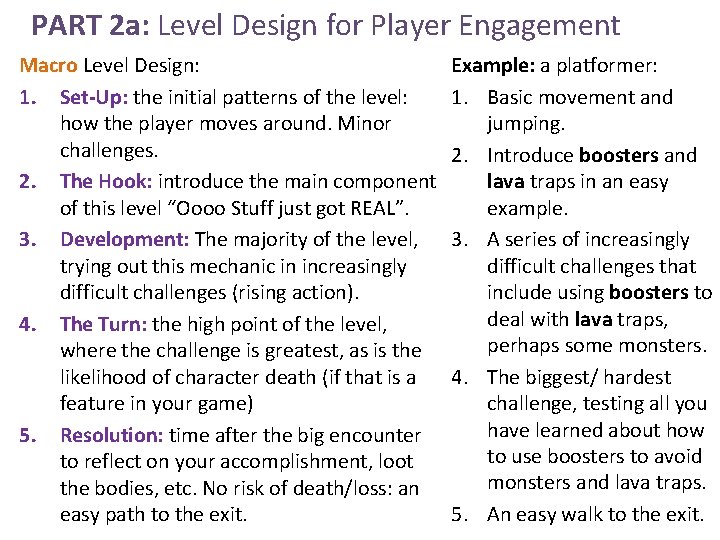
PART 2 a: Level Design for Player Engagement Macro Level Design: 1. Set-Up: the initial patterns of the level: how the player moves around. Minor challenges. 2. The Hook: introduce the main component of this level “Oooo Stuff just got REAL”. 3. Development: The majority of the level, trying out this mechanic in increasingly difficult challenges (rising action). 4. The Turn: the high point of the level, where the challenge is greatest, as is the likelihood of character death (if that is a feature in your game) 5. Resolution: time after the big encounter to reflect on your accomplishment, loot the bodies, etc. No risk of death/loss: an easy path to the exit. Example: a platformer: 1. Basic movement and jumping. 2. Introduce boosters and lava traps in an easy example. 3. A series of increasingly difficult challenges that include using boosters to deal with lava traps, perhaps some monsters. 4. The biggest/ hardest challenge, testing all you have learned about how to use boosters to avoid monsters and lava traps. 5. An easy walk to the exit.
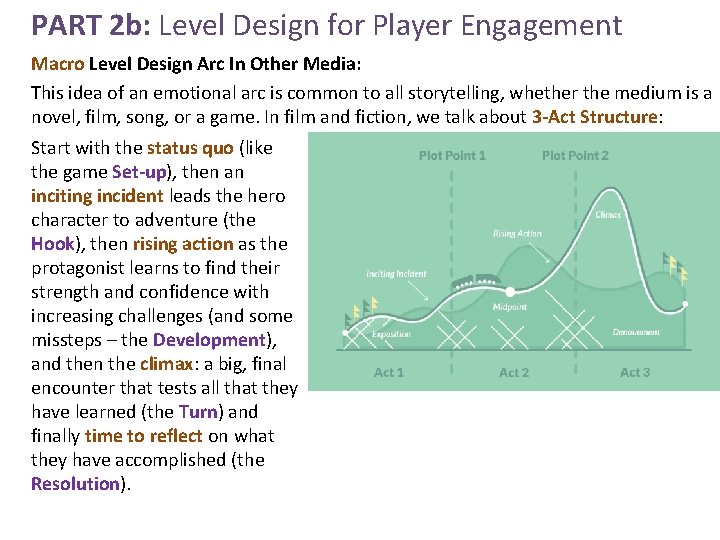
PART 2 b: Level Design for Player Engagement Macro Level Design Arc In Other Media: This idea of an emotional arc is common to all storytelling, whether the medium is a novel, film, song, or a game. In film and fiction, we talk about 3 -Act Structure: Start with the status quo (like the game Set-up), then an inciting incident leads the hero character to adventure (the Hook), then rising action as the protagonist learns to find their strength and confidence with increasing challenges (and some missteps – the Development), and then the climax: a big, final encounter that tests all that they have learned (the Turn) and finally time to reflect on what they have accomplished (the Resolution).
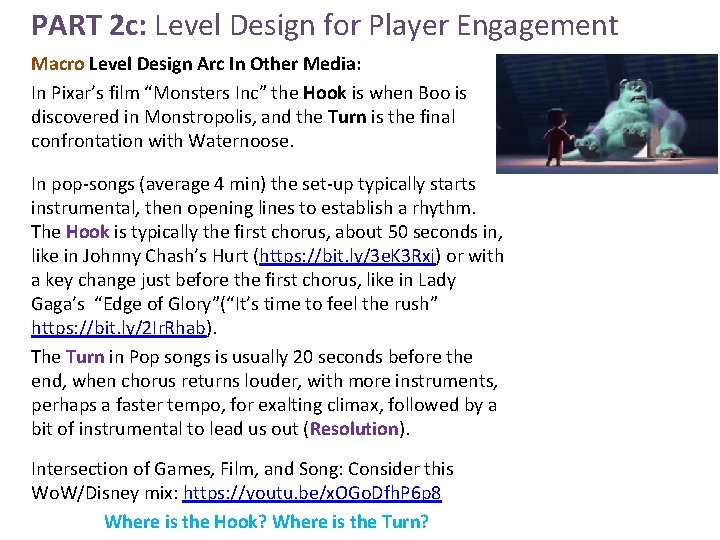
PART 2 c: Level Design for Player Engagement Macro Level Design Arc In Other Media: In Pixar’s film “Monsters Inc” the Hook is when Boo is discovered in Monstropolis, and the Turn is the final confrontation with Waternoose. In pop-songs (average 4 min) the set-up typically starts instrumental, then opening lines to establish a rhythm. The Hook is typically the first chorus, about 50 seconds in, like in Johnny Chash’s Hurt (https: //bit. ly/3 e. K 3 Rxj) or with a key change just before the first chorus, like in Lady Gaga’s “Edge of Glory”(“It’s time to feel the rush” https: //bit. ly/2 Ir. Rhab). The Turn in Pop songs is usually 20 seconds before the end, when chorus returns louder, with more instruments, perhaps a faster tempo, for exalting climax, followed by a bit of instrumental to lead us out (Resolution). Intersection of Games, Film, and Song: Consider this Wo. W/Disney mix: https: //youtu. be/x. OGo. Dfh. P 6 p 8 Where is the Hook? Where is the Turn?
PART 2 d: Level Design for Player Engagement Micro Level Design: How do we fill these MACRO structures with gameplay? We consider MICRO structures: patterns for players to learn and variations to make them interesting. Since games are a relatively, new medium, it is helpful to discuss how to create player movement patterns and variations using a medium that has done so for millennia: music.
PART 2 e: Level Design for Player Engagement Micro Level Design in a Platformer Game: • The player character has a base speed to run and jump. This is the TEMPO. • A single challenge element, like a Platform + a Gap, is a “NOTE”. Other notes can include a Wall to jump, Steps to climb, a Wall-gap to jump through and a Leap-of-faith Fall, as well as Boosters, Teleporters, Walljumping, Keys and Locks, etc. • A long flat platform would in music terms be a “rest” – not action – but put a single note together repeatedly and we get aaaa. • RHYTHM is created when we alternate these notes in repeating pattern: platform-gap, platform-wall, etc: abab • MELODY is when we add a surprise variation, like ababac, where “c” is a new note (suddenly we have Steps) or a smaller variation (a higher wall). • HARMONY is repeating these melody patterns in a row, with variation. In v 1 of the melody the gaps are small and the walls are low. In v 2, the gaps and walls are medium, and in v 3 they are large and tall.
PART 2 f: Level Design for Player Engagement Micro Level Design Arc In Other Media: Importantly, designing with the Tempo could mean that all of these variations require the same player motion: just hold down the rightarrow key and hit jump at the start and at every landing, so that all aps and all heights are mechanically identical (the work with the same jump height) but FEEL increasingly hard to at least surprising and different to the player. The player FEELS like we are giving them less room for error now that they have the rhythm, but it can be the same!
PART 2 g: Level Design for Player Engagement Micro Level Design Arc In Other Media:
Have an Splendid Week! And don’t forget to email us with questions: Instructor: JASON WISER Jason. Wiser. Art@gmail. com Available an hour after class and daily email.