
Game Design LESSON 6 Unity game progress Elements
- Slides: 57
Game Design LESSON #6: Unity game progress Elements of writing strong Branching Narrative: Pacing, Stakes, Choice Types, Voice, and Stat Tracking Alternative Reality Games
TODAY: 1. Making a PPR 2. More on our Unity games (Build settings, Game. Handler) and Branching Narrative. 3. Discussing the Reading: Mc. Gonigal & Schell 4. Game Design through Alternatives to Misery 5. Intro to 2 D games with the Unity engine
Important Documentation: PPR #1 The Personal progress Report is one of the critical tools in this course for reflection and grading. It is a weekly requirement for every production week in Unity, where you submit a short typed document including the following pieces of information: 1. What you agreed to take on 2. What you actually completed (it is OK for this to occasionally be less; you are learning what you can accomplish in a week!) 3. Who helped you 4. Who you helped 5. URLs for tutorial links your used. Please make sure your name and the date are included at the top, as well as the PPR number (this is #1). You are also encouraged to include screenshots of the work you completed for the game. This should be posted to Piazza every week we do not have peer/self evaluations. Normally, you will complete this before the day of class, but we will do the first one right now.
Narrative Game Design day 2: Game Progress Everyone please open Git. Hub Desktop App and your team game in Unity. Are you able to play the Scene you made (no script errors that prevent play)? Then Summarize/ Commit/ Push your work! 1. 1 person per team: Create the Start Menu Scene (then git-pull and add Game. Hander). 2. 1 person per team: Create the Win Scene (then git-pull and add Game. Hander). 3. 1 person per team: Create the Lose Scene (then git-pull and add Game. Hander). 4. 1 person per team: Create the Game. Handler prefab to help manage Start, Quit and Restart (and possibly stats). Add to all Scenes (communicate to avoid conflicts!). 5. 1 person per team: Add Unity Build Settings to allow movement between Scenes, and Save the Project. Share your progress by walking us through your game so far!
Narrative Game Design day 2: Pacing In a Text Adventure game, pacing is a Flow issue: how well and comfortably the player feels able to navigate the game Reading pace is mostly defined by text length: paragraph size, sentence length, and even word length have a big experience on the reader’s experience. If we want a section of a story to feel fast-paced, we use short sentences, short paragraphs, short words. In a Text game, the same is true for the length of text before hitting the next button, and whether that button just takes us to the next thing that happens or presents us with a choice we have to mull over. In general, to make the pacing and reading more interesting, we want to vary sentence length and avoid repetition. In particular, to build intensity we increase the pace of the story by using shorter sentences. Instead of “The other kid walks behind you, surrounding you. ” “The other kid walks behind you. You are surrounded”
Narrative Game Design day 2: Pacing Another Flow issue are the names we choose for places and characters, especially what we expect the player to remember. We usually want to be careful with the number of names we expect a player to remember. Are you telling a sci-fi or fantasy story? Don’t hit us with all of your fancy world-building names all at once. Only tell us what we need to know. Try keeping it simple, and include descriptors that aide in memory and define character, or subvert expectations. For example, if your player has to deal with a pair of bullies, instead of calling one “Dave” try “Big Dave. ” If we do not know the names of the attackers, find a characteristic to use as reference. “Smokestack” (for the smoking character) and “gloves” (for the one wearing gloves). Note that the choice
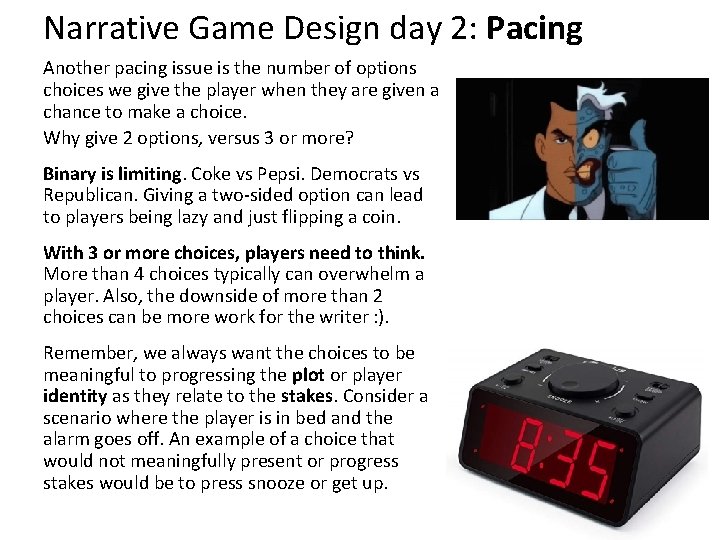
Narrative Game Design day 2: Pacing Another pacing issue is the number of options choices we give the player when they are given a chance to make a choice. Why give 2 options, versus 3 or more? Binary is limiting. Coke vs Pepsi. Democrats vs Republican. Giving a two-sided option can lead to players being lazy and just flipping a coin. With 3 or more choices, players need to think. More than 4 choices typically can overwhelm a player. Also, the downside of more than 2 choices can be more work for the writer : ). Remember, we always want the choices to be meaningful to progressing the plot or player identity as they relate to the stakes. Consider a scenario where the player is in bed and the alarm goes off. An example of a choice that would not meaningfully present or progress stakes would be to press snooze or get up.
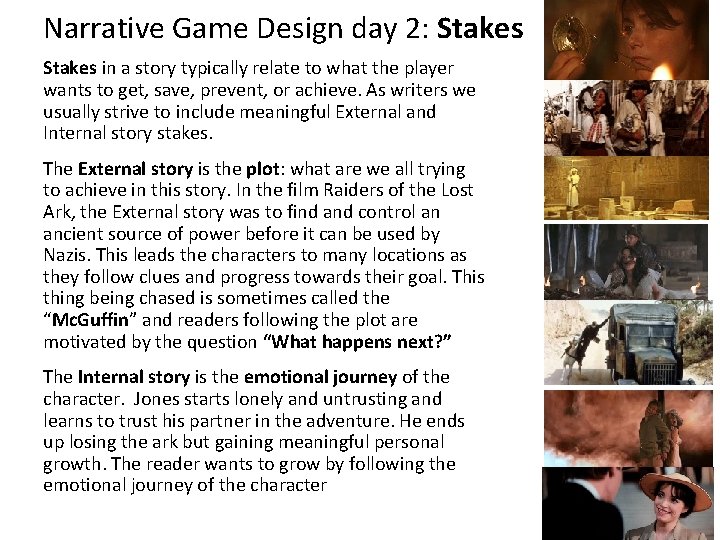
Narrative Game Design day 2: Stakes in a story typically relate to what the player wants to get, save, prevent, or achieve. As writers we usually strive to include meaningful External and Internal story stakes. The External story is the plot: what are we all trying to achieve in this story. In the film Raiders of the Lost Ark, the External story was to find and control an ancient source of power before it can be used by Nazis. This leads the characters to many locations as they follow clues and progress towards their goal. This thing being chased is sometimes called the “Mc. Guffin” and readers following the plot are motivated by the question “What happens next? ” The Internal story is the emotional journey of the character. Jones starts lonely and untrusting and learns to trust his partner in the adventure. He ends up losing the ark but gaining meaningful personal growth. The reader wants to grow by following the emotional journey of the character
Narrative Game Design day 2: Choice Types There are two kinds of choices you can give your player: A Plot Choice to change what happens: where players go, what they do, and actual outcomes that have an effect on what they get to see and do later. These occur in the possibility spaces between Pinch Points, and often have limited impact beyond the next pinch point except for how they change inventory (what the player has found/taken) and stats (connections made or ranks earned). An Identity Choice defines the character in the mind of the player and can also change character stats like health, bravery, and connections to other characters, which can change the choices available later. Remember: Pinch Points (also called Bottlenecks) are where all story branches converge to experience major plot points that we want to affect everyone who plays the story. In a disaster story, a Pinch Point can be when the building finally collapses, or the siren calls to evacuate. Whatever choices were made previously, everyone’s story re-aligns to the next major plot point. This supports story arc and scope management.
Narrative Game Design day 2: Choice Types In an introduction, we typically give the setting and create a context for identity, but then give the player a chance to make an Identity Choice: You are sitting on porch, your ten year old legs dangling over the edge. Are you… • … playing with a blade of grass to make a thumb-whistle? • … thinking about the home you left behind? • … carving your initials into the porch wood with a pen knife? The next card may be the same regardless of which they choose (you hear a shout from inside the house, etc), but this choice can serve the dual purpose of letting the player create a self-perceived identity for themselves in the game, and also perhaps contribute to player stats that could effect the game at a later point. For example, the ability to signal another player may only include humming a tune (or, more directly, a grass whistle) if the player signaled they liked that kind of interaction at the start.
Narrative Game Design day 2: Choice Types You can create other opportunities for the player to form their identity in the game, which do not significantly increase your writing if the choices still lead to the same outcome: EXAMPLE 1: You play a kid with a companion. Two others run to fight you. IDENTITY CHOICE: • Shout to your sidekick "Let's get out of here!" • Shout to your sidekick "Let's fight them!" RESULTS: • If you run, the companion runs with you, and the “Trust” stat for this friend is increased because you showed you care most about their safety. • If you choose to fight, your companion runs away and you have to follow and run anyway, but the “Bravery” stat is increased. We get the same apparent outcome (you run away both times), but different results in the mind of the player and in the stats that effect choices and opportunities later on.
Narrative Game Design day 2: Choice Types You can create other opportunities for the player to form their identity in the game, which do not significantly increase your writing if the choices still lead to the same outcome: EXAMPLE 2: You are in a kitchen, hiding behind a counter. There is a monster in the middle of the room. IDENTITY CHOICE: • Sneak out the back door, hoping monster does not see you • Wait until the monster leaves to sneak out. RESULTS: Because this is an identity choice (unbeknownst to the player), the outcome is the same: in both cases, the player gets out the backdoor, but the first increases a Bravery Stat, and the second increases a Caution Stat. We can also include knowledge gained by waiting, or getting out sooner, etc.
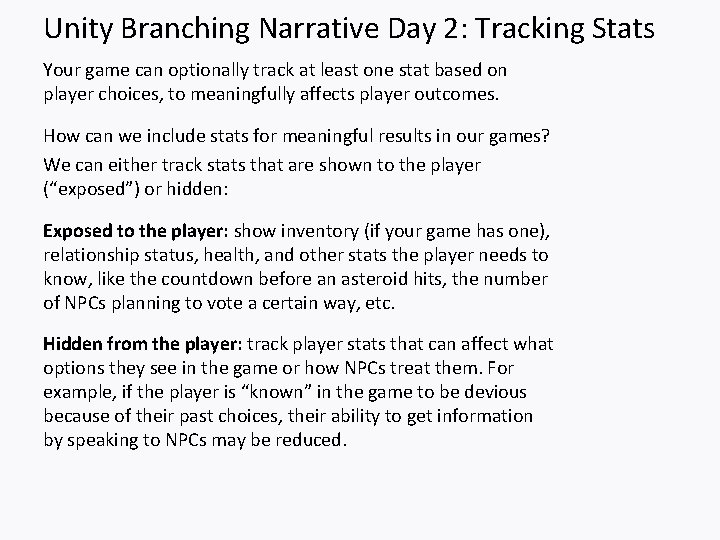
Unity Branching Narrative Day 2: Tracking Stats Your game can optionally track at least one stat based on player choices, to meaningfully affects player outcomes. How can we include stats for meaningful results in our games? We can either track stats that are shown to the player (“exposed”) or hidden: Exposed to the player: show inventory (if your game has one), relationship status, health, and other stats the player needs to know, like the countdown before an asteroid hits, the number of NPCs planning to vote a certain way, etc. Hidden from the player: track player stats that can affect what options they see in the game or how NPCs treat them. For example, if the player is “known” in the game to be devious because of their past choices, their ability to get information by speaking to NPCs may be reduced.
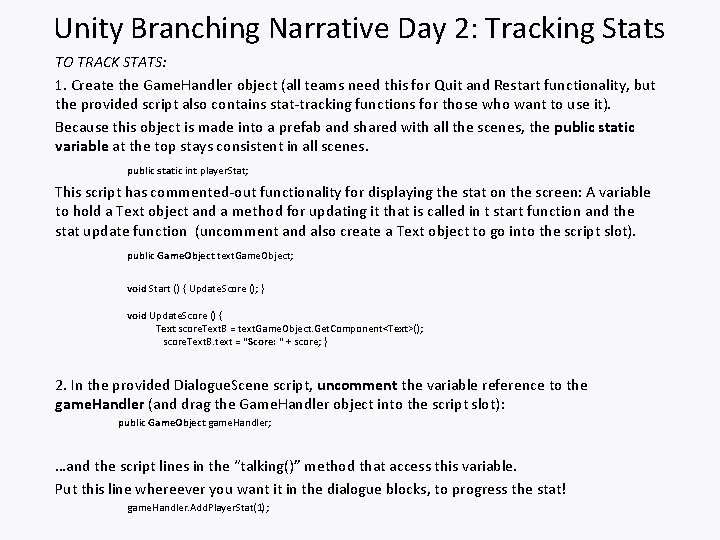
Unity Branching Narrative Day 2: Tracking Stats TO TRACK STATS: 1. Create the Game. Handler object (all teams need this for Quit and Restart functionality, but the provided script also contains stat-tracking functions for those who want to use it). Because this object is made into a prefab and shared with all the scenes, the public static variable at the top stays consistent in all scenes. public static int player. Stat; This script has commented-out functionality for displaying the stat on the screen: A variable to hold a Text object and a method for updating it that is called in t start function and the stat update function (uncomment and also create a Text object to go into the script slot). public Game. Object text. Game. Object; void Start () { Update. Score (); } void Update. Score () { Text score. Text. B = text. Game. Object. Get. Component<Text>(); score. Text. B. text = "Score: " + score; } 2. In the provided Dialogue. Scene script, uncomment the variable reference to the game. Handler (and drag the Game. Handler object into the script slot): public Game. Object game. Handler; …and the script lines in the “talking()” method that access this variable. Put this line whereever you want it in the dialogue blocks, to progress the stat! game. Handler. Add. Player. Stat(1);
Narrative Game Design day 2: Voice What do we mean by the VOICE of a character in a story or game? What is a story (in any medium) where you were interested the VOICE of a character?
Narrative Game Design day 2: Voice in a story is an important way we define the experience for the player. Every NPC (non-player character) should have a distinct way of speaking for them to come alive in your text game. We can use word choice, jargon (professional terms), slang (social coding), grammar (contractions, etc), and idioms to indicate a particular place, time, or social group. Language can reflect character age, education level, and interests. Also, consider: who is the narrator in your game? Consider the “evil” narrators in Portal and Stanley Parable. How can the narrator’s own bias or limited view add depth to the story/game experience? How does the language we choose define the player character?
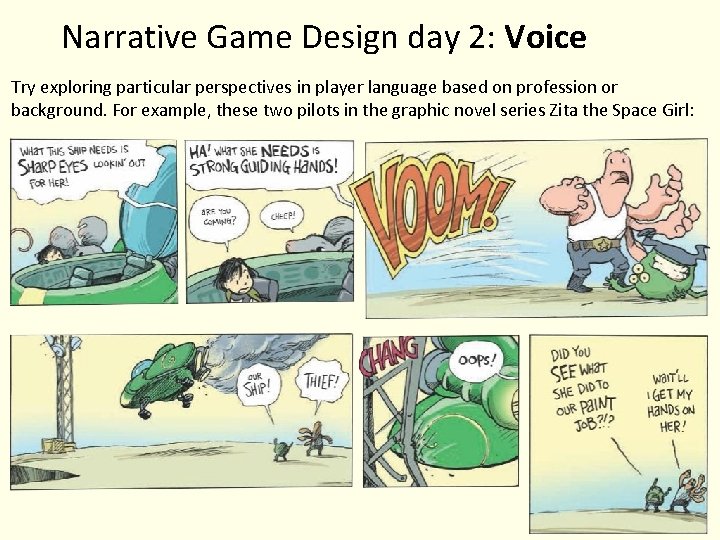
Narrative Game Design day 2: Voice Try exploring particular perspectives in player language based on profession or background. For example, these two pilots in the graphic novel series Zita the Space Girl:
Narrative Game Design day 2: Voice is one of the important ways that we reveal character, along with description and actions. Writing a character with a clear VOICE will reveals character through: • The vocabulary and word choice • The implied accent. • The rhythm: sentence length and emphasis • Tone: as text on a page, tone can be established through word choice (emotionally light or heavy), and through devices such as alliteration (creates a lighter/poetic tone). • Indications of a character’s inner mind: Freudian slips can sow what the character is really thinking, as can dialogue in secret that later can inform our understanding of scenes that seem to contradict what was said earlier; character revealed through lying
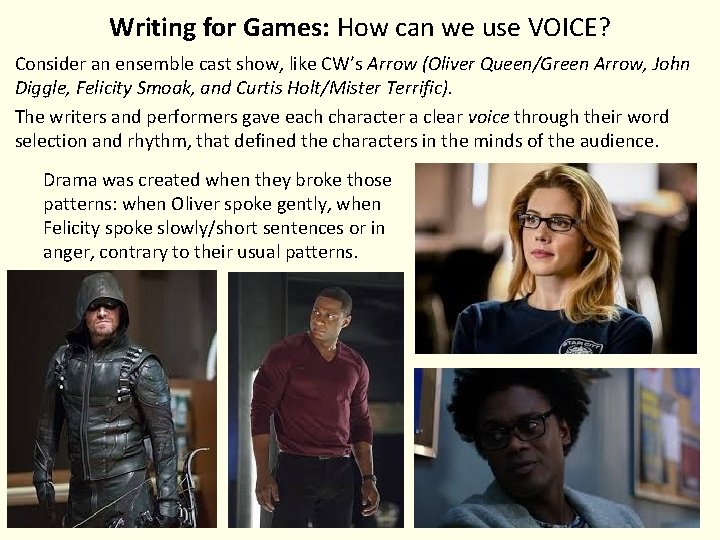
Writing for Games: How can we use VOICE? Consider an ensemble cast show, like CW’s Arrow (Oliver Queen/Green Arrow, John Diggle, Felicity Smoak, and Curtis Holt/Mister Terrific). The writers and performers gave each character a clear voice through their word selection and rhythm, that defined the characters in the minds of the audience. Drama was created when they broke those patterns: when Oliver spoke gently, when Felicity spoke slowly/short sentences or in anger, contrary to their usual patterns.
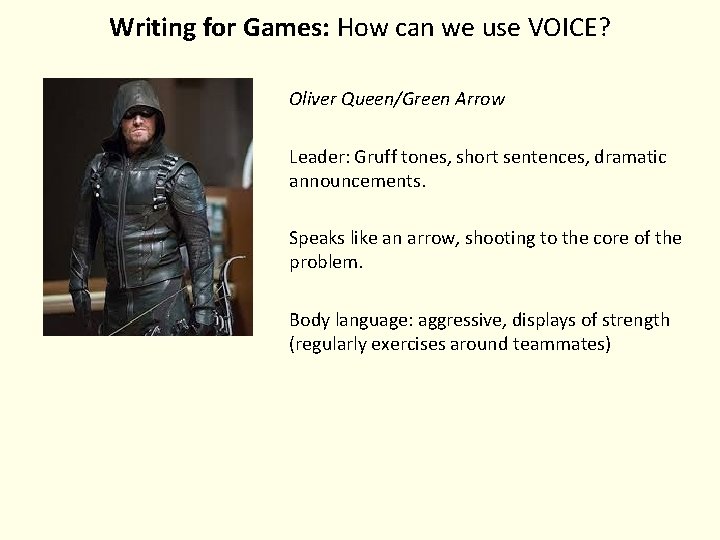
Writing for Games: How can we use VOICE? Oliver Queen/Green Arrow Leader: Gruff tones, short sentences, dramatic announcements. Speaks like an arrow, shooting to the core of the problem. Body language: aggressive, displays of strength (regularly exercises around teammates)
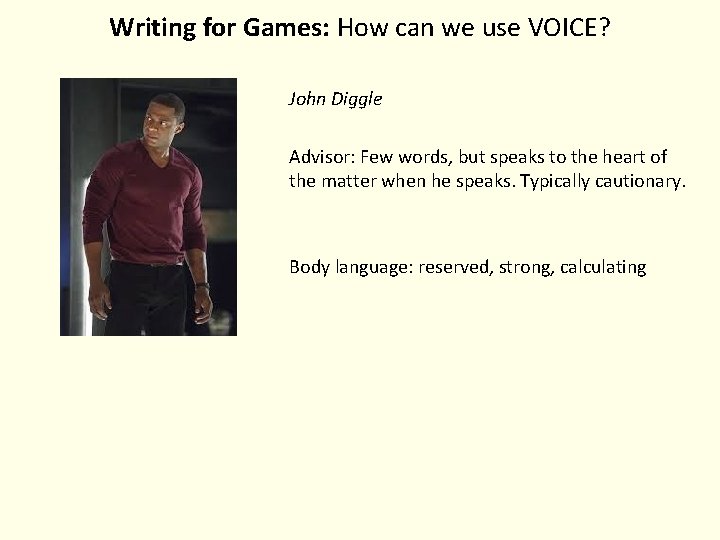
Writing for Games: How can we use VOICE? John Diggle Advisor: Few words, but speaks to the heart of the matter when he speaks. Typically cautionary. Body language: reserved, strong, calculating
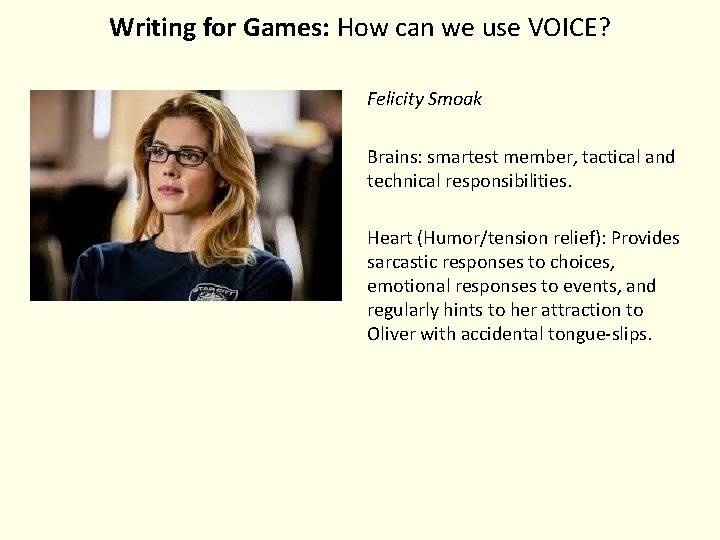
Writing for Games: How can we use VOICE? Felicity Smoak Brains: smartest member, tactical and technical responsibilities. Heart (Humor/tension relief): Provides sarcastic responses to choices, emotional responses to events, and regularly hints to her attraction to Oliver with accidental tongue-slips.
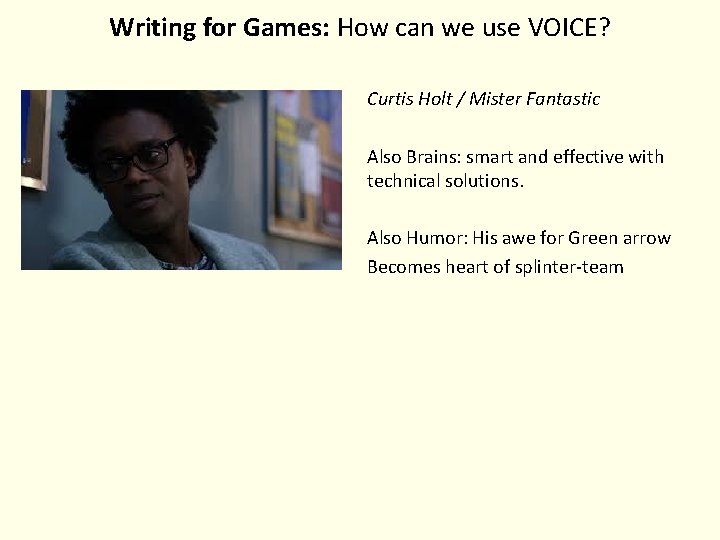
Writing for Games: How can we use VOICE? Curtis Holt / Mister Fantastic Also Brains: smart and effective with technical solutions. Also Humor: His awe for Green arrow Becomes heart of splinter-team
Character Design As a team, discuss the characters in your chosen story, and answer questions that can help inform the voice of the character: • Historical Period, class, and possible idioms • Character Age • Education, and media consumption • Passions/Occupations (people, profession, hobby that could inform their vocabulary and perspective) • Attitude towards parts of their life, and the world. What are they attracted to? To what do they feel fear or disdain? • Race, Gender, Ethnic Background • What else can we ask about these characters?
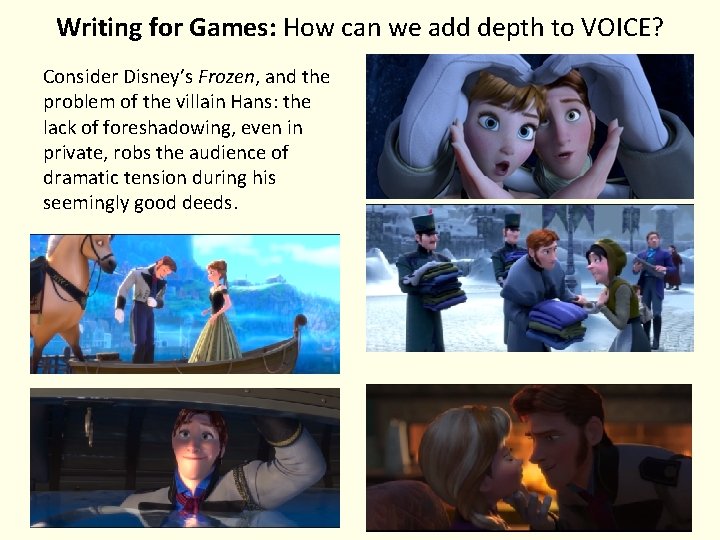
Writing for Games: How can we add depth to VOICE? Consider Disney’s Frozen, and the problem of the villain Hans: the lack of foreshadowing, even in private, robs the audience of dramatic tension during his seemingly good deeds.
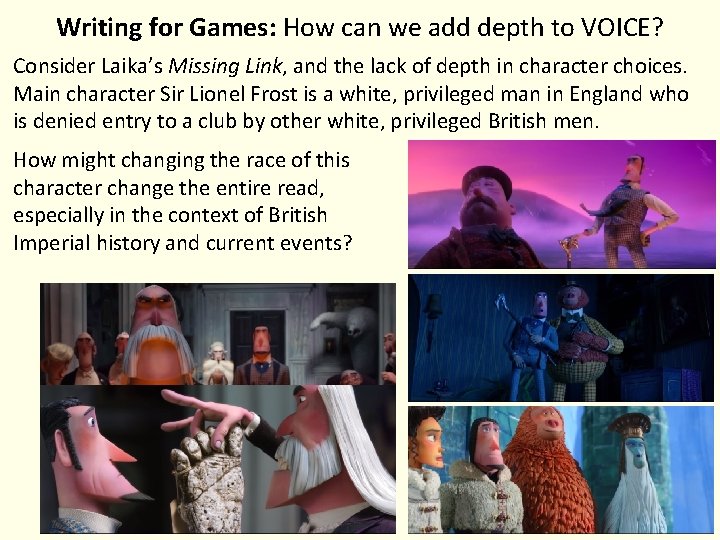
Writing for Games: How can we add depth to VOICE? Consider Laika’s Missing Link, and the lack of depth in character choices. Main character Sir Lionel Frost is a white, privileged man in England who is denied entry to a club by other white, privileged British men. How might changing the race of this character change the entire read, especially in the context of British Imperial history and current events?
Writing for Games: How can we add depth to VOICE? Writing Prompts!
The First Reading: Art of Game Design: a Book of Lenses by Jesse Schell (pp 40 -74)
The First Reading: Art of Game Design: a Book of Lenses by Jesse Schell (pp 40 -74) LENSES: • (p 43) Lense #7: Elemental Tetrad: » Mechanics » Story » Aesthetics » Technology (Focus revision on these four paths)
The First Reading: Art of Game Design: a Book of Lenses by Jesse Schell (pp 40 -74) LENSES: • (p 43) Lense #7: Elemental Tetrad: » Mechanics, Story, Aesthetics, Technology • (p 53) Lense #9: Unification: » All elements work to support a Theme
The First Reading: Art of Game Design: a Book of Lenses by Jesse Schell (pp 40 -74) LENSES: • (p 43) Lense #7: Elemental Tetrad: » Mechanics, Story, Aesthetics, Technology • (p 53) Lense #9: Unification: » All elements work to support a Theme • (p 59) Lense #11: Infinite Inspiration: » Get inspiration for games from everything EXCEPT games
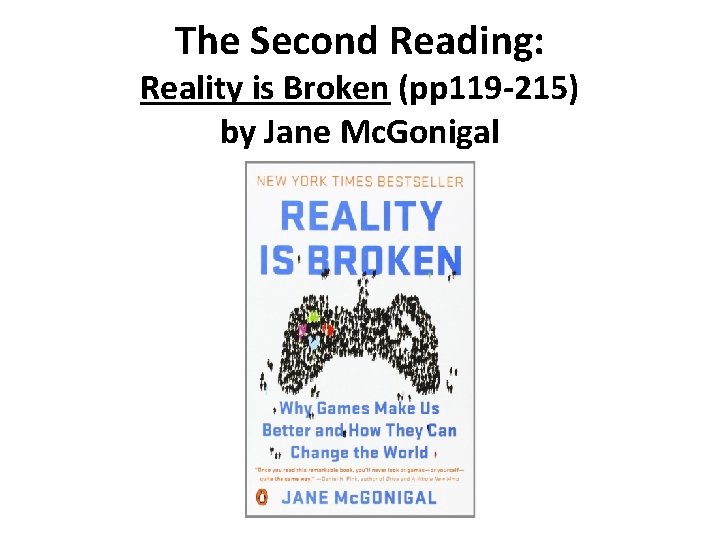
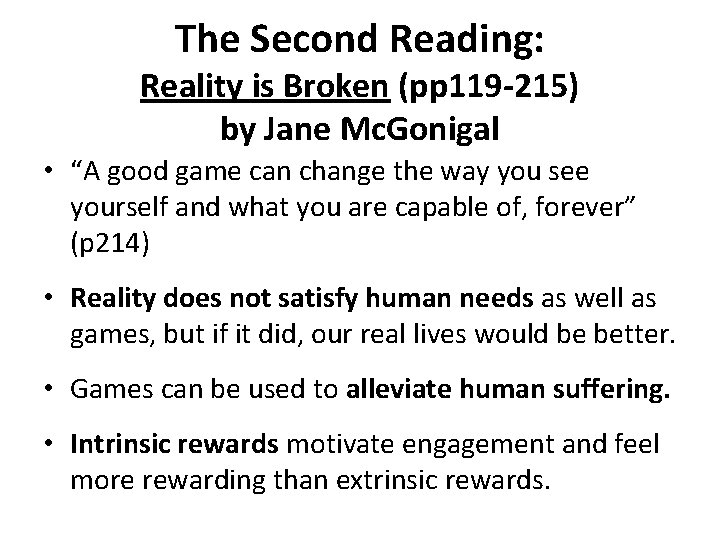
The Second Reading: Reality is Broken (pp 119 -215) by Jane Mc. Gonigal
The Second Reading: Reality is Broken (pp 119 -215) by Jane Mc. Gonigal • “A good game can change the way you see yourself and what you are capable of, forever” (p 214) • Reality does not satisfy human needs as well as games, but if it did, our real lives would be better. • Games can be used to alleviate human suffering. • Intrinsic rewards motivate engagement and feel more rewarding than extrinsic rewards.
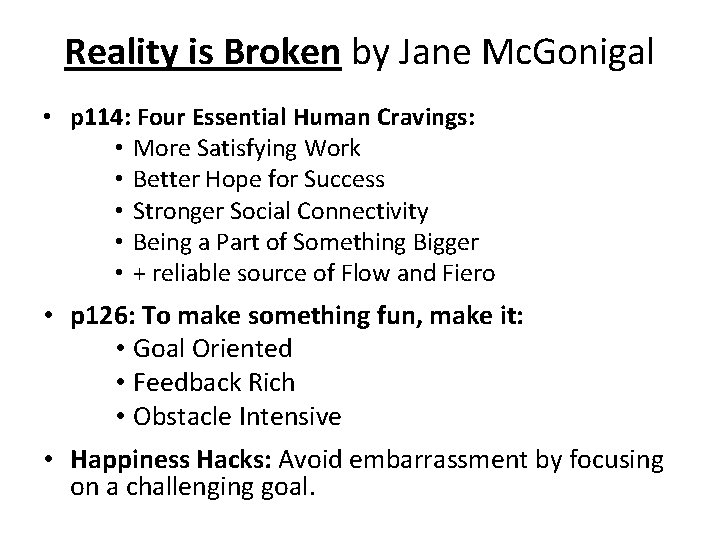
Reality is Broken by Jane Mc. Gonigal • p 114: Four Essential Human Cravings: • More Satisfying Work • Better Hope for Success • Stronger Social Connectivity • Being a Part of Something Bigger • + reliable source of Flow and Fiero • p 126: To make something fun, make it: • Goal Oriented • Feedback Rich • Obstacle Intensive • Happiness Hacks: Avoid embarrassment by focusing on a challenging goal.
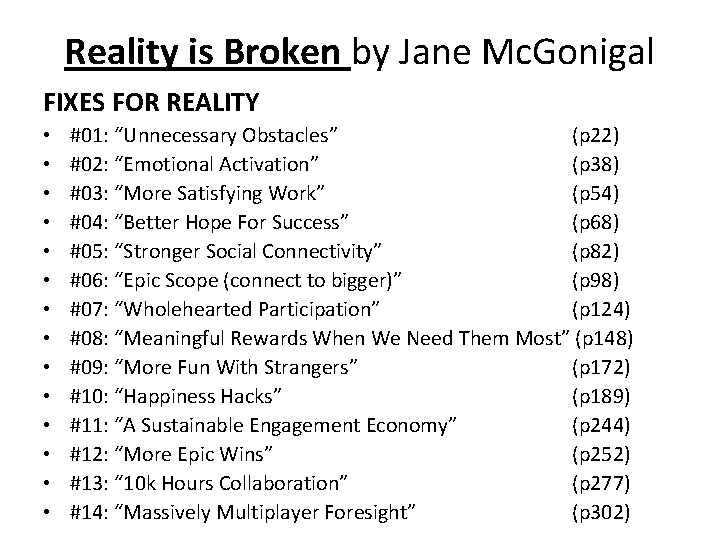
Reality is Broken by Jane Mc. Gonigal FIXES FOR REALITY • • • • #01: “Unnecessary Obstacles” (p 22) #02: “Emotional Activation” (p 38) #03: “More Satisfying Work” (p 54) #04: “Better Hope For Success” (p 68) #05: “Stronger Social Connectivity” (p 82) #06: “Epic Scope (connect to bigger)” (p 98) #07: “Wholehearted Participation” (p 124) #08: “Meaningful Rewards When We Need Them Most” (p 148) #09: “More Fun With Strangers” (p 172) #10: “Happiness Hacks” (p 189) #11: “A Sustainable Engagement Economy” (p 244) #12: “More Epic Wins” (p 252) #13: “ 10 k Hours Collaboration” (p 277) #14: “Massively Multiplayer Foresight” (p 302)
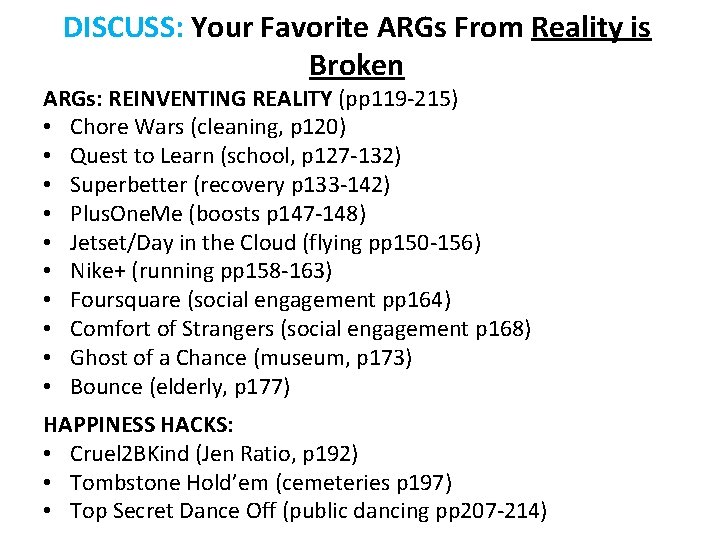
DISCUSS: Your Favorite ARGs From Reality is Broken ARGs: REINVENTING REALITY (pp 119 -215) • Chore Wars (cleaning, p 120) • Quest to Learn (school, p 127 -132) • Superbetter (recovery p 133 -142) • Plus. One. Me (boosts p 147 -148) • Jetset/Day in the Cloud (flying pp 150 -156) • Nike+ (running pp 158 -163) • Foursquare (social engagement pp 164) • Comfort of Strangers (social engagement p 168) • Ghost of a Chance (museum, p 173) • Bounce (elderly, p 177) HAPPINESS HACKS: • Cruel 2 BKind (Jen Ratio, p 192) • Tombstone Hold’em (cemeteries p 197) • Top Secret Dance Off (public dancing pp 207 -214)
DESIGN METHOD #4: ALTERNATIVES TO MISERY Process for making an Alternate Reality Game: 1. Identify a source of misery. 2. List the mechanics of the misery 3. List real-world solutions for the misery. These are likely behaviors that people would want to do if they were not embarrassed, too busy, thoughtless, afraid, or otherwise focused. 4. Focus on one tangible behavioral solution at a time, and consider game mechanics that could encourage that behavior. Iterate: what can make those mechanics more meaningful, and more specific to the behavioral solution desired?
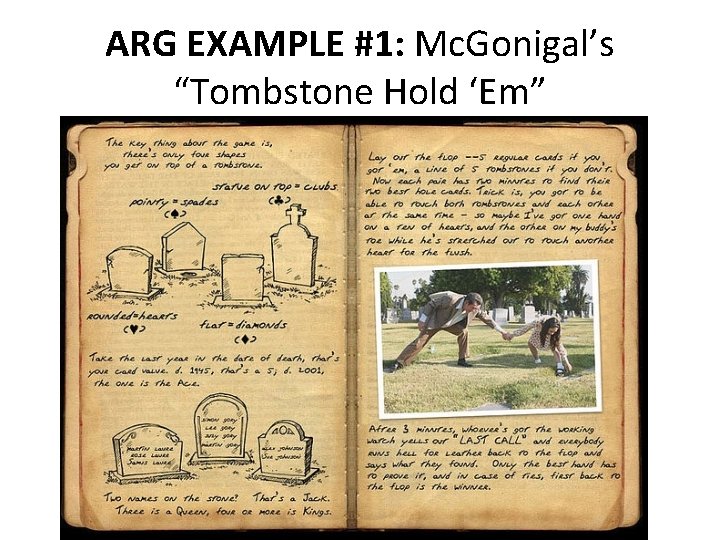
ARG EXAMPLE #1: Mc. Gonigal’s “Tombstone Hold ‘Em”
“Tombstone Hold ‘Em” ARG Process: 1. Identify Misery: Western culture has lost touch with it own mortality, leading to anxiety and loss of lifefocus. 2. List the Misery Mechanics: People avoid cemeteries, avoid thinking about the departed and their own limited lifetimes. Graveyards seen as creepy, taboo, isolating, sources of pain and fear. 3. List real-world solutions: Encourage death-bed roleplay, create social events in cemeteries. 4. Build a Game around one tangible solution: Social game in cemeteries where the gravestones themselves are critical game elements.
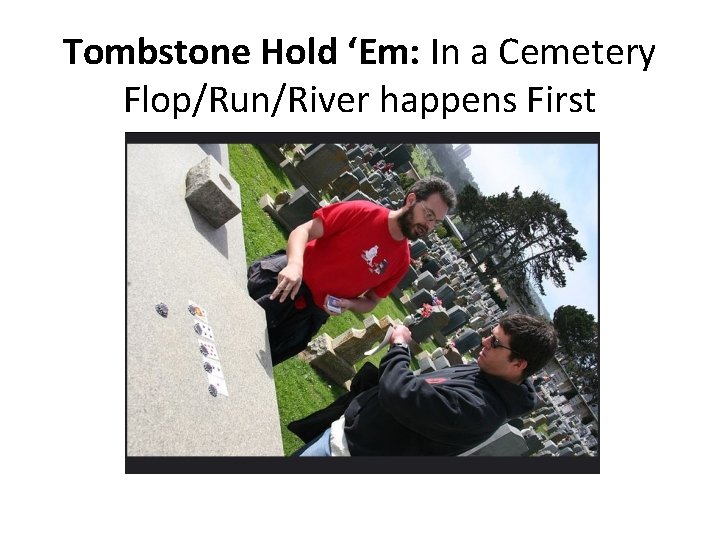
Texas Hold’em Basics: Sit at a Table • The Hole: Each player gets two cards (face down) • The Flop: Dealer deals 3 cards to the center of the table face up. • The Turn: Dealer adds a 4 th card to the Flop. • The River: Dealer adds a 5 th card to the Flop. • Hands/Betting: Between each of the above stages the players place bets based on the poker hand they can create between their Hole cards and the cards in the center (runs, pairs, etc).
Tombstone Hold ‘Em: In a Cemetery Flop/Run/River happens First
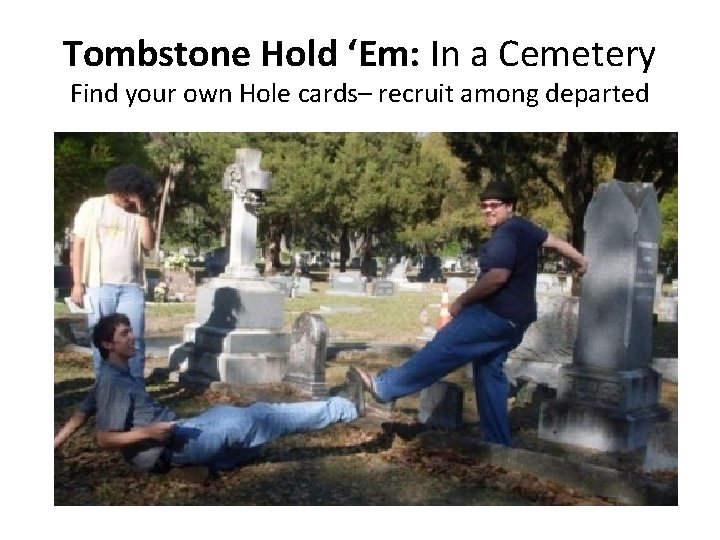
Tombstone Hold ‘Em: In a Cemetery • START WITH THE RIVER: All players gather in one location in the cemetery and the dealer puts out all five communal cards. • PLAYERS WORK IN PAIRS TO FIND THEIR HOLE CARDS: Search cemetery for two “cards” to get the best possible hand • stone shapes = suit: round=hearts, cross=clubs, point=spades, flat=diamonds. • dates/#names = card number/face: last number on a date = card number, multiple names on a stone = Jack, Queen, etc.
Tombstone Hold ‘Em: In a Cemetery Find your own Hole cards– recruit among departed
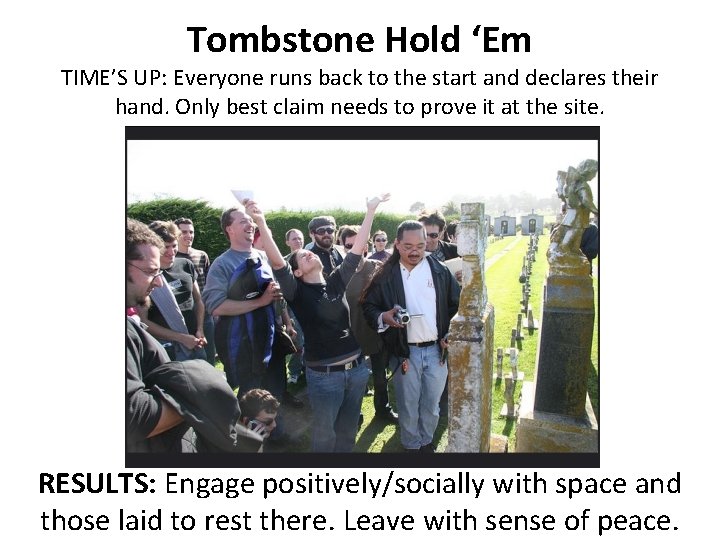
Tombstone Hold ‘Em TIME’S UP: Everyone runs back to the start and declares their hand. Only best claim needs to prove it at the site. RESULTS: Engage positively/socially with space and those laid to rest there. Leave with sense of peace.
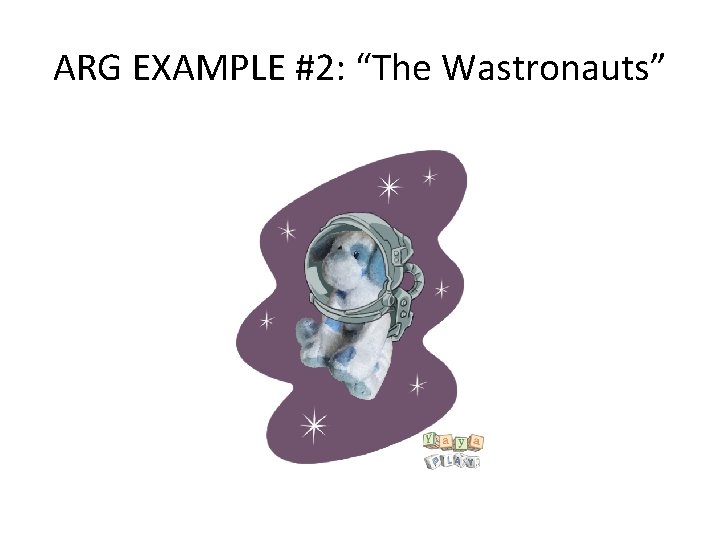
ARG EXAMPLE #2: “The Wastronauts”
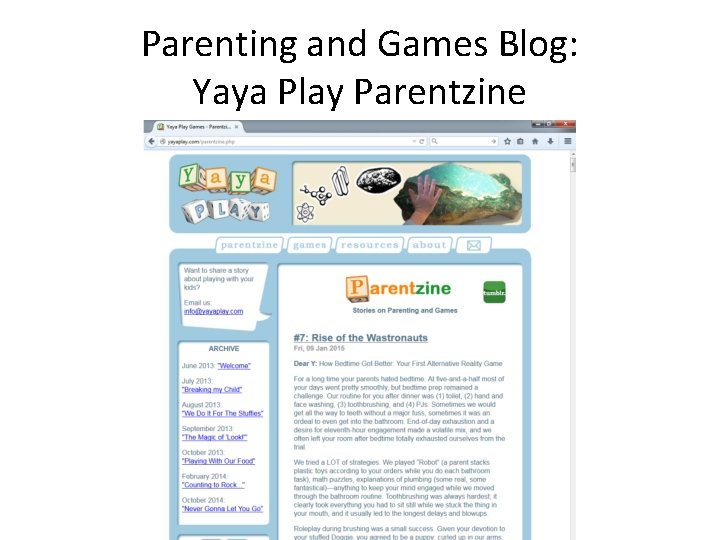
Parenting and Games Blog: Yaya Play Parentzine
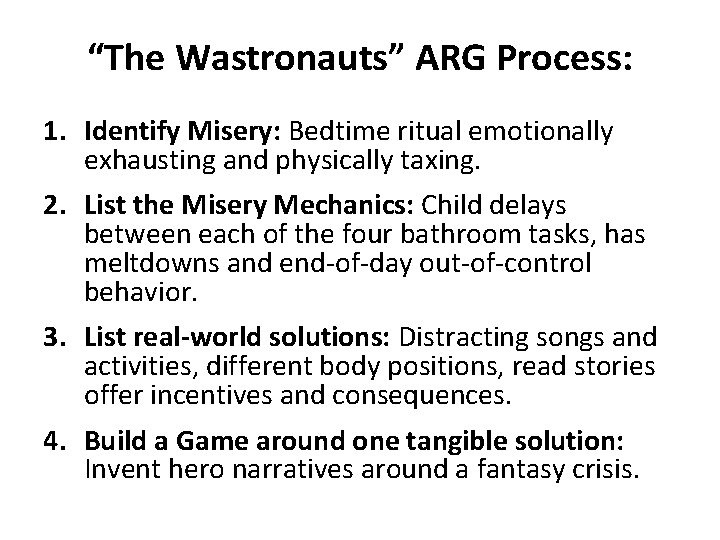
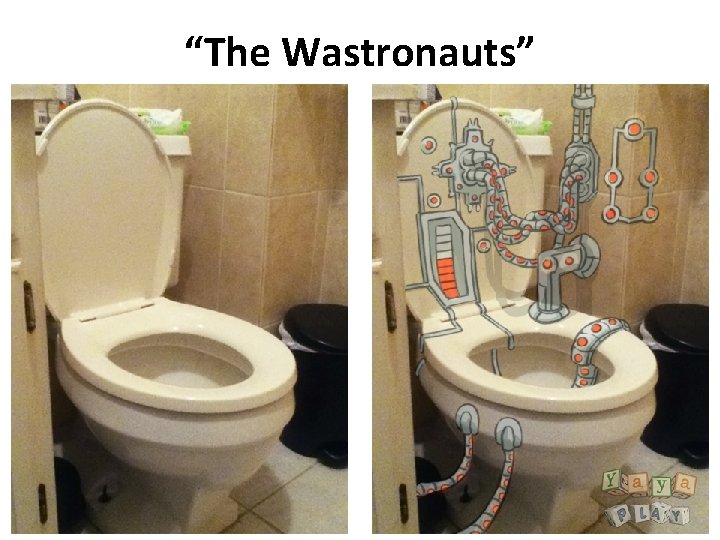
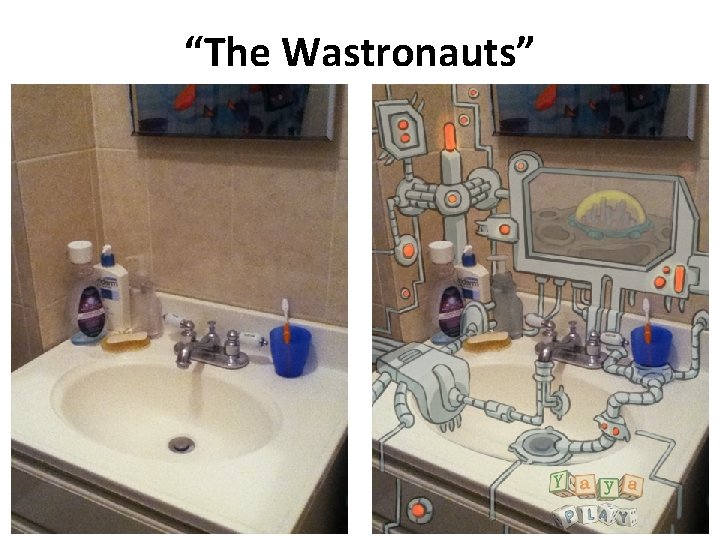
“The Wastronauts” ARG Process: 1. Identify Misery: Bedtime ritual emotionally exhausting and physically taxing. 2. List the Misery Mechanics: Child delays between each of the four bathroom tasks, has meltdowns and end-of-day out-of-control behavior. 3. List real-world solutions: Distracting songs and activities, different body positions, read stories offer incentives and consequences. 4. Build a Game around one tangible solution: Invent hero narratives around a fantasy crisis.
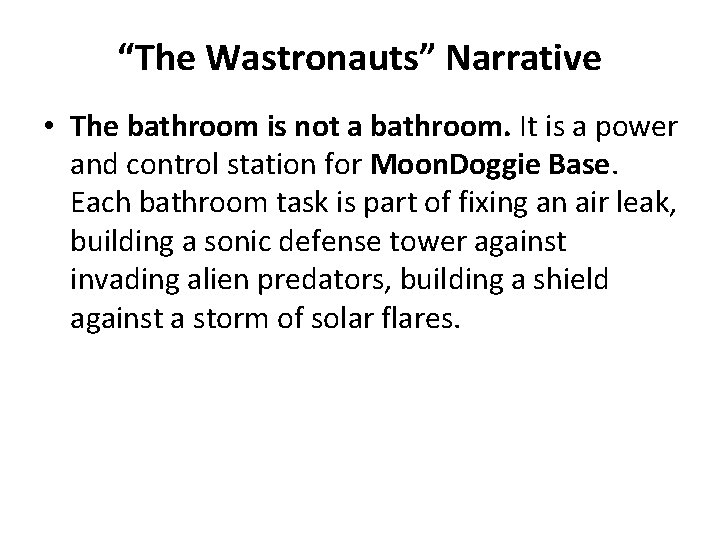
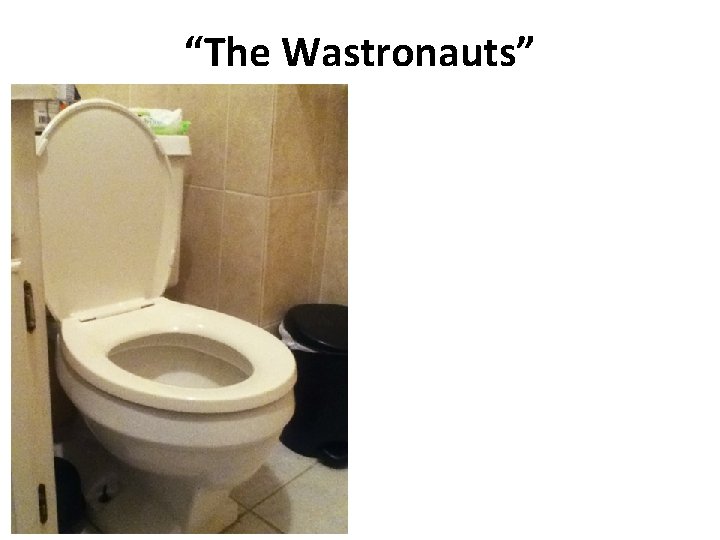
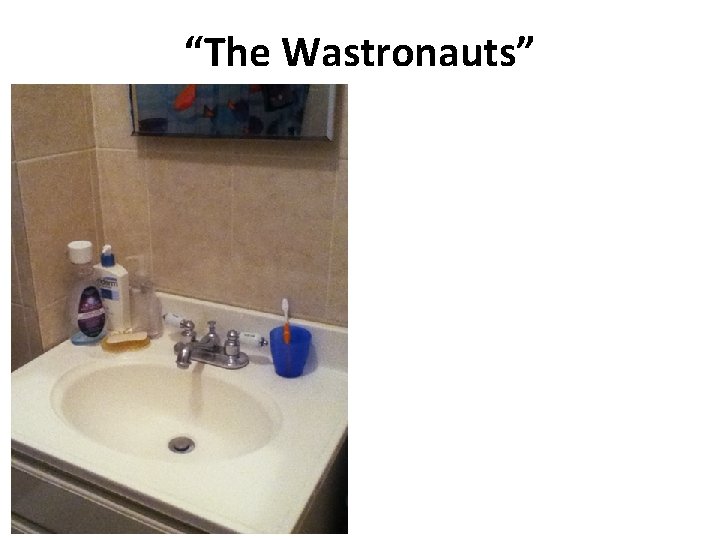
“The Wastronauts” Narrative • The bathroom is not a bathroom. It is a power and control station for Moon. Doggie Base. Each bathroom task is part of fixing an air leak, building a sonic defense tower against invading alien predators, building a shield against a storm of solar flares.
“The Wastronauts”
“The Wastronauts”
“The Wastronauts”
“The Wastronauts”
“The Wastronauts” • Translate each task into part of a larger narrative that supports her desire to take care of her stuffies. • Tasks she knows how to do so she feels happily productive and fully engaged. • Make it optional. • Make each task a bit more challenging than it needs to be so each completed task is an accomplishment. • Make the goal clear, add a ticking clock. • End with intrinsic reward: saving-the-day speech. • RESULT: Happy, engaged bedtimes, even improvements in timing.
GAME DESIGN EXERCISE: ALTERNATIVE REALITY GAMES PLEASE NOTE: • There is potential for this week’s assignment to enter into subjects which may be larger than your classmates have reasonable capacity in this course to engage. • Please be considerate and aware of your teammates and the larger class in choosing your topics and be aware of the possibility of “trigger” topics. • That said, I ask and trust you to communicate honestly with your teammates in setting appropriate boundaries this week in discussing sources of human misery, and please do not hesitate to contact your teacher with any questions or concerns.
GAME DESIGN EXERCISE: ALTERNATIVE REALITY GAMES • 1. TEAMS: Choose NEW teams of three. Everyone needs paper and pen to list Miseries/Solutions. • 2. MISERY IN PRIVATE: Take 5 minutes alone and in silence to list personal and social miseries. What makes you or people you know afraid in their daily lives? What unavoidable tasks make them unhappy, depressed, full of worry or shame? Both smaller and bigger sources are welcome. • 3. MISERY IN COMPANY: Discuss your list with your new teammates, taking notes on paper. • 4. MECHANICS OF MISERY: Choose a misery you find particularly interesting or deplorable. Identify the mechanics of the misery– how does it make people miserable? How does it affect their lives in larger ways? • 5. SOLUTIONS: Choose 1 mechanic of misery and consider behavioral solutions, if only the people involved were not so embarrassed, in pain, isolated, or otherwise feeling incapable of feeling otherwise. • 6. GAMES: Brainstorm game ideas – paper or participatory – to engage 1 of those solutions by adding GOALS, CHALLENGING OBSTACLES, and RICH FEEDBACK
Due Next Week: HOMEWORK #6: With your third team, discuss how one more player stats and ambient audio can be incorporated into your game for meaningful results. Complete your Narrative Game: Divide up the writing, art, and Scene building work to complete 10+ Scenes as well as the Menu, Win and Lose Scenes. PLAYTEST: Please have all members test the game to make fixes/revisions before creating the build and submitting (and also test the builds)! As a team, submit to Piazza hw 6: a. ZIP file containing the PC build another containing the Mac build. INDIVIDUALLY: : ALSO Individually, post a brief description of a final digital game concept. Start with the title, genre, and what is unique or interesting to you about this idea: 2 D or 3 D digital games, single or local multiplayer, with interesting place, time, character, movement, and goals.
Have a Spectacular Week! And don’t forget to email us with questions: Instructor: JASON WISER Jason. Wiser. Art@gmail. com Available an hour after class and daily email