
Game Art and Design Unit 3 Lesson 2

- Slides: 33
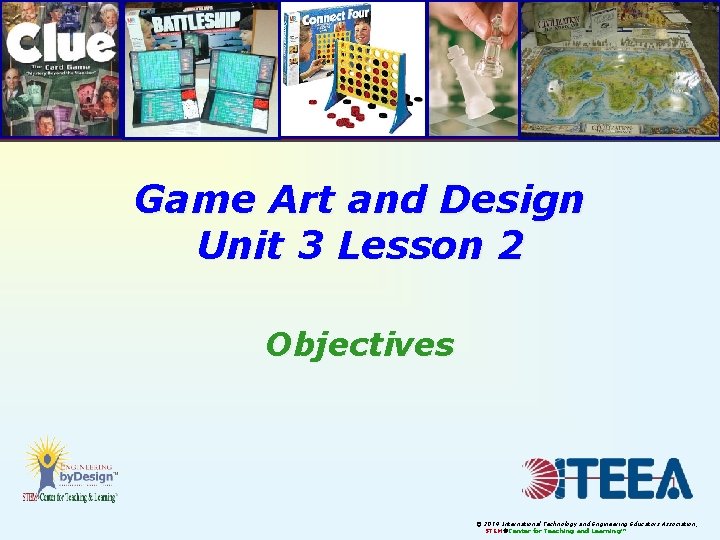
Game Art and Design Unit 3 Lesson 2 Objectives © 2014 International Technology and Engineering Educators Association, STEM Center for Teaching and Learning™
Big Idea Knowledge of the basic skills and components of any field makes one uniquely prepared to perform at a high level in that area. © 2011 2014 International Technology and Engineering Educators Association, STEM Center for Teaching and Learning™
GAME OBJECTIVES © 2011 International Technology and Engineering Educators Association, STEM Center for Teaching and Learning™
Game Objectives • A game objective is what a player is trying to achieve in order to win. • Consider these questions • What are some of the objectives of games you have played? • What are the players trying to do? • How do you win? • These are questions a designer asks about a game objective. © 2011 2014 International Technology and Engineering Educators Association, STEM Center for Teaching and Learning™
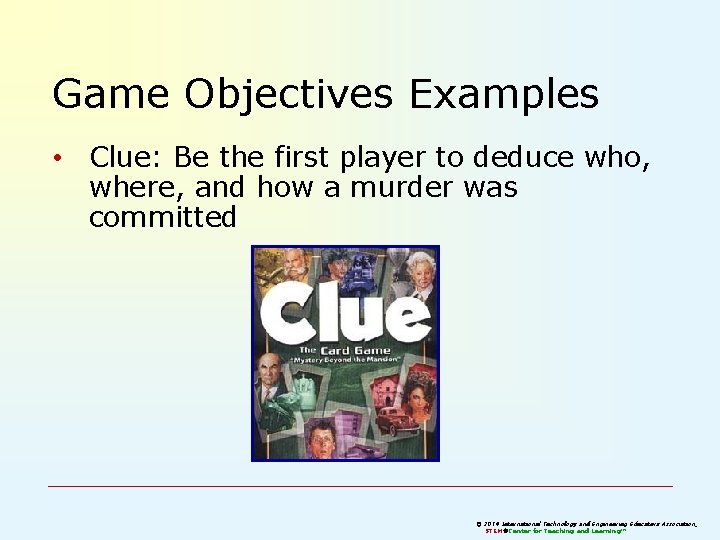
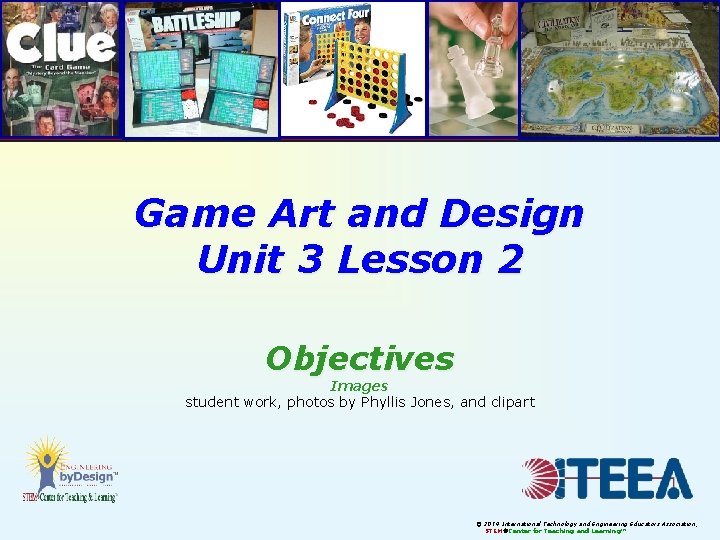
Game Objectives Examples • Clue: Be the first player to deduce who, where, and how a murder was committed © 2011 2014 International Technology and Engineering Educators Association, STEM Center for Teaching and Learning™
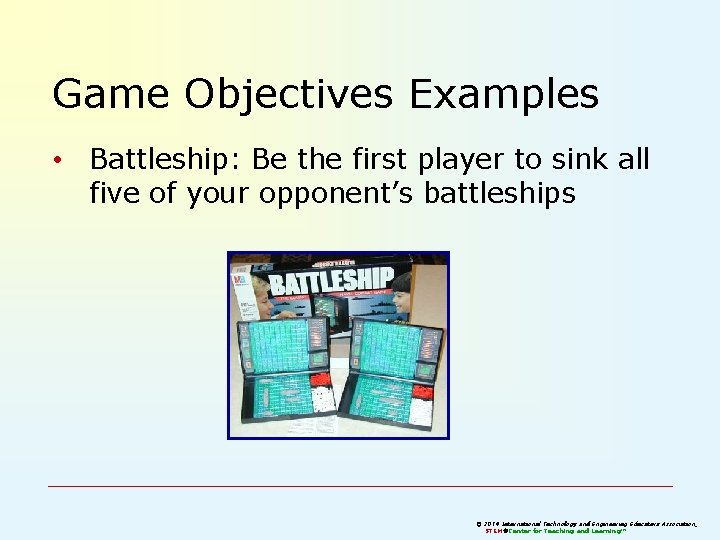
Game Objectives Examples • Battleship: Be the first player to sink all five of your opponent’s battleships © 2011 2014 International Technology and Engineering Educators Association, STEM Center for Teaching and Learning™
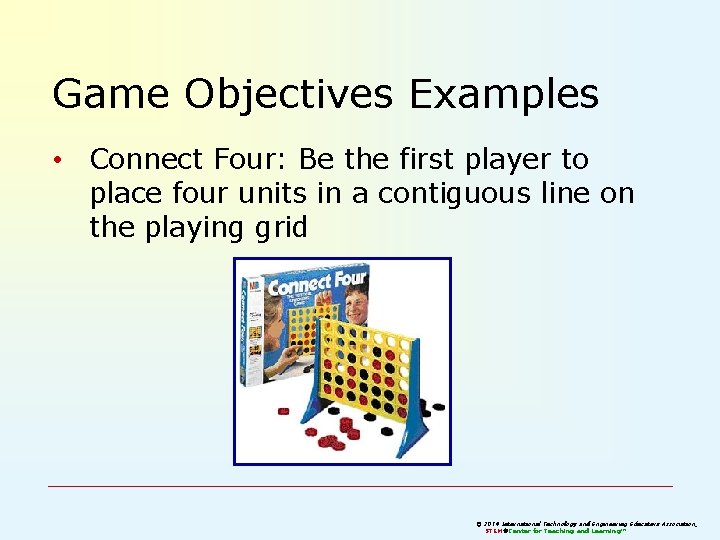
Game Objectives Examples • Connect Four: Be the first player to place four units in a contiguous line on the playing grid © 2011 2014 International Technology and Engineering Educators Association, STEM Center for Teaching and Learning™
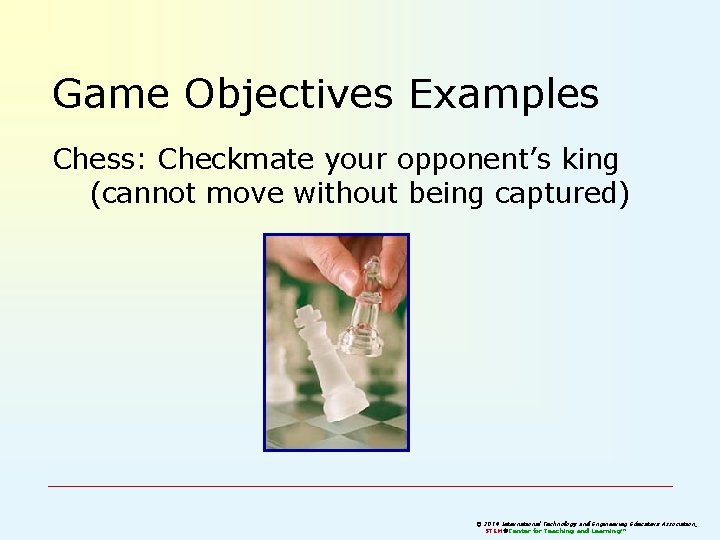
Game Objectives Examples Chess: Checkmate your opponent’s king (cannot move without being captured) © 2011 2014 International Technology and Engineering Educators Association, STEM Center for Teaching and Learning™
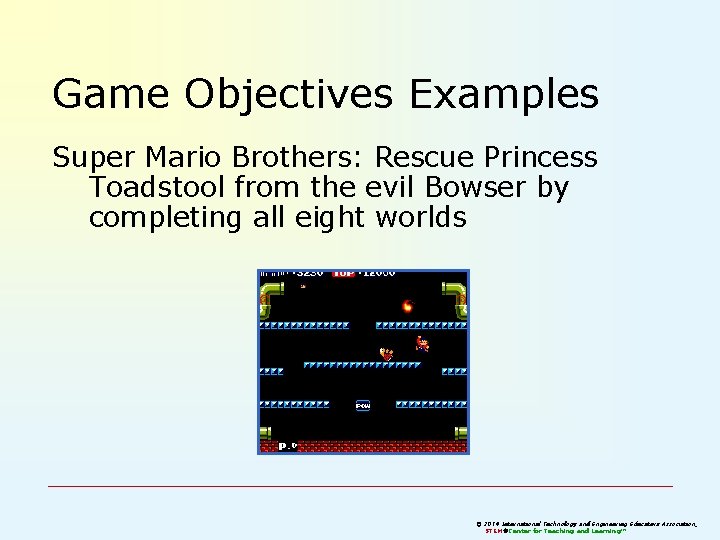
Game Objectives Examples Super Mario Brothers: Rescue Princess Toadstool from the evil Bowser by completing all eight worlds © 2011 2014 International Technology and Engineering Educators Association, STEM Center for Teaching and Learning™
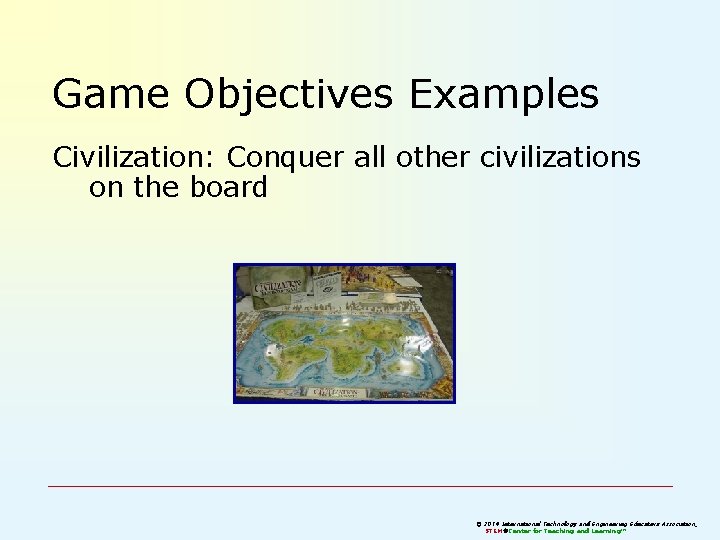
Game Objectives Examples Civilization: Conquer all other civilizations on the board © 2011 2014 International Technology and Engineering Educators Association, STEM Center for Teaching and Learning™
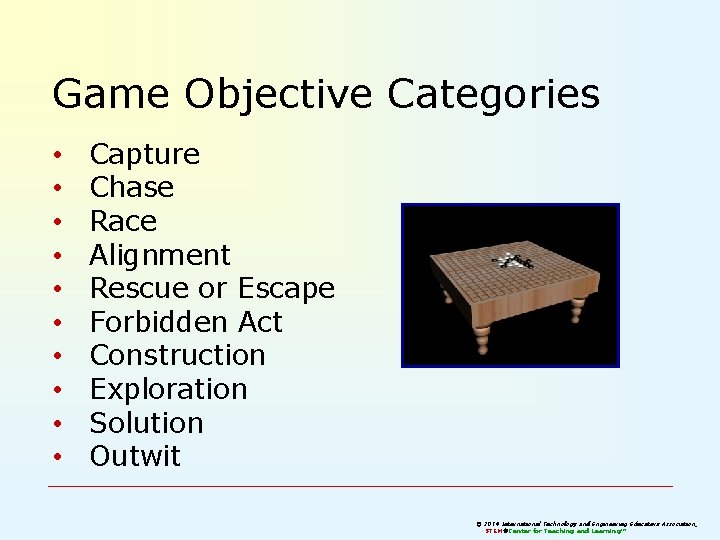
Game Objective Categories • • • Capture Chase Race Alignment Rescue or Escape Forbidden Act Construction Exploration Solution Outwit © 2011 2014 International Technology and Engineering Educators Association, STEM Center for Teaching and Learning™
Game Objective: Capture • Take or capture something of the opponent’s while avoiding being captured or killed. • Includes games like checkers and chess. • Also in this category are real-time strategy games. • The concept of capturing (killing) the opponent’s forces in very common in games. © 2011 2014 International Technology and Engineering Educators Association, STEM Center for Teaching and Learning™
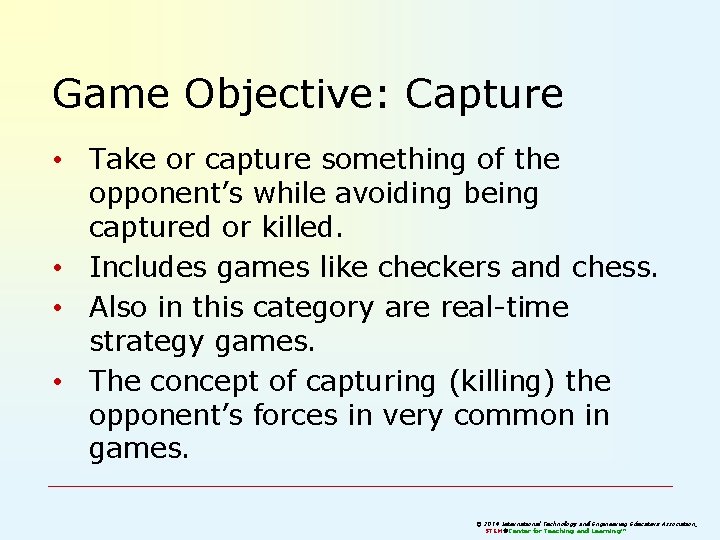
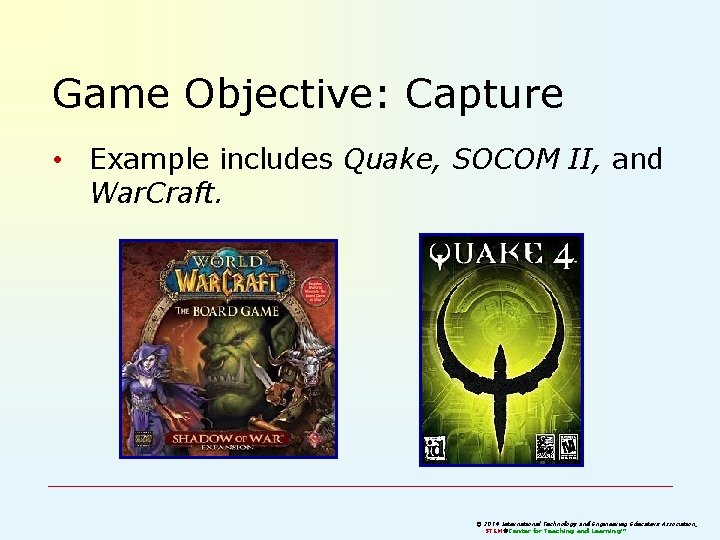
Game Objective: Capture • Example includes Quake, SOCOM II, and War. Craft. © 2011 2014 International Technology and Engineering Educators Association, STEM Center for Teaching and Learning™
Game Objective: Chase • Catch or elude an opponent. • Chase games can be structured as single -player vs. game, player vs. player, or unilateral competition. • Chase games can be determined by • speed or physical dexterity • Stealth and strategy • Logic and deduction © 2011 2014 International Technology and Engineering Educators Association, STEM Center for Teaching and Learning™
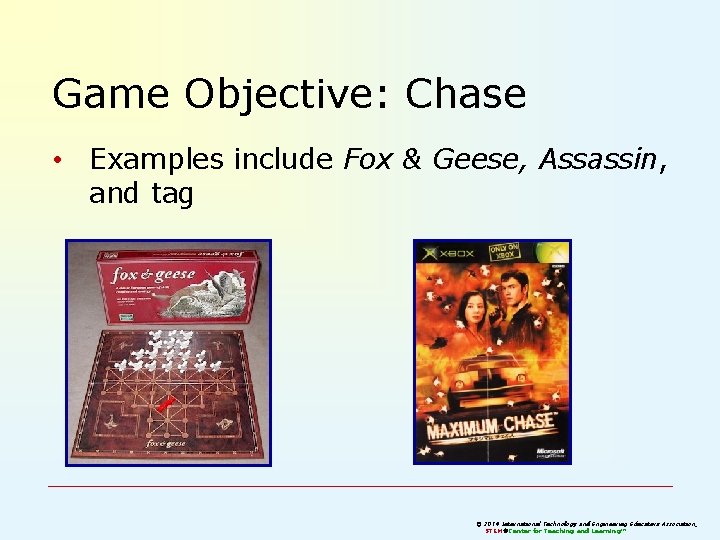
Game Objective: Chase • Examples include Fox & Geese, Assassin, and tag © 2011 2014 International Technology and Engineering Educators Association, STEM Center for Teaching and Learning™
Game Objective: Race • Reach a goal – physical or conceptual – before the other players. • Examples could be a footrace, a board game like Uncle Wiggly or Parcheesi. • Can be determined by physical dexterity. • Can also be determined by a mix of strategy and chance – like Backgammon. © 2011 2014 International Technology and Engineering Educators Association, STEM Center for Teaching and Learning™
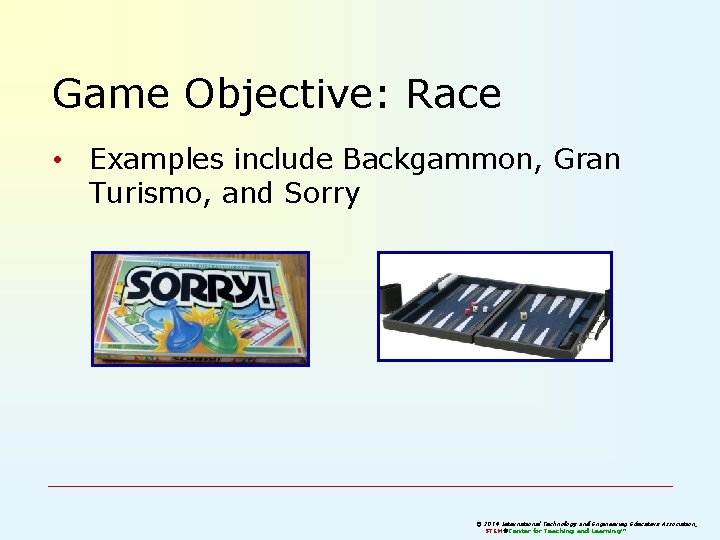
Game Objective: Race • Examples include Backgammon, Gran Turismo, and Sorry © 2011 2014 International Technology and Engineering Educators Association, STEM Center for Teaching and Learning™
Game Objective: Alignment • Arrange game pieces in a certain configuration or create conceptual alignment between categories of pieces. • Often puzzle-like because they require “solving” spatial or organizational problems. • Determined by: • • Logic and calculation Chance opportunity © 2011 2014 International Technology and Engineering Educators Association, STEM Center for Teaching and Learning™
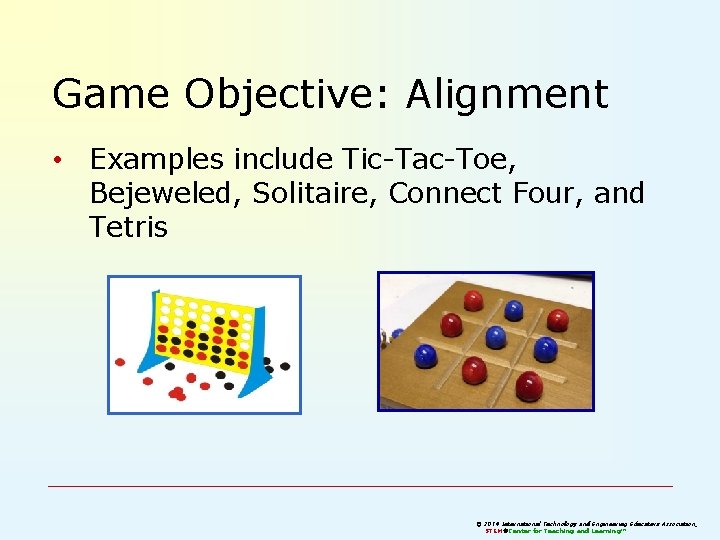
Game Objective: Alignment • Examples include Tic-Tac-Toe, Bejeweled, Solitaire, Connect Four, and Tetris © 2011 2014 International Technology and Engineering Educators Association, STEM Center for Teaching and Learning™
Game Objective Rescue • The objective is a rescue or escape game is to get a defined unit or units to safety. • The objective is often combined with other partial objectives. © 2011 2014 International Technology and Engineering Educators Association, STEM Center for Teaching and Learning™
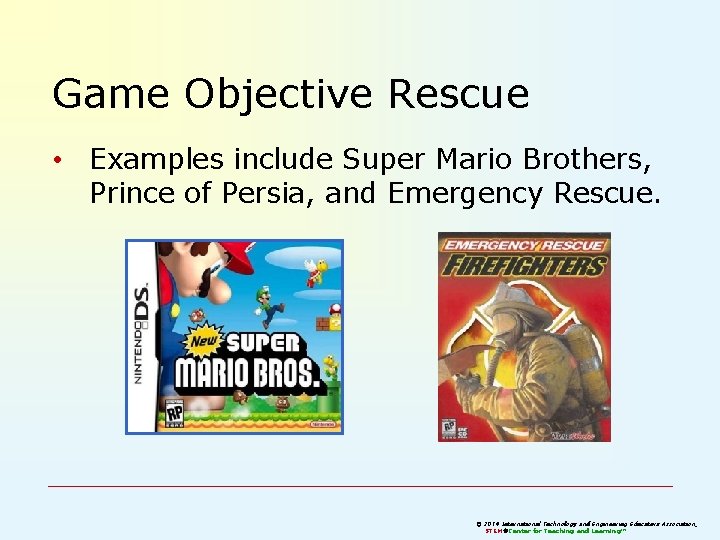
Game Objective Rescue • Examples include Super Mario Brothers, Prince of Persia, and Emergency Rescue. © 2011 2014 International Technology and Engineering Educators Association, STEM Center for Teaching and Learning™
Game Objective: Forbidden Act • The objective in a forbidden act game is to get the competition to “break the rules” by laughing, talking, letting go, making wrong moves, or doing something they shouldn’t. • Not often found in digital games. • Sometimes involves stamina or flexibility. © 2011 2014 International Technology and Engineering Educators Association, STEM Center for Teaching and Learning™
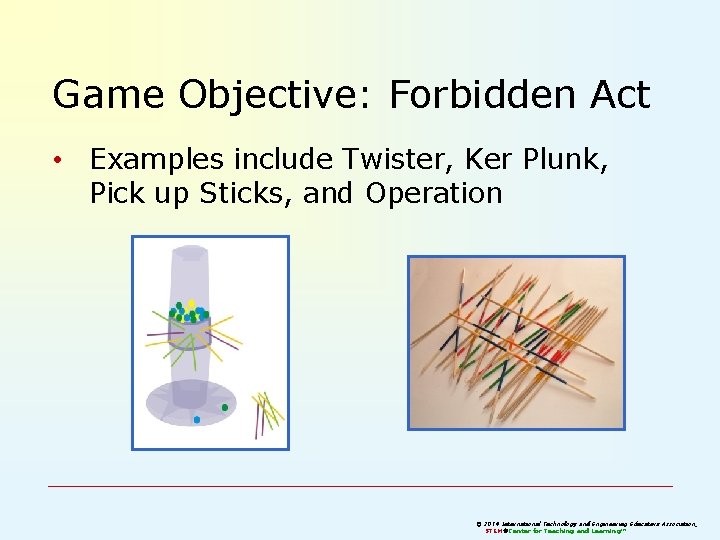
Game Objective: Forbidden Act • Examples include Twister, Ker Plunk, Pick up Sticks, and Operation © 2011 2014 International Technology and Engineering Educators Association, STEM Center for Teaching and Learning™
Game Objective: Construction • The object in a construction game is to build, maintain, or manage objects. • May be directly competitive or indirectly competitive. • Games with a construction objective often make use of resource management or trading as a game element. © 2011 2014 International Technology and Engineering Educators Association, STEM Center for Teaching and Learning™
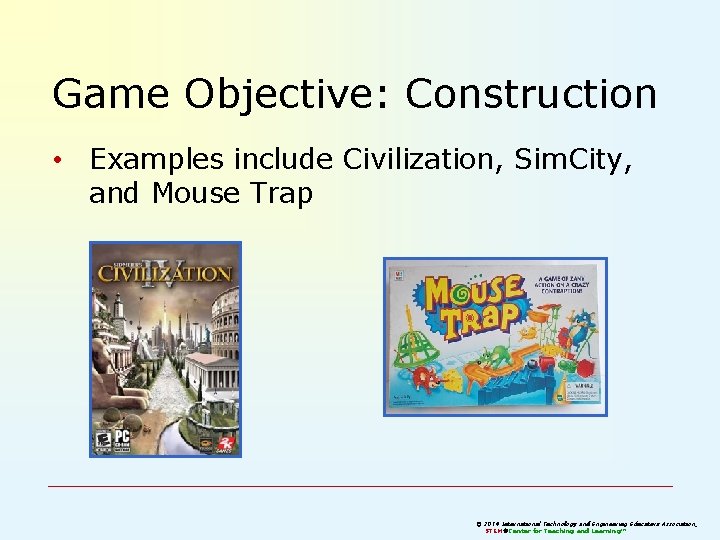
Game Objective: Construction • Examples include Civilization, Sim. City, and Mouse Trap © 2011 2014 International Technology and Engineering Educators Association, STEM Center for Teaching and Learning™
Game Objective: Exploration • The object in an exploration game is to explore game areas – usually combined with a competitive objective. • Sometimes multiple objectives such as exploration, puzzle solving, and combat intertwine to form multifaceted gameplay. © 2011 2014 International Technology and Engineering Educators Association, STEM Center for Teaching and Learning™
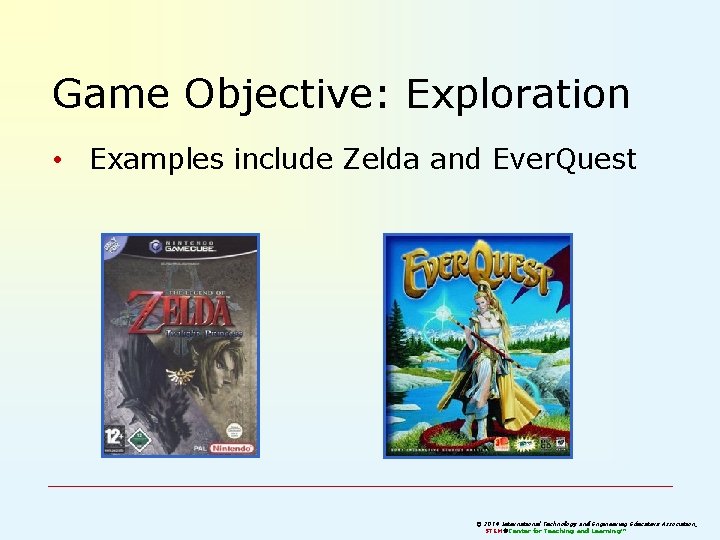
Game Objective: Exploration • Examples include Zelda and Ever. Quest © 2011 2014 International Technology and Engineering Educators Association, STEM Center for Teaching and Learning™
Game Objective: Solution • The object in a solution game is to solve a problem or puzzle before the competition. © 2011 2014 International Technology and Engineering Educators Association, STEM Center for Teaching and Learning™
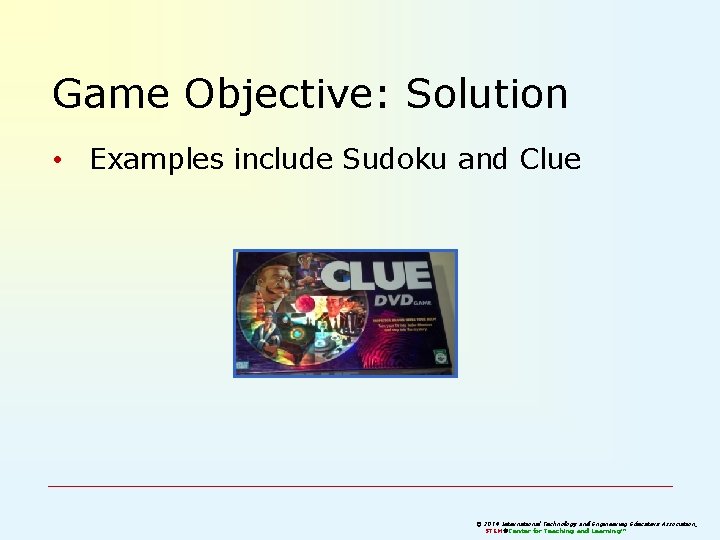
Game Objective: Solution • Examples include Sudoku and Clue © 2011 2014 International Technology and Engineering Educators Association, STEM Center for Teaching and Learning™
Game Objective: Outwit • The object in a game of wits is to gain and use knowledge in a way that defeats the other players. • Sometimes “extra-game” knowledge comes into gameplay (Jeopardy or Trivial Pursuit). • This type of game may provoke interesting social dynamics. © 2011 2014 International Technology and Engineering Educators Association, STEM Center for Teaching and Learning™
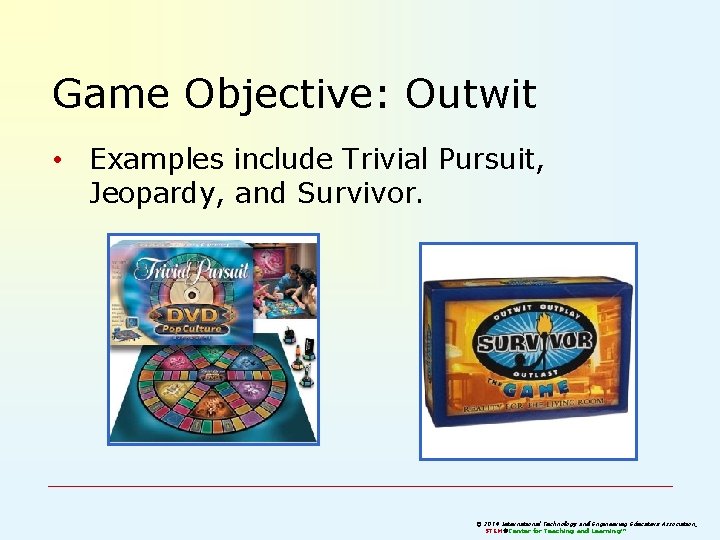
Game Objective: Outwit • Examples include Trivial Pursuit, Jeopardy, and Survivor. © 2011 2014 International Technology and Engineering Educators Association, STEM Center for Teaching and Learning™
Big Idea Knowledge of the basic skills and components of any field makes one uniquely prepared to perform at a high level in that area. © 2011 2014 International Technology and Engineering Educators Association, STEM Center for Teaching and Learning™
Game Art and Design Unit 3 Lesson 2 Objectives Images student work, photos by Phyllis Jones, and clipart © 2014 International Technology and Engineering Educators Association, STEM Center for Teaching and Learning™