
Galvanic Compatibility Assessment New Methodology and Standardization 21
Galvanic Compatibility Assessment: New Methodology and Standardization 21 AUG 2018 Presented to: ASETSDefense Workshop 2018 Presented by: Victor Rodriguez-Santiago, Anna Safigan NAVAIR Public Release 2018 -631. Distribution Statement A – “Approved for public release;
MIL-STD-889: Dissimilar Metals • Purpose: This standard defines and classifies dissimilar metals and establishes requirements for protecting coupled dissimilar metals against corrosion with attention directed to the anodic member of the couple. • Modernized Revision: Current version was modernized in 2016 to replace obsolete references to other standards (MIL-STD 889 C). • Last Technical Revision: The last technical revision was done in 1967, based on an AMCOM report (TR-67 -11). Was not done in sea water. • Proposed Approach: The proposed approach is to move to galvanic current, rather than potential, in order to determine galvanic compatibility. NAVAIR Public Release 2018 -631. Distribution Statement A – “Approved for public release; 2
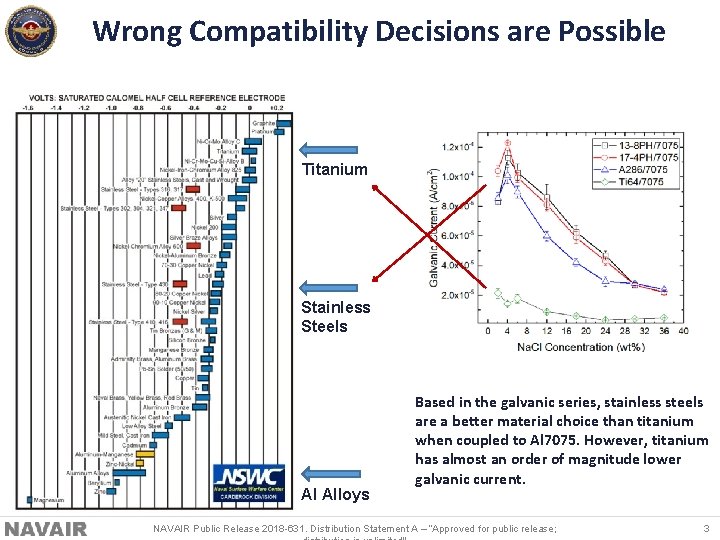
Wrong Compatibility Decisions are Possible Titanium Stainless Steels Al Alloys Based in the galvanic series, stainless steels are a better material choice than titanium when coupled to Al 7075. However, titanium has almost an order of magnitude lower galvanic current. NAVAIR Public Release 2018 -631. Distribution Statement A – “Approved for public release; 3
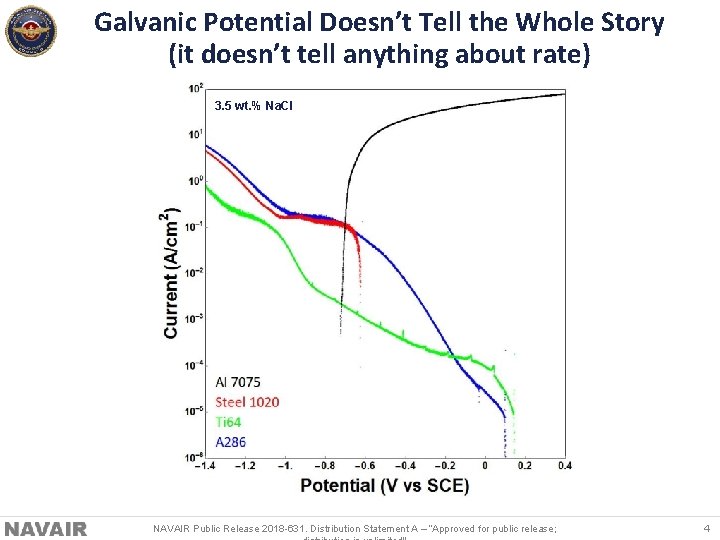
Galvanic Potential Doesn’t Tell the Whole Story (it doesn’t tell anything about rate) 3. 5 wt. % Na. Cl NAVAIR Public Release 2018 -631. Distribution Statement A – “Approved for public release; 4
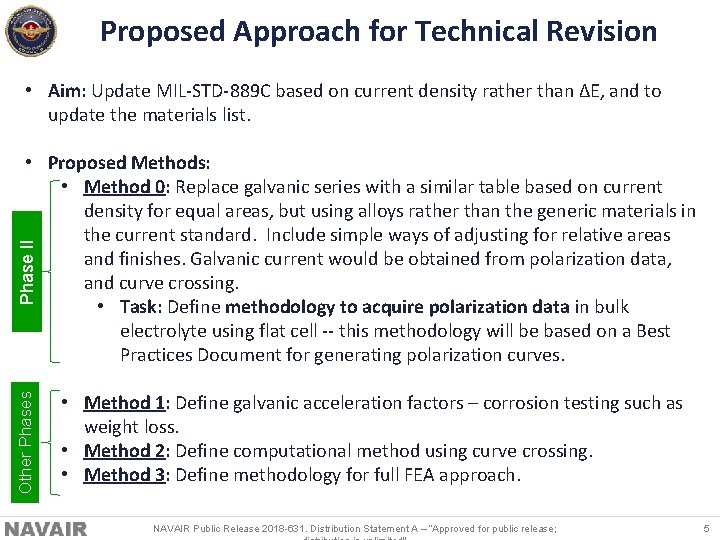
Proposed Approach for Technical Revision • Aim: Update MIL-STD-889 C based on current density rather than ΔE, and to update the materials list. Other Phases Phase II • Proposed Methods: • Method 0: Replace galvanic series with a similar table based on current density for equal areas, but using alloys rather than the generic materials in the current standard. Include simple ways of adjusting for relative areas and finishes. Galvanic current would be obtained from polarization data, and curve crossing. • Task: Define methodology to acquire polarization data in bulk electrolyte using flat cell -- this methodology will be based on a Best Practices Document for generating polarization curves. • Method 1: Define galvanic acceleration factors – corrosion testing such as weight loss. • Method 2: Define computational method using curve crossing. • Method 3: Define methodology for full FEA approach. NAVAIR Public Release 2018 -631. Distribution Statement A – “Approved for public release; 5
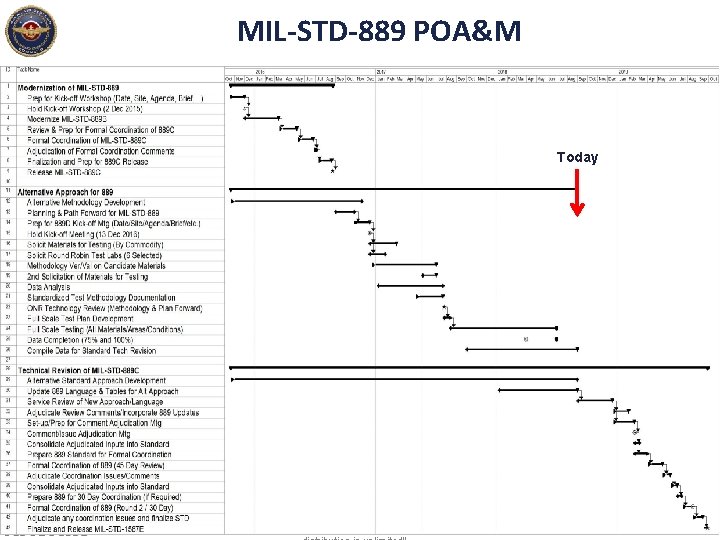
MIL-STD-889 POA&M Today NAVAIR Public Release 2018 -631. Distribution Statement A – “Approved for public release; 6
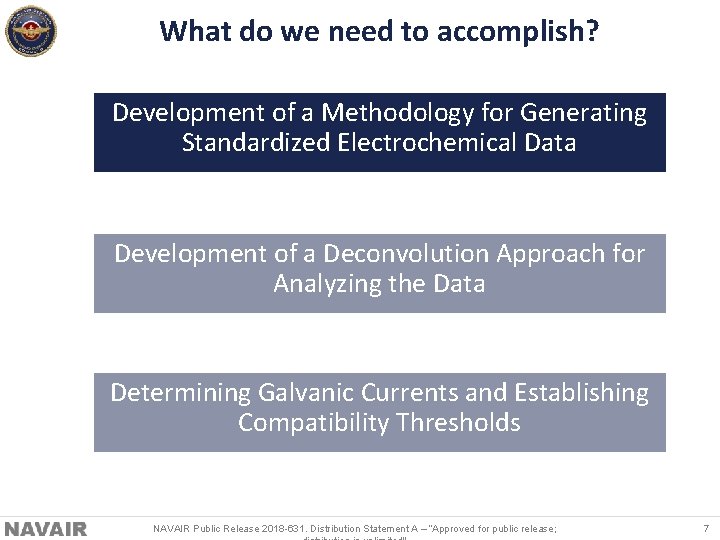
What do we need to accomplish? Development of a Methodology for Generating Standardized Electrochemical Data Development of a Deconvolution Approach for Analyzing the Data Determining Galvanic Currents and Establishing Compatibility Thresholds NAVAIR Public Release 2018 -631. Distribution Statement A – “Approved for public release; 7
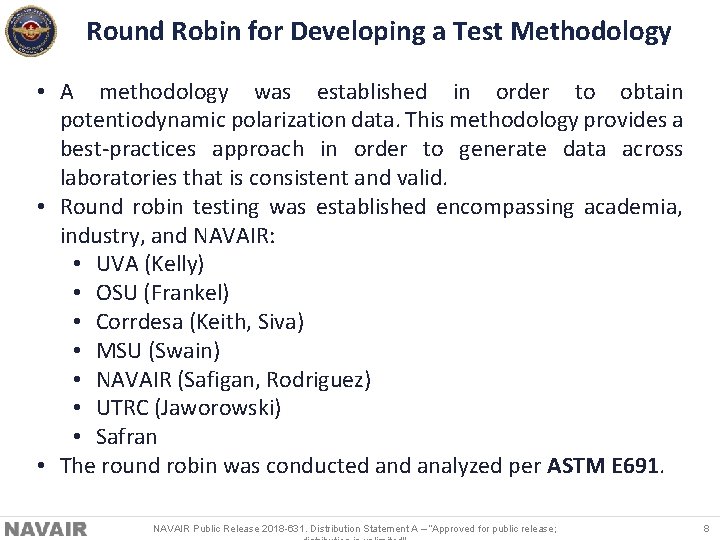
Round Robin for Developing a Test Methodology • A methodology was established in order to obtain potentiodynamic polarization data. This methodology provides a best-practices approach in order to generate data across laboratories that is consistent and valid. • Round robin testing was established encompassing academia, industry, and NAVAIR: • UVA (Kelly) • OSU (Frankel) • Corrdesa (Keith, Siva) • MSU (Swain) • NAVAIR (Safigan, Rodriguez) • UTRC (Jaworowski) • Safran • The round robin was conducted analyzed per ASTM E 691. NAVAIR Public Release 2018 -631. Distribution Statement A – “Approved for public release; 8
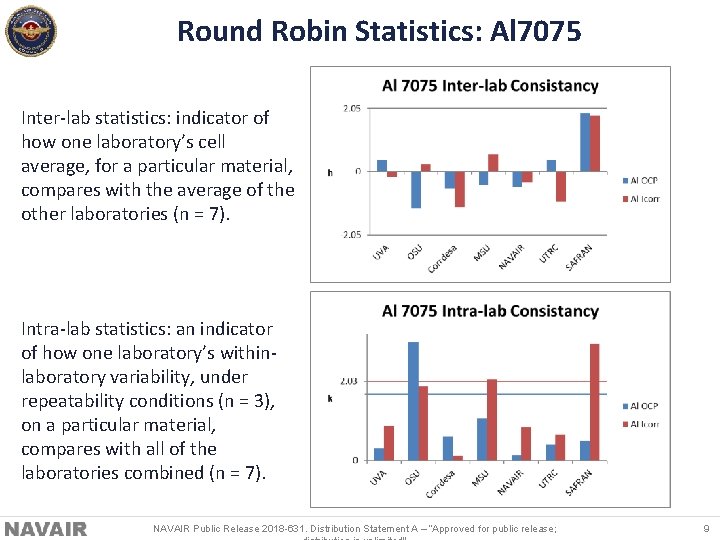
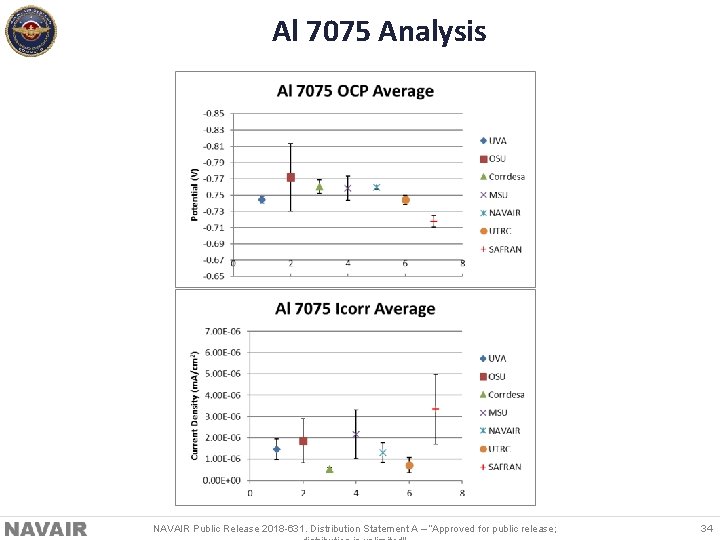
Round Robin Statistics: Al 7075 Inter-lab statistics: indicator of how one laboratory’s cell average, for a particular material, compares with the average of the other laboratories (n = 7). Intra-lab statistics: an indicator of how one laboratory’s withinlaboratory variability, under repeatability conditions (n = 3), on a particular material, compares with all of the laboratories combined (n = 7). NAVAIR Public Release 2018 -631. Distribution Statement A – “Approved for public release; 9
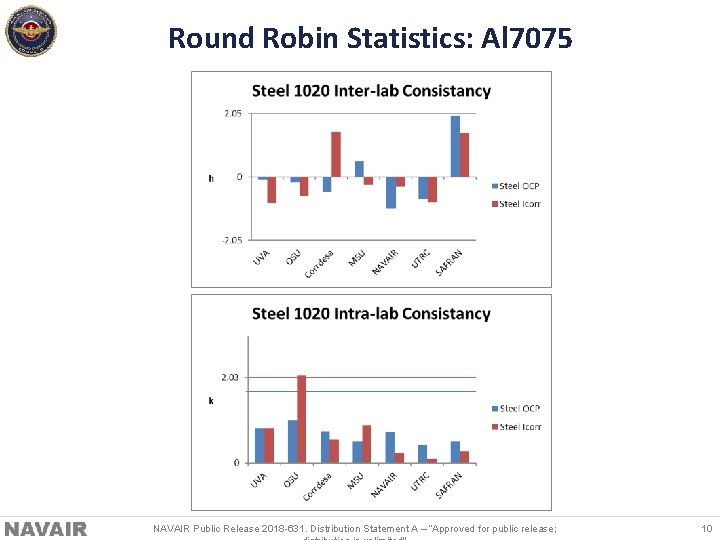
Round Robin Statistics: Al 7075 NAVAIR Public Release 2018 -631. Distribution Statement A – “Approved for public release; 10
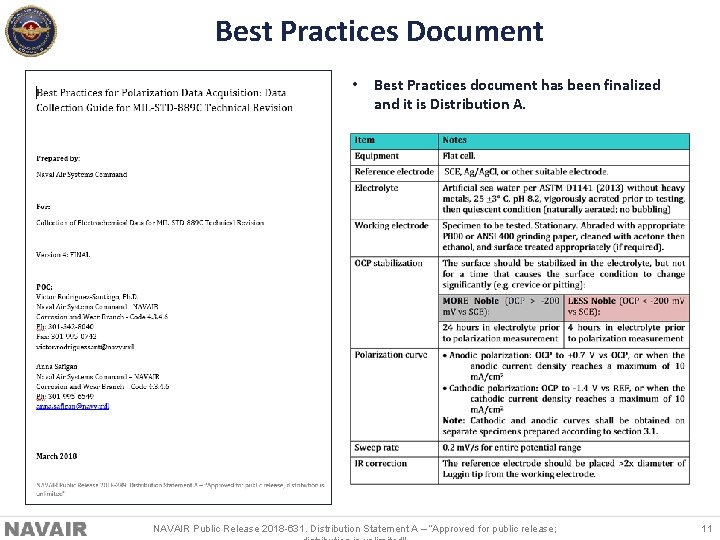
Best Practices Document • Best Practices document has been finalized and it is Distribution A. NAVAIR Public Release 2018 -631. Distribution Statement A – “Approved for public release; 11
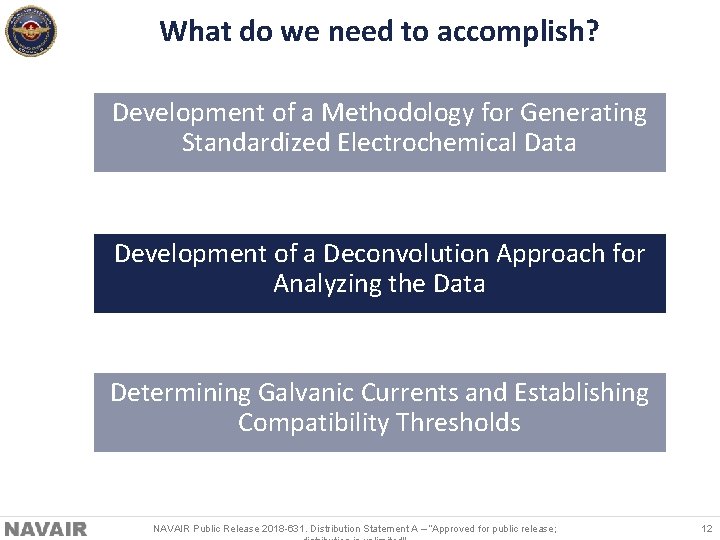
What do we need to accomplish? Development of a Methodology for Generating Standardized Electrochemical Data Development of a Deconvolution Approach for Analyzing the Data Determining Galvanic Currents and Establishing Compatibility Thresholds NAVAIR Public Release 2018 -631. Distribution Statement A – “Approved for public release; 12
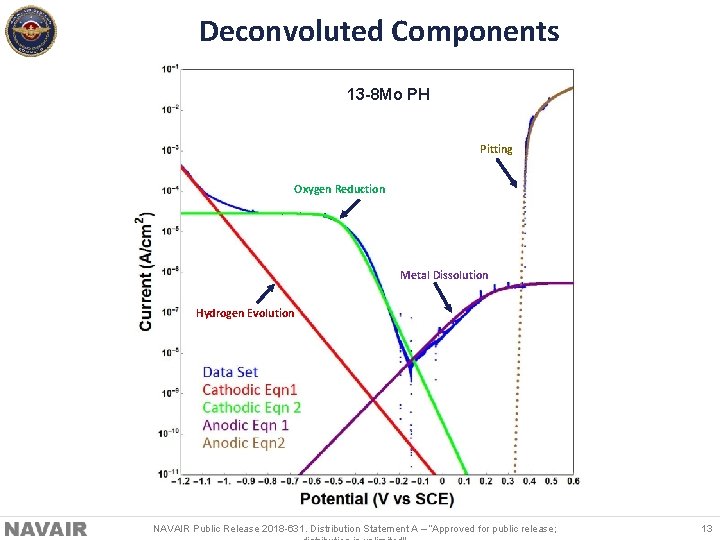
Deconvoluted Components 13 -8 Mo PH Pitting Oxygen Reduction Metal Dissolution Hydrogen Evolution NAVAIR Public Release 2018 -631. Distribution Statement A – “Approved for public release; 13
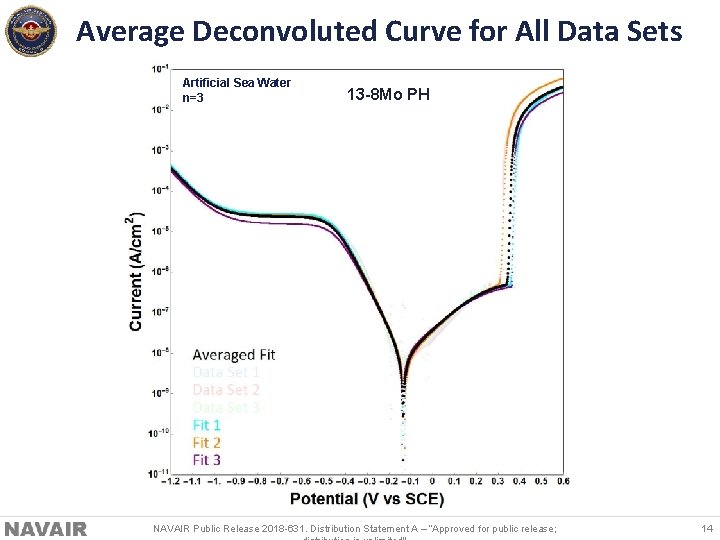
Average Deconvoluted Curve for All Data Sets Artificial Sea Water n=3 13 -8 Mo PH NAVAIR Public Release 2018 -631. Distribution Statement A – “Approved for public release; 14
What do we need to accomplish? Development of a Methodology for Generating Standardized Electrochemical Data Development of a Deconvolution Approach for Analyzing the Data Determining Galvanic Currents and Establishing Compatibility Thresholds NAVAIR Public Release 2018 -631. Distribution Statement A – “Approved for public release; 15
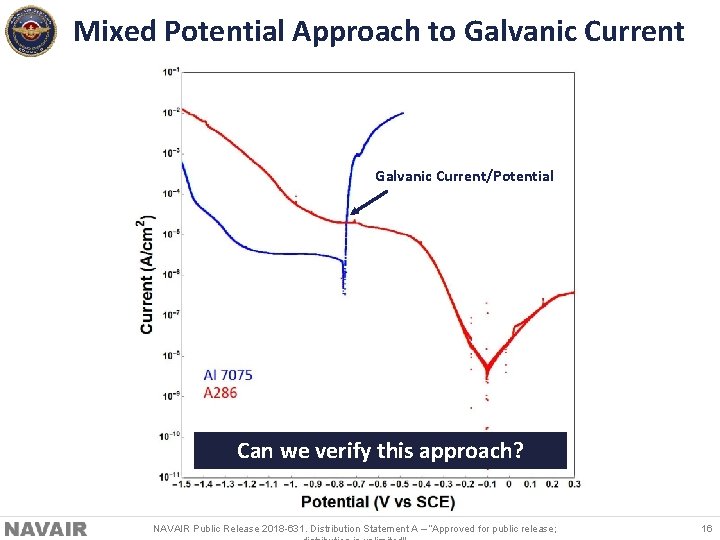
Mixed Potential Approach to Galvanic Current/Potential Can we verify this approach? NAVAIR Public Release 2018 -631. Distribution Statement A – “Approved for public release; 16
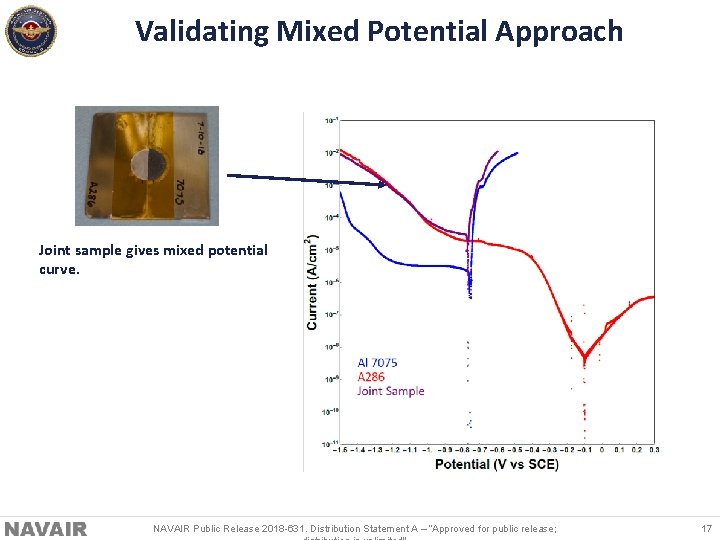
Validating Mixed Potential Approach Joint sample gives mixed potential curve. NAVAIR Public Release 2018 -631. Distribution Statement A – “Approved for public release; 17
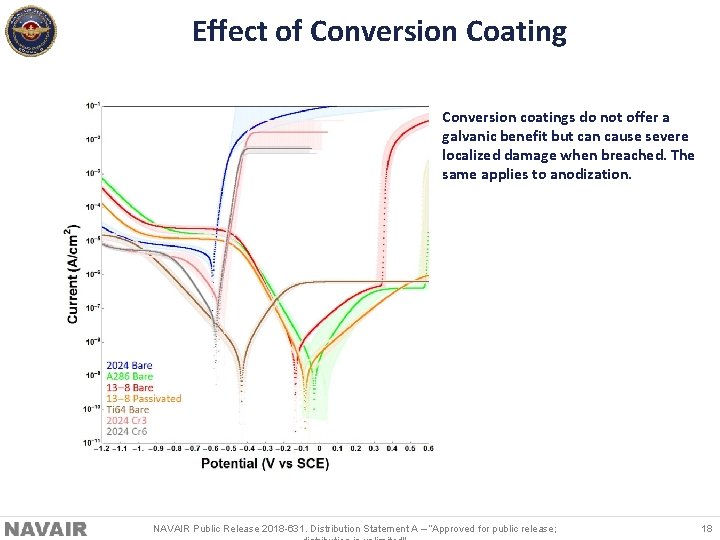
Effect of Conversion Coating Conversion coatings do not offer a galvanic benefit but can cause severe localized damage when breached. The same applies to anodization. NAVAIR Public Release 2018 -631. Distribution Statement A – “Approved for public release; 18
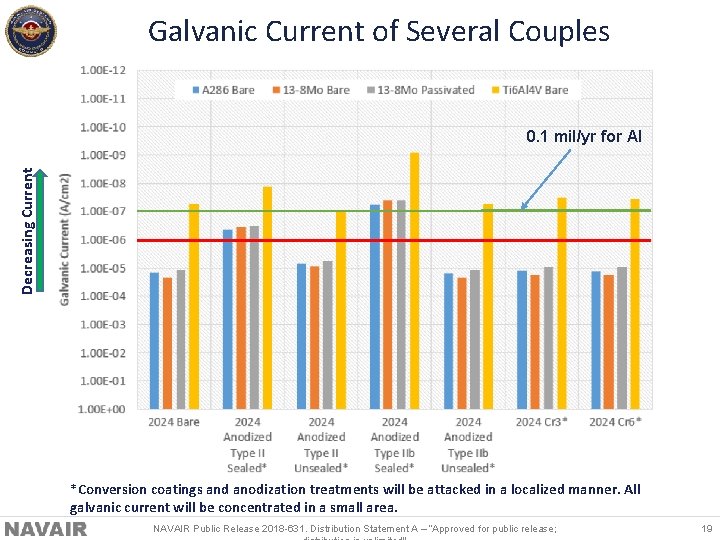
Galvanic Current of Several Couples Decreasing Current 0. 1 mil/yr for Al *Conversion coatings and anodization treatments will be attacked in a localized manner. All galvanic current will be concentrated in a small area. NAVAIR Public Release 2018 -631. Distribution Statement A – “Approved for public release; 19
Summary • Galvanic current is a better assessment metric than galvanic potential for determining galvanic compatibility. • A methodology was created to generate PDS. The methodology was validated through a round robin test. • A deconvolution approach was used to analyze the PDS. • The mixed potential approach to determine galvanic current is valid. • A ranking for galvanic compatibility will be created. NAVAIR Public Release 2018 -631. Distribution Statement A – “Approved for public release; 20
Acknowledgements • NAVAIR: Anna Safigan, Kip Koonce, Elizabeth Monillas, Andrew Lee, Kaylee Canales, Taylor Wolt, Van Nuyen, Nahid Ilyas, Ian Mac. Intyre • Round Robin Participants: Rob Kelly, Jerry Frankel, Keith Legg, Siva Palani, Alan Rose, Mark Jaworowski, Greg Swain, SAFRAN, students. • MIL-STD Logistics: Steven Spadafora. • MIL-STD-889 Working Group: AF, Army, Navy, MDA NAVAIR Public Release 2018 -631. Distribution Statement A – “Approved for public release; 21
Questions? NAVAIR Public Release 2018 -631. Distribution Statement A – “Approved for public release; 22

Backup
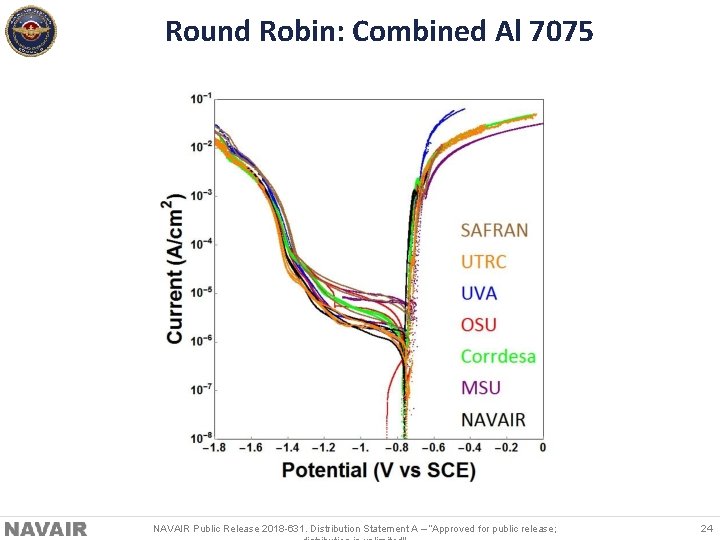
Round Robin: Combined Al 7075 NAVAIR Public Release 2018 -631. Distribution Statement A – “Approved for public release; 24
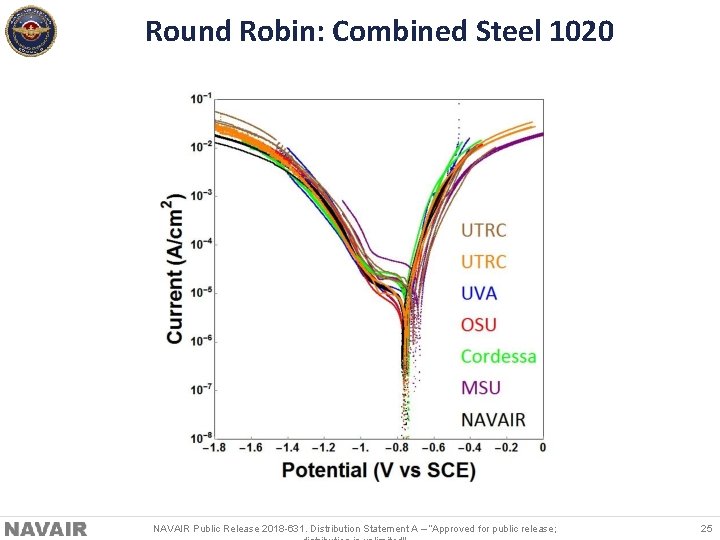
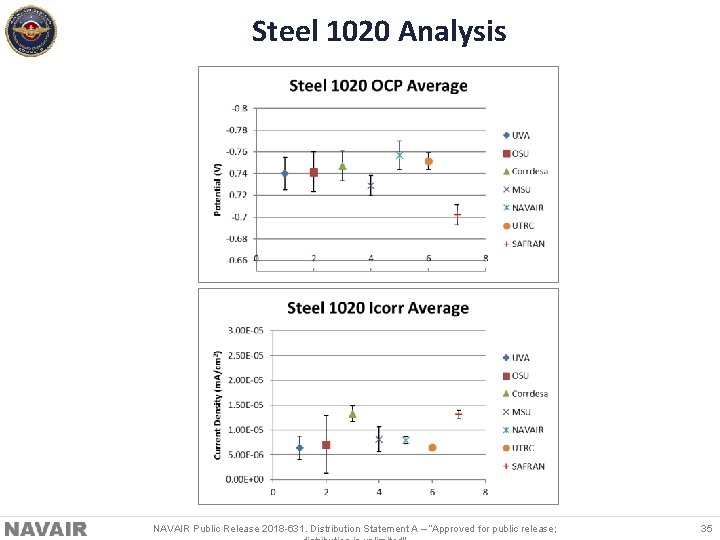
Round Robin: Combined Steel 1020 NAVAIR Public Release 2018 -631. Distribution Statement A – “Approved for public release; 25
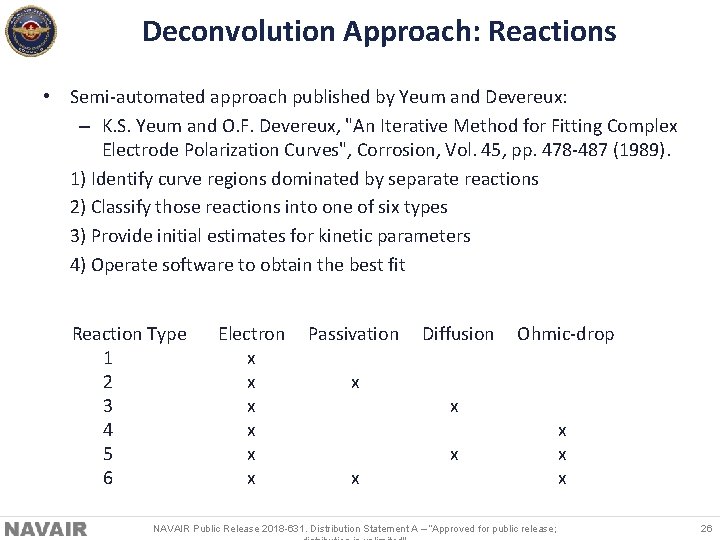
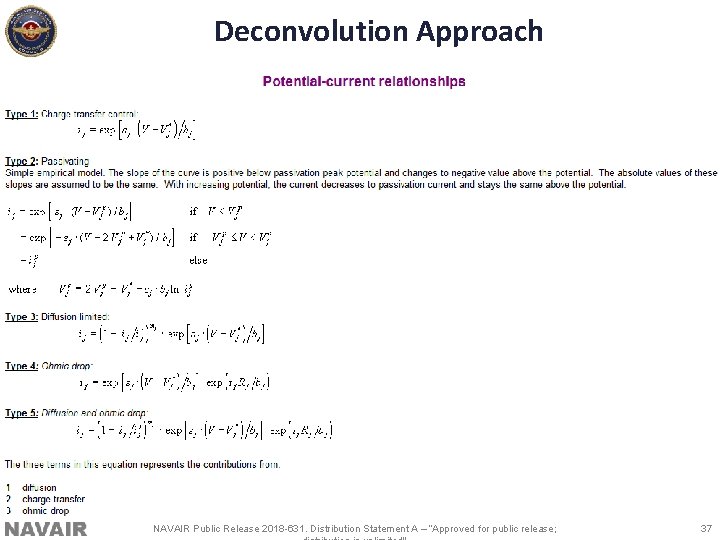
Deconvolution Approach: Reactions • Semi-automated approach published by Yeum and Devereux: – K. S. Yeum and O. F. Devereux, "An Iterative Method for Fitting Complex Electrode Polarization Curves", Corrosion, Vol. 45, pp. 478 -487 (1989). 1) Identify curve regions dominated by separate reactions 2) Classify those reactions into one of six types 3) Provide initial estimates for kinetic parameters 4) Operate software to obtain the best fit Reaction Type 1 2 3 4 5 6 Electron x x x Passivation x x Diffusion Ohmic-drop x x NAVAIR Public Release 2018 -631. Distribution Statement A – “Approved for public release; x x x 26
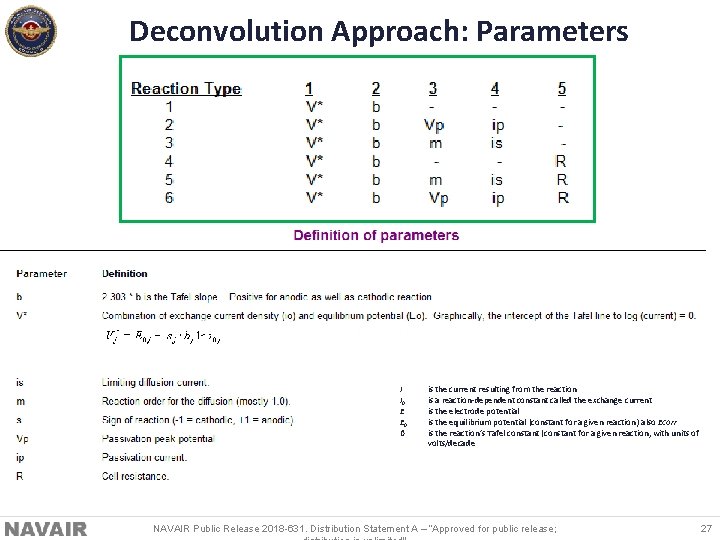
Deconvolution Approach: Parameters I I 0 E E 0 β is the current resulting from the reaction is a reaction-dependent constant called the exchange current is the electrode potential is the equilibrium potential (constant for a given reaction) also Ecorr is the reaction’s Tafel constant (constant for a given reaction, with units of volts/decade NAVAIR Public Release 2018 -631. Distribution Statement A – “Approved for public release; 27
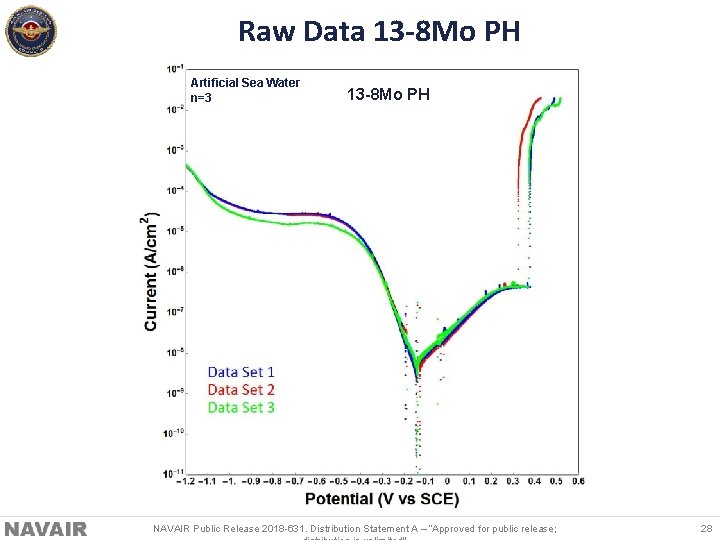
Raw Data 13 -8 Mo PH Artificial Sea Water n=3 13 -8 Mo PH NAVAIR Public Release 2018 -631. Distribution Statement A – “Approved for public release; 28
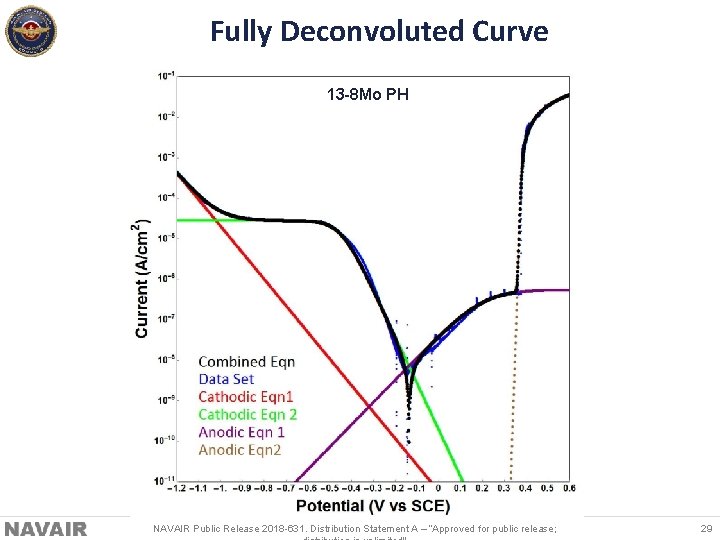
Fully Deconvoluted Curve 13 -8 Mo PH NAVAIR Public Release 2018 -631. Distribution Statement A – “Approved for public release; 29
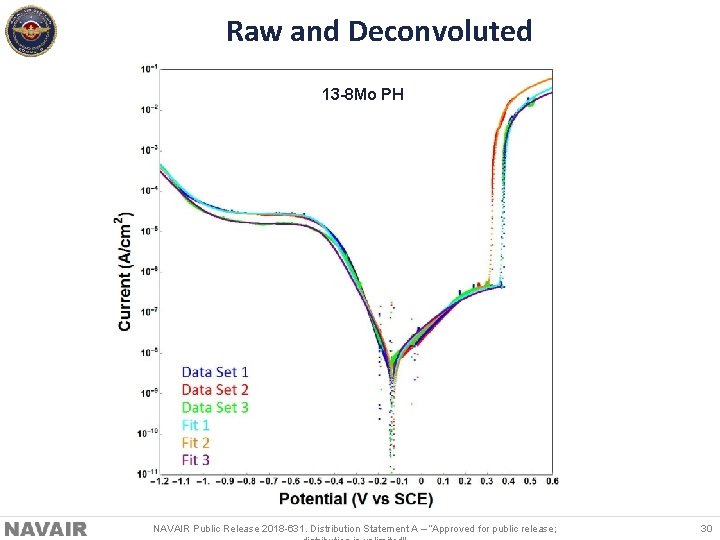
Raw and Deconvoluted 13 -8 Mo PH NAVAIR Public Release 2018 -631. Distribution Statement A – “Approved for public release; 30
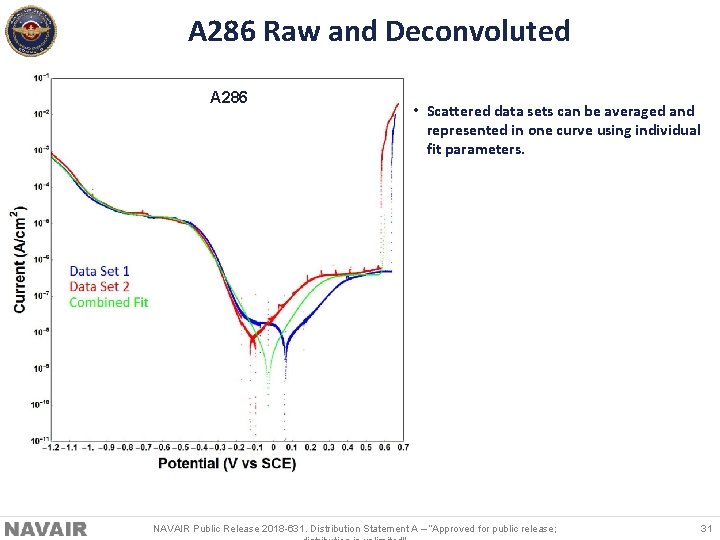
A 286 Raw and Deconvoluted A 286 • Scattered data sets can be averaged and represented in one curve using individual fit parameters. NAVAIR Public Release 2018 -631. Distribution Statement A – “Approved for public release; 31
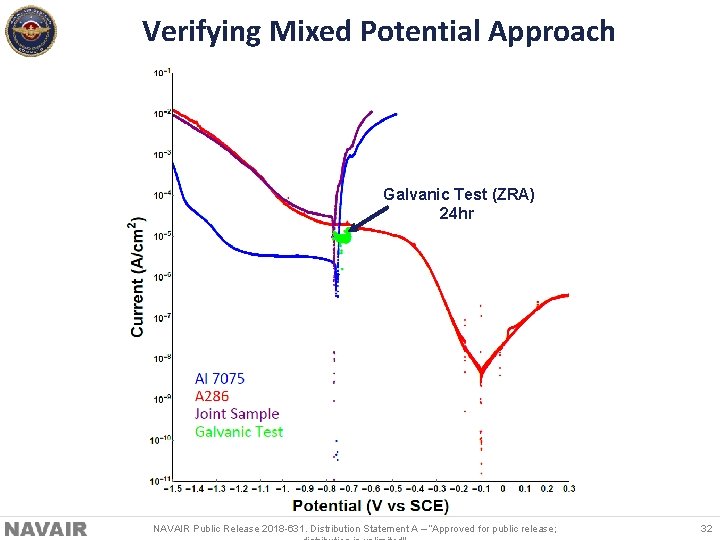
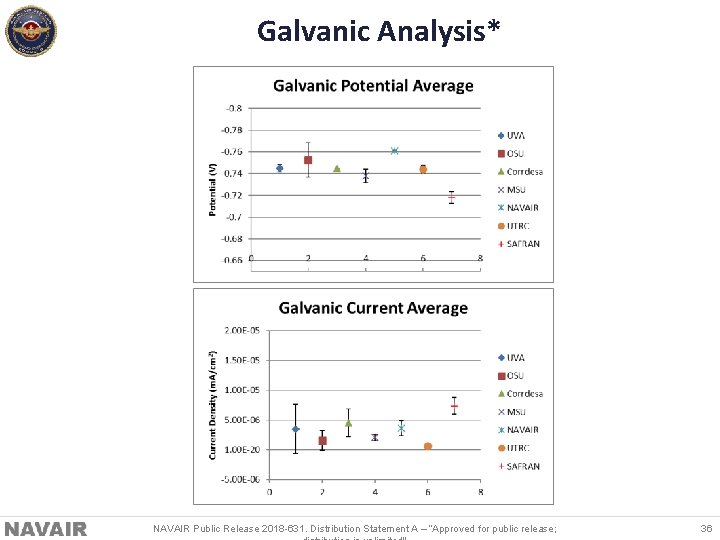
Verifying Mixed Potential Approach Galvanic Test (ZRA) 24 hr NAVAIR Public Release 2018 -631. Distribution Statement A – “Approved for public release; 32
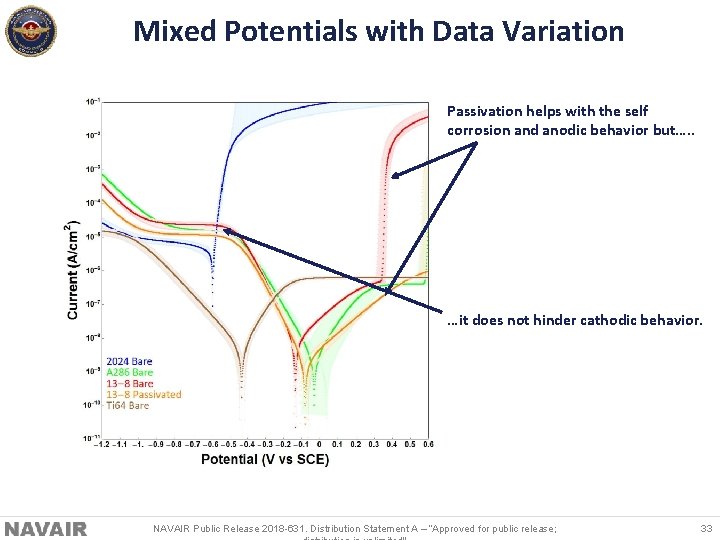
Mixed Potentials with Data Variation Passivation helps with the self corrosion and anodic behavior but…. . …it does not hinder cathodic behavior. NAVAIR Public Release 2018 -631. Distribution Statement A – “Approved for public release; 33
Al 7075 Analysis NAVAIR Public Release 2018 -631. Distribution Statement A – “Approved for public release; 34
Steel 1020 Analysis NAVAIR Public Release 2018 -631. Distribution Statement A – “Approved for public release; 35
Galvanic Analysis* NAVAIR Public Release 2018 -631. Distribution Statement A – “Approved for public release; 36
Deconvolution Approach NAVAIR Public Release 2018 -631. Distribution Statement A – “Approved for public release; 37
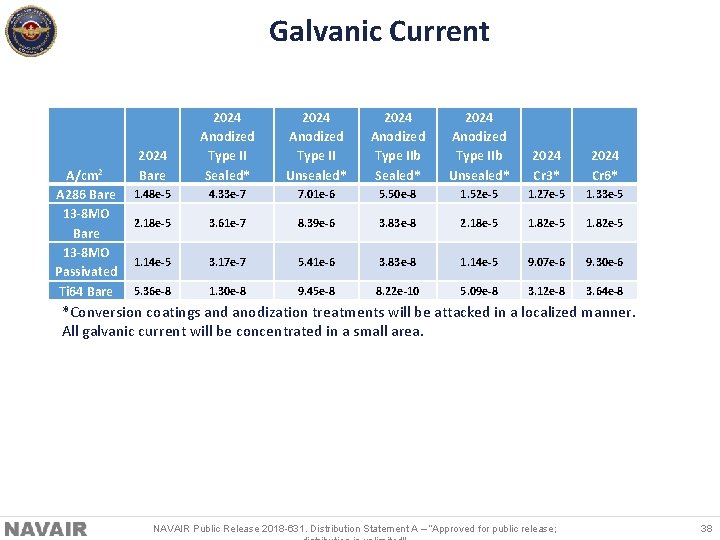
Galvanic Current A/cm 2 A 286 Bare 13 -8 MO Passivated Ti 64 Bare 2024 Anodized Type II Sealed* 2024 Anodized Type II Unsealed* 2024 Anodized Type IIb Sealed* 2024 Anodized Type IIb Unsealed* 2024 Cr 3* 2024 Cr 6* 1. 48 e-5 4. 33 e-7 7. 01 e-6 5. 50 e-8 1. 52 e-5 1. 27 e-5 1. 33 e-5 2. 18 e-5 3. 61 e-7 8. 39 e-6 3. 83 e-8 2. 18 e-5 1. 82 e-5 1. 14 e-5 3. 17 e-7 5. 41 e-6 3. 83 e-8 1. 14 e-5 9. 07 e-6 9. 30 e-6 5. 36 e-8 1. 30 e-8 9. 45 e-8 8. 22 e-10 5. 09 e-8 3. 12 e-8 3. 64 e-8 *Conversion coatings and anodization treatments will be attacked in a localized manner. All galvanic current will be concentrated in a small area. NAVAIR Public Release 2018 -631. Distribution Statement A – “Approved for public release; 38
NAVAIR Public Release 2018 -631. Distribution Statement A – “Approved for public release; 39
- Slides: 39