
Gall stone Cholelithiasis and CBD stone Choledocholithiasis Dr
Gall stone (Cholelithiasis) and CBD stone (Choledocholithiasis) Dr Dhiresh Kumar Maharjan 3/5/2021 1

Objective • • • Types of gall stone Pathophysiology of gall stone Clinical features and investigations Treatment of gall stones, CBD stone Complications of gall stone surgery. 3/5/2021 2

Pathogenesis • Gallstones are composed mainly of cholesterol, bilirubin, and calcium salts, with smaller amounts of protein and other materials. • There are three types of gallstones: 1. Pure cholesterol stones, which contain at least 90% cholesterol, 2. Pigment stones either brown or black, which contain at least 90% bilirubin. 3. Mixed composition stones, which contain varying proportions of cholesterol, bilirubin and other substances such as calcium carbonate, calcium phosphate and calcium palmitate. 3/5/2021 3
Salient characteristics of gall stones • Brown pigment stones are mainly composed of calcium bilirubinate whereas black pigment stones contain bilirubin, calcium and/or tribasic phosphate. • Pure cholesterol crystals are quite soft, and protein contributes importantly to the strength of cholesterol stones. 3/5/2021 4

Pathogenesis of gall bladder • In the simplest sense, cholesterol gallstones form when the cholesterol concentration in bile exceeds the ability of bile to hold it in solution, so that crystals form and grow as stones. • Cholesterol is virtually insoluble in aqueous solution, but in bile it is made soluble by association with bile salts and phospholipids in the form of mixed micelles and vesicles. 3/5/2021 5
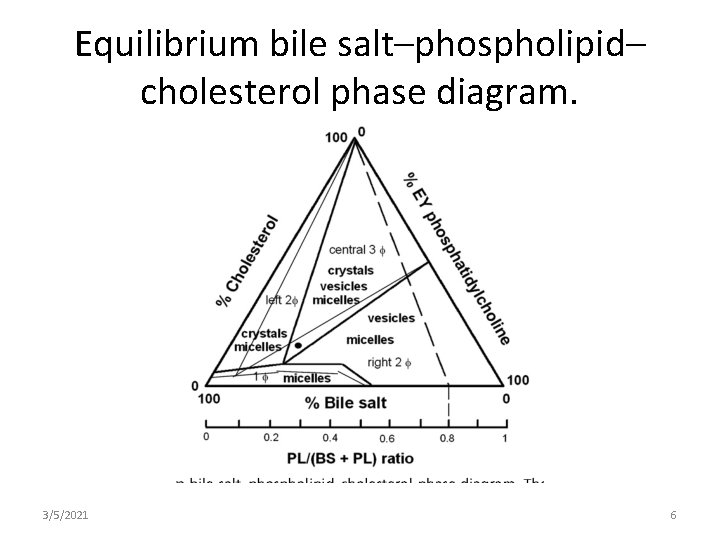
Equilibrium bile salt–phospholipid– cholesterol phase diagram. 3/5/2021 6
Predisposing factors for gallstones • Demographics – Family history, female sex, increasing age, specific races (e. g. , Chilean Indians, Mexican Americans, Pima Indians) • Dietary – Diet high in calories and refined carbohydrates, low in fiber and unsaturated fats; total parenteral nutrition • Lifestyle – Low-grade physical activity, pregnancy and multiparity, prolonged fasting, rapid weight loss • Associated conditions – Alcoholic cirrhosis, bariatric surgery, diabetes mellitus, dyslipidemia, estrogen therapy or use of oral contraceptives, gallbladder or intestinal stasis, hyperinsulinism, metabolic syndrome, obesity* 3/5/2021 7

Effects of Gallstones 1. In the gallbladder: • Asymptomatic stones • Biliary colic • Acute cholecystitis • Chronic cholecystitis • Mucocele of the gallbladder § Empyema gallbladder 3/5/2021 – – – Perforation causing biliary peritonitis or pericholecystitic abscess Limey gallbladder(porcelain gall bladder) Carcinoma gallbladder 8

Effects of Gallstones 2. In the common bile duct(CBD): • Obstructive jaundice • Cholangitis • Pancreatitis • Mirizzi syndrome 3: In small bowel Gallstone ileus leading to small bowel obstruction 3/5/2021 9
Biliary Colic and acute cholecystitis Commonest presentation 3/5/2021 10

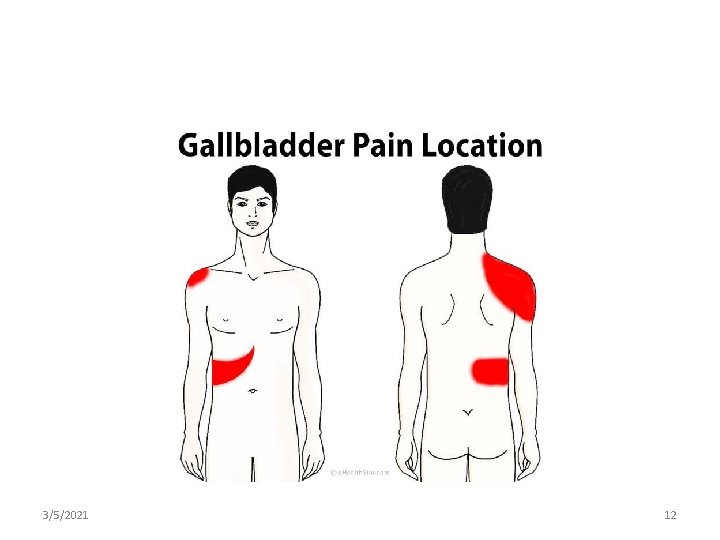
Clinical features • Patients typically present with biliary colic, described as acute onset of pain in the right upper quadrant of the abdomen or epigastrium (dermatomes T 8/9) and may radiate into right shoulder caused by brief impaction of the gallstone in the neck of the gallbladder • The pain is characteristically steady and is usually moderate to severe in intensity. • It typically starts abruptly without fluctuations, is not relieved with a bowel movement, and reaches a peak within one hour. • The pain tends to resolve gradually over one to five hours as the stone dislodges; 3/5/2021 11
3/5/2021 12
Acute Cholecystitis • Right upper quadrant pain, similar in severity but much longer in duration than pain from previous episodes of biliary colic • fever, nausea, and vomiting. 3/5/2021 13

Physical examination • Murphy's sign: Inspiratory arrest with deep palpation in the right upper quadrant, may also be present. • When inflammation spreads to the peritoneum, patients develop more diffuse tenderness, guarding and rigidity. • A mass, the gallbladder and adherent omentum, is occasionally palpable, 3/5/2021 14
• A mild leukocytosis is usually present (12, 00014, 000 cells/mm 3 ). • mild elevations in: – serum bilirubin (>4 mg/d. L), – alkaline phosphatase, transaminases, amylase may be present. 3/5/2021 15
Choledocholithiasis • Common bile duct stones may be silent and are often discovered incidentally. • Clinical features suspicious for biliary obstruction (obstructive/surgical jaundice) due to common bile duct stones: – biliary colic, – jaundice, – pruritis – Pale/clay coloured stools, and – dark of the urine. 3/5/2021 16
• Vitamin deficiency – Obstruction of bile flow also interferes with absorption of the fat soluble vitamins A, D, E, and K • Fever and chills may be present • Charcot’s triad - seen in Choledocholithiasis with ascending cholangitis : – Fever, Rt. Upper quadrant pain, jaundice • If untreated, may progress to septic shock – Reynold’s pentad: – Charcot’s triad + hypotension+ altered mental status 3/5/2021 17
Investigations TLC increased Serum bilirubin (>3. 0 mg/d. L), serum aminotransferases raised alkaline phosphatase & gamma glutamyl transpeptidase are • URINALYSIS: • • – Urine Bilirubin is increased. – Urobilinogen is negative. 3/5/2021 18

Investigations for Gall stones diseases • • Laboratory investigations – LFT’s – Hepatitis B&C viral serology – Urine • • Imaging – Non-invasive/ minimally invasive – Invasive 3/5/2021 19
Imaging for Biliary Diseases • • Non-invasive / minimally invasive – – – Abdominal X-ray Oral cholecystogram Ultrasonography (US) Magnetic Resonance Cholangio-Pancreatography (MRCP) Cholescintigraphy Computerized Tomography (CT) • • Invasive – – 3/5/2021 Endoscopic Retrograde Cholangio-Pancreatography (ERCP) Endoscopic Ultrasound Percutaneous Transhepatic Cholangiography (PTC) Intraoperative cholangiography 20
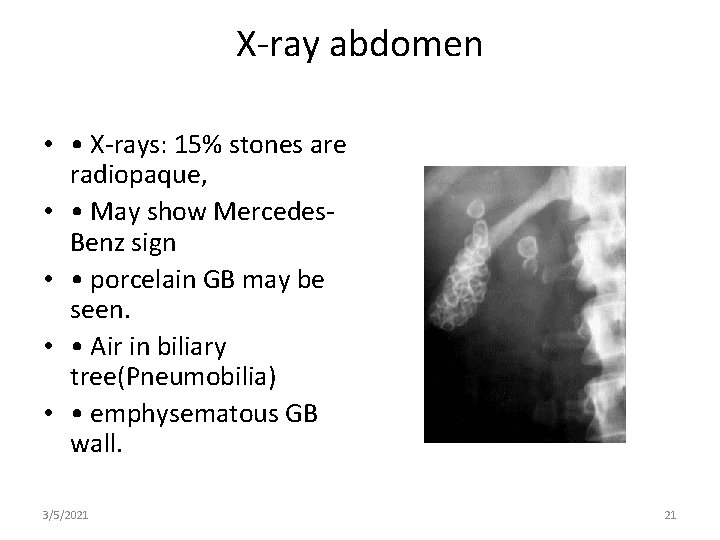
X-ray abdomen • • X-rays: 15% stones are radiopaque, • • May show Mercedes. Benz sign • • porcelain GB may be seen. • • Air in biliary tree(Pneumobilia) • • emphysematous GB wall. 3/5/2021 21
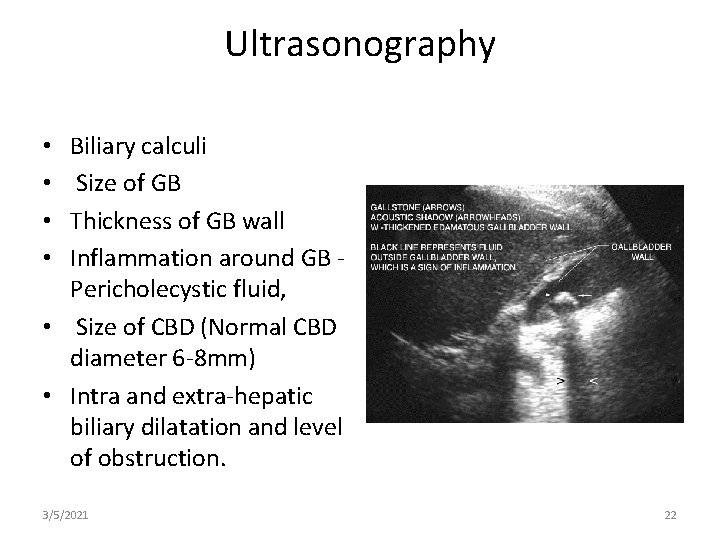
Ultrasonography Biliary calculi Size of GB Thickness of GB wall Inflammation around GB Pericholecystic fluid, • Size of CBD (Normal CBD diameter 6 -8 mm) • Intra and extra-hepatic biliary dilatation and level of obstruction. • • 3/5/2021 22

Magnetic Resonance Cholangiopancreaticography (MRCP) • Non-invasive • Contrast not required. • Demonstrates – – 3/5/2021 Ductal obstruction Visualizes stones Strictures Other intra & extra ductal abnormalities 23

Cholescintigraphy • Technitium 99 (Tc 99 -IDA chelate complex). • HIDA/ PIPIDA/ DISIDA scan. • Gallbladder visualized within 30 min to 1 hour in absence of disease. • Not visualized in Acute cholecystitis • 97 % sensitive and 94 % specific. • Diagnose obstruction. 3/5/2021 24

HIDA scan • • Bile leaks (detect and quantify). • • CBD obstruction appears as non visualization of small intestine. • • No external radiation exposure to the patient. • • Less helpful when the patient is fasting for more than 5 days, with a 40% false-positive rate. 3/5/2021 25
CT Scan • Useful when Carcinoma gallbladder is suspected • Gall stones often not visualized. . • Higher dose of radiation. 3/5/2021 26
Endoscopic Ultrasound • Procedure: USG probe passed through an upper GI endoscope and kept in pylorus/duodenum area. High frequency used - 20 -40 Mhz • • • 3/5/2021 Evaluates Pancreato-biliary system. Detection of microlithiasis Choledocholithiasis Evaluation of benign and malignant strictures. Detects regional lymphnodes Relationship to vascular structures. 27
Endoscopic Ultrasound Advantages: • • • High resolution imaging. • Less invasive. • No exposure to radiation. • Aspiration of a cyst or FNAC. 3/5/2021 Disadvantages: • • Higher operator dependency. • • Cost and availability. • • Visualization is limited to 8 cm. 28
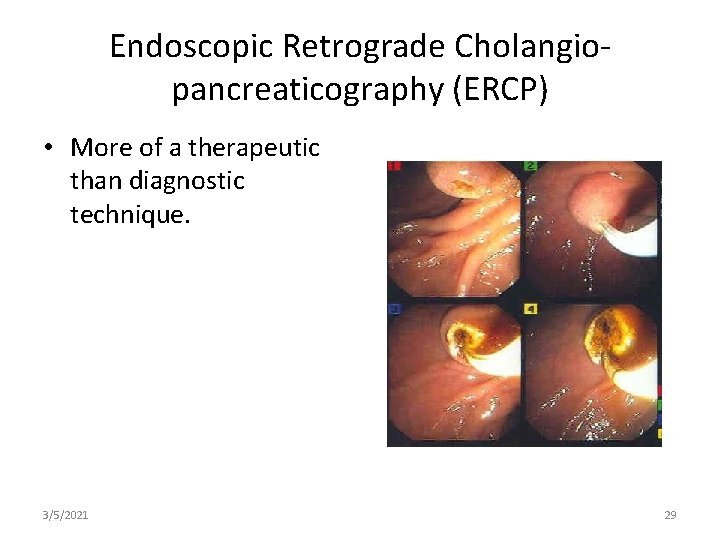
Endoscopic Retrograde Cholangiopancreaticography (ERCP) • More of a therapeutic than diagnostic technique. 3/5/2021 29
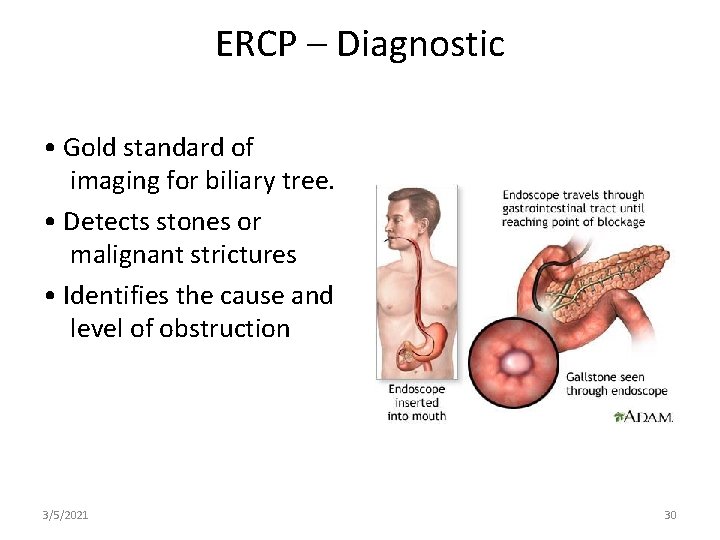
ERCP – Diagnostic • Gold standard of imaging for biliary tree. • Detects stones or malignant strictures • Identifies the cause and level of obstruction 3/5/2021 30

Percutaneous Transhepatic Cholangiography (PTC) • More of a palliative technique. • Bile ducts are cannulated directly. • Demonstrates areas of stricture/obstruction. • Effective in pts with a dilated biliary ductal system 3/5/2021 31
Percutaneous Transhepatic Cholangiography (PTC) Indications: • When ERCP fails or is not possible. • Stenting for biliary drainage. • Prior to biliary drainage procedure. 3/5/2021 Contraindications: • bleeding tendency, • Unfit for surgery, • Hydatid Cysts, • Ascites, CLD (chronic liver disease) 32
Treatment 3/5/2021 33

ASYMPTOMATIC CHOLELITHIASIS Prophylactic cholecystectomy considered in high risk pool: • Elderly diabetics • Those who do not have immediate access to hospital • Those from CA gallbladder belt as Nepal lies in this belt. • Porcelain gall bladder • Large gallstones (>2. 5 cms) • Long common channel of bile and pancreatic ducts • bariatric surgery • Prior to transplantation – life threatening infection in the immunocompromised. 3/5/2021 34
Acute calculous cholecystitis Medical management: • IV Fluids. • Anticholinergics such as dicyclomine hydrochloride to decrease GB and biliary tree tone. (20 mg IV q 8 hrs). • Analgesics : Tramadol 50 mg IV/TID • Antiemetics (Ondansetron). • Antibiotics (Cefotaxim 1 g IV/BD )need to cover Ecoli(39%), Klebsiella(54%), Enterobacter(34%), enterococci, group D strep. 3/5/2021 35
Surgical Treatment • Laparoscopic cholecystectomy is the definitive treatment for patients with acute cholecystitis. • Early cholecystectomy performed within 2 to 3 days of presentation preferred over interval or delayed cholecystectomy that is performed 6 to 10 weeks after initial medical therapy. • About 20% of patients fail initial medical therapy and require surgery during the initial admission 3/5/2021 36
• Occasionally, the inflammatory process obscures the structures in the triangle of Calot, precluding safe dissection and ligation of the cystic duct. • In these patients , open cholecystectomy is done 3/5/2021 37
OPEN CHOLECYSTECTOMY • performed as a conversion from an attempted laparoscopic cholecystectomy (4 -35%) or when • Laparoscopic facility is not available • Indications for Open Cholecystectomy: – Poor pulmonary or cardiac reserve – Suspected or known gallbladder cancer – Cirrhosis and portal hypertension – Third-trimester pregnancy – Combined procedure 3/5/2021 38

Intraoperative cholangiogram(IOC) An intraoperative cholangiogram at the time of cholecystectomy will document the presence of common bile duct stones. Indications: • Elevated preoperative liver enzymes (AST, ALP, bilirubin) • Unclear anatomy during laparoscopic dissection • Suspicion of intraoperative injury to biliary tract • Dilated common bile duct on preoperative imaging • Gallstone pancreatitis without endoscopic clearance of common bile duct • Large common bile duct and small stones • Unsuccessful preoperative endoscopic retrograde cholangiopancreatography for choledocholithiasis 3/5/2021 39
In septic shock patient • In patients considered too unstable to tolerate a laparotomy, percutaneous cholecystostomy under local anesthesia can be performed to drain the gallbladder. 3/5/2021 40
CHOLEDOCHOLITHIASIS • Treatment: – ERCP sphincterotomy with a balloon sweep and extraction of the stone followed by Laparoscopic cholecystectomy in the same admission. 3/5/2021 41
ERCP : Therapeutic Indications: • if expertise in laparoscopic common bile duct exploration is not available. • worsening cholangitis, • ampullary stone impaction, • biliary pancreatitis, • multiple comorbidities eg: cirrhosis 3/5/2021 42

Various applications of ERCP: • Endoscopic sphincterotomy/papillotomy • Removal of stones • Insertion of stents • Dilation of strictures • Extraction of worms 3/5/2021 43
Contra-indications of ERCP • Acute Pancreatitis • Pancreatic Pseudocyst • Previous Pancreato-duodenectomy • Coagulation disorders • Recent Myocardial Infarction • H/o contrast dye anaphylaxis • Not fit for surgery 3/5/2021 44
Complications of ERCP • Pancreatitis • Duodenal perforation • Bleeding • Cholangitis • Dye related allergic reactions 3/5/2021 45
LAPAROSCOPIC CBD EXPLORATION • Laparoscopic common bile duct exploration through cystic duct or with formal choledochotomy allows the stones to be retrieved during the same procedure. 3/5/2021 46

Open Common Bile Duct Exploration • An open common bile duct exploration should be performed if endoscopic intervention is not available or not feasible because of anatomic restrictions or expertise. • If a choledochotomy is performed, a T tube is left in place. • The purpose of the T tube is to provide access to the biliary system for postoperative radiologic stone extraction. • Completion cholangiography via the T tube documents stone removal. 3/5/2021 47

• Stones impacted in the ampulla may be difficult for both endoscopic ductal clearance and common bile duct exploration. • In these cases, transduodenal sphincteroplasty and stone extraction should be performed; if this is not successful, a choledochoduodenostomy or a Roux-en-Y choledochojejunostomy should be performed. • Sump syndrome associated with choledochoduodenostomy 3/5/2021 48
Complications of gall bladder surgery Can be divided into a)Intraoperative b)Post operative 3/5/2021 49
Intraoperative complications • Hemmorhage: represents potential danger because attempts at hemostasis by placing clamps with obstructed and insufficient view may result in inadvertent clamping of the right or common hepatic artery. • In such conditions we perform : Pringles maneuver: hemmorhage to be controlled by digital compression or by clamping of hepatoduodenal ligament to localize its precise origin : 3/5/2021 50
Post operative complications: • • • Bile duct injury Spilled/Lost stones Post cholecystectomy pain Retained bile stones Gall stone ileus Acute cholangitis Recurrent pyogenic cholangitis Bile leak Choledochoduodenal fistula Post cholecystectomy diarrhea Wound pain 3/5/2021 51

RETAINED BILIARY STONES: • Retained CBD stones/secondary common duct stones can be identified upto 2 yrs following cholecystectomy • Endoscopic removal of these stones via generous sphincterotomy is the treatment 3/5/2021 52
Assessments Time frame : 6 days Submission time: 19 th April 2020 by 5. 00 pm. Sunday Please submit by email: shantadhiresh@yahoo. com/Viber/Whatsapp/ as per your convenience 3/5/2021 53
MCQs • A 40 -year-old man underwent laparoscopic cholecystectomy 2 years earlier. He remains asymptomatic until 1 week before admission, when he complains of RUQ pain and jaundice. He develops a fever and has several rigor attacks on the day of admission. An ultrasound confirms the presence of gallstones in the distal CBD. The patient is given antibiotics. Which of the following should be undertaken as the next step in therapy? (A) Should be discharged home under observation (B) Should be observed in the hospital (C) Undergo surgical exploration of the CBD D) ERCP with sphincterotomy and stone removal E) Anticoagulants 3/5/2021 54
• A 43 -year-old woman undergoes open cholecystectomy. Intraoperative cholangiogram revealed multiple stones in the CBD. Exploration of the CBD was performed to extract gallstones. The CBD was drained with a #18 T-tube. After 10 days, a T-tube cholangiogram reveals a retained CBD stone. This should be treated by which of the following? (A) Laparotomy and CBD exploration (B) Subcutaneous heparinization (C) Antibiotic therapy for 6 months and then reevaluation (D) Extraction of the stone through the pathway created by the T-tube (after 6 weeks) (E) Ultrasound crushing of the CBD stone 3/5/2021 55
• In attempting to minimize complications during cholecystectomy, the surgeon defines the triangle of Calot during the operation. The boundaries of the triangle of Calot (modified) are the common hepatic duct medially, the cystic duct inferiorly, and the liver superiorly. Which structure courses through this triangle ? (A) Left hepatic artery (B) Right renal vein (C) Right hepatic artery (D) Cystic artery (E) Superior mesenteric vein 3/5/2021 56
• A 49 -year-old African American woman born in New York is admitted with RUQ pain, fever, and jaundice (Charcot’s triad. ) A diagnosis of ascending cholangitis is made. With regard to the etiology of ascending cholangitis, which of the following is TRUE? (A) It usually occurs in the absence of jaundice. (B) It usually occurs secondary to CBD stones. (C) It occurs frequently after choledochoduodenostomy. (D) It does not occur in patients with cholangiocarcinoma. (E) It is mainly caused by the liver fluke. 3/5/2021 57
• A 43 -year-old man is admitted with jaundice of 6 -week duration. An ultrasound shows multiple small stones in the gallbladder and the presence of a CBD stone. A preoperative ERCP followed by a laparoscopic cholecystectomy is planned. The international normalization ratio (INR) is elevated to 3. 1 What is the next step in management? (A) Infusion of cryoprecipitate (B) Oral vitamin K tablets to decrease prolonged INR (C) Parenteral vitamin K to decrease prolonged INR (D) Demonstration that urobilinogen is increased in the urine (E) Demonstration that stercobilinogen is increased in the stool 3/5/2021 58
• In designing a study related to gallbladder function, it should be noted that the healthy gallbladder mucosa selectively absorbs which of the following? (A) Bile pigment (B) Bile salts (C) Cholesterol (D) Sodium (E) Free fatty acids 3/5/2021 59
Assessments • Write Short Notes on (5 x 6=30) 1. Pathophysiology of gall stones 2. Fate of gall stones 3. ERCP 4. Difference between biliary colic and acute cholecystitis. 5. Liver function test. 6. Management of obstructive Jaundice patient. 3/5/2021 60
Long questions • A 40 years female with postpartum status complains of pain abdomen upper abdomen for 16 hours radiating to right shoulder and back after having meal associated with vomiting. She is tachycardiac, Temp 101 F, and total counts of 12000. What is your provisional diagnosis? Any differential diagnosis? How will you investigate? How will you treat her? (1+2+2+5) 3/5/2021 61
Meet you next week Stay safe 3/5/2021 62
- Slides: 62