
Galileo Activity Ptolemy vs Copernicus Ptolemys Explanation of
- Slides: 24
Galileo
Activity • Ptolemy vs Copernicus • Ptolemy’s Explanation of Mars’ retrograde motion
Sky. Gazer • A computer program that simulates the vision of the sky during day and night Things to observe: • Set your position on Earth: observe how view of sky changes as you move E, W, N, S • Note the distribution of sunlight on Earth! • Rotation is around Polaris which is not in zenith
Science vs Religion? • Historian of science Colin Russell: ‘The common belief that…the actual relations between religion and science over the last few centuries have been marked by deep and enduring hostility…is not only historically inaccurate, but actually a caricature so grotesque that what needs to be explained is how it could possibly have achieved any degree of respectability’
The Baroque Setting • In the 1600 s church through counterreformation (Council of Trent 1545 -1563) much stricter • G. BRUNO (Italian; 1548) proposes that the Sun is just one star out of an infinite number burned at the stake for heresy 1600 • 30 Years War (1618 -1648) between religions • New inventions: telescope, air pump, etc.
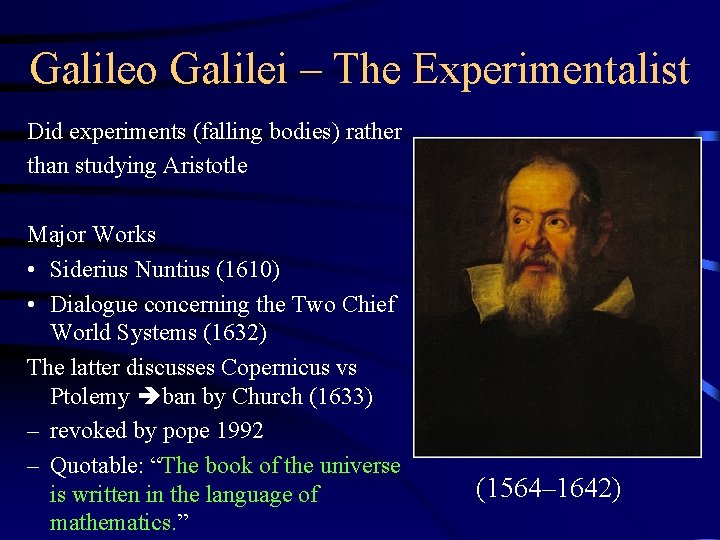
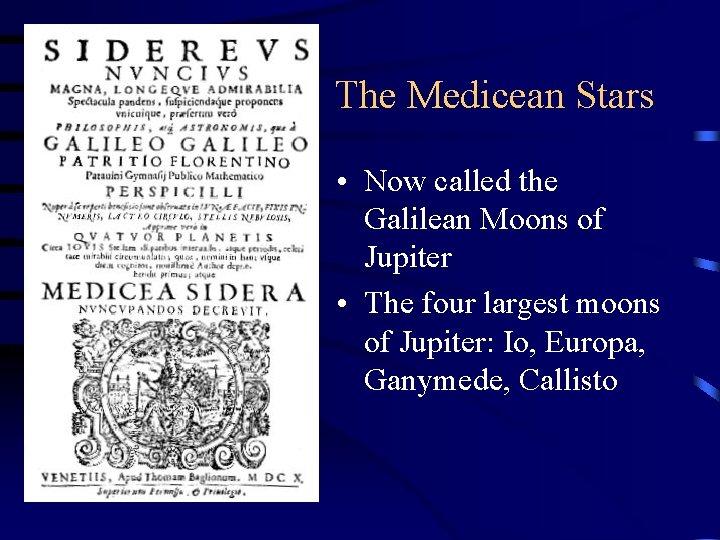
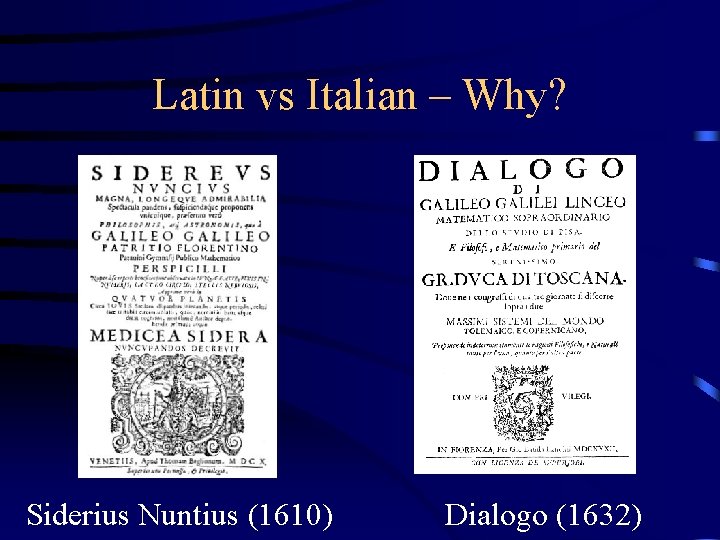
Galileo Galilei – The Experimentalist Did experiments (falling bodies) rather than studying Aristotle Major Works • Siderius Nuntius (1610) • Dialogue concerning the Two Chief World Systems (1632) The latter discusses Copernicus vs Ptolemy ban by Church (1633) – revoked by pope 1992 – Quotable: “The book of the universe is written in the language of mathematics. ” (1564– 1642)
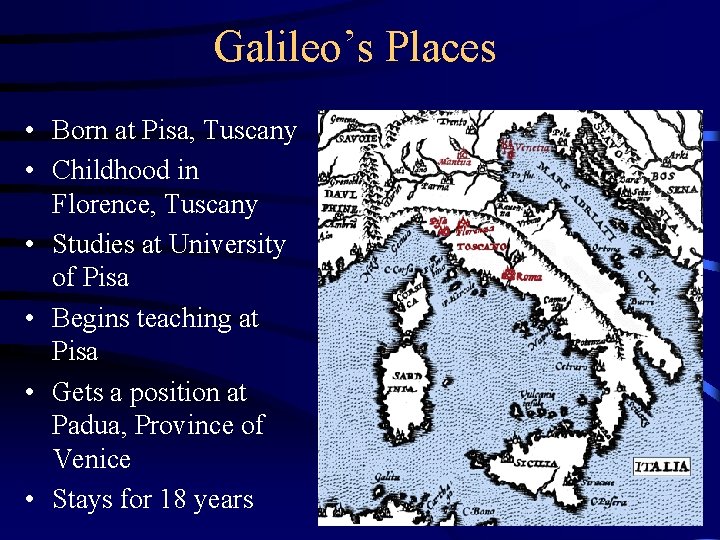
Galileo’s Places • Born at Pisa, Tuscany • Childhood in Florence, Tuscany • Studies at University of Pisa • Begins teaching at Pisa • Gets a position at Padua, Province of Venice • Stays for 18 years
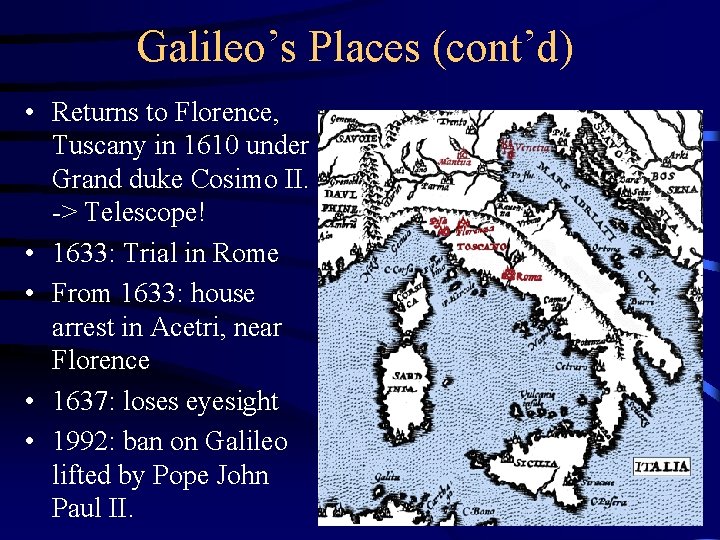
Galileo’s Places (cont’d) • Returns to Florence, Tuscany in 1610 under Grand duke Cosimo II. -> Telescope! • 1633: Trial in Rome • From 1633: house arrest in Acetri, near Florence • 1637: loses eyesight • 1992: ban on Galileo lifted by Pope John Paul II.
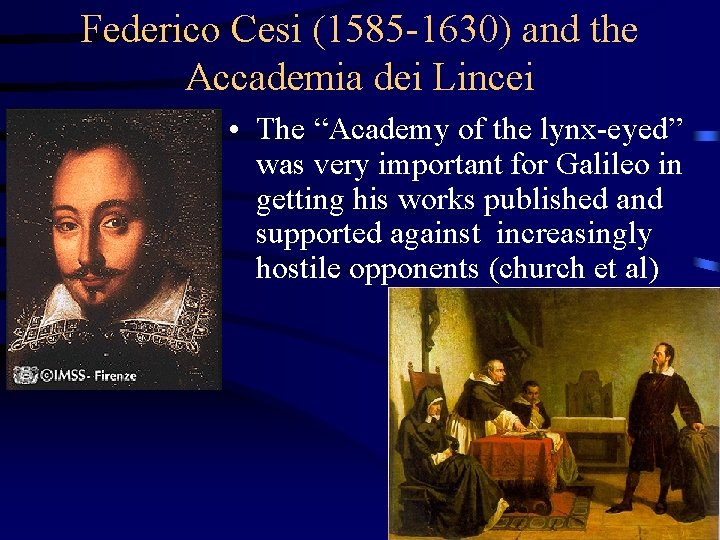
Federico Cesi (1585 -1630) and the Accademia dei Lincei • The “Academy of the lynx-eyed” was very important for Galileo in getting his works published and supported against increasingly hostile opponents (church et al)
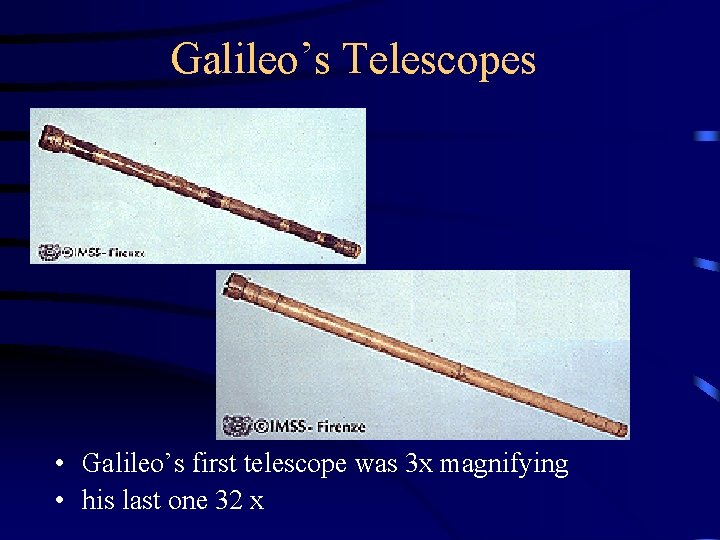
Galileo’s Telescopes • Galileo’s first telescope was 3 x magnifying • his last one 32 x
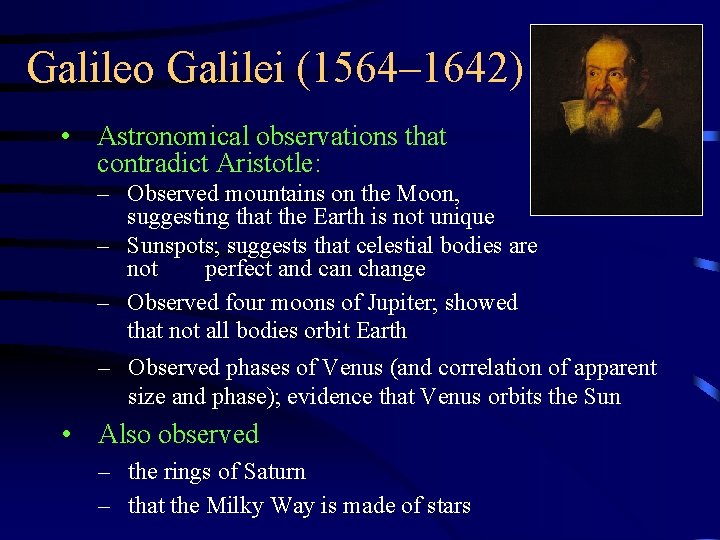
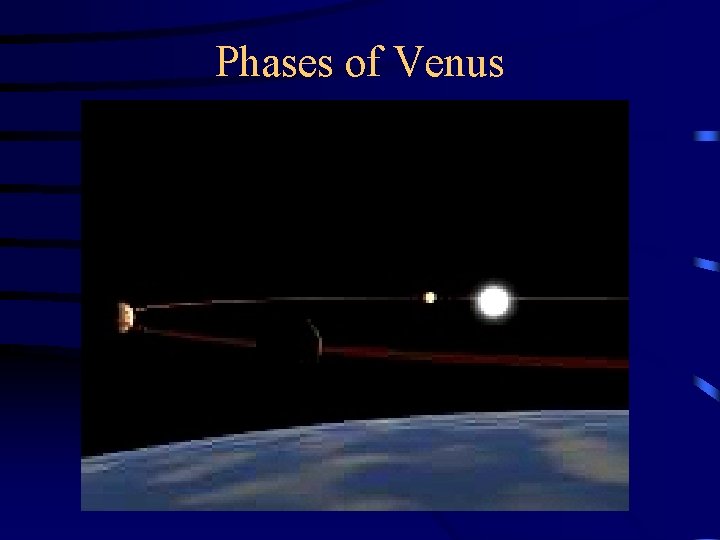
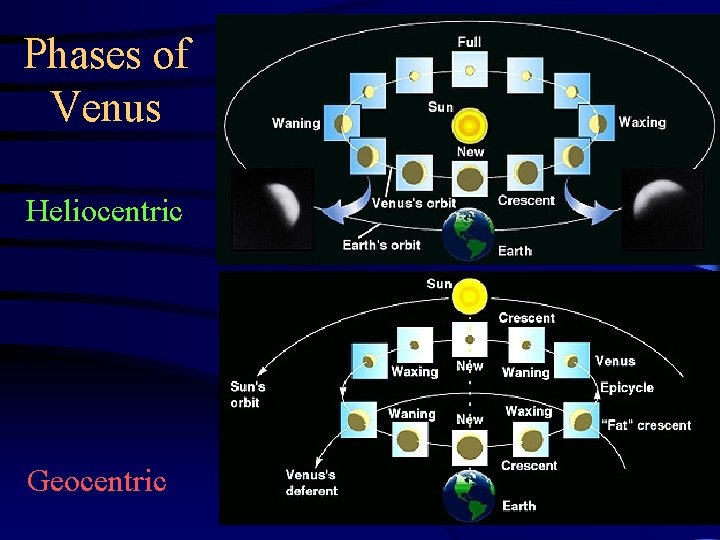
Galileo Galilei (1564– 1642) • Astronomical observations that contradict Aristotle: – Observed mountains on the Moon, suggesting that the Earth is not unique – Sunspots; suggests that celestial bodies are not perfect and can change – Observed four moons of Jupiter; showed that not all bodies orbit Earth – Observed phases of Venus (and correlation of apparent size and phase); evidence that Venus orbits the Sun • Also observed – the rings of Saturn – that the Milky Way is made of stars
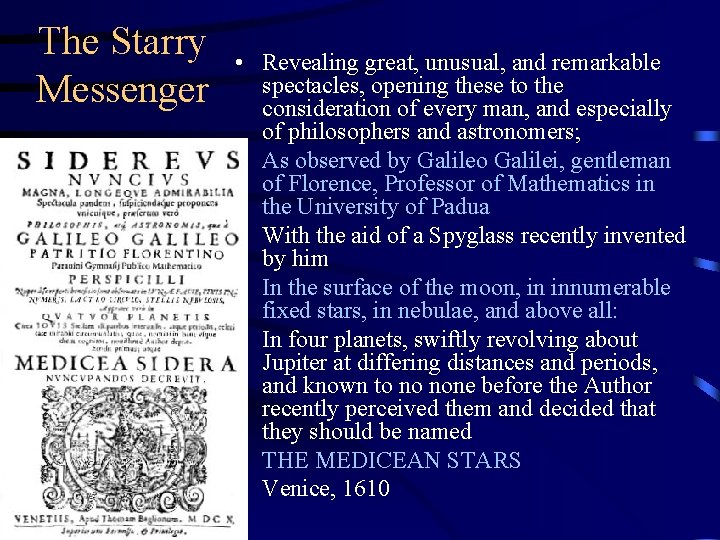
The Starry Messenger • Revealing great, unusual, and remarkable spectacles, opening these to the consideration of every man, and especially of philosophers and astronomers; • As observed by Galileo Galilei, gentleman of Florence, Professor of Mathematics in the University of Padua • With the aid of a Spyglass recently invented by him • In the surface of the moon, in innumerable fixed stars, in nebulae, and above all: • In four planets, swiftly revolving about Jupiter at differing distances and periods, and known to no none before the Author recently perceived them and decided that they should be named • THE MEDICEAN STARS • Venice, 1610
The Medicean Stars • Now called the Galilean Moons of Jupiter • The four largest moons of Jupiter: Io, Europa, Ganymede, Callisto
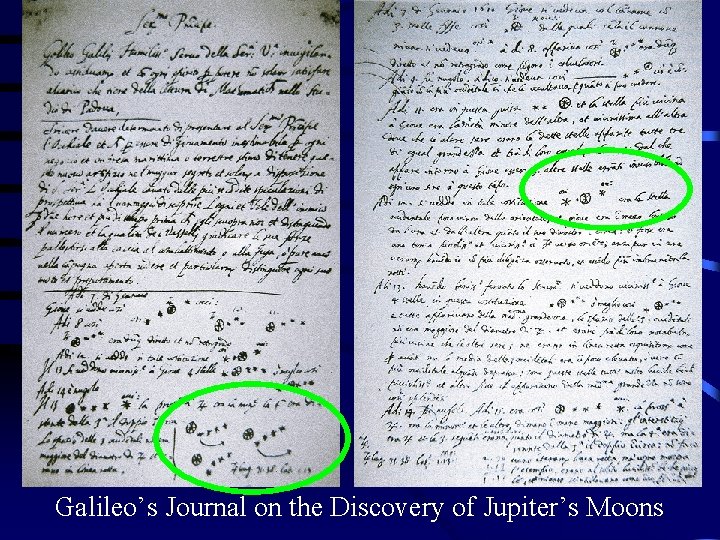
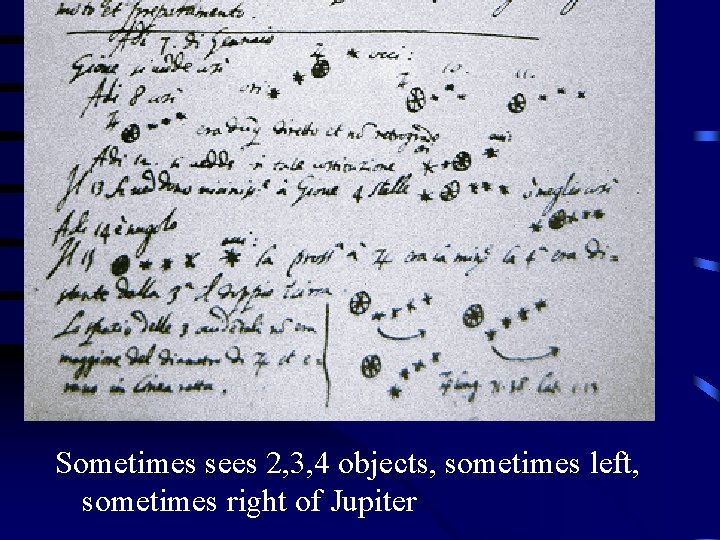
Galileo’s Journal on the Discovery of Jupiter’s Moons
Sometimes sees 2, 3, 4 objects, sometimes left, sometimes right of Jupiter
Latin vs Italian – Why? Siderius Nuntius (1610) Dialogo (1632)
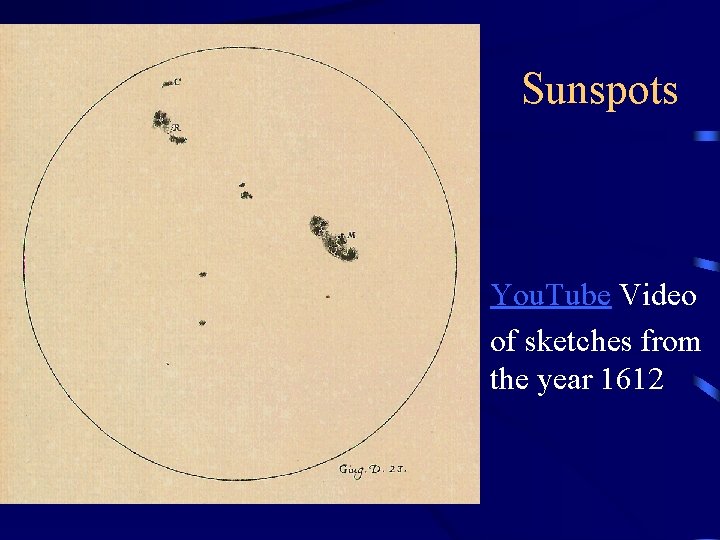
Sunspots • You. Tube Video • of sketches from the year 1612
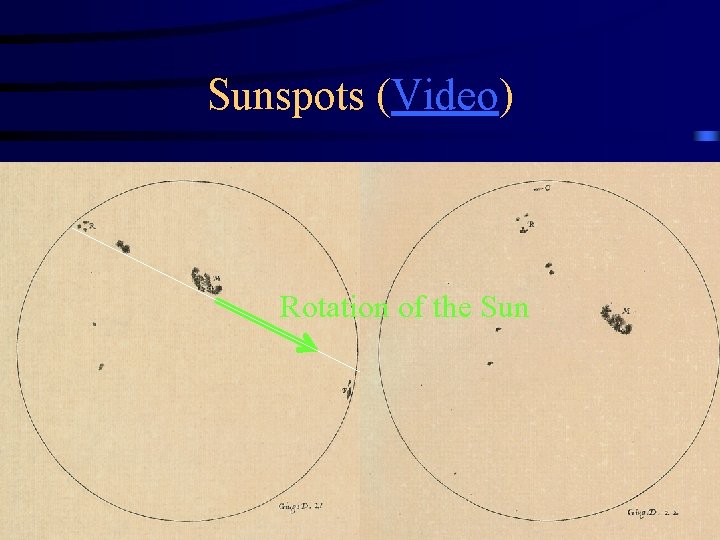
Sunspots (Video) Rotation of the Sun
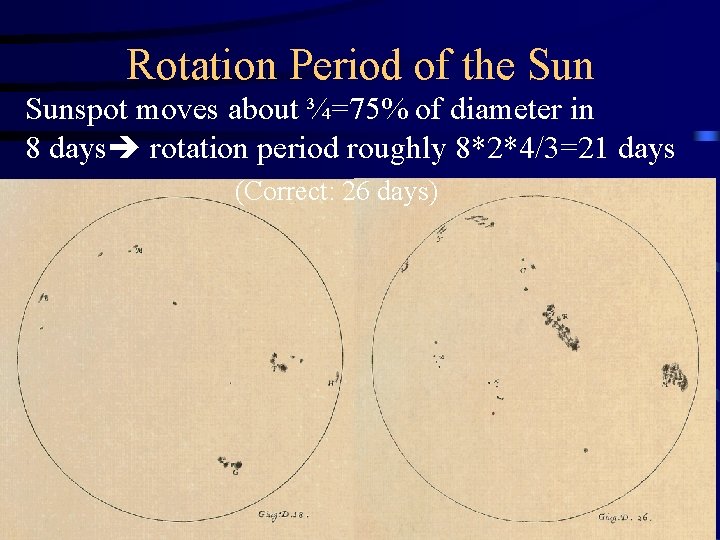
Rotation Period of the Sunspot moves about ¾=75% of diameter in 8 days rotation period roughly 8*2*4/3=21 days (Correct: 26 days)
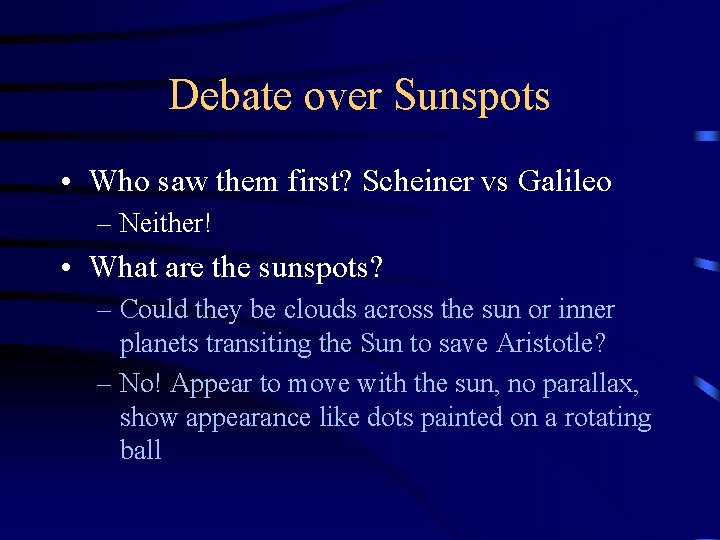
Debate over Sunspots • Who saw them first? Scheiner vs Galileo – Neither! • What are the sunspots? – Could they be clouds across the sun or inner planets transiting the Sun to save Aristotle? – No! Appear to move with the sun, no parallax, show appearance like dots painted on a rotating ball
Galileo’s Genius – Applied to Sunspots • Careful observation of a phenomenon – Observes sunspots (as did others before him) – Follows them over several weeks • Deriving conclusions from “data” – Concludes that these are things very close to the Sun’s surface • Making new predictions – Deduces that the sun rotates around itself in 26 days – Makes a prediction as to the Sun’s rotational axis • Publishing results “for everyone” [in Italian] – “Letters on Sunspots” (1612) • Anticipates his opponents arguments, and nullifies them by using stringent logic – Shows that sunspots can’t be inner planets
Phases of Venus
Geocentric vs Heliocentric: How do we know? • Is the Earth or the Sun the center of the solar system? • How do we decide between these two theories? • Invoke the scientific methods: – both theories make (different) predictions – Compare to observations – Decide which theory explains data
Phases of Venus Heliocentric Geocentric