
Galaxies What is a galaxy How many stars


- Slides: 27
Galaxies ● What is a galaxy? ● How many stars are there in an average galaxy? About how many galaxies are there in the universe? ● ● What is the name of our galaxy?
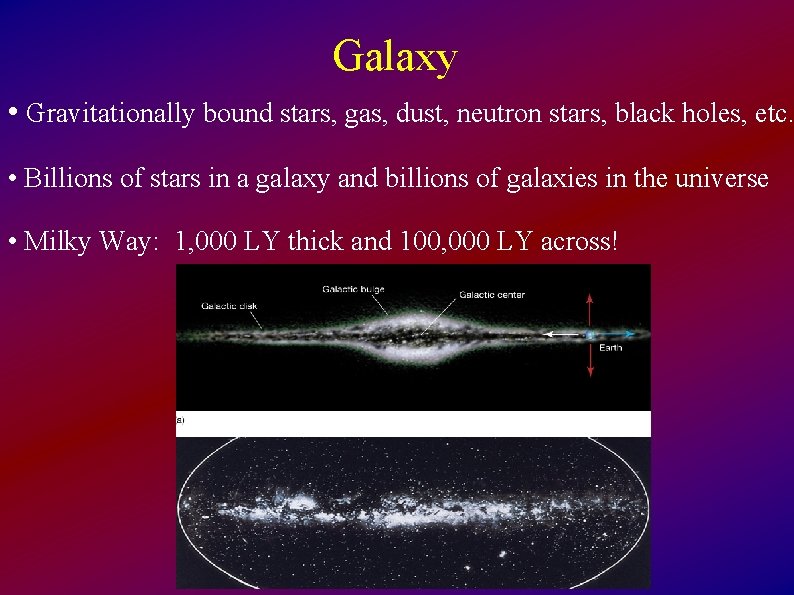
Galaxy • Gravitationally bound stars, gas, dust, neutron stars, black holes, etc. • Billions of stars in a galaxy and billions of galaxies in the universe • Milky Way: 1, 000 LY thick and 100, 000 LY across!
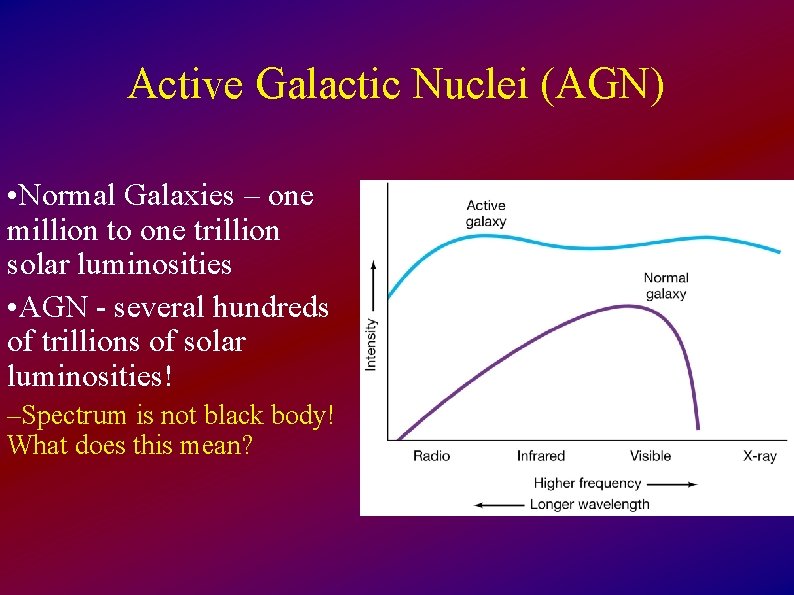
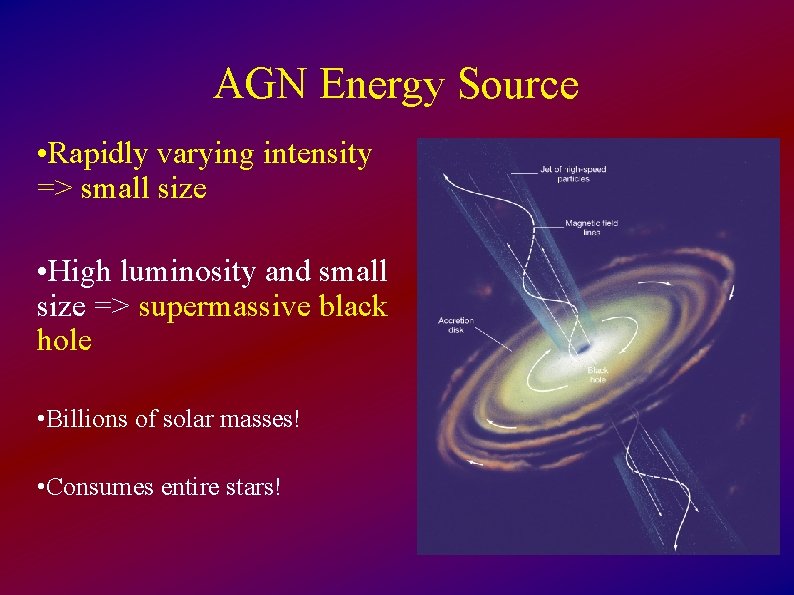
Active Galactic Nuclei (AGN) • Normal Galaxies – one million to one trillion solar luminosities • AGN - several hundreds of trillions of solar luminosities! –Spectrum is not black body! What does this mean?
AGN What is the power source that generates such enormous luminosities in AGNs? ●
AGN Energy Source • Rapidly varying intensity => small size • High luminosity and small size => supermassive black hole • Billions of solar masses! • Consumes entire stars!
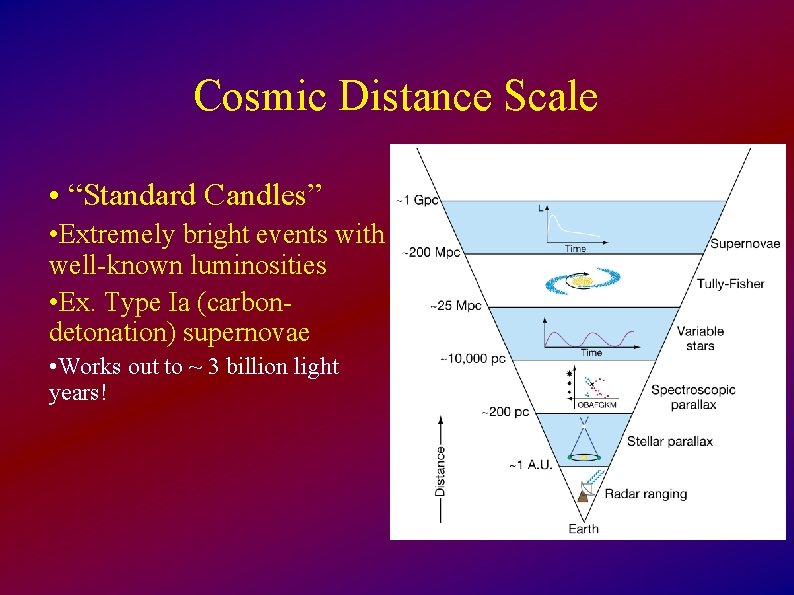
Cosmic Distance Scale • Closest galaxy: Andromeda – 2. 5 million light years away! • “Standard Candles” • Extremely bright events with well-known luminosities • Can you think of an example of such an event?
Cosmic Distance Scale • “Standard Candles” • Extremely bright events with well-known luminosities • Ex. Type Ia (carbondetonation) supernovae • Works out to ~ 3 billion light years!
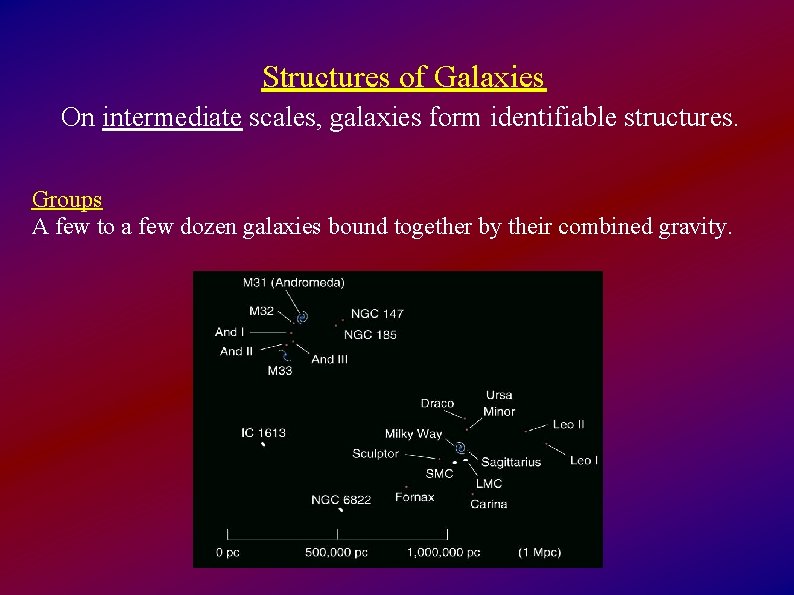
Structures of Galaxies On intermediate scales, galaxies form identifiable structures. Groups A few to a few dozen galaxies bound together by their combined gravity.
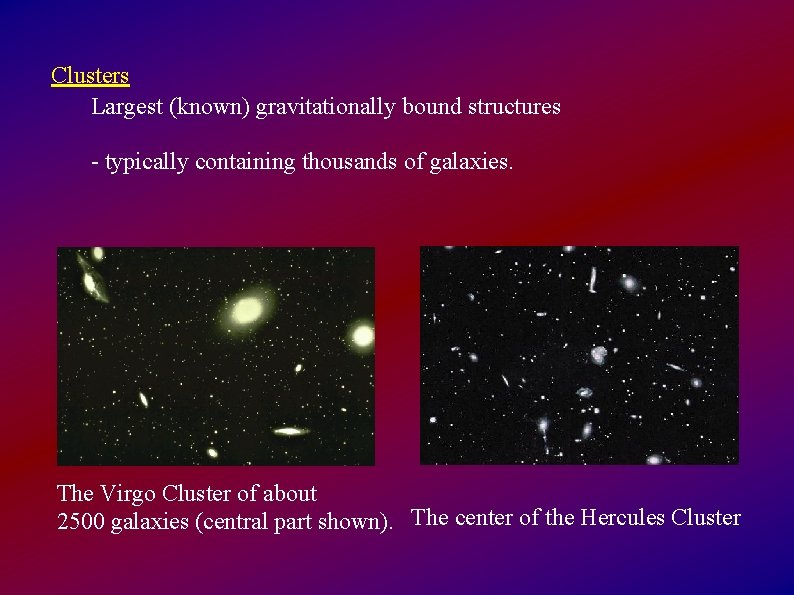
Clusters Largest (known) gravitationally bound structures - typically containing thousands of galaxies. The Virgo Cluster of about 2500 galaxies (central part shown). The center of the Hercules Cluster
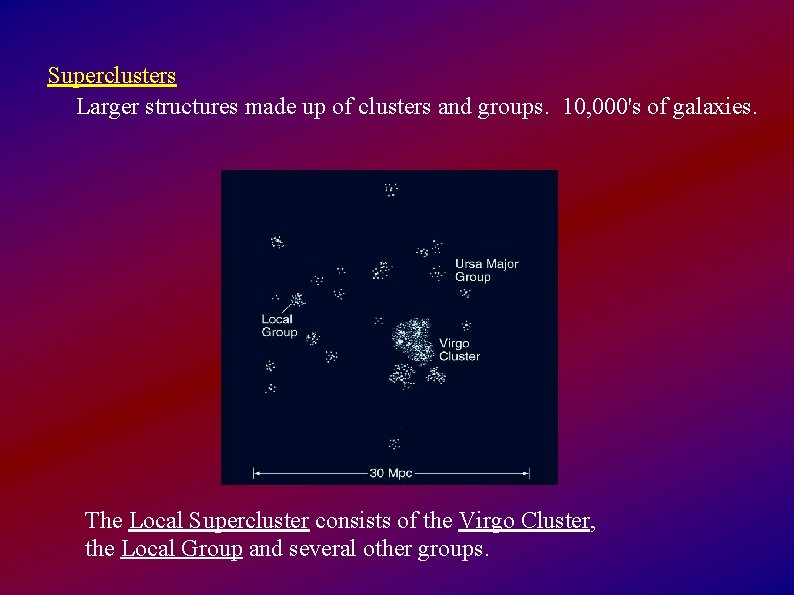
Superclusters Larger structures made up of clusters and groups. 10, 000's of galaxies. The Local Supercluster consists of the Virgo Cluster, the Local Group and several other groups.
Cosmological Structure? We have seen that galaxies are organized into clusters and superclusters on intermediate scales in the universe. ● How is matter distributed in the universe on the very largest scales? ●
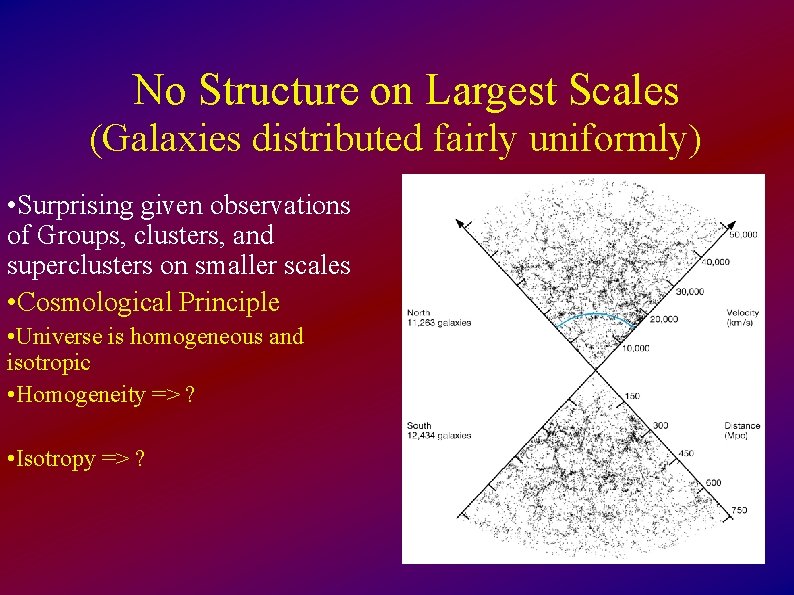
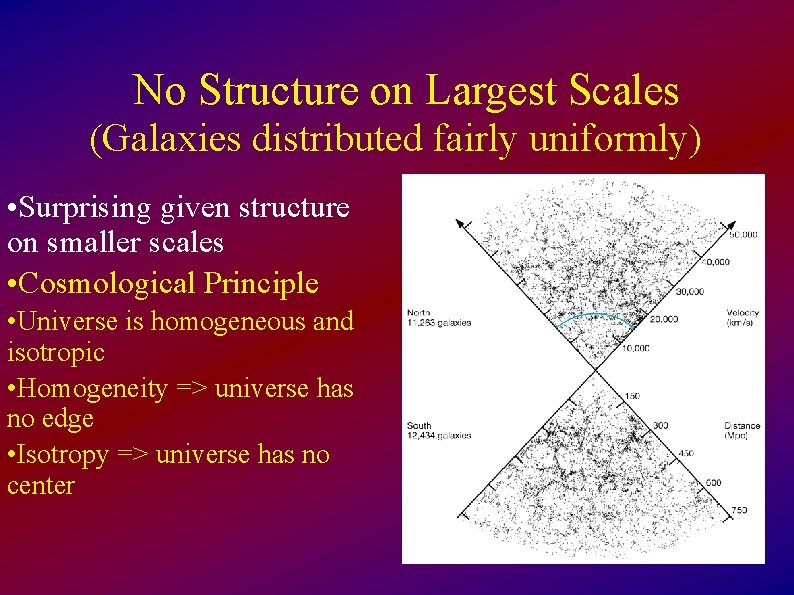
No Structure on Largest Scales (Galaxies distributed fairly uniformly) • Surprising given observations of Groups, clusters, and superclusters on smaller scales • Cosmological Principle • Universe is homogeneous and isotropic • Homogeneity => ? • Isotropy => ?
No Structure on Largest Scales (Galaxies distributed fairly uniformly) • Surprising given structure on smaller scales • Cosmological Principle • Universe is homogeneous and isotropic • Homogeneity => universe has no edge • Isotropy => universe has no center
Olbers` Paradox If the universe is homogeneous, isotropic, infinite, and unchanging, then the night sky should be as bright as the sun. Why isn't it?
The universe is expanding! => Assumption that universe is unchanging is incorrect. => Doesn’t matter whether universe is finite or infinite, we only see a finite part. => Light from objects greater than 14 billion light years away has not had time to reach us!
Cosmological Scales ● How do we know that the universe is expanding?
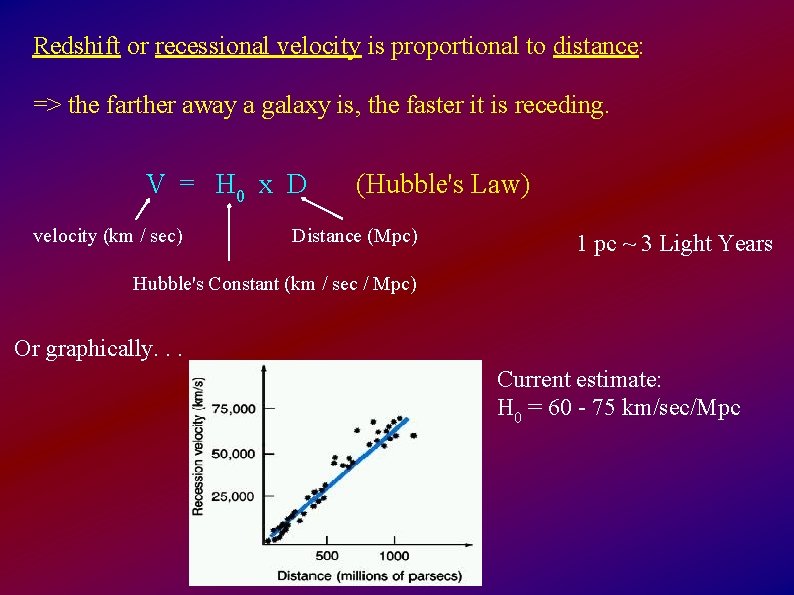
Almost all galaxies exhibit show redshifted spectral lines => they are receding from us! Size of universe is not static, nor shrinking due to influence of gravity. Universe is expanding.
Redshift or recessional velocity is proportional to distance: => the farther away a galaxy is, the faster it is receding. V = H 0 x D velocity (km / sec) (Hubble's Law) Distance (Mpc) 1 pc ~ 3 Light Years Hubble's Constant (km / sec / Mpc) Or graphically. . . Current estimate: H 0 = 60 - 75 km/sec/Mpc
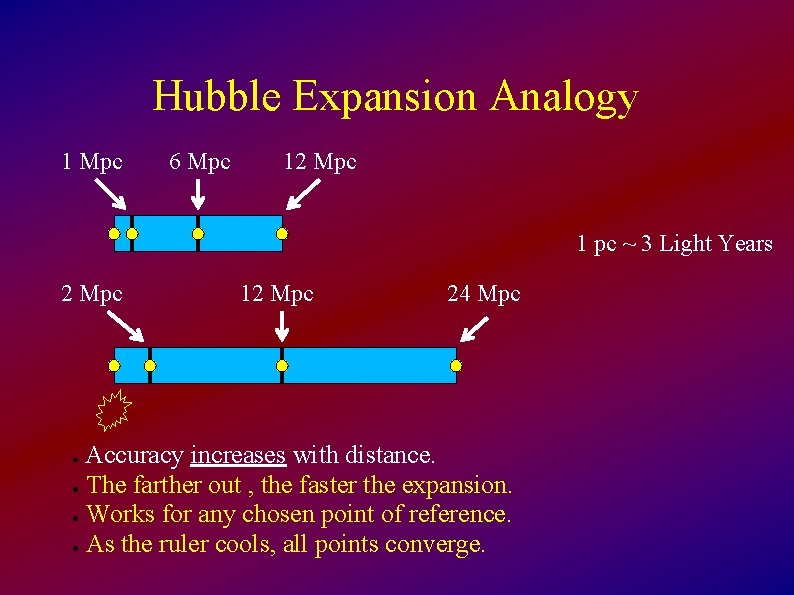
Hubble Expansion Analogy 1 Mpc 6 Mpc 12 Mpc 1 pc ~ 3 Light Years 2 Mpc 12 Mpc 24 Mpc Accuracy increases with distance. ● The farther out , the faster the expansion. ● Works for any chosen point of reference. ● As the ruler cools, all points converge. ●
The Fate of the Universe What property determines the ultimate fate of the universe? ●
Affect of Density on the Universe
Density Determines the Eventual Fate of the Universe ● How is the expansion rate changing with time? ● Will the universe expand forever?
Question What is it that is causing the expansion of the universe to accelerate? ●
● We aren't sure, but we call it dark energy. ● Repulsive nature suggests that universe may expand forever. • Largest contributor to cosmic density, more than normal matter or even dark matter! Recent Progress! • Cosmological constant – One possible source of dark energy • Effect of nonzero vacuum energy (pair creation) • Knew it was repulsive, but couldn't calculate strength • Recent work yields value consistent w/ observations ●
Review Question ● The spectrum of an AGN is _____. –A) mainly due to starlight –B) very dim –C) non-blackbody –D) highly stable
Review Question ● Hubble's law tells us that the ______. –A) closer a galaxy is, the faster it moves away –B) farther a galaxy is, the faster it moves away –C) farther a galaxy is, the slower it moves away –D) farther a galaxy is, the larger it is
Review Question ● Isotropy implies that the universe has no _____. –A) center –B) curvature –C) horizon –D) edge