
Galaxies Types and Formation Galaxy Facts There are


- Slides: 29
Galaxies Types and Formation
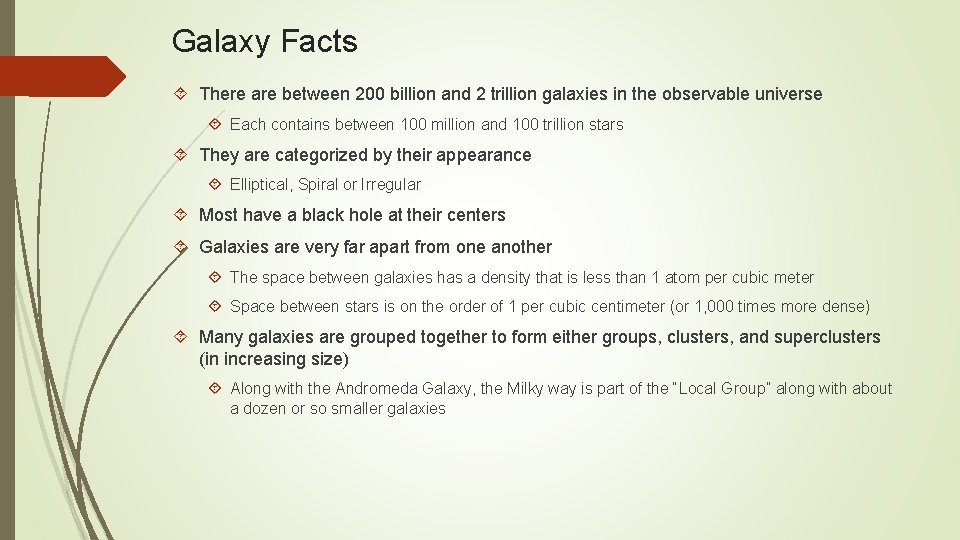
Galaxy Facts There are between 200 billion and 2 trillion galaxies in the observable universe Each contains between 100 million and 100 trillion stars They are categorized by their appearance Elliptical, Spiral or Irregular Most have a black hole at their centers Galaxies are very far apart from one another The space between galaxies has a density that is less than 1 atom per cubic meter Space between stars is on the order of 1 per cubic centimeter (or 1, 000 times more dense) Many galaxies are grouped together to form either groups, clusters, and superclusters (in increasing size) Along with the Andromeda Galaxy, the Milky way is part of the “Local Group” along with about a dozen or so smaller galaxies
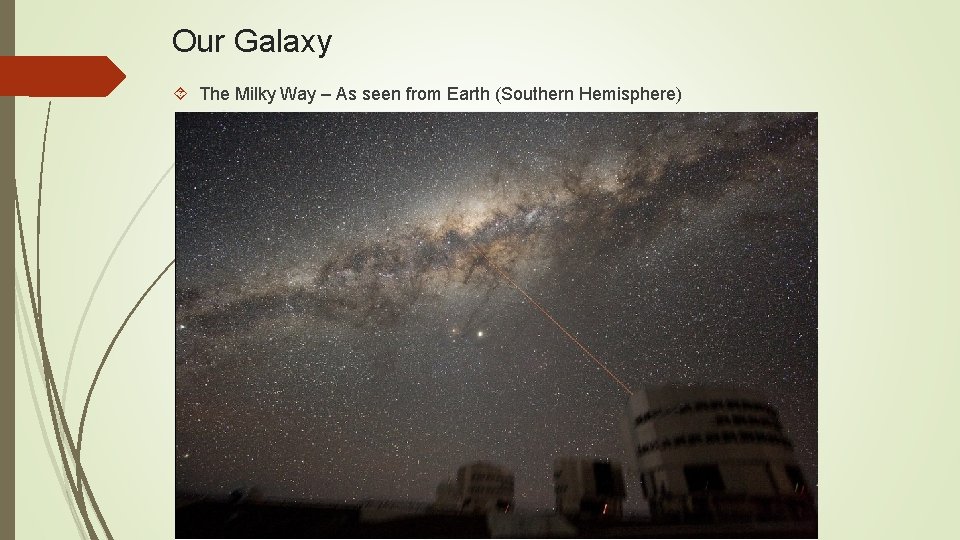
Our Galaxy The Milky Way – As seen from Earth (Southern Hemisphere)
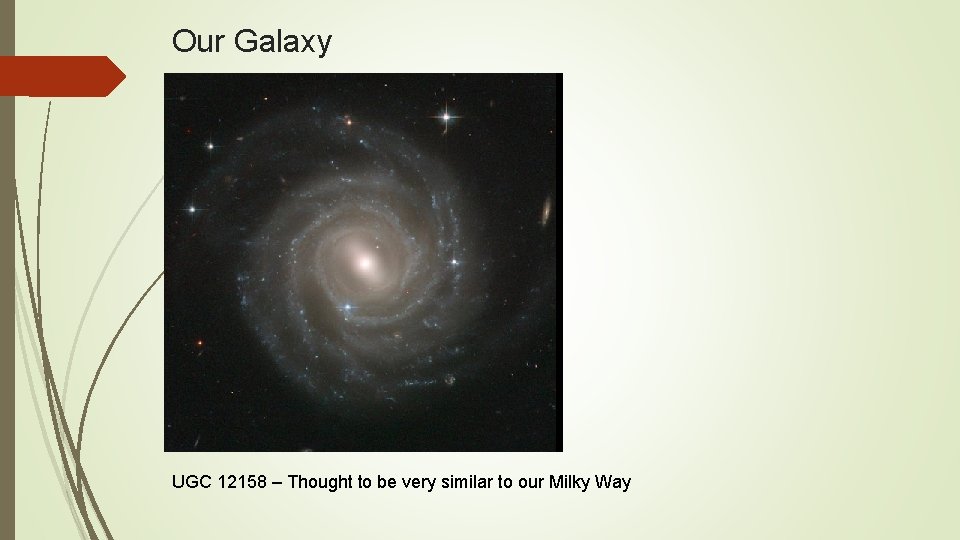
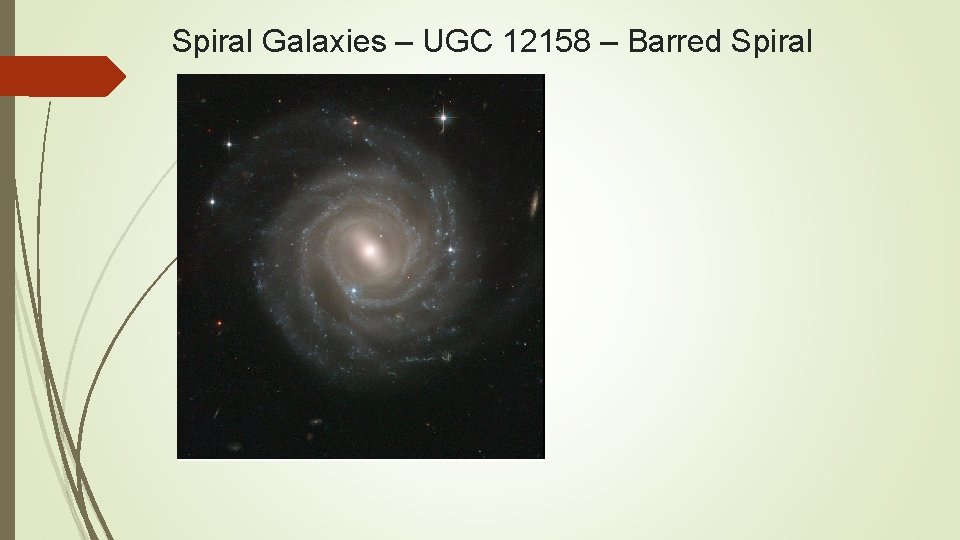
Our Galaxy UGC 12158 – Thought to be very similar to our Milky Way
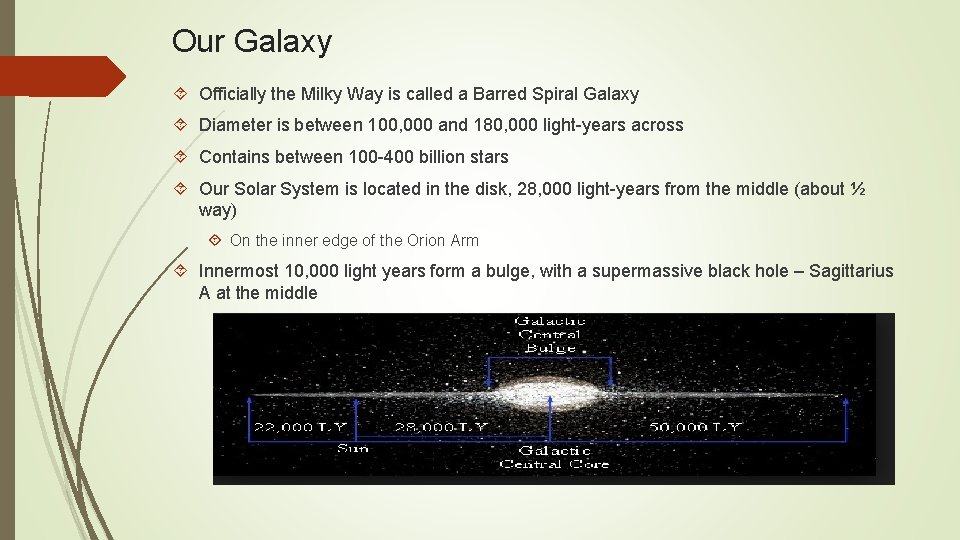
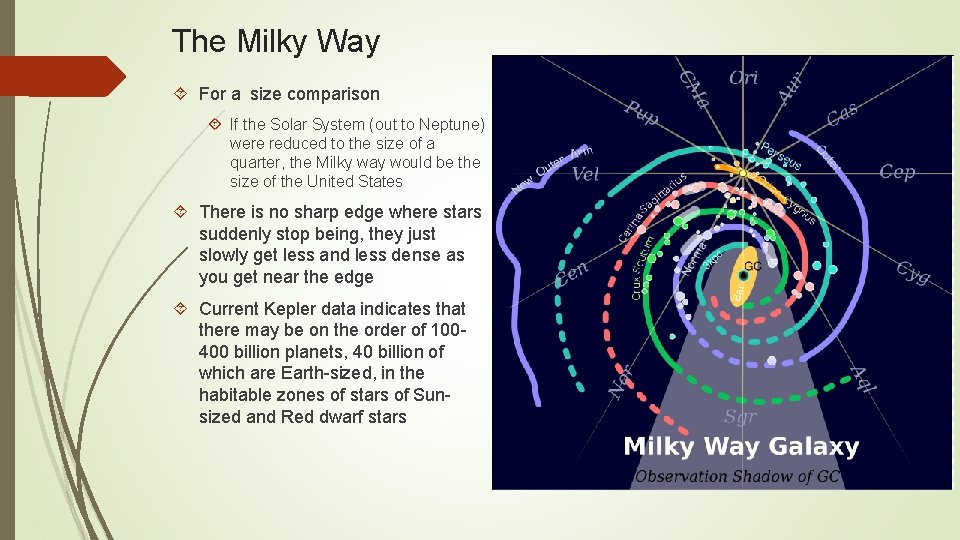
Our Galaxy Officially the Milky Way is called a Barred Spiral Galaxy Diameter is between 100, 000 and 180, 000 light-years across Contains between 100 -400 billion stars Our Solar System is located in the disk, 28, 000 light-years from the middle (about ½ way) On the inner edge of the Orion Arm Innermost 10, 000 light years form a bulge, with a supermassive black hole – Sagittarius A at the middle
The Milky Way For a size comparison If the Solar System (out to Neptune) were reduced to the size of a quarter, the Milky way would be the size of the United States There is no sharp edge where stars suddenly stop being, they just slowly get less and less dense as you get near the edge Current Kepler data indicates that there may be on the order of 100400 billion planets, 40 billion of which are Earth-sized, in the habitable zones of stars of Sunsized and Red dwarf stars
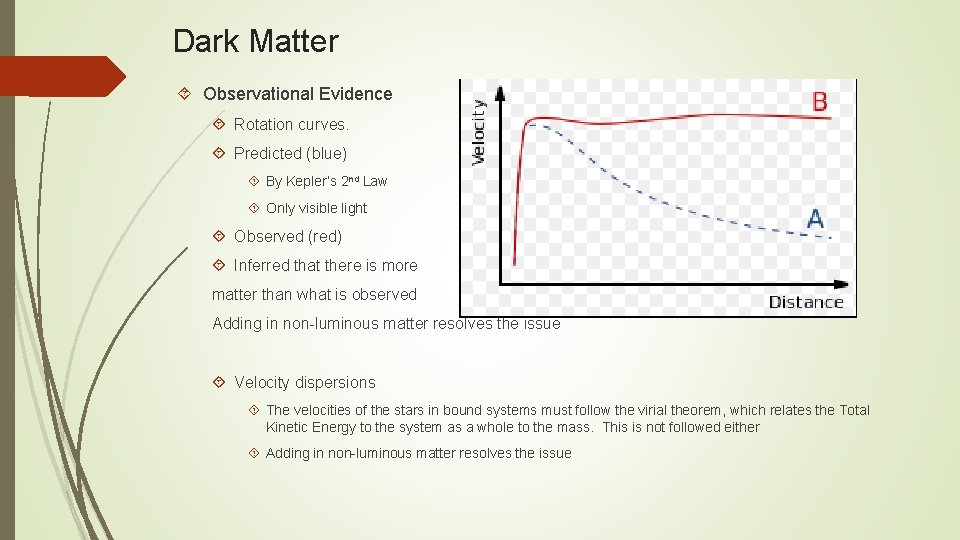
Galaxy Rotation The red line is the predicted rotational speed of the galaxy, as a function of distance, based on the observed mass of the galaxy The blue line is the observed speed of the rotations (with the grey lines being the margin of error) This indicates that there is some “other” mass causing the galaxy to rotate faster (particularly the further you get from the center) This “other” matter has been called “dark matter” as it cannot be seen, but only inferred from the observational data
Dark Matter Theorized form of matter. Accounts for about 25% of the universe’s total mass-energy (Visible matter accounts for only 4%) Believed to be non-baryonic in nature, which means that it does not react with matter other than through gravity Baryonic matter is the “stuff” that we are familiar with (Protons and Neutrons) Is only observed indirectly by gravitational effects that cannot be explained by visible matter The velocity curve of rotation in galaxies Gravitational lensing of distant objects Location of mass during galactic collisions First “observations” were done by Jan Oort and Fritz Zwicky in the 1930’s looking at the radial data of nearby galaxies. The primary candidate is what is known as a WIMP Weakly Interacting Massive Particle – an, as of yet, undiscovered elementary particle
Dark Matter Observational Evidence Rotation curves. Predicted (blue) By Kepler’s 2 nd Law Only visible light Observed (red) Inferred that there is more matter than what is observed Adding in non-luminous matter resolves the issue Velocity dispersions The velocities of the stars in bound systems must follow the virial theorem, which relates the Total Kinetic Energy to the system as a whole to the mass. This is not followed either Adding in non-luminous matter resolves the issue
Dark Matter Galaxy Clusters Can look at the scatter in radial velocities Can look at the X-ray emissions, which allows us to estimate the temperature and density, leading us to the mass Gravitational lensing, allows us to estimate mass without looking at velocity and other more tenuous observational data Cosmic Microwave Background Variations in the background radiation are caused first, by ordinary matter, and secondly, by dark matter Detailed observations of this background radiation have led to observational data on the existence of dark matter Galactic Structures Many of the clusters, and superclusters that are in the universe do not have enough luminous mass in them to properly account for them being held together by gravity, or for their relative velocities to one another.
Dark Matter Candidates To be a dark matter candidate, the matter must be non-interacting, non-luminous, and abundant One candidate are MACHO’s – Massive Compact Halo Objects These include black holes, neutron stars, old white dwarfs and brown dwarfs Objects that are so faint that we cannot detect them Based on the Big Bang Theory, and the nucleosynthesis of matter, these could at most only account for a fraction of the “missing” matter Non-Baryonic matter Hypothetical particles such as axions, sterile neutrinos, or WIMPS Neutrinos are Non-baryonic, and do not interact with normal matter commonly (10 million billion of them go through you every second) Unfortunately their mass is much too small to account for the missing matter
Dark Matter If dark matter is so prevalent, does it clump and form “stars”, “planets”, or “black holes” made of dark matter? It is unlikely Dark matter does not have a means to lose energy It only interacts with dark matter through gravity. All known means of matter losing energy use the electromagnetic and/or nuclear forces Dark matter does not have the interactions necessary to form structures Without electromagnetism, and the strong and weak nuclear forces, very hard to imagine how this could happen How could we detect dark matter directly? There are experiments happening at the LHC (Large Hadronic Collider) that might be used to detect dark matter LIGO – the gravitational wave detector might be able to as well, if it is in the form of primordial black holes.
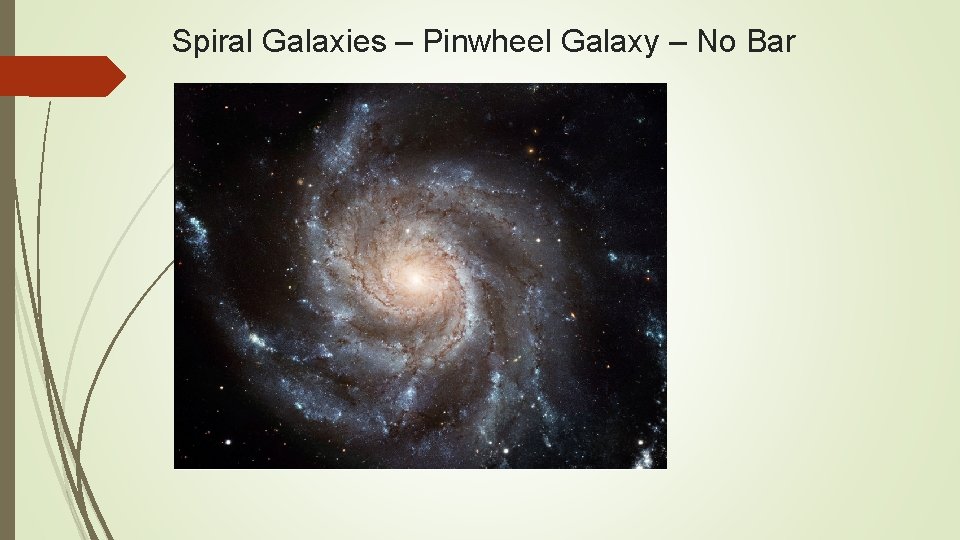
Types of Galaxies Spiral Most consist of a flat, rotating disk of stars, dust and gas. Has a central bulge of stars May also be surrounded by a much fainter halo of stars, which can reside in globular clusters About 2/3 rds of them also have a bar like structure Amount having bars tends to relate with age of galaxy, older galaxies are less likely to be barred than younger galaxies Make up about 60% of all galaxies (when combined with irregular galaxies) Tend to be found in lower-density regions away from the centers of galaxy clusters
Spiral Galaxies There are 5 distinct components that make up a spiral galaxy 1. A flat rotating disk, with spiral arms a prominent component Contains younger, brighter stars, as they are regions of stellar formation 2. A central bulge of older stars (which resembles an elliptical galaxy) Generally full of old, low-metal, red stars 3. A near-spherical halo of stars, including globular clusters Tends to be free of any dust, may be captured stars 4. A supermassive black hole at the very center of the bulge The rotation of the central stars is closely related to the mass of the black hole 5. A near-spherical halo of dark matter Gives the rotation of the galaxy it’s proper form
Spiral Galaxies – Pinwheel Galaxy – No Bar
Spiral Galaxies – UGC 12158 – Barred Spiral
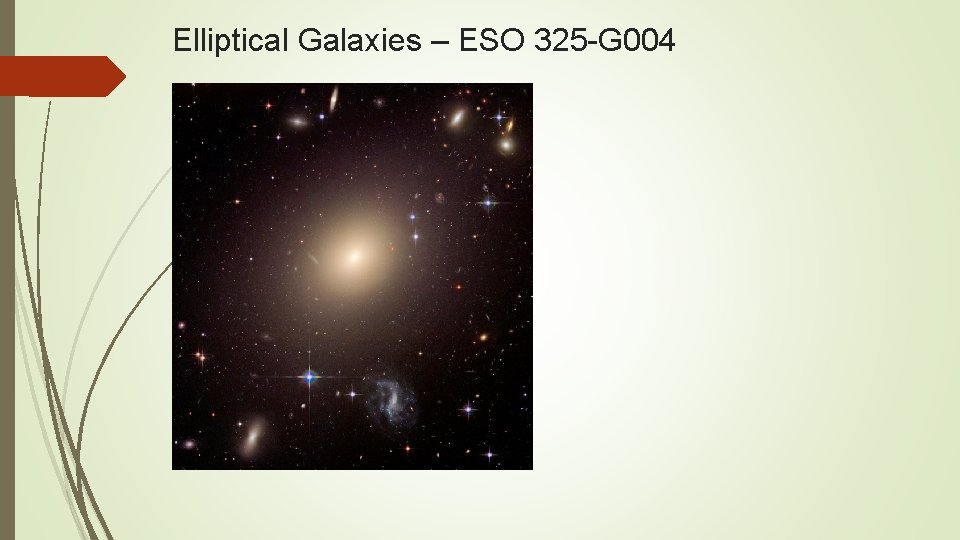
Elliptical Galaxies Have an approximately ellipsoidal shape Smooth, nearly featureless brightness profile More 3 -dimensional Stars have almost random orbits about the center Can contain anywhere from 10 million to 100 trillion stars (HUGE range) Most stars are older, reddish, metal poor stars Low amounts of stellar formation Make up 10 -15% of all galaxies in the universe. Believed that they are formed from the collision of two, similarly sized, galaxies The Milky Way and Andromeda galaxy will collide in about 5 billion years, and will probably form an elliptical galaxy
Elliptical Galaxies – ESO 325 -G 004
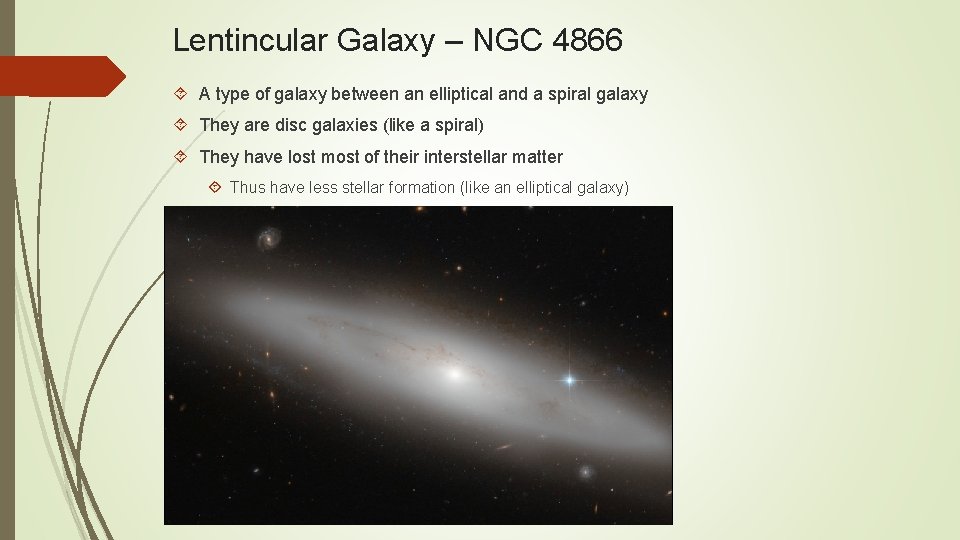
Lentincular Galaxy – NGC 4866 A type of galaxy between an elliptical and a spiral galaxy They are disc galaxies (like a spiral) They have lost most of their interstellar matter Thus have less stellar formation (like an elliptical galaxy)
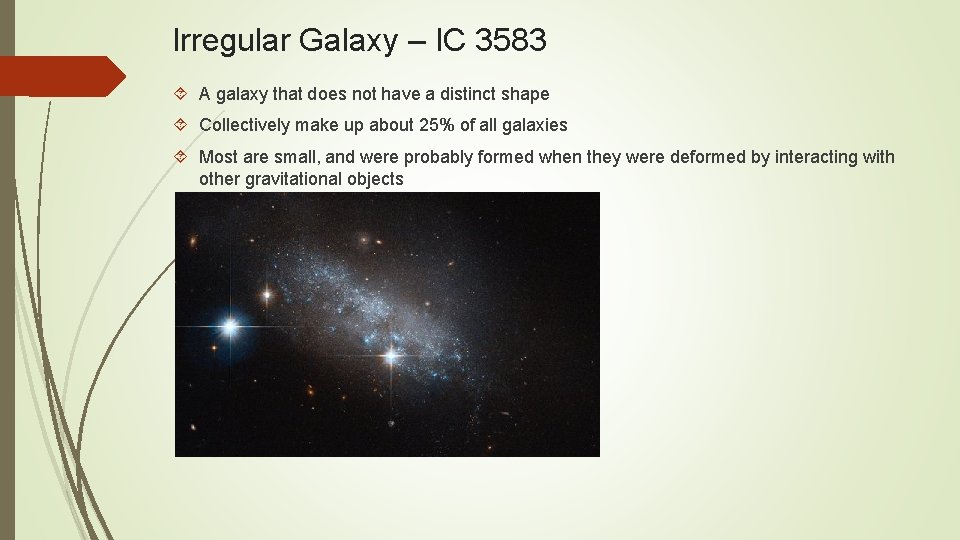
Irregular Galaxy – IC 3583 A galaxy that does not have a distinct shape Collectively make up about 25% of all galaxies Most are small, and were probably formed when they were deformed by interacting with other gravitational objects
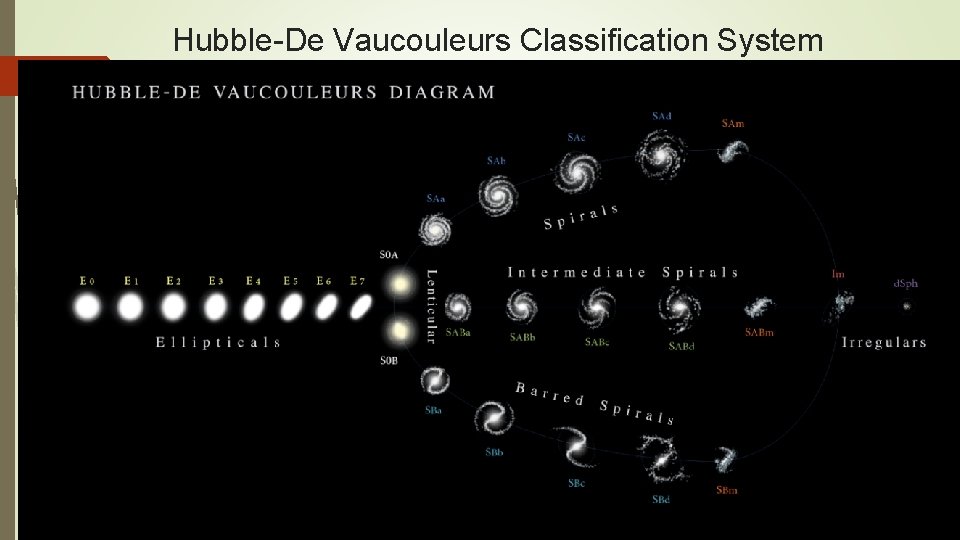
Hubble-De Vaucouleurs Classification System
The Distance Ladder To determine distance in space we use a “ladder” approach for nearby to far away objects We can only “directly” measure the distance of an object if it’s within about 1000 parsecs of the Earth, using parallax. All other methods use some form of a standard candle to determine distances No one method can measure all distances in astronomy There are many different ‘standard’ candles but the primary distance ladder goes as follows 1. Parallax – used for nearby stars < 1 kpc (kiloparsecs) 2. Cepheid Variables – The Milky Way and nearby galaxies <30 Mpc (Megaparsecs) 3. Type 1 a Supernova – Galaxies in our Supercluser <1000 Mpc (Megaparsecs) 4. Redshift – Observable universe >500 Mpc (Megaparsecs) The biggest gap is between parallax and Cepheid variables, so this is where our biggest uncertainty comes from.
Redshift Most of the universe if moving away from us at a very rapid pace, as the fabric of spacetime is expanding This causes the light from objects to be “redshifted” or moved towards the red end of the visible light spectrum This is the equivalent of the Doppler Effect for sound. You just need a much more massive velocity for its effects to be noticable It’s wavelength is expanded as the electromagnetic radiation is stretched on its move through space Objects can be shifted all the way to infrared, microwave, and even radio wavelengths depending on how fast they are moving The rate of motion is strongly correlated with the distance the object is away as well, so galaxies that are further away are more redshifted. The redshift is affixed from distant Type 1 a supernovae that we can measure their distance that way (this is another rung on the distance ladder)
Other Large Objects Quasars Contraction of Quasi-stellar radio source At visible wavelengths appear like a star First discovered in the radio wavelengths Emit radiation on multiple frequencies, covering radio, infrared, visible, UV and X-ray Have luminosities exceeding more than 1000 times that of our own Milky Way Some of the oldest (and furthest away) objects we’ve discovered are Quasars One was discovered at redshift z=7. 54, meaning the light it gave off that we see was emitted when the universe was only 690 million years old! The brightest Quasars would be brighter than our Sun in the sky if they were 33 light years away from us.
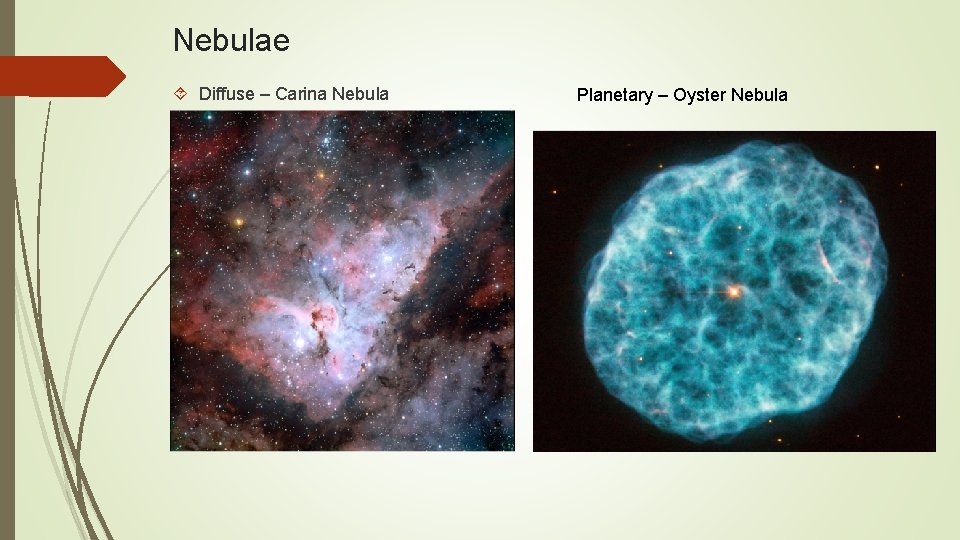
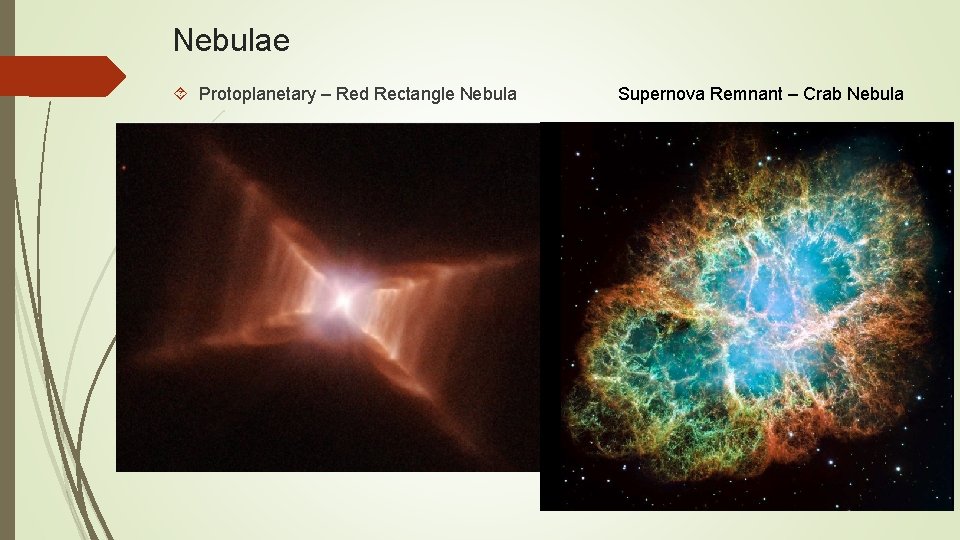
Nebulae are clouds of dust and gas Some are illuminated by background radiation, they may have a star in them, or stellar remnant. Types Diffuse No well defined boundaries Planetary Usually circular in shape, a result of stellar processes Protoplanetary Intermediate stage for giant branch stars – may or may not “evolve” into a planetary nebula Supernova Remnant The remnant of a supernova explosion
Nebulae Diffuse – Carina Nebula Planetary – Oyster Nebula
Nebulae Protoplanetary – Red Rectangle Nebula Supernova Remnant – Crab Nebula
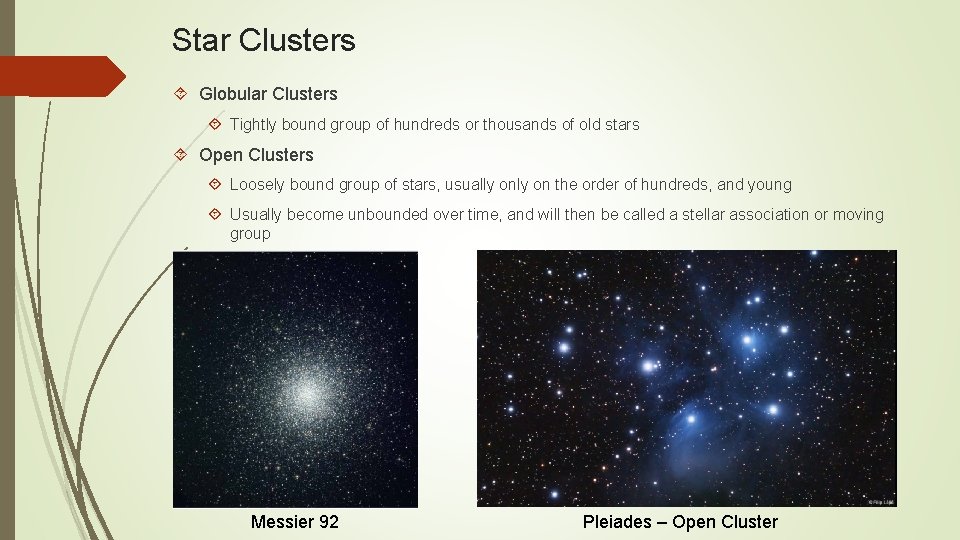
Star Clusters Globular Clusters Tightly bound group of hundreds or thousands of old stars Open Clusters Loosely bound group of stars, usually on the order of hundreds, and young Usually become unbounded over time, and will then be called a stellar association or moving group Messier 92 Pleiades – Open Cluster
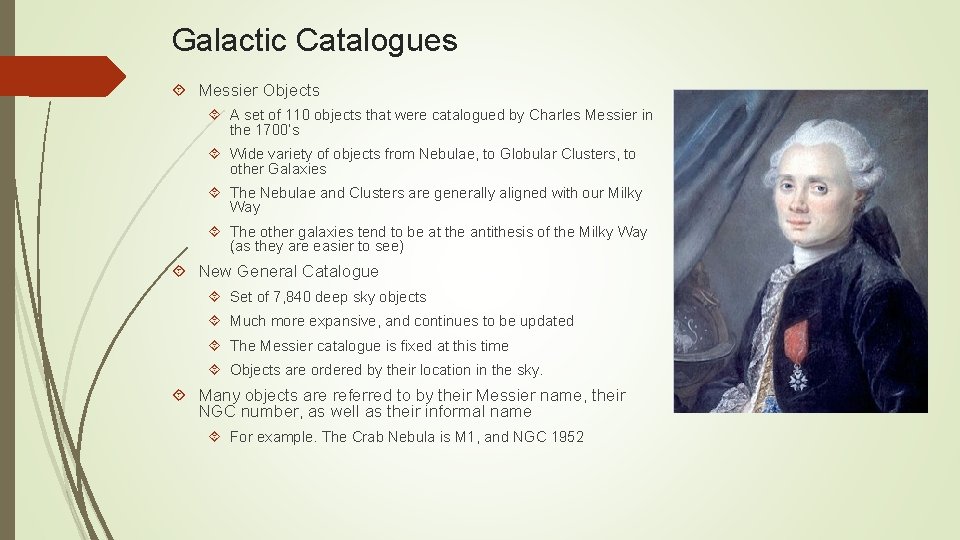
Galactic Catalogues Messier Objects A set of 110 objects that were catalogued by Charles Messier in the 1700’s Wide variety of objects from Nebulae, to Globular Clusters, to other Galaxies The Nebulae and Clusters are generally aligned with our Milky Way The other galaxies tend to be at the antithesis of the Milky Way (as they are easier to see) New General Catalogue Set of 7, 840 deep sky objects Much more expansive, and continues to be updated The Messier catalogue is fixed at this time Objects are ordered by their location in the sky. Many objects are referred to by their Messier name, their NGC number, as well as their informal name For example. The Crab Nebula is M 1, and NGC 1952