
Galatians Jesus Christ Our Liberty by Dana Burkinshaw

Galatians Jesus Christ, Our Liberty by Dana Burkinshaw October 14, 2020
F–L–I–G–H–T F – The apostle Paul wrote the book of Galatians, addressing it to a group of church assemblies rather than to one. Paul was born in the city of Tarsus in the southern part of the region of Galatia (in modern-day Turkey). After his conversion to Christ (around AD 34), Paul spent the remainder of his life ministering God’s grace & preaching the gospel. He was executed for his faith around AD 67. There are two different theories regarding the date Galatians was written, an early date (AD 48) and a late date (AD 55). Gospel of Grace Fellowship ggf. church 1
F–L–I–G–H–T L – Paul’s forceful little letter of Galatians addressed the Galatian church’s legalism and the false gospel of works. Galatians is a classic statement of the doctrine of justification by grace alone through faith alone, written to counter false teachers who were saying that a person must keep the Jewish law to be righteous before God. Much like Paul’s epistle to the Romans, Galatians has played a strategic role in the history of the Christian church. The letter had a notable impact on the life of Protestant giant Martin Luther. Gospel of Grace Fellowship ggf. church 2

F–L–I–G–H–T L – In Galatians, Paul addressed the problems raised by the oppressive theology of certain Jewish legalizers who had caused believers in Galatia to trade their freedom in Christ for bondage to the law. Paul also defended the gospel and his apostleship, described the differences between law and grace, and explained the practical application of these truths. Gospel of Grace Fellowship ggf. church 3
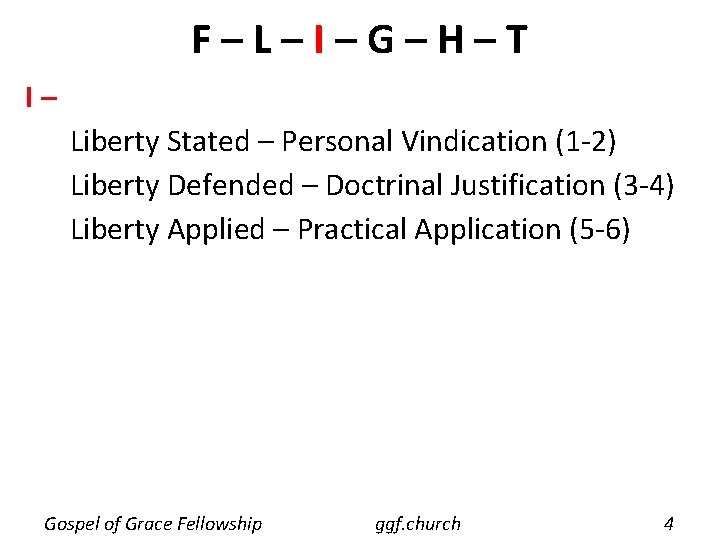
F–L–I–G–H–T I– Liberty Stated – Personal Vindication (1 -2) Liberty Defended – Doctrinal Justification (3 -4) Liberty Applied – Practical Application (5 -6) Gospel of Grace Fellowship ggf. church 4

F–L–I–G–H–T G – Galatians is the Magna Carta of Christian liberty. It emphasizes that freedom from sin is accompanied by freedom from the law and the doctrines of man. The law brings a curse upon us because we can never fulfill its demands. But because Jesus lived a perfect life and fulfilled its demands, he was able to take our place and take the punishment we deserved, becoming the curse for us, suffering its consequences, and defeating it once and for all by rising from the dead. Gospel of Grace Fellowship ggf. church 5
F–L–I–G–H–T G – As Paul wrote in Galatians 3: 13 -14, “Christ has redeemed us from the curse of the law, having become a curse for us (for it is written, ‘Cursed is everyone who hangs on a tree’), that the blessing of Abraham might come upon the Gentiles in Christ Jesus, that we might receive the promise of the Spirit through faith. ” Capital punishment by stoning was part of the Jewish law, but crucifixion wasn’t. Stoning was a holy remedy, but being nailed to a cross was considered to be defiling – an unclean death for an unholy people. Gospel of Grace Fellowship ggf. church 6
F–L–I–G–H–T G – Paul’s point was that Jesus died in a way that the Jews considered cursed. The weight of the true curse – our sins – was then placed on him, and because of that, he was able to purchase for us freedom from sin and perfect liberty in Christ. He was the perfect substitute for us, the only One who could bear the weight of all our sin. Only Jesus could do it – and that’s why salvation is a gift of God’s grace and not something any human being could ever earn. Gospel of Grace Fellowship ggf. church 7
F–L–I–G–H–T H – During the 3 rd century BC some Celtic people from Gaul (modern day France) migrated to the inner plateau of Asia Minor and established a kingdom. Under Amyntas (1 st century BC) the kingdom extended to Pisidia, Lycaonia, and other places in what is now Turkey, and most of the immigrants remained when, on the death of Amyntas (25 BC) the Romans took over and made it into the province of Galatia. [The apostle Paul was born in southern Galatia, and, because it was a Roman province, Paul was born a Roman citizen. ] Gospel of Grace Fellowship ggf. church 8
F–L–I–G–H–T H – The problem for us is whether the “Galatians” to which this epistle is addressed refers to ethnic Galatians in the north of the province or to the southerners of various races who were included in the Roman province. Toward the end of the 3 rd century AD, the southern area was detached, and the province was reduced to the northern sector. Traditionally, “Galatia” has thus been understood as the northern area. But was this the way Paul used the term? The apostle visited the southern area on his first missionary journey (Acts 13 -14), but he is never explicitly said to have visited the northern area – though many think that is what is meant in Acts 16: 6 and 18: 23. Gospel of Grace Fellowship ggf. church 9
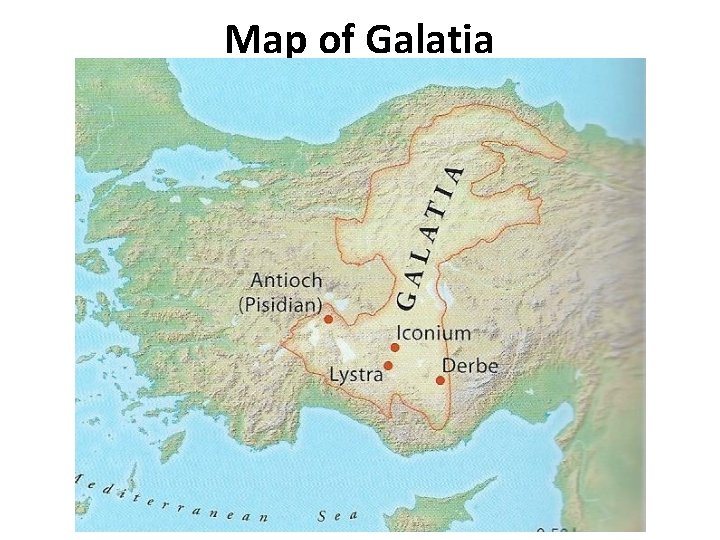
Map of Galatia Gospel of Grace Fellowship ggf. church 10
F–L–I–G–H–T T – Hold to the true gospel of grace. The Galatians had turned to “a different gospel” (1: 6) – one based on works instead of grace. Paul said that if anyone preached a gospel other than the one he had preached, then “let him be accursed” (1: 8). No matter how sweet a preacher’s words are – even if they come from an angel as Paul said – if they don’t match up with what the Bible says, they are false, and you are to reject them completely. Gospel of Grace Fellowship ggf. church 11
F–L–I–G–H–T T – Hold on to your liberty in Christ. Jesus set you free from the bondage of sin – from human nature and its shackles – so why would you chain yourself to those same things again (3: 13)? Jesus has set you free not only from sin, but also from manmade religious rules (John 8: 36). You’re free from any regulation anyone tries to add to the gospel, no matter how convincing it sounds or who is prescribing it. Gospel of Grace Fellowship ggf. church 12
F–L–I–G–H–T T – To fully receive God’s grace, you must first acknowledge your sin. No one can be good enough to earn their way to salvation. But unless you acknowledge you’re a sinner, you’ll never see your need for a Savior. The law is a source of blessing for the perfect; for the rest of us – and, yes, that’s all of us – it brings a curse from which only Christ can redeem us (3: 13). The law says, “Do this and live, ” whereas faith says, “Believe this and live. ” Gospel of Grace Fellowship ggf. church 13
F–L–I–G–H–T T – Christians are able to “walk in the Spirit” (5: 16). The Holy Spirit lives in every single believer, energizing our new nature in Christ – our liberty and freedom from sin – while helping us resist the impulses of our flesh. Freedom in Christ is not about doing what you want, but doing what Christ wants: loving other people and having a servant’s heart. That produces what Paul called the fruit of the Spirit: “love, joy, peace, longsuffering, kindness, goodness, faithfulness, gentleness, self-control” (5: 22 -23). Gospel of Grace Fellowship ggf. church 14
Theme of Galatians insists on Christian liberty from any doctrine of salvation that requires human effort in addition to divine grace, and on the unity of all believers in Jesus Christ. Gospel of Grace Fellowship ggf. church 15
Key Verse of Galatians “Know that a man is not justified by observing the law, but by faith in Jesus Christ. So we, too, have put our faith in Christ and not by observing the law, because by observing the law no one will be justified” (2: 16). Gospel of Grace Fellowship ggf. church 16
Dating of Galatians There are two theories regarding the date Galatians was written. § The north Galatian theory (also known as the geographical view) puts the date of authorship circa AD 55, when Paul was in Ephesus. § The south Galatian theory (also known as the political view) puts the date of authorship around AD 48, when Paul was in Antioch, perhaps establishing the need for church-wide clarification on the doctrine of salvation by grace. Gospel of Grace Fellowship ggf. church 17
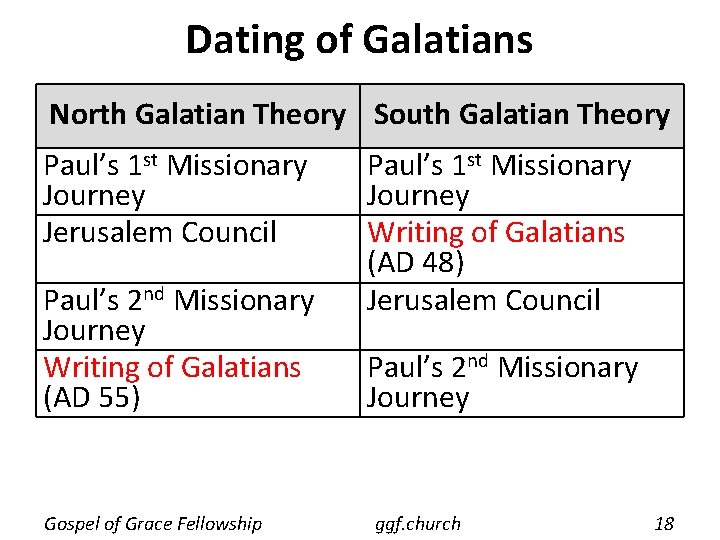
Dating of Galatians North Galatian Theory South Galatian Theory Paul’s 1 st Missionary Journey Jerusalem Council Paul’s 2 nd Missionary Journey Writing of Galatians (AD 55) Gospel of Grace Fellowship Paul’s 1 st Missionary Journey Writing of Galatians (AD 48) Jerusalem Council Paul’s 2 nd Missionary Journey ggf. church 18
Dating of Galatians Reasons for preferring the southern Galatian theory: § There is no clear scriptural evidence Paul ever went to northern Galatia. It is even doubtful that he visited the northern region on his second missionary journey. There is no record of any such visit in Acts 14 & 16, which mention “Galatia” but don’t specify northern Galatia. § Barnabas, an associate of Paul’s, was well-known in the south (2: 1, 9, 13; Acts 13: 2; 14: 1). He was Paul’s companion in south Galatia but not on the alleged journey to north Galatia. § In the list of men who accompanied Paul to deliver a collection for the poor in the Jerusalem church, there is no representative from north Galatia, whereas two men, Gaius & Timothy, both of south Galatia, are mentioned (Acts 20: 4). Gospel of Grace Fellowship ggf. church 19
Dating of Galatians If Paul had written the letter after the Jerusalem council, he would probably have capitalized on that council’s decree favoring Gentile Christian freedom from the Mosaic law, the main topic under discussion in Galatians. This implies that the letter was written before the council met. § It is doubtful that Peter would have vacillated (withdrawing from table fellowship with Gentiles), as he did according to Galatians 2: 11 -14, after the Jerusalem council, where he strongly supported the position of freedom from the Mosaic law. By the time Paul went through northern Galatia – if he did so at all on his second journey – Peter had declared that not even Jews were able to keep the law (“a yoke that neither our fathers nor we were able to bear, ” Acts 15: 10). § Gospel of Grace Fellowship ggf. church 20
Paul’s Visit to Jerusalem (2: 1) Galatians 2: 1 refers to a trip by Paul to Jerusalem. The determination of which trip this is adds further evidence regarding when the epistle to the Galatians was written. There are three trips to consider: § Paul’s first trip to Jerusalem after his conversion on the road to Damascus is recorded in Acts 9: 26. This is not the trip in 2: 1. This trip is referred to in Galatians 1: 18. § Paul’s second trip was to deliver a collection for famine relief (Acts 11: 30). This is the visit preferred by those who hold the southern view. § Paul’s third trip was for the Jerusalem council (Acts 15: 229). This is the trip preferred by those who hold the northern view. Gospel of Grace Fellowship ggf. church 21
Paul’s Trip to Jerusalem (2: 1) Reasons for believing 2: 1 refers to the famine relief visit: § When Paul uses the word “again” in 2: 1, it literally means his second visit. To say that 2: 1 refers to Paul’s third visit, one must explain why he skips over his second and uses “again” to refer to his third. § If 2: 1 refers to Paul’s second visit, it would better explain why the are no references to the Jerusalem council’s decrees. It had not yet taken place. § If 2: 1 refers to Paul’s second visit, it would better explain Peter’s inconsistent behavior (refusing to eat with Gentiles). It’s doubtful that he would have engaged in such behavior if the Jerusalem council had already convened. § There are important differences between Galatians 2 and Acts 15. Galatians 2 describes a private visit, but Acts 15 describes a public visit and is unlikely to be the one in Galatians 2: 1. Gospel of Grace Fellowship ggf. church 22
Introduction (1: 1 -10) The letter opens with a greeting in which Paul stresses his apostleship, for he wishes to establish his authority against the Judaizers. In place of the usual thanksgiving for his audience, Paul immediately & heatedly introduces the reason for his writing. He is shocked that the Galatian Christians are deserting to another gospel, which is not really a gospel (“good news”) at all. Gospel of Grace Fellowship ggf. church 23
Autobiographical Argument (1: 11 -2: 10) Now Paul puts forward an autobiographical argument for the gospel of God’s grace over against the Judaizing message, which requires adherence to the Mosaic law for salvation. He states that this gospel came to him by direct revelation from Jesus Christ. It certainly could not have come from his past, he argues, for before his divine call he had been zealous for Judaism. Nor did he learn it from the apostles in Jerusalem, for he did not even meet them until 3 years after his conversion. And when he did visit Jerusalem, he only saw Peter & James (Jesus’ brother), stayed only 15 days, & did not become acquainted with the Judean Christians at large. Gospel of Grace Fellowship ggf. church 24
Autobiographical Argument (1: 11 -2: 10) Since the gospel of grace could not have come from his Jewish past or from his Christian contacts in Jerusalem, it must have come from God. When he visited Jerusalem again after 14 years (figure either from his call or from his first visit to Jerusalem), the leaders there – James, Peter, & John – formally acknowledged the correctness of the gospel of grace that he had been preaching to the Gentiles. They did so by giving him the right hand of fellowship. Furthermore, they did not require Titus, his Gentile companion, to be circumcised. Gospel of Grace Fellowship ggf. church 25
Peter in Syrian Antioch (2: 11 -14) On coming to Antioch, Syria, Peter at first ate with Gentile Christians but then yielded to pressure from the Judaizers. Paul rebuked him publicly. Despite much present opinion to the contrary, the implication seems to be that Peter yielded to the rebuke. If not, Paul would hardly have brought up the incident as an argument in his favor. The fact that even Peter stood rebuked by Paul demonstrates the authority of Paul’s gospel of grace. Gospel of Grace Fellowship ggf. church 26
“Justify” (2: 15 -21) Paul’s summary of his reprimand to Peter contains the germ of his theological argument to follow. Here Paul uses the term justify, which appears repeatedly, for God’s treating believers in Christ as just – that is, righteous – even though they are sinners. In Classical Greek the term meant almost the opposite: to treat people justly, especially to secure justice for the righteous by punishing the wicked. Paul’s use of “justify” echoes OT usage, especially in Isaiah, where God graciously intervenes to set things right between himself & human beings. God’s gracious intervention remains just, however, for Christ suffered the penalty for others’ sins. And so it would be unjust if God were to condemn a believer in Christ. Gospel of Grace Fellowship ggf. church 27
“Justify” (2: 15 -21) A paraphrase may aid the understanding of 2: 17 -21: “If we have to forsake the Mosaic law to be justified by faith in Christ, does Christ encourage sin? No; rather, if I go back to that law, I imply I was sinning in abandoning it. But I did not sin in abandoning it, for Christ died under its judgment against sin; and if human beings could become righteous through keeping the law, he did not need to die. As a believer, I died with him in the sense that God counts Christ’s death as mine too. The law has no authority over a dead person, especially one who has died under its penalty. Having died with Christ, then, I am no longer obligated to keep the law. But he rose and lives in me, so that I live now by faith in him. ” Gospel of Grace Fellowship ggf. church 28
Theological Arguments (3: 1 -5: 12) Paul now develops his theological argument. It features three oppositions: § Law versus grace & promise § Works versus faith § Flesh versus the Spirit On the basis of these oppositions, Paul argues that if we are justified by faith at the start, we should continue by faith rather than by the law. Abraham was justified long before the law was given; so even in the OT righteousness came by faith, not by the law. The law can only curse or condemn, because no one obeys it entirely. Gospel of Grace Fellowship ggf. church 29
Theological Arguments (3: 1 -5: 12) Christ died to deliver us from the law and its inevitable curse. God’s making a covenant with Abraham before giving the law through Moses indicates that the Abrahamic covenant is more basic than the law. The law, then, did not annul it. On God’s side, the Abrahamic covenant consisted of a promise to bless Abraham’s seed; on the side of human beings, an acceptance of God’s promise by faith. Abraham’s seed consists of Christ plus all those incorporated into him by following Abraham’s example of faith. The law of Moses did have a purpose, but a temporary one. It was to lead people to Christ as ancient slave-tutors led children to school. The law accomplished this purpose by making people keenly aware of their inability to make themselves righteous. Being under the law, therefore, was like being minors or slaves. But in Christ people live as free adults, adopted into God’s family as sons & heirs with grownup privileges & responsibilities. Why revert to an inferior status? Gospel of Grace Fellowship ggf. church 30
Theological Arguments (3: 1 -5: 12) Paul then recalls how the Galatians accepted his message at their conversion & pleads with them to accept his present message as they did his first. He further supports his argument in rabbinic style by allegorizing an OT story. Hagar the slave woman stands for Mount Sinai, which in turn stands for the Mosaic law & its headquarters in Jerusalem. Ishmael, her slaveborn son, stands for those who are enslaved to the law. Sarah stands for Christianity & its capital, the heavenly Jerusalem. Isaac, her promised & freeborn son, stands for all the spiritual children of Abraham, that is, those who follow Abraham’s example of faith and are therefore freed in Christ from the law. Gospel of Grace Fellowship ggf. church 31
A Warning (5: 13 -6: 18) The last major section of the letter warns against libertinism, or antinomianism (literally, “against-lawism”), the attitude that freedom from the law means license to sin. Not so, writes Paul. Christians must conduct themselves according to the Holy Spirit rather than according to the flesh (the sinful urge). Moreover, they must lovingly help others, especially their fellow Christians, and give liberally to those who minister the gospel. Gospel of Grace Fellowship ggf. church 32
A Warning (5: 13 -6: 18) To his prolonged attack on the Judaizers’ legalism, Paul appends numerous precepts governing Christian conduct. These show that legalism does not consist merely in having rules. The books of the NT contain many rules of behavior. Legalism is rather the imposition of wrong rules, and particularly more rules than a situation warrants, so that in a maze of minutiae people lose their ability to distinguish the more important from the less important, the principle from its application. Legalism also includes a striving for merit in one’s obedience, over against a recognition that obedience is nothing more than one’s duty. The personal dimension of enjoying fellowship with God on the basis of his grace alone is lost. Gospel of Grace Fellowship ggf. church 33
A Warning (5: 13 -6: 18) Paul adds a conclusion in his own handwriting. The “large letters” that he uses may be for emphasis. Alternatively, poor eyesight or lack of facility in penmanship necessitated them. Paul charges that the Judaizers are motivated by a desire to avoid persecution from unbelieving Jews & by an ambition to boast that they are able to steal converts from him. By way of contrast, he calls attention to the sufferings he has gladly endured for his message & appeals to the Galatians that they themselves judge who has the purer motives, he or the Judaizers. Gospel of Grace Fellowship ggf. church 34
Blessed or Cursed? Paul declares that Christ was cursed of God, “having become a curse for us” (3: 13). However, the Bible declares repeatedly that Christ was blessed of God (see Ps. 72: 17; Rom. 9: 5), the one worthy to receive “glory and blessing” forever (Rev. 5: 12). Is Christ blessed or cursed? These passages view Christ from different aspects. He is blessed in heaven, but he became a curse for us on earth. He is blessed in himself, but was cursed for us on the cross. Actually, as the perfect Son of God, he is the most blessed of all persons. Yet, judicially, as he became our substitute, he was the most cursed of all. Gospel of Grace Fellowship ggf. church 35
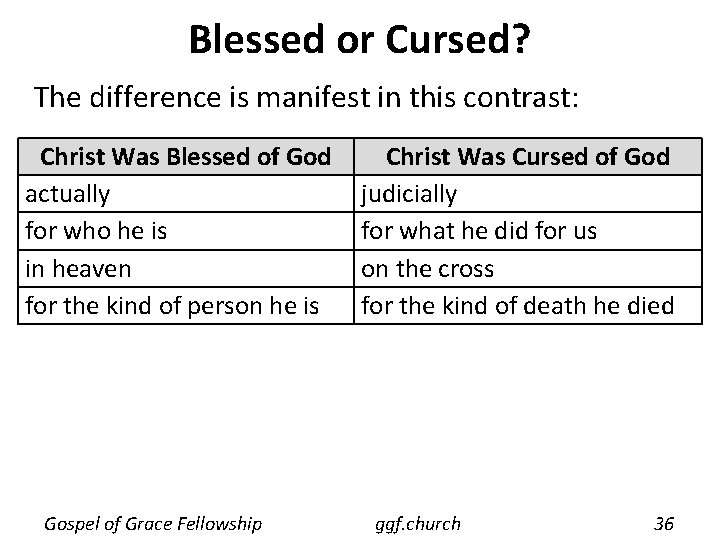
Blessed or Cursed? The difference is manifest in this contrast: Christ Was Blessed of God actually for who he is in heaven for the kind of person he is Gospel of Grace Fellowship Christ Was Cursed of God judicially for what he did for us on the cross for the kind of death he died ggf. church 36
Others’ Burdens or Our Own? In Galatians 6: 2 Paul exhorts us to “bear one another’s burdens, and so fulfill the law of Christ. ” But only a few verses later he says “every man shall bear his own burden. ” Are we to bear others’ burdens or our own? Gospel of Grace Fellowship ggf. church 37
Others’ Burdens or Our Own? The word for burden is different in each case. In the first passage Paul urges sympathy for others. In verse 5 he is speaking of taking responsibility for ourselves. There is no conflict between being accountable for our own lives and being helpful to others. Another aspect of this apparent contradiction is the present-future dimension. When Paul urges Christians to bear one another’s burdens, he means that they should help one another in their present difficulties. But at the future judgment each person will answer to God for his own conduct alone. Gospel of Grace Fellowship ggf. church 38
Principle of Bible Study “For precept must be upon precept…line upon line…here a little, and there a little…” (Isaiah 28: 10). Gospel of Grace Fellowship ggf. church 39
From Abraham to the Law “Now the promises were spoken to Abraham and to his seed. He does not say ‘and to seeds, ’ as though referring to many, but referring to one, and to your seed, who is Christ. And I say this: The law, which came 430 years later, does not revoke a covenant that was previously ratified by God and cancel the promise” (Gal. 3: 16 -17). “Now the sojourning of the children of Israel, who dwelt in Egypt, was four hundred and thirty years. And at the end of four hundred and thirty years, to the very day, all the hosts of the LORD went out from the land of Egypt” (Exod. 12: 40 -41). Gospel of Grace Fellowship ggf. church 40
From Abraham to the Law “Then the LORD said to Abram, ‘Know for certain that your offspring will be sojourners in a land that is not theirs and will be servants there, and they will be afflicted for four hundred years ’” (Gen. 15: 13). “And God spoke to this effect—that his [Abraham’s] offspring would be sojourners in a land belonging to others, who would enslave them and afflict them four hundred years” (Acts 7: 6). Gospel of Grace Fellowship ggf. church 41
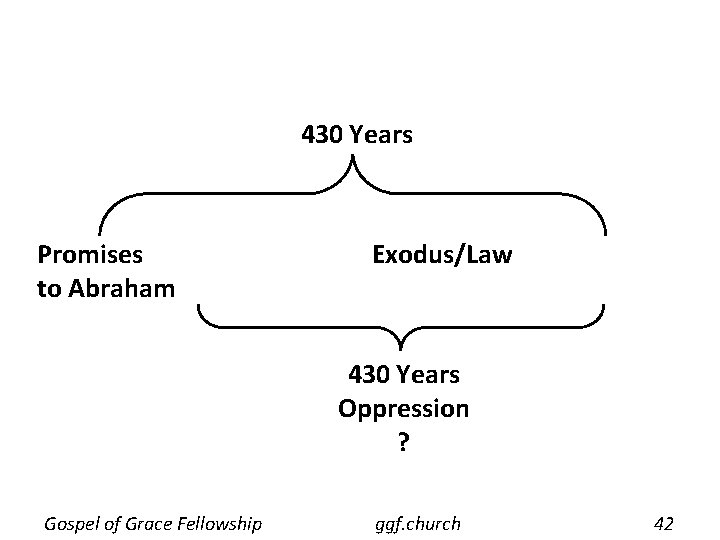
430 Years Promises to Abraham Exodus/Law 430 Years Oppression ? Gospel of Grace Fellowship ggf. church 42
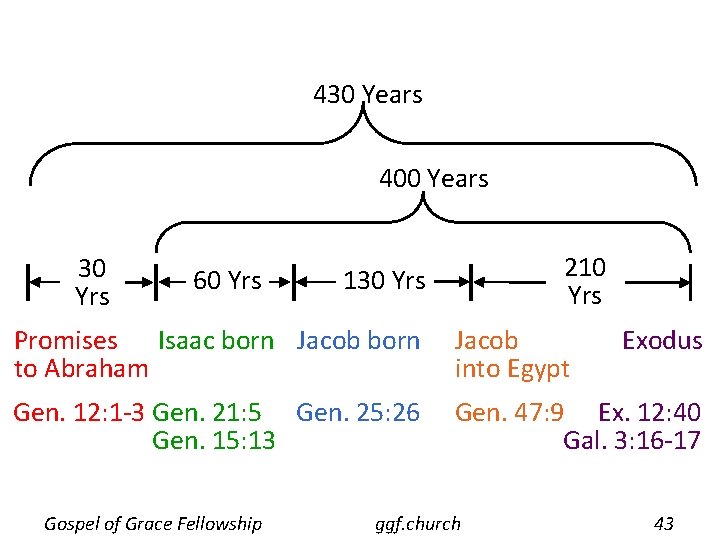
430 Years 400 Years 30 Yrs 60 Yrs 210 Yrs 130 Yrs Promises Isaac born Jacob born to Abraham Jacob into Egypt Gen. 12: 1 -3 Gen. 21: 5 Gen. 25: 26 Gen. 15: 13 Gen. 47: 9 Ex. 12: 40 Gal. 3: 16 -17 Gospel of Grace Fellowship ggf. church Exodus 43
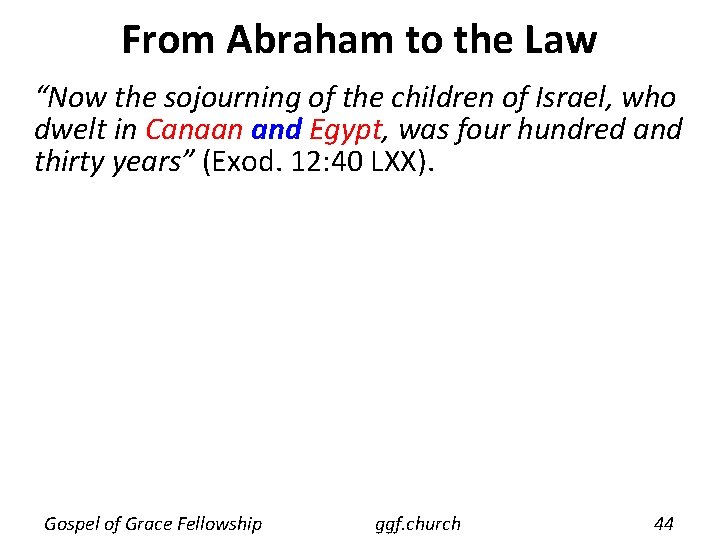
From Abraham to the Law “Now the sojourning of the children of Israel, who dwelt in Canaan and Egypt, was four hundred and thirty years” (Exod. 12: 40 LXX). Gospel of Grace Fellowship ggf. church 44
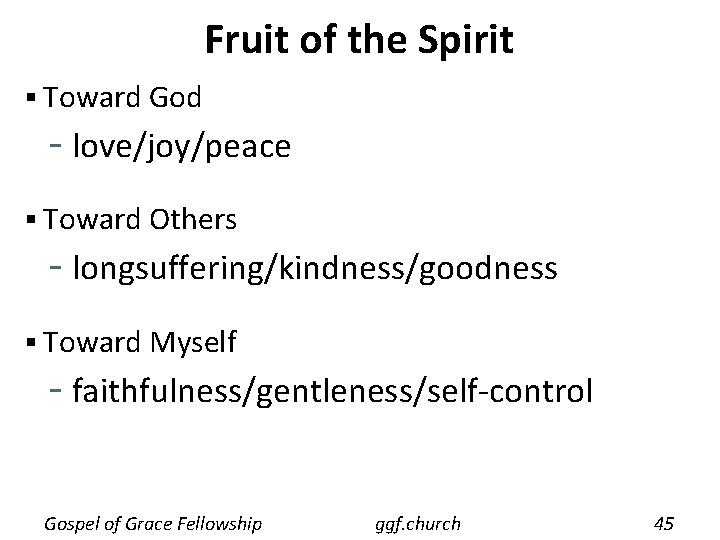
Fruit of the Spirit § Toward God - love/joy/peace § Toward Others - longsuffering/kindness/goodness § Toward Myself - faithfulness/gentleness/self-control Gospel of Grace Fellowship ggf. church 45
Contribution of Galatians This short letter has an importance out of all proportion to its size. There is always a tendency for people to think that their salvation (however it is understood) is something that is to be brought about by their own achievement. How they understand salvation may vary, and the kind of achievement they see as necessary may correspondingly vary. But that their eternal destiny rests in their own hands seems a truism so obvious that it scarcely needs stating. Christianity has often been understood as nothing more than a system of morality, as the careful observance of a sacramental system, as conformity to standards, as linking up with others in the church, and so on. Gospel of Grace Fellowship ggf. church 46
Contribution of Galatians There is always a need for Paul’s forthright setting out of the truth that justification comes only through faith in Christ. This must be said over against those who stress the importance of works done in accordance with Torah or of any other achievement. The Christian way stresses what God has done in Christ rather than what sinners do. There can be no improvement on the divine action by any human achievement, either by way of ritual observance or moral improvement. The cross is the one way of salvation, and no part of Scripture makes this clearer than does Galatians. Gospel of Grace Fellowship ggf. church 47
Contribution of Galatians We should not miss the importance of Paul’s appeal to Abraham (3: 6 -29). This takes the reader back to a time when the law had not been given; the covenant established with Abraham takes precedence over the law (3: 17). The law cannot annul the promise of God. Those who were forsaking simple reliance on the promise of God were turning from the divinely appointed way and mistaking the real purpose of the law (3: 19). If Paul’s Christian friends would give proper consideration to the example of Abraham, they would see the serious error into which they were falling when they began to rely on the Torah. Gospel of Grace Fellowship ggf. church 48
Contribution of Galatians If we read the account of Abraham and his faith in its proper sequence in the unfolding history of redemption instead of anachronistically assuming, with many Jews, that Abraham must have kept the law, it becomes clear that God’s way has always been the way of promise and faith. In short, this little book contributes to how Christians ought to be putting their Bibles together. Moreover, Paul insists that Christ came at the appointed time to redeem enslaved sinners (4: 4 -5), and he further specifies that Christ did this work of redemption “by becoming a curse for us” (3: 13). This is a significant contribution to our understanding of the atonement. Gospel of Grace Fellowship ggf. church 49
Contribution of Galatians Along with the emphasis on justification by faith in Christ is an emphasis on Christian freedom: “It is for freedom that Christ has set us free” (5: 1); believers are literally to “walk by the Spirit” (5: 16). Even those who are justified by faith in Christ sometimes find it easy to subject themselves to the slavery of a system. Paul’s words remain the classic expression of the liberty that is the heritage of everyone who is in Christ. Galatians is a constant reminder of how important it is to understand what the Christian faith implies for Christian living. Even Peter and Barnabas could go astray. Paul does not complain of their theology, but of their practice when “those who belonged to the circumcision group” induced them to with draw from table fellowship with Gentiles (2: 1114). No letter makes clearer than this one the importance of living out all the implications of salvation through the cross. Gospel of Grace Fellowship ggf. church 50

Final Thought The false teachers didn’t like Paul’s message because they thought preaching grace was in effect preaching lawlessness – that people would say, “I’m under grace, so I can do whatever I want. ” They reasoned that the law was necessary to keep believers in line, but Paul’s point was that grace will do in a person what the law never could. John Bunyan, the persecuted English author of Pilgrim’s Progress, beautifully summed up the difference in a poem: Run, John, run, the law commands, but gives us neither feet nor hands. Far better news the gospel brings: it bids us fly and gives us wings. Gospel of Grace Fellowship ggf. church 51
- Slides: 52