
Galactic Cosmic Ray Composition Spectra and Time Variations
- Slides: 21
Galactic Cosmic Ray Composition, Spectra, and Time Variations Mark E. Wiedenbeck Jet Propulsion Laboratory, California Institute of Technology mark. e. wiedenbeck@jpl. nasa. gov 16 -20 Oct 2005 SSPVSE Conference 1
With contributions from: Dick Mewaldt Alan Cummings Jeff George Andrew Davis and the entire ACE/CRIS science team. 16 -20 Oct 2005 SSPVSE Conference 2
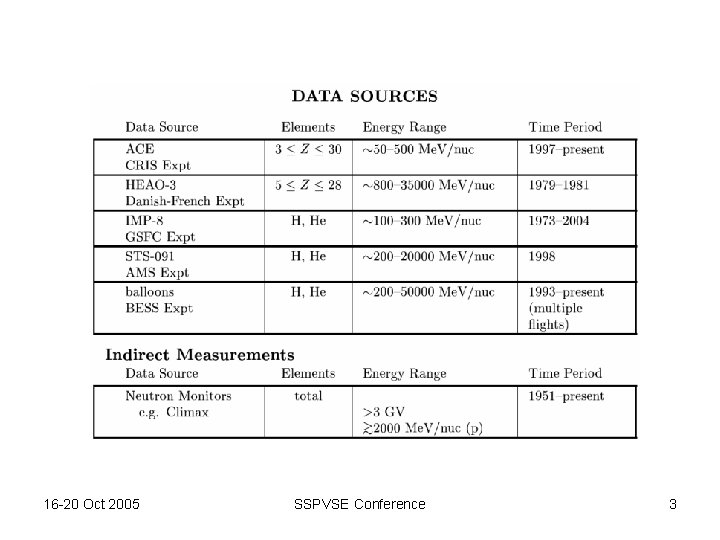
16 -20 Oct 2005 SSPVSE Conference 3
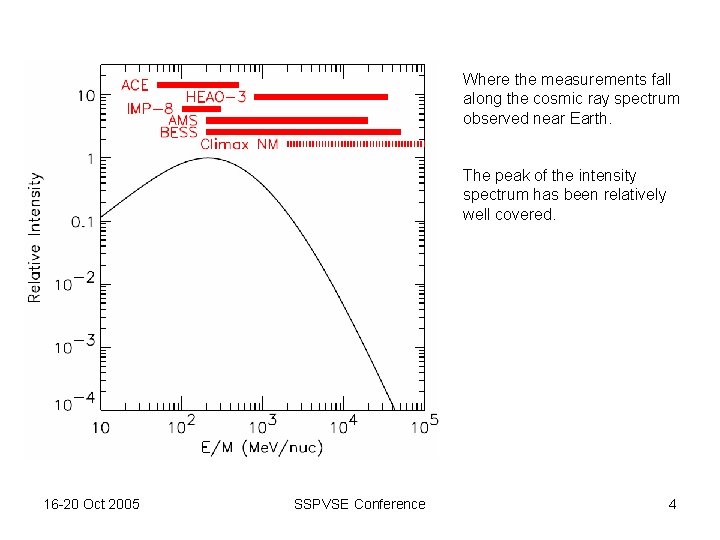
Where the measurements fall along the cosmic ray spectrum observed near Earth. The peak of the intensity spectrum has been relatively well covered. 16 -20 Oct 2005 SSPVSE Conference 4
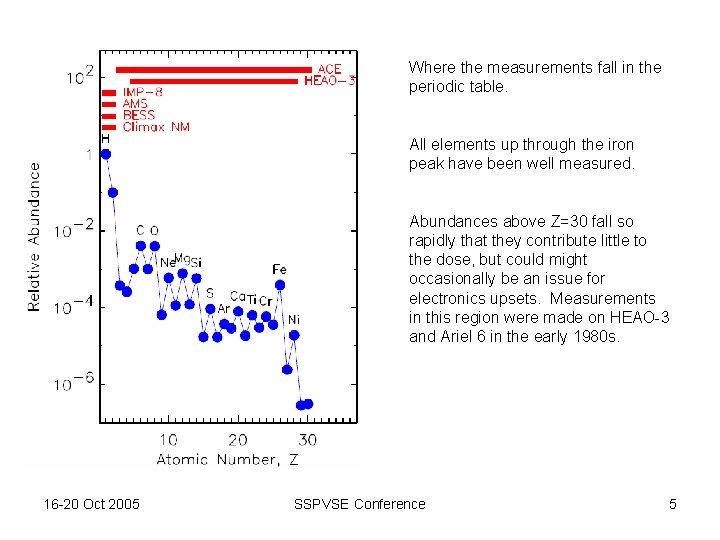
Where the measurements fall in the periodic table. All elements up through the iron peak have been well measured. Abundances above Z=30 fall so rapidly that they contribute little to the dose, but could might occasionally be an issue for electronics upsets. Measurements in this region were made on HEAO-3 and Ariel 6 in the early 1980 s. 16 -20 Oct 2005 SSPVSE Conference 5
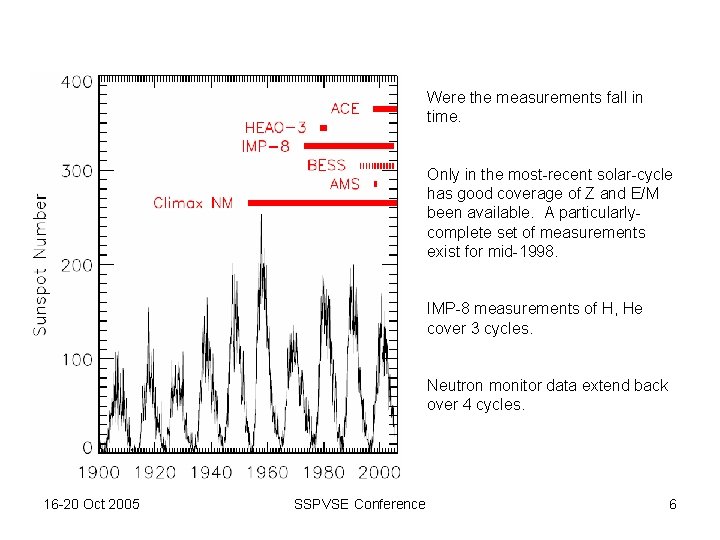
Were the measurements fall in time. Only in the most-recent solar-cycle has good coverage of Z and E/M been available. A particularlycomplete set of measurements exist for mid-1998. IMP-8 measurements of H, He cover 3 cycles. Neutron monitor data extend back over 4 cycles. 16 -20 Oct 2005 SSPVSE Conference 6
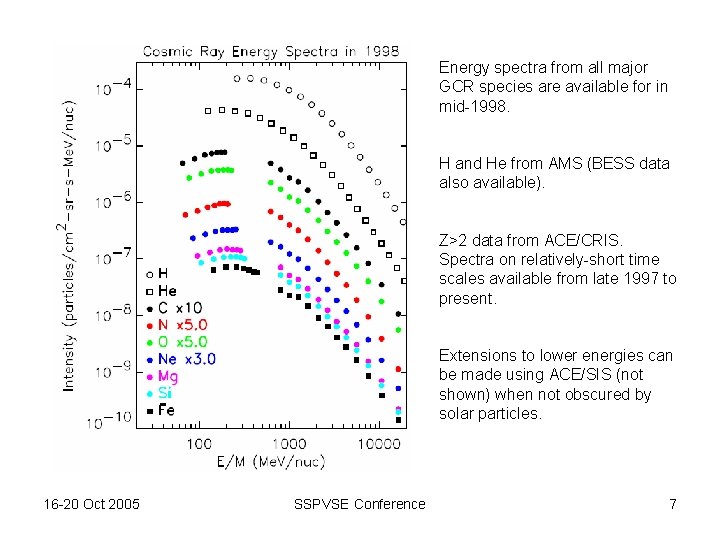
Energy spectra from all major GCR species are available for in mid-1998. H and He from AMS (BESS data also available). Z>2 data from ACE/CRIS. Spectra on relatively-short time scales available from late 1997 to present. Extensions to lower energies can be made using ACE/SIS (not shown) when not obscured by solar particles. 16 -20 Oct 2005 SSPVSE Conference 7
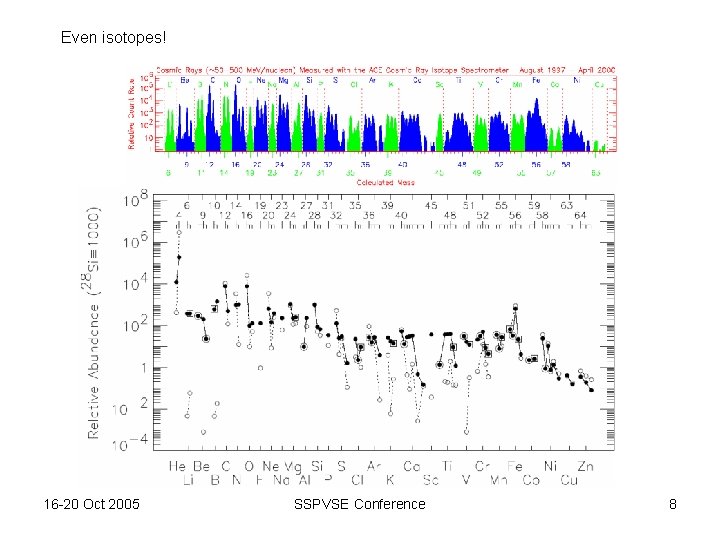
Even isotopes! 16 -20 Oct 2005 SSPVSE Conference 8
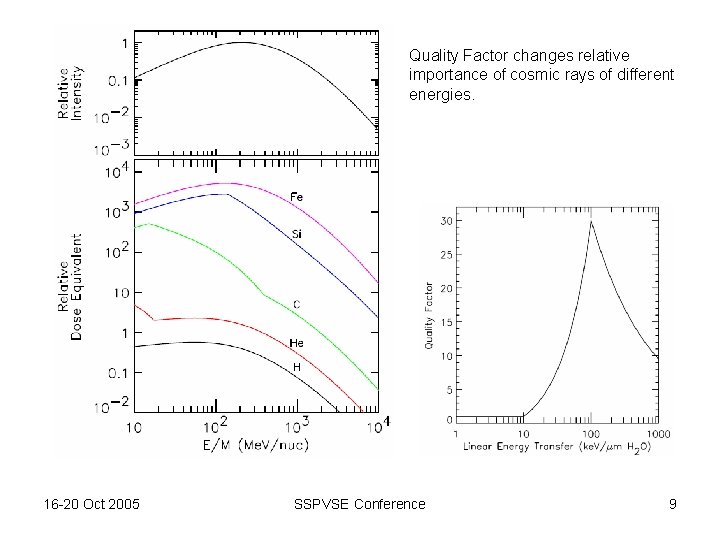
Quality Factor changes relative importance of cosmic rays of different energies. 16 -20 Oct 2005 SSPVSE Conference 9
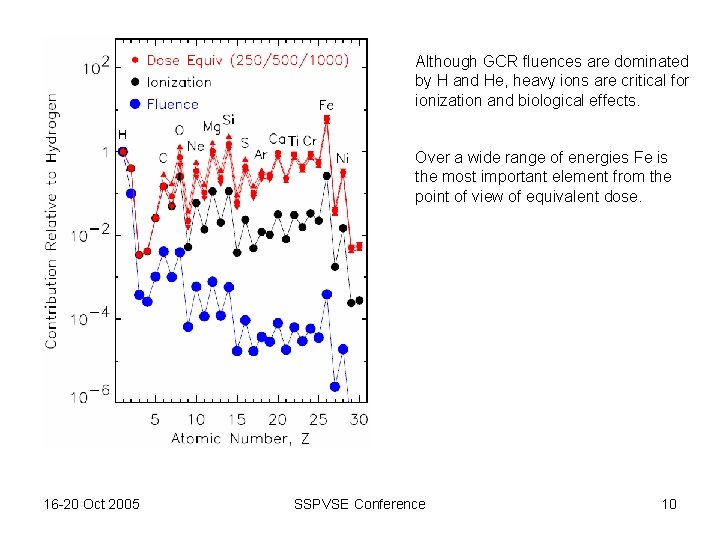
Although GCR fluences are dominated by H and He, heavy ions are critical for ionization and biological effects. Over a wide range of energies Fe is the most important element from the point of view of equivalent dose. 16 -20 Oct 2005 SSPVSE Conference 10
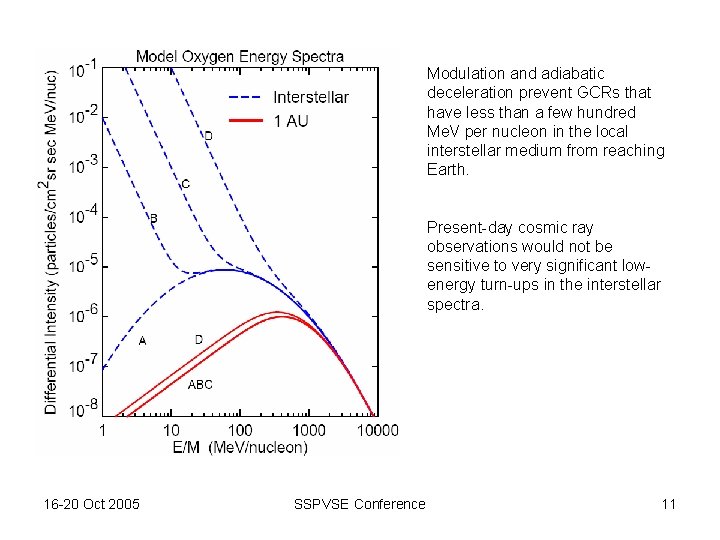
Modulation and adiabatic deceleration prevent GCRs that have less than a few hundred Me. V per nucleon in the local interstellar medium from reaching Earth. Present-day cosmic ray observations would not be sensitive to very significant lowenergy turn-ups in the interstellar spectra. 16 -20 Oct 2005 SSPVSE Conference 11
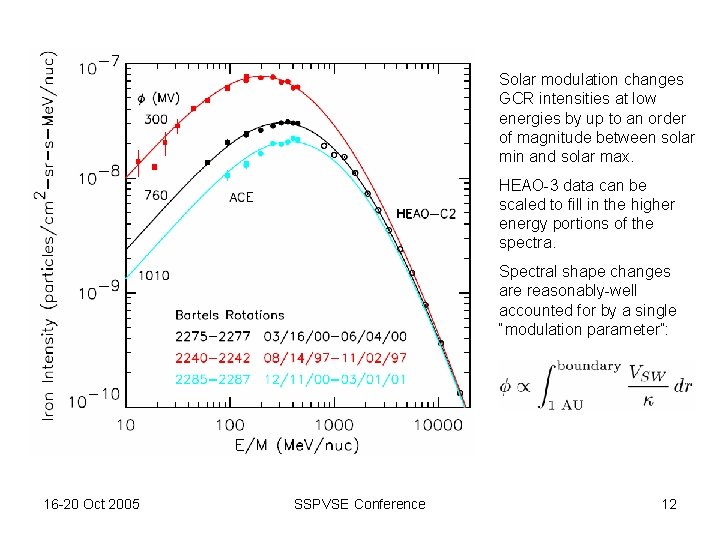
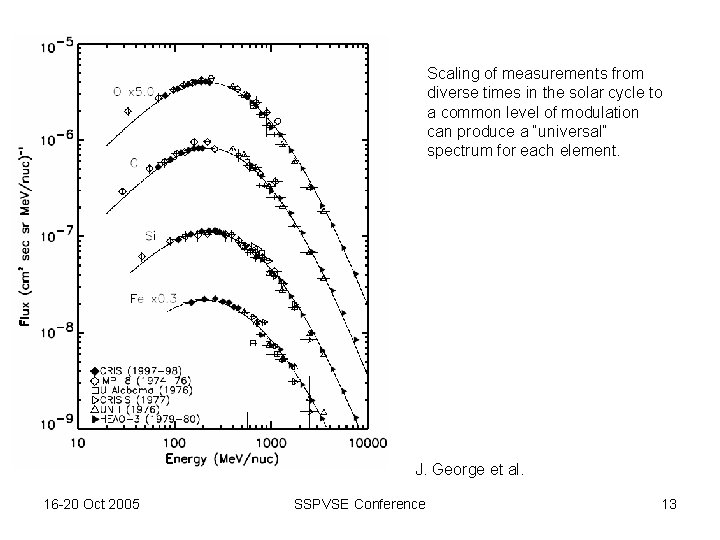
Solar modulation changes GCR intensities at low energies by up to an order of magnitude between solar min and solar max. HEAO-3 data can be scaled to fill in the higher energy portions of the spectra. Spectral shape changes are reasonably-well accounted for by a single “modulation parameter”: 16 -20 Oct 2005 SSPVSE Conference 12
Scaling of measurements from diverse times in the solar cycle to a common level of modulation can produce a “universal” spectrum for each element. J. George et al. 16 -20 Oct 2005 SSPVSE Conference 13
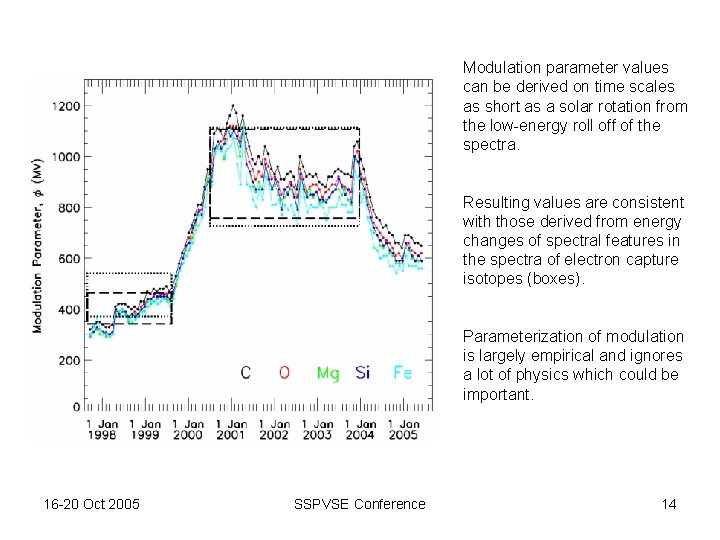
Modulation parameter values can be derived on time scales as short as a solar rotation from the low-energy roll off of the spectra. Resulting values are consistent with those derived from energy changes of spectral features in the spectra of electron capture isotopes (boxes). Parameterization of modulation is largely empirical and ignores a lot of physics which could be important. 16 -20 Oct 2005 SSPVSE Conference 14
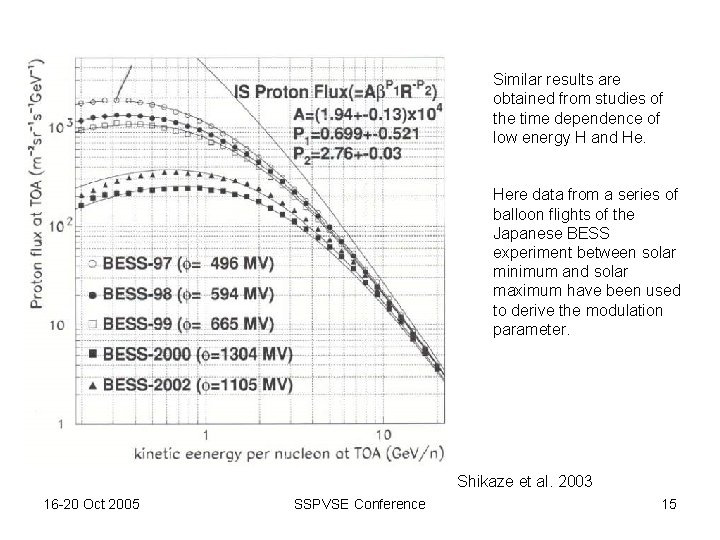
Similar results are obtained from studies of the time dependence of low energy H and He. Here data from a series of balloon flights of the Japanese BESS experiment between solar minimum and solar maximum have been used to derive the modulation parameter. Shikaze et al. 2003 16 -20 Oct 2005 SSPVSE Conference 15
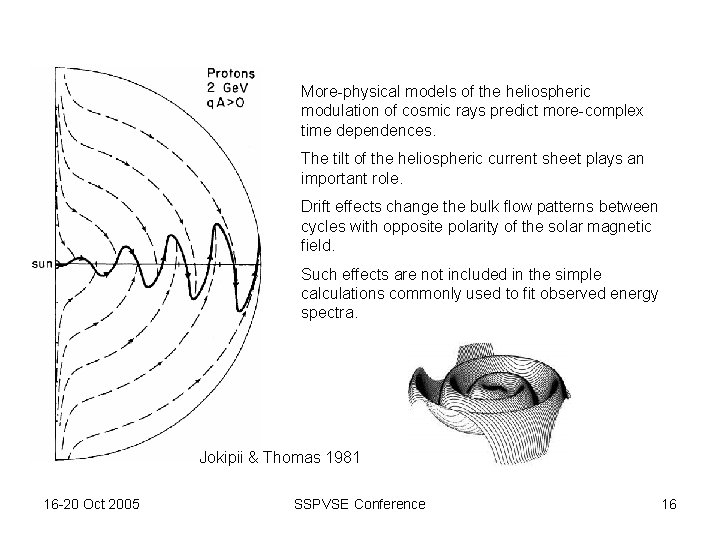
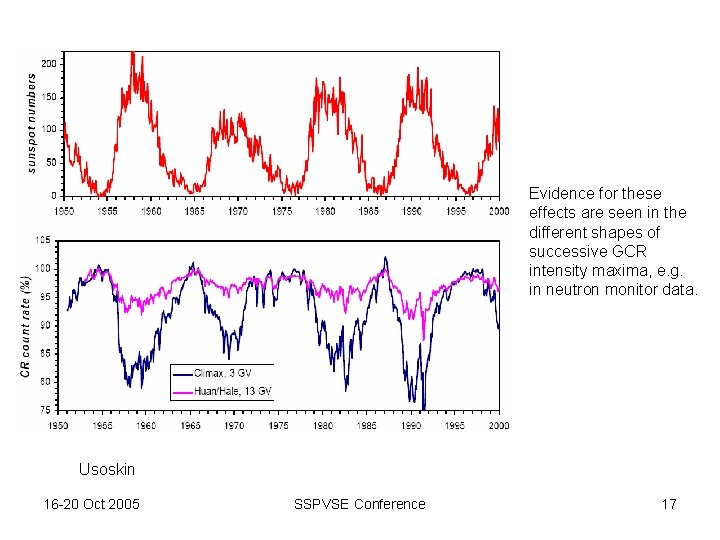
More-physical models of the heliospheric modulation of cosmic rays predict more-complex time dependences. The tilt of the heliospheric current sheet plays an important role. Drift effects change the bulk flow patterns between cycles with opposite polarity of the solar magnetic field. Such effects are not included in the simple calculations commonly used to fit observed energy spectra. Jokipii & Thomas 1981 16 -20 Oct 2005 SSPVSE Conference 16
Evidence for these effects are seen in the different shapes of successive GCR intensity maxima, e. g. in neutron monitor data. Usoskin 16 -20 Oct 2005 SSPVSE Conference 17
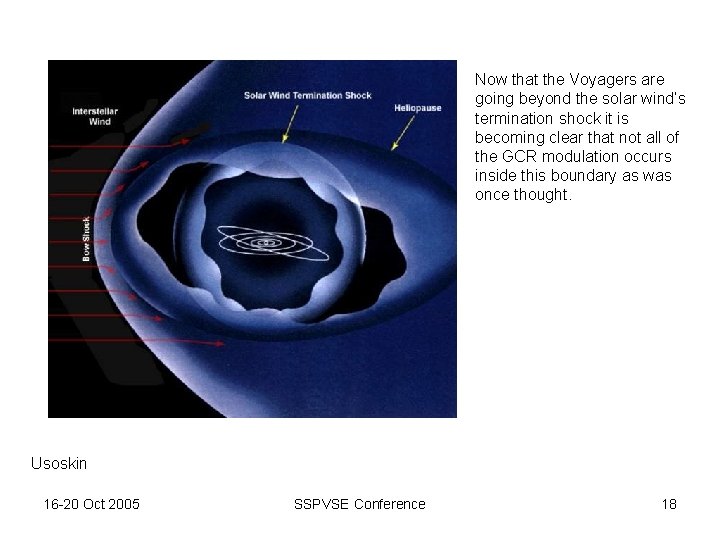
Now that the Voyagers are going beyond the solar wind’s termination shock it is becoming clear that not all of the GCR modulation occurs inside this boundary as was once thought. Usoskin 16 -20 Oct 2005 SSPVSE Conference 18
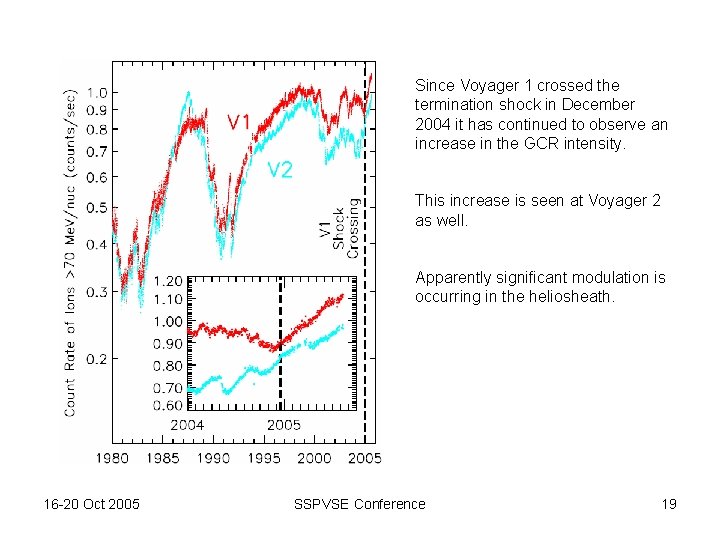
Since Voyager 1 crossed the termination shock in December 2004 it has continued to observe an increase in the GCR intensity. This increase is seen at Voyager 2 as well. Apparently significant modulation is occurring in the heliosheath. 16 -20 Oct 2005 SSPVSE Conference 19
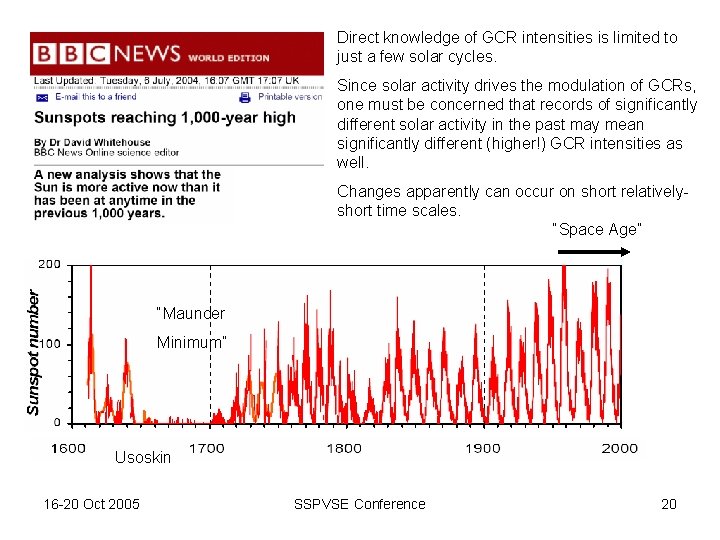
Direct knowledge of GCR intensities is limited to just a few solar cycles. Since solar activity drives the modulation of GCRs, one must be concerned that records of significantly different solar activity in the past may mean significantly different (higher!) GCR intensities as well. Changes apparently can occur on short relativelyshort time scales. “Space Age” “Maunder Minimum” Usoskin 16 -20 Oct 2005 SSPVSE Conference 20
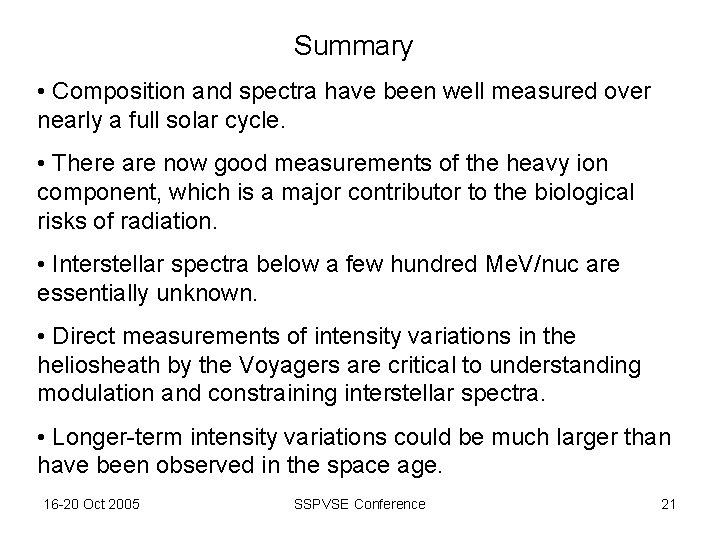
Summary • Composition and spectra have been well measured over nearly a full solar cycle. • There are now good measurements of the heavy ion component, which is a major contributor to the biological risks of radiation. • Interstellar spectra below a few hundred Me. V/nuc are essentially unknown. • Direct measurements of intensity variations in the heliosheath by the Voyagers are critical to understanding modulation and constraining interstellar spectra. • Longer-term intensity variations could be much larger than have been observed in the space age. 16 -20 Oct 2005 SSPVSE Conference 21