
GAIA science objectives GAIA will map a billion
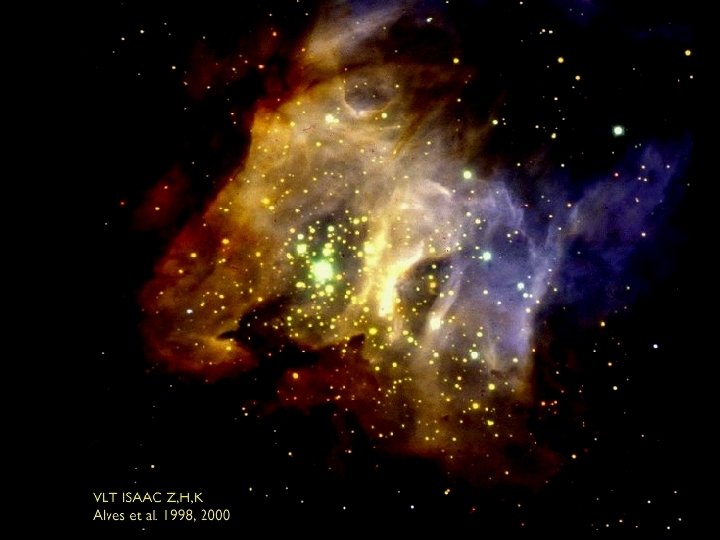

GAIA: science objectives GAIA will map a billion stars in 3 -d… …and thus provide: • • • our Galaxy’s spatial and dynamic structure + formation history distance and velocity distributions of all stellar populations a rigorous framework for stellar structure and evolution theories details of a template galaxy for cosmological studies definitive distance standards out to the LMC fundamental physical quantities to unprecedented accuracies support to developments such as VLT, JWST, etc a large-scale survey of extra-solar planets a large-scale survey of Solar System bodies rapid reaction alerts for supernovae and burst sources
Planck Science Capabilities Cosmology • • • CMB anisotropy maps to an accuracy DT/T~10 -6, on angular scales larger than 10 arcminutes Cosmological parameters, Ho, Wb, . . . to a precision of a few percent Tests of inflationary models of the early Universe Search for nongaussianity/topological defects Initial conditions formation of large-scale structure Nature of dark matter Astrophysics • • • Detection of Sunyaev-Zeldovich effect in thousands of rich clusters of galaxies Catalogs of extragalactic sources and backgrounds – IR and radio galaxies – AGN's, QSO's, blazars – Evolution of galaxy counts to z > 1 – Far-IR background fluctuations … Maps of Galaxy at frequencies 30 1000 GHz – Dust properties – Cloud and cirrus morphology – Star forming regions – Cosmic ray distribution – Galactic magnetic field …
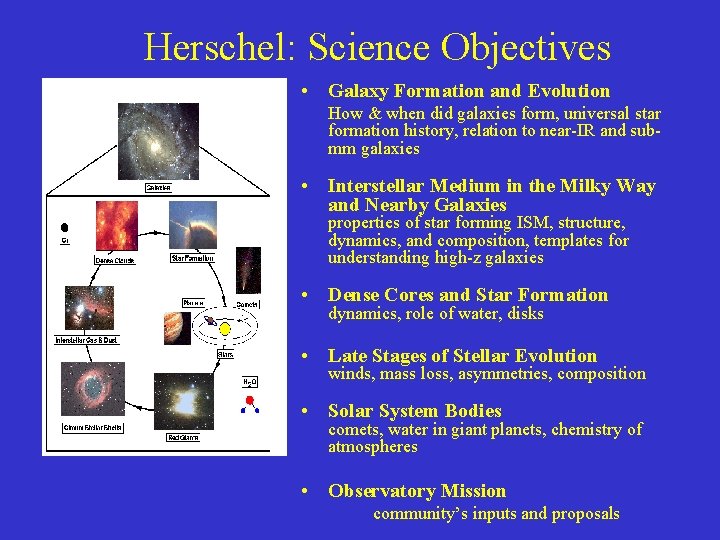
Herschel: Science Objectives • Galaxy Formation and Evolution How & when did galaxies form, universal star formation history, relation to near-IR and submm galaxies • Interstellar Medium in the Milky Way and Nearby Galaxies properties of star forming ISM, structure, dynamics, and composition, templates for understanding high-z galaxies • Dense Cores and Star Formation dynamics, role of water, disks • Late Stages of Stellar Evolution winds, mass loss, asymmetries, composition • Solar System Bodies comets, water in giant planets, chemistry of atmospheres • Observatory Mission community’s inputs and proposals
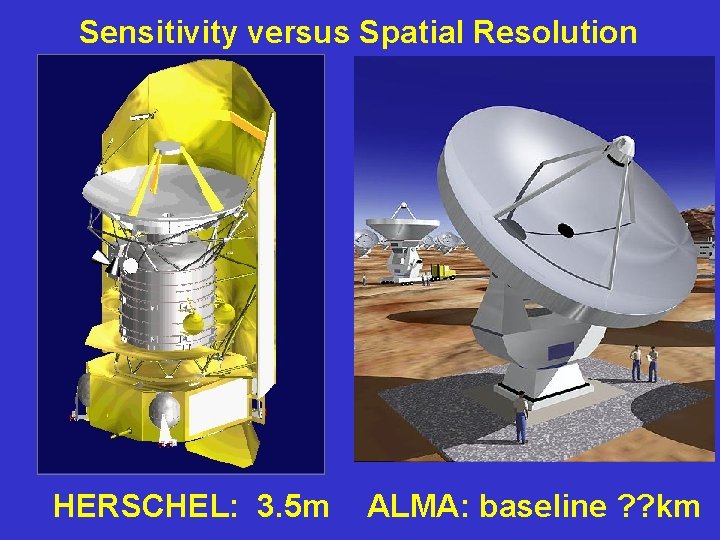
Sensitivity versus Spatial Resolution HERSCHEL: 3. 5 m ALMA: baseline ? ? km
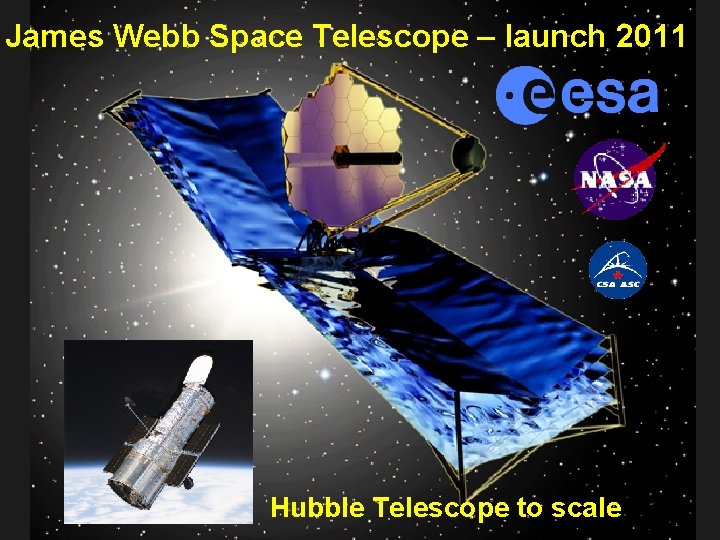
James Webb Space Telescope – launch 2011 NGST (James Webb Space Telescope) Hubble Telescope to scale
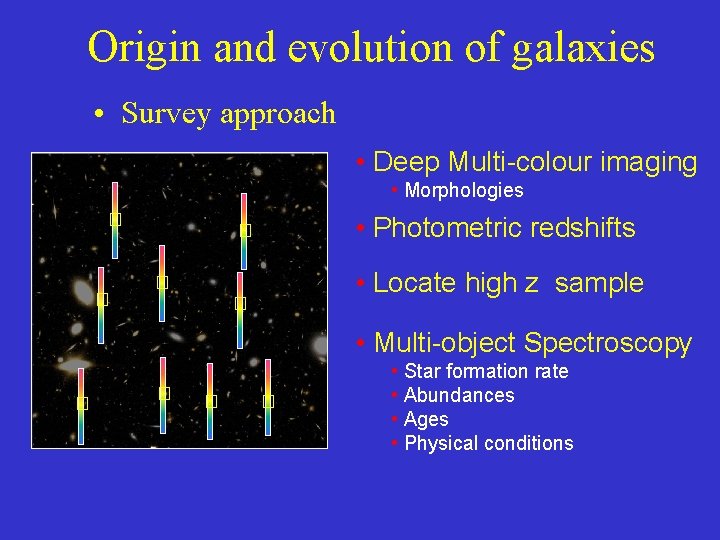
Origin and evolution of galaxies • Survey approach • Deep Multi-colour imaging • Morphologies • Photometric redshifts • Locate high z sample • Multi-object Spectroscopy • Star formation rate • Abundances • Ages • Physical conditions
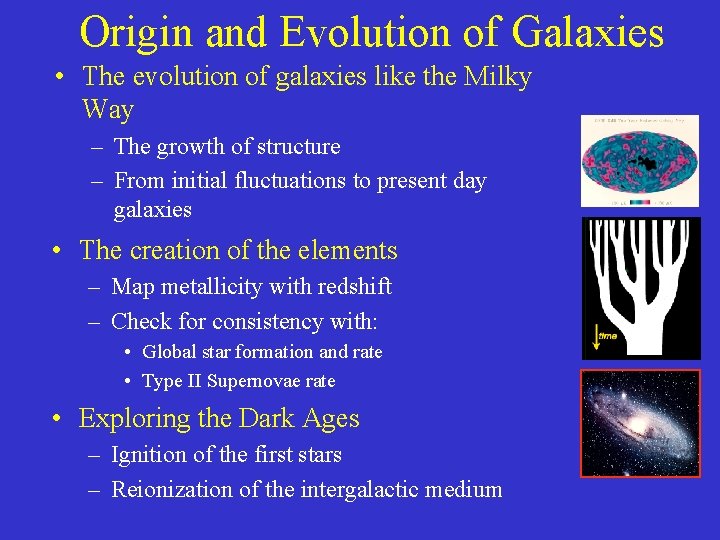
Origin and Evolution of Galaxies • The evolution of galaxies like the Milky Way – The growth of structure – From initial fluctuations to present day galaxies • The creation of the elements – Map metallicity with redshift – Check for consistency with: • Global star formation and rate • Type II Supernovae rate • Exploring the Dark Ages – Ignition of the first stars – Reionization of the intergalactic medium
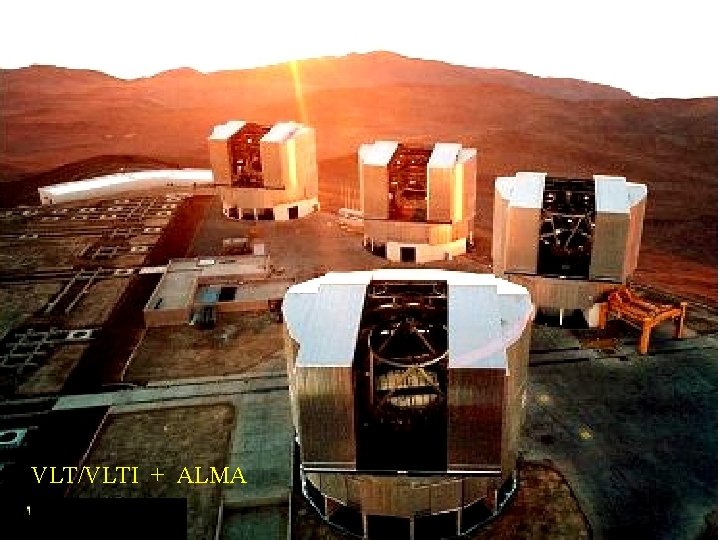
VLT/VLTI + ALMA
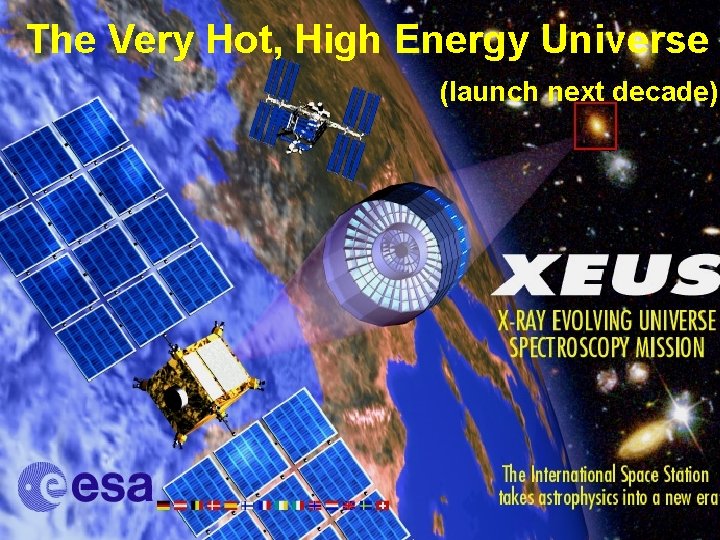
The Very Hot, High Energy Universe (launch next decade)

XEUS Science Topics Observations of the hot Universe at high redshifts will provide crucial complimentary information to JWST, ALMA, Herschel etc on: • • The formation and evolution of the first massive blackholes The large scale structure of the Universe and hot filamentary components at high redshift Study of the first small groups of galaxies and their evolution to today’s massive clusters Study of the formation of the first metals, in the hot inter-galactic medium
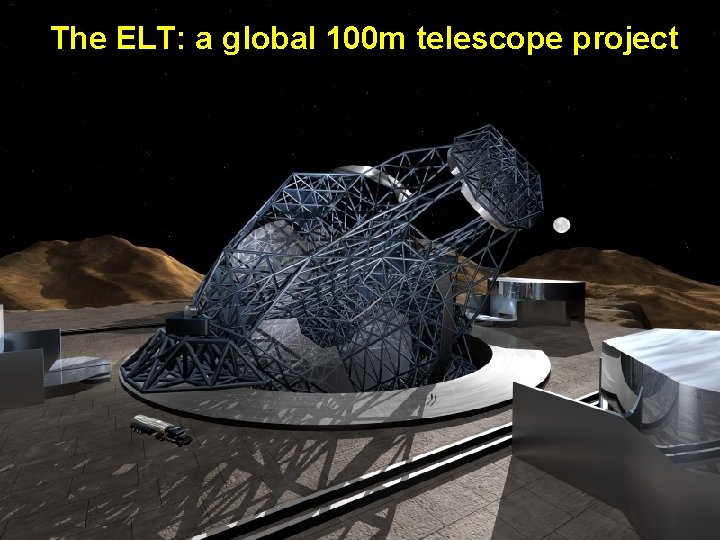
The ELT: a global 100 m telescope project
- Slides: 12