
Gabrielse The Electron and Its Moments The Most
Gabrielse The Electron and Its Moments: The Most Precise Tests of the Standard Model Gerald Gabrielse Leverett Professor of Physics, Harvard University 1. The Electron Magnetic Moment Most precisely measured property of an elementary particle Most precise prediction of the Standard Model Incredible agreement 2. The Electron Electric Dipole Moment Standard Model predicts unmeasurable small moment Extensions to Standard Mode predict measureable moments None detected so far (will this change this fall? ) Supported by NSF Download papers: http: //gabrielse. physics. harvard. edu
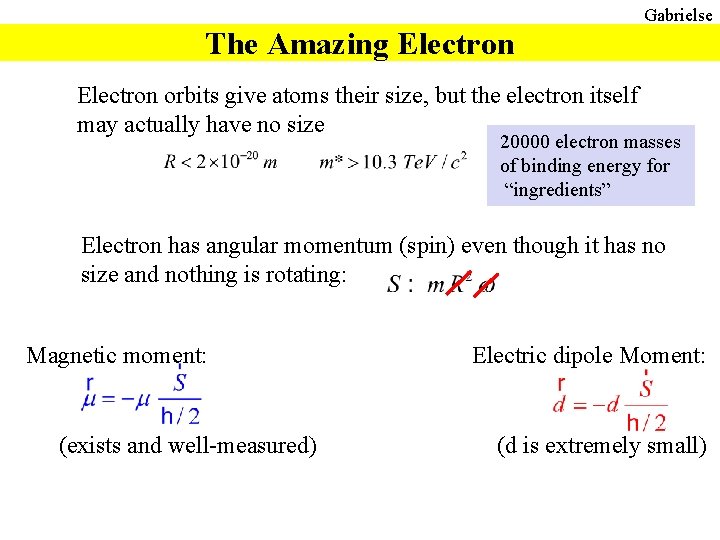
Gabrielse The Amazing Electron orbits give atoms their size, but the electron itself may actually have no size 20000 electron masses of binding energy for “ingredients” Electron has angular momentum (spin) even though it has no size and nothing is rotating: Magnetic moment: Electric dipole Moment: (exists and well-measured) (d is extremely small)

Gabrielse Electron Spin Magnetic Moment magnetic moment angular momentum Bohr magneton magnetic moment in Bohr magnetons for spin 1/2 mechanical model with identical charge and mass distribution spin for simple Dirac point particle simplest Dirac spin, plus QED (if electron g/2 is different electron has substructure)
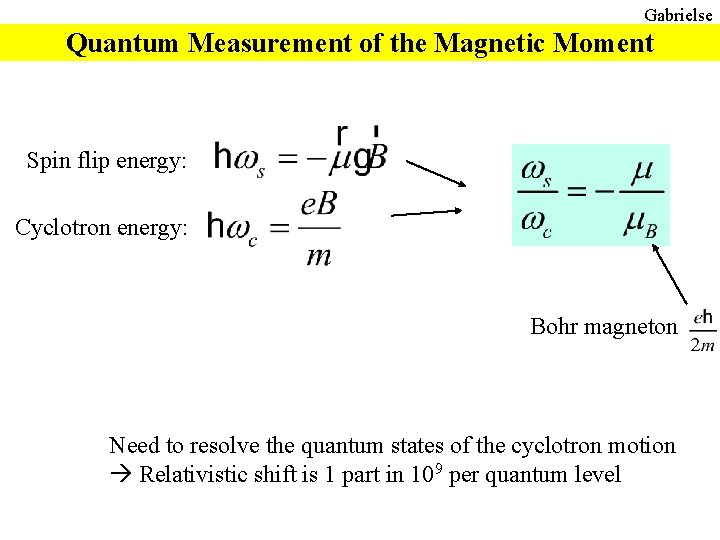
Gabrielse Quantum Measurement of the Magnetic Moment Spin flip energy: Cyclotron energy: Bohr magneton Need to resolve the quantum states of the cyclotron motion Relativistic shift is 1 part in 109 per quantum level
Gabrielse Need Good Students and Stable Funding Elise Novitski Joshua Dorr Shannon Fogwell Hogerheide David Hanneke Brian Odom, Brian D’Urso, 20 years Steve Peil, 8 theses Dafna Enzer, Kamal Abdullah Ching-hua Tseng Joseph Tan N$F
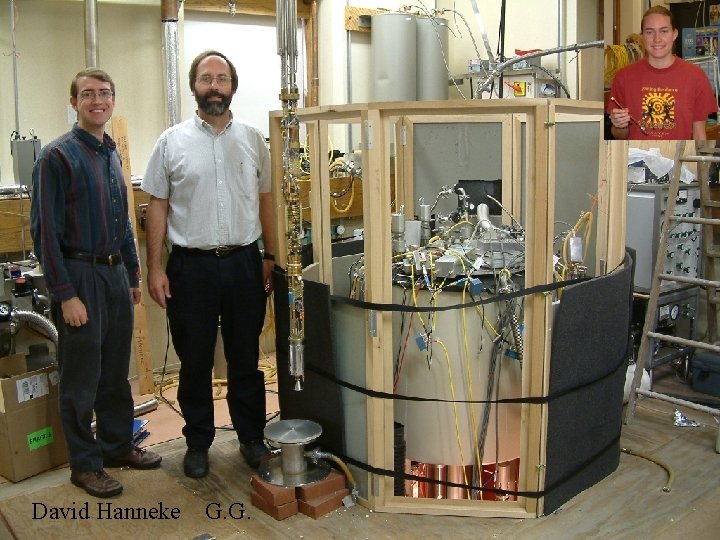
Gabrielse David Hanneke G. G.
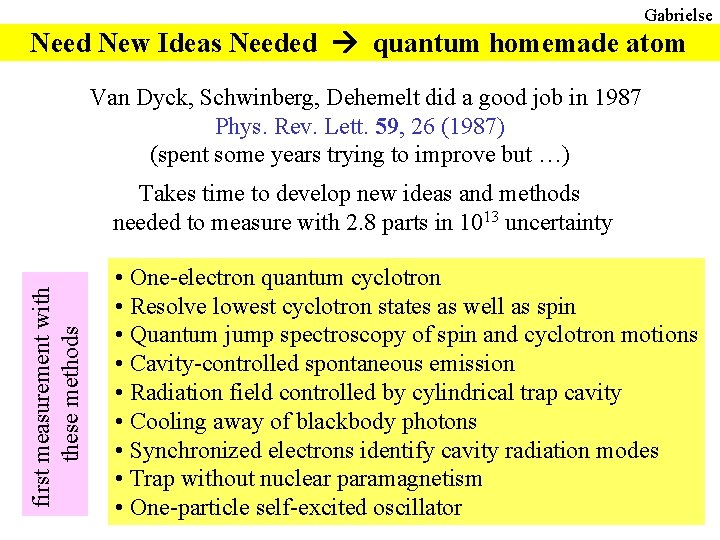
Gabrielse Need New Ideas Needed quantum homemade atom Van Dyck, Schwinberg, Dehemelt did a good job in 1987 Phys. Rev. Lett. 59, 26 (1987) (spent some years trying to improve but …) first measurement with these methods Takes time to develop new ideas and methods needed to measure with 2. 8 parts in 1013 uncertainty • One-electron quantum cyclotron • Resolve lowest cyclotron states as well as spin • Quantum jump spectroscopy of spin and cyclotron motions • Cavity-controlled spontaneous emission • Radiation field controlled by cylindrical trap cavity • Cooling away of blackbody photons • Synchronized electrons identify cavity radiation modes • Trap without nuclear paramagnetism • One-particle self-excited oscillator
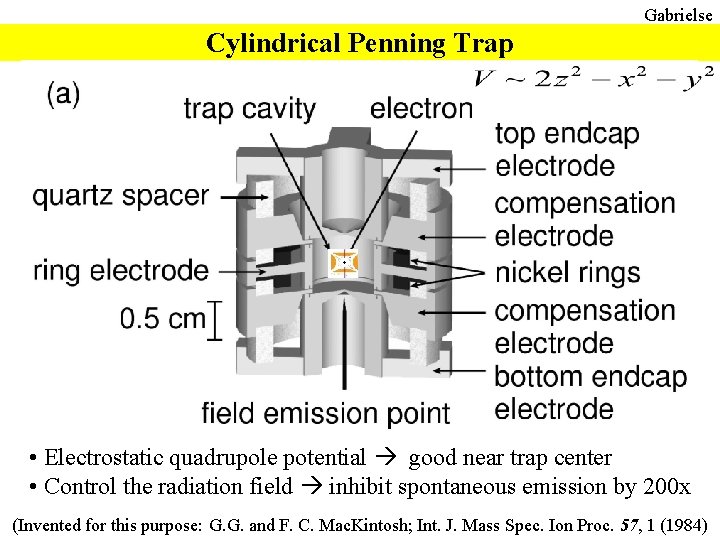
Gabrielse Cylindrical Penning Trap • Electrostatic quadrupole potential good near trap center • Control the radiation field inhibit spontaneous emission by 200 x (Invented for this purpose: G. G. and F. C. Mac. Kintosh; Int. J. Mass Spec. Ion Proc. 57, 1 (1984)
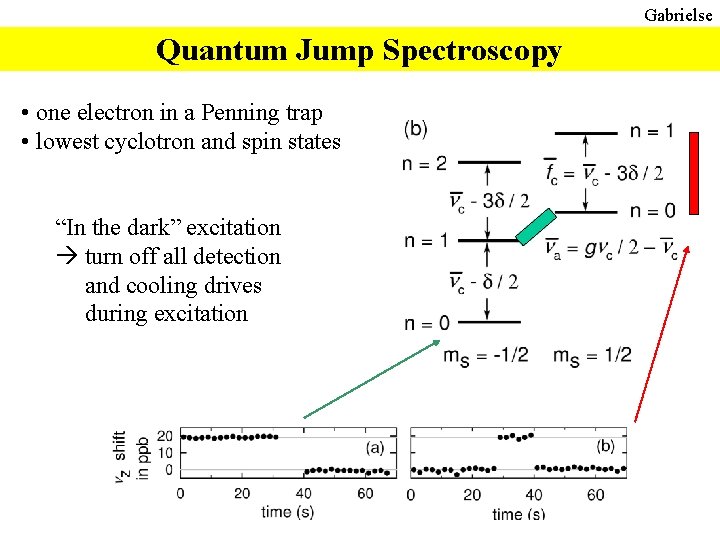
Gabrielse Quantum Jump Spectroscopy • one electron in a Penning trap • lowest cyclotron and spin states “In the dark” excitation turn off all detection and cooling drives during excitation
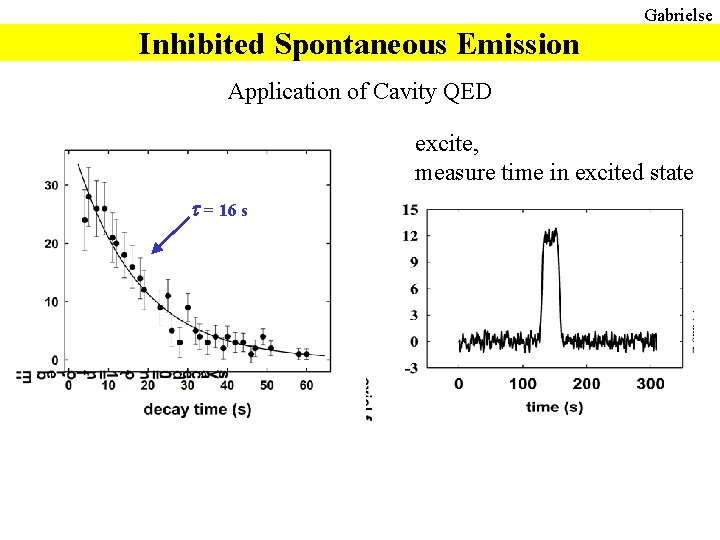
Gabrielse Inhibited Spontaneous Emission Application of Cavity QED excite, measure time in excited state t = 16 s
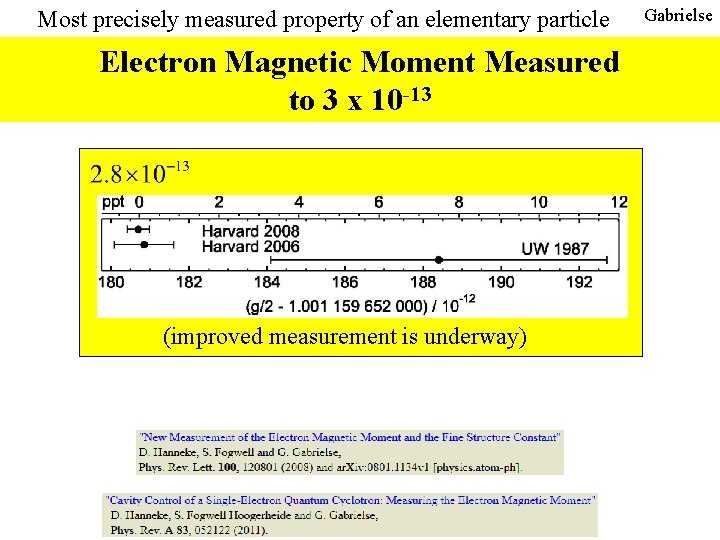
Most precisely measured property of an elementary particle Electron Magnetic Moment Measured to 3 x 10 -13 (improved measurement is underway) Gabrielse
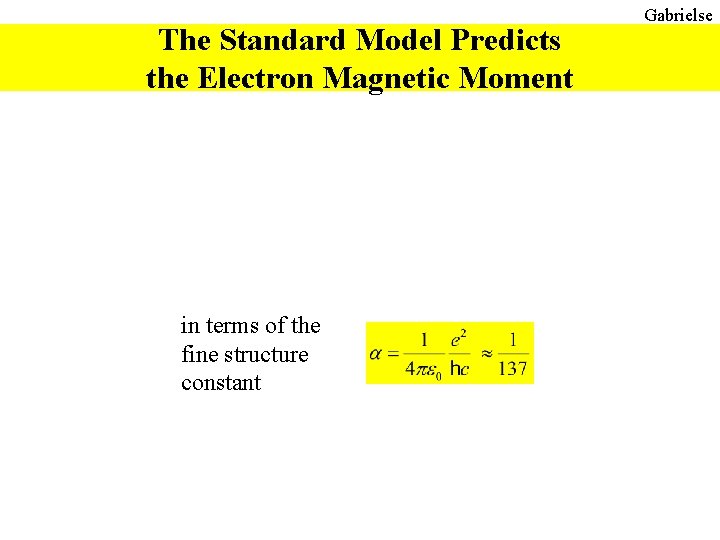
The Standard Model Predicts the Electron Magnetic Moment in terms of the fine structure constant Gabrielse
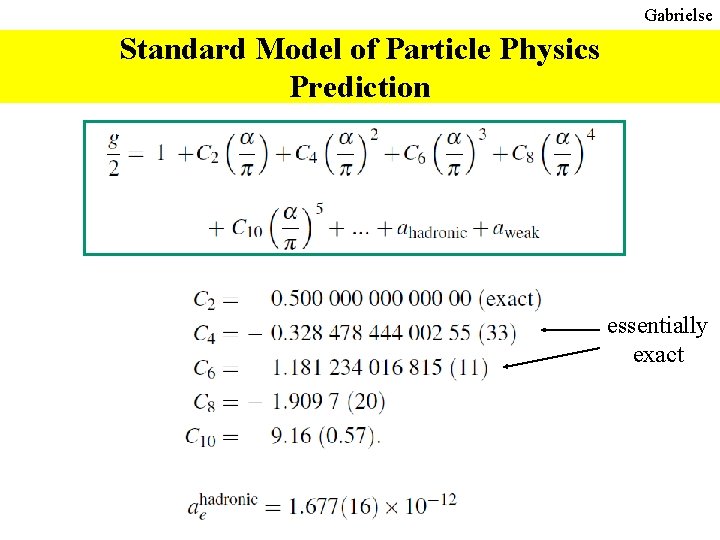
Gabrielse Standard Model of Particle Physics Prediction essentially exact
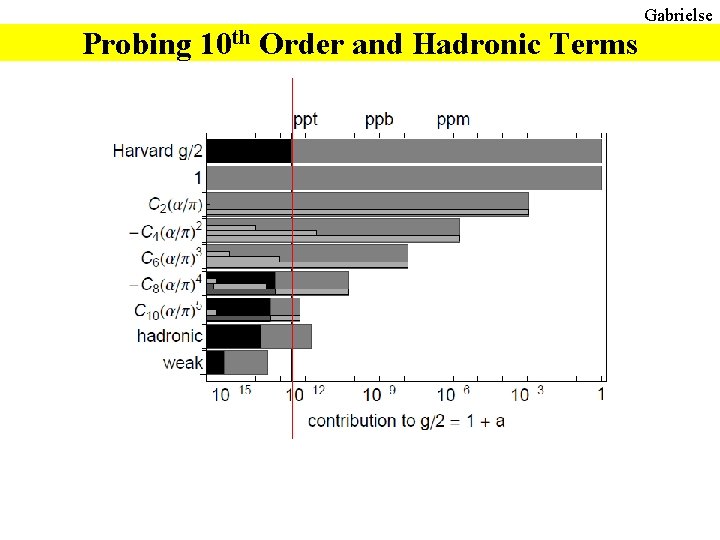
Gabrielse Probing 10 th Order and Hadronic Terms
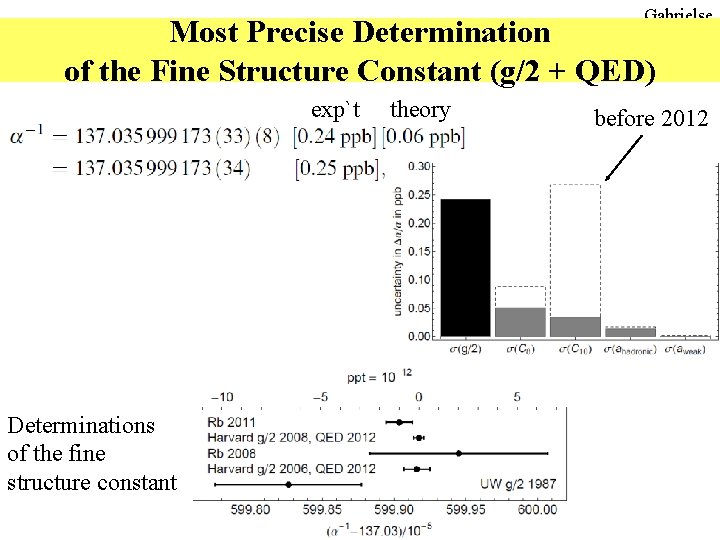
Gabrielse Most Precise Determination of the Fine Structure Constant (g/2 + QED) exp`t theory Determinations of the fine structure constant before 2012
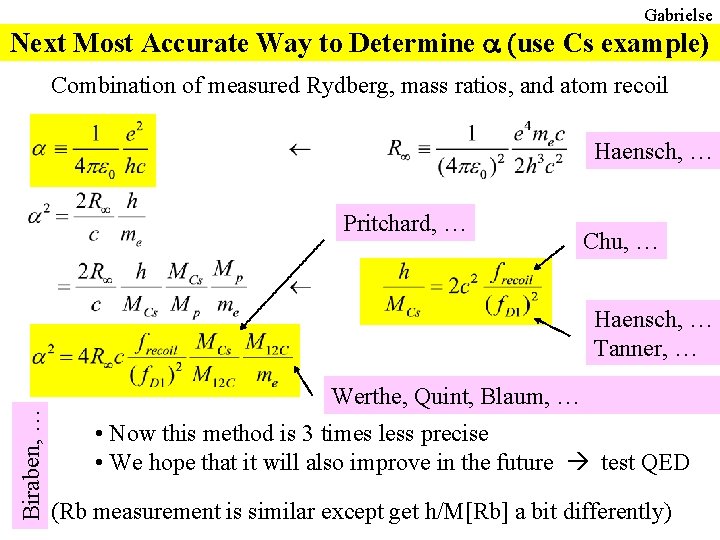
Gabrielse Next Most Accurate Way to Determine a (use Cs example) Combination of measured Rydberg, mass ratios, and atom recoil Haensch, … Pritchard, … Chu, … Haensch, … Tanner, … Biraben, … Werthe, Quint, Blaum, … • Now this method is 3 times less precise • We hope that it will also improve in the future test QED (Rb measurement is similar except get h/M[Rb] a bit differently)
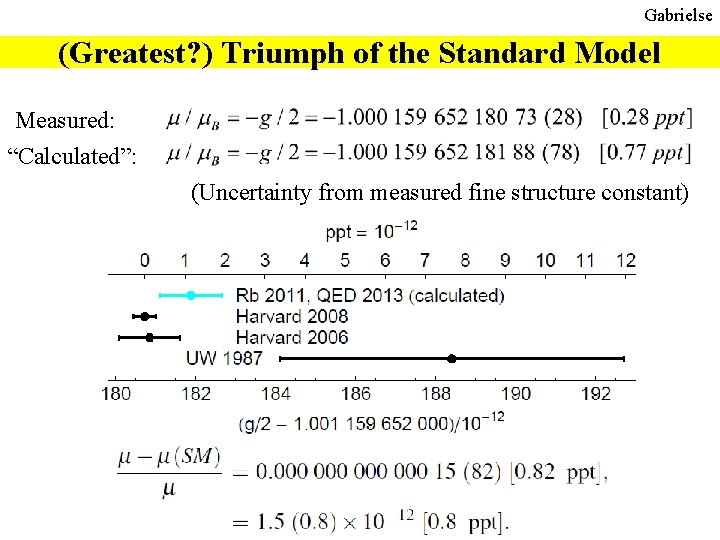
Gabrielse (Greatest? ) Triumph of the Standard Model Measured: “Calculated”: (Uncertainty from measured fine structure constant)
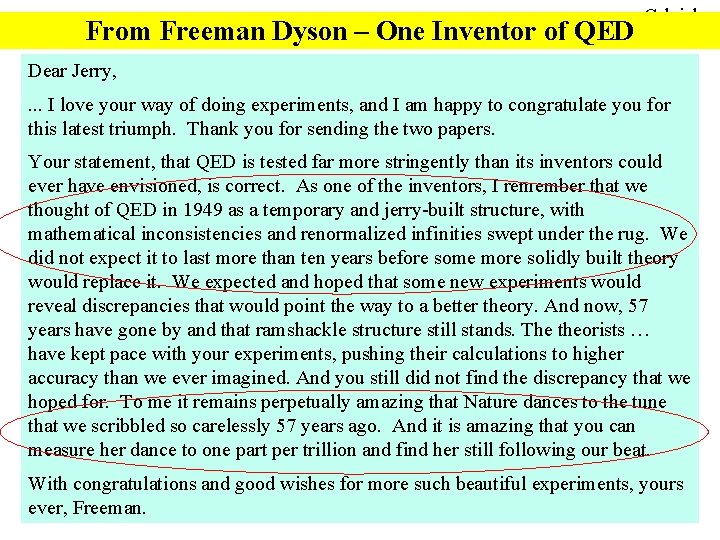
From Freeman Dyson – One Inventor of QED Gabrielse Dear Jerry, . . . I love your way of doing experiments, and I am happy to congratulate you for this latest triumph. Thank you for sending the two papers. Your statement, that QED is tested far more stringently than its inventors could ever have envisioned, is correct. As one of the inventors, I remember that we thought of QED in 1949 as a temporary and jerry-built structure, with mathematical inconsistencies and renormalized infinities swept under the rug. We did not expect it to last more than ten years before some more solidly built theory would replace it. We expected and hoped that some new experiments would reveal discrepancies that would point the way to a better theory. And now, 57 years have gone by and that ramshackle structure still stands. The theorists … have kept pace with your experiments, pushing their calculations to higher accuracy than we ever imagined. And you still did not find the discrepancy that we hoped for. To me it remains perpetually amazing that Nature dances to the tune that we scribbled so carelessly 57 years ago. And it is amazing that you can measure her dance to one part per trillion and find her still following our beat. With congratulations and good wishes for more such beautiful experiments, yours ever, Freeman.
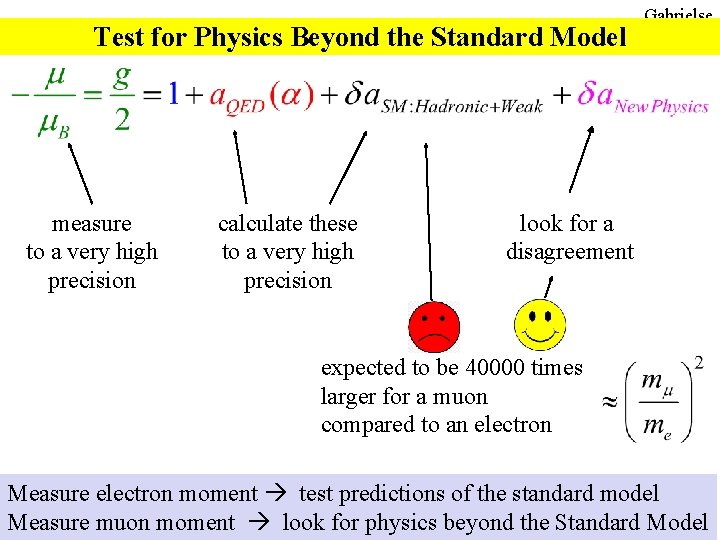
Test for Physics Beyond the Standard Model measure to a very high precision calculate these to a very high precision Gabrielse look for a disagreement expected to be 40000 times larger for a muon compared to an electron Measure electron moment test predictions of the standard model Measure muon moment look for physics beyond the Standard Model
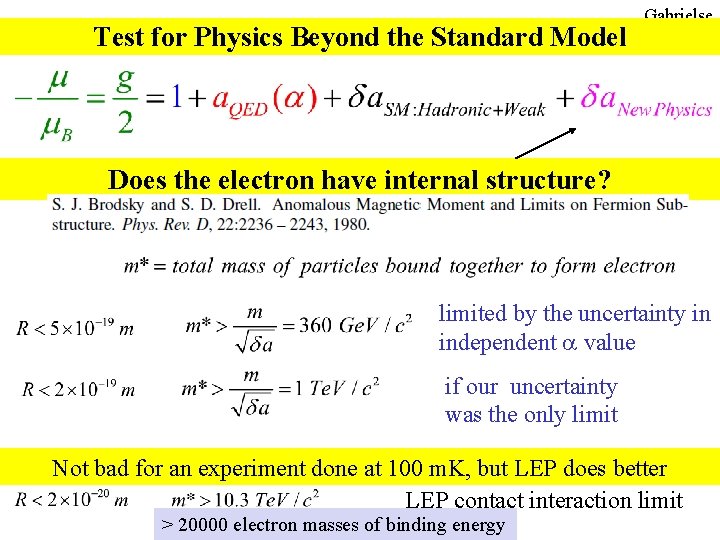
Test for Physics Beyond the Standard Model Gabrielse Does the electron have internal structure? limited by the uncertainty in independent a value if our uncertainty was the only limit Not bad for an experiment done at 100 m. K, but LEP does better LEP contact interaction limit > 20000 electron masses of binding energy
Gabrielse Emboldened by the Great Signal-to-Noise Make a one proton (antiproton) self-excited oscillator detect proton (and antiproton) spin flips

Gabrielse
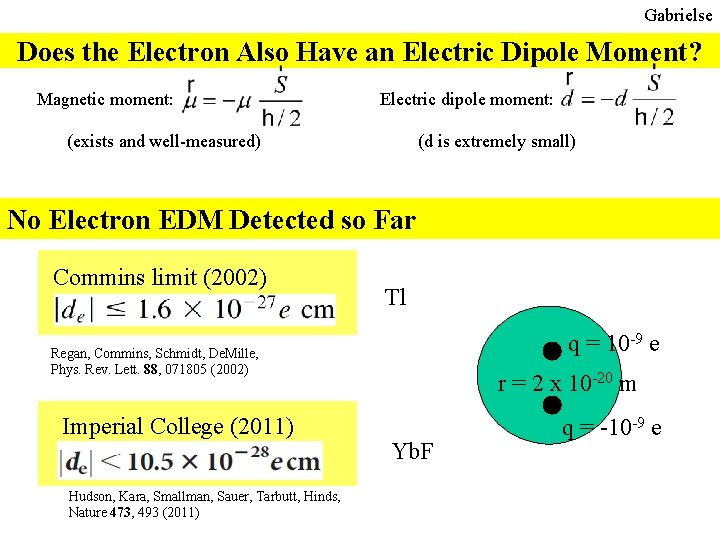
Gabrielse Does the Electron Also Have an Electric Dipole Moment? Magnetic moment: Electric dipole moment: (exists and well-measured) (d is extremely small) No Electron EDM Detected so Far Commins limit (2002) Tl q = 10 -9 e Regan, Commins, Schmidt, De. Mille, Phys. Rev. Lett. 88, 071805 (2002) Imperial College (2011) Hudson, Kara, Smallman, Sauer, Tarbutt, Hinds, Nature 473, 493 (2011) r = 2 x 10 -20 m Yb. F q = -10 -9 e
Gabrielse Advanced Cold-Molecule Electron EDM Harvard University Yale University John Doyle Group David De. Mille Group Gerald Gabrielse Group Nearing publication of a new result for the electron EDM Funding from NSF
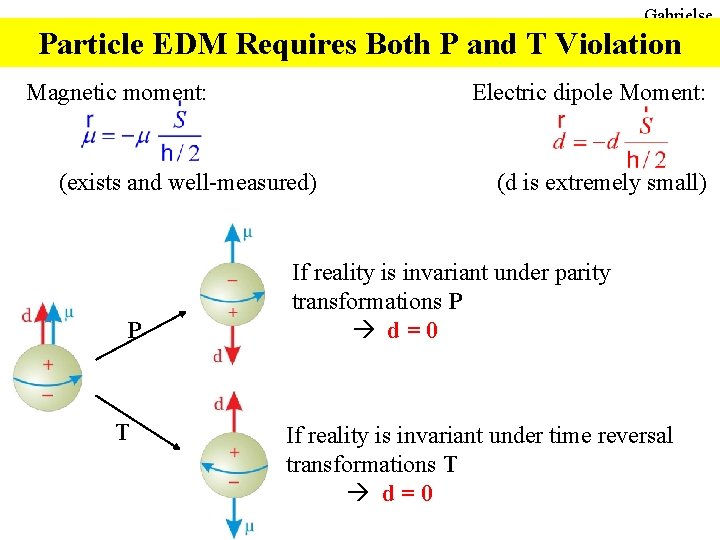
Gabrielse Particle EDM Requires Both P and T Violation Magnetic moment: Electric dipole Moment: (exists and well-measured) (d is extremely small) P T If reality is invariant under parity transformations P d = 0 If reality is invariant under time reversal transformations T d = 0
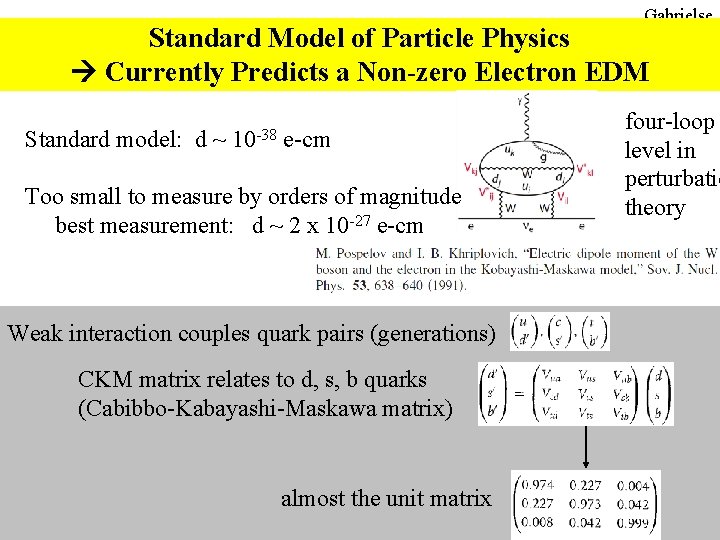
Gabrielse Standard Model of Particle Physics Currently Predicts a Non-zero Electron EDM Standard model: d ~ 10 -38 e-cm Too small to measure by orders of magnitude best measurement: d ~ 2 x 10 -27 e-cm Weak interaction couples quark pairs (generations) CKM matrix relates to d, s, b quarks (Cabibbo-Kabayashi-Maskawa matrix) almost the unit matrix four-loop level in perturbatio theory
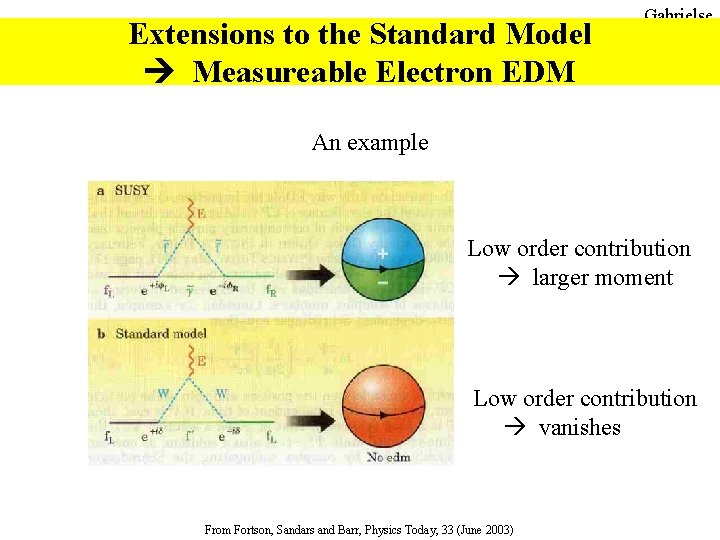
Extensions to the Standard Model Measureable Electron EDM Gabrielse An example Low order contribution larger moment Low order contribution vanishes From Fortson, Sandars and Barr, Physics Today, 33 (June 2003)
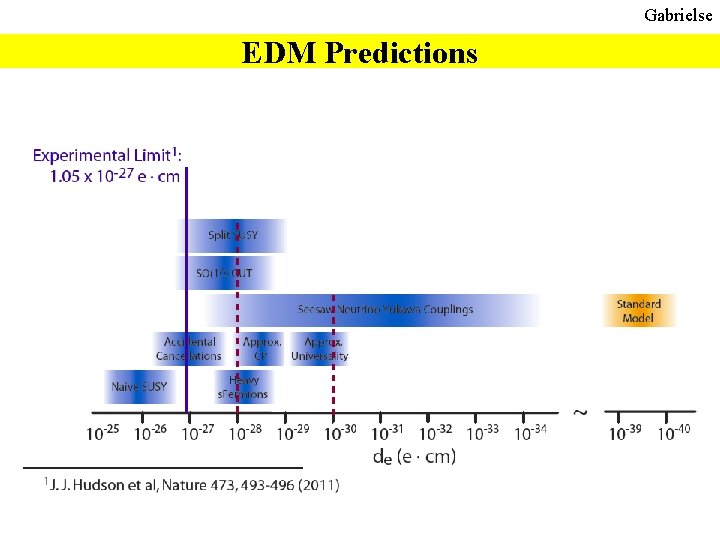
Gabrielse EDM Predictions
Cannot Use Electric Field Directly on an Electron or Proton Gabrielse Simple E and B can be used for neutron EDM measurement (neutron has magnetic moment but no net charge) Electric field would accelerate an electron out of the apparatus Electron EDM are done within atoms and molecules (first molecular ion measurement is now being attempted)
Gabrielse Schiff Theorem – for Electron in an Atom or Molecule Schiff (1963) – no atomic or molecular EDM (i. e. linear Stark effect) • from electron edm • nonrelativistic quantum mechanics limit Sandars (1965) – can get atomic or molecular EDM (i. e. linear Stark effect) • from electron edm • relativistic quantum mechanics • get significant enhancement (D >> d) for large Z Commins, Jackson, De. Mille (2007) – intuitive explanation for escape from Schiff Lorentz contraction of the electron EDM viewed in lab frame Schiff, Phys. Rev. Lett. 132, 2194 (1963); Sandars, Phys. Rev. Lett. 14, 194 (1965); ibid 22, 290 (1966). Commins, Jackson, De. Mille, Am. J. Phys. 75, 532 (2007).
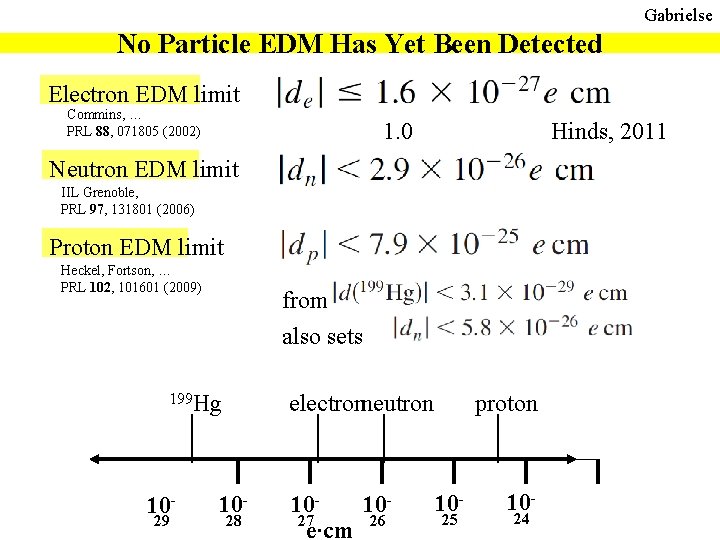
Gabrielse No Particle EDM Has Yet Been Detected Electron EDM limit Commins, … PRL 88, 071805 (2002) 1. 0 Hinds, 2011 Neutron EDM limit IIL Grenoble, PRL 97, 131801 (2006) Proton EDM limit Heckel, Fortson, … PRL 102, 101601 (2009) from also sets 199 Hg 1029 electronneutron 1028 101027 26 e∙cm proton 1025 1024
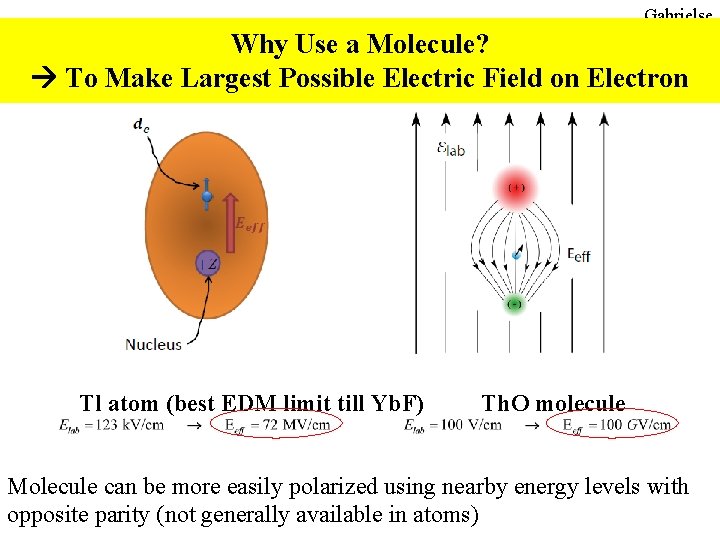
Gabrielse Why Use a Molecule? To Make Largest Possible Electric Field on Electron Tl atom (best EDM limit till Yb. F) Th. O molecule Molecule can be more easily polarized using nearby energy levels with opposite parity (not generally available in atoms)
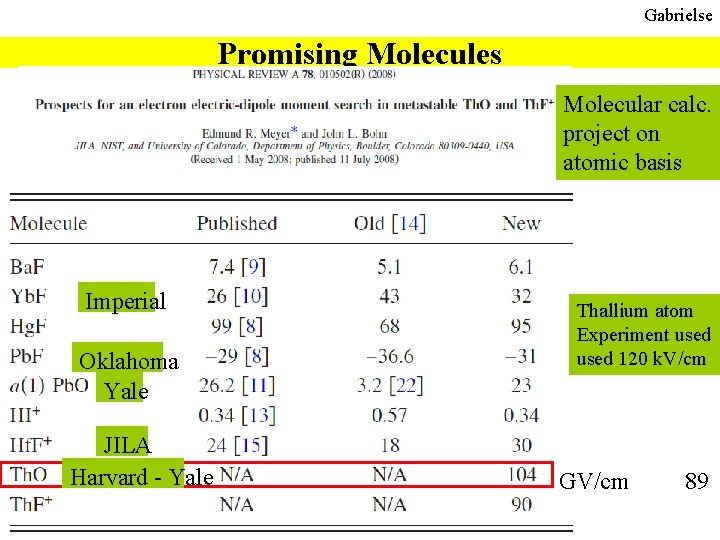
Gabrielse Promising Molecules Molecular calc. project on atomic basis Imperial Oklahoma Yale JILA Harvard - Yale Thallium atom Experiment used 120 k. V/cm GV/cm 89
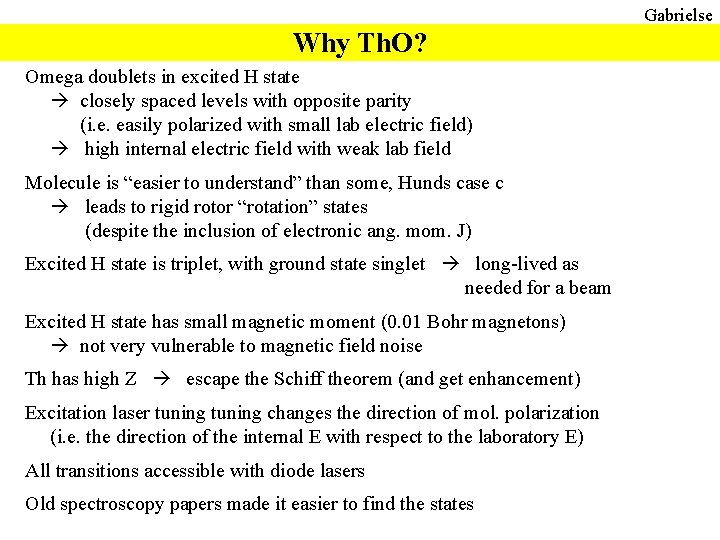
Gabrielse Why Th. O? Omega doublets in excited H state closely spaced levels with opposite parity (i. e. easily polarized with small lab electric field) high internal electric field with weak lab field Molecule is “easier to understand” than some, Hunds case c leads to rigid rotor “rotation” states (despite the inclusion of electronic ang. mom. J) Excited H state is triplet, with ground state singlet long-lived as needed for a beam Excited H state has small magnetic moment (0. 01 Bohr magnetons) not very vulnerable to magnetic field noise Th has high Z escape the Schiff theorem (and get enhancement) Excitation laser tuning changes the direction of mol. polarization (i. e. the direction of the internal E with respect to the laboratory E) All transitions accessible with diode lasers Old spectroscopy papers made it easier to find the states
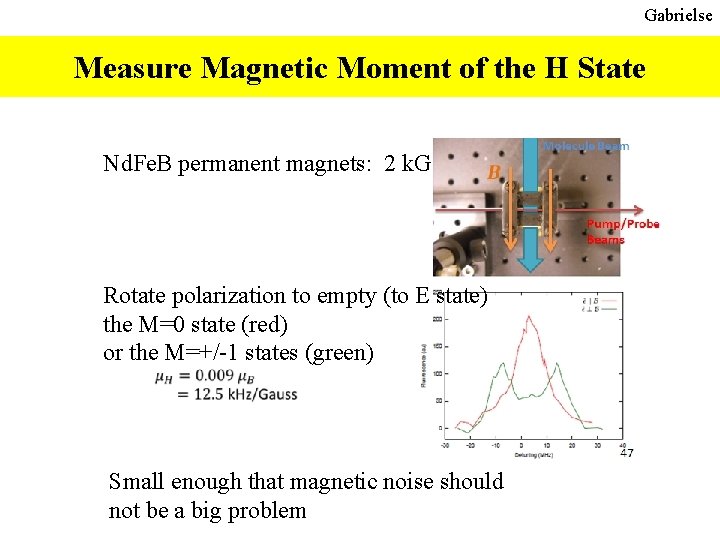
Gabrielse Measure Magnetic Moment of the H State Nd. Fe. B permanent magnets: 2 k. G Rotate polarization to empty (to E state) the M=0 state (red) or the M=+/-1 states (green) Small enough that magnetic noise should not be a big problem
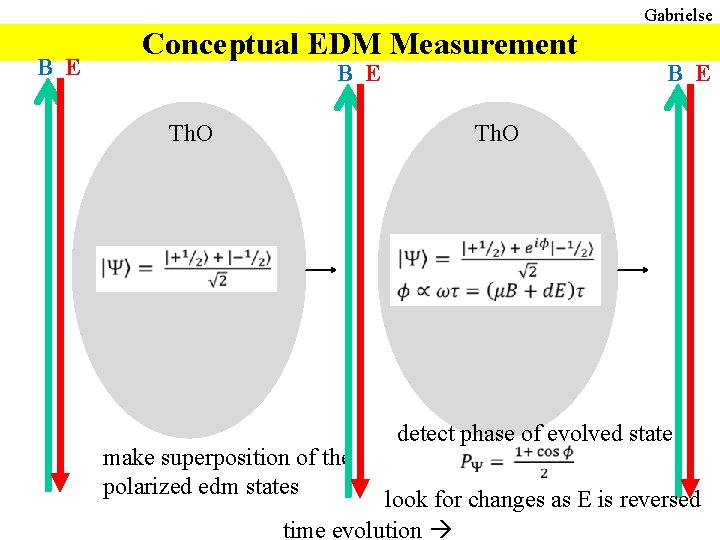
Gabrielse B E Conceptual EDM Measurement B E Th. O make superposition of the polarized edm states detect phase of evolved state look for changes as E is reversed time evolution
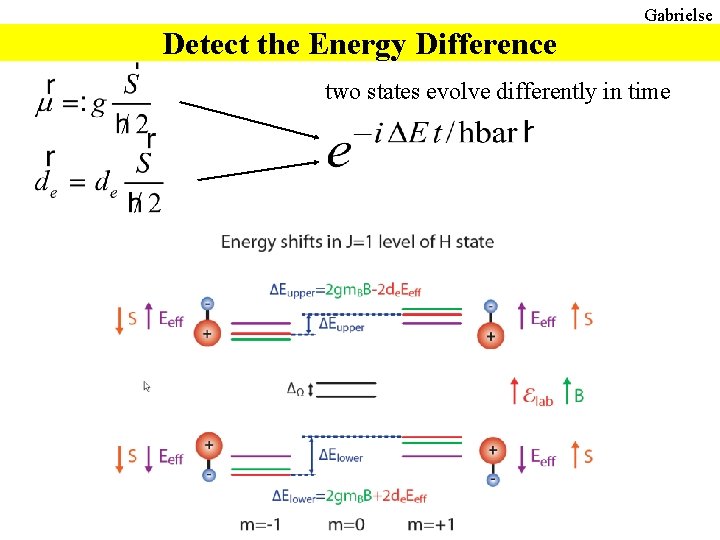
Gabrielse Detect the Energy Difference two states evolve differently in time
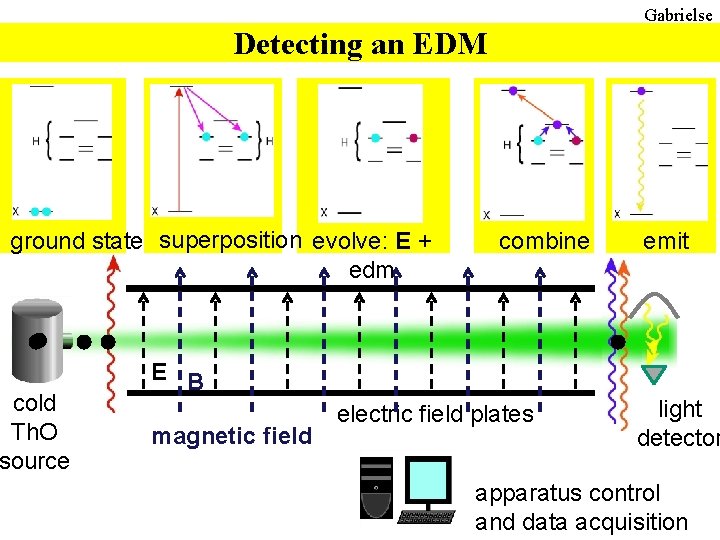
Gabrielse Detecting an EDM ground state superposition evolve: E + edm cold Th. O source combine emit E B magnetic field electric field plates light detector apparatus control and data acquisition
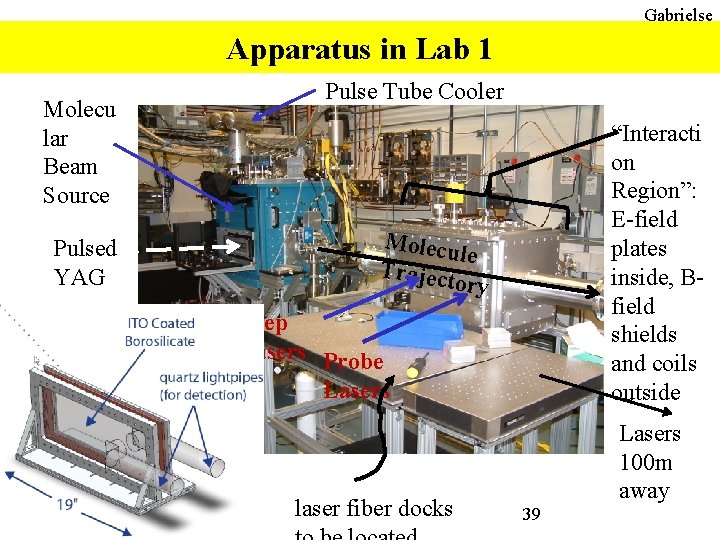
Gabrielse Apparatus in Lab 1 Molecu lar Beam Source Pulsed YAG Pulse Tube Cooler “Interacti on Region”: E-field plates inside, Bfield shields and coils outside Molecu le Traject or y Prep Lasers Probe Lasers laser fiber docks Lasers 100 m away 39
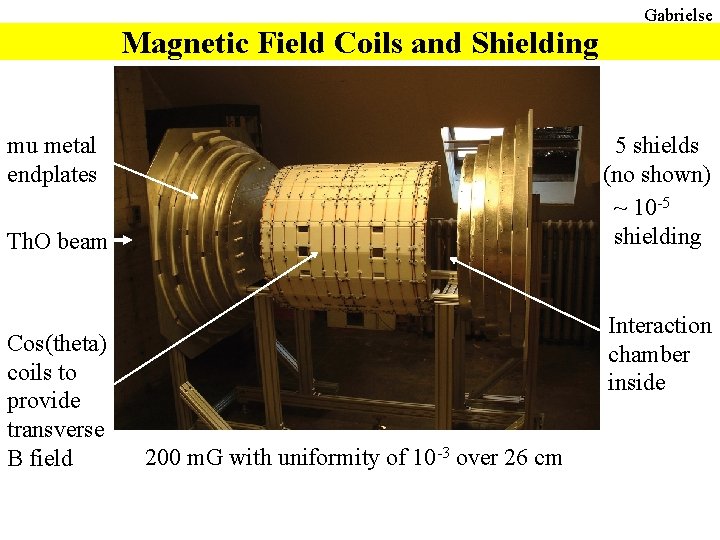
Magnetic Field Coils and Shielding mu metal endplates 5 shields (no shown) ~ 10 -5 shielding Th. O beam Cos(theta) coils to provide transverse B field Gabrielse Interaction chamber inside 200 m. G with uniformity of 10 -3 over 26 cm
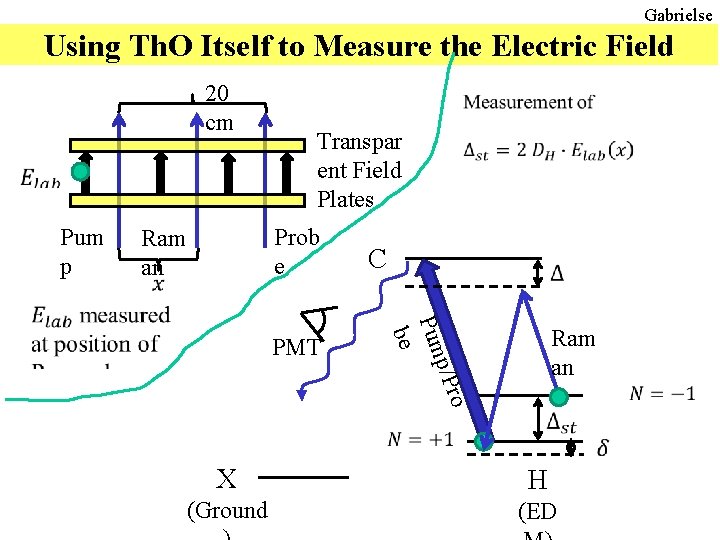
Gabrielse Using Th. O Itself to Measure the Electric Field 20 cm Pum p Transpar ent Field Plates Prob e Ram an C p Pum be PMT /Pro Ram an X H (Ground (ED
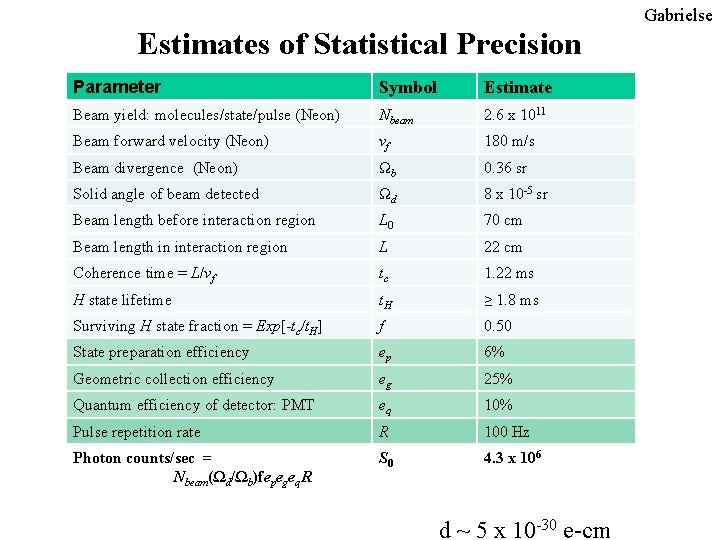
Gabrielse Estimates of Statistical Precision Parameter Symbol Estimate Beam yield: molecules/state/pulse (Neon) Nbeam 2. 6 x 10¹¹ Beam forward velocity (Neon) vf 180 m/s Beam divergence (Neon) Ωb 0. 36 sr Solid angle of beam detected Ωd 8 x 10 -5 sr Beam length before interaction region L 0 70 cm Beam length in interaction region L 22 cm Coherence time = L/vf tc 1. 22 ms H state lifetime t. H ≥ 1. 8 ms Surviving H state fraction = Exp[-tc/t. H] f 0. 50 State preparation efficiency ep 6% Geometric collection efficiency eg 25% Quantum efficiency of detector: PMT eq 10% Pulse repetition rate R 100 Hz Photon counts/sec = Nbeam(Ωd/Ωb)fepegeq. R S 0 4. 3 x 10⁶ d ~ 5 x 10 -30 e-cm
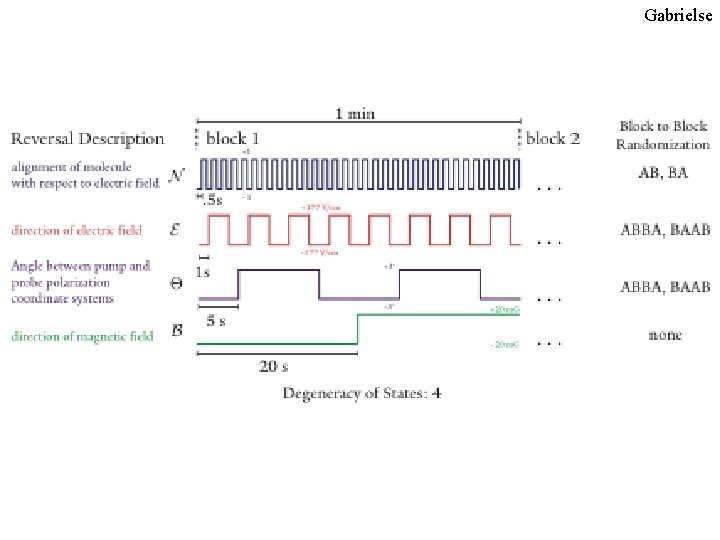
Gabrielse
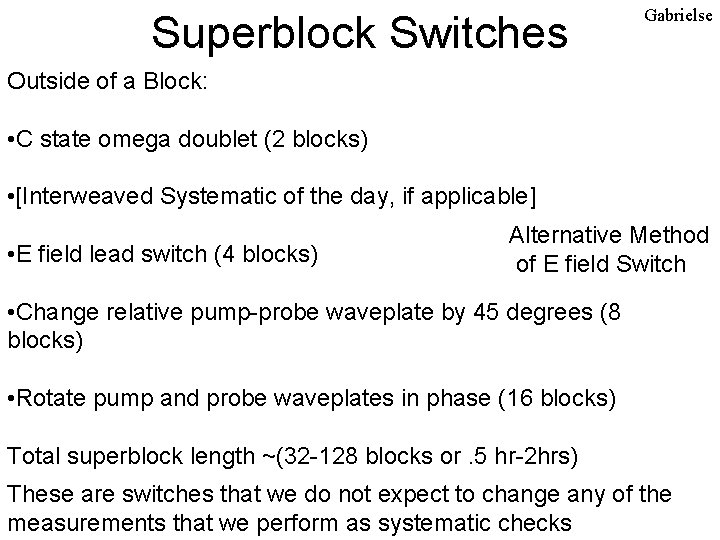
Superblock Switches Gabrielse Outside of a Block: • C state omega doublet (2 blocks) • [Interweaved Systematic of the day, if applicable] • E field lead switch (4 blocks) Alternative Method of E field Switch • Change relative pump-probe waveplate by 45 degrees (8 blocks) • Rotate pump and probe waveplates in phase (16 blocks) Total superblock length ~(32 -128 blocks or. 5 hr-2 hrs) These are switches that we do not expect to change any of the measurements that we perform as systematic checks
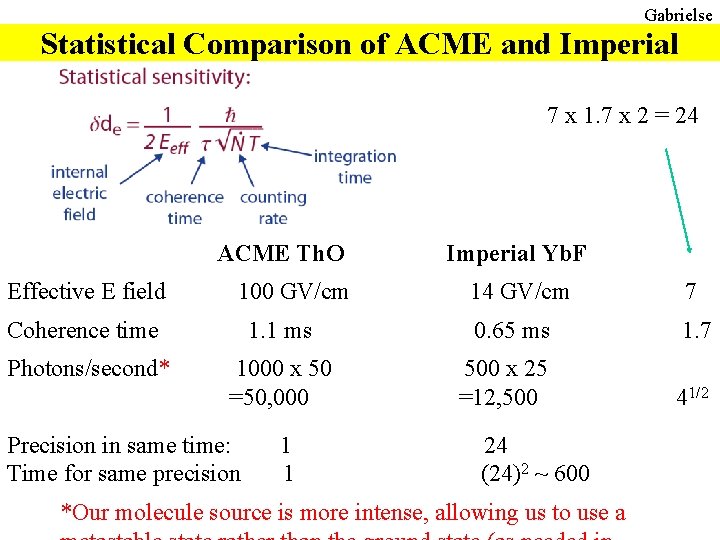
Gabrielse Statistical Comparison of ACME and Imperial 7 x 1. 7 x 2 = 24 ACME Th. O Imperial Yb. F Effective E field 100 GV/cm 14 GV/cm 7 Coherence time 1. 1 ms 0. 65 ms 1. 7 Photons/second* 1000 x 50 500 x 25 =50, 000 =12, 500 41/2 Precision in same time: 1 24 Time for same precision 1 (24)2 ~ 600 *Our molecule source is more intense, allowing us to use a
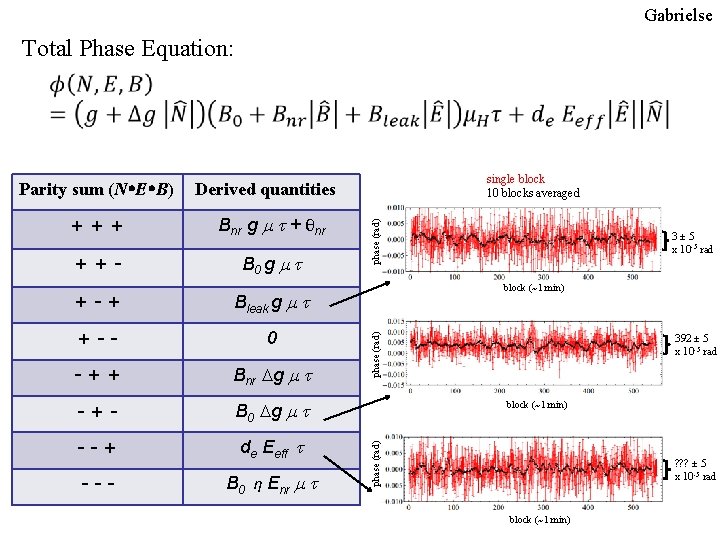
Gabrielse Total Phase Equation: single block 10 blocks averaged Bnr g m t + θnr ++- B 0 g m t +-+ Bleak g m t +-- 0 -++ Bnr Dg m t -+- B 0 Dg m t --+ de Eeff t --- B 0 η Enr m t 3 ± 5 x 10 -5 rad block (~1 min) 392 ± 5 x 10 -5 rad phase (rad) +++ phase (rad) Derived quantities block (~1 min) phase (rad) Parity sum (N E B) ? ? ? ± 5 x 10 -5 rad block (~1 min)
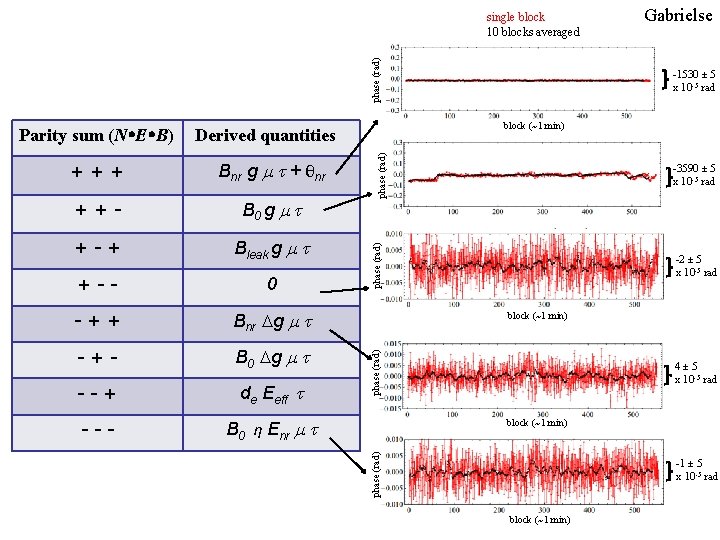
phase (rad) single block 10 blocks averaged block (~1 min) B 0 g m t +-+ Bleak g m t +-- 0 -++ Bnr Dg m t -+- B 0 Dg m t --+ de Eeff t --- B 0 η Enr m t phase (rad) ++- -3590 ± 5 x 10 -5 rad -2 ± 5 x 10 -5 rad block (~1 min) phase (rad) Bnr g m t + θnr phase (rad) Derived quantities +++ -1530 ± 5 x 10 -5 rad 4 ± 5 x 10 -5 rad block (~1 min) phase (rad) Parity sum (N E B) Gabrielse -1 ± 5 x 10 -5 rad block (~1 min)
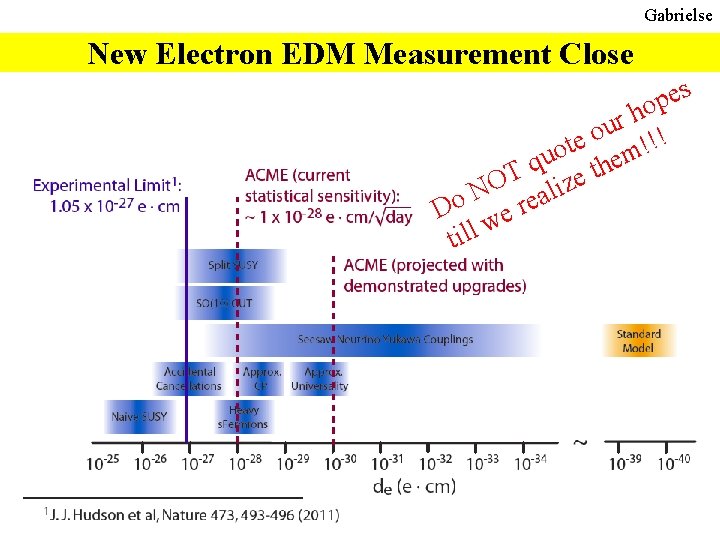
Gabrielse New Electron EDM Measurement Close s e p o h r u o ! ! e t ! uo them q T ize O N real o D we it ll
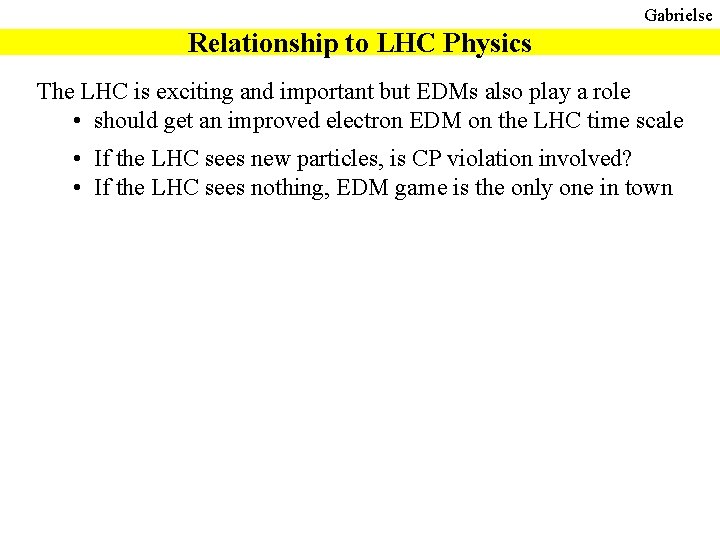
Gabrielse Relationship to LHC Physics The LHC is exciting and important but EDMs also play a role • should get an improved electron EDM on the LHC time scale • If the LHC sees new particles, is CP violation involved? • If the LHC sees nothing, EDM game is the only one in town
Gabrielse Planned Improvements
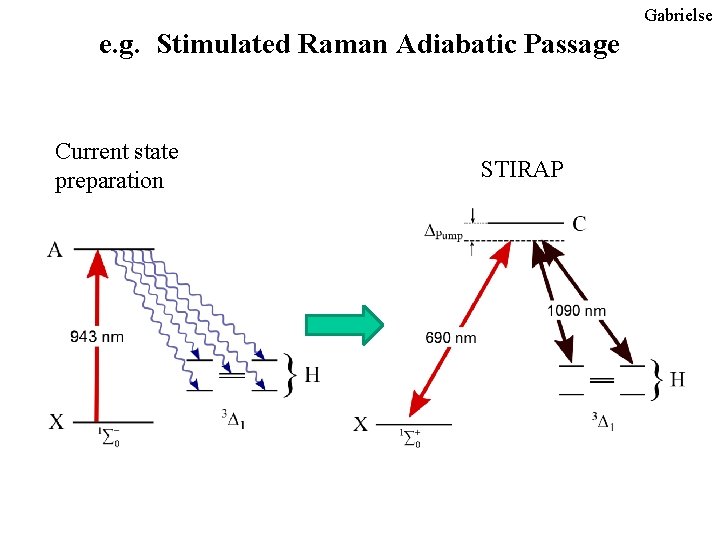
Gabrielse e. g. Stimulated Raman Adiabatic Passage Current state preparation STIRAP
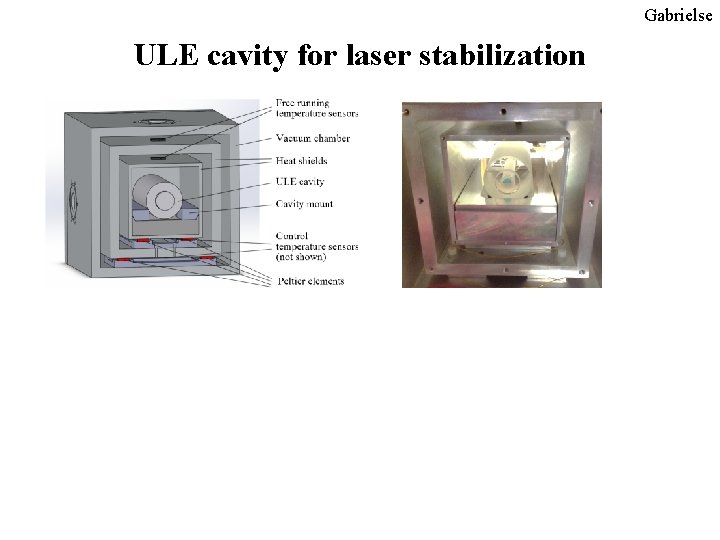
Gabrielse ULE cavity for laser stabilization
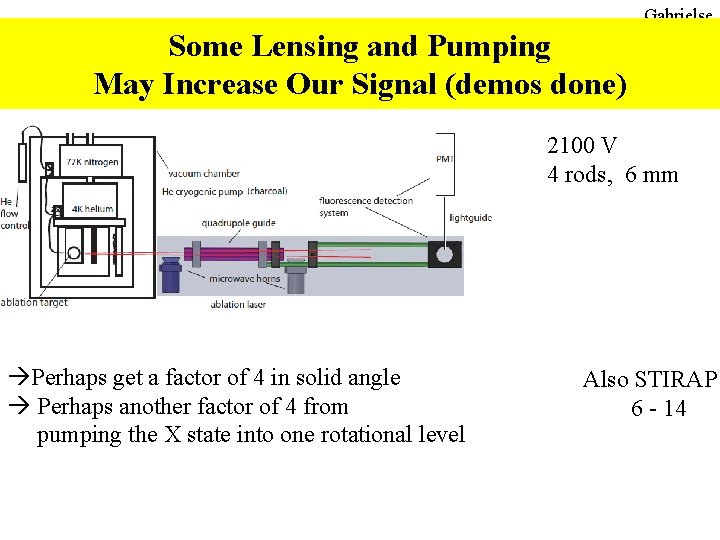
Gabrielse Some Lensing and Pumping May Increase Our Signal (demos done) 2100 V 4 rods, 6 mm Perhaps get a factor of 4 in solid angle Perhaps another factor of 4 from pumping the X state into one rotational level Also STIRAP 6 - 14
Gabrielse Summary Electron Magnetic Dipole Moment Most precisely measured property of an elementary particle Most precise prediction of the Standard Model Most precise and successful confrontation of theory and experiment Electron Electric Dipole Moment New result is close at hand. Stay tuned Substantial improvement in precision seems possible
- Slides: 54