
GABIKAT system Plasmid map of p AC 161

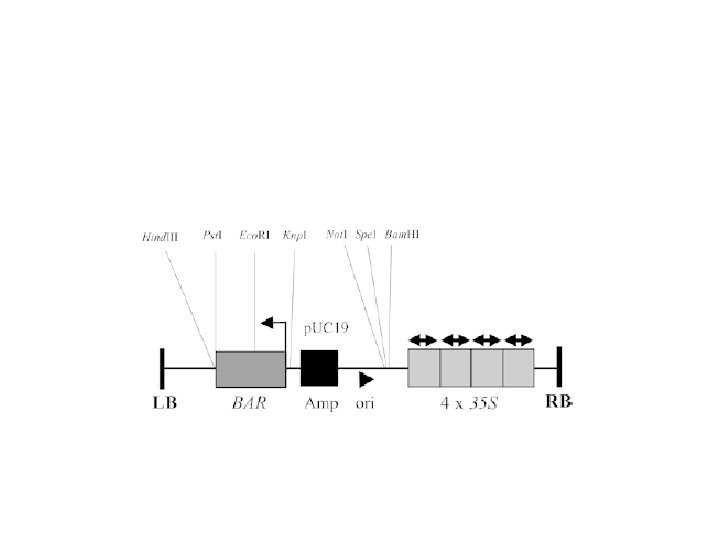
GABI-KAT system Plasmid map of p. AC 161 used for tagging. Map of the binary transformation vector p. AC 161 that contains the SULr ORF (for resistance against the herbicide sulfadiazine (sul; 4 -amino-N-2 -pyrimidinylbenzene sulfonamide) driven by the 1’ 2’ promoter. The 35 S Ca. MV promoter located at the right border can act as an activation tagging element after T-DNA integration. Structural parts and relevant restriction sites of the vector are marked.

Site Preferences of Insertional Mutagenesis Agents in Arabidopsis (Ref: Plant Physiol. 137: 168, 2005) Transposon-Based Agents Have Marked Preference for High GC Content, whereas T-DNA-Based Agents Show Preference for Low GC Content Insertion frequency by GC content. Insertion events have been normalized to 1, 000 insertions of each insertional mutagenesis agent to allow for comparison between the agents.
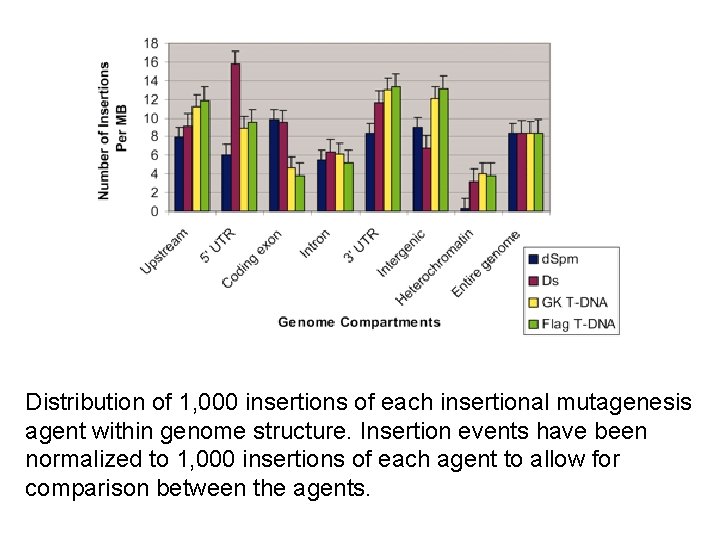
Distribution of 1, 000 insertions of each insertional mutagenesis agent within genome structure. Insertion events have been normalized to 1, 000 insertions of each agent to allow for comparison between the agents.
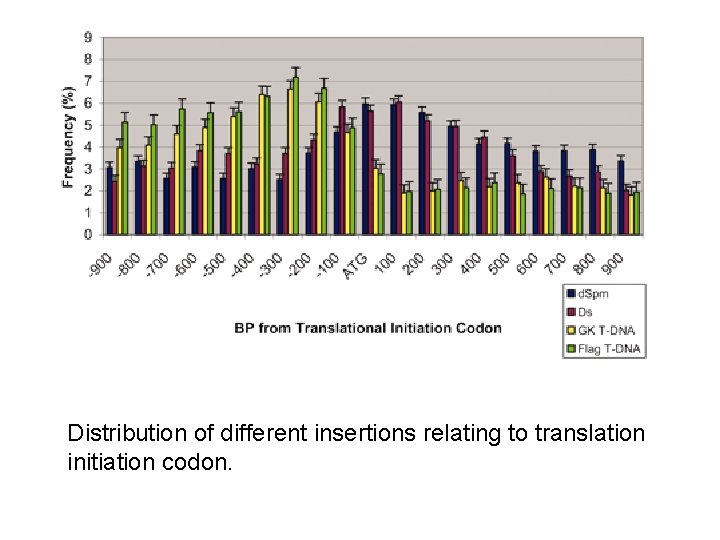
Distribution of different insertions relating to translation initiation codon.

T-DNA vectors for the PEF (plant exon finder) system. Schematic diagrams of the p. FJ 8 T-DNA construct with the 850 -bp Arabidopsis HSP 18. 2 heat-shock promoter and the p. FJ 18 T-DNA construct with the 800 -bp Ca. MV 35 S promoter. Both promoters are fused to the HSP 81 -1 first exon and intron partial sequences followed by the T-DNA left border (LB). ATG indicates the start codon of HSP 81 -1 in each construct.
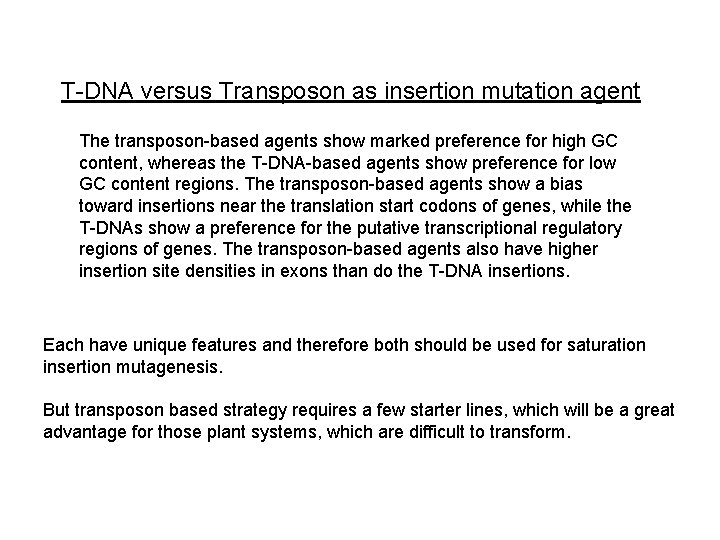
T-DNA versus Transposon as insertion mutation agent The transposon-based agents show marked preference for high GC content, whereas the T-DNA-based agents show preference for low GC content regions. The transposon-based agents show a bias toward insertions near the translation start codons of genes, while the T-DNAs show a preference for the putative transcriptional regulatory regions of genes. The transposon-based agents also have higher insertion site densities in exons than do the T-DNA insertions. Each have unique features and therefore both should be used for saturation insertion mutagenesis. But transposon based strategy requires a few starter lines, which will be a great advantage for those plant systems, which are difficult to transform.

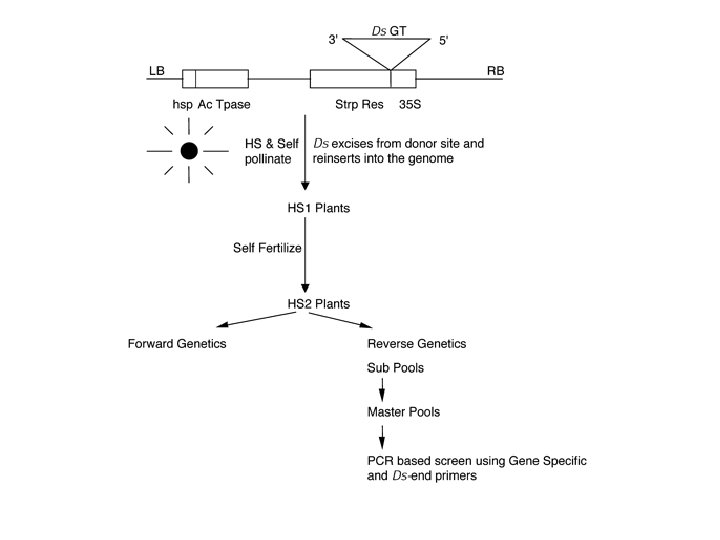
A schematic representation of the T-DNA vector harboring the plasmid p. YS 11 used for transforming wild-type Arabidopsis Ws-0. LB, Left border sequence of T-DNA; hsp, heat shock promoter from Glycine max; Ac, activator element; Ds, dissociation element; GT, gene trap; Strp. R, streptomycin resistance gene; A, triple-splice acceptor; I, Arabidopsis intron; GUS, -glucuronidase gene; Kan. R, kanamycin resistance gene; 35 S, 35 S cauliflower mosaic virus promoter; and RB, right border sequence of T-DNA.
- Slides: 10