
G T A AP Biology A C G
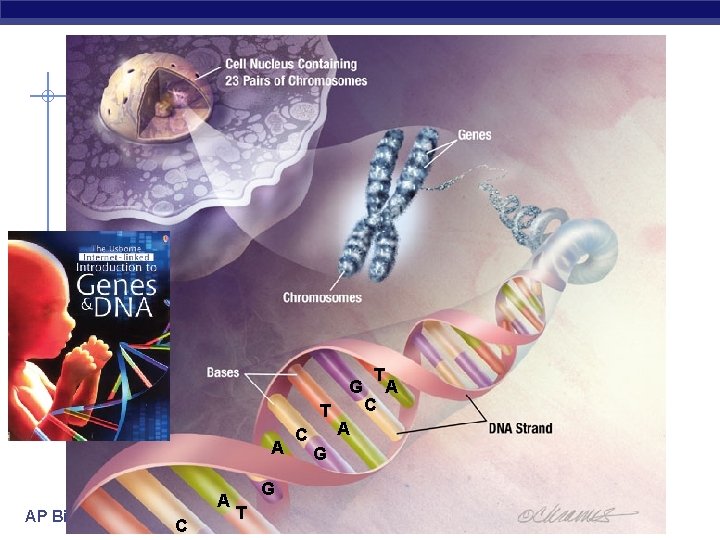
G T A AP Biology A C G T C G A T C A
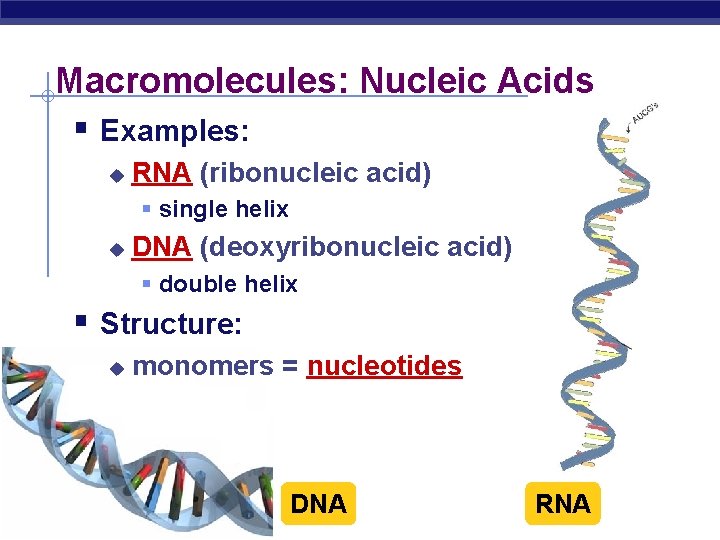
Macromolecules: Nucleic Acids § Examples: u RNA (ribonucleic acid) § single helix u DNA (deoxyribonucleic acid) § double helix § Structure: u AP Biology monomers = nucleotides DNA RNA
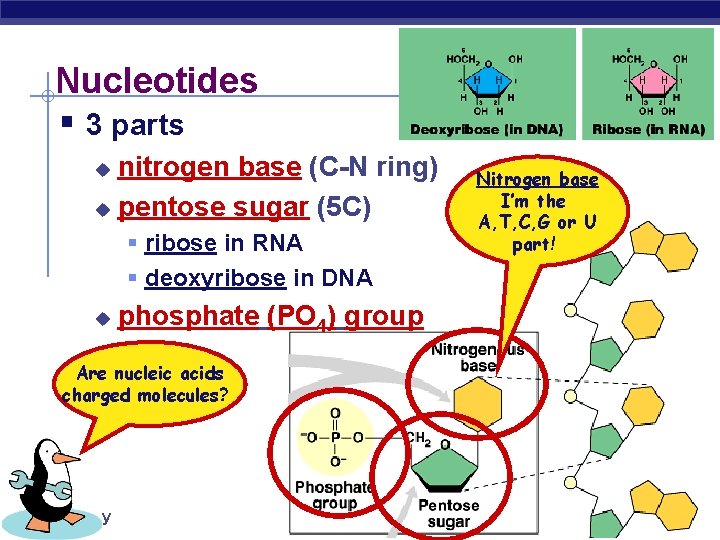
Nucleotides § 3 parts nitrogen base (C-N ring) u pentose sugar (5 C) u § ribose in RNA § deoxyribose in DNA u phosphate (PO 4) group Are nucleic acids charged molecules? AP Biology Nitrogen base I’m the A, T, C, G or U part!
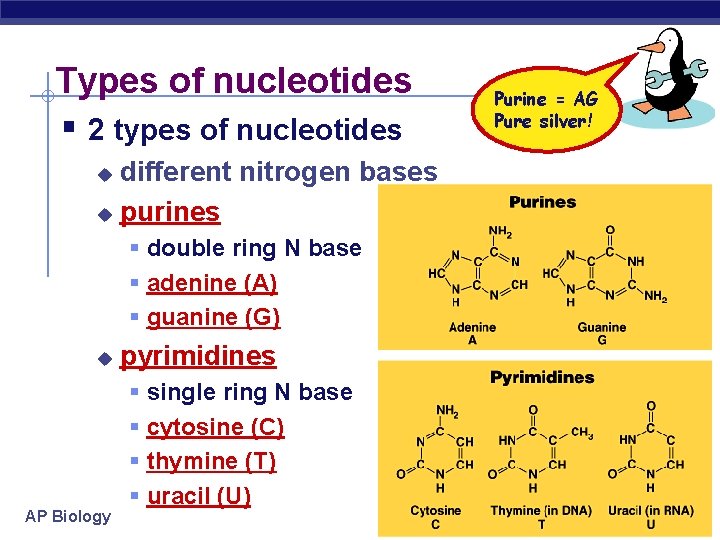
Types of nucleotides § 2 types of nucleotides different nitrogen bases u purines u § double ring N base § adenine (A) § guanine (G) u AP Biology pyrimidines § § single ring N base cytosine (C) thymine (T) uracil (U) Purine = AG Pure silver!
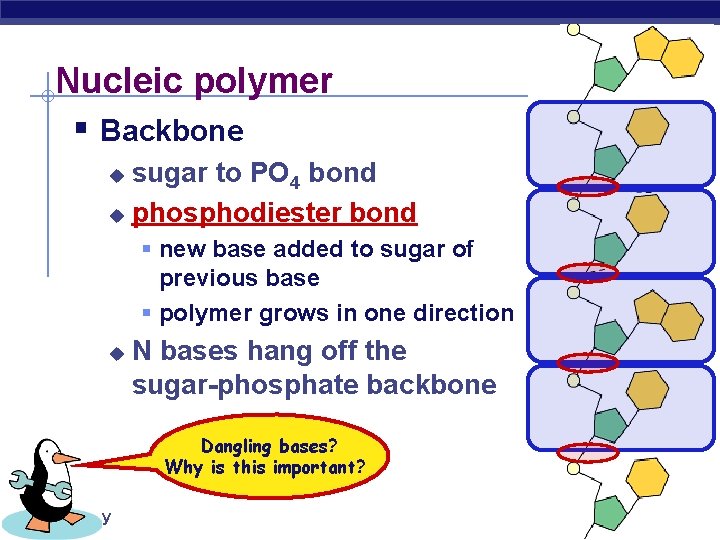
Nucleic polymer § Backbone sugar to PO 4 bond u phosphodiester bond u § new base added to sugar of previous base § polymer grows in one direction u N bases hang off the sugar-phosphate backbone Dangling bases? Why is this important? AP Biology
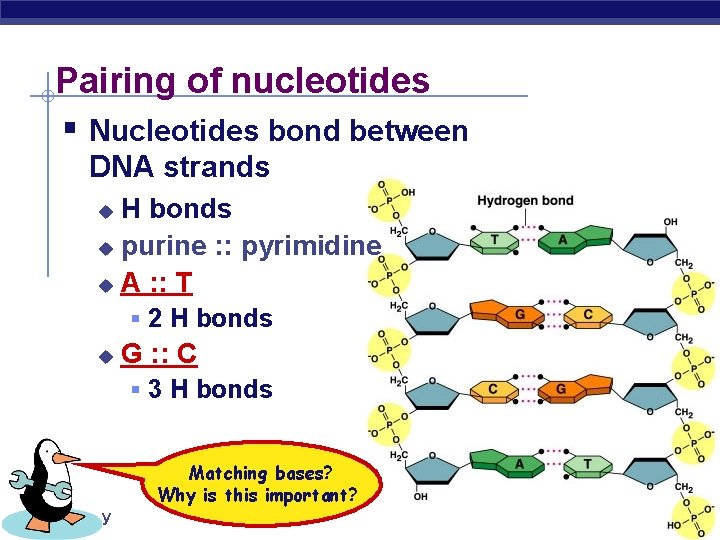
Pairing of nucleotides § Nucleotides bond between DNA strands H bonds u purine : : pyrimidine u A : : T u § 2 H bonds u G : : C § 3 H bonds Matching bases? Why is this important? AP Biology
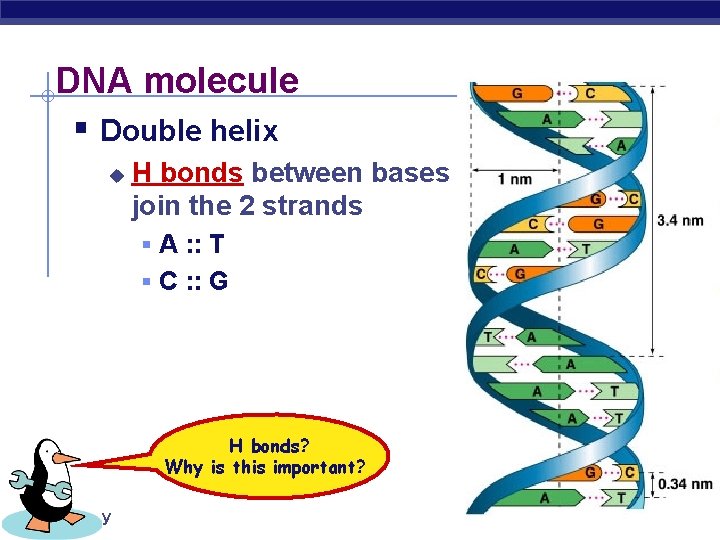
DNA molecule § Double helix u H bonds between bases join the 2 strands § A : : T § C : : G H bonds? Why is this important? AP Biology
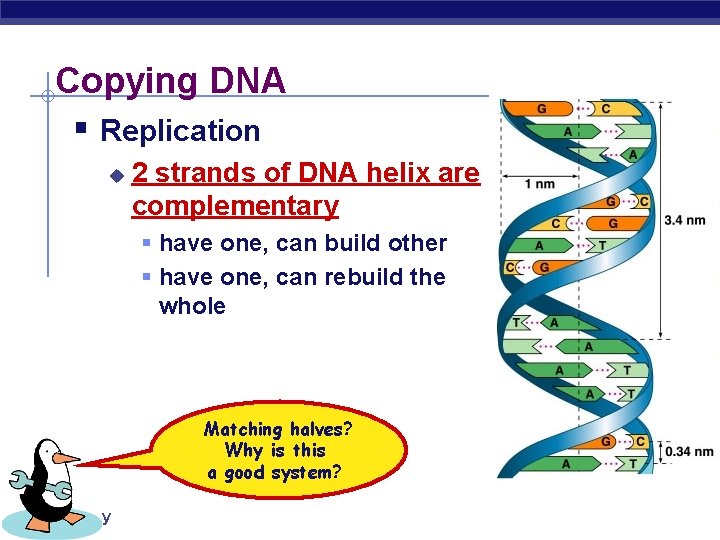
Copying DNA § Replication u 2 strands of DNA helix are complementary § have one, can build other § have one, can rebuild the whole Matching halves? Why is this a good system? AP Biology
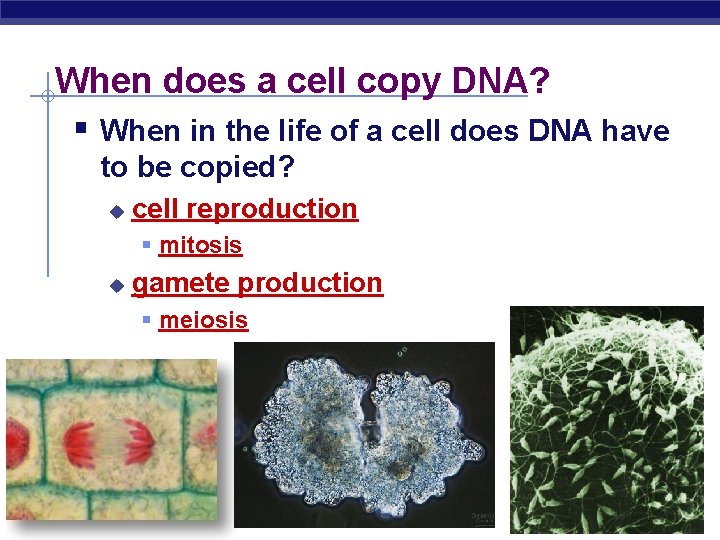
When does a cell copy DNA? § When in the life of a cell does DNA have to be copied? u cell reproduction § mitosis u gamete production § meiosis AP Biology
Learning Check § Use the candy and instructions to build a DNA model that follows Chargaff’s rules of base pairing AP Biology
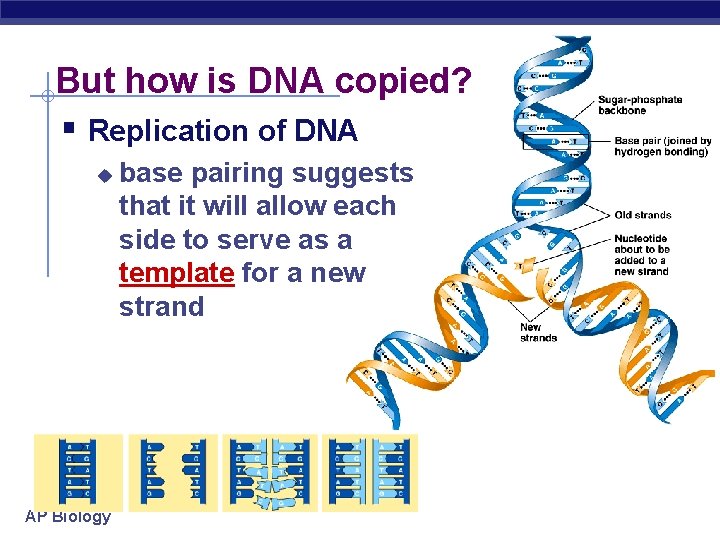
But how is DNA copied? § Replication of DNA u AP Biology base pairing suggests that it will allow each side to serve as a template for a new strand
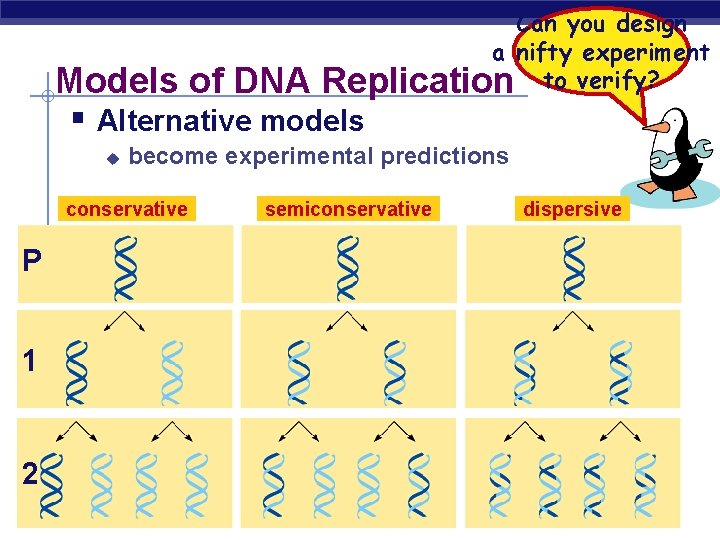
Can you design a nifty experiment Replication to verify? Models of DNA § Alternative models u become experimental predictions conservative P 1 2 AP Biology semiconservative dispersive
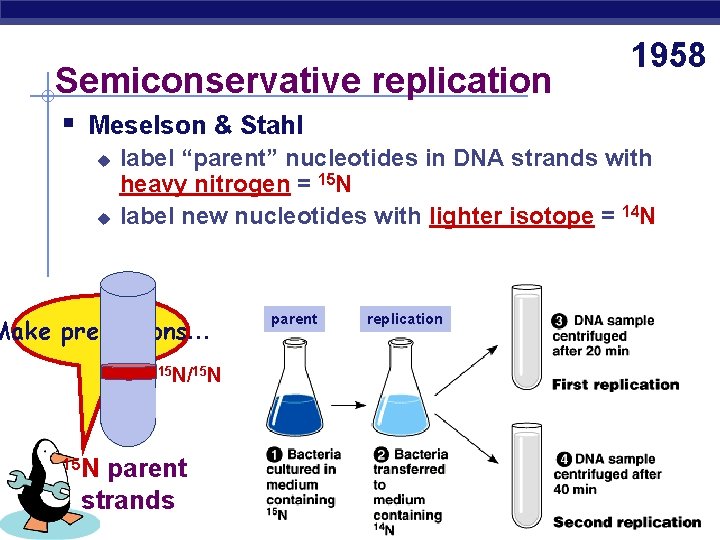
Semiconservative replication 1958 § Meselson & Stahl u u label “parent” nucleotides in DNA strands with heavy nitrogen = 15 N label new nucleotides with lighter isotope = 14 N Make predictions… 15 N/15 N parent strands AP Biology parent replication
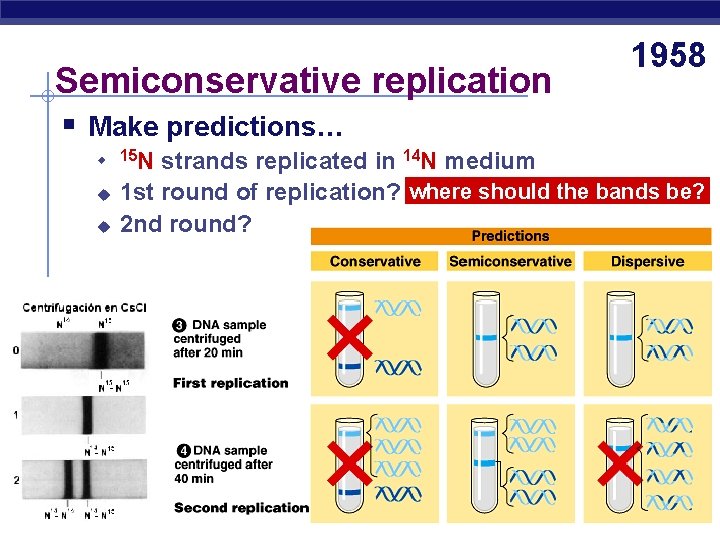
Semiconservative replication 1958 § Make predictions… u u u AP Biology 15 N strands replicated in 14 N medium 1 st round of replication? where should the bands be? 2 nd round?
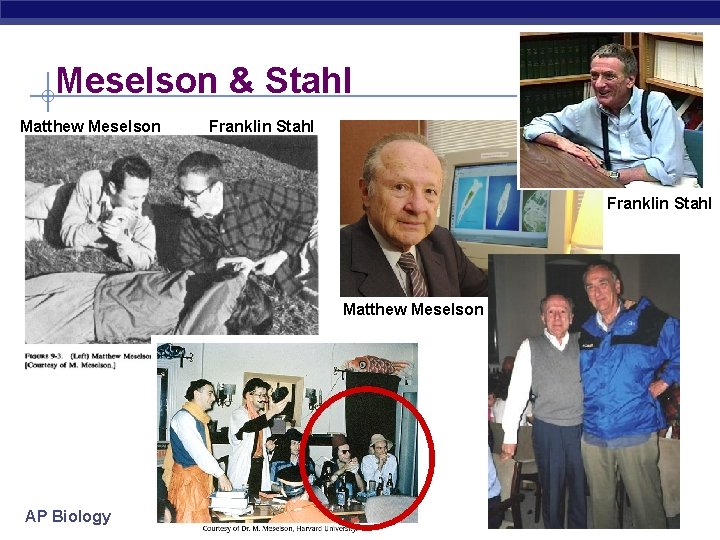
Meselson & Stahl Matthew Meselson Franklin Stahl Matthew Meselson AP Biology
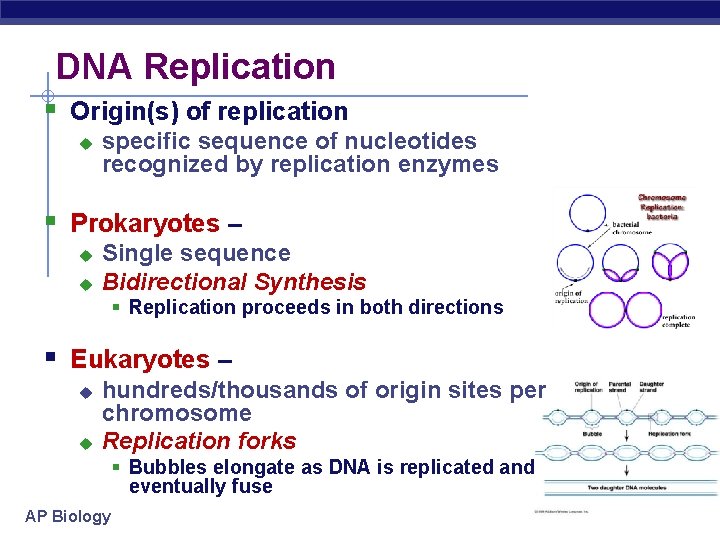
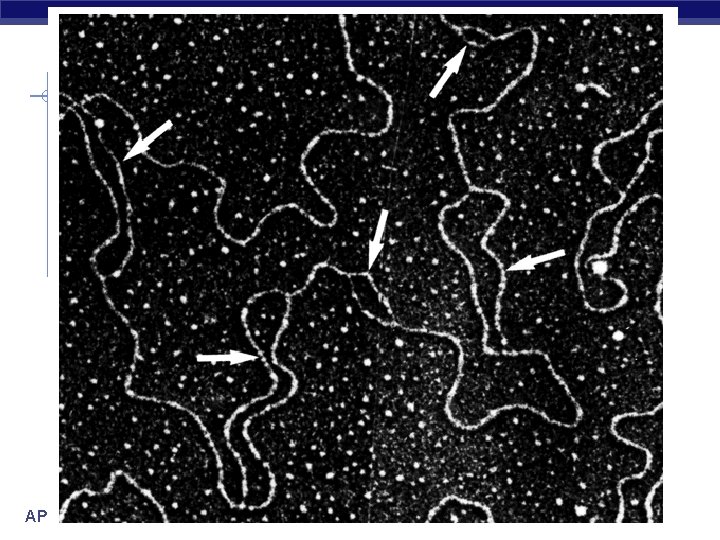
DNA Replication § Origin(s) of replication u specific sequence of nucleotides recognized by replication enzymes § Prokaryotes – u u Single sequence Bidirectional Synthesis § Replication proceeds in both directions § Eukaryotes – u u hundreds/thousands of origin sites per chromosome Replication forks § Bubbles elongate as DNA is replicated and eventually fuse AP Biology
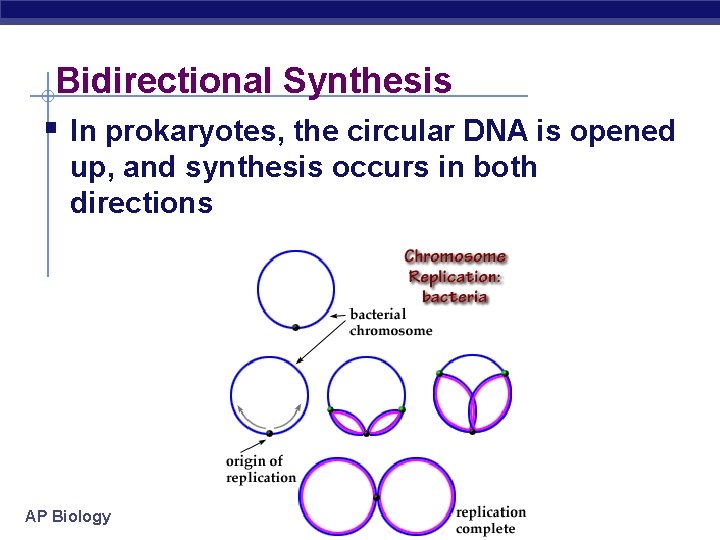
Bidirectional Synthesis § In prokaryotes, the circular DNA is opened up, and synthesis occurs in both directions AP Biology
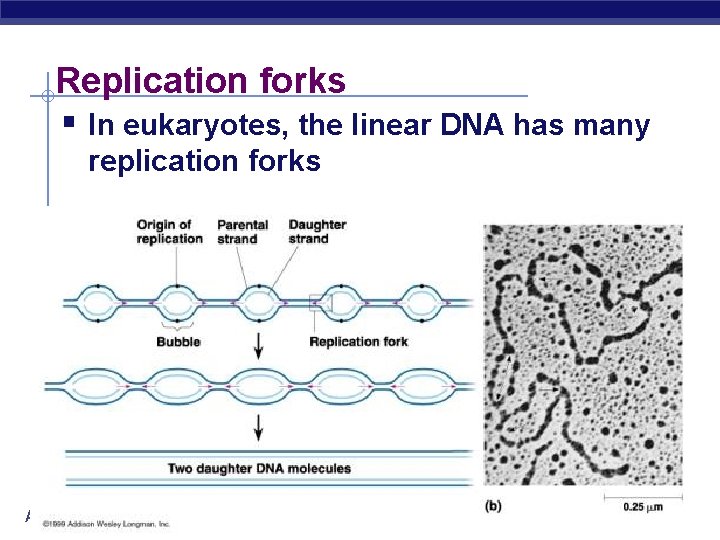
Replication forks § In eukaryotes, the linear DNA has many replication forks AP Biology
AP Biology
Learning Check § Break the toothpicks at the center of your models and replicate your DNA strand u You should end up with 2 complete strands of DNA § Keep in mind Chargaff’s rules and Meselson & Stahl’s semi-conservative model § Animation AP Biology
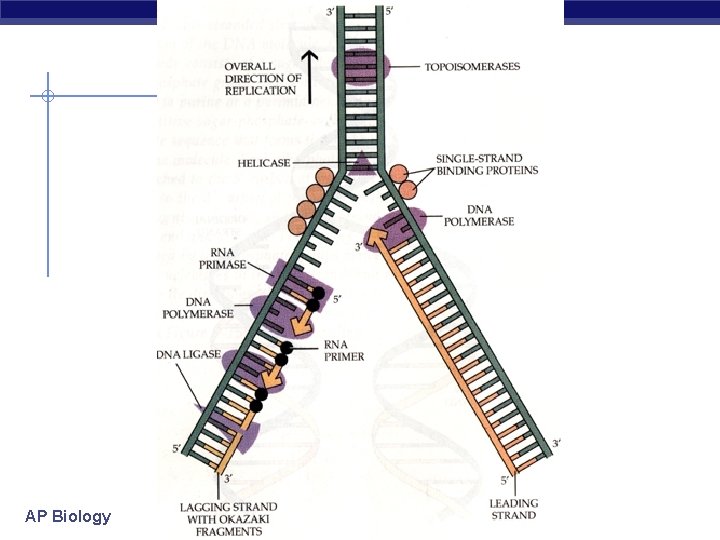
Replication- Create a diagram that shows how the following components interact with each other (15 min) § § § Lagging strand Helicase DNA polymerase Single stranded binding protein Topoisomerase AP Biology § § § Replication fork RNA primer Leading strand DNA ligase RNA primase Okazaki fragments
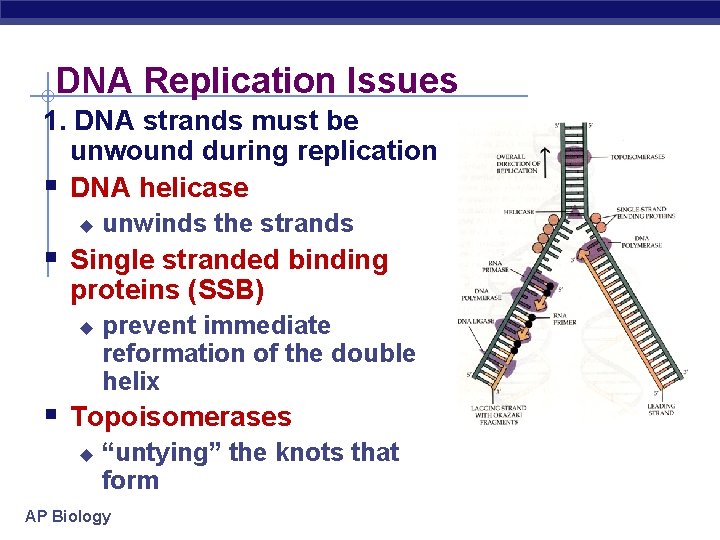
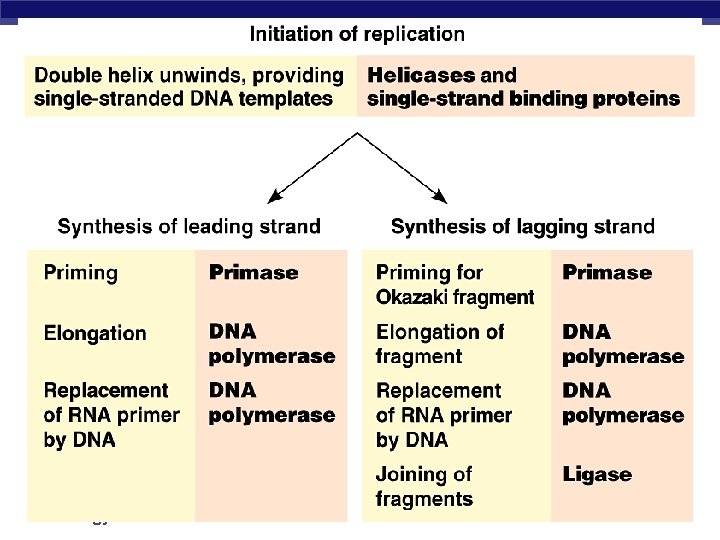
DNA Replication Issues 1. DNA strands must be unwound during replication § DNA helicase u unwinds the strands § Single stranded binding proteins (SSB) u prevent immediate reformation of the double helix § Topoisomerases u “untying” the knots that form AP Biology
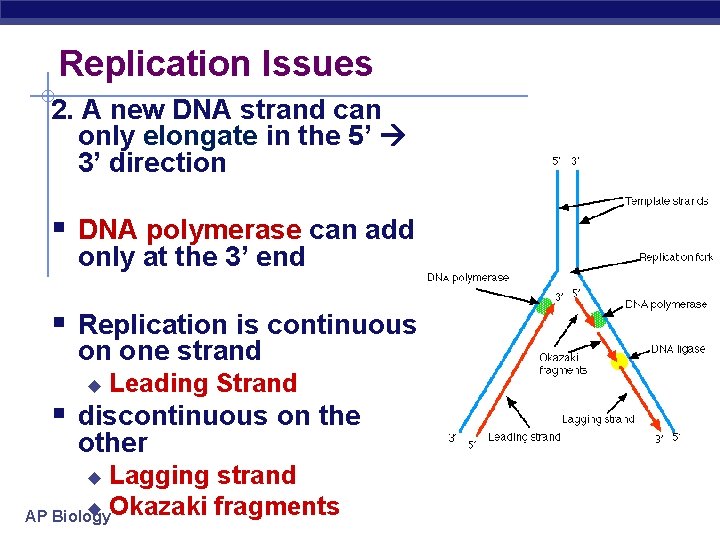
Replication Issues 2. A new DNA strand can only elongate in the 5’ 3’ direction § DNA polymerase can add only at the 3’ end § Replication is continuous on one strand u Leading Strand § discontinuous on the other Lagging strand u Okazaki fragments AP Biology u
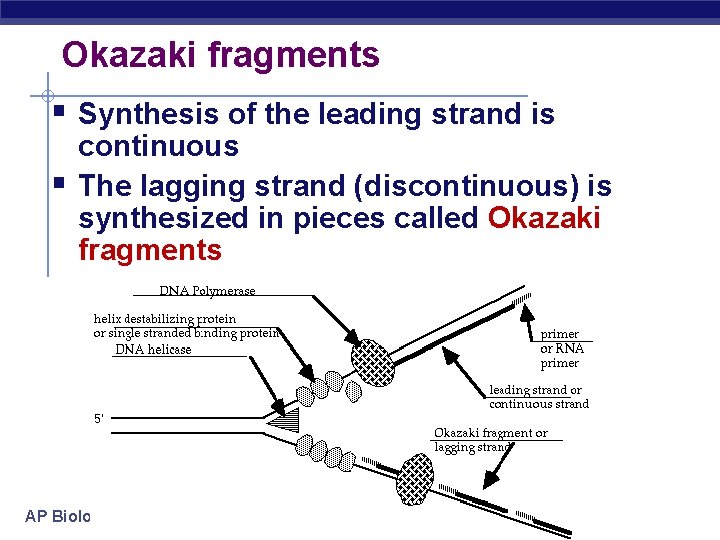
Okazaki fragments § Synthesis of the leading strand is § continuous The lagging strand (discontinuous) is synthesized in pieces called Okazaki fragments AP Biology
AP Biology
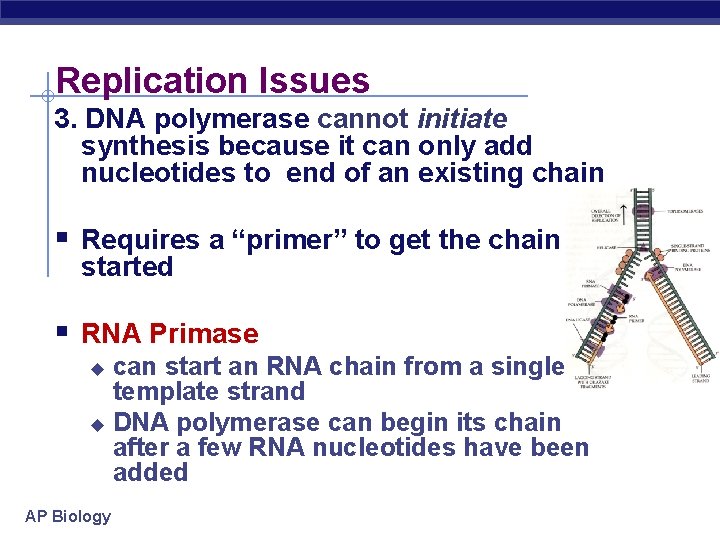
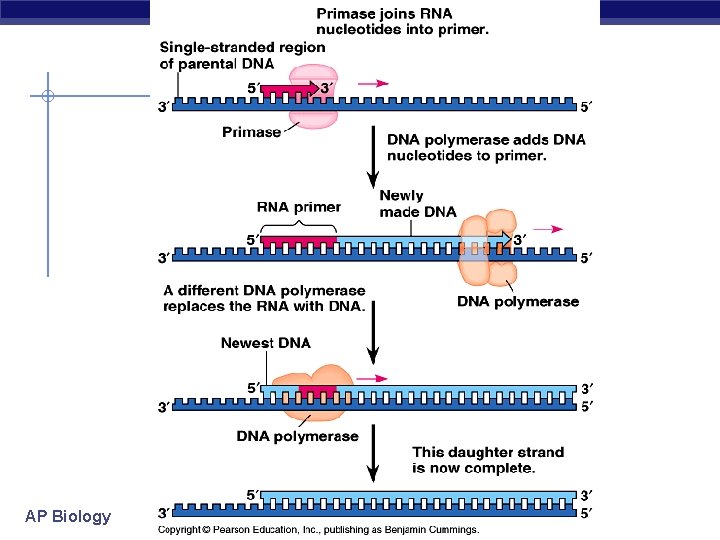
Replication Issues 3. DNA polymerase cannot initiate synthesis because it can only add nucleotides to end of an existing chain § Requires a “primer” to get the chain started § RNA Primase can start an RNA chain from a single template strand u DNA polymerase can begin its chain after a few RNA nucleotides have been added u AP Biology
AP Biology
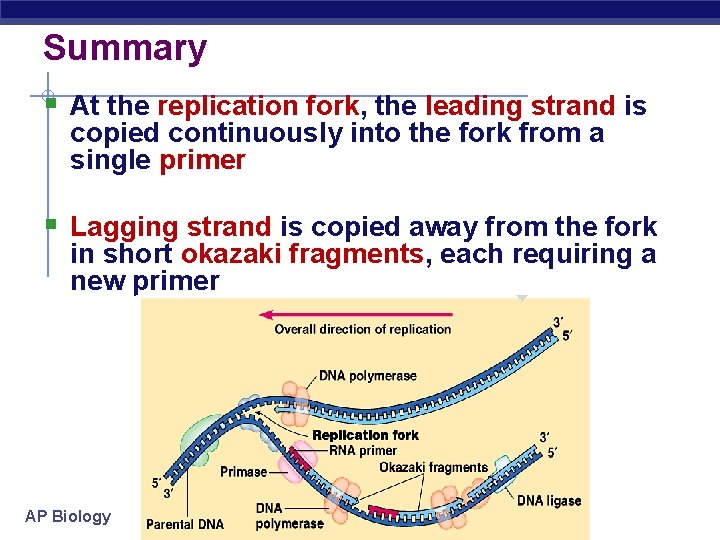
Summary § At the replication fork, the leading strand is copied continuously into the fork from a single primer § Lagging strand is copied away from the fork in short okazaki fragments, each requiring a new primer AP Biology
AP Biology
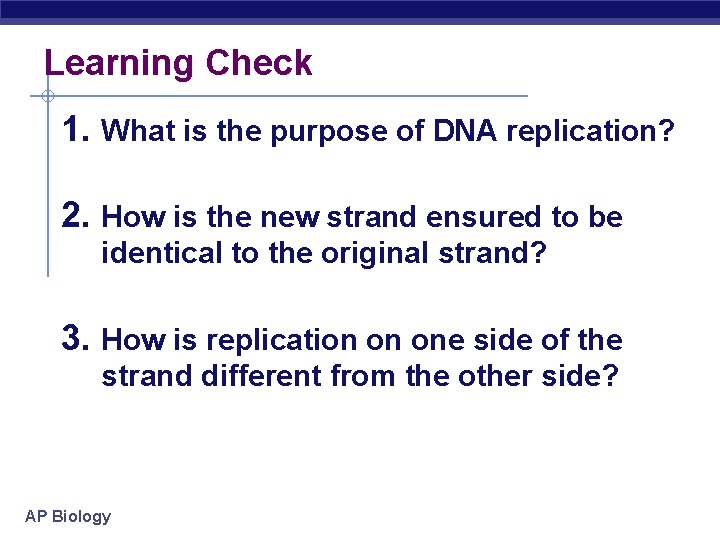
Learning Check 1. What is the purpose of DNA replication? 2. How is the new strand ensured to be identical to the original strand? 3. How is replication on one side of the strand different from the other side? AP Biology
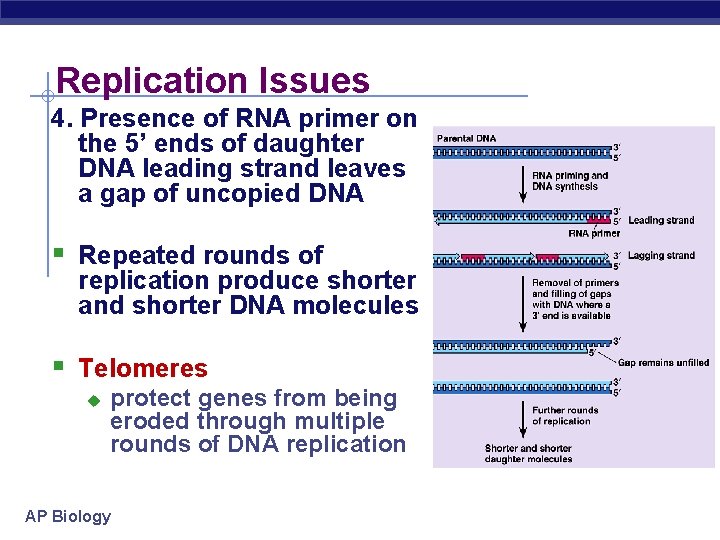
Replication Issues 4. Presence of RNA primer on the 5’ ends of daughter DNA leading strand leaves a gap of uncopied DNA § Repeated rounds of replication produce shorter and shorter DNA molecules § Telomeres u protect genes from being eroded through multiple rounds of DNA replication AP Biology
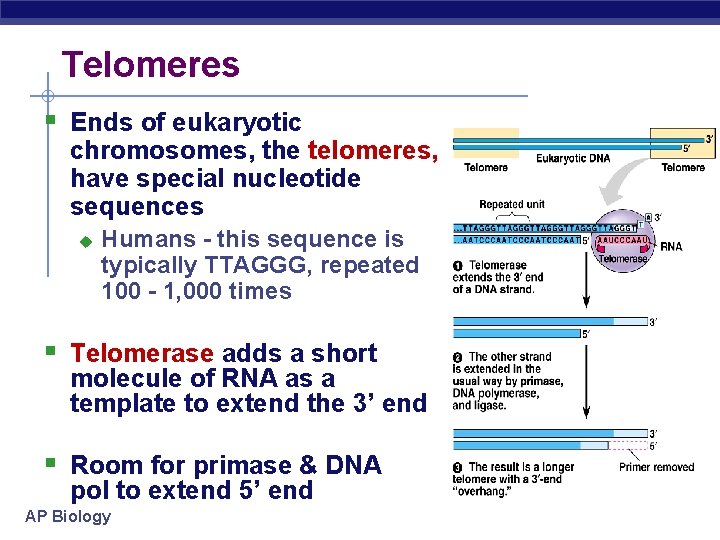
Telomeres § Ends of eukaryotic chromosomes, the telomeres, have special nucleotide sequences u Humans - this sequence is typically TTAGGG, repeated 100 - 1, 000 times § Telomerase adds a short molecule of RNA as a template to extend the 3’ end § Room for primase & DNA pol to extend 5’ end AP Biology
Summary § Explain how the cell overcomes each of the following issues in DNA replication 1. 2. 3. 4. AP Biology DNA strands must be unwound during replication A new DNA strand can only elongate in the 5’ 3’ direction DNA polymerase cannot initiate synthesis and can only add nucleotides to end of an existing chain Presence of RNA primer on the 5’ ends of daughter DNA leading strand leaves a gap of uncopied DNA
- Slides: 33