
g Sparsify Graph Motif Based Sparsification for Graph
g. Sparsify: Graph Motif Based Sparsification for Graph Clustering Peixiang Zhao Department of Computer Science Florida State University zhao@cs. fsu. edu Melbourne, Australia, Oct. , 2015
Synopsis • Introduction • g. Sparsify: Graph motif based sparsification – Cluster significance – Path-based indexing and computation • Experiments • Conclusions 1 / 18
Introduction • Graphs: – A generic model and ubiquitous abstraction for correlated/inter-connected data – Examples: social networks, bioinformatics, business intelligence, scientific computation, and the Web • Graph Clusterings: – Partition vertices of a graph into a series of clusters with an objective to optimizing • Intra-cluster density • Inter-cluster sparsity – Applications: community detection, visualization, ranking, and search 2 / 18
Challenges and Graph Sparsification Solutions • Existing Challenges 1. Real-world graphs are massive in scale • Many graph clustering solutions are hard to scale in large graphs 2. Real-world graphs are “dirty” • There exist many extremely tangled, noisy edges that easily obfuscate intrinsic cluster properties of graphs • Graph sparsification – Simplify (Reduce) the input graph G (V, E) into another graph G’(V, E’) where |E’| << |E| • Noisy edges eliminated while crucial structures of graphs well preserved 3 / 18

Sparsification Based Graph Clustering Graph Sparsification Graph Clustering Algorithm A Graph Clusters C Verification More Efficient! Graph Clusters C “ 4 / 18
Wait. Technical Questions Arise Here • Graph Sparsification for graph clustering 1. How can we differentiate “significant” edges from “insignificant” ones? 2. How to quantify and compute such “edge importance” efficiently? 3. How to sparsify the graph? 4. Can the resultant spasified graph G’ still preserve the clustering properties (and to what extent) of the original graph G? 5 / 18
g. Sparsify • Goal – Sparsify G in a way that cluster-significant edges are retained, while edges with little or no clustering insight are filtered • Ideas – Structure-aware graph motif based cluster significance – Path-based indexing for short-length cycle motif enumeration • Results – An effective preprocessing step for existing graph clustering techniques – Significant speedup with no comprise for clustering quality 6 / 18
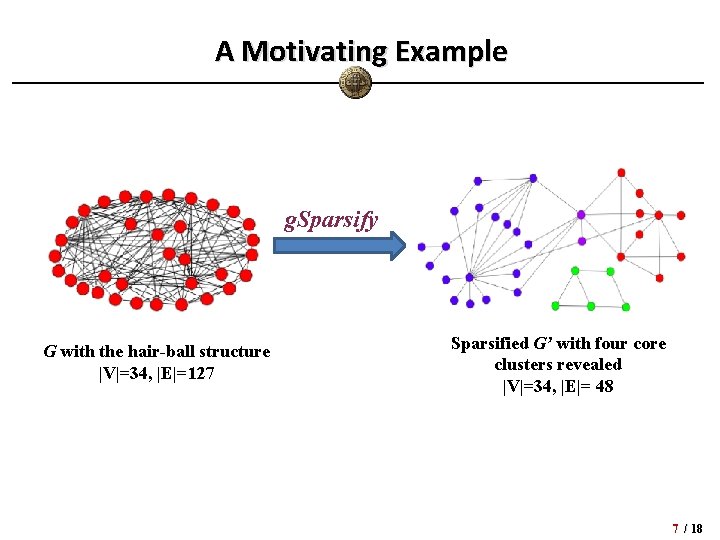
A Motivating Example g. Sparsify G with the hair-ball structure |V|=34, |E|=127 Sparsified G’ with four core clusters revealed |V|=34, |E|= 48 7 / 18

Graph Motifs: What and Why • Graph Motifs – Small, connected graphs encoding local graph structures – Elementary features representing key structure-aware functionalities of graphs 8 / 18

Graph Motifs: What and Why • Evidence: Clusters are oftentimes dense subgraphs involving many small-size graph motifs like cycles 1. An intra-cluster edge is more likely to be located within closed motifs (cycles) than inter-cluster edges 2. Cycles are simplest position-insensitive motifs, and thus easier to be enumerated and quantified 3. Many complex motifs are simply composed by cycles • We use cycle motifs to quantify the “significance” of edges in terms of graph clustering 9 / 18

Cluster Significance • We quantify the cluster significance of an edge e in terms of basic cycle motifs 1. Count-based significance The number of cycles of length l encompassing e 2. (Normalized) Ratio-based significance The number of paths of length l penetrating e – For l ≤ l 0, we aggregate cluster significance scores of e in order to quantify how often e is involved in a series of cycle motifs • The higher the cluster significance scores of e, the more likely e is an intra-cluster edge! 10/ 18
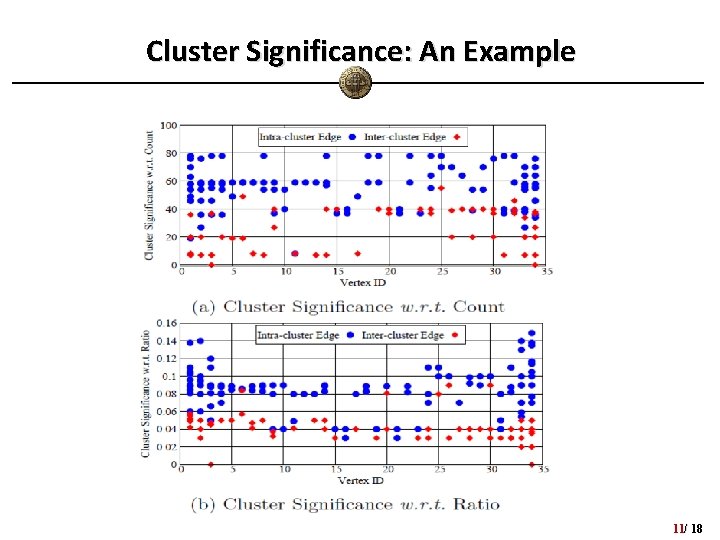
Cluster Significance: An Example 11/ 18
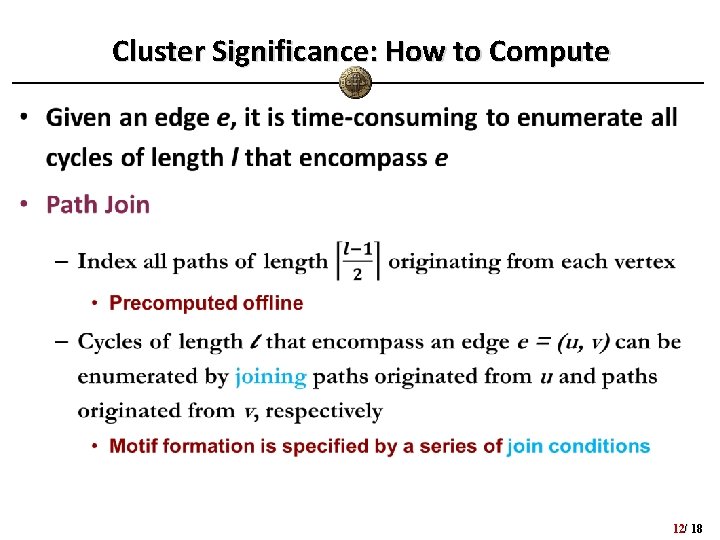
Cluster Significance: How to Compute • 12/ 18

Cluster Significance: How to Compute Three cycles of length 4 encompassing v) of length 5 encompassing (u, v) Seven(u, cycles 13/ 18
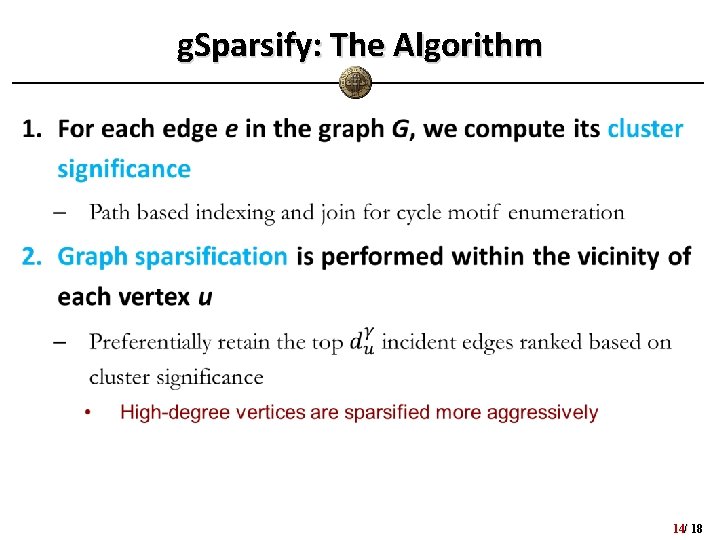
g. Sparsify: The Algorithm • 14/ 18

Experiments • Datasets – Yeast PPI network, DBLP, Orkut • Graph Clustering Methods – METIS, Graclus, MCL • Evaluation Metric 1. Sparsification ratio 2. Clustering quality (F-score, graph conductance) 3. Speedup for graph clustering • In comparison with L-Spar – Satuluri etc. in SIGMOD’ 11 (triangle motif with Min. Hash) 15/ 18
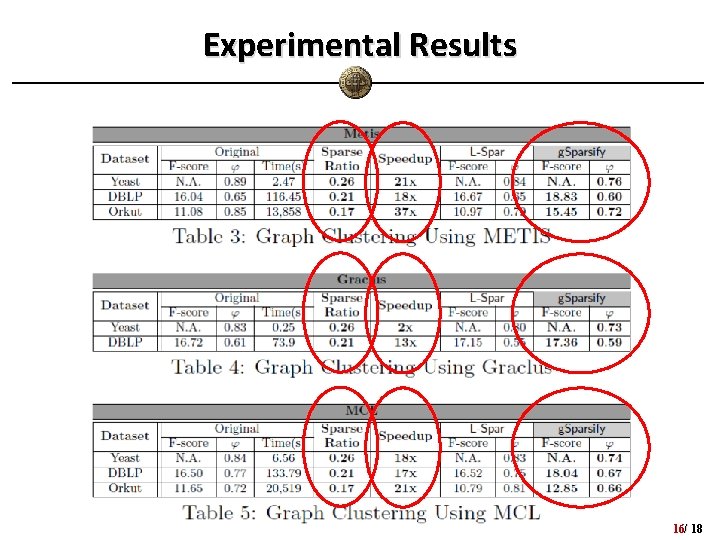
Experimental Results 16/ 18
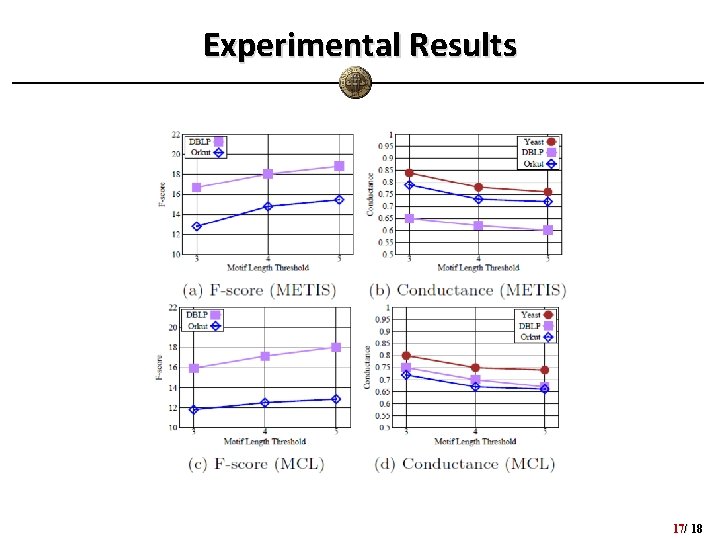
Experimental Results 17/ 18
Conclusions • Graph sparsification – Identify and preferentially retain cluster significant edges from a graph G into a sparsified graph G’ • Graph motif based cluster significance – Short-length cycles to quantify structure significance – Path based indexing and join to facilitate the computation • Future directions 1. More efficient graph motif enumeration methods 2. More complicated graph motifs 3. Sparsification for other graph computational tasks 18/ 18

Thank you! Q&A / 18
- Slides: 20