
G P S The Global Position System Miles
G. P. S. The Global Position System Miles Logsdon, College of Ocean and Fishery Sciences Phil Hurvitz, College of Forest Resouces 1
Basic Concepts z. GPS y. U. S. government y. NAVigation System with Time And Ranging – NAVSTAR • 24 satellites y. Russian syste x. GLONASS 2
Geography z. Location yindex space: coordinates x. Latitude-longitude x. UTM yabsolute v’s relative coordinates x 121 33’ 12” x 47 24’ 15” = absolute x 120 km east and 40 km north of Seattle 3
Position v’s Location z. Position : GPS ycoordinates that specify “where” z. Location: maps y“where” with respect to know objects 4
Why use GPS (1) z. Availability: y 1995, Do. D NAVSTAR, civilian use foreseeable future z. Accuracy: Factors ywork with “primary” data sources y. High inherent accuracy (2. 5 m medium-quality properly corrected receiver) y. Time Corrected to 1/1 billionth of a second 5
Why use GPS (2) z. Ease of use ystop and read a single coordinate = 20 m accuracy (+/- 5 m) real-time z 3 -D data yhorizontal (x & y) and altitude (z) yvariances in z = horizontal * 2 6
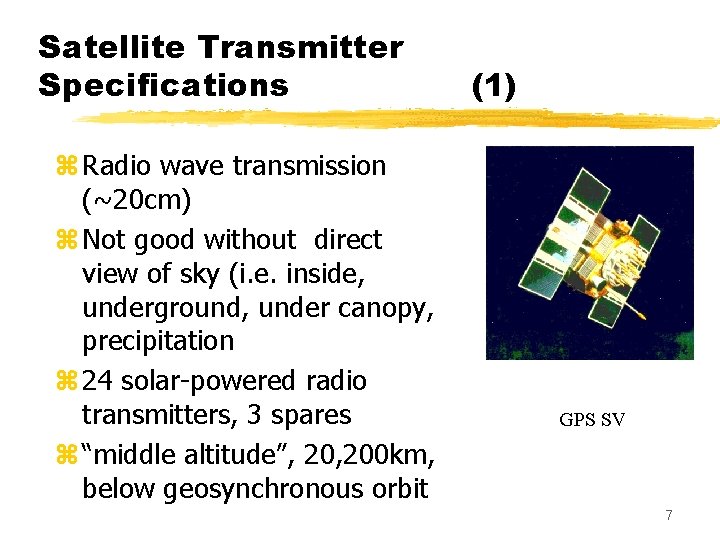
Satellite Transmitter Specifications z Radio wave transmission (~20 cm) z Not good without direct view of sky (i. e. inside, underground, under canopy, precipitation z 24 solar-powered radio transmitters, 3 spares z “middle altitude”, 200 km, below geosynchronous orbit (1) GPS SV 7
Satellite Transmitter Specifications (2) z Neither polar nor equatorial z each execute a single 12 hour orbit z 4 satellites in each of 6 orbital planes z speed of 3. 87 km/sec ( 8, 653 mph) z weigh ~ 1 ton with 27 feet of solar panels z Orbit tacks monitored by 4 base stations y. Master control station in Colorado Springs z Each satellite monitored twice a day 8
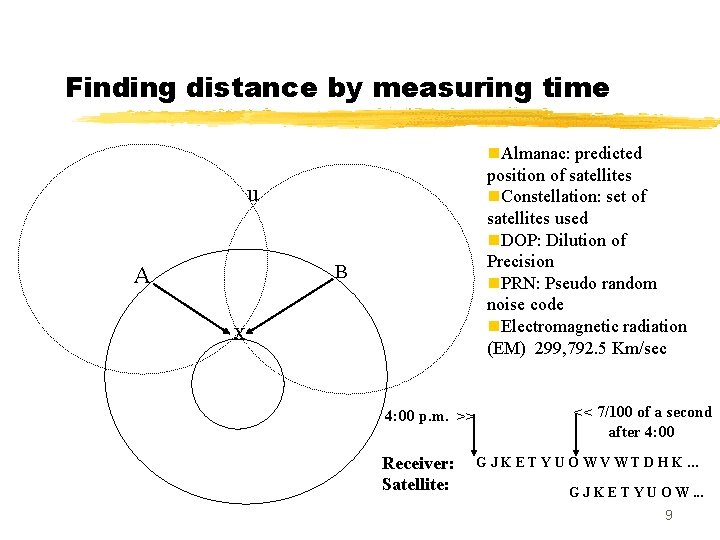
Finding distance by measuring time n. Almanac: predicted position of satellites n. Constellation: set of satellites used n. DOP: Dilution of Precision n. PRN: Pseudo random noise code n. Electromagnetic radiation (EM) 299, 792. 5 Km/sec u B A X 4: 00 p. m. >> Receiver: Satellite: << 7/100 of a second after 4: 00 GJKETYUOWVWTDHK… G J K E T Y U O W. . . 9
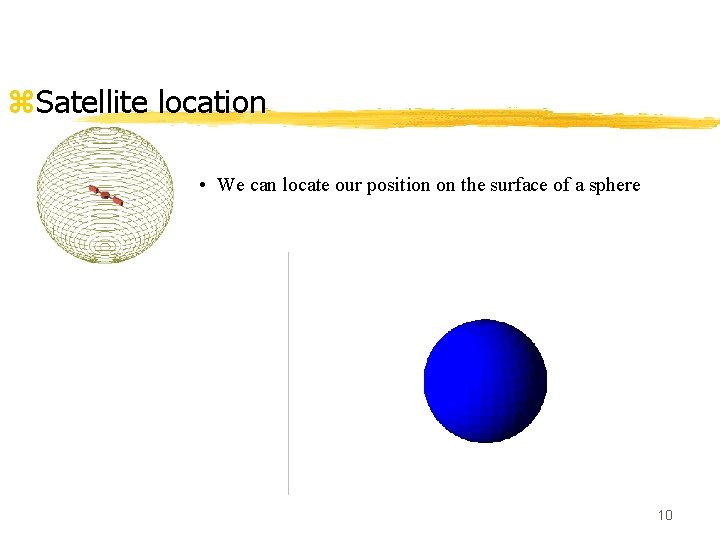
z. Satellite location • Given 1 satellite … • We can locate our position on the surface of a sphere 10
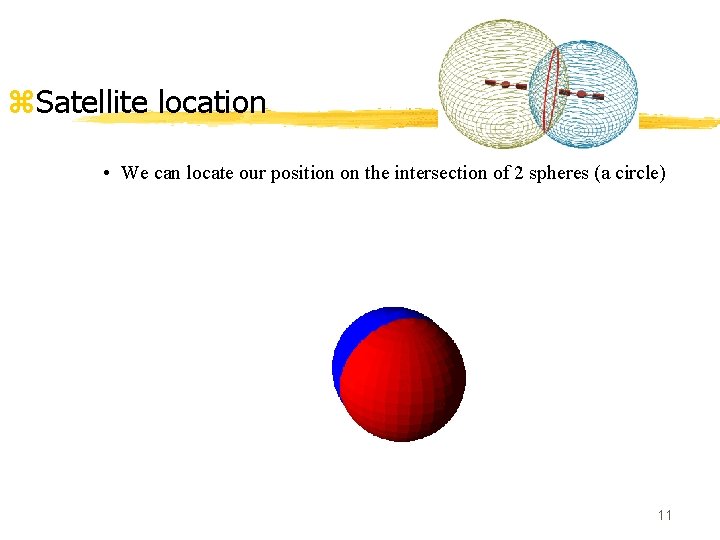
z. Satellite location • Given satellites We can 2 locate our… position on the intersection of 2 spheres (a circle) 11
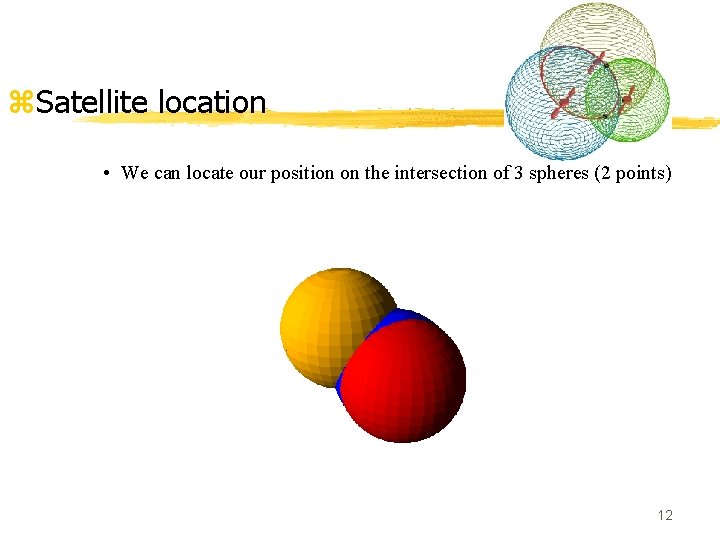
z. Satellite location • Given satellites We can 3 locate our… position on the intersection of 3 spheres (2 points) 12
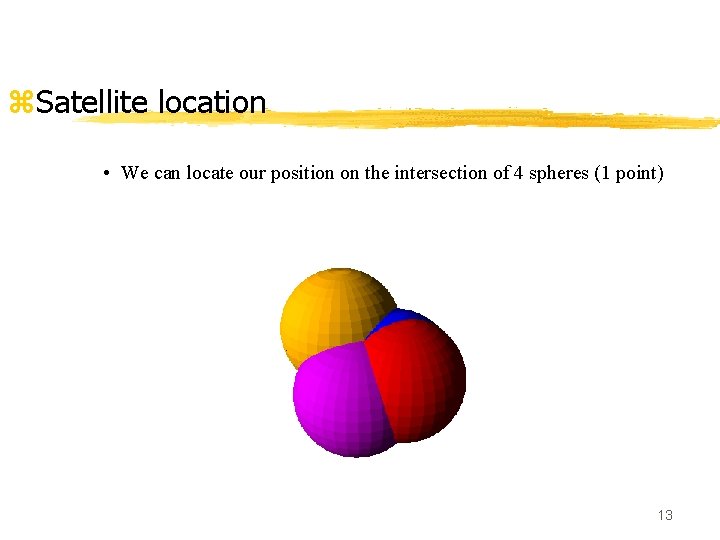
z. Satellite location • Given satellites We can 4 locate our… position on the intersection of 4 spheres (1 point) 13
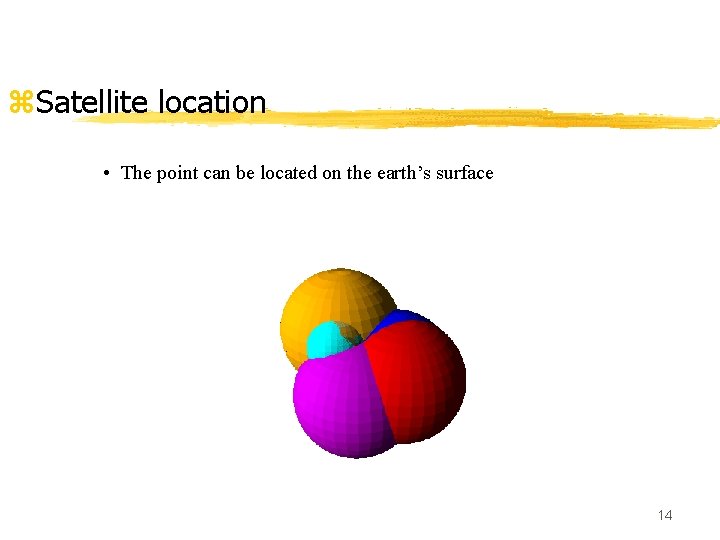
z. Satellite location • The point can be located on the earth’s surface 14
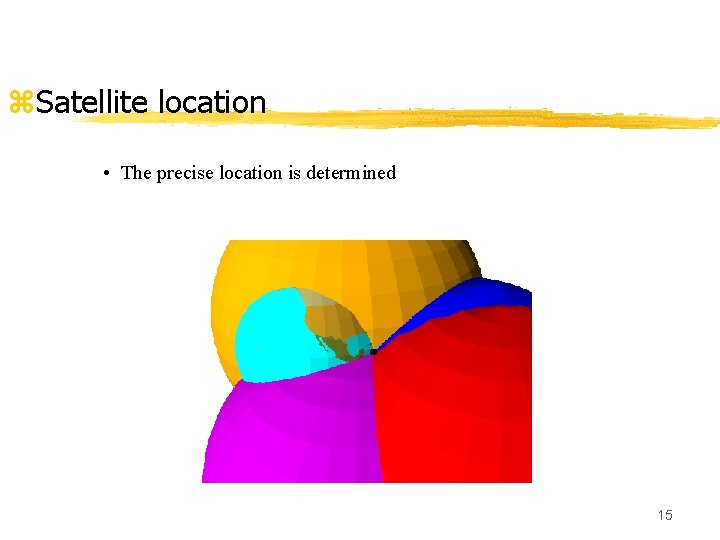
z. Satellite location • The precise location is determined 15
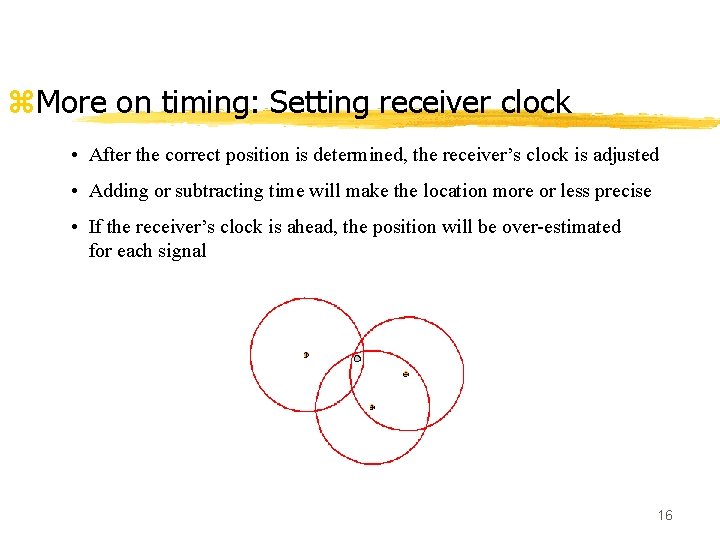
z. More on timing: Setting receiver clock • After the correct position is determined, the receiver’s clock is adjusted • Adding or subtracting time will make the location more or less precise • If the receiver’s clock is ahead, the position will be over-estimated for each signal 16
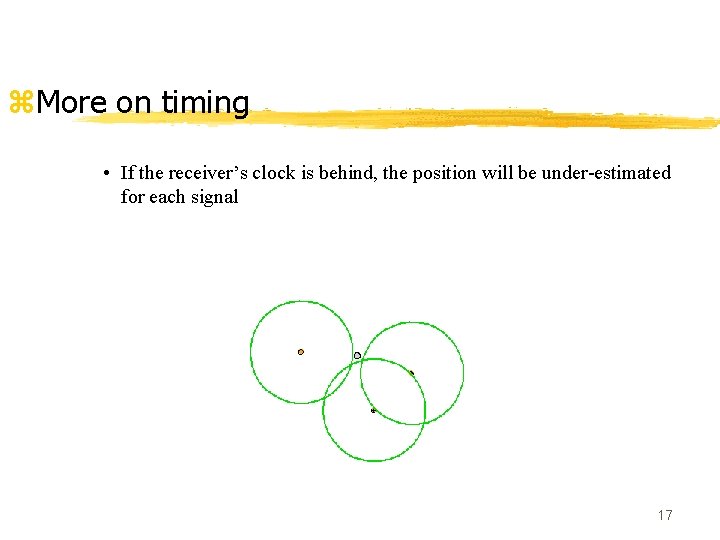
z. More on timing • If the receiver’s clock is behind, the position will be under-estimated for each signal 17
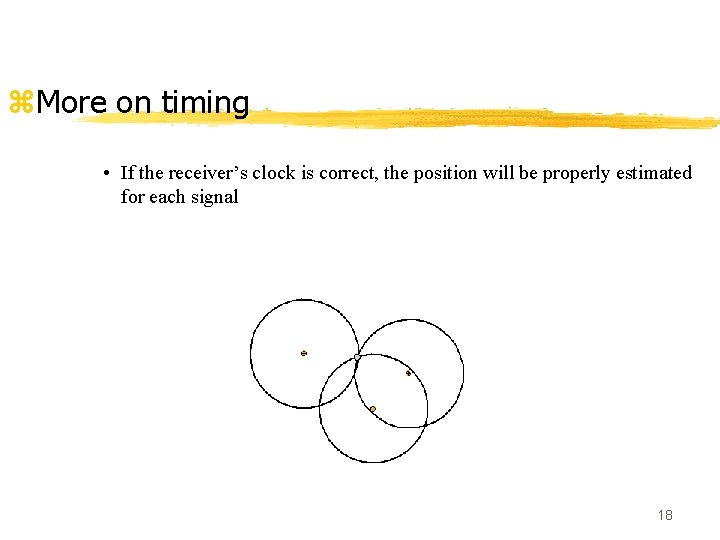
z. More on timing • If the receiver’s clock is correct, the position will be properly estimated for each signal 18
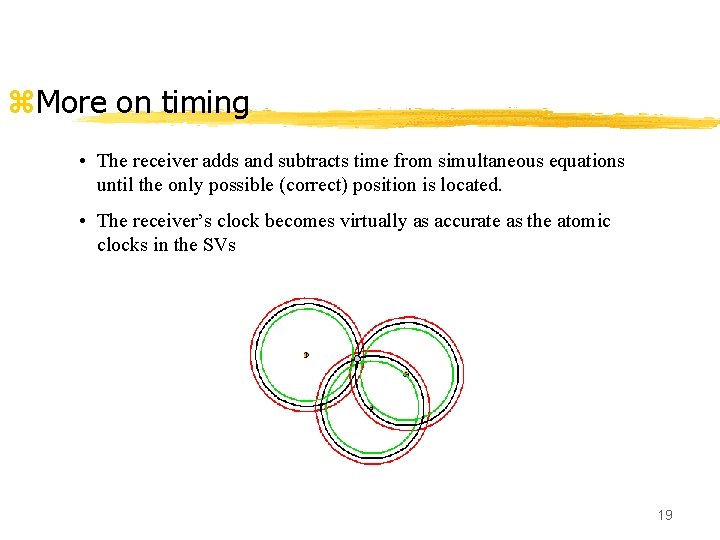
z. More on timing • The receiver adds and subtracts time from simultaneous equations until the only possible (correct) position is located. • The receiver’s clock becomes virtually as accurate as the atomic clocks in the SVs 19
z. Sources of error: Dilution of precision (DOP) • The best spread of satellites makes the best trilateration • We want low DOP • Satellites that are close to each other result in higher DOP: • • • HDOP: horizontal DOP VDOP: vertical DOP PDOP: positional DOP (combination of HDOP & VDOP) TDOP: time DOP GDOP: geometric DOP (combination of PDOP & TDOP) 20
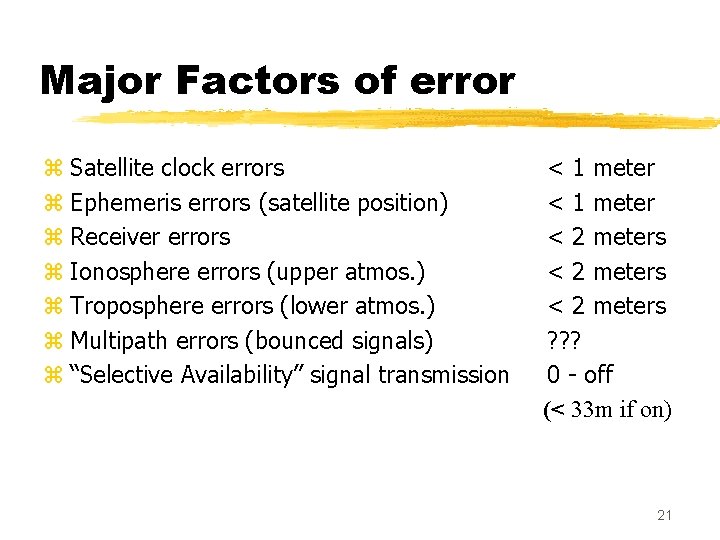
Major Factors of error z Satellite clock errors z Ephemeris errors (satellite position) z Receiver errors z Ionosphere errors (upper atmos. ) z Troposphere errors (lower atmos. ) z Multipath errors (bounced signals) z “Selective Availability” signal transmission < 1 meter < 2 meters ? ? ? 0 - off (< 33 m if on) 21
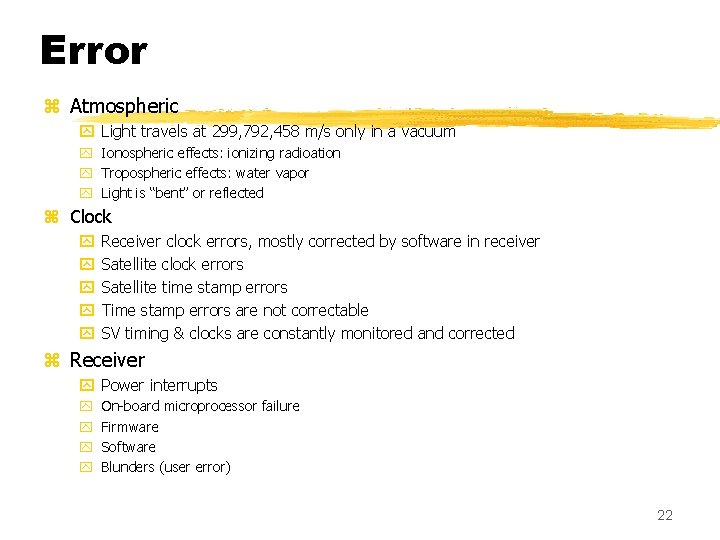
Error z Atmospheric y Light travels at 299, 792, 458 m/s only in a vacuum y Ionospheric effects: ionizing radioation y Tropospheric effects: water vapor y Light is “bent” or reflected z Clock y y y Receiver clock errors, mostly corrected by software in receiver Satellite clock errors Satellite time stamp errors Time stamp errors are not correctable SV timing & clocks are constantly monitored and corrected z Receiver y Power interrupts y y On-board microprocessor failure Firmware Software Blunders (user error) 22
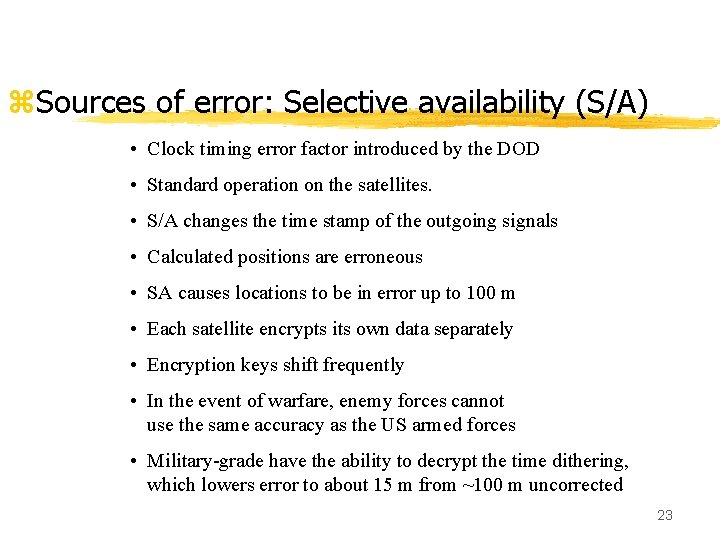
z. Sources of error: Selective availability (S/A) • Clock timing error factor introduced by the DOD • Standard operation on the satellites. • S/A changes the time stamp of the outgoing signals • Calculated positions are erroneous • SA causes locations to be in error up to 100 m • Each satellite encrypts its own data separately • Encryption keys shift frequently • In the event of warfare, enemy forces cannot use the same accuracy as the US armed forces • Military-grade have the ability to decrypt the time dithering, which lowers error to about 15 m from ~100 m uncorrected 23
Recording Data z 180 fixes needed for maximum accuracy for a receiver and constellations z 1 fix every 3 seconds z. You’ll need ~ 9 minutes 24
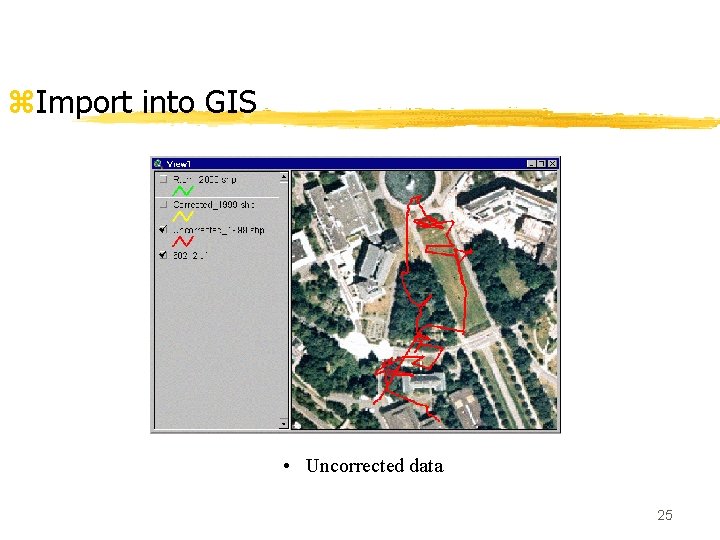
z. Import into GIS • Uncorrected data 25
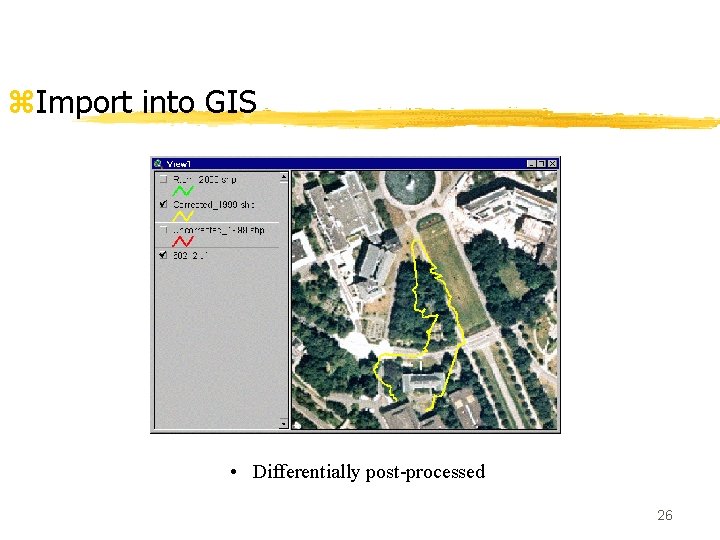
z. Import into GIS • Differentially post-processed 26
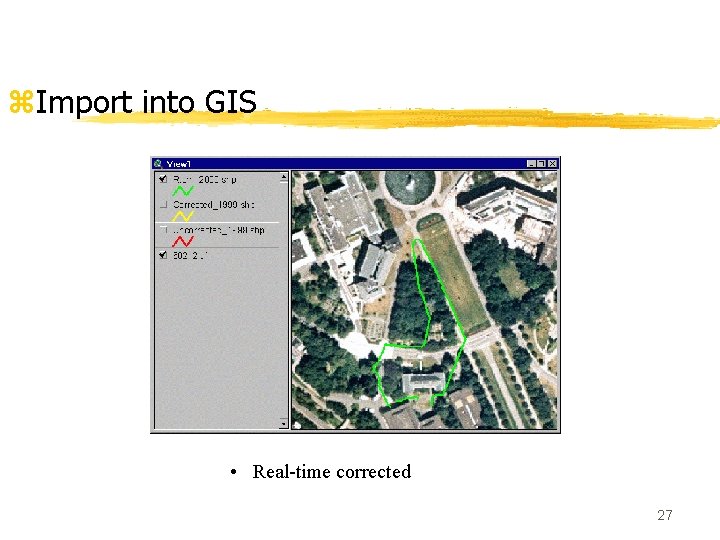
z. Import into GIS • Real-time corrected 27
- Slides: 27