
G 8 SIGNALS AND EMISSIONS 2 exam questions
![G 8 - SIGNALS AND EMISSIONS [2 exam questions - 2 groups] G 8](https://slidetodoc.com/presentation_image_h/1bd9c616de9e528111d1adc9580736b5/image-1.jpg "G 8 - SIGNALS AND EMISSIONS [2 exam questions - 2 groups] G 8")
![G 8 - SIGNALS AND EMISSIONS [2 exam questions - 2 groups] 54 Signals](https://slidetodoc.com/presentation_image_h/1bd9c616de9e528111d1adc9580736b5/image-54.jpg "G 8 - SIGNALS AND EMISSIONS [2 exam questions - 2 groups] 54 Signals")
- Slides: 54
G 8 - SIGNALS AND EMISSIONS [2 exam questions - 2 groups] G 8 A - Carriers and modulation: AM; FM; single and double sideband; modulation envelope; overmodulation G 8 B - Frequency mixing; multiplication; HF data communications; bandwidths of various modes; deviation 1 Signals and Emissions
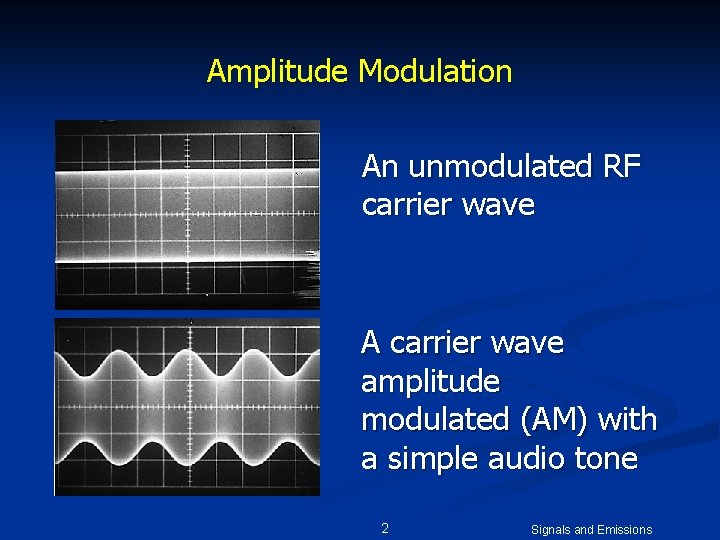
Amplitude Modulation An unmodulated RF carrier wave A carrier wave amplitude modulated (AM) with a simple audio tone 2 Signals and Emissions
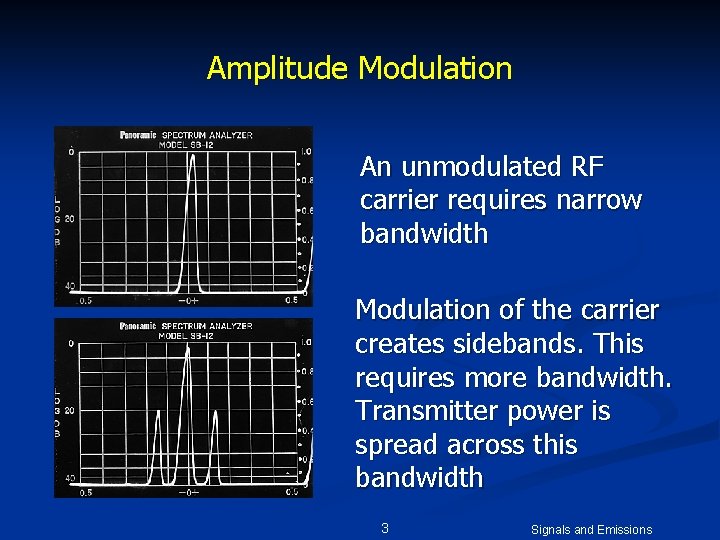
Amplitude Modulation An unmodulated RF carrier requires narrow bandwidth Modulation of the carrier creates sidebands. This requires more bandwidth. Transmitter power is spread across this bandwidth 3 Signals and Emissions
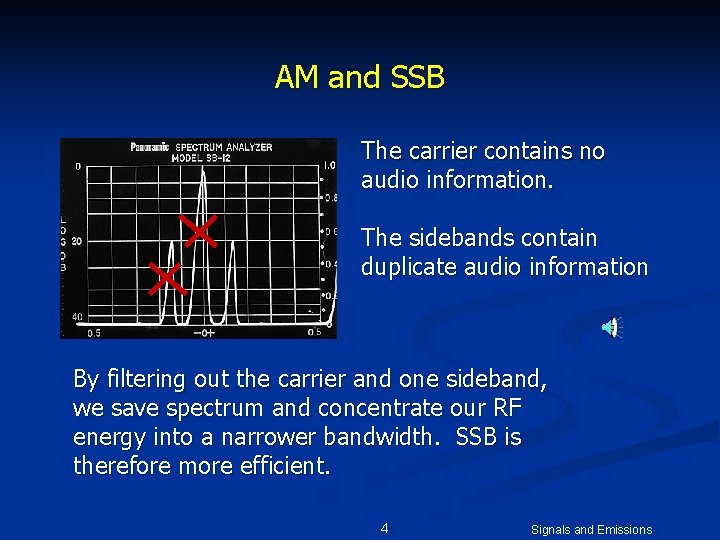
AM and SSB The carrier contains no audio information. The sidebands contain duplicate audio information By filtering out the carrier and one sideband, we save spectrum and concentrate our RF energy into a narrower bandwidth. SSB is therefore more efficient. 4 Signals and Emissions
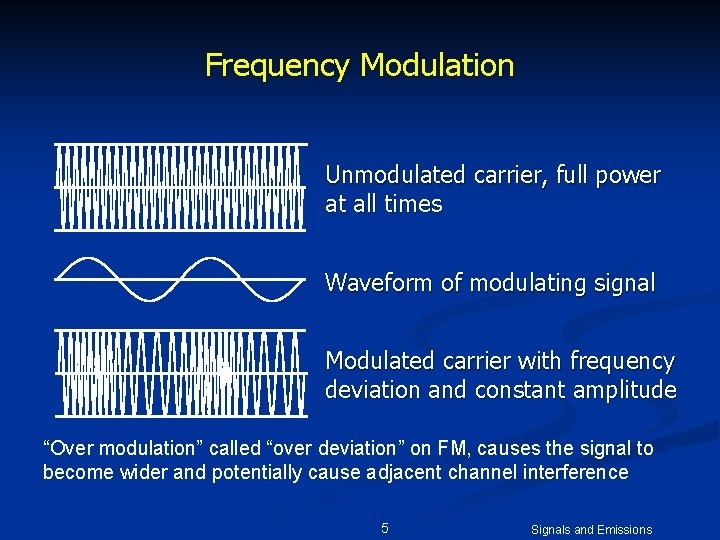
Frequency Modulation Unmodulated carrier, full power at all times Waveform of modulating signal Modulated carrier with frequency deviation and constant amplitude “Over modulation” called “over deviation” on FM, causes the signal to become wider and potentially cause adjacent channel interference 5 Signals and Emissions
G 8 A 01 What is the name of the process that changes the envelope of an RF wave to carry information? A. Phase modulation B. Frequency modulation C. Spread spectrum modulation D. Amplitude modulation
G 8 A 01 What is the name of the process that changes the envelope of an RF wave to carry information? A. Phase modulation B. Frequency modulation C. Spread spectrum modulation D. Amplitude modulation
G 8 A 02 What is the name of the process that changes the phase angle of an RF wave to convey information? A. Phase convolution B. Phase modulation C. Angle convolution D. Radian inversion
G 8 A 02 What is the name of the process that changes the phase angle of an RF wave to convey information? A. Phase convolution B. Phase modulation C. Angle convolution D. Radian inversion
G 8 A 03 What is the name of the process which changes the frequency of an RF wave to convey information? A. Frequency convolution B. Frequency transformation C. Frequency conversion D. Frequency modulation
G 8 A 03 What is the name of the process which changes the frequency of an RF wave to convey information? A. Frequency convolution B. Frequency transformation C. Frequency conversion D. Frequency modulation
G 8 A 04 What emission is produced by a reactance modulator connected to an RF power amplifier? A. Multiplex modulation B. Phase modulation C. Amplitude modulation D. Pulse modulation
G 8 A 04 What emission is produced by a reactance modulator connected to an RF power amplifier? A. Multiplex modulation B. Phase modulation C. Amplitude modulation D. Pulse modulation
G 8 A 05 What type of modulation varies the instantaneous power level of the RF signal? A. Frequency shift keying B. Pulse position modulation C. Frequency modulation D. Amplitude modulation
G 8 A 05 What type of modulation varies the instantaneous power level of the RF signal? A. Frequency shift keying B. Pulse position modulation C. Frequency modulation D. Amplitude modulation
G 8 A 06 What is one advantage of carrier suppression in a single-sideband phone transmission? A. Audio fidelity is improved B. Greater modulation percentage is obtainable with lower distortion C. The available transmitter power can be used more effectively D. Simpler receiving equipment can be used
G 8 A 06 What is one advantage of carrier suppression in a single-sideband phone transmission? A. Audio fidelity is improved B. Greater modulation percentage is obtainable with lower distortion C. The available transmitter power can be used more effectively D. Simpler receiving equipment can be used
G 8 A 07 Which of the following phone emissions uses the narrowest frequency bandwidth? A. Single sideband B. Double sideband C. Phase modulation D. Frequency modulation
G 8 A 07 Which of the following phone emissions uses the narrowest frequency bandwidth? A. Single sideband B. Double sideband C. Phase modulation D. Frequency modulation
G 8 A 08 Which of the following is an effect of over-modulation? A. Insufficient audio B. Insufficient bandwidth C. Frequency drift D. Excessive bandwidth
G 8 A 08 Which of the following is an effect of over-modulation? A. Insufficient audio B. Insufficient bandwidth C. Frequency drift D. Excessive bandwidth
G 8 A 09 What control is typically adjusted for proper ALC setting on an amateur single sideband transceiver? A. The RF clipping level B. Transmit audio or microphone gain C. Antenna inductance or capacitance D. Attenuator level
G 8 A 09 What control is typically adjusted for proper ALC setting on an amateur single sideband transceiver? A. The RF clipping level B. Transmit audio or microphone gain C. Antenna inductance or capacitance D. Attenuator level
G 8 A 10 What is meant by flat-topping of a single -sideband phone transmission? A. Signal distortion caused by insufficient collector current B. The transmitter's automatic level control is properly adjusted C. Signal distortion caused by excessive drive D. The transmitter's carrier is properly suppressed
G 8 A 10 What is meant by flat-topping of a single -sideband phone transmission? A. Signal distortion caused by insufficient collector current B. The transmitter's automatic level control is properly adjusted C. Signal distortion caused by excessive drive D. The transmitter's carrier is properly suppressed
G 8 A 11 What happens to the RF carrier signal when a modulating audio signal is applied to an FM transmitter? A. The carrier frequency changes proportionally to the instantaneous amplitude of the modulating signal B. The carrier frequency changes proportionally to the amplitude and frequency of the modulating signal C. The carrier amplitude changes proportionally to the instantaneous frequency of the modulating signal D. The carrier phase changes proportionally to the instantaneous amplitude of the modulating signal
G 8 A 11 What happens to the RF carrier signal when a modulating audio signal is applied to an FM transmitter? A. The carrier frequency changes proportionally to the instantaneous amplitude of the modulating signal B. The carrier frequency changes proportionally to the amplitude and frequency of the modulating signal C. The carrier amplitude changes proportionally to the instantaneous frequency of the modulating signal D. The carrier phase changes proportionally to the instantaneous amplitude of the modulating signal
G 8 A 12 What signal(s) would be found at the output of a properly adjusted balanced modulator? A. Both upper and lower sidebands B. Either upper or lower sideband, but not both C. Both upper and lower sidebands and the carrier D. The modulating signal and the unmodulated carrier
G 8 A 12 What signal(s) would be found at the output of a properly adjusted balanced modulator? A. Both upper and lower sidebands B. Either upper or lower sideband, but not both C. Both upper and lower sidebands and the carrier D. The modulating signal and the unmodulated carrier
G 8 B 01 What receiver stage combines a 14. 250 MHz input signal with a 13. 795 MHz oscillator signal to produce a 455 k. Hz intermediate frequency (IF) signal? A. Mixer B. BFO C. VFO D. Discriminator
G 8 B 01 What receiver stage combines a 14. 250 MHz input signal with a 13. 795 MHz oscillator signal to produce a 455 k. Hz intermediate frequency (IF) signal? A. Mixer B. BFO C. VFO D. Discriminator
G 8 B 02 If a receiver mixes a 13. 800 MHz VFO with a 14. 255 MHz received signal to produce a 455 k. Hz intermediate frequency (IF) signal, what type of interference will a 13. 345 MHz signal produce in the receiver? A. Quadrature noise B. Image response C. Mixer interference D. Intermediate interference
G 8 B 02 If a receiver mixes a 13. 800 MHz VFO with a 14. 255 MHz received signal to produce a 455 k. Hz intermediate frequency (IF) signal, what type of interference will a 13. 345 MHz signal produce in the receiver? A. Quadrature noise B. Image response C. Mixer interference D. Intermediate interference
G 8 B 03 What is another term for the mixing of two RF signals? A. Heterodyning B. Synthesizing C. Cancellation D. Phase inverting
G 8 B 03 What is another term for the mixing of two RF signals? A. Heterodyning B. Synthesizing C. Cancellation D. Phase inverting
G 8 B 04 What is the name of the stage in a VHF FM transmitter that generates a harmonic of a lower frequency signal to reach the desired operating frequency? A. Mixer B. Reactance modulator C. Pre-emphasis network D. Multiplier
G 8 B 04 What is the name of the stage in a VHF FM transmitter that generates a harmonic of a lower frequency signal to reach the desired operating frequency? A. Mixer B. Reactance modulator C. Pre-emphasis network D. Multiplier
G 8 B 05 Why isn't frequency modulated (FM) phone used below 29. 5 MHz? A. The transmitter efficiency for this mode is low B. Harmonics could not be attenuated to practical levels C. The wide bandwidth is prohibited by FCC rules D. The frequency stability would not be adequate
G 8 B 05 Why isn't frequency modulated (FM) phone used below 29. 5 MHz? A. The transmitter efficiency for this mode is low B. Harmonics could not be attenuated to practical levels C. The wide bandwidth is prohibited by FCC rules D. The frequency stability would not be adequate
G 8 B 06 What is the total bandwidth of an FMphone transmission having a 5 k. Hz deviation and a 3 k. Hz modulating frequency? A. 3 k. Hz B. 5 k. Hz C. 8 k. Hz D. 16 k. Hz
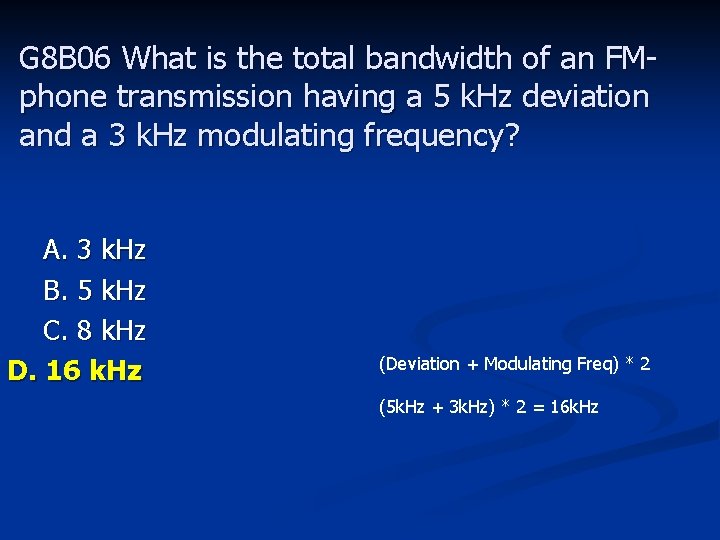
G 8 B 06 What is the total bandwidth of an FMphone transmission having a 5 k. Hz deviation and a 3 k. Hz modulating frequency? A. 3 k. Hz B. 5 k. Hz C. 8 k. Hz D. 16 k. Hz (Deviation + Modulating Freq) * 2 (5 k. Hz + 3 k. Hz) * 2 = 16 k. Hz
G 8 B 07 What is the frequency deviation for a 12. 21 -MHz reactance-modulated oscillator in a 5 -k. Hz deviation, 146. 52 -MHz FM-phone transmitter? A. 101. 75 Hz B. 416. 7 Hz C. 5 k. Hz D. 60 k. Hz
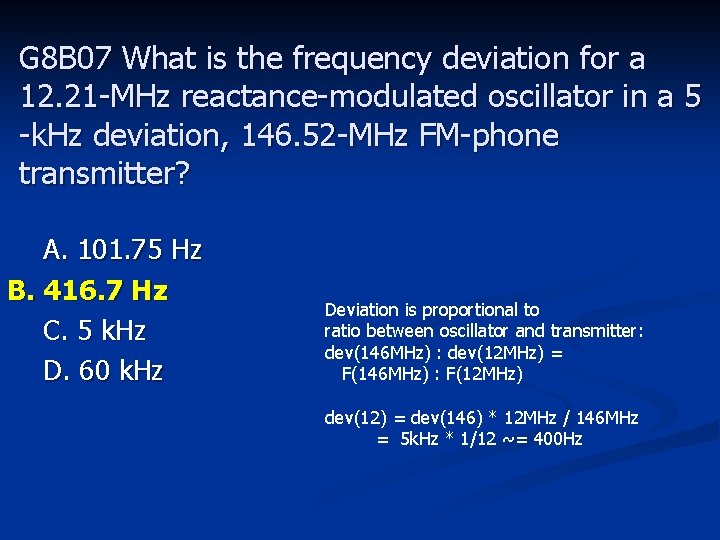
G 8 B 07 What is the frequency deviation for a 12. 21 -MHz reactance-modulated oscillator in a 5 -k. Hz deviation, 146. 52 -MHz FM-phone transmitter? A. 101. 75 Hz B. 416. 7 Hz C. 5 k. Hz D. 60 k. Hz Deviation is proportional to ratio between oscillator and transmitter: dev(146 MHz) : dev(12 MHz) = F(146 MHz) : F(12 MHz) dev(12) = dev(146) * 12 MHz / 146 MHz = 5 k. Hz * 1/12 ~= 400 Hz
G 8 B 08 Why is it important to know the duty cycle of the data mode you are using when transmitting? A. To aid in tuning your transmitter B. Some modes have high duty cycles which could exceed the transmitter's average power rating. C. To allow time for the other station to break in during a transmission D. All of these choices are correct
G 8 B 08 Why is it important to know the duty cycle of the data mode you are using when transmitting? A. To aid in tuning your transmitter B. Some modes have high duty cycles which could exceed the transmitter's average power rating. C. To allow time for the other station to break in during a transmission D. All of these choices are correct
G 8 B 09 Why is it good to match receiver bandwidth to the bandwidth of the operating mode? A. It is required by FCC rules B. It minimizes power consumption in the receiver C. It improves impedance matching of the antenna D. It results in the best signal to noise ratio
G 8 B 09 Why is it good to match receiver bandwidth to the bandwidth of the operating mode? A. It is required by FCC rules B. It minimizes power consumption in the receiver C. It improves impedance matching of the antenna D. It results in the best signal to noise ratio
G 8 B 10 What does the number 31 represent in PSK 31? A. The approximate transmitted symbol rate B. The version of the PSK protocol C. The year in which PSK 31 was invented D. The number of characters that can be represented by PSK 31
G 8 B 10 What does the number 31 represent in PSK 31? A. The approximate transmitted symbol rate B. The version of the PSK protocol C. The year in which PSK 31 was invented D. The number of characters that can be represented by PSK 31
G 8 B 11 How does forward error correction allow the receiver to correct errors in received data packets? A. By controlling transmitter output power for optimum signal strength B. By using the varicode character set C. By transmitting redundant information with the data D. By using a parity bit with each character
G 8 B 11 How does forward error correction allow the receiver to correct errors in received data packets? A. By controlling transmitter output power for optimum signal strength B. By using the varicode character set C. By transmitting redundant information with the data D. By using a parity bit with each character
G 8 B 12 What is the relationship between transmitted symbol rate and bandwidth? A. Symbol rate and bandwidth are not related B. Higher symbol rates require higher bandwidth C. Lower symbol rates require higher bandwidth D. Bandwidth is constant for data mode signals
G 8 B 12 What is the relationship between transmitted symbol rate and bandwidth? A. Symbol rate and bandwidth are not related B. Higher symbol rates require higher bandwidth C. Lower symbol rates require higher bandwidth D. Bandwidth is constant for data mode signals
G 8 - SIGNALS AND EMISSIONS [2 exam questions - 2 groups] 54 Signals and Emissions